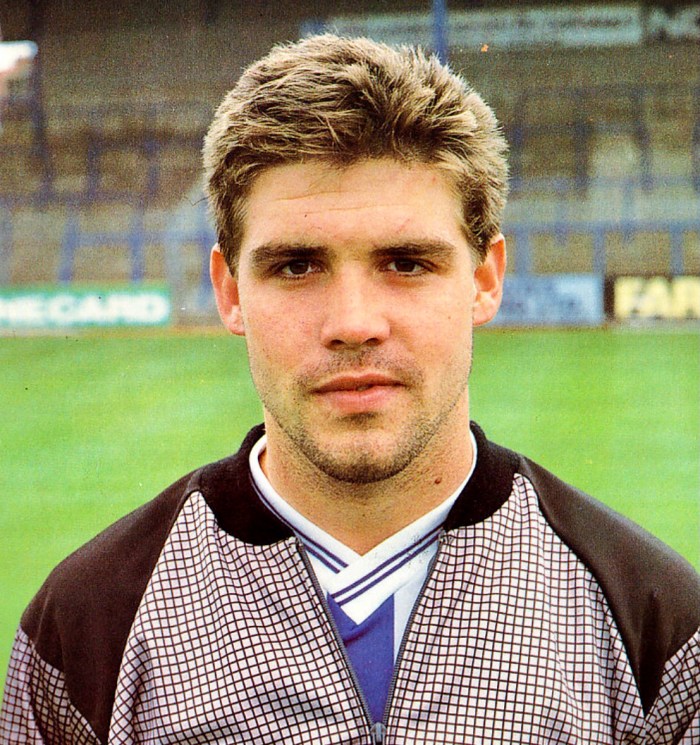
Isaac’s long, long wait for an Albion win

IT seems extraordinary to think Robert Isaac had to wait FOURTEEN MONTHS to experience a win as a Brighton player after joining the club from Chelsea.

The young defender who had realised every schoolboy’s dream by playing for the team he’d always supported left a disgruntled dressing room at Stamford Bridge only to join a side sliding inexorably toward the relegation trapdoor of what is now the Championship.

“I must admit it was a bit depressing at first because we just couldn’t do anything right,” Isaac told Dave Beckett in an Albion matchday programme article. “We just had no luck at all; if we had I think we might well have survived in Division Two.”

Isaac also appears to have gone out of the frying pan into the fire. Telling thegoldstonewrap.com how he’d left Chelsea because the management was losing support of the players and he wanted regular first team football, he added: “When I joined Brighton in February 1987 they were in freefall. The dressing room was even more at odds with the manager than at Chelsea.

Barry Lloyd dropped Dean Saunders, our only hope of surviving the drop. I found Barry rather rude. He’d blank me in the corridor and make me train on my own.”

The young defender made his Seagulls debut on 21 February 1987 in a 2-1 defeat at home to Oldham Athletic and featured in four draws and five defeats by the season’s dismal end.

Back at what was for so long Albion’s normal level of third tier football, Lloyd’s side did begin to pick up points – but Isaac wasn’t involved because of a groin strain and a troublesome hernia injury that sidelined him for months.

“I had stomach trouble quite a lot but no-one could put their finger on the problem until I saw a specialist in Harley Street,” he explained.

“After the operation, I was out of action for the best part of six months and at times I didn’t think I would get back to full fitness. I had around 40 internal stitches and even when I began playing again they would stretch and pull and I felt sick after games.”

It wasn’t until March 1988, with Albion in sixth spot, that Lloyd shook things up, initially drafting Isaac in at right-back in place of Kevan Brown, and then selecting him to replace suspended captain – and Isaac’s former Chelsea teammate – Doug Rougvie at centre back alongside Steve Gatting.

Isaac also stepped in when Rougvie missed a couple of games with a ‘flu virus and, although a win in Seagulls’ colours continued to elude him in his first three games back in the side (a defeat and two draws), he kept the no.5 shirt ahead of the rugged Scot. That elusive win finally came in a 2-1 away win at Notts County on 4 April.

Five wins and a draw followed and the successful run-in saw promotion gained as divisional runners-up behind Sunderland. Isaac was one of three former Chelsea players in that back four, with Gary Chivers (who’d arrived from Watford) at right-back and Keith Dublin at left-back.

Dublin had played for England under 19s with Isaac three years earlier. They both played four games in Dave Sexton’s side at the Toulon Tournament in the south of France in 1985 (England beat Cameroon 1-0 and Mexico 2-0, lost 2-0 to the USSR and succumbed 3-1 to France in the final at the Stade Mayol in Toulon).

Sadly, the subsequent fortunes of the two players went in opposite directions: Dublin went on to become such a success with the Seagulls that he was the 1989-90 Player of the Year and was sold to Watford for £275,000; the injury-beset Isaac had to quit the game after only 33 matches in a Brighton shirt.

After Albion bounced back to the second tier, the defender played in the first 11 matches of the 1988-89 season – eight of which were defeats – but his appearance in a 1-0 defeat away to Leicester turned out to be his last as an Albion player.
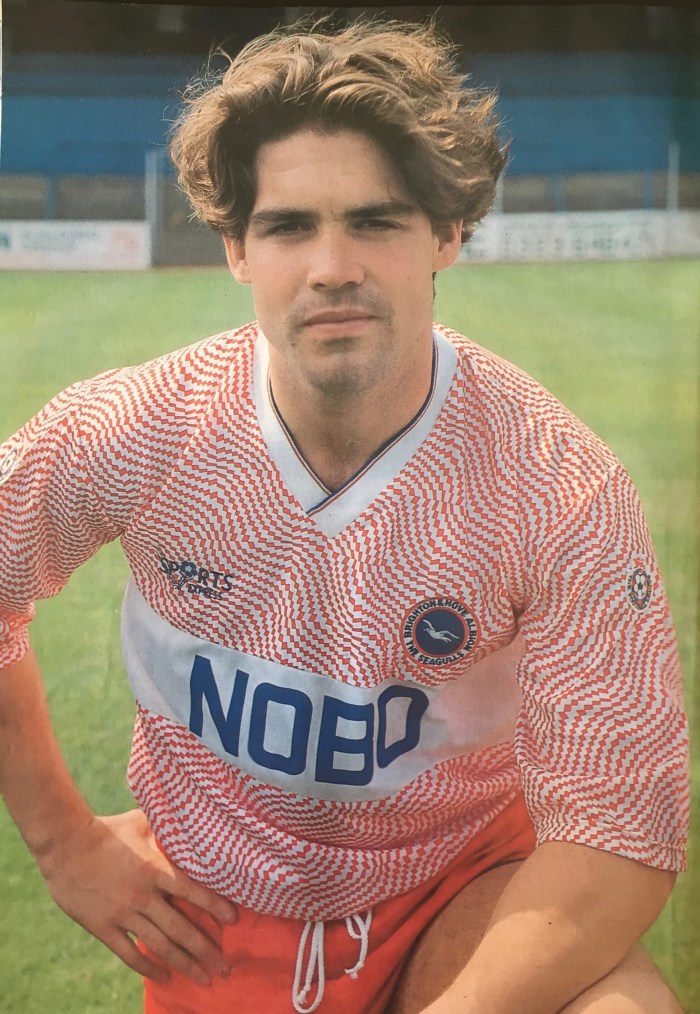
“I got injured at Leicester,” he recalled. “I didn’t feel it until the next day and then it really hit me. My knee just blew up. Come Monday morning I couldn’t even walk.”

He required an operation to repair the patella tendon in his left knee and, as he sought to regain fitness, spent a fortnight at the National Rehabilitation Centre at Lilleshall.

Meanwhile, Lloyd signed experienced central defender Larry May (whose own playing career would be ended by injury later that season) and, subsequently, Nicky Bissett.

A programme item in the 1989-90 season reminded supporters that Isaac was still around, although he hadn’t played at all throughout 1989.

Looking ahead to 1990, Isaac said: “I just hope I have a better year. I’d like to think that I deserve it after all the frustrations of the last few years with two major operations.”

Sadly, it didn’t happen and in August 1990, he was forced to quit football. After retiring, he worked as a chauffeur for the Maktoums, the ruling family in Dubai, before running his own vehicle business.

Born in Hackney on 30 November 1965, Isaac was Chelsea through and through from an early age.

“We lived in Chelsea and my great grandfather went to the first ever match at Stamford Bridge,” he told thegoldstonewrap.com. “My family have been going to matches home and away since. I went to see Chelsea play Stoke in the (1972) League Cup Final aged six.”

Isaac went on to join the club as a junior, made his reserve team debut at the tender age of 15 and was named Chelsea’s young player of the year in 1984.

It was on 9 October 1984 that his promising career could have been snuffed out before it had even begun: it’s a horrifying tale, told the following day on the front page of The Sun, and covered in detail by that1980sportsblog.
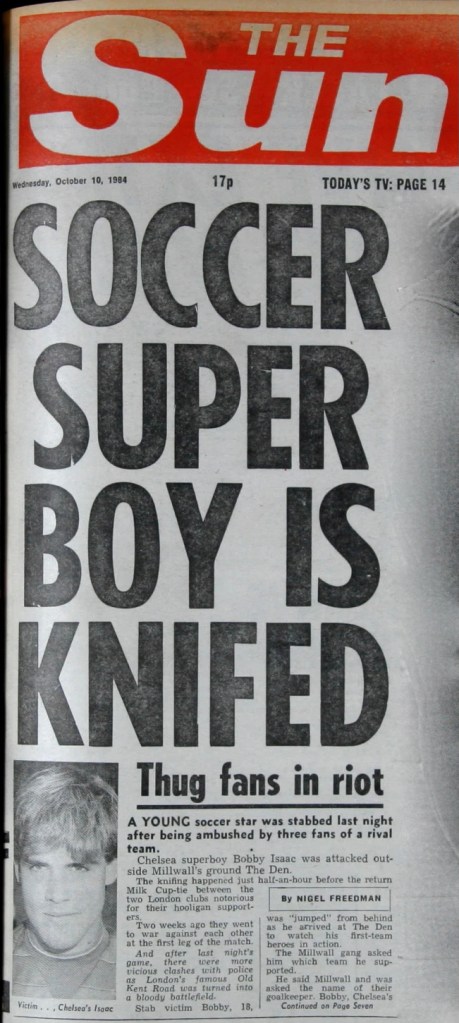
Three knife-wielding Millwall thugs slashed his back from his shoulder to the base of his spine in a dark alley near the south London club’s notorious old stadium, The Den.

Isaac needed 55 stitches to repair the damage and only the thickness of a leather coat he was wearing prevented the wound being potentially life-threatening.

Remarkably, later the same season, in March, he had recovered well enough to make his Chelsea first team debut in a 3-1 win at Watford, although Eddie Niedzwiecki, a Chelsea coach who later worked with Mark Hughes for Wales and at several clubs, told Kelvin Barker’s Celery! Representing Chelsea in the 1980s: “He was a young, up-and-coming apprentice at the time and luckily he managed to pull through, although he never really recovered from it.”

In the 1985-86 season, Isaac played two league cup games for Chelsea and three times in the league. The following season saw him get a mini-run in the side, playing four consecutive league games in November, but his fifth match – a 4-0 home defeat by Wimbledon in which Rougvie was sent off in the first 10 minutes for headbutting John Fashanu – proved to be his last.

The website sporting-heroes.net said of him: “A steady, reliable centre-half and occasional full-back, Robert did little wrong during his time in the Chelsea first-team, but was unfortunate to play for the club at a time when Colin Pates, Joe McLaughlin and, a little later, Steve Wicks, were all demonstrating their considerable talents at the heart of the defence.”

Isaac asked for a transfer after a disagreement with manager John Hollins and his assistant Ernie Walley, and that led to his transfer to Brighton for a £50,000 fee.
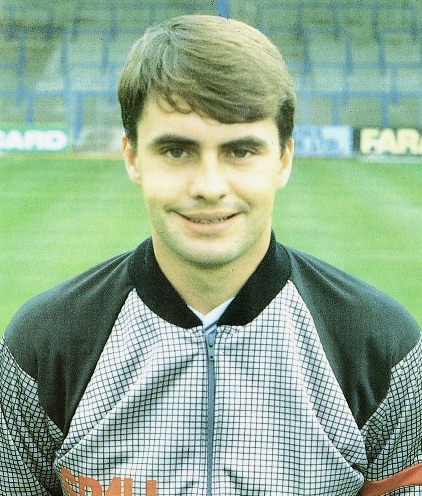
Cards came up trumps for ex-Saints full-back Kevan Brown

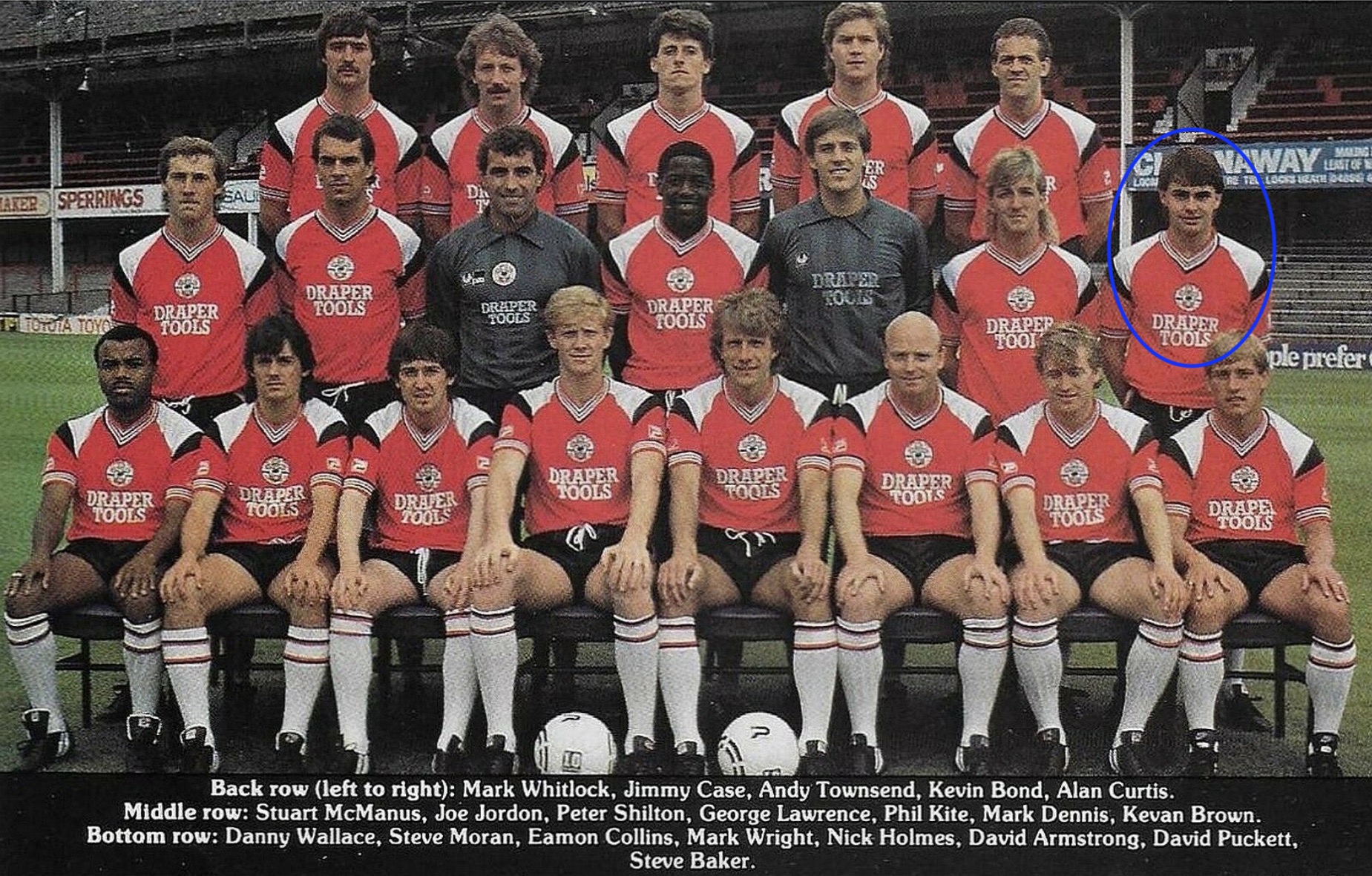
FULL-BACK Kevan Brown made more than 120 appearances for Southampton reserves during three years as a young professional but it took a move east along the coast to Brighton to play league football.

Brown arrived at the Goldstone Ground for a fee of £7,500 shortly after Barry Lloyd had taken over from Alan Mullery early in 1987.

Lloyd preferred the youngster from Andover as right-back to the ageing Les Berry, who’d joined on a free transfer the previous summer.

The club put Brown into digs in Hove (run by Val and Dave Tillson) with another young player who had moved away from home, former Everton youngster Darren Hughes.

In a programme profile feature, Brown said Hughes had been a big help in him settling into his new surroundings. “He has been showing me around the area and we’ve become good friends,” he said. “I’m glad I wasn’t put in a hotel on my own.”

Unfortunately, Brown was only on the winning side twice in the 15 matches he played that season and Albion were relegated from the second tier in rock bottom place.

Brown was a permanent fixture in the no.2 shirt for 46 league and cup matches in the 1987-88 season until the arrival of experienced defender Gary Chivers from Watford.

With promotion in sight, while Lloyd dropped the experienced captain Doug Rougvie in favour of the relatively untried Robert Isaac in the centre of defence, he saw Chivers rather than Brown as the better option at right-back.

Chivers went straight into the side for the promotion run-in and the 2-1 home win against Walsall on 12 March 1988 was the last time Brown appeared that season.

He played in the opening two games of the following season but Chivers on the right and Keith Dublin on the left were Lloyd’s preferred full-back pairing, and Brown found himself on the outside looking in.

Born on 2 January 1966, Brown was an associate schoolboy with Southampton at the age of 13, following in the footsteps of his father Peter, who had played for Saints in the late 1950s.

Brown said in an Albion profile feature that his father and Saints youth development officer Bob Higgins had been the biggest influences on his career, although Higgins later drew opprobrium.

Lawrie McMenemy awarded Brown a professional contract but neither he nor his successor Chris Nicholl elevated the young full-back to the first team, although he did get to play against Manchester United in Trinidad and Tobago while on tour with Southampton.

Having had his fill of reserve team football at Saints, rather than repeat the experience at Brighton, he moved on to Aldershot in the autumn of 1988.

He spent four years there and made quite a few more appearances than the 175 that the record books show: the 1991-92 season records having been expunged  after the club went out of business.

Aldershot found themselves in a worse financial situation than the Albion were to suffer later that decade and the club was finally wound up owing £1.2m on 25 March 1992.

Five days earlier, Brown played in a match – alongside future Albion hero Robbie Reinelt – that was the last game Aldershot would play.

Although his next career move saw him drop out of the league, he enjoyed huge success in terms of silverware and recognition.

He joined Geoff Chapple’s Woking in the Football Conference and captained The Cards to three FA Trophy wins – in 1994, 1995 and 1997 – with veteran former Albion winger Clive Walker the side’s talisman.

In addition to leading his team up the steps at Wembley to lift the silverware, Brown’s performances with Woking earned him international recognition with the England semi-professional ‘C’ side.

He made his debut in a 1-0 win over Wales at Huish Park, Yeovil, on 28 February 1995. He made three more appearances that year: away to Netherlands (0-0) on 11 April, home on 19 May (played in St Albans) against the Highland League (3-4), then away to Gibraltar (3-2) on 31 May.

His fifth and final appearance was on 2 April the following year as England beat the Netherlands 3-1 at the Nene Park home of Rushden & Diamonds.

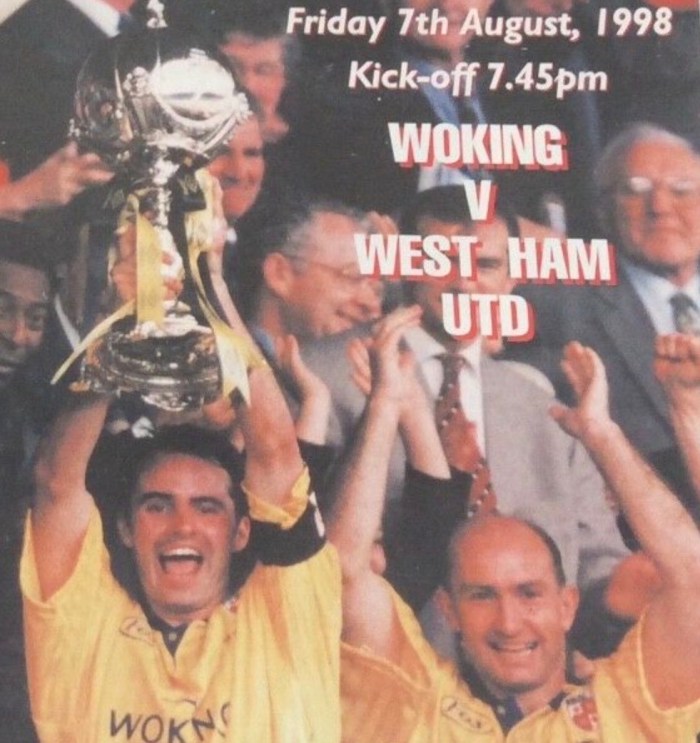
Brown’s loyalty to Woking – he made more than 350 appearances across six years – was rewarded with a testimonial game at home to West Ham United in August 1998.

More than 5,500 turned out at the Kingfield Stadium to see the Hammers edge it 2-1 with goals from Frank Lampard and Steve Lomas. Rio Ferdinand limped off early in the match and Ian Wright played up front for West Ham.

The game took place five months after Brown had moved on from Woking to Yeovil Town.

Chapple’s former assistant, Colin Lippiatt, had taken charge at Huish Park in January that year, having joined three months earlier as a coach under Graham Roberts.

One of his first moves was to sign Brown and teammate Steve Thompson (who ended up staying with The Glovers for ten years). Brown stayed for two years, making a total of 88 appearances, latterly playing under Thompson when he took over as caretaker manager following Lippiatt’s departure.

The arrival of former Chelsea defender David Webb as manager in March 2000 spelled the end of Brown’s time at Yeovil and he returned to Woking to play a further 25 games as they battled against relegation from the Conference in the 2000-2001 season.

Playing part-time had enabled Brown to pursue a teaching career and in April 2007 he was appointed director of sport at independent co-educational St Francis School in Pewsey, Wiltshire.

Brown’s devotion to the club who set him on the road remains undimmed and on his Twitter account @KevanBrown05 he declares himself a Saints season ticket holder.

It was chirpy Chiv of the Cherries after six years with the Seagulls

THESE DAYS Gary Chivers is a familiar face around the hospitality lounges at Brighton’s Amex Stadium and Chelsea’s Stamford Bridge, the two clubs where he spent most of his playing days.

His association with Chelsea goes back to the tender age of 10, when he joined their academy, and he went on to play in their first team for five years. After six years with Brighton, he played out the final two years of his 16-year career at AFC Bournemouth under fledgling boss Tony Pulis. Among his teammates were Mark Morris, Warren Aspinall, Paul Wood and Steve Cotterill, all of whom also played for the Seagulls.

Born in Stockwell, London, on 15 May 1960, Chivers started supporting Chelsea at the age of eight, and, like many future professionals, got a foothold in the game at Stepney-based development club Senrab.

He told journalist Nick Szczepanik in a 2018 Backpass magazine article (below): “My brother had been training with Chelsea and my dad took me along when I was ten, and I went into their academy about two years before I should have.”

Chiv in BackpassAlthough initially a midfielder, coach Ken Shellito turned him into a defender and Chivers’ versatility in defence meant he could play centrally or in either full-back berth. Among his early contemporaries were John Bumstead, Colin Pates and Micky Fillery: Pates would later join him at Brighton.

With Chelsea already relegated, Chivers made his first team debut on 21 April 1979, aged 18, as he recounted in a December 2017 interview on the Chelsea website. Irish legend Danny Blanchflower was the manager who handed him his debut, at Stamford Bridge against Middlesbrough, which finished in a 2-1 win in front of just 12,007.

Chivers did enough to keep his place for the last four games of the season, and he told Szczepanik how in one he had to mark Arsenal’s Malcolm Macdonald and another Manchester United’s Joe Jordan.

In the second tier the following season, an injury to first choice right-back Gary Locke gave Chivers a chance to establish himself under new manager Geoff Hurst, and he retained the shirt for much of the season.

In total he made 148 appearances for Chelsea, scoring four goals, one of which was voted runner-up in Match of the Day’s Goal of the Season competition in 1980-81.

He got on the end of a Clive Walker cross following a delightful flowing move as top-of-the-table Newcastle were beaten 6-0 by second-placed Chelsea.

Chivers deputised at left-back for the injured Chris Hutchings towards the end of the 1982-83 season, by which time John Neal had taken over as manager. Chelsea were at a low ebb and only a point from a goalless draw against Middlesbrough on 14 May 1983 saved from them from relegation to the old Third Division. Neal overhauled the playing staff, and Chivers was amongst the casualities.

Explaining how he didn’t see eye to eye with Neal, he added: “I didn’t want to go, but you have to play games.”

He briefly switched to relegated Swansea City, under John Toshack, but only stayed six months as managers came and went in rapid succession. Seeking a move back to London, he joined QPR under Terry Venables – “the best manager I ever played for” – where he played alongside John Byrne, another player he’d be reunited with at the Albion.

At the end of his contract, he moved on to Watford during the uncomfortable spell when former Wimbledon boss Dave Bassett was in charge, but he got the feeling he didn’t fit in. Brighton boss Barry Lloyd, himself a former Chelsea player, agreed a £40,000 fee with the Hornets as Chivers dropped down a division to third-tier Albion, where he linked up with some familiar ex-Chelsea faces in Doug Rougvie, Robert Isaac and Keith Dublin.

He explained to Szczepanik: “I decided to go to Brighton because I had a look at their fixtures and I even asked for a promotion bonus because I was so confident they would go up.”

The confidence was well-placed because promotion was duly gained, and Chivers went on to become part of the furniture for the next six years, including playing in the play-off final at Wembley in 1990-91.

An incident that led to a Notts County goal still rankles with Chivers. “At 0-0, I played the ball off Tommy Johnson for a goal kick and David Elleray, the referee, gave a corner that they scored from. I saw him a few years ago and went over to set the facts straight. He said: ‘You’re not still going on about that from 20 years ago?’ and I said: ‘Too right I am!’ I walked away from him because it was winding me up, but it was because of how much it would have meant to the club.

“We would have gone on from there if we had got into the First Division but instead we ended up having to sell Mike Small and Budgie (John Byrne) and we went down at the end of the next season.”

Albion played a  benefit match for Chivers against Crystal Palace just before the start of the 1992-93 season and Chivers left the club in 1993, not because he wanted to, but because players on “decent money” had to go.

His enthusiasm for the club continues to this day, bantering with supporters in corporate hospitality and the Albion club website carried an article about the former defender’s divided loyalties when the Albion entertained Chelsea on New Year’s Day.


  • Pictures mainly from the club programme.

Promotion-winner Keith Dublin delivered £240,000 profit

BRIGHTON & Hove Albion’s promotion from the old Third Division in 1987-88 earned two of the squad places in that season’s PFA representative team; one quite naturally was top goalscorer Garry Nelson, the other was defender Keith Dublin.

Also in the same XI was Fulham’s Leroy Rosenior, father of latter day Albion utility man, Liam.

Dublin was an ever-present during that successful Seagulls campaign having joined in August 1987 from Chelsea, where he had played 50 league games (plus one as a sub) between 1983 and 1987.

Born in High Wycombe on 29 January 1966, Dublin became an apprentice at Stamford Bridge in July 1982 and signed professional 15 months later.

When regular left back Joey Jones was injured, he made his first team debut in a 3-1 home win over Barnsley. It was the penultimate game of the 1983-84 season, and the last at home as John Neal’s team won the Second Division Championship.

Dublin also caught the eye of the England selectors and played six times for the under-19 team.

At the time, Dublin, or Dubbers as he was known, was one of the few black players emerging at Chelsea, following after Paul Canoville and Keith Jones.

Canoville wrote in his autobiography with Rick Glanvill, Black and Blue: How Racism, Drugs and Cancer Almost Destroyed Me (Headline Publishing Group, 2012), about some atrocious treatment they all received – and not just from the terraces!

“When Jonah and then Dubbers made the step up, they no longer trained with the reserves but with the first team,” said Canoville. “That made three black faces and, on more than one occasion, there were altercations with one player who obviously had a problem with black men.

“It was always dealt with properly, but, as if the colour wasn’t an issue. Of course it was. Back then, casual, institutional racism was displayed at almost every level of the club – not so much that you would quit over it or kick up a rumpus, but enough to make you feel different and an outsider most of the time.”

Canoville added: “Dubbers was strong, athletic and fast. But as soon as either of them made a mistake, the crowd was on to them, slagging them off. There wasn’t the same open racist abuse I received, but still the tolerance threshold was low, as much in the coaching staff as the crowd.”

Dublin played 28 games in the top division for Chelsea during the 1986-87 season, but with competition for the left back spot hotting up in the shape of future England international Tony Dorigo and Clive Wilson, he decided to move on.

“John Hollins couldn’t guarantee me regular first team football at Chelsea so I’m looking forward to an enjoyable and successful season with Brighton,” he said.

Brighton manager Barry Lloyd snapped up Dublin for £35,000, and what an investment because he was ever-present at left back in the promotion season. In fact for the latter part of that season, three of the back four were ex-Chelsea defenders: Gary Chivers at right back, Robert Isaac centre back, and Dublin at left back.

When introducing Dublin in the Albion matchday programme, an article pointed out how five years previously Dublin had been cleaning Chris Hutchings‘ boots at Chelsea – and now he was taking over his no.3 shirt. Hutchings had been moved forward to play in midfield, although four months later he left the club to join Huddersfield Town.

On signing for the Albion, Dublin said: “I’m not worried about dropping two divisions because I don’t believe Brighton will be in this division for long. It’s an easy club to settle down with because I know so many former Chelsea players.” He pointed out he had known Isaac since the age of 12 or 13 when they both played in the same district schools team.

Dublin used to travel down daily to training with Chivers and although defending was their first priority they had a friendly rivalry over who could score the most goals. Dublin chipped in with five in that first season but Chivers regularly went up for corners so won the little private wager in the following two seasons.

The promotion was a great experience for Dublin who said in an interview in the matchday programme: “There’s never been anything like it for me obviously, and it’s going to be a long time before anything can top the day we clinched second place. It might never happen.

“Probably the best thing was getting a few goals along the way as well because that had never happened to me before.”

As young Ian Chapman gradually made the left back berth his own, Dublin switched inside to centre back.

Dublin welcomed the competition for his place from Chapman, explaining: “I think it’s good when you’ve got someone chasing your place, snapping at you all the time to get in the first team.

“Ian’s been quite a good mate of mine since I arrived and you have to always remember that being dropped or selected ahead of someone else is what football is all about.

“It keeps me on my toes, and if you can have six or seven players in the team in the same situation then that’s the best thing possible at any club.

“Ian’s facing the same scene now as I was experiencing at Chelsea.”

Dub leapIt was not unusual to see Dublin selected as man of the match and several programmes featured pictures of the obligatory post-match presentation by the sponsor to the nattily-dressed defender. Dublin admitted in another profile piece that clothes and shopping were hobbies.
Meanwhile, on the pitch in 1989-90, his consistent performances at the heart of the defence earned him the Albion player of the season accolade.

After 132 appearances in three seasons with Brighton, Brighton cashed in on Dublin’s prowess by picking up a £275,000 fee from Watford in the summer of 1990.

With goalkeeper John Keeley departing for Oldham for £238,000 at around the same time, fans feared another frustrating season was ahead. But they were in for a surprise.

While Dublin joined a side that would struggle, at first under former Chelsea striker Colin Lee, then ex-Tottenham legend, Steve Perryman, Brighton surprised the critics and ended the season at Wembley.

Indeed Watford finished fourth from bottom of what was then Division 2, while Brighton sneaked into sixth place with that memorable last game win over Ipswich Town, beat Millwall over two legs in the play-off semi-final and then went down 3-1 to Neil Warnock’s Notts County in the play-off final.

The following year, with future England goalkeeper David James emerging, Watford turned around a disappointing first half to the season and eventually finished 10th.

Dublin was an integral part of Watford’s defence for four years, making 168 appearances, although it appears not all Watford supporters appreciated him.

The amusing Watford fans’ website, Blind Stupid and Desperate recalled this among other memories: “The fondness with which Keith Dublin is remembered, the way that fans still tell tall tales of remarkable own goals, insanely cavalier defending and sporadic heroism with broad smiles and genuine affection, demonstrates that perfection isn’t the be-all and end-all for supporters.”

At the end of the 1993-94 season, which had been a struggle against relegation from the First Division under manager Glenn Roeder, Watford did a swap-deal which saw striker Tommy Mooney (yes, the same Mooney who famously missed the Swindon shoot-out penalty against Brighton in 2004) and midfielder Derek Payne join from Southend United and Dublin going in the opposite direction. He spent five years at Roots Hall and amassed a further 179 games.

He subsequently moved to Colchester United, but only played a couple of games, and ended his career in non-league, initially with Farnborough Town and then Carshalton Athletic.

In an Argus article in 2010, they discovered Dublin was busy in ‘retirement’ running soccer camps at home and abroad, and according to wfc.net, Dublin worked in a family property management business after his footballing days were over.

Footnote: Perhaps Dublin set a trend for Albion left backs named after Irish places, with the double whammy Kerry Mayo following in his wake some years later!

1 Dublin1a Dublin portrait2 Dublin header3 Dublin Argus cut4 Dub mom5 dub another mom

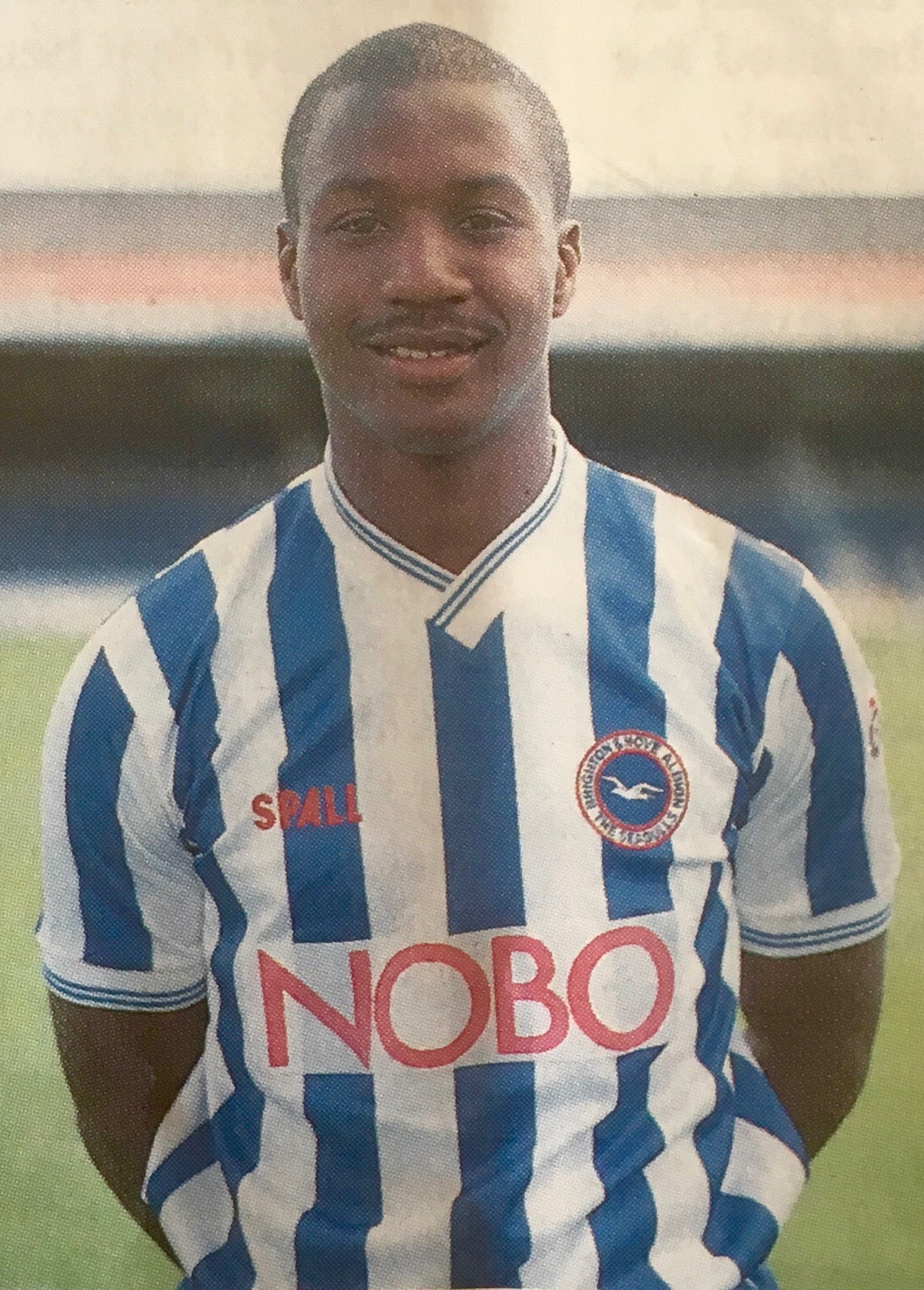
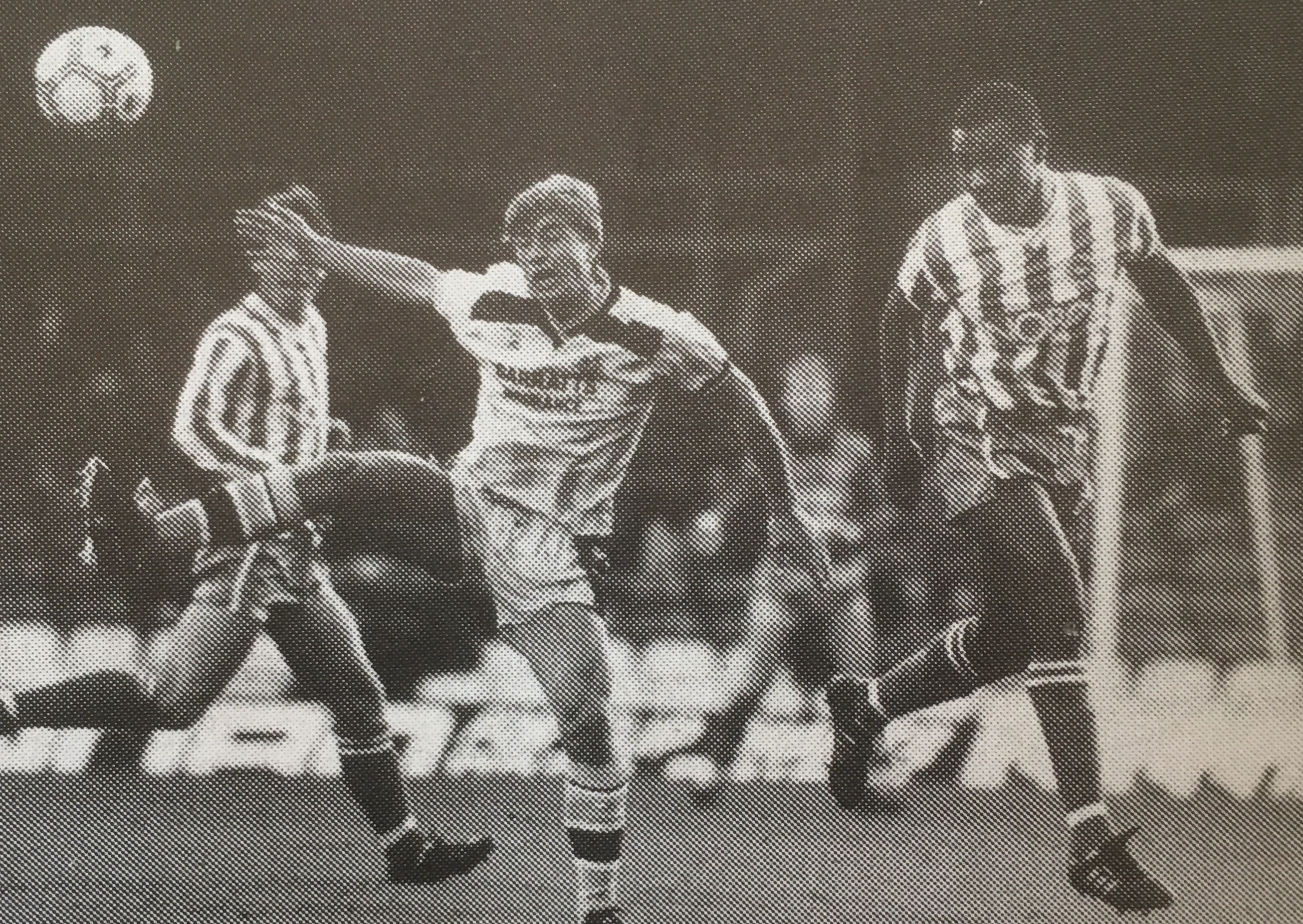
• Pictures from my scrapbook show portraits of Dublin that appeared in the matchday programme; action shots (one from the programme and one from the Argus) and a couple of man of the match presentations