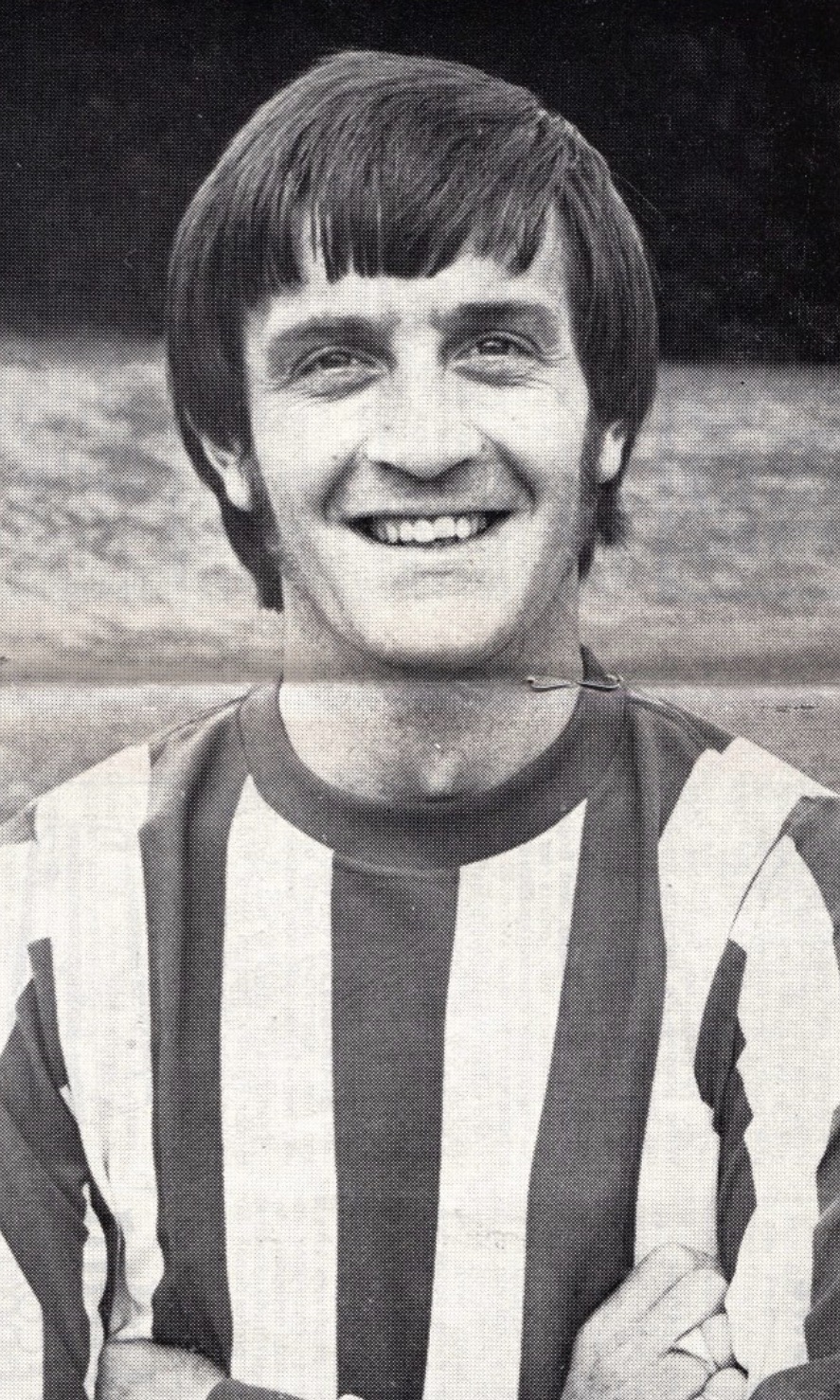
Winger Neil Smillie was a Wembley winner eventually

NS v MU Wemb

AN UNSUNG hero of Brighton’s 1983 FA Cup Final side, winger Neil Smillie, had the distinction of being the first ever apprentice the legendary Malcolm Allison signed for Crystal Palace.

Big Mal had enjoyed league and FA Cup success at Manchester City as Joe Mercer’s sidekick but he swept into Palace in the early 70s as a boss in his own right, courting publicity with his flamboyant fedora hat and giant cigar.

Smillie admitted: “I was going to West Ham but Allison persuaded me to take a look at Palace.

“The place was so alive and vibrant under him that I went there instead.”

Born in Barnsley on 19 July 1958, Neil followed in the footsteps of his dad, Ron, a former professional who played for Barnsley and Lincoln.

After joining Palace in 1974, Smillie turned professional a year later and was on Palace’s books for seven years, although he had three loan spells away from Selhurst.

In 1977, he went briefly to Brentford, who he ultimately would have a long association with later in his career.
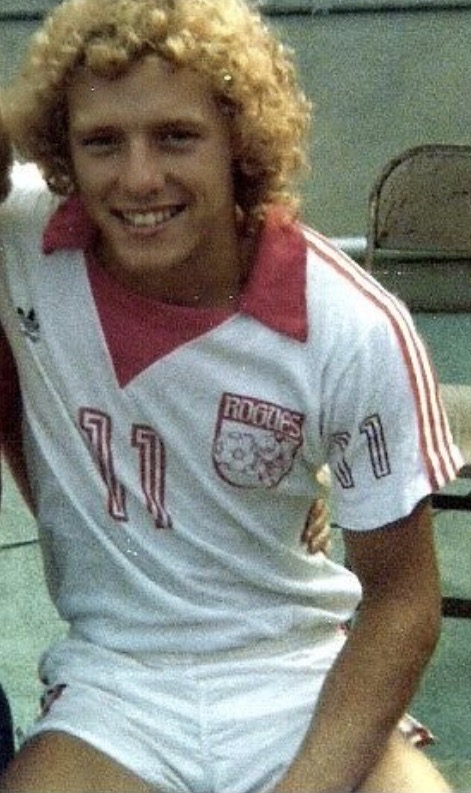
Smillie MemphisThe following two years, he went to play in America for Memphis Rogues (pictured left) where his teammates were players from the English game winding down their careers: the likes of former Albion players Tony Burns and Phil Beal, ex-Chelsea, Leicester and Palace striker Alan Birchenall and former Chelsea winger Charlie Cooke; the side being managed by former Chelsea defender Eddie McCreadie.

At the end of the 1981-82 season, Smillie was denied a pay rise by Palace so he decided to quit and wrote letters to clubs in the top two divisions in England asking for a job!

Brighton had managed to offload the troublesome Mickey Thomas to Stoke City so had a need for a left winger. They were the first to come up with an offer, and with full back Gary Williams surplus to requirements since the arrival of experienced defender Sammy Nelson, Brighton offered him in exchange for Smillie.

The bubble-haired winger gratefully accepted the switch to the Seagulls. While he made the starting line-up for the opening game of the new season, a heavy (5-0) defeat away at West Brom in the next game then saw him dropped and sidelined for months.

It was only once ultra-cautious manager Mike Bailey had left that Smillie got back in contention, and only then – in January 1983 – through someone else’s misfortune.

He said: “I was out in the cold and only got my break when Giles Stille was injured during the Cup game against Newcastle United.”

Smillie seized his opportunity and remained in the side for the rest of the season, culminating in the two Wembley FA Cup Final matches against Manchester United.

Back in the second tier following Brighton’s relegation, Smillie played 28 games plus once as a sub but following new manager Chris Cattlin’s signing of Northern Irish winger Steve Penney, there was competition in the wide areas.

Throughout the 1984-85 campaign, Smillie was more often than not a substitute rather than a starter. He did manage a seven-game run of appearances in the late autumn and began the final three games of the season, but the last game, a 1-0 home win over Sheffield United, proved to be his farewell.

Smillie revealed in a 2003 interview with Spencer Vignes that he’d discovered Manchester City had been keen to take him on loan but Cattlin hadn’t sanctioned it, even though he wasn’t selecting him.

“Chris had turned them down, saying I was a good player and he needed me. Yet he wasn’t even playing me! I just couldn’t believe he’d done it,” he said. Although he and his family were settled in Sussex, he realised he had to move.

Several eyebrows were raised when Cattlin managed to secure a £100,000 fee from Watford for Smillie’s services in the summer of 1985. The winger joined Graham Taylor’s beaten FA Cup finalists but he failed to establish himself in the side and made just 16 first team appearances in a season with the Hornets.

In the summer of 1986, he moved on to Reading for two years and, in 1988, after his disappointment with Brighton, Smillie was finally a winner at Wembley, scoring and setting up two goals as Reading beat Luton 4-1 in the Simod Cup Final.

The Hatters were led by former Albion captain Steve Foster and another of Smillie’s former teammates, Danny Wilson, was in their midfield. Mick Harford scored the opening goal for Luton, but Smillie’s pass allowed Michael Gilkes to bundle home an equaliser.

Smillie then won a spot kick converted by Stuart Beavon, and, in the second half, Mick Tait swept home another Smillie assist. Smillie then rounded off a great afternoon by scoring himself. It was hailed as one of the best days in Reading’s history, witnessed by over 45,000 loyal Royals fans.

Nevertheless, Smillie didn’t hang around and instead joined Brentford, where his former Palace teammate Phil Holder was assisting the manager at the time, Steve Perryman.NS Bees

Nick Bruzon interviewed Smillie in depth for a Where are they now? feature on the Brentford FC website in July 2010.

“Representing Brentford over three different decades, initially on loan in 1977 and then for five years from 1988 to 1993, Neil Smillie combined raw pace with ceaseless energy to make him one of the most popular players to patrol the New Road touchline,” said Bruzon. “Whilst with Brentford he experienced promotion, relegation and play off heartbreak, scoring 18 goals in 185 games.”

Smillie said: “I’ve got to say, the five years I spent at Brentford (and I was 30 when I signed) I thoroughly enjoyed.

“I’d reached a point in my career where I felt comfortable in terms of what I could give on the pitch. I’d always been a hard worker and I got the feeling that the supporters appreciated someone who worked hard.”

In the 1992-93 season, he played alongside Chris Hughton, who, like Smillie, was winding down his playing career.

“I loved taking people on and I loved getting crosses in for people to score so that just seemed to fit in nicely at the time with the team that we had,” he said. “I played my part as well as others who played theirs in getting the ball to me. We all did our bit and for me it was a great part of my career.”

On leaving Brentford, Smillie became a player-coach at Gillingham when his old Palace teammate Mike Flanagan was the manager. When Flanagan was sacked, Smillie took over the managerial reigns on a caretaker basis while the club tried to stabilise during financial troubles.

Smillie told Bruzon: “We were in a fairly precarious position and ended up in a decent position. So there was some enjoyment to it but the situation at a club without any money and struggling was difficult.”

Some names familiar to Brighton fans were at Gillingham at the time. Smillie played up front with Nicky Forster. Paul Watson was in defence and Richard Carpenter in midfield.

His three-month reign came to an end when Gillingham appointed Tony Pulis as the new manager and former Palace manager Alan Smith took Smillie to Wycombe Wanderers to look after their youth team.

When Smith left, Smillie was caretaker manager until former Albion full back John Gregory got the managerial post. Smillie then became Gregory’s successor in the hot seat for a year.

When the inevitable sack came, Smillie stepped outside of day to day running of football to become sports marketing manager for Nike in the UK. His role was to identify emerging talent for Nike to associate themselves with, and, as a result he stayed in touch with the game.

Among the players he signed to Nike were Theo Walcott, Darren Bent, Gabby Agbonlahor, James Milner, Tom Huddlestone, Danny Welbeck and Johnny Evans.

Pictures show (top) Smillie in action on the cover of the Albion programme; walking his dog; in Match magazine, on the cover of Shoot! being tackled by Liverpool’s Sammy Lee; a Simod Cup winner with Reading.

When Chris Cattlin rocked up to play for and manage Brighton

1-cat-in-goalIT MUST BE difficult for today’s reader to imagine a player with the opportunity to sign for either Coventry City or Chelsea choosing the Sky Blues over the London giants.

But in 1968, when the choice faced Huddersfield Town’s Cattlin, he moved to Highfield Road because the following day they were playing a star-studded Manchester United side and, as the full-back who’d be marking the legendary George Best, he couldn’t resist pitting his ability against the Irish wizard.

It was one of several career insights Cattlin revealed in an excellent interview by Doug Thomson in the Huddersfield Examiner in June 2013.

Huddersfield were happy to collect a £70,000 transfer fee when Coventry bid for Cattlin, but he told the Examiner: “Chelsea also came in for me and I was due to speak to them in the afternoon after talking to Coventry in the morning.

“City were playing Manchester United the next day and the manager, Noel Cantwell, told me I would definitely be in the team.

“I knew that if I could say I’d played against George Best, Denis Law and Bobby Charlton, I could die a happy man, so I never got as far as Stamford Bridge!

“I signed for £65 a week when the man in the street was probably getting £20, so to be paid like that for playing football made me more than happy!”

As it turned out, Cattlin marked Best out of the game and his new team won 2-0 with goals from Ernie Machin (who later left the Albion at the same time Cattlin arrived at the Goldstone) and Maurice Setters, against his old team.

Cattlin went on to play more than 250 league and cup games for Coventry, (then in the equivalent of today’s Premier League), before moving to Brighton in 1976, where his playing career finished, but he returned as manager between 1983 and 1986.

Going back to the beginning, though, Cattlin was born in Milnrow, Lancashire, on 25 June 1946, the son of a rugby league player, Bob, and his early school days were spent at Milnrow Parish School. He moved on to Ashton-under-Lyne Technical College (Geoff Hurst was three years his senior there) and then took a job in textile engineering.

In the meantime, he trained and played for Burnley’s youth team but he struggled with the 40-mile round trip travelling from his home. A Huddersfield Town scout, Harry Hooper, had spotted his potential and he was offered a professional contract with the Terriers in the summer of 1964 which allowed him to carry on working two days a week at the textiles factory.

“I went across to Leeds Road, and just fell in love with the place. It was far from luxurious, but there was just a feel about the ground and the people there,” he recalled.

Maybe it was also a feeling that Huddersfield knew a thing or two about decent left backs. Cattlin took over from Bob McNab, who later made a name for himself at Arsenal, and played four games for England, and McNab had replaced England World Cup winner Ray Wilson, who Town transferred to Everton.

Cattlin was signed by Eddie Boot only for the manager to resign the day after, following a 2-1 home defeat by Plymouth. Boot’s successor was Tom Johnston and he insisted on Cattlin becoming a full-time pro, which caused a degree of angst with Cattlin’s concerned parents, but he went for it and didn’t look back.

It was emerging coach Ian Greaves, a former Manchester United player (who later took Town to the top flight as manager), who was to have a lasting effect on Cattlin. “Ian lived in Shaw, the next village to Milnrow, and he’d give me a lift to Leeds Road each day, in the days before the M62, on that winding old road over the moors,” he explained.

“He was a great coach and later manager, and a superb motivator, just a football man through and through.”

Cattlin made his debut in a 3-1 home win over Derby on the final day of the 1964-65 Division 2 (now Championship) campaign but didn’t fully establish himself in the side until the 1966-67 campaign.

In total, he played 70 times for Huddersfield and, for a while, he was playing for the town’s football team while dad Bob was playing for its rugby league side. “My dad played for Huddersfield at rugby league, I played for Huddersfield Town at football. I think we’re the only father and son to have done that,” he said.

After that 1968 transfer to Coventry, Cattlin became a firm favourite at Highfield Road and although he didn’t quite emulate Wilson and McNab, he did play twice for England Under 23s. He made his debut on 2 October 1968 in a 3-1 win over Wales at Wrexham in a side that also included Peter Shilton in goal, West Ham’s Billy Bonds and John Sissons and Everton’s Howard Kendall and John Hurst.

Six weeks later he won his other cap in a 2-2 draw with the Netherlands at Birmingham’s St Andrews ground, when Arsenal’s John Radford and Hurst were the scorers. Cattlin also represented the Football League v the Scottish Football League.

Cattlin was part of the only Coventry side ever to qualify for Europe (in 1970-71) and remembered relative success, only eventually getting knocked out by a Bayern Munich side that included the likes of Franz Beckenbauer and Gerd Muller.

On another occasion, in a tour match, he played in a 2-2 daw against Santos of Brazil, with Pele in their team, in front of an 80,000 crowd. “Pitting your wits against those kinds of players was a fantastic education,” he said.

When manager Gordon Milne decided to give Cattlin a free transfer after nine years and 239 matches for Coventry, fans organised a petition to keep him at Highfield Road.

But there was no turning back and Peter Taylor signed him for Brighton – along with another experienced defender, Graham Cross (from Leicester City) – a short time before quitting the club to rejoin Brian Clough at Nottingham Forest.

CC76

It was Alan Mullery’s good fortune to inherit a squad that would take Division 3 by storm to earn promotion and Cattlin was able to contribute in both full back positions although mainly at left back, having the edge on Harry Wilson.

With the arrival of Gary Williams from Preston, Cattlin switched to the right and vied with Ken Tiler for the shirt, regaining the upper hand for the final two thirds of the season which ended with promotion from the old Division 2 in 1978.

“That Brighton promotion team – what a fantastic set of lads, with no little ability,” he said. “They could all play and were great characters. I was a very lucky lad to come along at the end of my career and join a dressing room like that.”

Although he made just one appearance (in the disastrous 4-0 League Cup defeat at Arsenal) during the 1979-80 season, he notched up a total of 114 games for Brighton.

And he obviously liked the place so much that once his playing days were over he opened a rock shop on Brighton seafront, as well as investing in property. However, three years after quitting as a player, he returned to the Goldstone as a coach, appointed in the summer of 1983 by chairman Mike Bamber to assist manager Jimmy Melia – without Melia’s knowledge!

It all got rather messy with Melia and Cattlin clearly not getting on and talk of a takeover rumbling on in the background.

By the middle of October, Melia quit and Cattlin took over as manager, with another well known former left back, Sammy Nelson, elevated from reserve team manager to assistant manager.

Cattlin then began to shape his own squad and among notable signings who served Albion well were Steve Penney, Danny Wilson and Dean Saunders while there were some memorable cup games, including beating Liverpool in what I believe was the first FA Cup tie – other than finals – to be shown live on TV.

One of TV’s pundits of today, Martin Keown, was another Cattlin signing, joining on loan from Arsenal and beginning with Brighton what was a memorable career with the Gunners, Aston Villa, Everton and England.

Cattlin admitted in 2010: “I had to sell a lot of the popular, best players for financial reasons and bring other ones in to keep the show on the road and make it interesting for the crowd. That was my job.” The likes of Steve Foster (to Aston Villa), Jimmy Case (to Southampton), Tony Grealish (to West Brom) and Gordon Smith (to Manchester City) were all sold by Cattlin.

In 1984, Cattlin certainly found an entertainer when he brought to the Albion a former teammate from his days at Leeds Road, the mercurial Frank Worthington, who moved along the south coast from Southampton.

By that time, Worthington wasn’t too mobile but he’d lost none of his skill and flamboyance and Cattlin told his 2013 interviewer: “He did a good job for me.

“Frank wasn’t only a great player, but a great bloke as well, a dedicated trainer and a great bloke to have around a club.”

Catt dog
Barking up the wrong tree? Cattlin couldn’t quite restore Albion to the elite when he returned as manager

Cattlin stayed in the manager’s chair until April 1986, overseeing finishes of ninth, sixth and 11th in the second tier, although he clearly felt the writing was on the wall as far as his job was concerned when the Albion board wouldn’t give him £6,500 to sign the experienced defender Jeff Clarke from Newcastle, as Cattlin explained at the Albion Roar live show in December 2018 (skip to 28 minutes in).

Distractions and changes in the boardroom were an uncomfortable backdrop to much of his time in charge and it was evident that the fans didn’t perceive Cattlin to be to blame for the failure to finish higher.

When he was sacked, there were protests from supporters, a 2,000-signature petition calling for his reinstatement and Cattlin himself addressed a 200-strong rally in Hove.

But it was all to no avail. His former boss, Mullery, returned and Cattlin went back to his non-football business interests.

In a 2010 interview in the matchday programme, Cattlin said: “I think I deserved another season at least to get them back into what is now the Premiership.

“If it had gone wonky then they wouldn’t have had to fire me – I’d have gone myself. Nevertheless, to play, coach and manage Brighton and Hove Albion made me a very proud man. But I wish I could have put them back where I felt they belonged.”

  • Pictures show (top) Chris Cattlin pictured in Goal magazine in Coventry’s sky blue; in an Evening Argus shot alongside new manager Alan Mullery and fellow close season signing Graham Cross; how the Albion programme headed his managerial notes.

Cattlin pictured in 2010

Willie Irvine restored Irish international career at Brighton

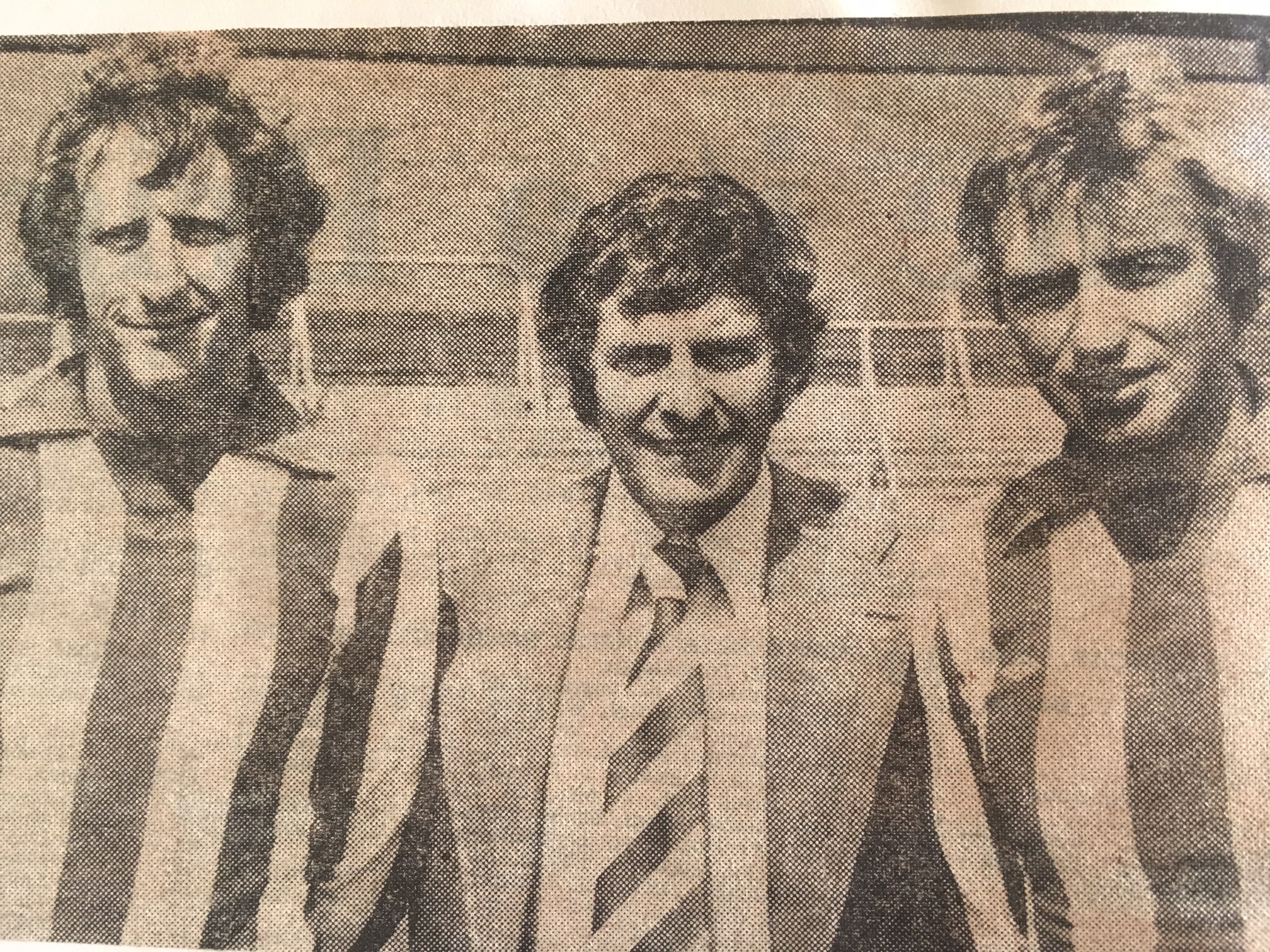
willie + chris

NORTHERN Ireland international Willie Irvine has encountered the highs and lows in life and I would urge anyone who hasn’t yet read his autobiography, Together Again (written by Dave Thomas) to add it to their book collection.

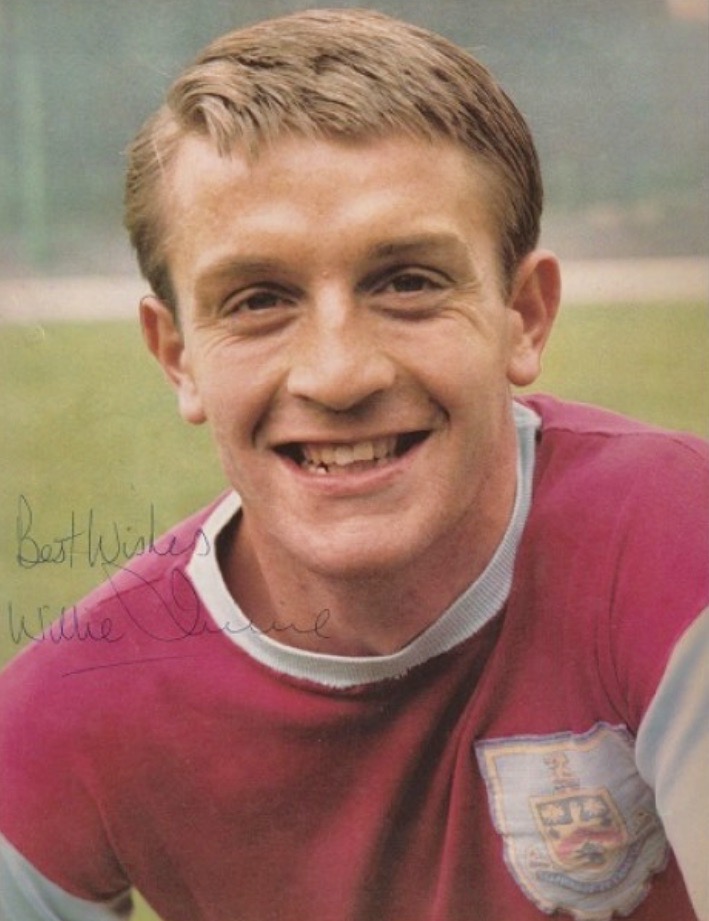
The Albion provided a platform for a brief resurgence in Willie’s career in the early 1970s but in the mid Sixties he was a big star scoring goals for fun as Burnley strutted their stuff amongst English football’s elite.

He scored 97 goals in 144 games (plus four as a sub) for the Lancashire side between 1962 and 1968 and in the 1965-66 season notched 29 league goals (37 including cup games) in what was the equivalent of today’s Premiership.

On the excellent Clarets Mad website, Tony Scholes wrote: “In my time watching the Clarets, none have been quite able to match the goalscoring exploits of Willie Irvine who, for two and a half years, was as good as anyone in English football when it came to putting the ball in the net.”

Sadly his highly-promising career at Burnley was never the same after he suffered a broken leg in a tackle with Johnny Morrissey in a FA Cup third round match at Everton in 1967.

A year later, the Turf Moor club turfed him out, transferring him to nearby Preston North End. By 1971, he was surplus to requirements there, and Pat Saward brought him to Third Division Albion on loan.

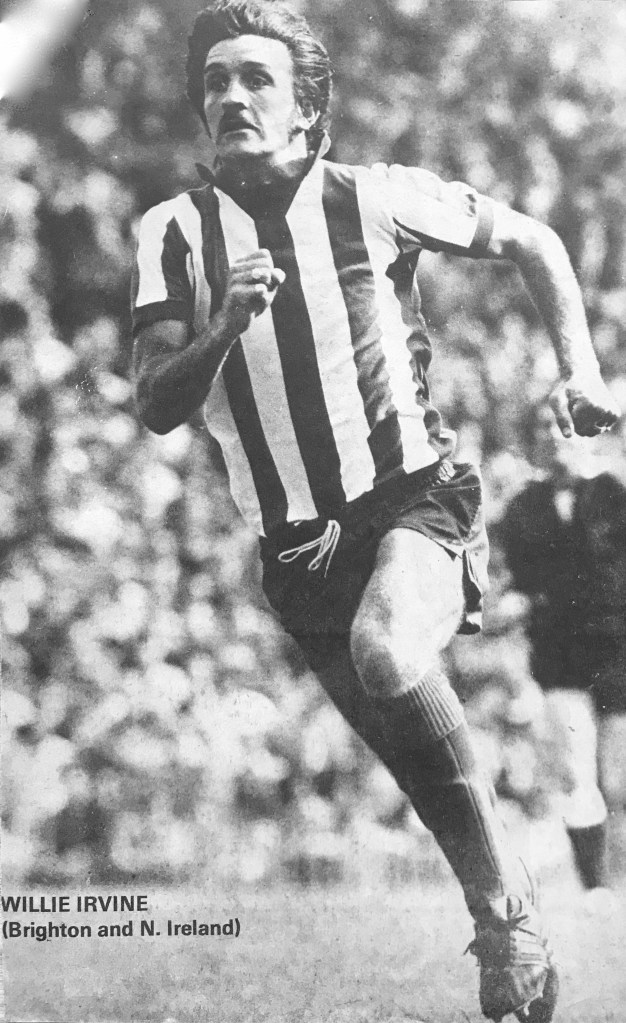
His first game, on the evening of 10 March 1971 at home to Fulham, couldn’t have gone much better because he marked his debut by scoring two in a 3-2 win.

He also scored in 1-0 wins over Shrewsbury and Bury, in a 3-0 win at Reading and in the last game of the season, a 1-1 draw with Plymouth Argyle. Not surprisingly, those goals led to him signing on a permanent basis that summer and the following season saw him play a key role as Brighton secured promotion to the second tier as runners-up to champions Aston Villa.

Irvine described warmly how Saward attracted him to up sticks from the North West and move to Sussex. “Pat sold me the place with his charm and persuasive ways,” he said, describing the former male model as “extrovert, infectious and bubbly”.

He added: “Pat Saward was a gem of a manager and a pleasure to play for. He said what he thought, but never offensively; in a matter-of-fact, plain-speaking kind of way, rather than aggressively.”

Irvine continued: “Saward had the knack of making people feel important. He instilled pride and a sense of identity…..Pat loved attacking, entertaining football and worked tirelessly for the club. I would have run through that proverbial brick wall for him.”

As Brighton neared promotion, Irvine said: “Saward, with a joke or a smile, an arm around the shoulder or a bit of geeing up, knew just how to keep a dressing room happy or dispel any tension or nerves.”

Fans of a certain vintage will recall a memorable goalscoring season for Irvine was capped off (literally!) by a most magical strike against Aston Villa in front of the Match of the Day cameras.

Willie’s goal was judged by the legendary manager Jock Stein as the third best goal of the season shown on Match of the Day and Brighton went on to win promotion. It was undoubtedly the best of the 17 he scored in 40 matches that season.

It was the first time I had experienced the excitement of going up, but there was one further thrill in store for me before the season came to a complete close.

In those days, there was an end-of-season tournament played between the “home” nations (England, Scotland, Wales and Northern Ireland). I had already been to a couple of England internationals at Wembley but the England international on May 23 1972 was extra special because lining up for Northern Ireland was Albion’s very own Irvine.

Now, I had not been a football supporter for very long, but even I knew that it was virtually unheard of for Third Division teams to have current international players playing for them.

Born at Eden in County Antrim on 18 June 1943, Irvine was the youngest of 18 children, and was brought up with seven siblings in the seaside town of Carrickfergus by his mother, Agnes, after his father Alec died during a wartime blitz in Belfast.

He had played five times for Northern Ireland’s under 23 side before stepping up to the full international team and winning 21 caps at the height of his career. But I never dreamt – and, on reading the autobiography many years later, neither had he – that he would re-appear for his country after dropping down to the third tier of English football.

My allegiances were split that day and I have to say it didn’t really upset me that Northern Ireland ended up 1-0 winners thanks to player-manager Terry Neill’s solitary goal – laid on by Irvine!

Here is how The Official FA Year Book (1972-73) described the goal: “From Hegan’s corner, Irvine beat Shilton to the ball and headed it down to Neill, the Irish player-manager, playing in his 50th international, to shoot into an empty net from two yards range.”

The game saw England give international debuts to Colin Todd and Tony Currie, and Colin Bell was England captain in the absence of Bobby Moore. Two players who would later join the Albion – Martin Chivers, as a substitute for Malcolm Macdonald, and Sammy Nelson, the Arsenal left-back – were also on show.

“I was delighted to have won my place back in my national team and I thought I did reasonably well,” Irvine told the Albion matchday programme. “When I reported back for international duty Derek Dougan welcomed me like a long lost uncle. He is a little older than I am. But I feel that at 29 I still have something to offer to the Irish side.

“It’s a wonderful experience playing for one’s country. I always get a great thrill when I hear I have been selected. My last three appearances, I believe, were solely due to that much publicised and televised goal against Aston Villa.”

Irvine also said he hoped to earn more caps, especially as he opened the new season with four goals in three games. But he wasn’t selected again, and his days as an Albion player came to an end before Christmas that year.

It’s no surprise that Irvine played alongside George Best in some matches for their country and in a 2010 interview with Suzanne Geldard in the Lancashire Telegraph, he recalled how they became roommates in 1964.

“I was 18, George was only 16, so because we were the babies in the team they put us together,” said Irvine. “He was the kindest, nicest lad you could ever meet in your life.

“People adored him. I’ve even seen people cutting pieces of his hair off for keepsakes, but he would just shrug his shoulders.

“George Best was without doubt an amazing footballer. You had to get on his wavelength, but that was difficult because he was way above everyone else. He picked me out two or three times and helped me score.”

Life has been rather unkind to Irvine since his glory days but, as the title of the book implies, he has got it back together after reaching a very low ebb.

Together Again reveals how it all turned sour for him at the Albion when his relationship with Saward deteriorated badly. Despite scoring five in 13 league and cup appearances in the opening months of the new season, in December 1973, against his wishes, he was transferred to Halifax Town in part exchange for Lammie Robertson.

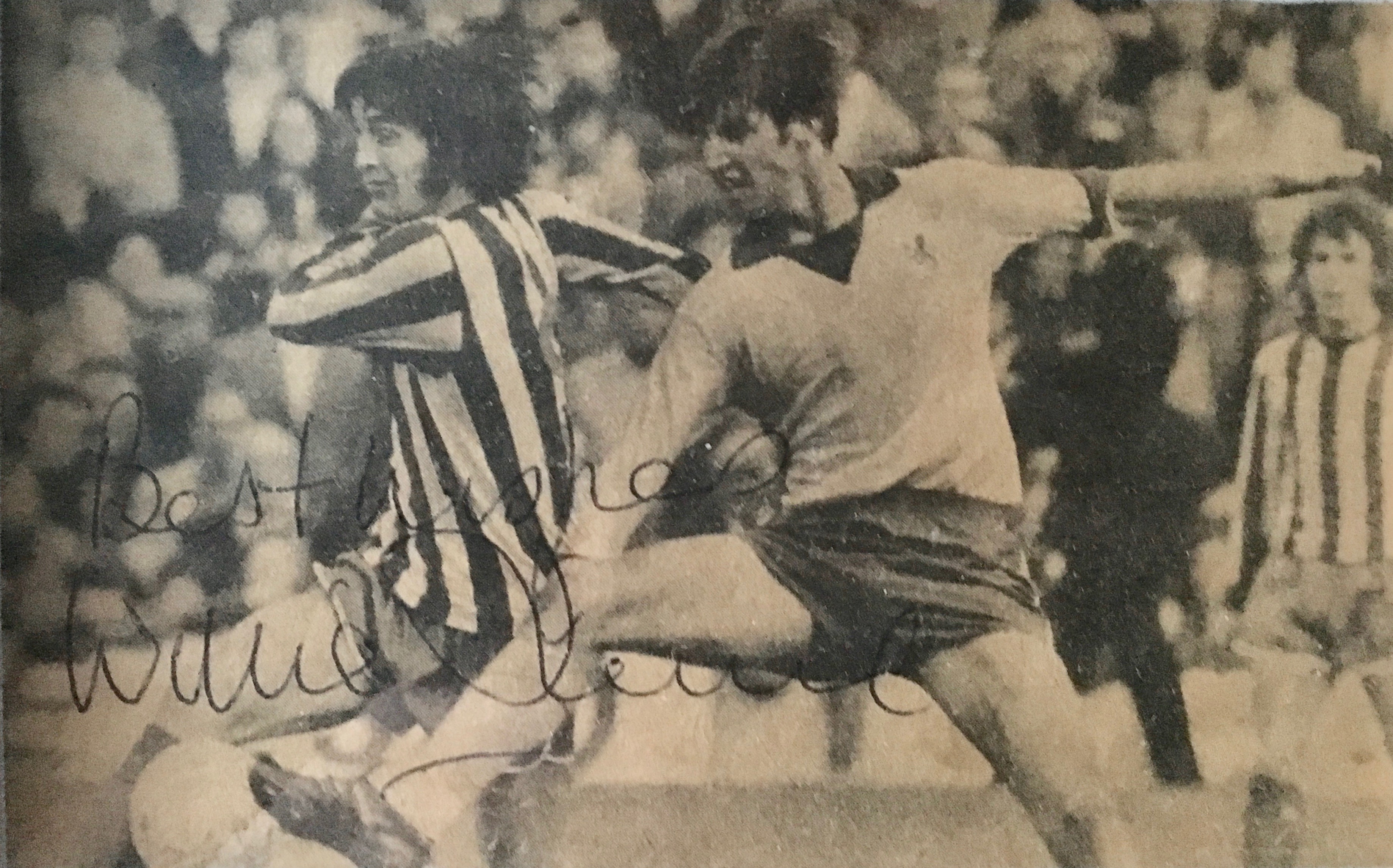
On reading that he had no memorabilia of his time at the Goldstone, 35 years after he left the Albion, I sent him my copy of the Albion programme for that famous win over Villa and he kindly returned an autographed photo showing him in action with Chris Nicholl, which I had sent with the programme.

Irvine died aged 82 in July 2025.