Mis-firing Mick Ferguson couldn’t repeat goalscoring prowess for Everton or Brighton

MICK FERGUSON was a prolific goalscorer for Coventry City but the goals dried up in spells with Everton and Brighton & Hove Albion.

Ferguson’s arrival at the Goldstone in the early autumn of 1984 was certainly not amid a great fanfare. The Albion, under new chairman Bryan Bedson, were wrestling with debt and, to bring in some much-needed funds, sold striker Alan Young to Notts County for £50,000 and full-back Mark Jones to Birmingham for £30,000.

Needing a cut-price replacement for Young, and with Ferguson unwanted at Birmingham having been responsible for getting them relegated (see below), he came to the Goldstone as part of the deal that took Jones to St Andrews.

In modern-day football, loan players don’t generally play against their parent clubs but, amazingly, at the end of the previous season, Ferguson was allowed to play against Birmingham while on loan at his old club Coventry, and ended up scoring a goal that kept the Sky Blues in the top division but sent Birmingham down.

It was such an unusual saga that as recently as May 2017, the Guardian revisited the tale, catching up with Ferguson to explain the circumstances.

As the article explains, shortly before the player’s 30th birthday, manager Ron Saunders offloaded him to Brighton, where the manager was Ferguson’s former Coventry teammate, Chris Cattlin. Just to prolong Saunders’ agony, Ferguson made his Seagulls debut in a 2-0 home win… over Birmingham! This time he didn’t score. And, for Brighton, that state of affairs existed for several months.

I remember his second game quite vividly. It was a midweek league cup tie away to Fourth Division Aldershot and I went to the game with my pal Colin Snowball, who at that time was living in nearby Bagshot. There wasn’t anything subtle about Albion’s tactics that night. Goalkeeper Graham Moseley would kick the ball long for Ferguson to get on the end of it.

But, as the striker tried to lay it off, all he succeeded in doing was heading it into touch – repeatedly. The new signing did not impress! Despite their superior status in the league, Albion succumbed 3-0 in what was a pretty humiliating exit. Ferguson was remarkably selected for the following Saturday’s game, an away defeat to Oxford, after which he was omitted for four games. Cattlin gave him another chance with a four-game spell but still the dismal form continued and he didn’t get another look-in for four months.

Freelance journalist Spencer Vignes did a retrospective article about Ferguson for the Albion matchday programme and discovered the striker didn’t have a high opinion of his former playing colleague. “Several of the players just didn’t get along with him, and I was one of them,” he said. “His man-management skills  left a lot to be desired. As a manager you need to have the players on-side. Chris certainly didn’t have us on-side.”

Ferguson admitted to being frustrated by Cattlin chopping and changing the side and said there were times he turned out when only 80 per cent fit, which didn’t do justice to himself, the team or the supporters. “My ankles weren’t great and towards the end I did struggle with my back, but I felt when I was fit I could certainly do a good job.”

The striker felt with the ability in the squad at the time they should have achieved more but pointed the finger at Cattlin for it not happening. “Some people aren’t cut out for management and I don’t think Chris was. It doesn’t surprise me that he never worked as a manager again.”

The history books (many thanks to Tim Carder and Roger Harris) recall him as the goalscorer in a 1-1 draw away to Portsmouth on 6 April 1986 but, having been to that game too, I seem to recall it was a rather desperate claim for what looked more like an own goal by Noel Blake.

The start of the following season saw the arrival of former £1m striker Justin Fashanu from Notts County and Dean Saunders, a free transfer from Swansea City, so Ferguson’s prospects of a starting place looked bleak.

However, the 1985-86 season was not very old before Cattlin had a striker crisis on his hands. Gerry Ryan was out long-term with the horrific leg break from which he never recovered, Terry Connor and summer signing Fashanu were also sidelined with injury and a big man was needed to play alongside Alan Biley.

Cattlin had little choice but to bring back the previously mis-firing Ferguson, and to everyone’s surprise and delight his goal touch returned, albeit briefly.

“I was virtually forced into the team through injury,” Ferguson admitted in a matchday programme interview. “But, fortunately, things turned out quite well. It was nice to get a goal against Blackburn in my first match back. That seemed to pave the way.”

The programme article had tried to give some perspective to the dismal form when he had first arrived. It said: “Mick’s confidence was affected by his loss of form, but he never lost an inner belief that he would pull himself out of the bad patch. And what a difference the goals make. He has shown great character this season and did a marvellous job for the team while Justin Fashanu was out with injury.”

Ferguson himself said: “It took us quite a while to settle down. We were in a flat at first and I was having a lot of problems, one way and the other, so it wasn’t an easy time.”

Eventually Ferguson, his wife and two daughters settled into a house in Hove, and the striker admitted: “When you’re having a bad time there is a tendency to bring your problems home. It’s unfair on your family. I didn’t notice at the time, but, looking back, I think I probably was a little snappy with my wife and children.

“I think you can reach the stage where you really start to wonder, but I always knew I could score goals for Brighton. I’ve scored goals everywhere else I’ve played. It was just a question of time and waiting for the right break.”

Indeed, Ferguson scored in three successive matches in September 1985, prompting Cattlin to give him a special mention in his programme notes for the league cup game at home to Bradford City. “The form of Mick Ferguson is bound to improve even more with the confidence he is gaining through his three goals in three games,” wrote the manager. “His header against Wimbledon was a true indication of his ability; it was of the highest class.”

The renewed confidence saw him add another consecutive pair the following month – before on-loan Martin Keown took over the no.9 shirt and demonstrated he could score goals as well as defend!

Sadly, the revival in Ferguson’s fortunes were not to last. When Fashanu was fit again, Ferguson was dropped and only stepped in a couple more times. His goal in a 4-3 home win over Huddersfield on 16 November was the last he scored for the club.

Apart from a lone outing in January, in a 3-0 defeat at Sheffield United, Ferguson was on the outside looking in until, to everyone’s astonishment, after a five-week absence from first team action, he was selected by Cattlin to lead the line in a FA Cup Sixth Round tie against First Division Southampton on 8 March 1986.

Ferg action Shilts Bond CaseFerguson, sandwiched between Kevin Bond and Jimmy Case, is foiled by Southampton goalkeeper Peter Shilton in what turned out to be the striker’s final Brighton game.

A crowd of 25,069 packed into the Goldstone – when the average attendance at the time often dipped below 10,000 – but it ended in a disappointing 2-0 defeat and the manager admitted he had made a mistake with his selection. It turned out to be Ferguson’s last game for the club.

Just over three weeks later, he moved to fourth-tier Colchester United – whose manager Cyril Lea was promptly sacked!

United’s reserve team manager, Mike Walker (who would later manage Everton) took over the first team as caretaker and, as the team went on an unbeaten run of eight games, Ferguson scored seven times, the first of which came in a 4-0 win over Leyton Orient on 8 April.

The following season he played 19 games and scored four times before leaving on 7 November 1986 to join non-league Wealdstone.

It was quite a fall from the heady days of the early Seventies.

Born in Newcastle on 3 October 1954, Ferguson was picked up by Coventry City’s youth scheme in 1970 and, although he made his debut in 1975, shortly after the sale of Scotland international Colin Stein, it wasn’t until the start of the 1976-77 season that he became a Highfield Road regular.

In tandem with Ian Wallace (who was later a strike partner of Peter Ward’s at Nottingham Forest), he really started to attract attention, as the Coventry Telegraph recounted when describing him as a “truly great goalscorer”.

The article reckoned he was strongly tipped for international honours at one point but injury and loss of form affected him over the next two seasons. Forest, Villa and Ipswich were all supposedly keen to sign him, with Brian Clough agreeing a £500,000 deal, then pulling out.

However, in the summer of 1981, he finally left City having scored 57 goals in 141 games (plus eight sub appearances) all in the top flight when Everton paid £280,000 for him. Ferguson scored six times in his first eight games – but the goals dried up after that and he was gone within less than a year having made only made 10 appearances (plus two as a sub).

In 2007, David Prentice, in the Liverpool Echo, sought out Ferguson for an explanation of his less than happy time on Merseyside.

Manager Howard Kendall initially loaned him to Birmingham City, before making the deal permanent, but injury disrupted his chances at St Andrews, hence the loan move back to Coventry.

After retiring from playing in 1987, Ferguson stayed in the game working in community development roles for Sunderland – for 10 years, until he fell out with manager Peter Reid – Newcastle United and Leeds United, where he was head of Football in the Community.

Pictures from Albion matchday programes and, via YouTube, from Coventry City’s Sky Blues TV.

Desk job at Leeds in later life

Saint Dean a sinner in some Albion fans’ eyes

HASTINGS-born Dean Hammond enjoyed two spells with the Albion having joined the club aged 11 and progressed from the school of excellence though the youth team and reserves to become a first team regular and captain of the side.

He also went on to captain Southampton as they rose from League One to the Premiership.

However, it’s a pretty surefire bet to say fans would be divided if asked to judge his contribution.

An over-the-top celebration in front of the Albion faithful after scoring for Southampton at Withdean made him public enemy number one in many people’s eyes.

The way he left the club under a cloud, suggesting they lacked ambition, was another catalyst for rancour.

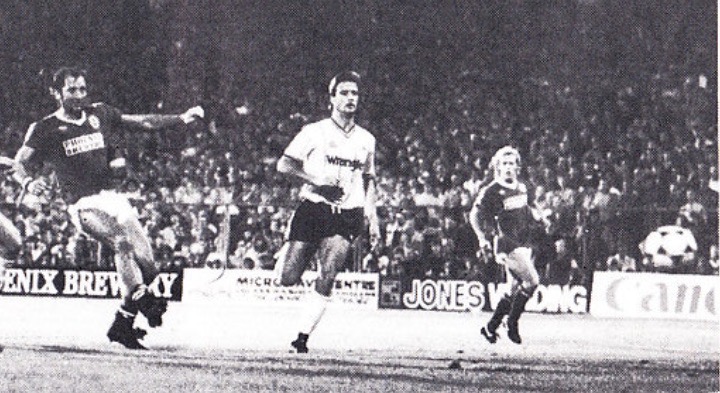
Personally, I struggled with his penchant for missing some unbelievable, gilt-edged chances to score. There was one away at Leicester (one of his future employers) – a proverbial ‘easier to score than miss’ – that was particularly galling in a game that finished 0-0.

Putting all these things to one side, there is no denying that he ultimately enjoyed a decent career and, while his most successful years were spent in the second tier of English football, he also got to play at the highest level.

Albion have struggled for a good many years to bring through promising local talent from schoolboy level but Hammond was one of the few who made it.

Born a couple of months before Brighton’s 1983 FA Cup Final appearance, he made his Albion bow in December 2000 when former Saints full-back Micky Adams put him on as a substitute in a 2-0 Football League Trophy win over Cardiff, but it was only when former youth coach Martin Hinshelwood briefly held the first team manager’s role that he got his next chance.

That came as an 85th minute substitute for Nathan Jones in a 4-2 defeat at Gillingham in September 2002 and 10 days later he made his first start and scored his first Albion goal (celebrating below right) after only eight minutes in a 3-1 League Cup defeat to Ipswich.

When Hinshelwood was sacked, new boss Steve Coppell opted for experience over youth and Hammond’s next competitive action came during two spells out on loan in 2003 – at Aldershot (seven games) and Orient (eight games).

In an Argus interview in November 2006, Hammond said: “It’s been up and down for me at Brighton. I loved it when I came through the youth team and then broke into the first team at quite a young age.”

Hammond watched from the sidelines at the Millennium Stadium in May 2004 as the Albion won promotion to the Championship via play-off victory over Bristol City. A couple of months later, the Argus was reporting how he had been given three months to prove he had a future with the club.

He did enough in a handful of games to be offered a contract until the end of the season and, although he was mainly used from the bench between October and March, by the season’s end he was playing a pivotal role in helping to steer Albion clear of the drop zone, scoring the equaliser in a 1-1 draw away to Burnley and getting both goals in a vital 2-2 draw at home to West Ham.

Before the 2006-07 season got under way, manager Mark McGhee obviously felt players like Hammond needed toughening up and sent him and a few others to some boxing sessions with former world heavyweight title contender Scott Welch, from Shoreham, at his Hove gym.

Hammond told Andy Naylor of the Argus: “When the gaffer mentioned it, I think the boys were thinking ‘Boxing? How is that going to help us’. But he worked on the mental side, as well as the power and strength stuff.

“If we felt tired or felt we couldn’t go on, he was pushing us and he said it would help us in a game. I think he’s right. When we went back for pre-season training you tended to push yourself that bit more, so I think it will help in the long run.”

Unfortunately, it didn’t help enough because the season saw Albion relegated back to the third tier. It wasn’t long before former youth coach Dean Wilkins was installed as manager and youngsters were given a chance to flourish in the first team, with Hammond appointed captain.

“I would say it is the best time of my career and I am really enjoying it,” he told Naylor. “It’s brilliant at the moment.”

In the same interview, however, there were perhaps the first rumblings of his discontent with the progress of the club.

“I’ve been here since the age of 11. I’m like every other player. I’m ambitious and I want to do the best I can in my career and play as high as I can. Hopefully that will be with Brighton.”

A career-ending injury to Charlie Oatway and Richard Carpenter’s departure from the club in January 2007 led to Hammond taking over the captain’s armband and 2006-07 was undoubtedly his best Albion season. He finished with 11 goals from 39 appearances and the award of Player of the Season.

D Ham v W HamIt was in the 2007-08 season that it turned sour between player and club, even though before a ball had been kicked he told the Argus he thought Brighton had it in them to make the play-offs.

“We can beat anyone in the division. It’s just about being consistent. Realistically we can push for the play-offs,” he told Brian Owen.

Considering he had been at the club from such an early age, what happened next clearly rankled with chairman Dick Knight, who talked about it in his autobiography, Mad Man: From the Gutter to the Stars, the Ad Man who saved Brighton.

Knight accused Hammond’s agent, Tim Webb, of touting his client around Championship clubs while there was an offer on the table from the Albion that would have made him the highest paid player at the club.

“Hammond kept telling the local media that he wanted to stay and sign a contract, but I think he was being told to hold out for more money,” said Knight.

Because Hammond could have walked away from the club for nothing at the end of the season, the pressure was on to resolve the situation one way or another by the close of the January transfer window.
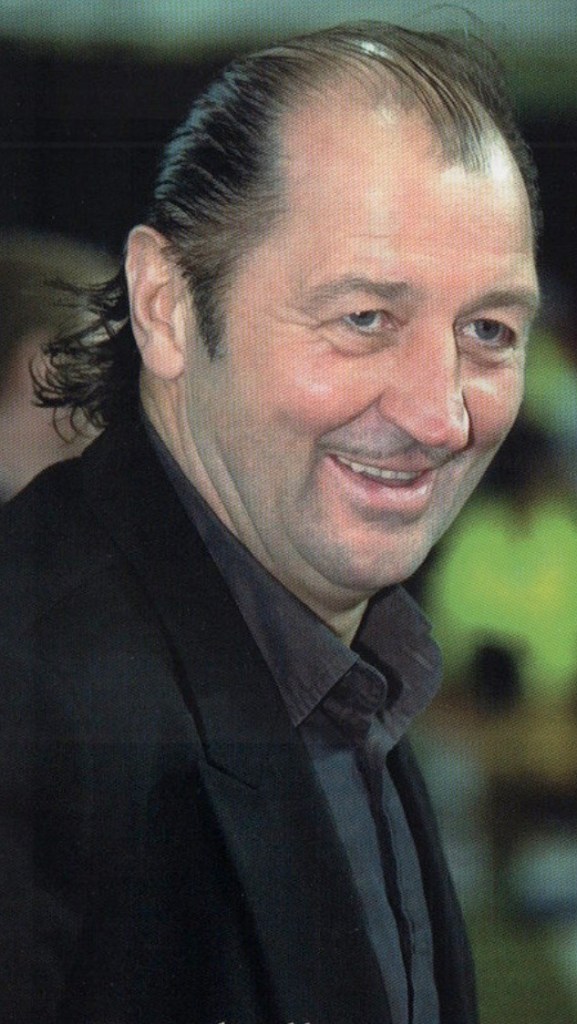
All the off-field stuff was clearly affecting Hammond’s head and I can remember a game at Oldham in the second week of January when he lunged into a reckless challenge after only nine minutes which certainly appeared to be a deliberate attempt to get himself sent off. That early dismissal was his last action for the Seagulls until his return to the club in 2012.

“I didn’t want to sell Dean but I was forced to,” said Knight, who persuaded Colchester United to buy him for £250,000, with a clause added in that Brighton would earn 20 per cent of any subsequent transfer involving the player. “In normal circumstances, I might have got more, but time was running out,” Knight added.

The move to Colchester wasn’t an unbridled success because his arrival couldn’t prevent them being relegated from the Championship, but, with Paul Lambert as manager, Hammond took over the captaincy in December 2008 and by the season’s end was voted Player of the Season.

Throughout the season there had been speculation that Southampton wanted to sign him and a deal duly went through in August 2009. At the time, Alan Pardew was the Saints manager and Hammond’s former Albion youth team coach and first team manager, Dean Wilkins, was Southampton first team coach, and played a part in him deciding to make the move. “His knowledge of the game and his passion for football is second to none and he was really good for Southampton – he had a good partnership there with Alan,” said Hammond.

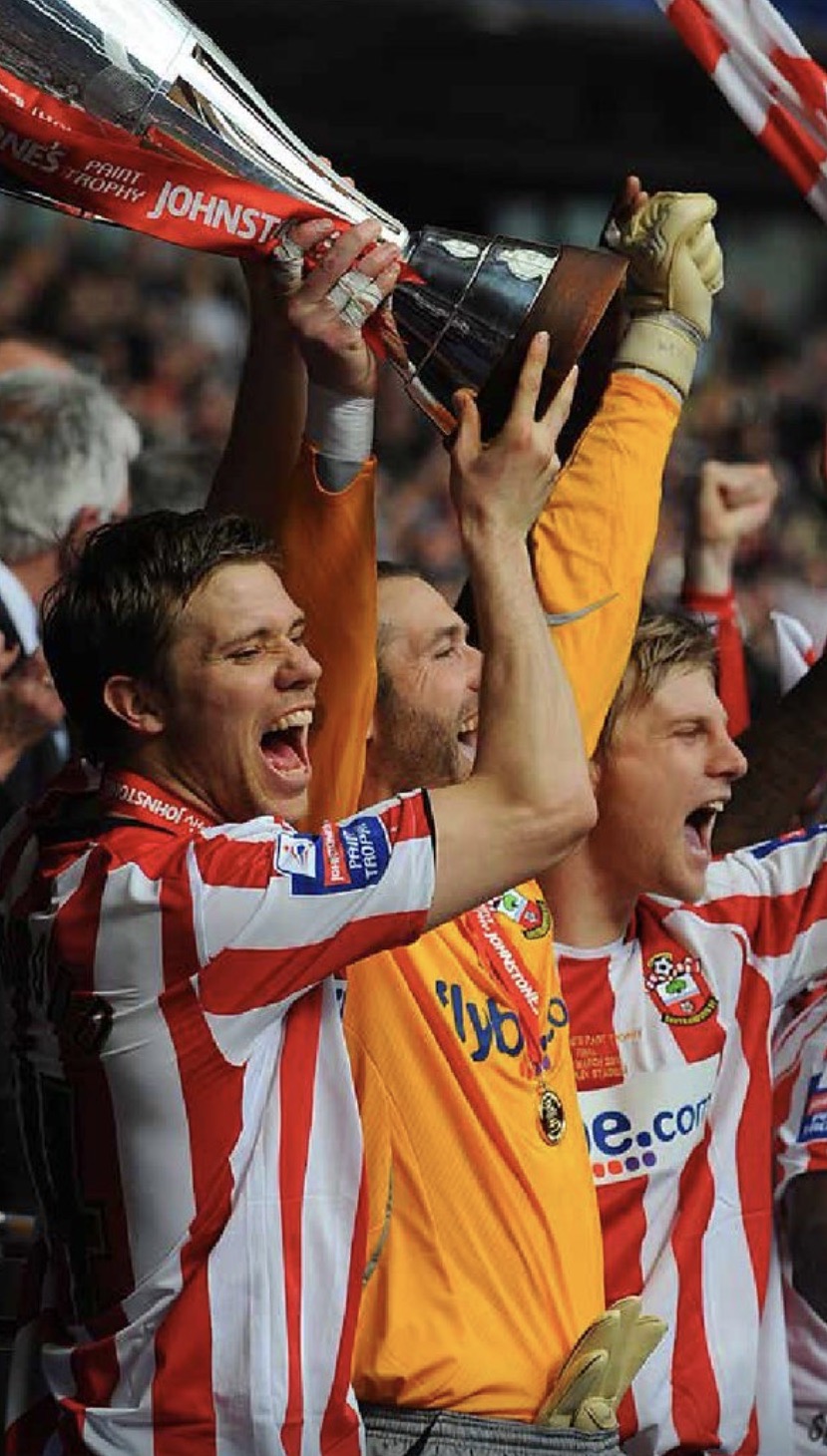
D hammo trophyAs had happened at his previous two clubs, it wasn’t long before Hammond was taking on the captaincy and he got to lift the Johnstone’s Paint Trophy at Wembley on 28 March 2010 (above) when Pardew’s team beat Carlisle United 4-1 – the first piece of silverware Saints had won since the 1976 FA Cup.
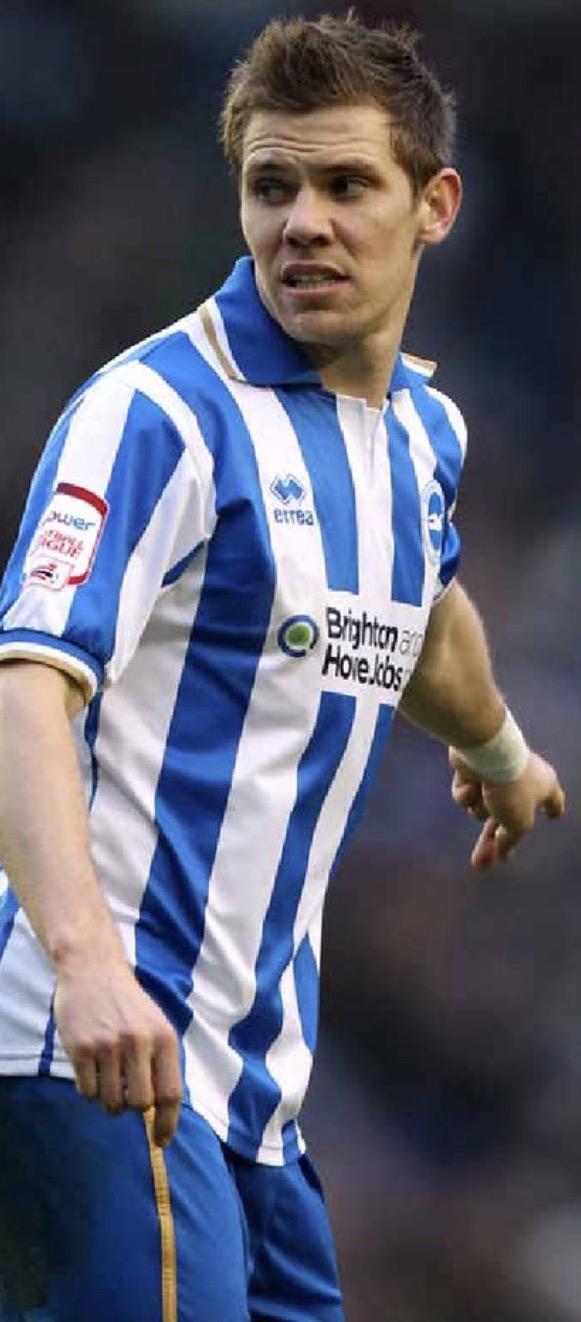
“I was really enjoying my football and it was like a new beginning for everyone connected with the club,” he said in an Albion matchday programme article. “Nicola Cortese came in off the field and a raft of new signings had been made, the likes of Rickie Lambert, Jason Puncheon, Lee Barnard, Radhi Jaidi, Dan Harding, Michail Antonio and Jose Fonte. When you add the likes of Morgan Schneiderlin and Adam Lallana, we had the makings of a really good team. It took us a little time to gel, but once we clicked we had a really good season.”

When Albion travelled to St Mary’s on 23 November 2010, the matchday programme inevitably featured their captain and former Seagull. It said: “Hammond was barely out of nappies when he first started supporting the Seagulls. He can even recall the days they played in front of 20,000 crowds at the old Goldstone Ground.

“The new Brighton stadium will hold just over 22,000 and the Saints midfielder said: ‘There’s no doubt they’ll fill it, certainly for their early games. That’s just about the size of their fan base and, if anyone deserved a bigger ground, it’s them’.”

Reflecting that he had certainly made the right career move, Hammond said: “I’ve developed as a player. I have a slightly deeper midfield role which means I pass the ball more and get involved in the game more.”

After two seasons in the third tier, Southampton famously finished runners up to Brighton in 2010-11 to regain their place in the Championship. Hammond was a regular throughout the 2011-12 season, although at times contributing from the bench, as Saints won promotion back to the Premier League, runners up behind Reading.

However, manager Nigel Adkins obviously didn’t see Hammond as top tier material and on transfer deadline day (31 August 2012) the midfielder agreed a season-long loan deal back at Brighton.

D Hammo 2By then 29, Hammond told the Argus: “It’s a different club now. The stadium is amazing and I can’t wait to get going.

“I saw the plans when I was 15 and it’s amazing to see it come to life. It will be a dream to play at this stadium as a Brighton player and I have been dreaming of that since a boy.”

Hammond made 33 appearances plus five as a sub during that season, alongside fellow loanees Wayne Bridge and Matt Upson, and said: “I loved my year back at the club. It was brilliant.

“I’d been sold the dream of the new stadium since I was 15 coming through the ranks, so to walk out of that tunnel for the first time as an Albion player was a fantastic feeling and one I’ll always cherish.”

Hammond reflected that the side did well to reach the play-offs but drew too many games. “We were only four points off automatic promotion and just didn’t do ourselves justice in that play-off game against Crystal Palace.

“Having drawn 0-0 at Selhurst Park, we really fancied finishing off the job at the Amex, but it just didn’t happen for us on the night. That has to rate as one of the biggest disappointments of my career.”

When manager Gus Poyet departed the Albion in the wake of the play-offs loss, Hammond returned to parent club Southampton, but, three months later he signed a two-year contract with Championship side Leicester City. Manager Nigel Pearson told the club’s website: “We’re really pleased to be able to add a player of Dean’s quality and experience to the squad.

“As well as having played a considerable number of games in his career, he also arrives with promotion credentials and will be a very positive influence on the squad both on and off the pitch.”

DHLCFC

Hammond added: “Once I knew of Leicester’s interest I wanted to come. My mind was made up. There was some interest from other clubs, but once Leicester was mentioned, and I spoke to the manager, I wanted to come here.

“It’s a massive football club. They came close last year in the play-offs and they’ve got a good history. It’s a club that’s going places and wants to push to the Premier League. It’s very exciting to be here.”

While facing midfield competition from Danny Drinkwater and Matty James, Hammond nevertheless played 29 games as Leicester were promoted and he finally got to play in the Premiership, albeit competition and injury restricted his number of appearances to 12.

Not all Saints fans felt it right that he had been abandoned as soon as the club reached the Premiership and, on the eve of his return to St Mary’s as a Leicester player, Saints’ fansnetwork.co.uk considered supporters might like to “thank him for his contribution to our resurgence in the game …. without Dean Hammond perhaps none of what they are enjoying in the Premier League would have been possible”.

Although Hammond earned a one-year extension to his contract in July 2015, he was not involved in the side that surprised the nation by winning the Premier League.

He had gone on loan to Sheffield United, then managed by his old Saints boss Adkins, and made 34 appearances for the Blades by the season’s end. However, he didn’t figure in new boss Chris Wilder’s plans and left the club in the summer of 2016.

Russell Slade gave him a trial at Coventry City in January 2017 but he didn’t get taken on and eventually he returned to Leicester to work with their under 23s. He later became loans manager for the Leicester City Academy.

Hammond opened up about his career, and some of the difficulties he’s faced since stopping playing, in an interview with James Rowe for The Secret Footballer.

  • Most photos from Argus cuttings; plus Southampton programme, Albion programme and Leicester City website.

Imperious Mark Lawrenson starred at Brighton before hitting Liverpool heights

MARK LAWRENSON was without doubt in my mind the best player ever to play for Brighton and Hove Albion. Peter Ward was exceptional but Lawrenson did it for Brighton and went on to have a glittering career with Liverpool, the top club in the country at the time.

And, whatever your thoughts about his contribution as a pundit – and many are very disparaging – you can’t take away his longevity on our TV screens and across our media.

Although now slightly less prominent as a TV pundit, for a good many years, Lawrenson reprised his successful Liverpool central defensive partnership with Alan Hansen in the BBC Match of the Day studios.

But where did it all begin? Born on 2 June 1957 in Penwortham, Lancashire, Lawrenson joined nearby Preston at 17 in 1974, who at the time were managed by the legendary Bobby Charlton.

Lawrenson made his full debut for the Lilywhites the following year, two months before his 18th birthday. However, it was Charlton’s fellow World Cup winner, Nobby Stiles, to whom Lawrenson was most grateful.

“I was a winger when I joined Preston, while he was coach, and he was the one who converted me to my present position – in the middle of the back four,” Lawrenson told Keir Radnedge in Football Weekly News.

“Nobby was very good with the youngsters. He was almost like a father-figure. He commanded respect not only because of what he’d achieved himself but because of the way he’d help iron out your faults.”

At the age of 19, and thinking he’d never be good enough to play for England, Lawrenson opted to play for the Republic of Ireland when player-manager Johnny Giles (perhaps not coincidentally, Nobby’s brother-in-law) found out that he qualified to play for them through his grandfather.

That debut for Ireland in April 1977, in a 0-0 draw with Poland, came at the end of a season in which he was voted Preston’s Player of the Year.

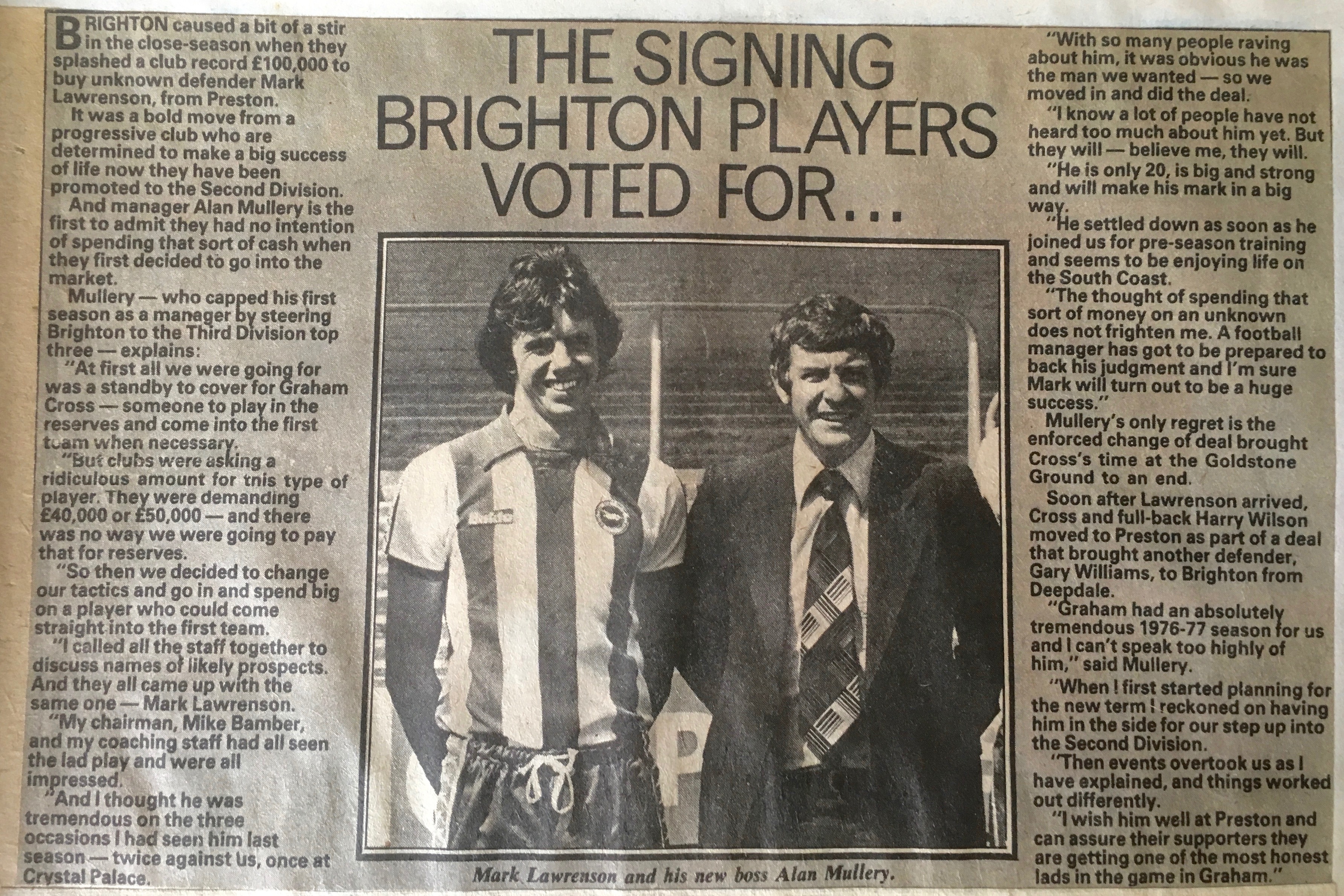
Within weeks, he joined the Albion for £112,000 (£100,000 + VAT @ 12 per cent) after Brighton manager Alan Mullery persuaded Albion to outbid Liverpool to get their man.

Shoot article

Mullery recalled in his 2006 autobiography how he had taken the board of directors to see Lawrenson perform superbly in an end-of-season game at Crystal Palace, where he marked their new star striker Mike Flanagan out of the game.

Lawrenson recollects how he was on an end-of-season ‘jolly’ in Spain with his Preston team-mates when Brighton chairman Mike Bamber and director Dudley Sizen turned up and ‘sold’ the club to him in a Benidorm beachside bar.

There was nearly a hitch in the deal when his medical showed high sugar levels in his blood – but it turned out he had been drinking blackcurrant-flavoured Guinness while on the Spanish holiday.

Mullery was building on the success of guiding the Seagulls to promotion from Division Three in his first season in charge, and the young defender replaced the experienced Graham Cross, who went to Preston in part-exchange.

Shortly after signing Lawrenson, Mullery told Shoot magazine: “I know a lot of people have not heard too much about him yet. But they will – believe me, they will. He is only 20, is big and strong and will make his mark in a big way.”

And, in his autobiography, Mullery said: “Any manager would love to have a player of Mark’s ability in their side. He had a calm, strong temperament, he never caused any problems and he always performed brilliantly on the field. His presence helped to lift the team to a whole new level of performance in the 1977-78 season.”

Lawrenson made his Brighton debut on the 20 August 1977 in a 1-1 draw against Southampton at The Dell and went on to make 40 league appearances by the end of his first season at the club.

The following season, when Albion went one better and earned promotion to the top division for the first time, Lawrenson was a stand-out performer. In his book, A Few Good Men, author Spencer Vignes said: “His timing in the tackle and ability to read the game belied his relative youth, but what really caught the eye was his skill on the ball, which, for a centre-back still earning his wages in English football’s second tier, was little short of remarkable.”

Skipper Brian Horton told Vignes: “The way he used to bring the ball out from the back had to be seen to be believed.”

In a special Argus supplement of April 1997, to mark Albion’s departure from the Goldstone, Lawrenson was interviewed by Mike Donovan, and told him: “The Goldstone was a great place to play and I was extremely happy there.

“It was an excellent team that played good football the way it should be played – by passing it around. Also, we had a great team spirit, mainly because a lot of the team were outsiders coming in and stuck together. We all played and socialised together.”

Unfortunately, Albion’s first season amongst the elite was only five games in when Lawrenson received a serious injury in a clash with Glenn Hoddle at White Hart Lane.

Badly torn ankle ligaments and a chipped bone was the diagnosis and it sidelined Lawrenson for 12 matches, although his absence created an opportunity for young Gary Stevens.

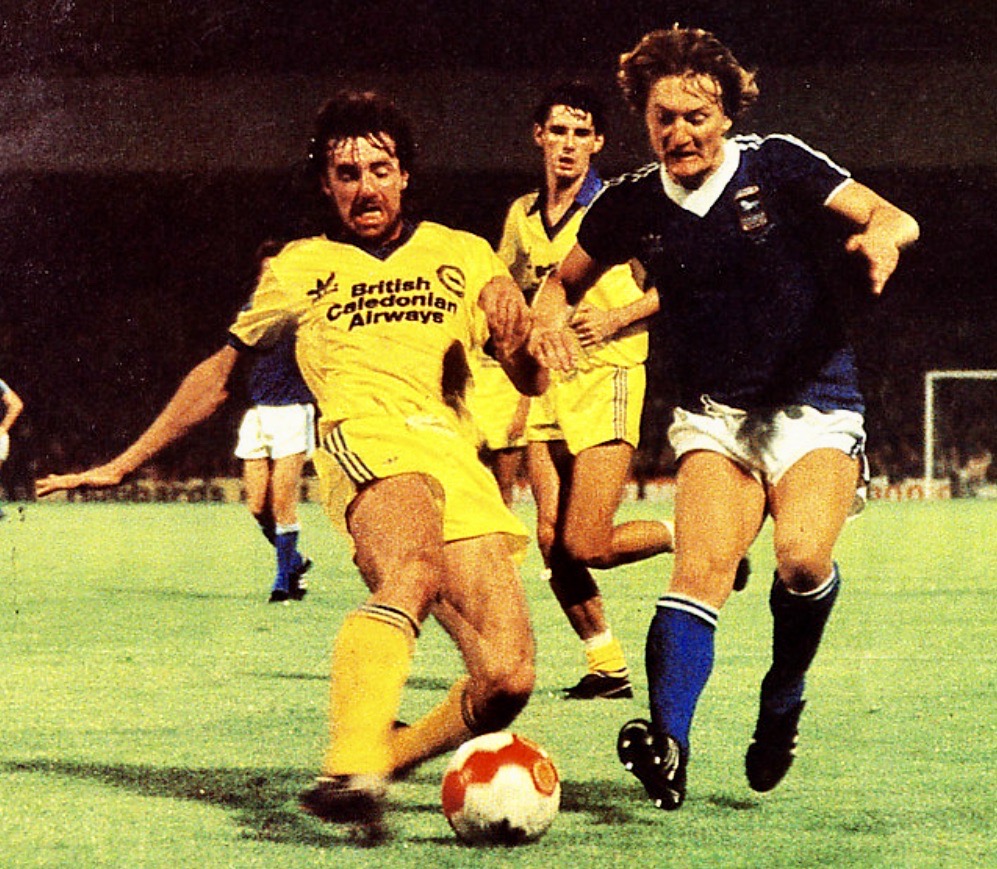
lawro yellowWhen Lawrenson was fit to return, Mullery sprung a surprise by utilising him in midfield, but it was an inspired decision and he stayed there for the rest of the season, helping Albion to finish a respectable 16th of 22.
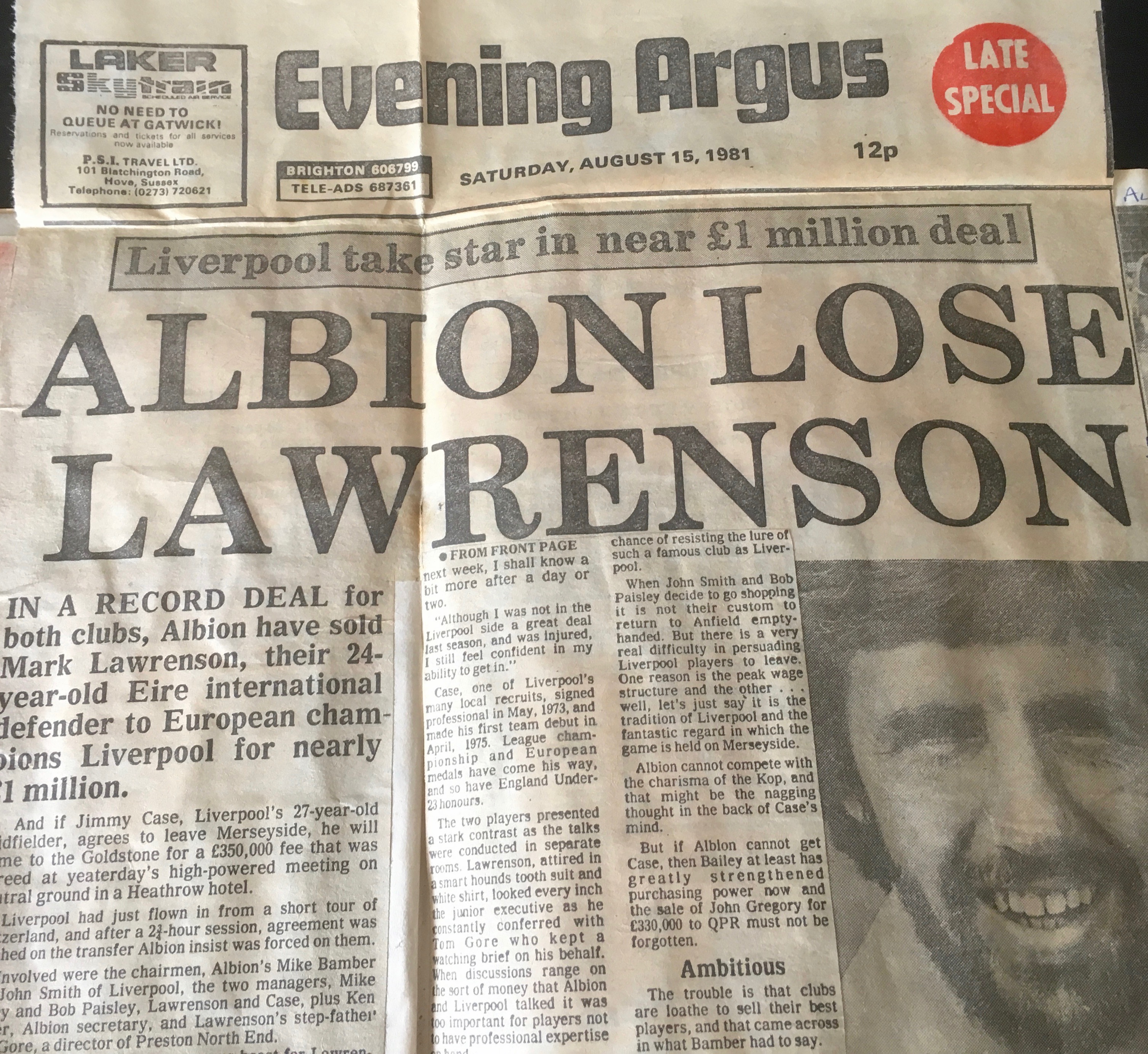
He went on to make 152 league appearances by the end of 1980-81.

It was his sale to Liverpool in the summer of 1981 that was part of the reason Mullery’s reign at the club came to an end. Mullery had negotiated with Ron Atkinson to sell him to Manchester United with two United players coming to Brighton as part of the deal.

But, behind his back, chairman Bamber had been talking to Liverpool and, in exchange for what was then a Liverpool club transfer record of £900,000, he was destined to be heading back to the North West with midfielder Jimmy Case coming South as part of the deal.

Interestingly, though, Lawrenson revealed in his autobiography how new manager Mike Bailey had actually made him Albion captain, but then asked him how he saw his future, which sowed a seed of doubt about the club’s intentions.

“I don’t know if there was a financial crisis and they were looking for a big transfer fee from my sale to sort themselves out, but the uncertainty did unsettle me,” he wrote. Lawrenson was sent off in an ill-tempered pre-season friendly (against FC Utrecht in the Dordrecht Tournament) and put it down to his personal frustration.

“On our return flight, there was a message that Terry Neill of Arsenal was waiting to meet the chairman at Gatwick,” Lawrenson recalled. “Somehow they missed each other and the next day there was talk of me going to Manchester United.

“But then Mike Bailey asked me if I would meet Liverpool, and I travelled to the Aerial Hotel at Heathrow to meet Bob Paisley, Peter Robinson and Liverpool chairman John Smith.

“Terry Neill was, at the time, waiting in the next hotel in case discussions broke down. He missed out because it only took me 15 minutes to agree to move to Liverpool.

“I travelled North and had a medical at 11.30 at night. I even took the registration forms to the League offices myself, because they are only a few doors away from my mother’s home at St Annes.”

Argus front page

Lawrenson went on to form a formidable central defensive partnership with Hansen after England centre back Phil Thompson suffered an injury, but, as he had showed at Brighton, he was versatile enough also to play at full back or in midfield.

Indeed, Lawrenson made his first start for Liverpool at left-back in a 1-0 league defeat to Wolves. In his first season, Liverpool won the League championship and the League Cup. They won it again in 1982 and retained both for another two seasons, becoming only the third club in history to win three titles in a row. They also added the club’s fourth European Cup in 1984.

Many believed Lawrenson and Hansen were the best central defensive partnership in English football by the time Liverpool clinched the League and FA Cup “double” in 1986.

But Lawrenson was being put under pressure by young centre back Gary Gillespie and an Achilles tendon injury in 1988 prematurely ended his career after 332 appearances and 18 goals, although he earned a fifth and final title medal when that season ended.

Lawrenson tried his hand at management at Oxford United in 1988 but, in almost a mirror image of the situation over his own transfer from Brighton, he resigned after their star striker Dean Saunders, the former Albion player, was sold by the board of directors without Lawrenson’s blessing.

Lawrenson later managed Peterborough United for 14 months between September 1989 and November 1990, but it was a largely unsuccessful tenure.

Apart from one brief foray back into football as a defensive coach at Newcastle during Kevin Keegan’s first reign in the North East, Lawrenson’s involvement since has been one step removed as a pundit and newspaper columnist.

At the 2018 World Cup, Lawrenson particularly hit the headlines when many observed his cantankerous and sarcastic observations were just too much.

Never shy of voicing his opinions, they once led to him losing what at the time was a trademark moustache!

He was so convinced that Bolton would be relegated that he said live on Football Focus that he would shave it off if they proved him wrong, which they did!

In 2003, my friend Andrew Setten somehow blagged tickets which gave us the opportunity to go into the exclusive Football Association area at the FA Cup Final between Arsenal and Southampton at the Millennium Stadium and, all those years later, I finally got the chance to meet Lawro and to get his autograph.

• Pictures from Shoot magazine, cuttings from the Evening Argus and the matchday programme.

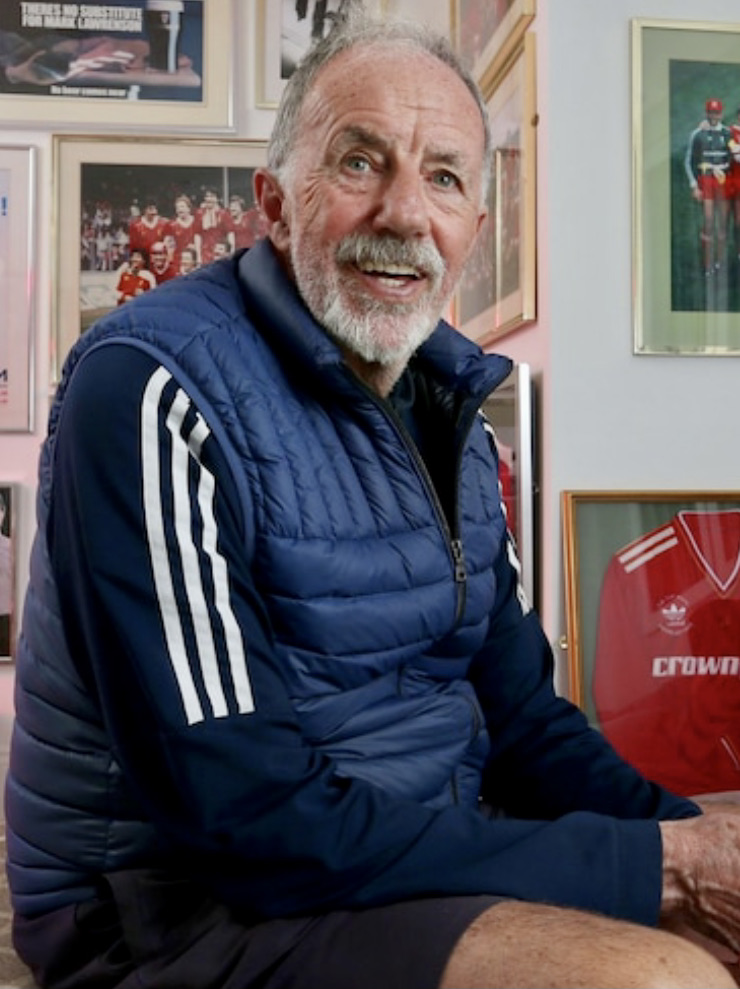
Lawrenson pictured in 2024

Steve Gatting’s three Brighton Wembley dates after missing out with Arsenal

1 MAIN gat sees GS goal.jpgSTEVE Gatting played at Wembley three times for Brighton having twice been denied the opportunity by Arsenal.

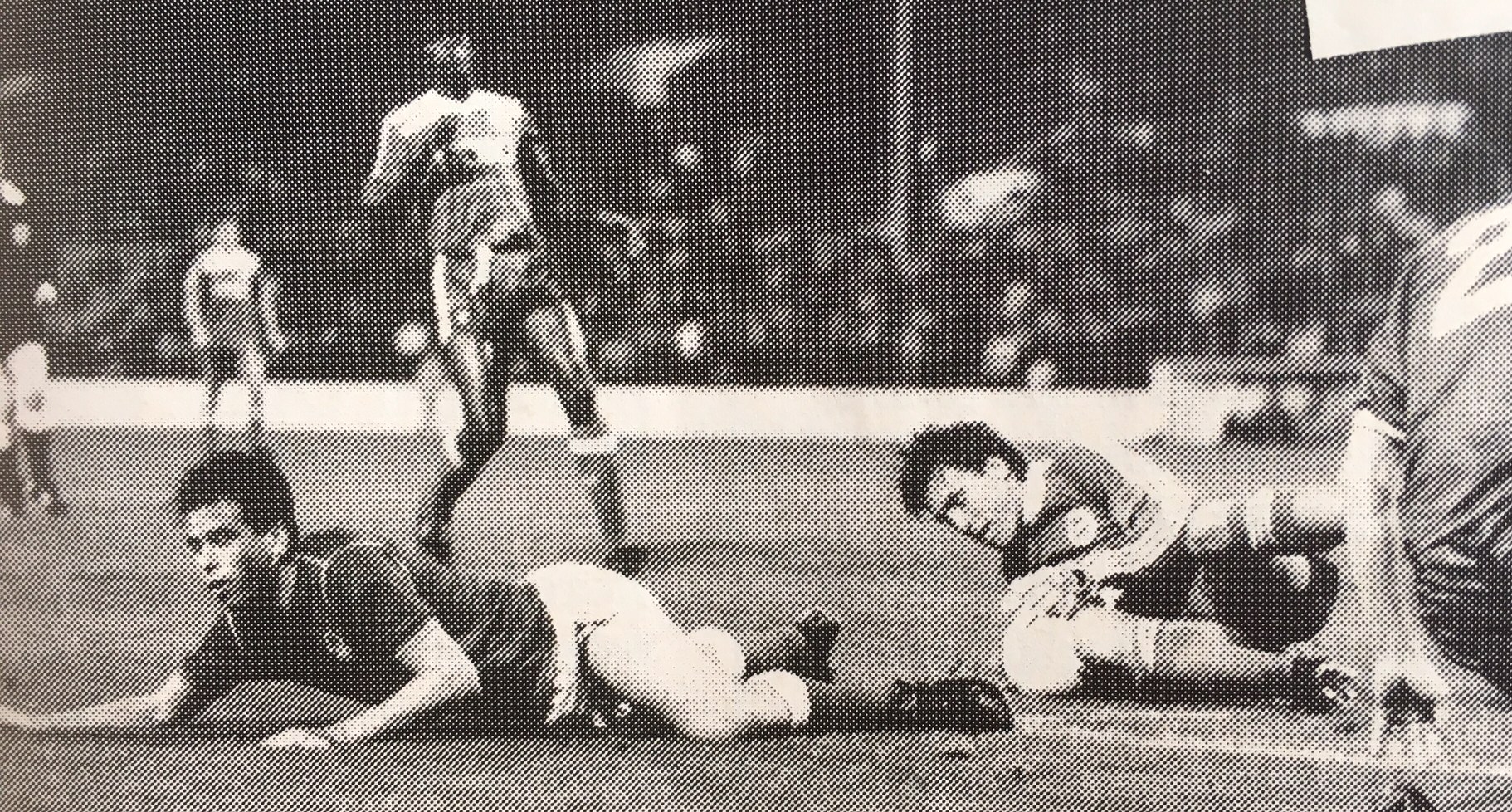
After being left out of Arsenal’s FA Cup Final sides in both 1979 and 1980 he finally got to step out onto the hallowed turf twice in the space of five days in 1983.

And his appearance in Brighton’s 3-1 defeat to Notts County in the 1991 play-off final at the famous old stadium was also his last in an Albion shirt after 10 years at the club.

In Match Weekly’s 1983 Cup Final preview edition, Gatting revealed his heartache at missing out with Arsenal in 1979. “I expected to be at least substitute after playing in five of the games leading up to Wembley, including the semi-final,” he said. “I was desperately sick when I didn’t get a chance. Although I really wanted the lads to do well, I couldn’t help feeling pangs of regret as the cup was paraded around the ground.”

Born on 29 May 1959 in Park Royal, London, two years after his famous brother Mike, the former Middlesex and England cricket captain, Steve was no mean batsman himself.

Instead of joining the ground staff at Middlesex County Cricket Club, though, Gatting shone at football with Middlesex and London Schoolboys teams and became an associate schoolboy with Arsenal before joining as an apprentice in July 1975. Terry Neill signed him as a professional at the age of 17 and a year later he made his First Division debut against Southampton at Highbury.

Gatting made 76 appearances for Arsenal over three seasons, his most memorable being the 1979 FA Cup semi-final against Wolves at Villa Park. He said his biggest disappointment was missing out on the May 1980 European Cup Winners Cup Final against Valencia in Brussels.

In his youth career, Gatting played in the centre of the back four but Arsenal generally played him in midfield, where competition for places was fierce with the likes of Liam Brady and Graham Rix. He admitted after joining Brighton: “When they bought Brian Talbot from Ipswich, I sensed I was on my way out.”

It was rumoured Albion would take Gatting as part of a swap deal that would see Mark Lawrenson join Arsenal but, of course, Lawrenson went to Liverpool instead. Albion were still interested in Gatting, though, and in September 1981 new manager Mike Bailey met him and his displaced colleague Sammy Nelson at Gatwick Airport and agreed terms to buy the pair of them; £200,000 the fee for the young Gatting.

Albion offered Gatting the chance of regular first team football and, although the expectation was for him to occupy a midfield spot, he quickly stepped in alongside Steve Foster in the back four and completed 45 appearances that season.

Aside from a rare couple of spells back in midfield, he remained a defender for the rest of his career, often slotting in at left back – apart from when he played right-back in the Cup Final replay.

Gatting had a terrific game alongside Gary Stevens in the 2-2 drawn first game against Man United, but Jimmy Melia unwisely chose to play the left-footed Gatting in place of injured Chris Ramsey (he should have put Stevens there) and the back line was noticeably unbalanced as they went down 4-0.

The Paul Camillin / Stewart Weir book Albion The first 100 years said: “Played out of position at right-back in the replay, he endured an uncomfortable evening in an unfamiliar role.”

Even so, interviewed three years later in the Albion matchday programme, Gatting spoke fondly about his memories of the whole occasion.

“The helicopter flight to Wembley was a new experience. We flew over the stadium and saw all our fans below,” he said. “That was a great moment. We landed and drove to the ground and went straight out onto the pitch to get a taste of the atmosphere. I met my brother Mike out there and to be honest he was more nervous than me!

“The greatest part of the whole day was walking out of the tunnel and seeing all the fans and being deafened by the cheering. That is an ambition every footballer has, to play in the Cup Final at Wembley. It was a dream come true for us and I think it lifted our game.”

Gatting had made only eight first team appearances in the 1984-85 season before, in November 1984, he sustained a serious pelvic injury which threatened his career. After five months, it was decided the only solution was a bone graft to the pelvis.

He had to remain motionless in hospital for a month and then rest on his couch when he was allowed home.

His wife Joy told Tony Norman in March 1986: “I felt sorry for Steve. He’s usually such an active person but suddenly he just had to sit there. It must have been very difficult. But Steve never got into self-pity. He stayed very positive and I respected him for that.”

Norman reported: “It was a long hard road for Steve. He started taking long walks in July, to build up strength and that progressed into jogging, light training and finally full training. He made his comeback game in the Reserves on 26 October.

Gatting told the interviewer: “When you are playing regularly, you tend to take things for granted. But when something like a serious injury comes along, it makes you realise how lucky you are to be fit and playing the game you enjoy so much. When you’re sitting on the sidelines week in week out it brings it home to you.”

The injury restricted him to only 17 appearances in the 1985-86 season but he was restored fully to the side in 1986-87 when financial issues clouded Alan Mullery’s return to the manager’s chair and successor Barry Lloyd couldn’t stop the inexorable slide to relegation from the second tier.

In a League Cup game replay away against First Division leaders Nottingham Forest, Gatting had to take over in goal when Perry Digweed  was forced off with a broken cheekbone. Gatting completed 45 appearances that season and said: “Dropping into the Third Division was far worse than going out of the First.

'keeper Gatt - webb on ground

Makeshift ‘keeper Gatting claims the ball with Nottingham Forest’s Neil Webb grounded

“All the players at the time felt they were good enough to stay up, but it didn’t happen and we gave a lot of silly goals away.

“The whole club was unsettled, too, but things became better again. Getting back into the Second Division was a boost for everybody.”

Gatting was ever-present in the 1987-88 promotion-winning campaign, even though in July 1987 Lloyd had given him a free transfer! The defender had other ideas and managed to play his way back into contention to such an extent that he ended up the season as captain, taking over from Doug Rougvie.

“It was nice to know I was wanted, particularly after relegation the year before,” he said.

Having made his 200th league appearance for the Albion against Chester on 12 December 1987, it was no surprise he viewed with some relish a FA Cup tie against his old club.

“Quite honestly, as a Third Division club, we don’t expect to go all the way, but I think we have the ability to scrape a result against Arsenal,” he said. “It gives me the opportunity to renew old friendships with Kenny Sansom, David O’Leary, Graham Rix and Paul Davis who were all members of the Arsenal staff when I was there.”

Albion pushed the Gunners all the way in front of a packed house and Garry Nelson rifled a memorable goal, but Arsenal prevailed 2-1.

Evening Argus Albion reporter John Vinicombe profiled Gatting warmly in a piece produced for a pre-season supplement ahead of the 1989-90 season, headlined “ice-cool Gatt”.

He described Gatting as “surely one of the most laid-back of individuals, whose natural personality is quiet and reserved”.

The report continued: “He shuns being the centre of attention, but the fact that he stays cool, even in nerve-wracking situations, is an important consideration when assessing leadership qualities.

“Leadership runs in the family, and many would say that older brother Mike was unlucky to lose the captaincy of England’s cricket team.”

On another occasion, Gatting said of his brother: “I’m proud of what Mike has achieved and I keep up to date with the latest news and enjoy watching the highlights on TV.

“We are close, we always have been, but the funny thing is I hardly ever go to see Mike play. When I do go, he never seems to make runs. So I think it’s best to stay at home and watch the Tests on TV.”

As mentioned previously, Steve was a good batsman in his own right and played for Middlesex Second XI. In Sussex, he enjoyed a summer tour with Brighton Brunswick as well as making runs for Preston Nomads.

Vincombe wrote: “Gatting occupies a special niche in the affections of Albion regulars. They see in him a thoroughly decent and well-behaved person whose standards on and off the field are high. Albion have been good to him and Gatting, after not a few periods of uncertainty, has been good for Albion.”

Gatting for his part said: “I’ve seen a lot of changes since arriving here, and I’ve played under five managers who have all had different ideas.”

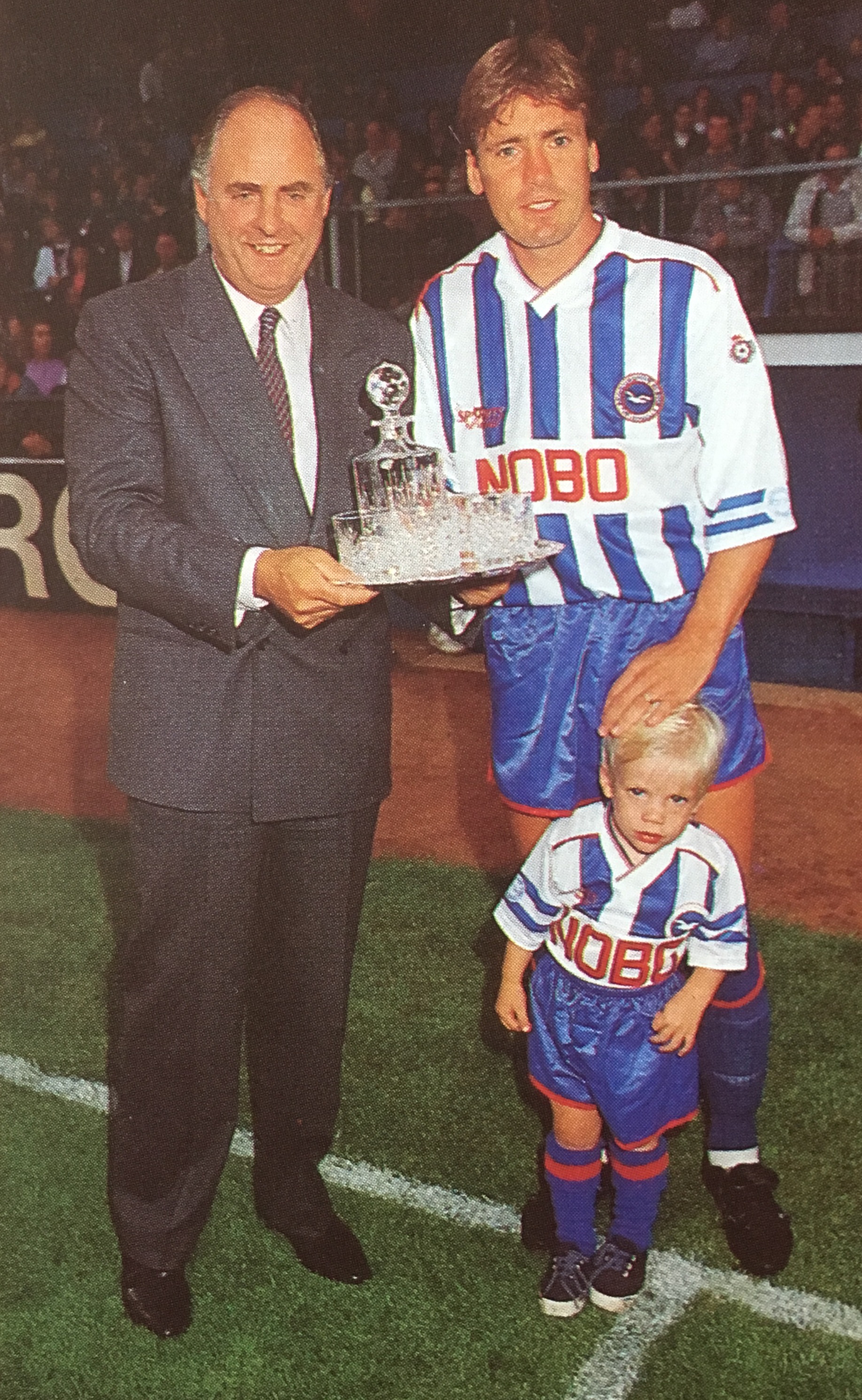
testimonialA cut glass decanter and glasses from chairman Dudley Sizen at Gatting’s testimonial

He was granted a testimonial for his long service and a curtain-raiser to his 10th season with the club saw Albion draw 2-2 with Arsenal in front of a crowd of 5,517. The Gunners included their recent big money signings David Seaman, Andy Linighan and Anders Limpar.

Injury niggles continued to plague him towards the end of his 10 years at the club but he worked his way back into the side in 1990-91, slotting in at left-back and culminating in that 1991 play-off final against Notts County at Wembley.

Long after all the other members of the Brighton 1983 Cup Final side had departed, Gatting was still pulling on the stripes, and, but for those injuries, he would surely have made many more appearances than the 366 + three as sub (21 goals) that stand as his record.

Given another free transfer in 1991, he departed for Second Division Charlton Athletic along with Garry Nelson, linking up with former Albion teammate Alan Curbishley who at the time was joint manager with Steve Gritt.

Charlton only narrowly missed out on a play-off place while Albion were relegated!

By the end of the following season, when Gatting retired, he had played a total of 64 games for the Addicks.

He then turned his attention to coaching and spent seven years at independent school Christ’s Hospital, Horsham, before returning to Arsenal in 2007 to work as an academy coach. Gatting was working as Arsenal’s under-23s coach until May 2018 when he and his assistant Carl Laraman were suspended after accusations of bullying were made against them, and neither returned to their roles.

Gatting subsequently joined League Two Stevenage as assistant coach under Dino Maamria just before Christmas 2018 but he left the Hertfordshire club shortly before the end of the 2018-19 season.

• There have not been many father-son combos during my time watching Albion (Gerry and Darragh Ryan were the first that spring to mind) but it must have given Steve great pride to see his son Joe make it through the youth ranks at Brighton and go on to play for the first team. He made 44 appearances and I recall an away game at Carrow Road when Steve and Uncle Mike were both watching the youngster in Albion’s forward line. Eventually, after he left the Seagulls in 2008, he turned to cricket and was good enough to play at county level for Sussex and Hampshire.

‘Save of the season’ one of few bouquets for goalkeeping florist Alan Blayney

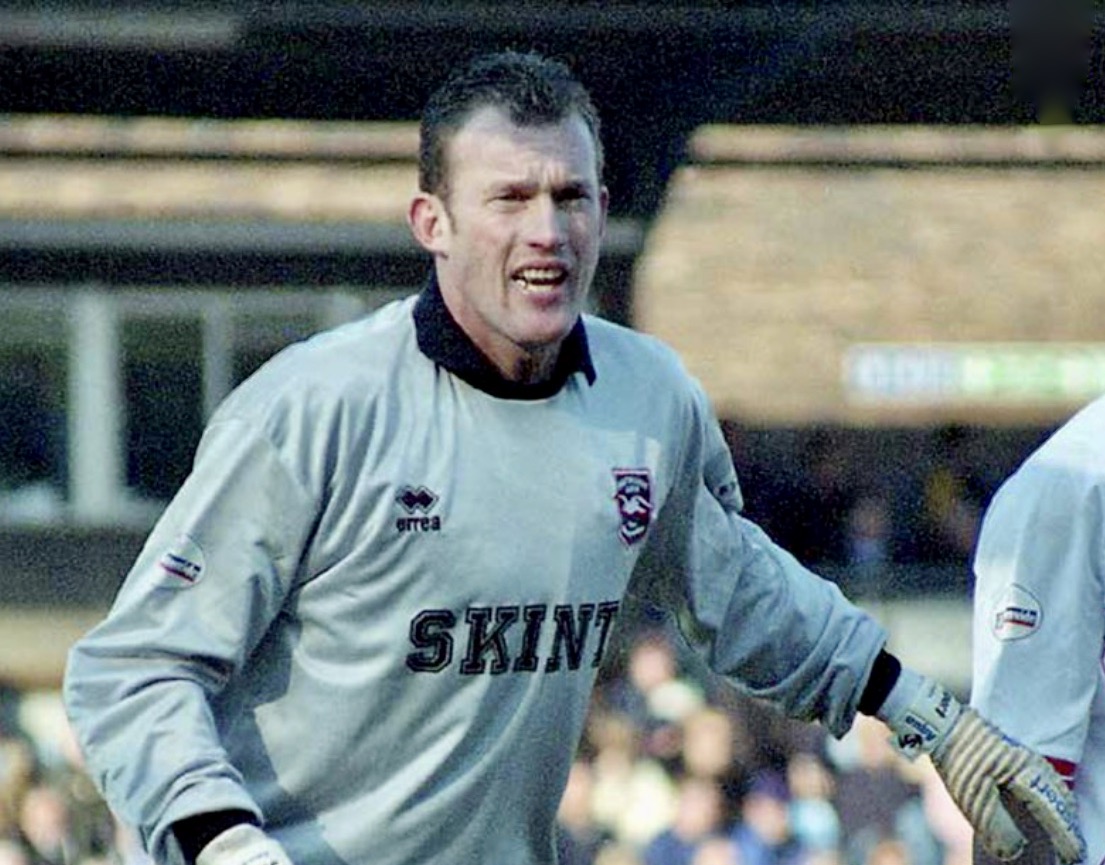
blayney intenseGOALKEEPER Alan Blayney only played 15 games on loan to Brighton from Southampton but if finances had been better at the time he could have signed permanently and his career may have taken a different turn.
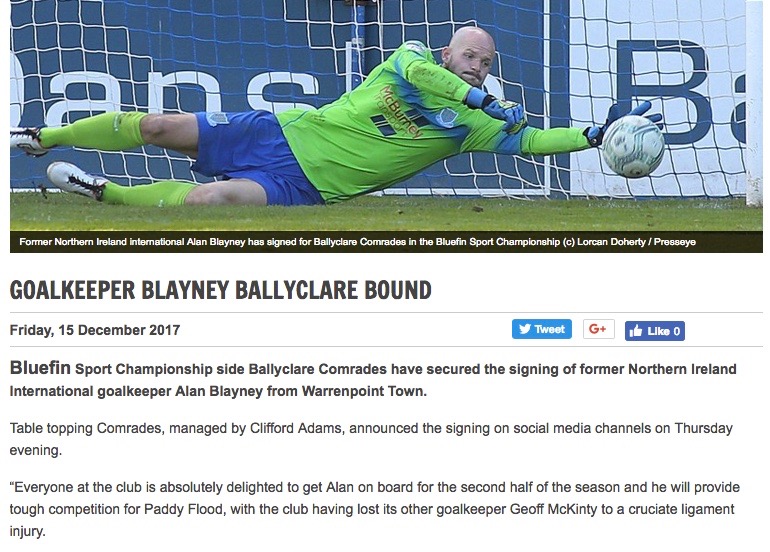
Blayney is still playing, nifootballleague.com reporting only in December 2017 a move to Ballyclare Comrades from Warrenpoint Town. He also runs a florist business with his wife Laura in Newtownabbey.

Only a month earlier he opened his heart to the belfasttelegraph.co.uk and talked about the demons he’s had to face during a career that rarely hit the heights in England but has seen him represent his country and enjoy success in his native Northern Ireland.

Born in Belfast on 9 October 1981, Blayney was picked up by the city’s Irish league side Glentoran at 16 before moving to the UK aged 19 to join Premier League Southampton.

Blayney was initially loaned out to Stockport County, but his time there was cut short by a broken finger.

He also had a couple of games along the coast at Bournemouth when he suffered one of his most embarrassing goalkeeping moments. In a Q and A for the Albion programme, Blayney told interviewer Dan Tester: “I’d rolled the ball outside the 18-yard box in readiness to kick it up field. The Rochdale striker, my former Northern Ireland under 21 teammate Lee McEvilly, was running away and it hit him on the head and flew over mine into the back of the net.”

Back at Southampton, the young ‘keeper finally got a first team chance in May 2004, a couple of months after Paul Sturrock had replaced Gordon Strachan as manager.

It was some debut because the game against Newcastle United finished 3-3 and a save Blayney made from an Alan Shearer header won him the accolade of Sky Sports save of the season.

The young Irishman kept his place for the following game, a 2-1 defeat at Charlton and he played twice more the following season, in a 2-2 league draw against West Bromwich Albion and a 5-2 League Cup defeat to Watford.

With future Albion goalkeeping coach Antti Niemi and Paul Smith ahead of him in the pecking order, Blayney went on loan to Rushden & Diamonds, where he played four games, before securing the first loan to Brighton in early 2005.

Albion’s regular ‘keeper Michel Kuipers had sustained a horrific shoulder injury in a home game against Nottingham Forest and the no.2 at the time, Chris May, had no experience so manager Mark McGhee needed emergency reinforcements.

Initially he obtained David Yeldell from Blackburn Rovers and also brought in Rami Shabaan from Arsenal, but Blayney, no doubt recommended by McGhee’s old pal Strachan, became the preferred option and played seven games at the end of the season.

Amongst several impressive displays was a game I went to with my son, Rhys, at Burnley, on 16 April 2005.

Against the odds, it finished 1-1 but the media was keener to focus on the post-match news that striker Mark McCammon had been ordered off the team bus by McGhee for his reaction to being substituted at half time.

Reporter Peter Gardner, on telegraph.co.uk, said: “The incident overshadowed a rousing second-half comeback to a game Brighton might ultimately have won, not least through the contribution of Jake Robinson, McCammon’s half-time replacement.

“However, McGhee’s men were equally fortunate not to have been overwhelmed by the home side in the opening 45 minutes when only splendid saves by Alan Blayney from Graham Branch (twice) and Mo Camara, plus Burnley’s own profligacy, prevented an avalanche of goals.”

Blayney was also between the sticks for the nail-biting final game of the season when a 1-1 draw with Ipswich Town kept the Seagulls in the Championship by the skin of their teeth.

Such had been Blayney’s contribution that McGhee was keen to sign him permanently, the manager telling skysports.com: “Alan did absolutely brilliantly here for us. We have to see how realistic an option that is, and whether they’re even prepared to consider letting him go, and what the conditions would be.”

The answer was that Brighton couldn’t afford the fee Southampton wanted so at the start of the following season Wayne Henderson was brought in instead on a three-month loan from Aston Villa.

When Henderson returned to Villa, McGhee was keen to buy him outright but in the meantime brought Blayney back for an eight-game stint.

Blayney told BBC Southern Counties Radio: “If I don’t perform they’ll end up going for Wayne instead of me. I have to come in and show I’m as good as Wayne, if not better. This first game at Stoke is really important.”

Unfortunately, the game at Stoke ended in a 3-0 defeat and a 3-2 reverse at home to Crystal Palace followed.

After a point was gained away at Cardiff City, Blayney saved a penalty from Inigo Idiakez in a 0-0 draw with Derby at Withdean on 26 November 2005, and the following week he helped earn another point, repeating the feat against Watford’s Marlon King.

The Watford Observer reported: “King passed up a glorious chance to fire Watford ahead on 58 minutes when he saw his penalty saved. King’s tame penalty was parried by Blayney, who dived low to his left, and the keeper then gathered the rebound.”

After a 5-1 hammering away to Reading, Blayney returned to Southampton in mid-December and within a matter of weeks Southampton’s technical support director, Sir Clive Woodward, informed him he had been sold to Doncaster Rovers for £50,000.

Blayney told the Belfast Telegraph in November 2017: “My response was, ‘Do I not have any say in this?’ He said the deal was done but I didn’t want to live in Doncaster. I loved it in Southampton. I didn’t settle in Doncaster, they gave me an apartment, but it was a tip. If I was getting those wages now I would bite your arm off but then it felt I wasn’t getting much and it was a terrible time.”

Although he started out as no.1, and made 24 appearances for Rovers, following an ankle injury he slipped to third choice behind Ben Smith and Jan Budtz, and came to an agreement to terminate his two and a half year contract early.

Blayney admitted in his Belfast Telegraph interview: “I do regret going out and drinking in my later career in England when I was at Doncaster. I was getting injuries and was a bit disillusioned with the game. I regret it because people had opinions of me at that club which is not the real me. They only saw me behave like that for a few months.”

He wasn’t quite done with England, though, and in February 2007 joined League One Oldham Athletic until the end of the season, after impressing in a reserve team match. However, he only played one first team game, in a 1-2 home defeat against Bournemouth.

There had been the possibility of a return to Brighton to replace Henderson, who had been sold to Preston, but the Argus reported on 2 February 2007: “Albion are not re-signing goalkeeper Alan Blayney after all. They have not been able to agree a length of contract with the former loan signing.”

On his return to Northern Ireland, he initially managed just three games as an understudy at Bohemians, but then he played 32 times for Ballymena United in 2008-09 as a prelude to what would turn out to be the most successful period of his career.

In five seasons with NIFL premiership side Linfield, he played 164 games and, in 2010-11, when Linfield won the league and cup double, he was named Ulster Footballer of the Year.

His form for Linfield also earned him a recall to the Northern Ireland squad. He had initially made his debut in 2006 under Lawrie Sanchez on a summer tour of the United States.

An appearance from the bench in a drawn friendly against Morocco in November 2010 saw Blayney concede an embarrassing goal as his clearance rebounded off Marouane Chamakh, then of Arsenal, to give the Africans the lead.

Manager Nigel Worthington put the incident into context after the game, telling the media Blayney had travelled to the ground just hours after his partner had given birth to a son.

“I was disappointed for Alan but it has been a terrific day for him and we have come out of the game unbeaten,” said Worthington. “He’s fine and I have given him every encouragement. It is one of those you learn from. You cannot take a split second to delay.”

Blayney said it was the worst moment of his career. He told the Belfast Telegraph: “I came on at half-time for Jonny Tuffey but took a terrible touch and Chamakh came in to challenge me. I kicked the ball off him and it went into the net.

“Everybody had welcomed me onto the pitch and you don’t forget moments like that. You aren’t used to playing against players who are as quick as that. I looked up and he was there. I wanted the ground to swallow me up but earlier that same day Phoenix was born. It was a bittersweet day.”

In May 2011 Blayney shared goalkeeping duties with Tuffey as an inexperienced Northern Ireland team endured an embarrassing Carling Nations Cup defeat to the Republic of Ireland. Although left exposed by a threadbare defence, Blayney was culpable in at least two of the goals in a 5-0 hammering, one of which was scored by debut-making Stephen Ward, a future left back loanee for the Seagulls. bbc.co.uk reported: “Blayney was badly at fault six minutes later as he spilled a tame Treacy cross which allowed Ward to poke home from close range.”

With Linfield, Blayney continued to rack up honours until they signed Tuffey in 2013, and he was no longer first choice. In January 2014, he joined Ards on loan but couldn’t help them avoid relegation.

After spending 2014-15 with Glenavon, he returned to Ballymena where he had two successful seasons, before losing his place. In January 2017, he dropped down to the Premier Intermediate League with Dundela. At the start of this season, he returned to the higher division with Warrenpoint Town but, in December, moved to be closer to home, with semi-professional Ballyclare.

Blayney savedec 17 blay cutBlayney cover

Further reading

https://www.not606.com/threads/whatever-happened-to-alan-blayney-part-5-of-many.126334/

https://www.belfasttelegraph.co.uk/sport/football/irish-league/footballers-lives-with-alan-blayney-why-ive-been-gripped-by-selfdoubt-and-how-i-almost-died-after-training-36284956.html

http://news.bbc.co.uk/sport1/hi/football/teams/b/brighton/4102810.stm

http://nifootball.blogspot.co.uk/2006/08/alan-blayney.html

Cup Final hero Dave Beasant was Brighton’s oldest player

Beasant BHA

THE FIRST goalkeeper to save a penalty in an FA Cup Final – and the first to captain his team in the historic end of season finale – played between the sticks for Brighton at the ripe old age of 44.

Admittedly Dave Beasant is better known for his years playing for Wimbledon, during which time he laid down those FA Cup milestones in the 1988 final against Liverpool.

Nicknamed Lurch after the butler in The Addams family, Beasant’s heroics to keep out John Aldridge’s spot kick and preserve the 1-0 lead given to the humble south west London club by Lawrie Sanchez, led to the giant goalkeeper lifting the cup.

It also turned out to be the last ever game he played for Wimbledon. A month after that Wembley triumph, Newcastle paid £750,000 for his services – a transfer fee record for a goalkeeper at that time.

Not a bad return on Wimbledon’s £1,000 investment ten years earlier after he had impressed Dario Gradi playing for Edgware Town against the Dons in a pre-season friendly.

Beasant made his league debut against Blackpool in January 1979, and, remarkably, between August 1981 and the end of that 1987-88 season, made 304 consecutive league appearances for the Dons as they rose through the leagues.

When Newcastle sold Paul Gascoigne to Spurs for £2.2 million, they decided to splash £750,000 of it on the big Wimbledon goalkeeper.

Sadly, it was not money well spent. Beasant’s spell on Tyneside lasted just five months and certainly didn’t match the fairytale ending at Wimbledon.

Newcastle struggled at the foot of the table in 1988-89, and were relegated, but before the trapdoor opened Beasant had already departed after just 20 appearances.

He moved back to London in January 1989 to join Chelsea, where he played 193 times, initially under Ian Porterfield, until falling out of favour in 1992.

It was towards the end of 1989 that Beasant won two England caps, playing against Italy and Yugoslavia, and an injury to David Seaman saw Beasant selected for Bobby Robson’s 1990 England World Cup squad, although he didn’t play.

When Glenn Hoddle took over at Stamford Bridge, Beasant was relegated to number three ‘keeper behind Dmitri Kharine and Kevin Hitchcock, so he went out on loan for brief spells at Grimsby Town (six games) and Wolves (four games) before securing a £300,000 move to Southampton in 1993 to succeed Tim Flowers as their no.1.

He played 105 times for Saints but several managerial changes saw his fortunes fluctuate and, in 1997, he once again found himself third choice – this time behind Maik Taylor and Paul Jones – and he was on the move again.

By this time he was 38, but retirement was still not on his agenda. After joining on loan initially, Beasant moved permanently to Nottingham Forest in November 1997 and played 139 games in four years.

It was back to the south coast again in 2001, when Portsmouth needed a goalie following the death in a road accident of their regular ‘keeper, Aaron Flahavan. Beasant played 27 times for Pompey.

Emergency loan spells then followed successively at Tottenham, Bradford City and Wigan Athletic, although he didn’t play any first team games for any of them.

It was from Wigan, just a few weeks before his 44th birthday in 2003, that he once again headed south, this time to join Brighton’s brave but ultimately unsuccessful attempt under Steve Coppell to stave off relegation from Division One.

With Michel Kuipers out of the side with a thigh injury and loan replacement, Ben Roberts, suffering from ‘flu, Beasant was drafted in.

In the Bradford City v Brighton programme in February 2003, Colin Benson wrote almost poetically about the legendary goalkeeper.

Beasant landsc“The unmistakeable figure of Dave Beasant stood tall under the Brighton crossbar at the Bescot Stadium a fortnight ago marking his debut for his 11th club at 43 years of age by brilliantly saving from Leitao’s shot on the rebound after beating out an effort from Corica,” he wrote. “Unfortunately he could not crown the day with a match winning clean sheet for Walsall pinched a 1-0 victory but it amply demonstrated that after 20 years between the posts he has lost none of his technique or resilience.”

In a 2018 interview with Spencer Vignes, Beasant said: “Stevie Coppell gave me a bell. I think you’d lost 12 straight games. I remember looking at the table thinking ‘They’re going down’. But there was also something about it that I quite liked. It was a challenge.”

Beasant said that morale was good despite the league position, and he added: “Wherever I go, I can add something on the field and off it. And that’s what happened. We clicked really well together.”

He played 16 games through to the end of the season and although ultimately the bid to stay up was not successful, no blame could be laid at Beasant’s door for lack of effort.

Never was it more evident than in the final game of the season away to Grimsby. With the score 2-2 and all hope virtually extinct, Beasant was still giving his all when other players’ heads had dropped.

I chatted briefly to Beasant at the club’s end of season dinner and remarked how I had been impressed by his never-say-die attitude right to the very end of that game, even though it was a lost cause.

Obviously the consummate professional, he said to me that however unlikely a win would be, you had to continue to play in the hope things might change round.

What a pro and exactly the sort of attitude that meant Beasant endeared himself to the Albion faithful. In a prophetic assessment after the Grimsby game, he told the Argus:

“You feel for those fans because they have been superb. They are gearing themselves for next season already and hopefully the players can set the same target as the fans and, obviously, that is to bounce straight back.”

Beasant cemented his place in the record books as Albion’s oldest-ever player while Albion, of course, went on and did just as he thought they might on that glorious day at the Millennium Stadium in Cardiff.

Although Coppell offered Beasant the chance to stay on with the Seagulls, he didn’t want to drop down to the third tier and instead took up Chris Coleman’s offer to become a player-coach at Fulham. He was proud to say that on his 45th birthday he was on the bench when Fulham played Chelsea.

Beasant remained on the Fulham coaching staff after Coleman’s departure under his old Wimbledon teammate Lawrie Sanchez (he had already worked with Sanchez in his previous role as Northern Ireland manager). But when Sanchez was fired, Beasant went too.

He subsequently worked for his son, Sam, at Stevenage, and at the age of 55 was famously registered as part of the squad for the 2015 play-off final, even though he didn’t play.

Between 2015 and 2018, Beasant was goalkeeping coach at Reading.

Flamboyant Frank Worthington’s career included a brief Brighton stopover

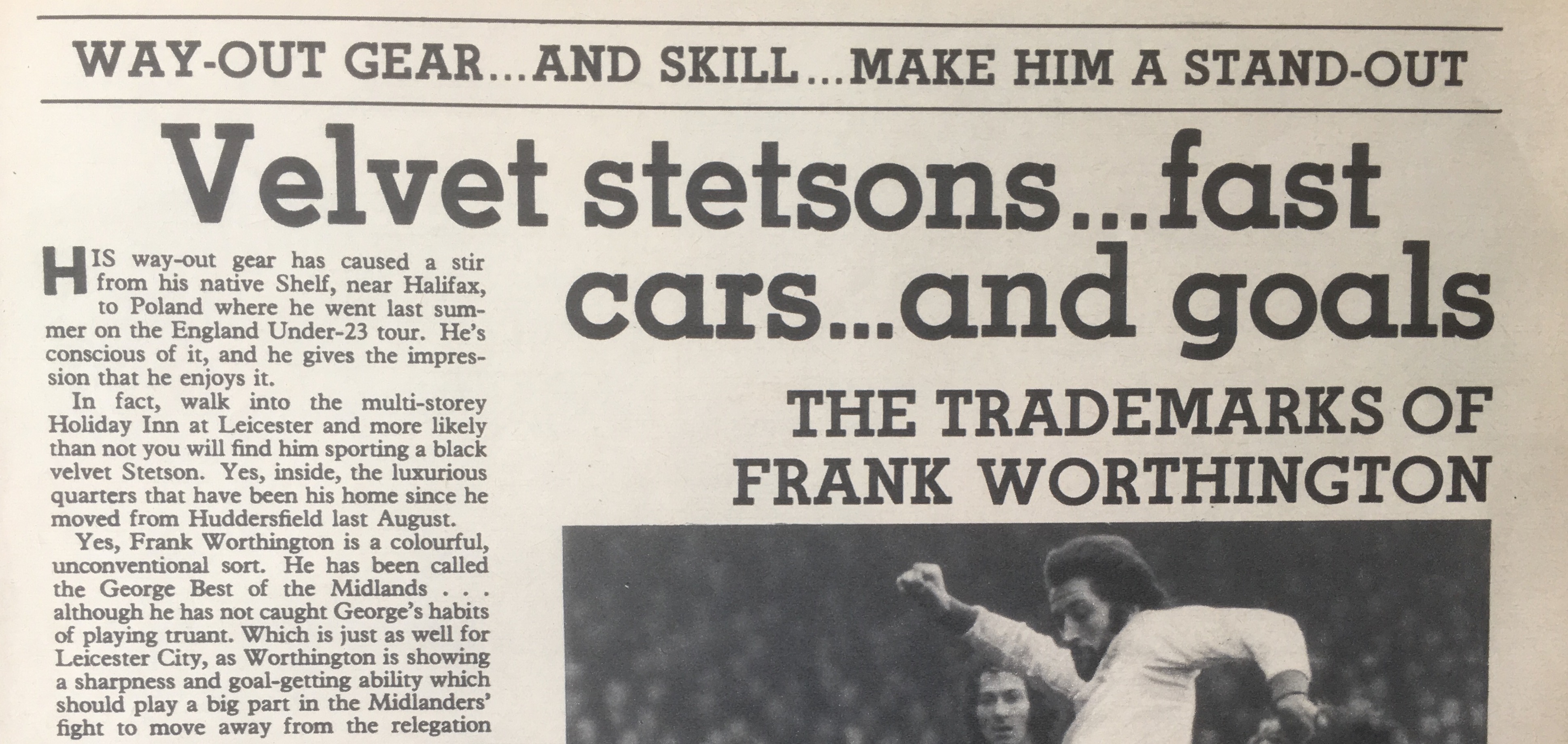
3-fw-albionFRANK Worthington was one of football’s genuine entertainers and it was a privilege to witness his season at The Goldstone between 1984 and 1985.
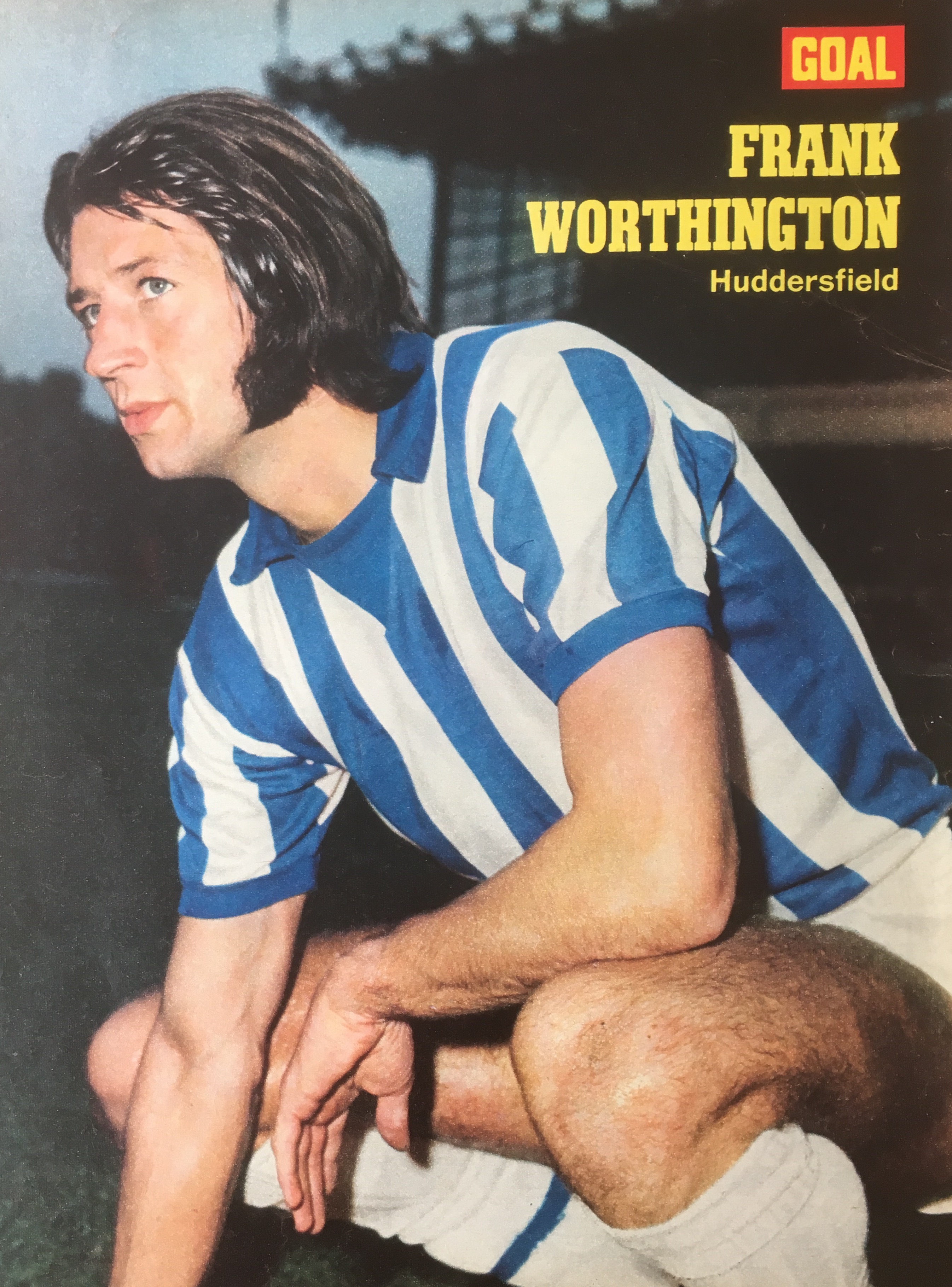
An all-too-brief England career which saw him win eight caps in 1974 was a long way behind him by the time his former Huddersfield Town teammate Chris Cattlin secured his signature for Brighton, but what the legs could no longer do, the brain more than made up for.

He was on the scoresheet in only his second game, a bruising encounter when Notts County were beaten 2-1, even though Albion played the second half with only 10 men – centre backs Eric Young and Jeff Clarke having been hospitalised by clashes with Justin Fashanu.

Worthington went on to make 30 appearances (plus five as sub) scoring eight times in total. Two of the goals came in his penultimate match against Wolverhampton Wanderers, one being a penalty struck so hard that it broke the hand of their ‘keeper Tim Flowers.

In June 2013, in the Huddersfield Examiner, Cattlin told interviewer Doug Thomson: “He did a good job for me. Frank wasn’t only a great player, but a great bloke as well, a dedicated trainer and a great bloke to have around a club.”

Worthington reflected on his time at the club in a matchday programme interview with Spencer Vignes in 2003. “I’d known Chris since my early days at Huddersfield,” he said. “I’d liked him so when he asked whether or not I’d be prepared to come to Brighton, I didn’t really have to think too long about it. They were a good side that hadn’t long been out of the First Division, so it sounded attractive.”

He continued: “We had some good players and certainly had no problems finding the net. I felt as though I was playing OK and the fans seemed to like me. But Chris did have this thing where he would chop and change the team around quite a bit, even if we were winning. He never really seemed sure what his best side was, and I think our form began to suffer because of it.”

Worthington reckoned it led to disharmony in the dressing room, and, for his own part, while he was good friends with Jimmy Case and Hans Kraay, he couldn’t say the same for Chris Hutchings or Kieran O’Regan. Albion finished sixth in the table, three points off automatic promotion and, although he was offered a new one-year contract, he decided to move on to try his hand at management.

So Brighton was only a brief stop-off in a 20-year career which saw Worthington score 236 goals in 757 league games. Add in games he also played in the United States with Philadelphia Fury and Tampa Bay Rowdies, in South Africa, Sweden and in English non-league, and the games total amounts to an amazing 828.

Halifax-born Worthington’s father was a pre-war professional and his two brothers, David and Bob, were also professionals. Unlike his brothers, the hometown club dithered over signing Frank and Huddersfield jumped in and secured his signature.

After manager Ian Greaves selected him for the opening fixture of the 1969-70 season, he clocked up 100 consecutive appearances for the Terriers.

The flamboyant Worthington famously almost joined Liverpool in 1972 but the deal was called off when he failed a medical due to a reported high blood pressure reading.

Liverpool signed John Toshack instead while Worthington went to Leicester City for £85,000.

Having made nearly a quarter of a million pounds from the sale of David Nish to Derby County, Leicester boss Jimmy Bloomfield had a useful kitty which he splashed on Worthington, Dennis Rofe, Keith Weller, Jon Sammels and Alan Birchenall.

Worthington scored on his Leicester debut at Old Trafford and in an article with Goal magazine on 21 October 1972, he said: “It’s different playing for Leicester City compared with Huddersfield. At Huddersfield the emphasis was on hard running and effort – here it is on skill, and there is a hell of a lot of skill in this side.”

In the same publication two years later, he had finished the 1973-74 season with 25 goals to his name and he was full of compliments for Bloomfield.

“Basically I am a player who relies on skill and that fits perfectly into Jim’s plans,” he said. “I always think that teams reflect the style and outlook of their managers. That’s why Leicester’s philosophy is that there is no substitute for skill.”

His time at Leicester lasted five years and spanned more than 200 appearances before he switched to Bolton Wanderers – where one audacious goal he scored against Ipswich remains a YouTube favourite – and then Birmingham City, helping both sides to promotions.

In 1982 he played for Leeds, the following season Sunderland and the next, Southampton, before pitching up at The Goldstone.

Worthington’s first go at management, while continuing to play, came with two years at Tranmere – and his first signing was Albion’s Ian Muir. He told Vignes: “Ian Muir was a fantastic forward with great touch. He did things in training you just wouldn’t believe, yet he wasn’t even making the side at Brighton under Chris.”

Muir became a hero on Wirral, scoring 141 goals as Rovers won promotion twice and won the Associate Members Cup at Wembley in 1991. By then, Worthington was long gone, having moved on to Preston, then Stockport County, and, after a succession of brief stays with various non-league clubs, ended up with hometown club Halifax Town, where he was briefly joined by Case.

Albion’s shirt sponsor during his season with the club was Phoenix Brewery. Quite apt for a player who was famously quoted as saying: “I’ve squandered fortunes on booze, birds and gambling – it’s better than wasting it!”

Tellingly, his autobiography, published in 1995, entitled One Hump or Two, was a classic tell-all romp of a colourful career on and off the pitch.

Worthington died aged 72 on 22 March 2021 and, in a statement, his wife Carol said: “Frank brought joy to so many people throughout his career and in his private life. He will be greatly missed by everyone who loved him so much.”

The great man’s lifestyle spawned many eye-catching headlines over the years and there is no shortage of stories about him to be found on the internet.

Follow the links for just three examples.

https://www.theguardian.com/football/2016/may/06/frank-worthington-denies-being-diagnosed-with-alzheimers-disease

http://www.90min.com/posts/26691-england-s-wasted-talent-1-frank-worthington

http://www-users.york.ac.uk/~sph2/lufc/mag/worthing.htm

1-fw-hudd2-fw-leic4-fw-headline

Pictures from my scrapbook show Worthington in Goal magazine in Huddersfield and Leicester’s colours, in Albion’s Phoenix Brewery-sponsored shirt and a classic headline. Pictures also from the Albion matchday programme.

Tidy full back Stewart Henderson polished Saints diamonds

1 SH monoALBION’S right back when I first started watching them in the late 1960s was someone who would go on to make much more of a mark as a coach.
Gareth Bale, Theo Walcott and Adam Lallana were among the players developed by Stewart Henderson. Wayne Bridge and Chris Baird, too.

That was all to come for Stewart when I first saw him wearing the number 2 shirt in Freddie Goodwin’s Division 3 side.

hendo biog

Henderson, who shares the same June birthday as me, albeit he was born 11 years earlier, was only 5’6″ tall but he had noticeably muscular thighs. Hailing from Bridge of Allan in Scotland, his stature didn’t stop him earning Scottish schoolboy international honours and he was on the winning side in three matches.

The Scots beat Northern Ireland 5-1 at Windsor Park, Belfast – when future Albion teammate John Napier was playing for the home side – Wales at Ninian Park, Cardiff, and England at Ibrox Park where a 30,000 crowd watched.

That recognition followed his success playing for his school team, St Modans High School in Stirling, and Stirlingshire Schoolboys. It eventually took him to England at the age of 17 in 1964 to join Chelsea.

Tommy Docherty was their manager at that time and he obviously wasn’t convinced Henderson was good enough for the First Division, so he dropped down to the Third with Brighton where, for a couple of seasons, he had the unenviable task of trying to oust captain and Northern Irish international Jimmy Magill from the right back slot.


Stew Hendo blue

He made his debut on 3 May 1966 away to Exeter a month before his 19th birthday and didn’t make his home debut until 1 October that year, stepping up when Magill was injured and helping Albion to a 5-2 win over Peterborough.

It wasn’t until March 1968, though, that he eventually cemented his place in the side. But when he did, he became a near-permanent fixture for the next four years. He only scored once in 199 appearances, that coming in a 6-0 drubbing of Oldham Athletic on 24 August 1968.

Stew Hendo PoYIn the 1969-70 campaign, he missed only one game and the supporters chose him as player of the season. He played 36 league games in Pat Saward’s first season in charge and in the 1971-72 promotion campaign was a regular in the line-up right through until the famous televised Aston Villa home game in March 1972 when Saward made two shock changes and left out both Henderson and captain John Napier for the top of the table clash.

It was the beginning of the end for Henderson and he cuts a rather-forlorn looking figure in a picture of the newly-promoted team captured in the Goldstone dressing room after gaining the necessary point against Rochdale, standing fully-clothed alongside his team mates in their kit, taking a sip of champagne.

Saward made him available for transfer at the end of the season and although he stayed with the club, he played only two more league games, and a league cup game, in the following season before being transferred to Reading in June 1973.

Henderson had chalked up 198 league games and 14 cup games during his time with Brighton but the move to Berkshire was by no means a petering out of his career.

I am grateful to the website of the Reading FC Former Players Association (readingformerplayers.co.uk) to discover how, although manager Charlie Hurley signed Stewart initially as a full-back, in 1975 he pushed him into a midfield role with immediate success: Stewart scored twice in the first 17 minutes at Bradford City.

He went on to be an influential member of Reading’s 1976 Fourth Division promotion winning side. In May 1977, he was made club coach and worked closely with manager Maurice Evans helping the club win the 1978/79 Fourth Division Championship.

Amazingly Stewart was recalled to the playing squad at the beginning of the 1979/80 season, at the age of 32, and continued playing intermittently until May 1983 when he played the last of his 186 games for the Royals and became Reading’s first Centre of Excellence director.

Coaching became his new direction and he was at manager Ian Branfoot’s side when Reading beat Luton at Wembley to win the Simod Cup in 1988 (a game incidentally in which former Albion winger Neil Smillie was one of the goalscorers for the Royals and Steve Foster and Danny Wilson were playing for Luton).

Henderson left Elm Park in 1989 to take up the role of youth development officer at Southampton, where his work began helping to produce some of the finest footballing talent in the country.

He was to spend over 20 years at Southampton in various roles working with the youth and academy teams, the reserve side and even had a short spell as first team manager.

It’s worth quoting an article from the Mirror in October 2012, when Matt Law reckoned Southampton owed a £55million debt of gratitude to Malcolm Elias, Steve Wigley, Huw Jennings and Stewart ­Henderson who spotted and coached the incredible Southampton Fame Academy, which through transfer fees effectively saved the club from extinction.

Gareth Bale, Theo Walcott, Alex Oxlade-Chamberlain, Wayne Bridge, Kenwyne Jones, Adam Lallana, James ­Ward-Prowse and Luke Shaw were all named as coming under the influence of the quartet who, after being released by Southampton moved on together to Fulham.

Henderson was a guest at an Albion raceday in 2006 and met up with former teammate Ian Goodwin