Cucurella a Euros winner despite the boos backdrop 

MARC CUCURELLA has got used to going from hero to zero in the eyes of fickle football fans.

A revelation in his one and only season playing for Brighton, he scored a stunning goal in a 4-0 thrashing of Manchester United and was crowned both Players’ Player and Player of the Season.

But he pushed for a transfer only one year into a five-year contract and, although he didn’t get his hoped-for move to Manchester City, joined Chelsea for £62m.

While his first few months at Stamford Bridge were tough on and off the pitch, he finished the season as a regular in Mauricio Pochettino’s side and then went on to bigger and better things for his country.

He became a cult hero for his impressive performances at left-back during Spain’s winning run to claim the European Championship in July.

Euro winners: Cucurella with Nico Williams

Capping an excellent tournament by supplying the inch-perfect pass for Mikel Oyarzabal’s late winner, Cucurella was justified in having a dig at pundit Gary Neville who’d previously said the defender was “probably one of the reasons why Spain could not go all the way” in the tournament.

“We went all the way, Gary. Thanks for your support,” was Cucurella’s social media retort after the 2-1 win over England rounded off a tournament that he might not have been involved in if Valencia’s Jose Gaya and Barcelona’s Alejandro Balde hadn’t been injured.

The left-back with the “massive” hair also let his feet do the talking in response to German fans who booed his every touch of the ball in the semi-final and final because they reckoned he was guilty of a handball in the penalty area against the host nation but a penalty wasn’t given.

“I did not care too much, but at the same time, it felt a bit sad that some people came to that game just to boo a single player,” Cucurella told The Athletic. “Some people wasted tickets that could have gone to fans who would have really enjoyed the match.”

But, he pointed out, it wasn’t a new experience because Brighton fans, angered by the manner of his big money departure from the club after only one season, reacted similarly when he returned to the Amex playing for Chelsea.

“It was another night when the boos were really loud every time I touched the ball, so I got used to it,” he said. “The first time I went through this… I won’t say it’s an unbearable feeling but it’s unpleasant. Now I’m more used to it.”

Some players move on stylishly, others go about it in what is perceived to be the wrong way – thus incurring the opprobrium of supporters who remain loyal to the club.

A sizeable enough contingent of Albion fans were aggrieved by the manner of Cucurella’s departure from the club to vent spleen whenever he touched the ball as a Chelsea player back at the Amex.

It was a toss-up between Cucurella and Graham Potter as to who was the bigger pantomime villain when Chelsea were thumped 4-1 at Falmer in October 2022. “The Spaniard was booed and jeered relentlessly for over an hour on his first game at Brighton since his transfer,” The Athletic noted.

The online sports news outlet continued: “According to Whoscored, Cucurella’s defensive output included no tackles, no interceptions and just one clearance.”

They noted it was the fourth time in five starts that Cucurella had been taken off early, and said: “This change would have hurt the most. The taunts grew louder as he made his way off the pitch and the look on his face spoke volumes.”

Things might not have been going well for him at the time, but Potter was not unduly concerned and said: “He’s a resilient character, he’s a really good person. Sometimes when you move clubs it goes really well, and sometimes it can be a little bit of an up-and-down period. Marc’s a little bit up and down but he’s a top player and he will show his quality.”

Cucurella was an unused sub when Albion clinched the double over the Londoners that season with a 2-1 win at Stamford Bridge. But the next time he faced his old teammates, he demonstrated a level of commitment that in some quarters earned him the man of the match accolade.

When Potter’s successor Mauricio Pochettino selected him at right-back in the Carabao Cup against Brighton in September 2023, previously critical Chelsea supporters couldn’t believe what they saw as the home side edged the match 1-0. One said: “Pocketed Mitoma and Joao Pedro . What a shift for him.”

Agreeing he was ‘man of the match’, another said: “Cucurella was absolutely brilliant in that second half, playing that well at right-back was not something that I expected, fair play to him, maybe he should be given more opportunities.”

Arguably, he answered Brighton supporters’ criticism even more effectively – in a similar style to what he did in the Euros final v England – on 15 May 2024 at the Amex when his pinpoint cross in the 34th minute was comprehensively buried in the back of Albion’s net by Cole Palmer’s head.

But let’s remember a much happier time, when the Spaniard was the toast of the Albion faithful with a quite magnificent contribution to that 4-0 thumping of Manchester United.

Muhammad Butt on squawka.com positively purred about Cucurella’s performance declaring his man of the match accolade as “a richly deserved reward for a player who could truly ascend to any height in the world game”.

The writer’s colourful report observed:“What Cucurella did to poor Diogo Dalot all afternoon recalled The Avengers when Hulk whipped Loki around like a caveman trying to dry a wet sock on some rocks.

“Cucurella has the instantly iconic look of a comic book hero, a wiry frame with a face that is all prominent eyebrows and colossal curly hair giving him an instantly iconic silhouette.

“And he plays with the kind of ceaseless energy that one would attribute to those spandex-adorned heroes for whom stamina never seems to be an issue.”

Warming to his theme, Butt continued: “Cucurella grabbed the game by the scruff of the neck and was the dominant force on the pitch. Even when he played no part in the goals, the overall pressure that was weighing on United and keeping them pinned back in their own half was born of the Catalan’s drive and determination.
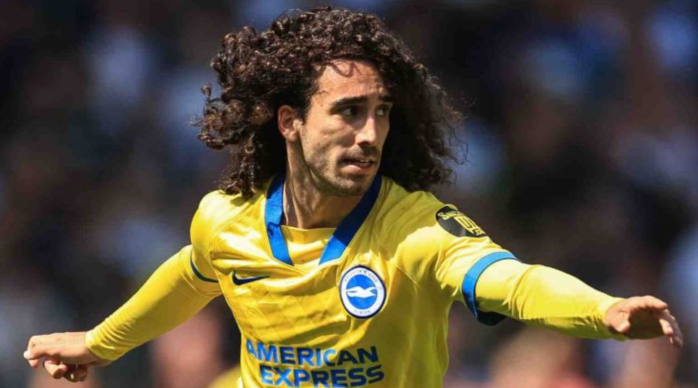
‘Such was Cucurella’s power against United that when he scored Brighton’s second goal, arriving late in the box like some left-sided Frank Lampard to lash the ball home violently at the near-post leaving David de Gea in the early stages of a Bee Gees tribute dance, it wasn’t even surprising. It made perfect sense, as though he had been doing it all season when, in fact, it was his first goal of the campaign.”

Sadly for Brighton fans, that showing seemed to be like an audition for a bigger and better stage and he had only two more matches in Albion’s colours.

Born in the Catalan village of Allela on 22 July 1998, he played futsal with his local club before linking up with the junior sides of Espanyol, where he was made captain. From there, at the age of 14, he joined Catalan giants Barcelona in 201

A rare appearance for Barcelona

“Barcelona were always my team,” he told the Albion matchday programme. “I liked the style of play and the big players the club always attracted.”

He went on: “For me to join such a special club, at such a special time in its history, was a proud moment for my family.”

He made his debut for the club’s B team at the age of 18 but also had the chance to train with the stars of the first team.

“While I was still in the academy, I would sometimes train with Messi or Neymar, which was really exciting,” he said. “I’d train with Busquets, Jordi Alba, sometimes Suarez, and it was scary the first time I stepped up.

“I was very nervous, training alongside players I’d only seen on TV or on the PlayStation, but these are the moments you remember for the rest of your life.”

He only made one brief substitute appearance for the Barcelona first team, going on for Lucas Digne in a 3-0 Copa del Rey win at Real Murcia in October 2017, and he said: “It was a very nice moment for me but it was a shame I never got to play for the team at Camp Nou.”

Cucurella got to play in La Liga on loan at Eibar (in 2018-19) and Getafe (in 2019-2020) before moving permanently to Getafe for the 2020-21 season.

When Albion signed him, fellow former Barca B graduate and ex-Albion midfielder Andrea Orlandi, now a TV pundit, told the Albion matchday programme: “Marc is a super-energetic player whose main assets are his energy, attitude and intensity.

“He was in the top three in every physical study in La Liga for the last three seasons and can’t play without giving it 100 per cent. He has the perfect attributes to be a success in the Premier League.”

Perhaps it should be no surprise that he shone for Spain at the 2024 Euros because he had been selected by his country at almost every age group level and won a silver medal as part of the under-23 side at the 2020 Olympic Games.

His first senior appearance was in a friendly against Lithuania in June 2021 when he captained the side to a 4-0 win. A second cap followed in a 3-3 draw with Brazil at the Bernabeu in Madrid in March 2024. The run through to the final took his caps tally to 10.

In an in-depth interview with Pol Ballus for The Athletic in July 2024, Cucurella opened up on the turbulence he had suffered after making the move to Chelsea. “Until the summer of 2022, my football career had been great: a constant progression, always upwards with no setbacks. Then I arrived at a club where the expectations were so, so high.

“Until then, I had played at clubs where every victory felt really special, where every point is celebrated. Then you go to Chelsea, where you win a game because that’s what you have to do. There is no time to chill or enjoy.”

Not only was managerial change disruptive, things didn’t go well for him off the field. “I spent the first two months living in a hotel with my family, then soon after we found a place to live we had thieves breaking into our home. After this, I spent two days hospitalised for a virus. I lost a lot of weight and had to start from scratch to get in shape again. It wasn’t easy to come back. The team couldn’t find their way on the pitch, either.”

Cucurella said fans had expectations of him because of the size of the fee Chelsea played Brighton but he pointed out: “People expect that, with certain price tags, you need to be a machine. Sometimes it’s difficult to understand that we are normal people who have our own problems off the pitch. We have worse and better phases in our lives.”

He worked with a psychologist to try to help him through his struggles, admitting: “Confidence is the most important thing. You miss it when you struggle, but it flows when you thrive. I’ve worked a lot on this, to stabilise those moments.”

Certain he could improve, he knuckled down in training and eventually seized his chance when it was given.

Towards the end of the 2023-24 season, Pochettino tinkered with Chelsea’s formation and successfully deployed Cucurella in a midfield role, drawing praise from observers such as Nick Purewal in The Standard, who said: “Cucurella’s ability in possession, to act as an auxiliary pivot and progress the ball has transformed Chelsea.”

The player himself had some fun on social media in the summer (right) when, with a nod to the chant Brighton fans conjured up during his time at the Amex, he filmed himself with a bottle of Estrella and sang the song… “he drinks Estrella, eats paella…” but his normally “massive” hair was neatly matted down!
Former Gunner Raphael Meade a damp squib for the Seagulls

Meade best

ISLINGTON-born Raphael Meade joined Arsenal as a schoolboy and made it through the ranks to play more than 50 times for the Gunners.

A rather eclectic career saw him play in Portugal, Spain, Scotland, Denmark, Hong Kong and back in England.

Brighton boss Barry Lloyd had something of a penchant for picking up players from these shores who’d rather lost their way playing abroad and, while forwards Mike Small and John Byrne would count as great successes of that genre, Meade was largely a disappointment.

He played 40 times and scored 12 goals in the 1991-92 season, but the Albion were relegated to the third tier, so it was memorable for all the wrong reasons.

Born on 22 November 1962, Meade was on the Gunners’ books from June 1977 to the summer of 1985.

The superb thegoldstonewrap.com unearthed the Arsenal annual for 1981 in its research; it said of the young Meade: “He’s got a hell of a lot of pace and is fantastically brave in the box. He’s got all the makings of a top player. However, he’s another one who has got to work on his control like Brian McDermott with tighter controls and lay-offs. But with his type of pace he will always be a threat.”

The reality was that with the likes of initially Alan Sunderland and John Hawley ahead of him in the pecking order, then Tony Woodcock and Lee Chapman, followed by the arrival of Charlie Nicholas and former Ipswich striker Paul Mariner, his first team chances at Highbury were restricted.

While he was prolific in the Reserves (24 goals in 27 league games in 1983-84), his first team appearances over four years were somewhat sporadic.

Manager Terry Neill handed him his debut in a 3-0 UEFA Cup away win against Panathinaikos on 16 September 1981 and he scored a spectacular goal with his very first kick! His league debut came a month later – and he scored again, netting the only goal in a 1-0 win at home to Manchester City. The 1981-82 season saw the majority of his first team involvement: he played a total of 22 games, scoring five times.

A cartilage injury sidelined him for a large part of the 1982-83 season but when he did return in February 1983 he scored twice against Brighton in a 3-1 win.

CN + RM braces v SpursThe following season, Meade scored a hat-trick in the 3-1 win over Watford, which began Don Howe’s tenure as Arsenal manager, and he also earned a special place in Gunners’ fans hearts when scoring twice (pictured celebrating above with Charlie Nicholas, who also got two) in Arsenal’s 4-2 victory over arch-rivals Spurs on Boxing Day 1983.

Unfortunately, they were sporadic highlights and, in the summer of 1985, he was sold to Sporting Lisbon.

“Sporting Lisbon provided me with a great experience. I really enjoyed myself because the climate was great and, as well as finishing third in the league one season, we also reached the quarter finals of the UEFA Cup,” Meade said in a Shoot/Goal article.

He said it was the arrival of former Spurs boss Keith Burkinshaw that precipitated the end of his time in Portugal because he wanted him to play in an unfamiliar right midfield role.

Thus he was loaned to Spanish side Real Betis towards the end of his three-year contract, and, on his return, was transferred to Dundee United where he made 16 starts, plus six substitute appearances, scoring seven goals.

However, United boss Jim McLean made public his dissatisfaction with the striker and questioned his fitness. Meade hit back saying he was fit but being played out of position on the wing.

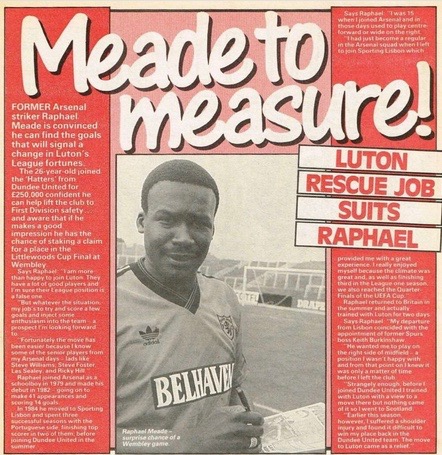
Subsequently a shoulder injury saw him sidelined and unable to regain his place and he joined a struggling Luton Town side for a £250,000 fee.

luton moveBut after only four games for the Hatters he was on his way again, this time to Odense BK in Denmark.
During two years on their books, he had loan spells back in the UK, playing once for Ipswich Town and five times for Plymouth Argyle.

As the 1991-92 season got under way, cash-strapped Brighton were forced to sell the previous season’s successful strike duo of Small (to West Ham) and Byrne (to Sunderland).

Byrne’s departure didn’t happen until October, and it was while playing alongside the popular Republic of Ireland international that Meade scored his first goal for the Seagulls, in a 3-1 home win over Port Vale.

He had found himself in the right place at the right time in only the fourth game of the season when an injury sidelined Bryan Wade, who had started the first three games alongside Byrne. smart Meade

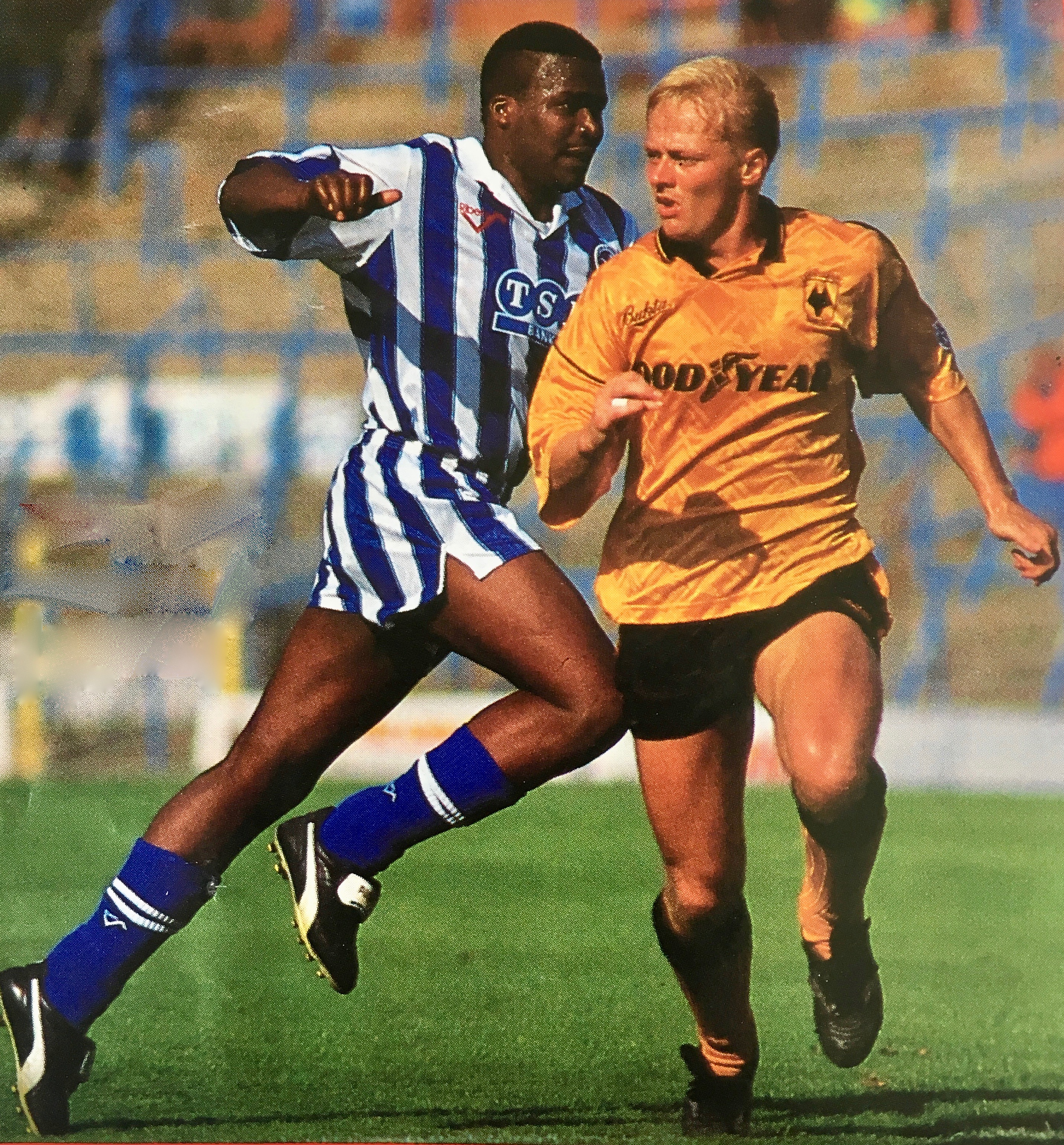
Lloyd had watched the former Arsenal striker score in a 2-0 win for the reserves against Fulham and pitched him in against Wolves – a 3-3 thriller in which Mark Barham, Gary O’Reilly and John Robinson netted for the Albion.

“Ideally, I needed one or two games to get match fit but it was great to get the chance in the first team and I wasn’t going to waste it,” said Meade.

Meade in action with another former Gunner, and ex-Albion defender, Steve Gatting (in Charlton’s colours), and a man of the match award for a brace against Grimsby Town.

After Byrne’s departure to the north east, there was seldom a regular strike partner for Meade. The busy and bustling Mark Gall, signed from non-league Maidstone United for £45,000, managed 14 goals but was some way short of Byrne or Small’s quality. And another of Lloyd’s overseas ‘finds’- Mark Farrington from Feyenoord – was an almighty flop.

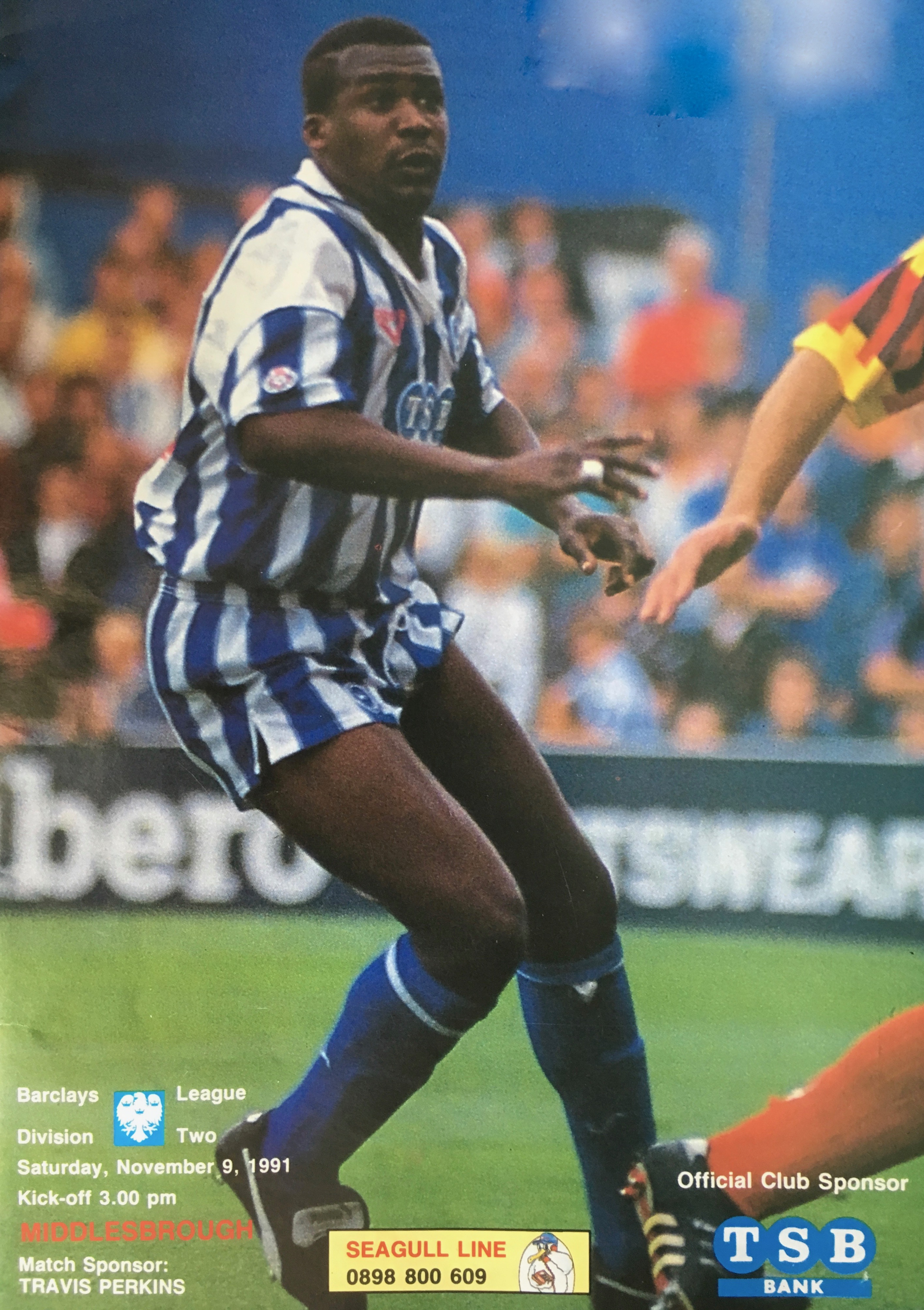
Meade cover boy

Meade popped up with the occasional goal and one of those rare glimmers of light in an otherwise dark season came in a game I went to see at Vicarage Road on 31 March 1992.

Although Albion were ultimately headed back to Division 3, a brief respite from that tumble came against the Hornets courtesy of a howler by David ‘Calamity’ James in their goal. James came to the edge of his area to collect a routine-looking through ball, spilled it rather than gathering it cleanly and Meade was on hand to pick up the loose ball, round the stranded ‘keeper and slot what turned out to be the only goal of the game.

Meade scored twice more before the season’s end but Albion lost four of the final six games and were relegated along with Port Vale and Plymouth. Meade elected to leave the club and head for Hong Kong.

After a season with Sea Bee, he returned to England and rejoined Brighton but only featured in three games. He moved on to Crawley Town in 1995-96, where he ended his playing days.

Pictures from various sources including the matchday programme, Shoot/Goal, and online.

World Cup legend Armstrong too often warmed Albion bench

IMG_3807

IN THE SPACE of 10 weeks, Gerry Armstrong went from 71st minute substitute for Northern Ireland against Brazil at the 1986 World Cup in front of 51,000 in the Estadio Jalisco, Guadalajara, Mexico, to centre forward for Brighton & Hove Albion in front of 13,723 at the Goldstone Ground in a season-opening 0-0 draw against Portsmouth.

That 3-0 defeat to the mighty Brazilians signalled the end of an international career in which Armstrong had written his name in Northern Irish football history at the 1982 World Cup in Spain four years earlier. He had scored 12 goals in 63 appearances for his country but none as important as the one which beat hosts Spain to send the Irish through to the quarter-finals, which I shall come on to.

Screenshot

Four years later, while away with Ireland in Mexico, former Spurs striker Armstrong took a call at the team’s hotel from someone else who had made his name with the North London club – Alan Mullery – who had recently been restored to the managerial chair at Brighton.

“Alan knew I was a free agent and I promised to talk things over with him when I got back from Mexico,” Armstrong said in a matchday programme article. “I was impressed by the manager’s ideas for the future and Brighton appealed to me because I have always liked the club,” he said.

“I always got the impression that there is a good, family atmosphere here and I liked that.

“In many ways, Brighton reminds me of Watford. I had three very happy years there and I’m looking forward to enjoying myself just as much here at Brighton.”

Born in Belfast on 23 May 1954, Armstrong grew up in the Falls Road area and initially played Gaelic football and could have made that his chosen sport. But while he was banned from playing, he took up soccer with junior Irish clubs St Paul’s Swifts and Cromac Albion before beginning a three-year spell playing semi-professionally with Bangor between 1972 and 1975.

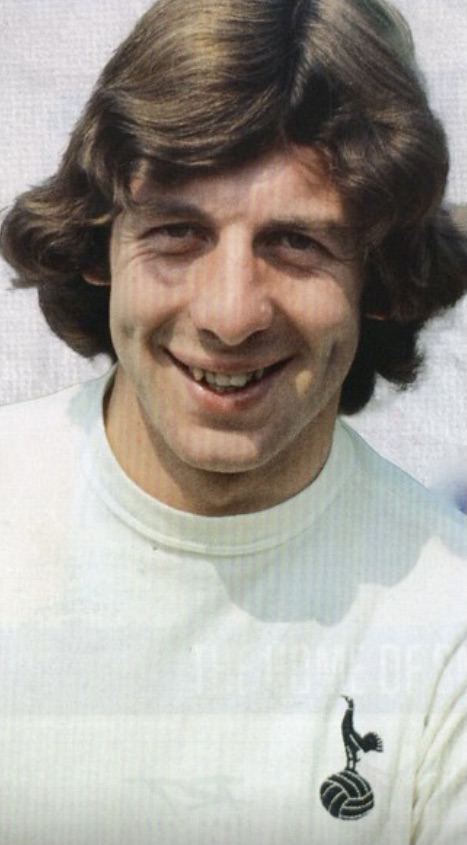
Spurs manager Terry Neill had family in Bangor and Tottenham paid a £25,000 fee for Armstrong’s services in November 1975. He made his Spurs debut in a 3-1 defeat at Ipswich Town on 21 August 1976. The season ended in relegation for the North Londoners but the young Armstrong was trying to make his way.GA Spurs

He said: “I was basically big, strong and courageous but that wasn’t enough alone so Spurs made me skilful as well.

“I set myself the task of gradually playing more first team games each season and managed to achieve it.”

After scoring 16 goals in 98 league and cup games for Spurs, Armstrong was sold to Watford for £250,000 in November 1980.

When the Hornets made it to the top division for the first time in their history, Armstrong scored their first goal at that level, against Everton, and they finished the season as runners up.

“Graham Taylor influenced me more than anybody,” he said. “My time at Spurs was going stale because they were using me in all sorts of different positions but, at Vicarage Road, Graham taught me about forward play and then gave me the chance to repay him.”

Nevertheless, it was breaking through at Spurs that helped Armstrong onto the international stage. He made his debut for Northern Ireland playing up front with George Best in a 5-0 defeat to West Germany in Cologne in April 1977. And in November the same year he scored his first goals for his country, netting twice in a 3-0 win against Iceland in Belfast.

His stand-out moment in football which fans still talk about came when Northern Ireland were minnows at the 1982 World Cup in Spain. In front of a crowd of 49,562 – mostly Spanish – packed into Valencia’s Estadio Luis Casanova, on 25 June 1982, Ireland beat the hosts 1-0 and Armstrong fired home the only goal of the game in the 47th minute.

“I cracked it in between a couple of defenders, but couldn’t really believe it because there was this deathly hush. Fifty-five thousand people (a bit of Irish overstatement) all there to see Spain, and we ruined the party!”

He added: “It was a very satisfying one to get for the team, because it was a great win for us. “The odds were against us because there was a huge crowd in the stadium and virtually all of them were backing Spain. Nobody really gave us a chance, but it was a great team performance.

Armstrong Spain

“All the players worked hard for each other and that game summed up the excellent team spirit I have enjoyed with the national side over the years.”

Armstrong also scored Ireland’s only goal in their 4-1 quarter-final defeat to France.

The Spanish climate obviously agreed with Armstrong because in the summer of 1983, having scored 12 goals in 76 league games for Watford, Real Mallorca signed him for £200,000. Although he got stick from certain sections of Spanish supporters who remembered the goal he scored against them, he spent two years with Real Mallorca scoring 13 times in 55 league games.

On his return to the UK in August 1985, he initially signed for West Brom on a free transfer but struggled with travelling to and from London to train and play, didn’t see eye to eye with manager Ron Saunders, and picked up some injuries. He spent the second half of the season at Chesterfield, where former Spurs teammate John Duncan was boss, so he could get some game time to put him in contention to be selected by Northern Ireland for the upcoming World Cup.

irish news gerry arm

A free agent on his return, he joined Mullery’s Brighton having heard good things about the former Spurs captain from his Irish international colleague Pat Jennings, who’d played in the same Tottenham team as Mullery. However, it was 17 games before Armstrong managed to get on the scoresheet – in a 3-1 defeat at Leeds – although he did score again in the very next game, as Shrewsbury were beaten 3-0 at the Goldstone.

When Mullery’s second spell as manager ended rather abruptly, in January 1987, Armstrong was loaned to Millwall. New manager Barry Lloyd did restore him to the Albion line-up for the final eight games of the season, but the side finished in bottom place.

Back in Division 3, Armstrong was transfer listed along with Steve Gatting and Chris Hutchings as Lloyd was forced to shuffle the pack. He stayed with the club, but only got one full game, in a league cup tie, all season: he came off the bench 11 times and was a non-playing sub on 14 other occasions.

He was suitably philosophical about his involvement from the bench, however, and said in another matchday programme interview: “Over the years I’ve gained a bit of a reputation for grabbing goals when it matters most, and I figure that if I only get on for the last 20 minutes then there’s even more reason to take the game by the throat and get stuck in.”

In the 1988-89 season, Armstrong managed four starts but was once more on the bench more often than not and eventually was appointed reserve team player-coach.

But his time with the club ended ignominiously. In a Sussex Senior Cup tie at Southwick in January 1989, following the first ever red card of his career, as he walked off, he took exception to a comment from a supporter, jumped into the crowd and headbutted the person concerned.

The incident is referred to amongst the annals of assaults by players on fans. Armstrong left the club a fortnight after the altercation but the matter ended up in court and the footballer received a conditional discharge.

His final games as a player were at Glenavon back in Ireland after he had spent some time as a player-coach at Crawley Town, who were in the Beazer Homes League at the time.

In November 1991, he became manager of Worthing and led them to a promotion before being appointed assistant manager of Northern Ireland by his former teammate Bryan Hamilton.

He continued to live in Hove, though, and worked as a cable advisor for Nynex Communications. He even carried on playing football for Sussex Sunday League side James Lytle.

Although he left the national assistant role in 1996, he reprised it under Lawrie Sanchez between 2004 and 2006. Then, in 2011, the Irish FA recruited him as an elite player mentor – in essence to try to persuade young Catholic Northern Irishmen considering playing for the Republic of Ireland (a choice made by Shane Duffy, for example) to stick with the country of their birth.

Throughout all of this time, Armstrong has also forged a successful media career and is probably best known for his work with Sky Sports coverage of La Liga.

In 2015, the Belfast Telegraph did an interview with Armstrong and his wife Debbie in which they spoke about running a restaurant in Majorca, and his involvement as part-owner of a football club in Portugal.

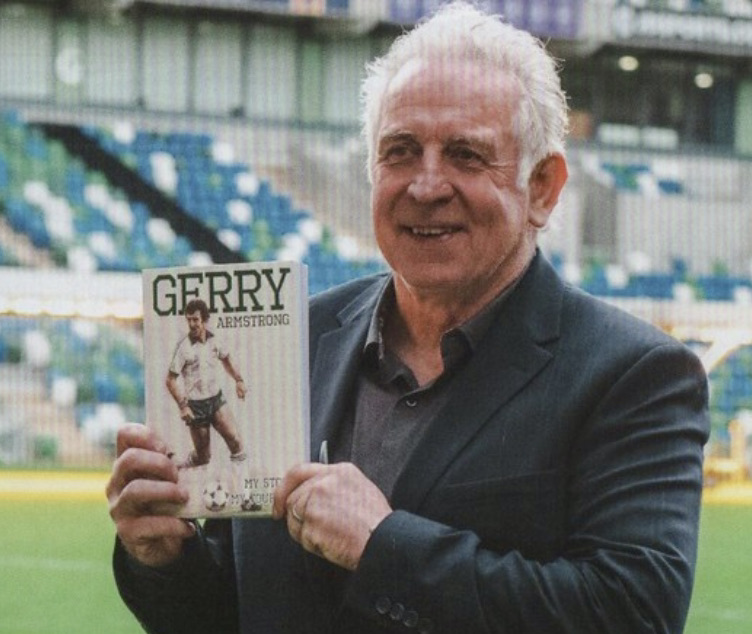
The player’s autobiography, Gerry Armstrong: My Story, My Journey, written in conjunction with Dave Bowler, was published in November 2021 by Curtis Sport.Armstrong autobiog

Pictures from the Albion matchday programme and in the international shirt from the Irish News.