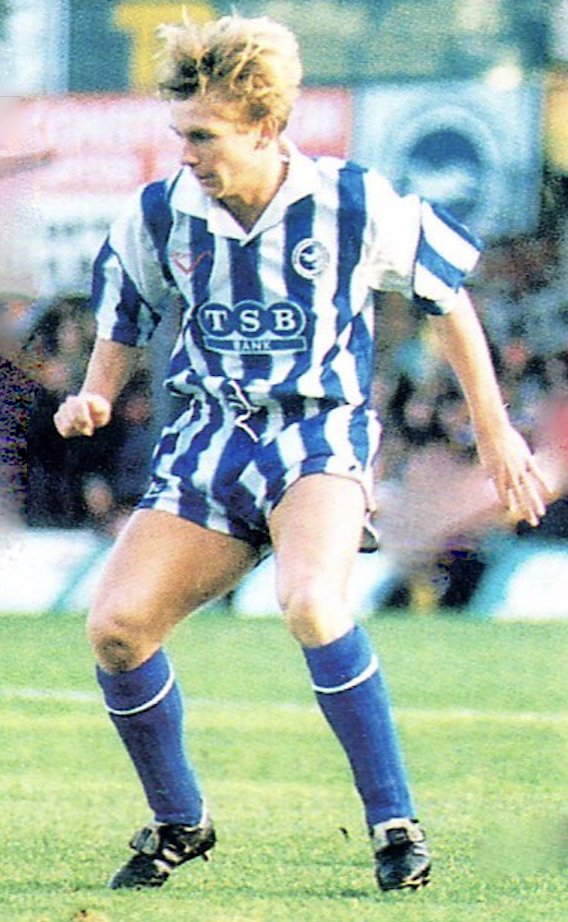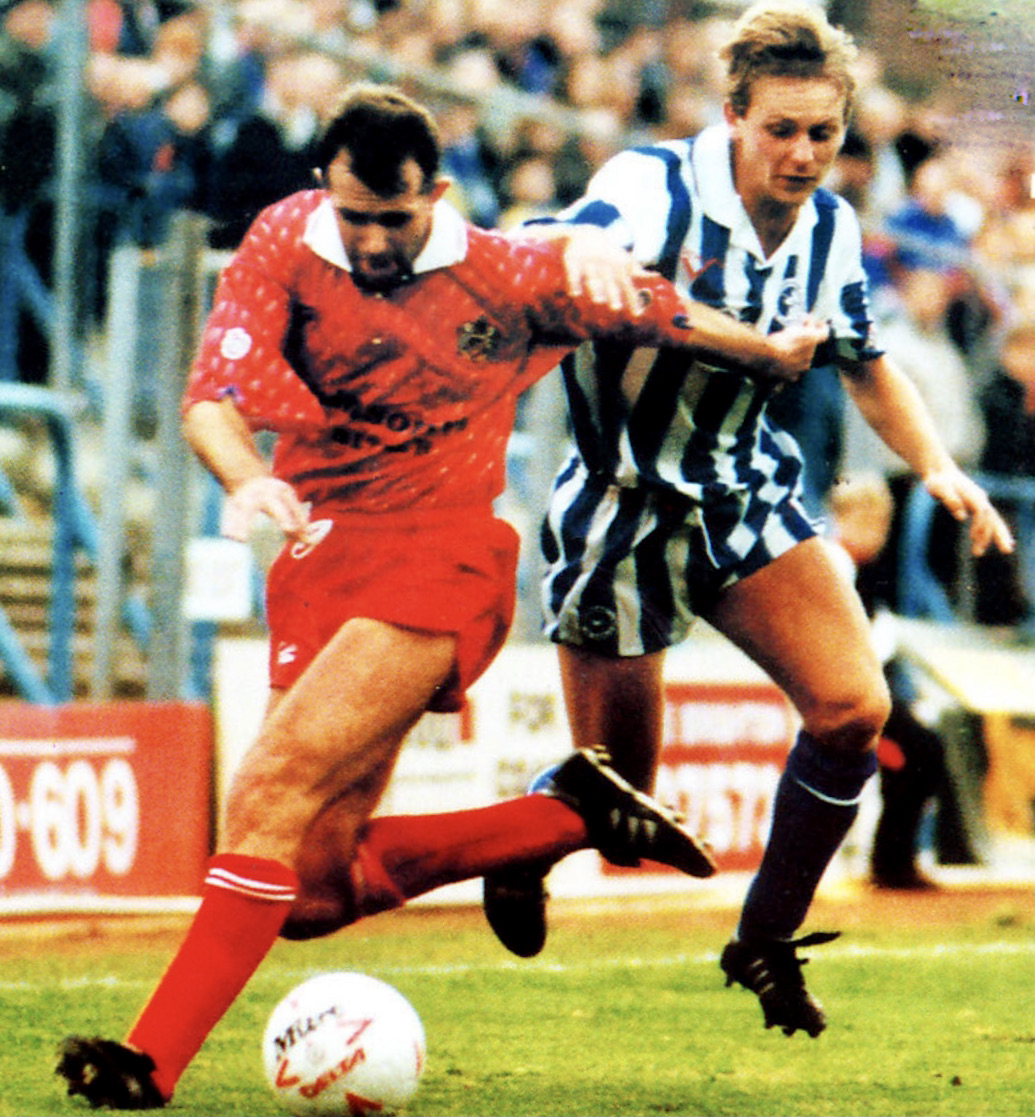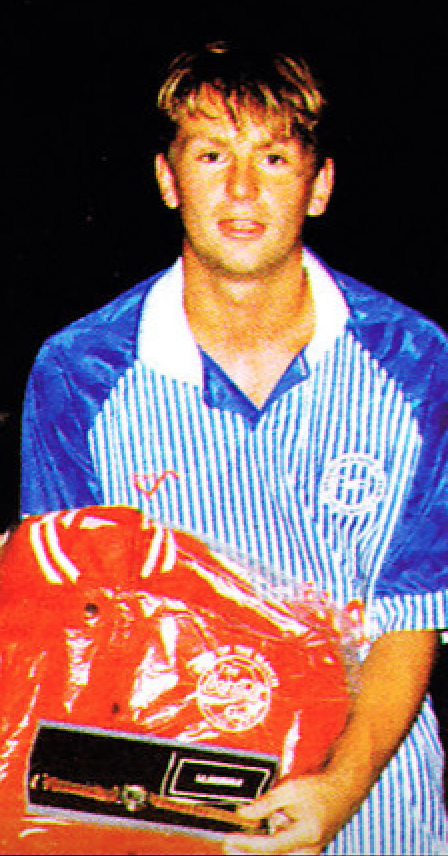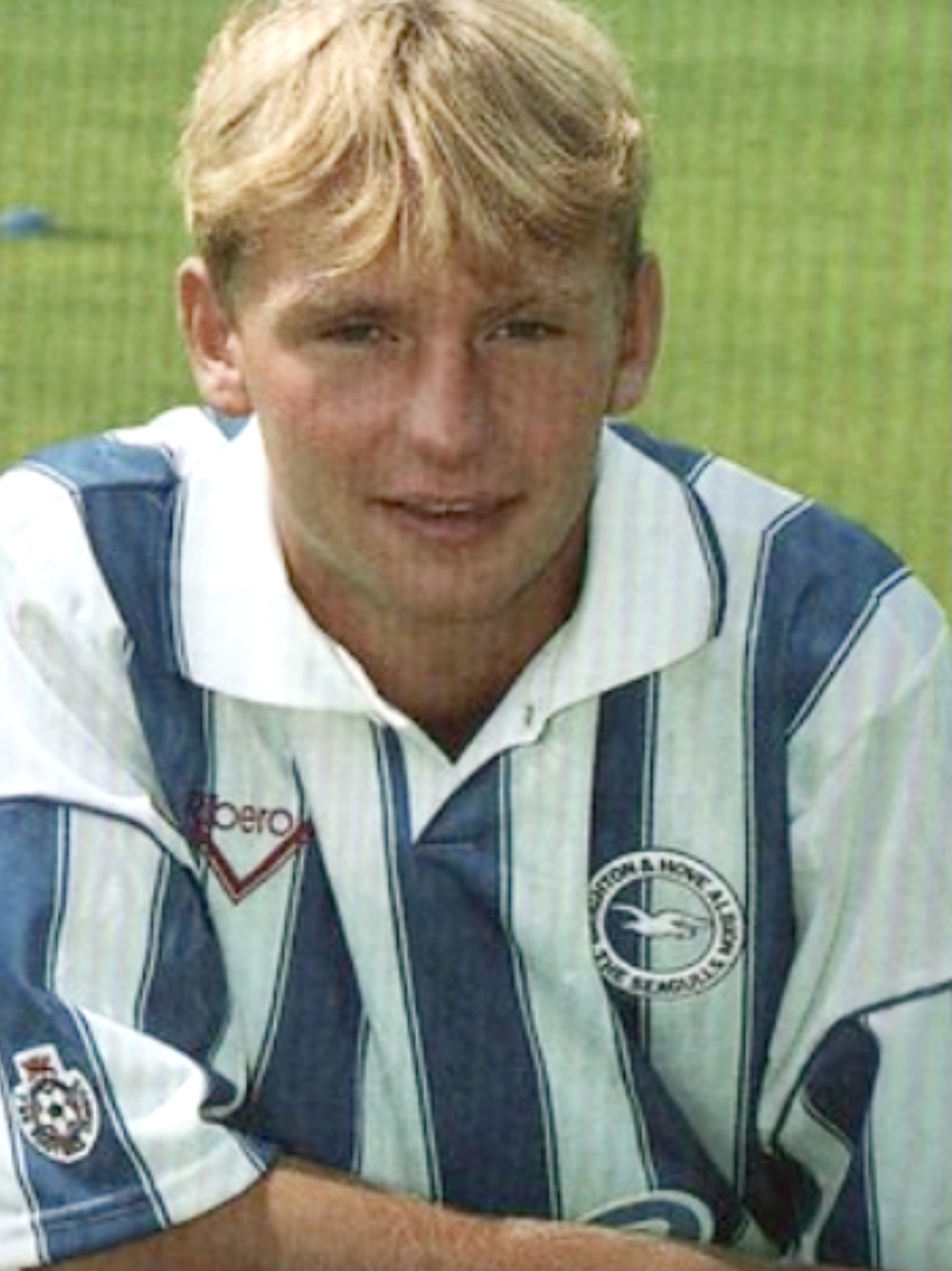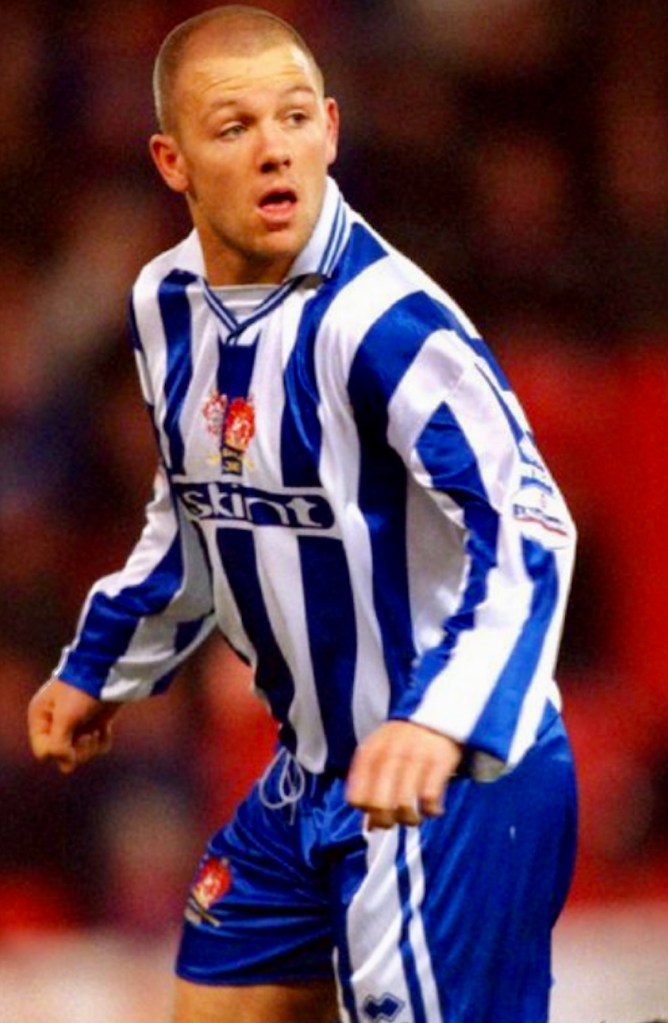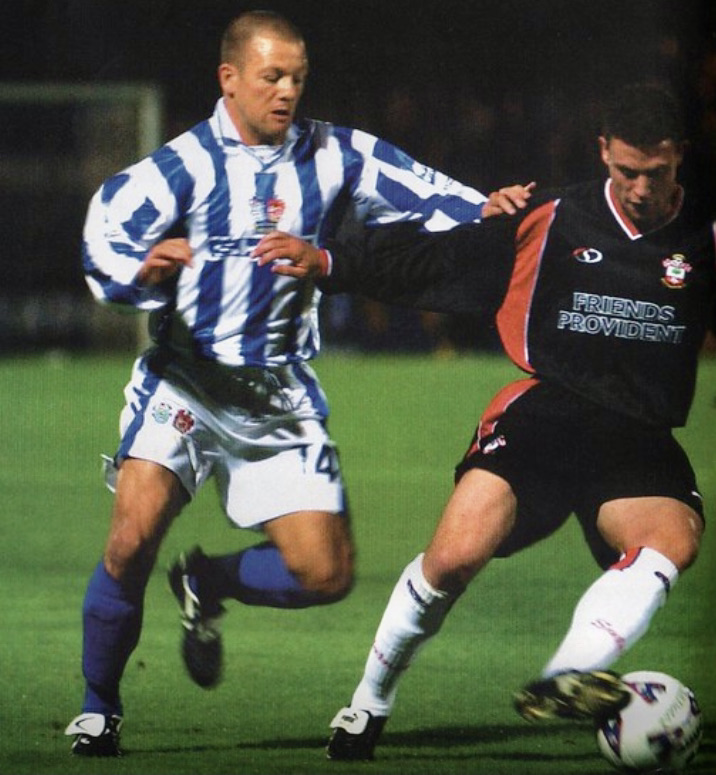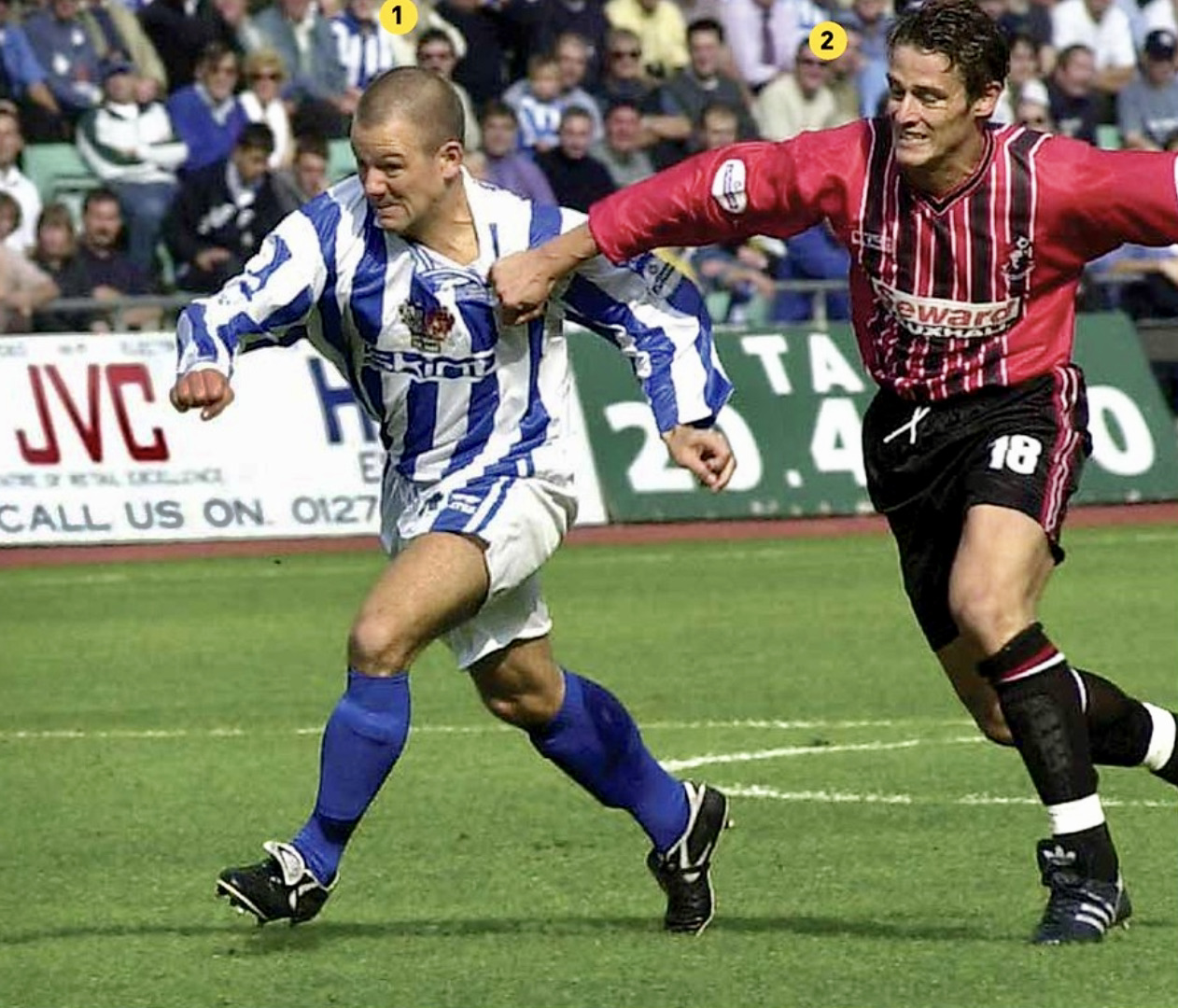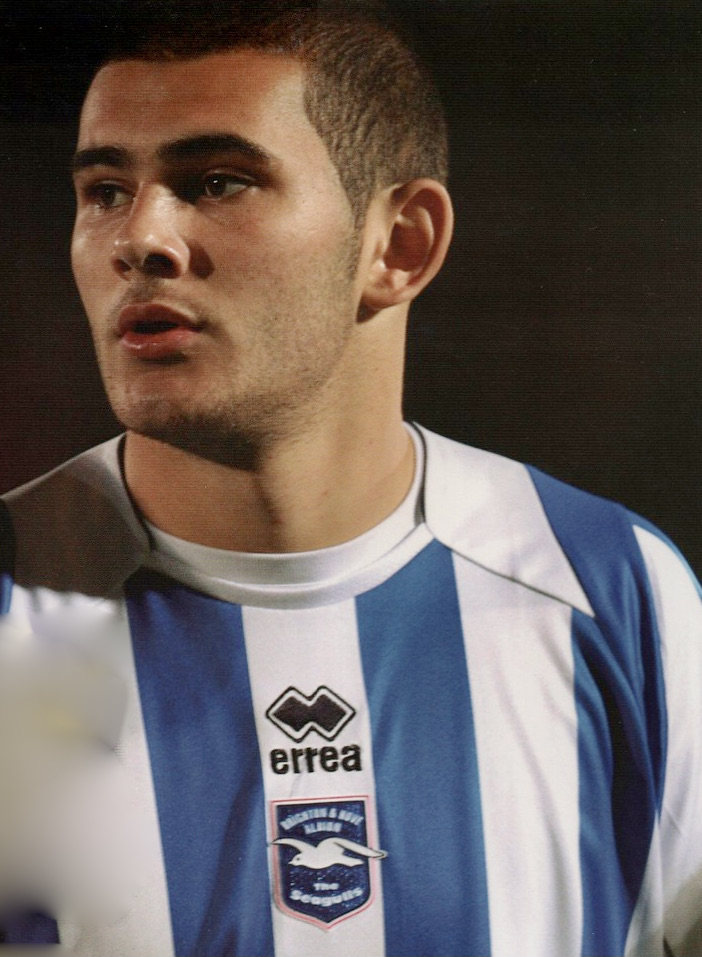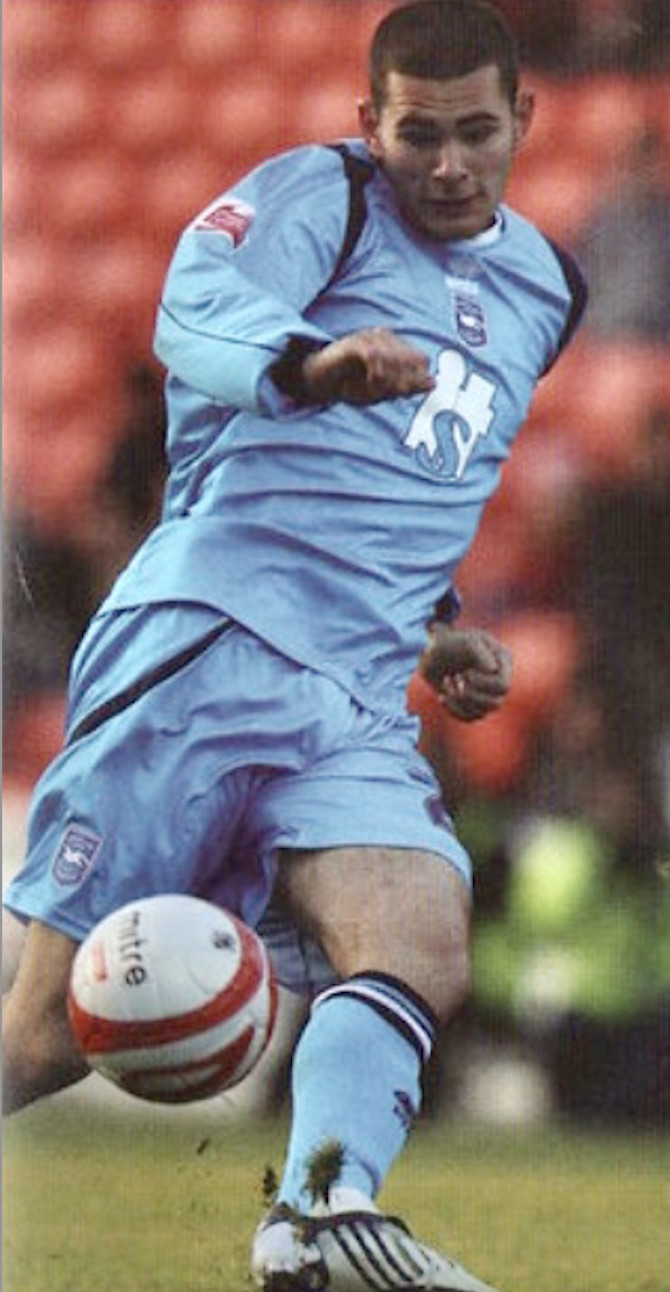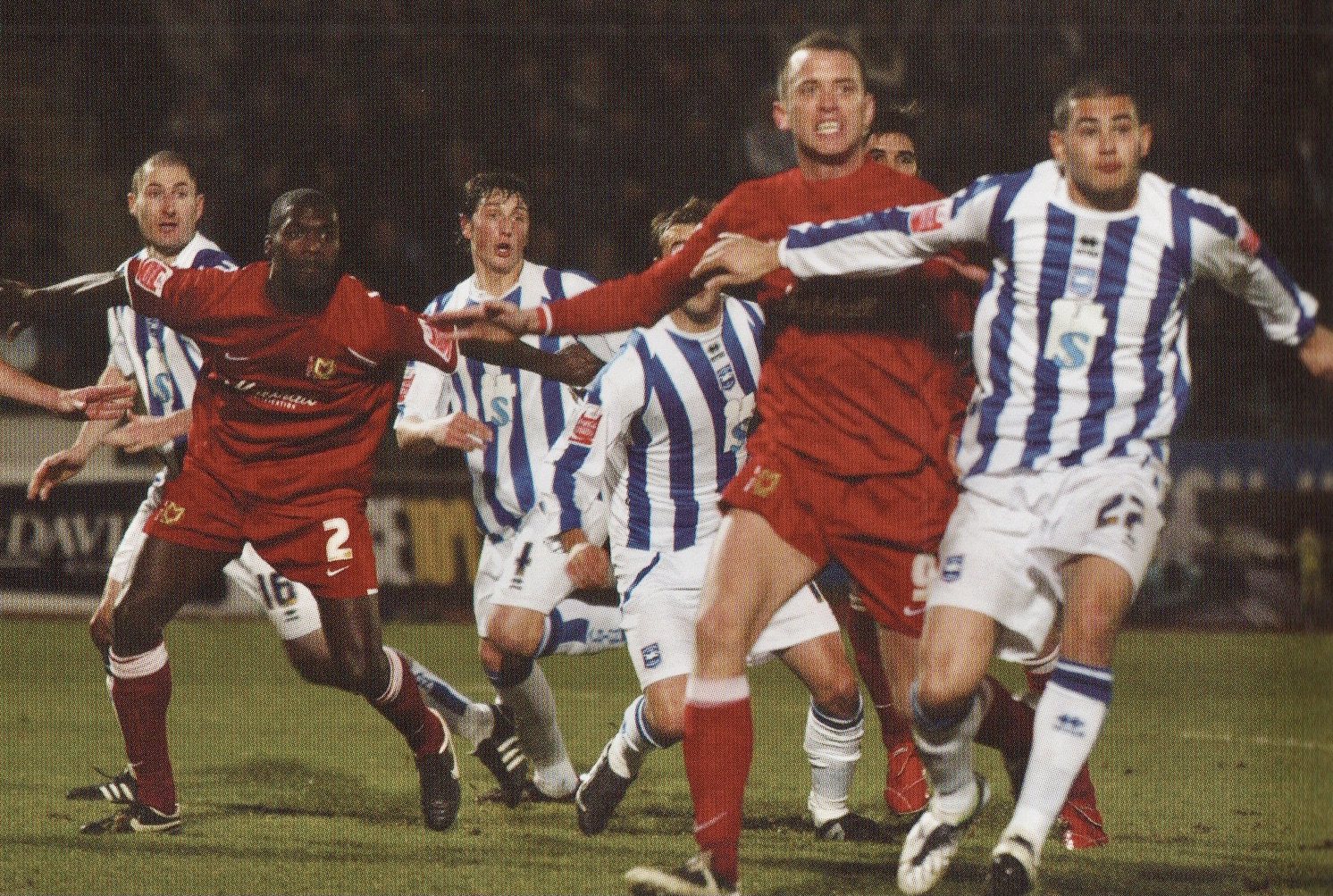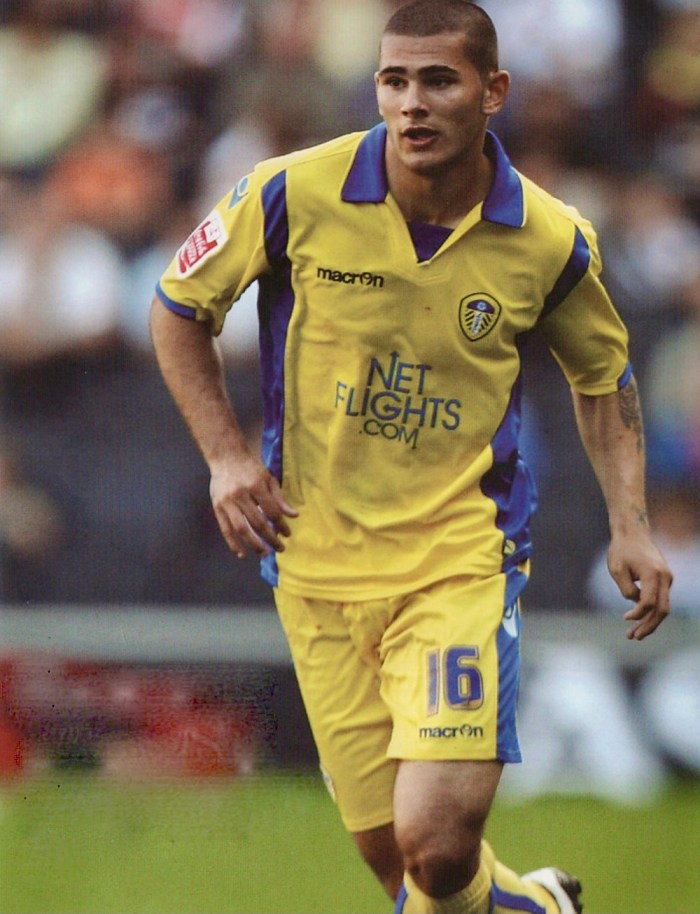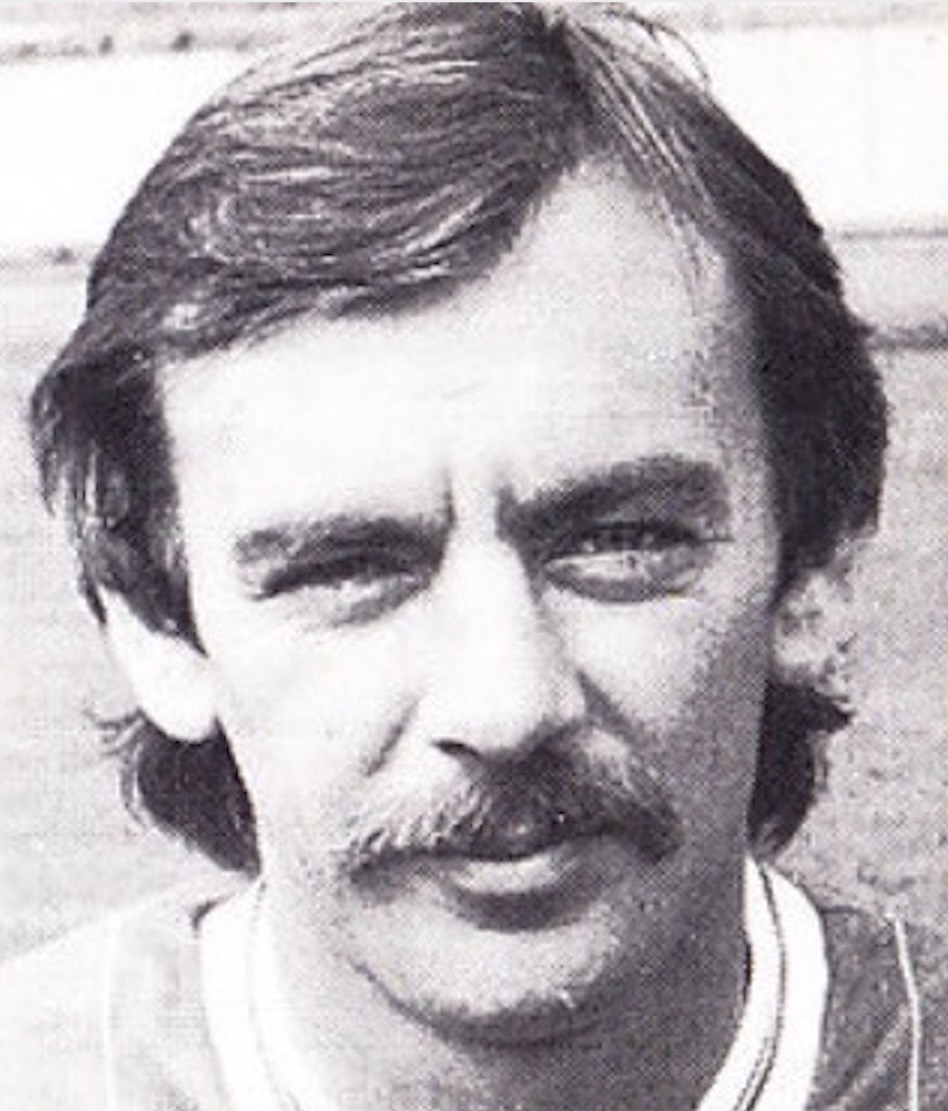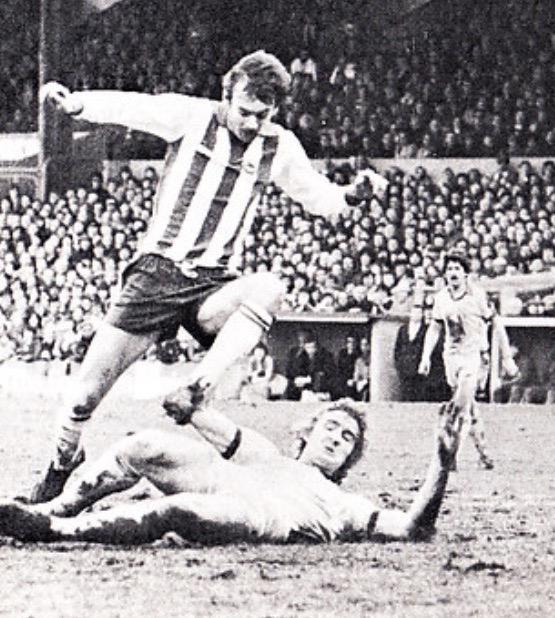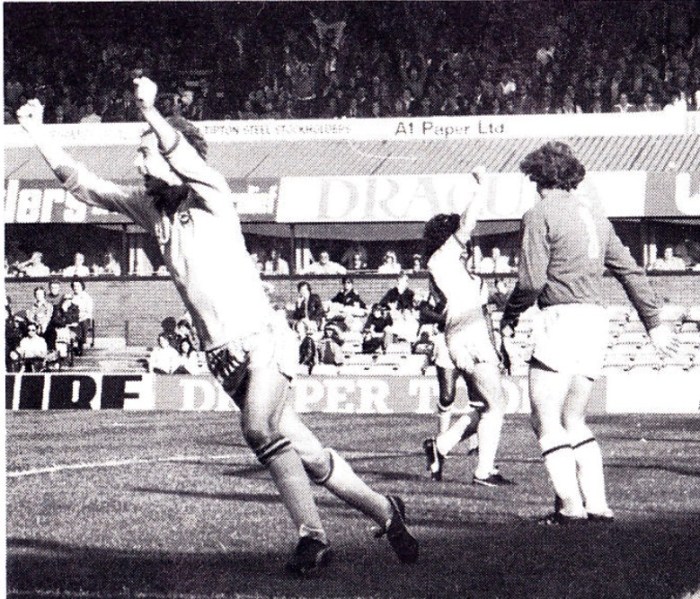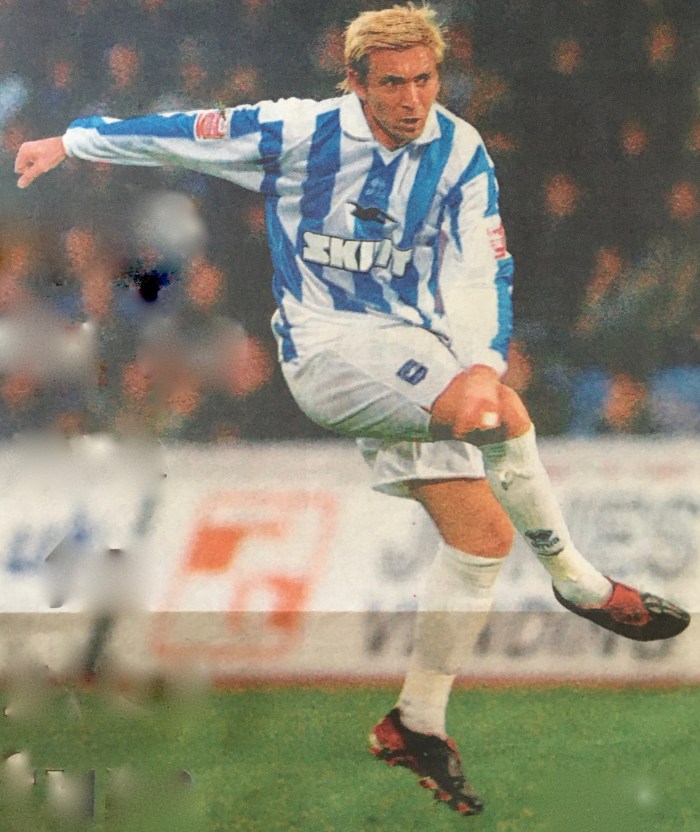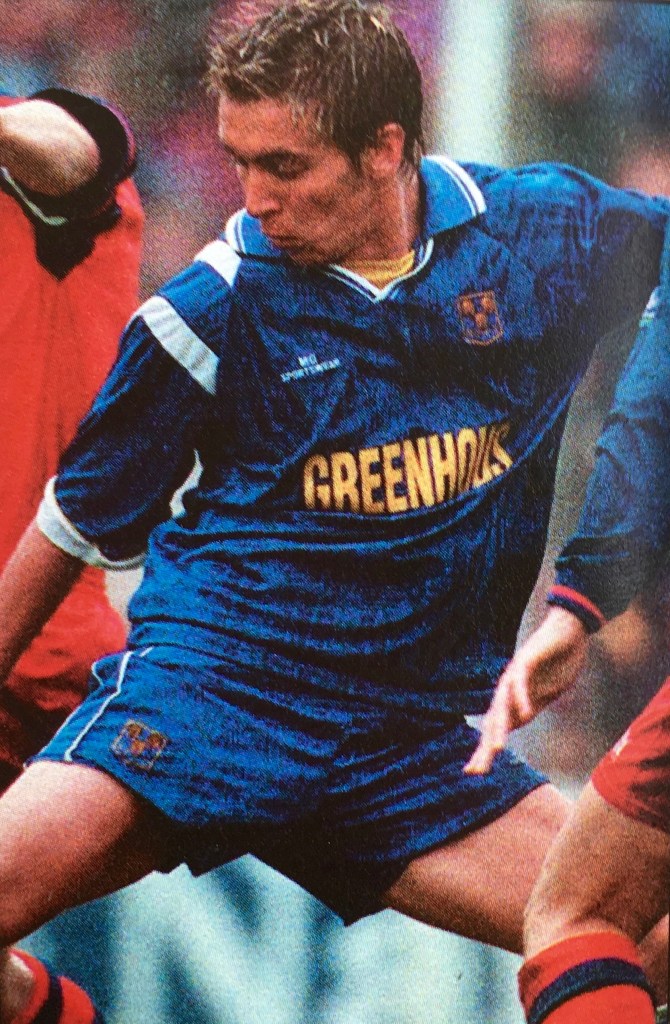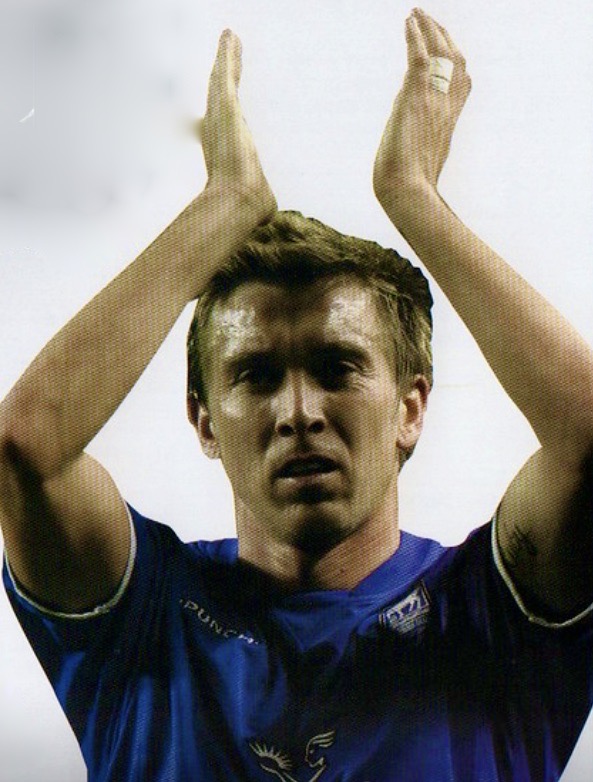
Bradley Johnson scores on his debut v Leicester (photo Simon Dack)
THE COCA-COLA Kid’s cousin was an instant hit when he joined seventh-from-bottom Brighton on loan from second-placed League One rivals Leeds United in October 2008.
Bradley Johnson, who’d heard about the Seagulls from his relative Colin Kazim-Richards, scored twice on his debut as the Seagulls turned round a 2-0 half-time deficit to beat Leicester City 3-2.
“I hadn’t played for two months and Micky (Adams) asked if I was fit and I admitted I wasn’t match fit, but he said he would throw me in anyway,” Johnson recounted.
“The two goals I scored gave me great confidence as a player, but the win helped everyone,” he said. “On the night, the fans were immense and the result gave us all a good boost.”
In an Argus interview in March 2021, Johnson recalled: “I was a young boy from Leeds coming into a struggling team against a team who were flying so it was a bit daunting for me.
“I didn’t know what to expect but, as debuts go, I don’t think it could have gone any better.
“Anyone who knows me knows I like a shot and I’ve always had that since a young age. Some don’t go where planned but thankfully on that night they did.”
Albion had failed to score in their three previous games, against Hereford, Peterborough and Hartlepool, and soon found themselves 2-0 down to City courtesy of two Matty Fryatt goals.
Adams hauled off a somewhat better known loanee – the ineffective Robbie Savage – at half-time, along with wideman Kevin McLeod, and the changes galvanised the Albion in the second half.
Right-back Andrew Whing reckoned the withdrawal of Savage might have helped Johnson to shine. “Maybe he’d felt a bit in Robbie’s shadow up until that point,” he told Spencer Vignes. “But he really stepped up in the second half and scored twice, one of them an unbelievable strike. We needed a spark and that was it.
“Bradley deserved a lot of credit that night. He’d come to us from Leeds and he just took responsibility, scored twice and got us back into it. He really made an impression.”
After Johnson’s pair of long range strikes past David Martin in the Leicester goal, City defender Jack Hobbs sealed a memorable comeback for the Seagulls when he diverted Joe Anyinsah’s cross past his own ‘keeper.
It was a tad ironic that Johnson should have scored against Leicester too because at the start of that year he came very close to signing for them but couldn’t agree terms and ended up at Leeds instead.
Five days after his impressive Albion debut, Johnson was on the scoresheet again as Adams’ side beat Millwall 4-1 at the Withdean Stadium (Glenn Murray, two, and Dean Cox, the other scorers).
Kazim-Richards, whose £250,000 transfer from Bury to Brighton had been paid for via fan Aaron Berry winning a competition organised by the soft drink giant, had already moved on to Fenerbahçe in Turkey via Sheffield United by the time Johnson arrived in Sussex.
But he said: “My cousin Colin had played there so I knew Brighton and I knew a few lads, and that it was a good place to be. But it was Micky that really sold the place to me and I just wanted to play. That is all I wanted to do; I didn’t look at the side’s league position. I just wanted to be a part of what Micky spoke about and help the club beat relegation.”
Unfortunately, the mini revival in the autumn of 2008 didn’t continue although Johnson was on the winning side again when, in his 10th and last game for the Albion, two Nicky Forster goals earned a 2-0 win at Swindon Town, spoiling Danny Wilson’s first game in charge of the Robins (Peter Brezovan was in goal for Town).
By then, Johnson, who’d lost his place at Leeds following an injury, had scored four times for the Albion (some records show he scored twice in a 4-2 home defeat to MK Dons, others that the second Brighton goal was netted by Stuart Fleetwood).
Somewhat gallingly, Johnson was next seen at Withdean less than three weeks into the new year – back in the fold with Leeds as they took all three points in a 2-0 win on 17 January 2009.
“When I was out on loan, Leeds were struggling and when I went back Gary McAllister got the sack. Simon Grayson came in and I didn’t know where my future lay, but Grayson told me I had a part to play and it was down to me to train hard and prove myself,” he said.
“He was true to his word, and I kept my head down, then I ended up coming back to Brighton and played against them for Leeds. It was a bit surreal to be in the away dressing room, but that is football.”
Johnson became a regular at Elland Road for the next two years and was part of the Leeds side who won promotion to the Championship in 2010, as well as earning headlines in memorable FA Cup ties against Premier League opposition.
In particular, in a third round replay against Arsenal at Elland Road in January 2011, Johnson scored a spectacular goal for the home side although they lost the tie 3-1.
Having spent five years on Arsenal’s books as a promising youngster, it was a bittersweet moment for Johnson who said afterwards: “It was a goal I’m not going to forget. I’m an Arsenal fan myself and so are all my family.”
On the transfer list at the time because he couldn’t agree a new deal with Leeds, he eventually got the chance he craved to play in the Premier League that summer when he moved to newly promoted Norwich City, where his teammates included Elliott Bennett and Andrew Crofts.
It was Canaries boss Paul Lambert who sold the club to him at the time but he also sang the praises of his successor, Chris Hughton.
Johnson joined the Canaries
“Hughton did come in with a different style of play,” he told pinkun.com. “He was very tactical. He was mindful that we were playing in the Premier League against good players whereas Paul Lambert wouldn’t care, if we were playing Manchester United, he’d say ‘if they score two, we’ll score three’.
“Different approaches, different ideas and different philosophies. People weren’t happy with the way he played but we finished 11th. I can only speak for myself, but I really enjoyed my time there and Chris is a great manager.”
He added: “Credit to him when he got the sack because he stuck by his morals and got Brighton promoted.”
After three seasons in the Premier League, the 2014–15 Championship season was one of Johnson’s most successful seasons with the Canaries: he became vice-captain to Russell Martin, appeared in 44 of the 46 league matches (including one appearance as a sub) and scored 15 goals.
He was voted fans’ Player of the Year and was part of the side that won the play-off final 2-0 against Middlesbrough to ensure City won back their Premier League place.
However, unable to get a place in Alex Neil’s side back among the elite, he switched to Derby County for £6m in September 2015.
That was the start of seven more seasons in the Championship: after 140 appearances over four years with the Rams, he moved on a free transfer to Blackburn Rovers, where he made 86 appearances over three seasons.
He eventually left Ewood Park at the end of the 2021-22 season and in the summer of 2022 joined MK Dons on a free transfer.
Johnson scored both goals as MK Dons turned round a disappointing start to the season by beating Port Vale 2-1 in their fourth match.
Johnson interviewed after scoring twice for MK Dons
Born in Hackney on 28 April 1987, Johnson was on Arsenal’s books from 1997 to 2002 but was released aged 15.
“Like any kid, being released from a club was horrible and I didn’t really feel like going back on a round of trials with other professional clubs, so instead I just played locally in Leyton.
He went to Ryman Premier side Waltham Forest but when he was 17 was invited for a trial at Cambridge United. He signed on a non-contract basis for eight months and was then offered a professional contract.
Johnson attracted suitors when playing for Northampton Town
But Northampton Town had been tracking him. “They made me a counter-offer which I accepted and that is where my career began,” he said.
That was in May 2005, and after he had been out on loan to gain experience at Gravesend & Northfleet and Stevenage Borough, he became a regular starter under Stuart Gray and his performances attracted scouts from clubs further up the league.
When that aforementioned move to Leicester fell through in January 2008, a few days later Leeds stepped in and paid a £250,000 fee for him.
He played in the same Leeds side as Casper Ankergren that lost the 2008 League One play-off final 1-0 to Doncaster, but picked up a back injury in pre season that led to him being sidelined. Although he returned to fitness, the side was doing well in his absence which meant he was unable to force his way back in. And then the chance to play competitive football was presented by the Albion.
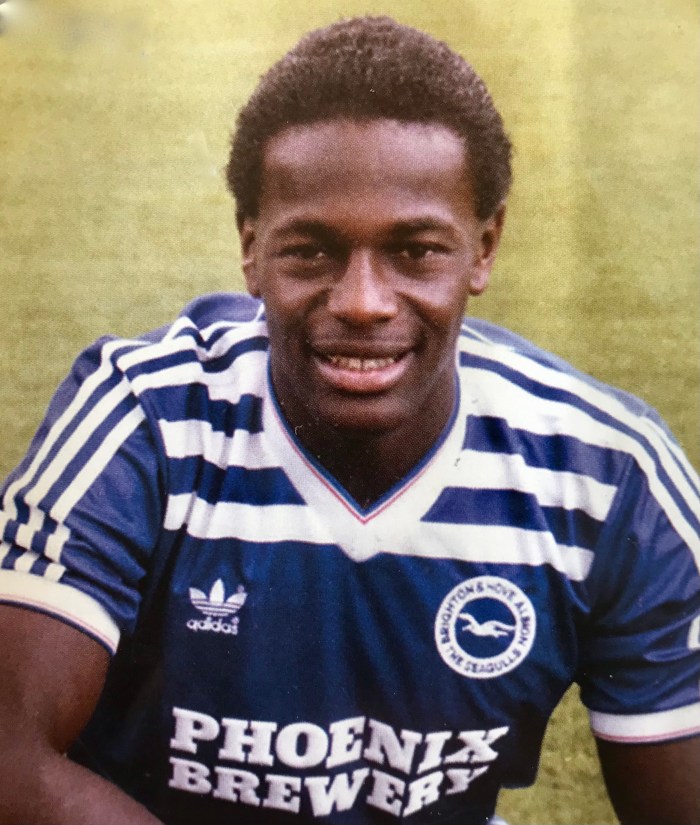
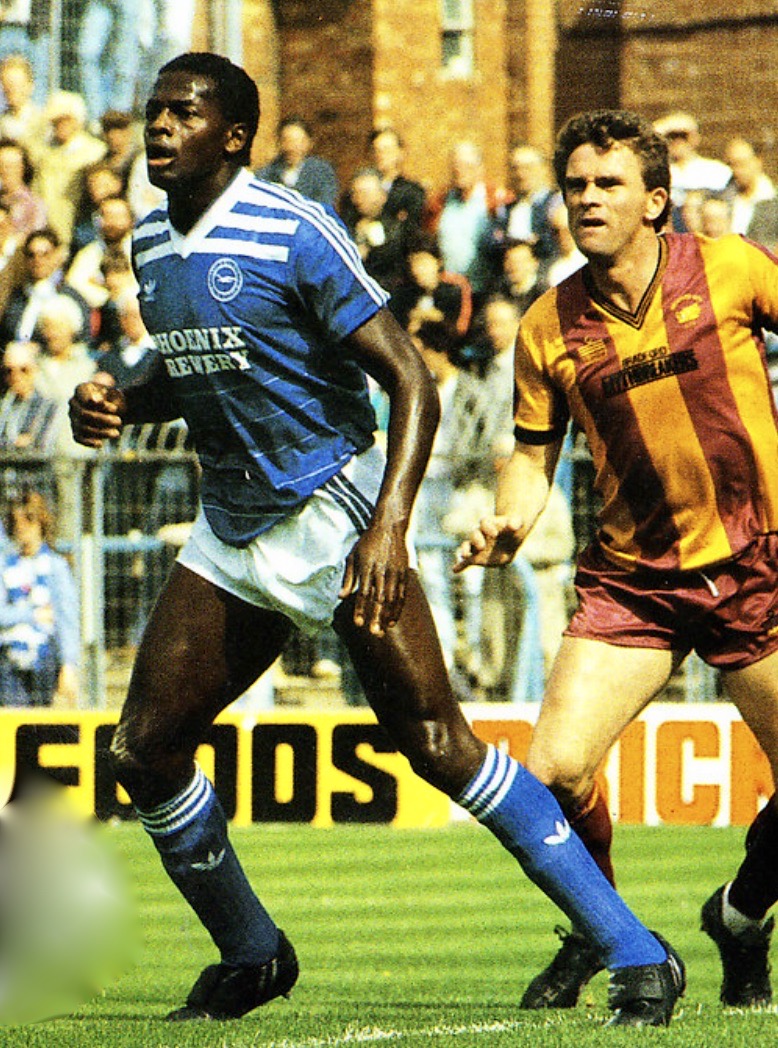
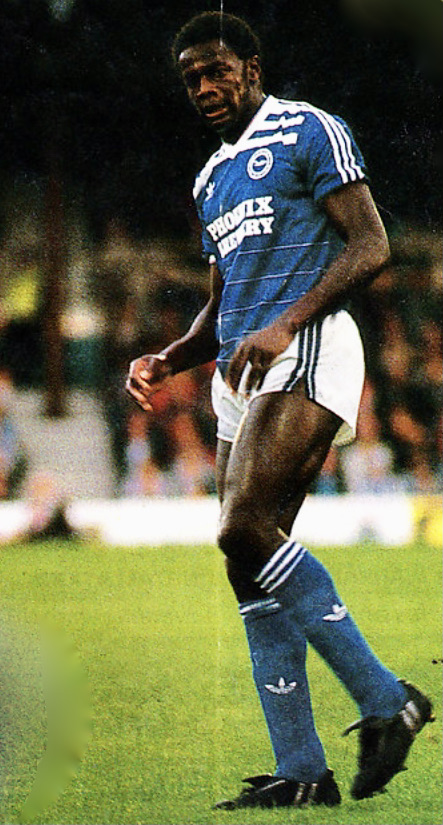
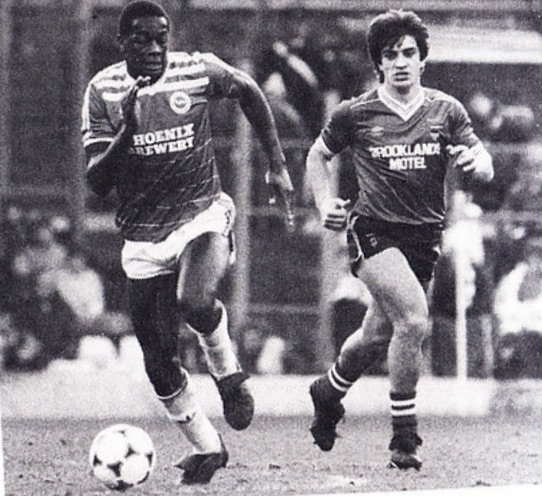
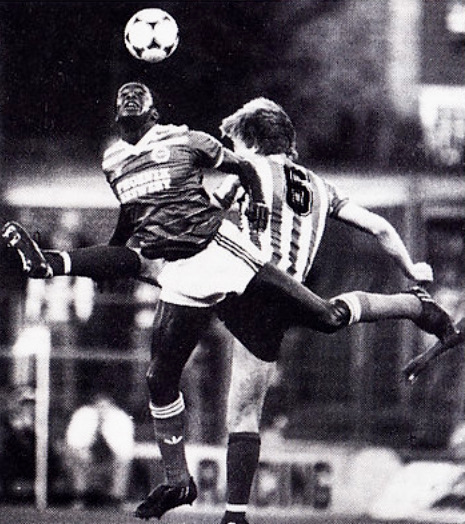
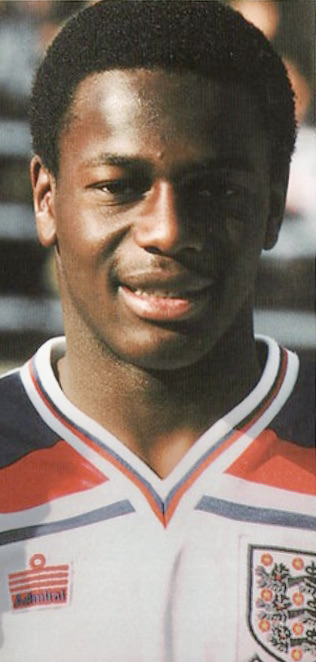
JUSTIN FASHANU, renowned for an iconic televised Goal of the Season for Norwich City against Liverpool in 1979, played 20 games for Brighton in the 1985-86 season.
Those bald facts tell only a fraction of the story of the short and complex life of a bustling centre forward who burst onto the football scene as a teenager, scoring 40 goals in 103 games for the Canaries.
Several books have been written about him, acres of newspaper column inches filled covering colourful tales of what happened to the first £1m black footballer, and there is no shortage of articles across the internet. There’s even been a theatre play about his life: Justin Fashanu in Extra Time.
Here I will focus mainly on the football, and, in particular, that time at Brighton, although some context is needed to explain how a player who only three years earlier had helped England win the UEFA Under 21 Championship ended up with the then second tier Seagulls.
Fashanu’s signing for Brighton in June 1985 seemed like a major coup for manager Chris Cattlin as the Seagulls sought to return to the elite level they’d been relegated from two years previously.
Why was he so convinced Fashanu would be a hit at Brighton? In an interview with Spencer Vignes for the matchday programme, he said: “We’d put a good side together with a tight defence, an exciting midfield and a forward line that included Dean Saunders and Terry Connor.
“I knew all about Justin and I went to see him play for Notts County against Manchester City and he was simply amazing. He battered the best defender in the league at that time – Mick McCarthy – and I mean he really battered him. I thought: ‘That’s our fella!’ With those three up front, we were going to have one hell of a chance of winning promotion.”
In his programme notes for the opening game of the season, Cattlin wrote: “With the right service I expect Justin to be the best centre-forward this club has had in a very long time.”
At the end of a season when Albion missed out on promotion by finishing sixth, Frank Worthington at 36 had demanded a signing-on fee to stay a second season with the Albion – money Cattlin said wasn’t available. There was no such demand from Fashanu, who at only 24 was trying to rebuild a career that had gone off the rails.
To make his own personal assessment of a player who had already attracted plenty of negative attention, Cattlin even had the player to stay at his house for four days before signing him.
Only the previous season, Fashanu’s aggression on the pitch for Notts County had put both Albion centre backs Eric Young and Jeff Clarke in hospital. He’d previously had an altercation with Albion’s former Canaries defender Andy Rollings while playing for Norwich at the Goldstone, resulting in Rollings’ dismissal for throwing a punch at the striker.
Nottingham Forest boss Brian Clough, who’d persuaded the board of the two-times European Cup winners to part with £1m to sign the 20-year-old from Norwich in 1981, had numerous clashes with the player when he was unable to replicate his previous goalscoring form (more of which later), and, after just 15 months, he cut the club’s losses and sold him to neighbours County for only £150,000.
More crucially, though, Fashanu had sustained an injury to his left knee on New Year’s Eve 1983 inflicted courtesy of the studs of Ipswich, and later Brighton, defender Russell Osman. The wound had become infected and the medics at the time were clearly concerned. It meant insurers inserted an exclusion clause into their cover. Any claim for subsequent injury would only be covered if he’d previously played 12 consecutive League games.
After his stay chez Cattlin, a fee of £115,000 was paid to Notts County, who’d just been relegated to the old Third Division, and the manager said: “Justin had a reputation of being a bit of a problem player with his other clubs but that is all in the past.
“In my dealings with him I’ve found him to be a smashing person and the sort of player our supporters will take to.”
He told the Evening Argus that Justin was “a dedicated player who has been asleep for a couple of years”, adding “I’m sure, with us, he will bring his talents to fruition”.
Meanwhile, Fashanu told The Times: “I only took this step after a good deal of thought and prayer. I am convinced Chris Cattlin can get the very best out of me.”
He got off to a great start when scoring twice as Albion thrashed Aldershot 5-0 in a pre-season friendly at the Recreation Ground on 29 July 1985.
Stiffer competition was promised in the shape of three Goldstone friendlies in a week against First Division sides Arsenal, Liverpool and Nottingham Forest. Arsenal won 2-1 on 2 August and Liverpool 4-1 on 5 August. Two days later, Fashanu netted one of Brighton’s successful spot kicks in a 5-4 penalty shoot-out against Oxford United at the Manor Ground which saw them win the Oxfordshire Benevolent Cup.
Fashanu (front row, third from left) all smiles after Albion won a trophy in Oxfordshire
The pre-season fixtures were rounded off on 9 August when second tier Albion walloped Forest 5-2, and the matchday programme captured the mood with some delight.
“The match was a real thriller for the fans, and no-one except perhaps for Brian Clough and his team, went home unhappy,” the programme crowed. “Justin Fashanu had an outstanding game against his former teammates.”
Fashanu was involved in setting up three of Albion’s goals and of the fifth the programme recorded: “The final goal came after just about the most powerful shot seen at the Goldstone for years. Fashanu connected from 15 yards out. Segers could only parry the ball, and (Gary) O’Reilly tapped it over the line.” Tellingly, Clough declined to be interviewed after the game.
Fashanu started in the no.9 shirt and was sent off in only his third game, a 2-1 home win over Bradford City. Cattlin was quick to leap to his defence, using his programme notes to tell supporters: “I understand that the referee sent him off for dissent after committing a cautionable offence. All Justin said was ‘Surely you’re not booking me for that ref’…and if that either brings the game into disrepute or deserves any punishment at all, surely there’s something wrong in the game.
“Justin has joined us this season and is a great professional. One hundred per cent effort is appreciated by the fans and our supporters know they are getting just that. There was nothing malicious in anything he did on Saturday.
“Justin is a ‘gentle giant’. He never swears and he tries all the time…that is just the sort of player we need in the game. I would like to go firmly on record as saying his sending off was a complete injustice.”
Disciplinary action took a little longer to come into effect back then and Fashanu didn’t have to serve his suspension until the sixth game of the season.
However, it turned out he would have missed the game anyway because he’d undergone surgery.
It emerged that during pre-season training, Fashanu had taken a whack on his knee and it was six weeks and several matches later before he underwent a procedure at the Royal Sussex County Hospital. Cattlin admitted: “Mr Fearn, the club surgeon, had to work on the bone.”
In hindsight, Cattlin’s programme notes about the injury could be viewed, at best, as insensitive. “I would like to explain the problem of Justin Fashanu,” he wrote. “He jarred his knee pre-season, there is apparently a floating body there somewhere….probably a piece of black pudding or something!”
Cattlin already had Gerry Ryan out long term injured and he also lost Fashanu’s strike partner Connor to injury in those opening weeks. That absence presented an opportunity for Mick Ferguson to stake a claim and he responded with three goals in three games – until he too got injured, as did Alan Biley. In the emergency, loanee Arsenal defender Martin Keown was put up front to play alongside Saunders.
Gerry Ryan, Chris Hutchings, Fashanu and Terry Connor were all out injured
In the programme for the 19 October home game against Charlton, Cattlin was pleased to report Fashanu had resumed training and was busy building up his thigh muscles after his period of inactivity.
He finally made his comeback in an away League Cup match at Liverpool and, as Albion were sent packing 4-0, Fashanu was booked after clashing with Craig Johnston.
However, at least he was back in the no.9 shirt and, after leading the line in a home 1-1 draw against his old club Norwich, he scored his first goal for the Seagulls the following week when Brighton lost 2-1 at Shrewsbury Town.
Defending Fashanu after yet another booking in a 2-1 defeat away to Sunderland, Cattlin said: “Justin is anything but a dirty player. He is certainly strong, but if he was dirty I can assure everyone he would not be wearing the blue shirt of Brighton. I can see all sorts of trouble in the game if referees cannot differentiate between dirty play and wholehearted endeavour.”
Later the same month, Fashanu scored his second and only other league goal for Brighton, at home to Hull City on 30 November, when the Albion won 3-1 (Danny Wilson and Connor also on the scoresheet).
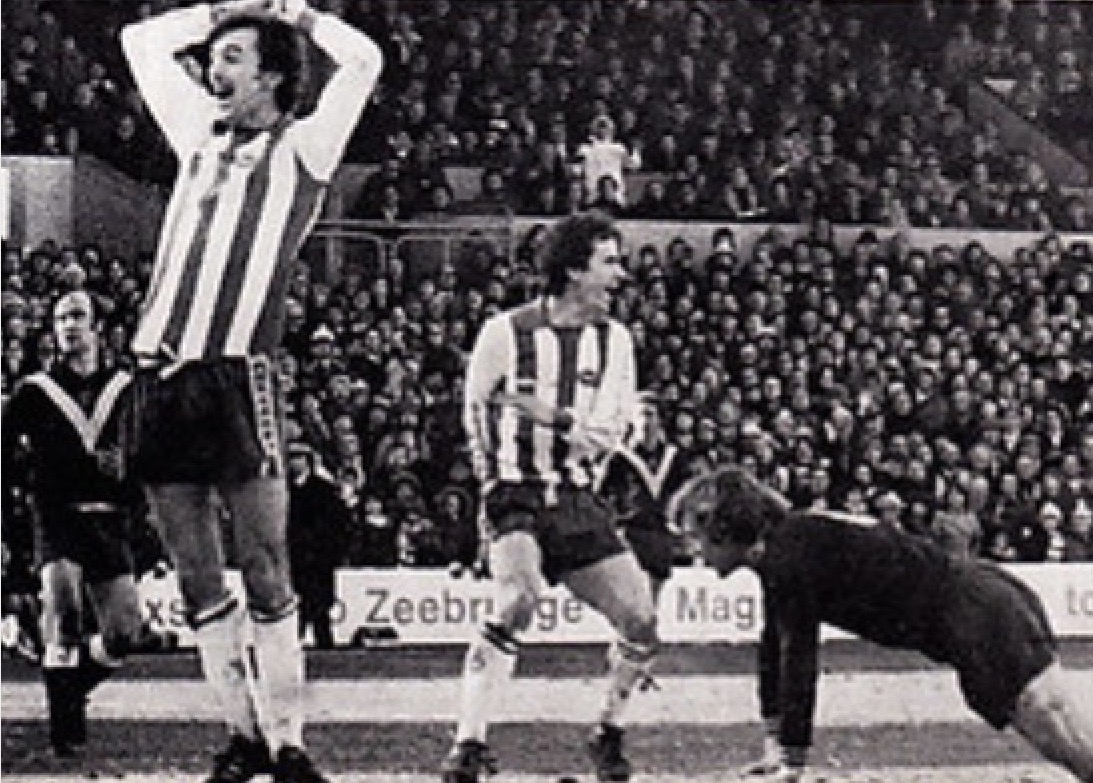
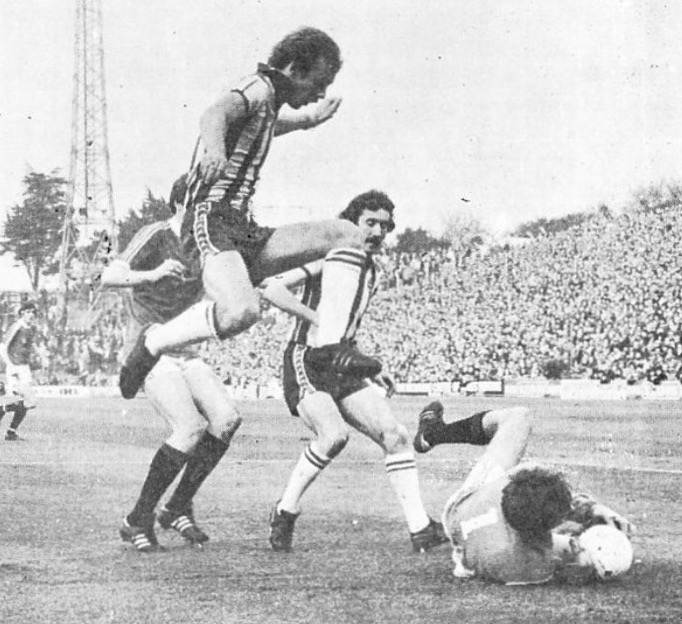
That match came during an 11-game unbroken run at centre forward, including an influential display in a 2-1 Boxing Day win over Portsmouth (below) which gave Albion their first league victory at Fratton Park in 62 years.
Fashanu set up Saunders for Albion’s first and, 18 minutes from time, Fashanu’s close-range shot was parried by Alan Knight only to Connor, who buried the winner.
Although the shortage of goals was bad news for him personally, it was good news for Shoreham butcher Roy Parsons who promised the striker 2lb of steak for every goal he scored for the Albion!
After missing two matches at the start of February, Fashanu returned to the side for the memorable FA Cup fifth round tie against Peterborough on a snow-covered pitch at London Road. Substitute Steve Jacobs went on for him for the second half and scored Albion’s second equaliser to take the tie to a replay, Saunders having got Albion back in the game to cancel out the home side’s lead. But it proved to be Fashanu’s last game in an Albion shirt.
The striker had to undergo further surgery on his knee although, at the time, it wasn’t made to sound career-ending. The matchday programme for the game against his brother John’s Millwall side on 22 March 1986 said merely: “Our popular striker had a minor operation this week and we hope this will finally clear up his knee problem.”
Subsequent reports had it that Fashanu’s right knee had been nearly shattered and the prognosis from the medical people was that he would have to give up the game. The player got an insurance payout but he was reluctant to give up the game and spent money in the UK and America trying to get the knee fixed.
“I had been told by doctors and surgeons in England that I’d never walk again properly – let alone play,” Fashanu told the Los Angeles Times in July 1988. “They were proposing an operation to remove the lining from the inside of my knee.”
Fashanu was born in Hackney, London, on 19 February 1961, the son of a Nigerian barrister and a Guyanese nurse. The parents split up when Fashanu and brother John were five and four. Unable to support them, their mother, Pearl, sent them to a Barnardo’s children’s home.
The boys were eventually fostered and raised by Alf and Betty Jackson in the small rural Norfolk village of Shropham, near Attleborough.
Norwich City’s youth scout Ronnie Brooks identified 14-year-old Fashanu as a prospect while visiting Norfolk schools looking for talent. He was invited to train with the club during his holidays and then signed as an apprentice.
In a 2011 article, writer Juliet Jacques recounted: “Having persuaded Fashanu to play football rather than box (he was twice an ABA junior heavyweight finalist, aged 14 and 15), Brooks spent time with him in the gym at Norwich’s training ground at Trowse, wanting him to become less one-footed and learn how to strike the ball in the air.
“Endlessly, Brooks would throw a ball over Fashanu’s shoulder, demanding that he turn, volley it against the wall with one foot and then hit it back with the other.”
That practice would pay off big time, Jacques capturing in words the moment the 18-year-old Fashanu connected so sweetly from distance to draw Norwich level, 3-3, with Liverpool at Carrow Road on 9 February 1980, and, in the days of limited football coverage on TV, featured on BBC’s Match of the Day.
“With the impudence of youth, he flicked the ball up with his right foot, turned, and volleyed it into the tiny space between Ray Clemence’s head and the post. The strike was perfect – and so was the celebration. There was a split second while the crowd, and the commentator, processed its brilliance: as the fans roared, Fashanu stood alone, one finger raised to the skies as if to announce his genius,” she wrote.
“Norwich eventually lost 5-3, but the goal overshadowed the result: it made the perfect televisual image, coming as a generation of black footballers were breaking through at England’s top level, leaving Fashanu poised to become their leading light.”
One of his teammates back then, Greg Downs, recently told The Athletic: “We took the mickey out of Justin at the time because we maintained he miscontrolled it. We swore it bounced up and hit him on the ankle, which is why he then hit it.
“With all due respect to Justin, his greatest attribute wasn’t his feet. His strength was in the air. He was a magnificent header of the ball. I think that was why it surprised everybody.
“It was a magnificent strike. You couldn’t have hit a better shot. Ray Clemence had no chance. I don’t think any other keeper anywhere would have had any chance with it. Justin just caught it sweet.
“I got on great with Justin. I remember going to his 18th birthday in Attleborough with his family. He was a nice fella.
“He was so popular at Norwich. He was also probably the first local black footballer we had. He was famous, this lad from Norfolk, he had a personality, he was eloquent. I knew his parents and they raised him with very high morals, and he was a lovely lad.”
England under 21 cap
Two months after that Liverpool game, Fashanu scored England’s only goal in a 2-1 defeat to East Germany in a 1980 UEFA under 21 championship semi-final at Bramall Lane, playing alongside future full internationals Gary Bailey, Kenny Sansom, Bryan Robson, Russell Osman, Terry Butcher, Glenn Hoddle, Garry Birtles and Gordon Cowans.
In September the same year, he went on as a substitute for Paul Goddard as England beat Norway in a friendly at The Dell, Southampton. The following month he was a starter as England were thrashed 4-0 away to Romania in a 1982 UEFA under 21 championship preliminary match but on 18 November at Portman Road he was on the scoresheet as England swept aside Switzerland 5-0 in the same competition.
He featured as a sub in a 1-0 friendly win over the Republic of Ireland at Anfield in February 1981, then was on the scoresheet as England beat Hungary 2-1 in a friendly in Keszthely.
His seventh cap came as a starter in the 0-0 draw away to Norway in September and two months later he opened the scoring for England in another 1982 UEFA under 21 championship preliminary match when England beat Hungary 2-0.
The following March he started again as England won a quarter final away leg in Poland 2-1 and was in the semi-final second leg line-up that drew 1-1 with Scotland at Maine Road, Manchester.
In the first leg of the final of that competition, played at Bramall Lane, Sheffield, on 21 September,1982, Fashanu went on for David Hodgson and scored as England beat West Germany 3-1, although he didn’t feature in the second leg away when England lost 3-2 but ran out 5-4 aggregate winners.
At that time, Fashanu was on loan at Southampton having endured a nightmare time at the City Ground under Clough. The stories of what happened are legendary and varied.
Unfortunately for Fashanu, he joined Forest as the European Cup-winning side was being broken up and there were rumours of disagreements between Clough and his sidekick Peter Taylor, who eventually quit the City Ground. Clough had some health issues at the time too.
Peter Ward, who had moved to Forest from Brighton for £500,000, sometimes played alongside Fashanu and witnessed first hand the difficulties the manager had with him. He described various incidents in some detail in Matthew Horner’s He Shot, He Scored biography.
“It must have been very hard for Fashanu; he had signed for a lot of money and he really struggled to score goals,” said Ward. “In a way, it was similar to my situation but he had the added complication of his social life and constant rumours about his sexuality.
“Cloughie found it difficult to live with Fashanu’s lifestyle and he later admitted he wished that he had treated him differently.”
Forest were £1m in debt; three directors quit because they didn’t like the terms of a guarantee for the bank overdraft, and the Nottingham public weren’t turning up in sufficient numbers to help the club break even.
“At the heart of it was Fashanu, who was effectively the physical embodiment of that £1m overdraft,” wrote Jonathan Wilson in his Brian Clough biography, Nobody Ever Says Thank You.
“Goal statistics often don’t tell the full story, but in this case his record of three league goals in 31 appearances did. He was offering little to the team and, had he not been signed, Forest’s bank balance would have been a comforting nil. By the end of his unhappy 15 months at the club his confidence was so shot he almost scored an own goal from the halfway line in a reserve team game.”
Clough blamed Fashanu’s arrival for the breakdown in his relationship with Taylor. According to Wilson: “Clough said: ‘He used to burst into tears if I said hello to him’ and ‘He had so many personal problems a platoon of agony aunts couldn’t have sorted him out.’
Wilson details incidents such as Fashanu insisting on using his own towels rather than ones provided by the club amongst a number of issues that irritated the manager.
Clough maintained that the player’s homosexuality didn’t bother him (although the manager’s use of the word ‘poof’ might suggest otherwise), instead he said: “It was just that his shiftiness, combined with an articulate image that impressed the impressionable, made it difficult for me to accept Fashanu as genuine and one of us.”
Accusations of ill discipline prompted Clough to ban the player from training. When he turned up anyway there was more trouble and the manager called in the police to remove him from the training ground.
Those circumstances led to Fashanu being loaned to Southampton where he scored three goals in nine games under Lawrie McMenemy, but they couldn’t afford to make it a permanent deal.
Eventually in December 1982, Forest cut their losses and Fashanu was transferred across the Trent to Notts County for £150,000, being signed by former Brighton winger Howard Wilkinson, who had taken over as manager at Meadow Lane that August.
At least Fashanu got his goal touch back, netting 20 in 64 matches, but they weren’t enough to prevent back-to-back relegations. It probably didn’t help his reputation that he was sent off in a derby game against Forest for retaliating to a Paul Hart tackle just 11 minutes into the second half.
After heading to America in his battle to overcome his knee problem, Fashanu failed to recapture the spark that had made him such a huge talent in his teens and early 20s.
The record books show he played for 22 clubs in seven different countries. A brief attempt to recover past glory under Lou Macari at West Ham is remembered by Dan Coker on West Ham Till I Die.
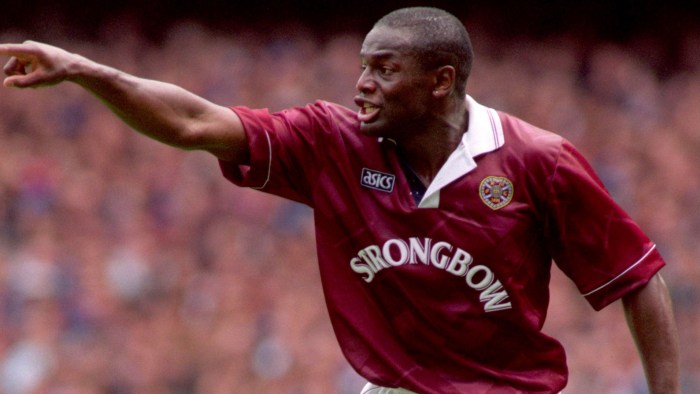
He was playing at Leyton Orient when he went public about his sexuality and he later scored 15 goals in 41 games for Torquay United. He also played in Scotland for Airdrieonians and Hearts (below).
What led to him taking his own life in a deserted lock-up garage in Shoreditch in May 1998 is well documented, such as in this footballpink.net piece written by Paul Breen.
Fashanu’s memory certainly lives on in many ways. In February 2020, a tribute to his outstanding goal against Liverpool was unveiled in the form of a 20-metre long banner produced by supporters groups Along Come Norwich and Barclay End Norwich, led by Proud Canaries: the first club-affiliated LGBT+ fan group in the country.
“Two years ago I drew a massive artwork for Norwich Pride of LGBT+ icons nominated by the community,” said banner designer David Shenton. “The most voted-for person was Justin: a man so treasured in this city, especially by the football club for his artistry as a player, and by the LGBT+ community for his courage in not hiding who he was.”
• Pictures from Albion’s matchday programmes, the Argus, and various online sources.
ONES that got away always make for fascinating stories and a striker who went on to become a goalscoring legend slipped through the net at both Brighton and Burnley.
Ian Muir is hailed an all-time hero by fans of Tranmere Rovers for whom he scored 180 goals in all competitions during what many regard as the best period in Rovers’ history. If it hadn’t been for injury, he could have played in the Premier League and Europe for Leeds United.
But he’s barely remembered for the struggles he had to get games at Brighton, let alone in a month with the Clarets.
Success could have eluded himf it hadn’t been for the time he spent at Brighton alongside the legendary Frank Worthington. He was considering a move to non-league Maidstone United, but, when Worthington quit Brighton in the summer of 1985 to take his first step into management on the Wirral, he made Muir his first signing.
“Ian Muir was a fantastic forward with great touch,” Worthington told Spencer Vignes in an Albion matchday programme interview. “He did things in training you just wouldn’t believe, yet he wasn’t even making the side at Brighton under Chris (Cattlin).”
Cattlin had taken the youngster on after he had been given a free transfer by Birmingham City where he’d made just one League Cup appearance in the 1983-84 season under Ron Saunders. But competition for forward places was intense with the likes of initially Alan Young and Terry Connor, then Worthington, Mick Ferguson and later Alan Biley.
Muir’s first involvement with the Albion first team was as a non-playing substitute for the home 3-0 win over Leeds on 24 March 1984. He made his debut the following Saturday at Fratton Park in place of the injured Young and was brought down in the penalty area only 20 minutes into the game to earn Brighton a spot kick, which Danny Wilson successfully buried to put the Seagulls ahead.
Muir in his Brighton days
Connor had a chance to put Albion further ahead and, as the matchday programme reported, “Muir sliced wide as Connor made the opening” before Pompey began a devastating fight back.
Albion had been hoping to complete a fourth win in a row for the first time in six years, but it wasn’t to be, and, into the bargain, Muir couldn’t cap his debut with a goal, instead firing wide when set up by winger Steve Penney.
Unfortunately, this was the game when former Spurs and Arsenal centre back Willie Young, on loan from Norwich City, was given the runaround by Pompey centre forward Mark Hateley, and, courtesy of a second half blitz, the home side ran out 5-1 winners.
Alan Young was restored to the no.9 shirt in the next match and scored twice as Albion beat Grimsby Town 2-0 at the Goldstone, but Muir was drafted in to take Connor’s place in the away game at Shrewsbury Town.
That match ended in a 2-1 defeat, but the News of the World angled its report on an unlucky afternoon for the young forward.
“It just wasn’t Ian Muir’s day,” wrote reporter Brian Russell. “The Brighton teenager (actually he was 20) playing only his second league game could so easily have taken the limelight from Shrewsbury two-goal hero, 17-year-old Gerry Nardiello.
“Young Muir headed the ball home in the eighth minute from Jimmy Case’s corner, but it was ruled out (for a foul by centre-half Eric Young).”
Alan Young produced a powerful header from a Muir cross that Steve Ogrizovic (later of Liverpool and Coventry City fame, of course) saved brilliantly.
Russell continued: “With Brighton battling to cancel out Nardiello’s 23rd-minute opportunist goal, striker Muir suffered. His delicate chip left the ‘keeper clutching thin air, but Shrewsbury skipper Ross McLaren headed out.
“Brighton levelled it with 15 minutes to go (through Eric Young). But, five minutes later, Nardiello pounced on Chick Bates’s chested pass to beat Joe Corrigan.”
Muir was on the scoresheet when Albion’s reserve side began the 1984-85 season with a 1-0 win over reserve team boss George Petchey’s old club, Millwall. It was a very experienced team featuring Corrigan in goal, full-backs Chris Ramsey and Graham Pearce – who had both played for the Seagulls in the FA Cup Final the year before – along with Steve Gatting and Neil Smillie. Giles Stille and Alan Young were also in the line-up.
Muir had to wait until 13 October for his next first team opportunity when he was a non-playing sub as Albion went down 2-1 at Oxford United. He then got on as a sub for Connor in a 0-0 home draw with Barnsley, but the game was so dire that Cattlin very publicly forfeited a week’s wages.
After three goalless games straddling October and November 1984, Cattlin paired Muir with Worthington away to Blackburn on 10 November but still the drought couldn’t be breached, and Albion went down 2-0. The next game, Cattlin tried Ferguson and Connor as his front pair – same outcome: a 1-0 defeat at Leeds.
Muir didn’t get another chance with the Albion but in the spring of 1985 was sent out on loan to Lou Macari’s Swindon Town, where he played in three matches (and his teammates included Ramsey, who’d been released by Cattlin, and Garry Nelson, who would later become a promotion winner with the Seagulls).
Somewhat curiously, when commenting on Muir’s departure from the club that summer, Cattlin said in the matchday programme: “I am sure Ian will get goals at whatever level he plays.”
Sure enough, Prenton Park eventually became his spiritual home and, although Tranmere struggled to stay in the fourth tier initially, Muir’s goalscoring exploits were synonymous with four years in which Rovers were promoted twice and appeared at Wembley five times. Highlights saw Muir score in the FA’s centenary celebrations in 1988 and an acrobatic and precise volley in Tranmere’s Leyland DAF Trophy victory over Bristol Rovers in 1990.
Muir and strike partner Jim Steel
He particularly began to prosper after Worthington’s successor, Johnny King, brought in tall target man Jim Steel alongside him in 1987.
Steel, who later became a police officer on Merseyside, said King, a Bill Shankly devotee, would compare him and Muir to John Toshack and Kevin Keegan. “That’s the way football was at the time,” he told the Liverpool Echo. “You looked for a little mobile player to feed off a tall striker.
“Muiry was one of the best finishers in the game at the time. If I’m honest, the intelligence of the partnership was down to Muiry, who was very good at reacting to things off me,” he said.
“I wasn’t the most technically gifted of players compared to the likes of Johnny Morrissey and Jim Harvey. But things happened around me and Muiry was very good at picking up the crumbs.”
Muir was Tranmere’s leading scorer from 1986 to 1990 and, in the 1989-90 season, he scored 35 goals in 65 games.
Born in Coventry on 5 May 1963, Muir played for the City’s schools side and Bedworth Juniors and won four England Schoolboy caps (against Wales, Scotland and two v West Germany) featuring alongside the likes of Tommy Caton, Ian Dawes, Terry Gibson and Kevin Brock.
He joined QPR as an apprentice aged 17 in 1980 and was a Hoops player for four years in total during Terry Venables’ reign as manager. In October 1982, he went on a one-month loan to Burnley. The respected all-things-Burnley writer, Tony Scholes, takes up the story.
“When Burnley played on QPR’s plastic pitch at Loftus Road in 1982 we came home with more than we’d bargained for. Two Trevor Steven goals in front at half time, we’d suffered a 3-2 defeat in the end although we managed to acquire a striker.”
Scholes pointed out how Muir had progressed into the first team squad at Loftus Road, but after a goalscoring start had fallen out of favour.
“He made a dramatic start to his first team career, scoring twice on his debut in a 5-0 thrashing of Cambridge United in April 1981,” said Scholes. “He kept his place for the one remaining game of the 1980-81 season but by the time he arrived at Turf Moor, well over a year later, he was still looking for his third game.”
It eventually came with Burnley, when he went on as a substitute in a 2-1 defeat at Charlton, replacing skipper Martin Dobson. He then started and scored Burnley’s goal in a 3-1 defeat at Leeds.
“He impressed, but the home fans never saw him and. at the end of the month, he was dispatched back to West London, his Burnley career over,” said Scholes.
Ian Muir alongside Terry Fenwick when Terry Venables managed QPR
Unable to get back into Terry Venables’ side at Loftus Road, Muir joined Birmingham and subsequently Brighton.
Finally given a platform to shine, the striker scored the majority of his 180 Tranmere goals between 1985 and 1991 and spearheaded the side that vaulted two divisions in three seasons between 1988 and 1991, before eventually being edged out by the arrival of John Aldridge.
The Liverpool Echo remembered: “It was inevitable his subtle skills and clinical finishing would make him a target for a larger club. Muir knew of Leeds’s interest as Tranmere campaigned to secure a place in the Third Division playoffs in 1990-91.
Muir told the newspaper: “Howard Wilkinson was sending scouts to watch me and coming along himself. When I went along to the ticket office before games, the Leeds scout was sometimes at the kiosk and I’d chat to him. He told me what was happening.
“Mark Proctor, who joined us from Middlesbrough the following season and worked under Wilkinson, knew about the deal and told me.”
Muir was arguably in his prime at the age of 27, but he suffered what would be a fateful knee ligament injury in a game against Chester City on 23 March 1991.
When Tranmere visited Leeds in a League Cup tie early in the following season, Muir hobbled into Elland Road on crutches. Muir recalled: “Before the game Gordon Strachan asked our midfielder, Neil McNab, where I was. Neil pointed to me standing there on crutches.
“Then Strachan said: ‘Ian is the unluckiest man in the world because we were going to sign him’. Leeds went on to win the league that season and I could have been with them, playing at the highest level playing in Europe the following season.
“I was gutted. I was so close and the injury changed everything. But that’s football. You get your ups and downs.
“I could never complain about the fantastic career I had at Tranmere and I wouldn’t swap my memories of the years at Prenton Park for anything.”
He wasn’t granted a testimonial after a decade with Rovers, but in 2020 there were moves afoot amongst their supporters to help him publish his autobiography.
Adulation has not waned and a young writer who didn’t even get to see him play wrote warmly about the striker’s achievements in this tribute.
In 1995, Muir returned to Birmingham City for a £125,000 feebut he played only twice before he suffered a groin injury. In an effort to get fit, he spent a month on loan at Darlington, and scored a goal, but his league career was over.
He went to play in Hong Kong, scoring a hat-trick on his debut for Sing Tao, and later played for Happy Valley. In June 2011, he recalled in an interview with the Liverpool Post: “The warm climate was a big help. Then the medical people found the cause of the groin problem was my spine. The pelvis wasn’t lined up properly. It could get out of joint just by lying in bed.
“One of the lads on the medical side was able to click me back into place. I have to say I have not had many problems with it since.”
Muir returned to the UK, and his native West Midlands and joined Nuneaton Borough.
“We won the league by 20 points and got into the Conference,” Muir told the Post. “We were top of the league after three months of the following season then it all went pear-shaped.”
The newspaper reported that Muir stepped down a level to Stratford Town, where his football days finished.
He did some voluntary coaching in schools and took a job in a factory for a year, and subsequently joined a friend in a business fitting out pubs and shops.
MALCOLM POSKETT’s goals helped Brighton to win promotion from the second tier after he’d made a terrific start to his Albion career.
Only two days after putting pen to paper in Hove, Poskett netted the equaliser in a 1-1 draw away to Hull City on 4 February 1978 and a week later he marked his home debut with a goal in Albion’s 2-1 win over Burnley.
The game at Boothferry Park was only six minutes old when the home side went ahead but Poskett levelled it up just before half-time after a Tony Towner corner was headed goalwards by Andy Rollings and the new arrival diverted it into the net.
A £60,000 signing from fourth tier Hartlepool United, Poskett had taken over the no.9 shirt from Ian Mellor, who had only been in the side for one game in the injury absence of Teddy Maybank.
Maybank’s big money signing from Fulham four months earlier had broken up the highly successful Mellor-Peter Ward partnership that earned Albion promotion from the old Third Division, and Poskett’s arrival only served to illuminate the Goldstone exit door even brighter for Mellor, who swiftly departed for Chester.
A crowd of 22,694 saw the new man’s Division Two debut on an icy Goldstone Ground pitch. Poskett once again profited from a Towner pass to score. Skipper Brian Horton scored Albion’s other goal.
It all must have felt very showbiz to the lad from Teesside, used to playing in front of 5,000 crowds in the Fourth Division, especially when prior to kick off against the Clarets, Slade, a famous chart-topping pop group of the time, recorded a single on the pitch in front of the North Stand.
While Maybank reclaimed his starting berth from Poskett for six matches, he was troubled by a knee injury and Poskett got the nod for the remaining seven games of the season as Albion chased automatic promotion, which at that time was earned by the top three sides in the division. There were no play-offs.
Poskett repaid Mullery’s faith in him with a hat-trick in a 4-0 win away to Bristol Rovers and by netting the only goal of the game in the penultimate fixture at home to Charlton Athletic in front of 31,203 fans.
What happened next has been well documented: Albion missed out on promotion when Southampton (in second) and Spurs (third) conveniently drew 0-0 in the final match of the season; Spurs edging out the Seagulls on goal difference.
Maybank had a successful cartilage operation during the summer break and was initially the preferred partner for Ward as the new season got under way.
Poskett banged in a transfer request as a mark of his frustration but, after Mullery persuaded him to withdraw it, he got his chance back in the side and made the most of opportunities that came his way.
Mullery admitted in Matthew Horner’s biography of Ward (He Shot, He Scored, Sea View Media) that he wasn’t always fair on Poskett when reverting to the Ward-Maybank partnership.
He pointed out: “Malcolm Poskett did a terrific job when we signed him. He was one of the most under-rated goalscorers – absolutely brilliant.
“He was really similar to Wardy, very sharp and very quick but a bit taller and a bit stronger.”
By the end of the season that ended in promotion to the top tier of English football for the first time, Poskett had contributed 10 goals in 24 games (plus eight sub appearances). He was the substitute in the famous 3-1 win back in his native north-east when Newcastle were beaten by the Seagulls on 5 May 1979.
Brighton struggled to find their feet in more exalted company and Poskett barely got a look-in, coming on as a sub twice and only starting three matches, the last of which was in the resounding 4-0 defeat to Arsenal in the League Cup on 13 November 1979.
He scored twice, though: netting the only goal in an away League Cup win over Northampton Town, and four days later scoring along with Peter O’Sullivan as Albion pulled back a 2-0 deficit to draw 2-2 at West Brom.
Poskett wheels away to celebrate his only top flight goal, away to West Brom
However, with the arrival of Ray Clarke from Ajax, it was clear Poskett’s chances at the Albion were going to remain limited, so he dropped back down a level to join promotion-seeking Watford under Graham Taylor. Albion goalkeeper Eric Steele had already made a similar switch in the autumn of that season shortly after a famous spat with Gary Williams at Old Trafford. Mullery also secured a £120,000 fee for Poskett, so Albion did very nicely out of the deal.
“I would have loved to stay at Brighton for the rest of my career, but it wasn’t to be,” Poskett told Spencer Vignes in a retrospective matchday programme article. “One week I was partnering Peter Ward, the next it would be Teddy with Peter. I never got a run in the team, even though I scored a couple of goals when I did play.
“At least with Watford I got the chance to start games. People called us kick and run, a long ball side, but we had a lot of talented players like Ross Jenkins, John Barnes and Nigel Callaghan.”
Poskett struck up a friendship with fellow new boy Martin Patching and both were on the scoresheet (Poskett scored twice) in a memorable 7-1 League Cup thrashing of Southampton on 2 September 1980.
Although being Watford’s top scorer with 21 goals in the 1980-81season, when the Hornets finished ninth, the following season he found himself in the reserves after a three-game barren spell.
In a Watford matchday programme article, he mused: “It’s a strange profession – one minute you’re up and the next down.
“I played in the first three league games of the season without scoring and was dropped. But I’m scoring fairly regularly in the reserve side and my chance will come if I keep on hitting the net. I’m a battler and not the type of player to give less than 100 per cent, no matter what grade of football I’m playing in.”
Watford won promotion as runners up behind close rivals Luton Town but Poskett couldn’t shift Luther Blissett or Jenkins, who were the preferred strike pairing, and Gerry Armstrong, later to join Brighton, was invariably the back-up option.
Born in Middlesbrough on 19 July 1953, Poskett went to Beechwood Junior School and then on to Brackenhoe Secondary Technical. His footballing ability in school sides eventually led to him being selected for North Riding Schools.
He was a decent all-round sportsman – a useful cricketer who played for Middlesbrough Schools, he also featured in local leagues at table tennis, and enjoyed tennis and badminton too.
But at 16 the budding sportsman started out as an apprenticeship plater at Cargofleet Steelworks, only playing football for the local Beechwood Youth Club and then South Bank in the Northern League.
His performances for South Bank caught the eye of Middlesbrough and he was taken on as a professional. But after 18 months in their reserves, manager Jack Charlton gave him a free transfer and he opted to become a plater on North Sea oil rigs to earn a wage.
He didn’t turn his back on football altogether, turning out part-time for Whitby Town in the Northern League. Scoring an incredible 98 goals over two seasons was bound to attract attention.
George Aitken, later a Watford coach and then a coach under Mullery at Brighton, was Workington manager at the time and tried to sign Poskett, but, disillusioned by his Boro experience he chose to stick with Whitby until Hartlepool manager Billy Horner convinced him he could still make it in the professional game.
For a £25 transfer fee, Horner took him on and devoted hours of extra time working on the youngster’s skills and sharpness. It paid off.
“My work rate was non-existent, but Billy Horner really worked on me and got me going,” Poskett told Shoot! magazine. “If it wasn’t for him, I don’t think I would have got anywhere – I’d still be in non-League soccer. It was so hard at first, I felt like packing it in, but he kept me at it and I’m very grateful now.”
His goalscoring at Hartlepool caught the eye of Ken Craggs when he was a coach at Fulham and when Craggs switched to become Mullery’s no.2 at the Goldstone, Poskett followed soon after, the £60,000 fee representing a tidy profit for the struggling North East minnows.
“I came in during the season when we just missed out on promotion and the lads were fantastic. It was a fabulous place to live as well.
“I had to come from one end of the country to the other but, once I got there, there were lads from up north, the Midlands, so it was a good mixed bunch and I felt right at home.”
After helping Watford to promotion in 1982, Poskett headed back north and played for Carlisle United for three seasons, thriving under the managership of Bob Stokoe, who’d led Sunderland to FA Cup glory in 1973.
In the penultimate game of the 1983-84 season, Poskett scored his 100th career goal – and his 101st – as Carlisle drew 2-2 at home to Crystal Palace in front of a paltry crowd at Brunton Park of just 3,038.
Poskett subsequently had six months at Darlington, before switching to Stockport County in January 1986.
Appearances were few and far between and he went on loan to his old club Hartlepool in March the same year before moving back to Carlisle in August 1986. He finally hung up his boots at the end of the 1987-88 season.
He remained in the town and in 2017 was working as an examiner at Pirelli, the tyre manufacturer.
Pictures from Albion matchday programmes and online sources.
THE PINPOINT accuracy of Darren Currie’s passing and shooting was a joy to watch, even though a lack of pace stopped him being as good a player as his famous uncle.
Currie was a decent player in his own right, making nearly 700 appearances for 15 different clubs, but wherever he went he was always known as the nephew of the former Sheffield United, Leeds, QPR and England creative midfielder Tony Currie.
Perhaps with a hint of family bias, Uncle Tony said in an interview for ITV Digital: “Darren is, without doubt, the best crosser of the ball, after Beckham, in the country. He’ll produce nine times out of ten, right foot or left foot.”
The young Currie attributed his crowd-pleasing skills to the start he was given in the game by West Ham. After 10 years stuck in the lower leagues, Currie was given a platform to perform in the Championship by Brighton, and he very nearly made it to the top when transferred for £250,000 to high-flying Ipswich Town.
As if by a cruel twist of fate, Ipswich lost to the Hammers in the 2004-05 Championship play-off semi-finals having just missed out on automatic promotion.
“Playing for West Ham at youth and reserve levels was a terrific way to start a career,” Currie told the Ipswich Star. “They gave me everything but my debut.”
He certainly came close though, featuring alongside recognised first-teamers like Lee Chapman and Frank Lampard in friendlies and testimonials, but he had to move elsewhere to gain competitive first-team action.
Initially he had loan spells with Shrewsbury Town and Leyton Orient, and when the Shrews bid £70,000 for him in 1996, he chose to drop down a couple of divisions to get regular football.
“The difference in money was only about £50. The then West Ham manager Harry Redknapp called me in and said that I was an adult and had to think about continuing to play regular first team football,” Currie explained. “I was given the opportunity to have a new contract at West Ham or moving permanently to Shrewsbury.
“I was a young pro at West Ham and I had been out on loan a couple of times and I got the buzz for playing at three o’clock on a Saturday afternoon. There was no other feeling like it.
“I thought to myself I’ll go to Shrewsbury and I’ll play really well for a year and I’ll get a move back up to the top.
“My naivety kicked in then because it didn’t quite happen. I thought I’d done OK and I was linked with a couple of moves but the route back to the top wasn’t as simple as I thought it would be in my head.”
Indeed, it was a decade in which, after three seasons with the Shrews, he moved on briefly to Plymouth Argyle, then to Barnet (three seasons) and Wycombe Wanderers (three seasons).
Currie said it got to a point where Wycombe couldn’t afford to keep him, and boss Tony Adams made it clear he was free to look elsewhere.
Mark McGhee invited him to Brighton for a trial and was impressed with the way he knuckled down in training to get himself fit following a programme devised by McGhee’s deputy, Bob Booker.
Currie was offered a 12-month contract but it was more about the opportunity to play at a higher level that prompted him to sign.
“It wasn’t a fantastic offer – put it this way, Peterborough offered me three years – but it wasn’t about the money,” Currie told Spencer Vignes in an Albion matchday programme article.
“It was about the football and playing in the Championship. I was determined to do well and to prove myself, which I did. That’s when people began to sit up and take notice.”
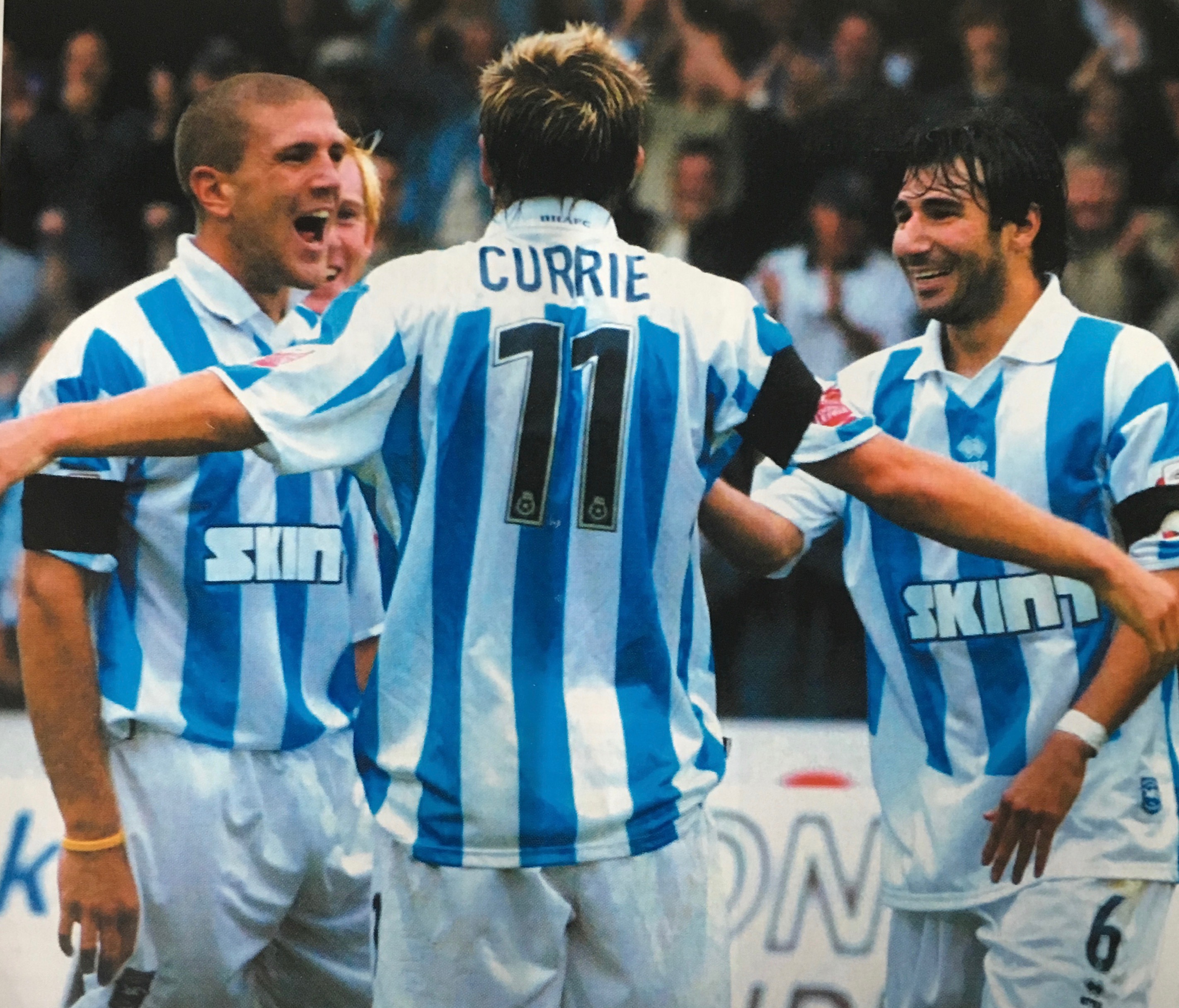
Currie’s ability on the ball carved him out to be a crowd-pleaser and the first of two goals for the Albion typically came from a free kick in a 3-2 home defeat to QPR that left Argus reporter Andy Naylor purring over its execution.
“Currie, having shaved a post and hit the bar with two earlier free-kicks, made it third time lucky from 20 yards just before the break. It was a sumptuous effort from the set-piece expert which rendered Rangers’ keeper Chris Day motionless.”
His other goal came in a 1-1 draw at home to Sheffield United, more noted for Albion wearing the limited-edition Palookaville strip to help publicise backer Fatboy Slim’s latest album.
Injury-hit Albion considered it a point gained rather than two dropped and Naylor complimented Leon Knight for “superbly crafting” Currie’s goal by evading his marker and threading a square pass through the legs of Leigh Bromby.
“Currie, with time as well as room, picked his spot to score, which meant even more to him because of the opposition,” wrote Naylor, informing readers that the Yorkshire side had rejected him as a 16-year-old following a fortnight’s trial.
Unfortunately for Currie, he was only on the bench when the Albion travelled to Upton Park on 13 November 2004. After three successive defeats, McGhee confessed he set the side up not to lose rather than go for a win.
Somewhat ironically, the Seagulls blagged a 1-0 win courtesy of a Guy Butters goal, in a real backs-to-the-wall match, with veteran striker Steve Claridge ploughing a lone furrow up front.
It was only in the 90th minute of the match that McGhee introduced Currie in place of Claridge to play out the final few minutes of the game.
Currie only played 22 games for Brighton over four months but the fee they received for him from Ipswich gave a vital boost to club funds when they were struggling to compete in the division because of the restricted crowd numbers at Withdean. Having signed him on a free transfer, the deal was a no-brainer for the Albion hierarchy, even if it weakened a squad who subsequently only avoided relegation back to the third tier by a single point.
McGhee wasn’t that surprised to see Currie go, telling the Argus: “He was obviously happy here, but I thought he was doing so well that he would keep his options open.
“I cannot see Darren being a regular for Ipswich in the Premiership if they are promoted, but his skills and touch are good enough to justify him making a contribution to a squad in the Premiership.”
It didn’t pan out like that, but Currie was nonetheless grateful to the Albion, and told Vignes: “I am so pleased I had the chance to be a part of it all down there, to see what the support is like and to play with a group of lads who stick together through thick and thin.
“I played at the Goldstone when I was a kid, playing youth team football with West Ham, so I know how important the stadium issue is for everyone. I always will be extremely grateful to the Brighton fans and Mark McGhee because without a doubt without their help this opportunity wouldn’t have come along.”
Currie explained in a matchday programme article how McGhee had helped to develop his game and to add other dimensions which improved him. “I owe a helluva lot to Mark and Bob Booker,” he said.
Currie became an instant hit with the Tractor Boys fans earning the man of the match accolade in two of his first four games.
“I tend to build up a rapport with supporters wherever I go,” he told the Ipswich Star. “I am my own biggest critic and I know when I have done well, and I am very satisfied with my contribution so far.”
After his brief cameo for the Seagulls at West Ham, he got the chance to play against his boyhood club three times that season with Ipswich.
He was in the Town side that lost 2-0 at home to the Hammers on New Year’s Day 2005. Then, in the first leg of the play-off semi-final, Currie and Matt Richards (later a loanee with the Albion) were half-time substitutes who helped Ipswich to recover a deficit to draw 2-2.
Currie started the second leg and had Ipswich’s best opportunities with a shot straight at James Walker, then a long-range drive 10 minutes before the interval which the goalkeeper hopelessly misjudged but fumbled to safety. But they failed to make the final when Bobby Zamora scored two second half goals for West Ham to earn them a 2-0 second leg win. West Ham beat Preston in the play-off final.
Born in Hampstead on 29 November 1974, Currie’s early footballing talent drew interest from Watford and Chelsea, but he decided to join West Ham’s academy.
“The facilities were great, the training for us there as kids was first class and I really enjoyed my time there,” Currie said.
“A lot of the player I became was what I was taught as a kid at West Ham,” he told twtd.co.uk. “It was all about the ball and all about the technical skill and how to manipulate the ball. It was a way I enjoyed playing anyway so it was a really good fit for me.”
After signing professional in 1993, he was a regular in the West Ham reserve side and a trawl through the excellent archive website whu-programmes.co.uk records show he played in a Football Combination game away to Brighton on 1 April 1994, and later the same month was up against Guy Butters in Portsmouth’s reserve side at the Boleyn Ground. Mark Flatts and Paul Dickov were in opposition when the Hammers stiffs entertained their Arsenal counterparts at home on 11 May.
In an Avon Insurance Combination match at the Goldstone Ground on 30 November 1994, Currie scored the only goal of the game from the penalty spot in a West Ham side also featuring Lee Chapman and Frank Lampard.
The following summer, Currie played in four matches when he was part of West Ham’s squad on a centenary tour of Australia.
Shrewsbury boss Fred Davies, a former playing colleague of Redknapp’s at Bournemouth, took Currie on full time after his two loan spells at Gay Meadow.
He moved on to Plymouth Argyle in 1998 but only played five matches in three months, then switched to Barnet where he made 136 appearances, plus seven as a sub, in three years.
Wycombe Wanderers paid £200,000 to sign him in the summer of 2001 and manager Lawrie Sanchez told BBC Three Counties Radio: “He’s obviously a quality player. He gets crosses in and that’s an area where we weren’t very good last year. He’s come to add that to our game and his free kicks will trouble the ‘keeper as well.
“It was quite a lot of money for our club to spend but I’ve got to back my judgement. I’d looked at him for a while and quite liked him. He gives us something we haven’t got, he’s a great technician. He hasn’t got particularly great pace but what he does with the ball is tremendous. We’re hoping he does all the things he was doing at Barnet and a little bit more for us.”
Sanchez added: “A lot of people looked at him for a long time. He’s always been considered one of the best players in the Third Division and hopefully we’ll give him the stage where he can prove he’s one of the best players in the Second Division.”
After Currie’s flirtation with promotion to the Premier League ended in disappointment, Joe Royle left Portman Road and his replacement Jim Magilton axed Currie from the side in the 2006-07 season. He was sent on loan to fellow Championship sides Coventry City and Derby County, for whom he made a play-offs appearance as a substitute, although he wasn’t involved in the final when County beat West Brom 1-0.
That summer, on the expiry of his Ipswich contract, Currie moved on a free transfer to League One Luton Town. He made 38 appearances for the Hatters but when they went into administration, were deducted 10 points and relegated, he was among several players given a free transfer.
Micky Adams, back in the hotseat at the Albion, was hopeful of getting Currie back to Brighton for a second spell, telling BBC Southern Counties Radio on 11 July: “He’s a player I’ve admired for a long, long time. We want him, and he wants to come back. He’d offer competition for places and fantastic delivery from set pieces.”
But at the end of the month the player rejected the terms on offer and took up a three-year contract at Chesterfield instead.
While the first year at Saltergate went OK, in the second season, the manager who signed him, Lee Richardson, had been replaced by John Sheridan, and Currie was out of the picture. He went on loan to fellow League Two side Dagenham & Redbridge and the deal was made permanent in January 2010. Currie played in 16 matches as the Daggers won promotion to League One.
They went straight back down the following season, and Currie departed for Conference South outfit Borehamwood as player assistant manager. He was there less than three months before moving to Isthmian League Hendon for a year as a player.
In October 2012, Currie returned to Dagenham & Redbridge, initially as a development coach and later as assistant manager under John Still.
In June 2018, Currie was appointed assistant manager at National League side Barnet, working under Still. He succeeded Still in December 2018, initially as caretaker, before landing the role permanently in January 2019.
Steve Foster challenges Spurs’ Steve Archibald at White Hart Lane
LEGEND is overused far too much in football circles but, in some circumstances, it is justified. That applies to Steve Foster.
He played 800 games in a 21-year career which included nine years with Brighton in two separate spells.
His performances in the top-flight for Brighton led him to play for England at the 1982 World Cup and he lifted the League Cup in 1988 as the captain of Luton Town.
He might have enjoyed a longer spell at Aston Villa if the European Cup-winning manager who signed him hadn’t been unceremoniously dumped by ‘Deadly’ Doug Ellis.
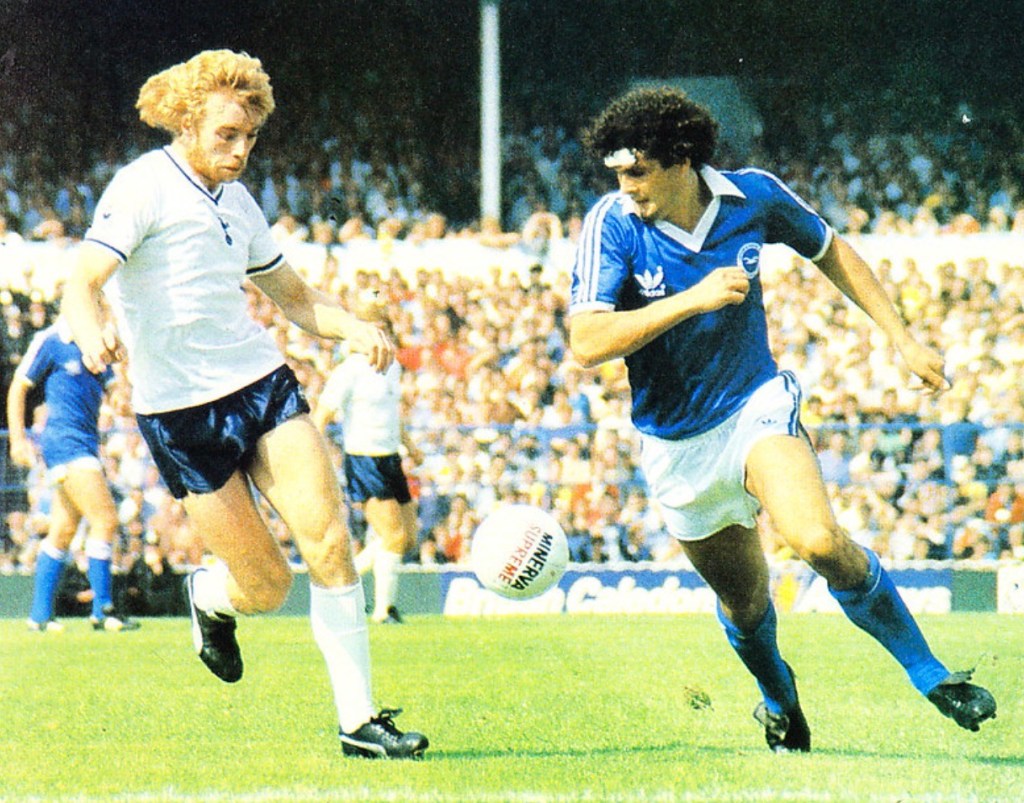
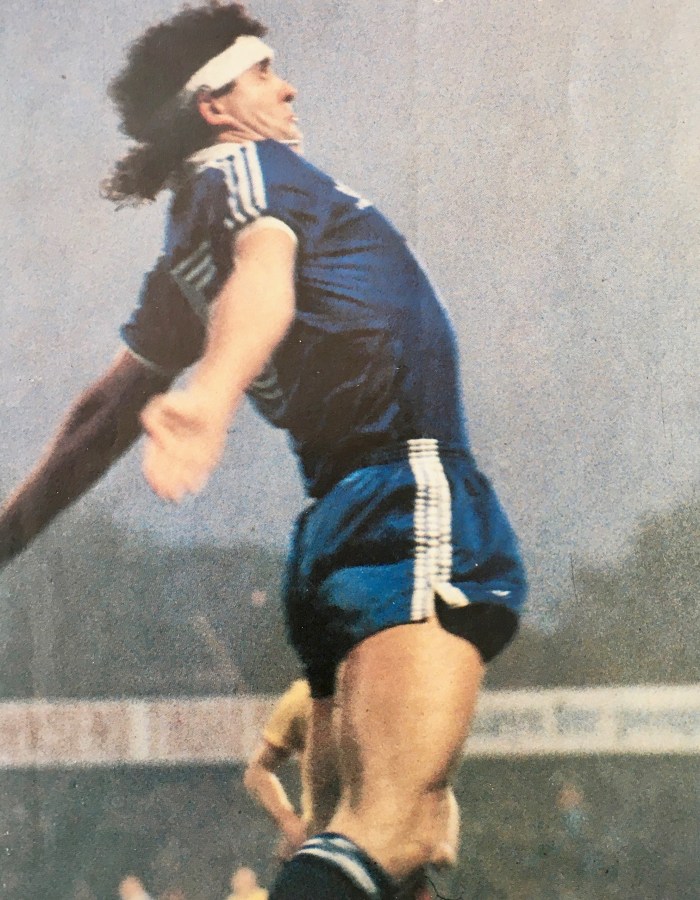
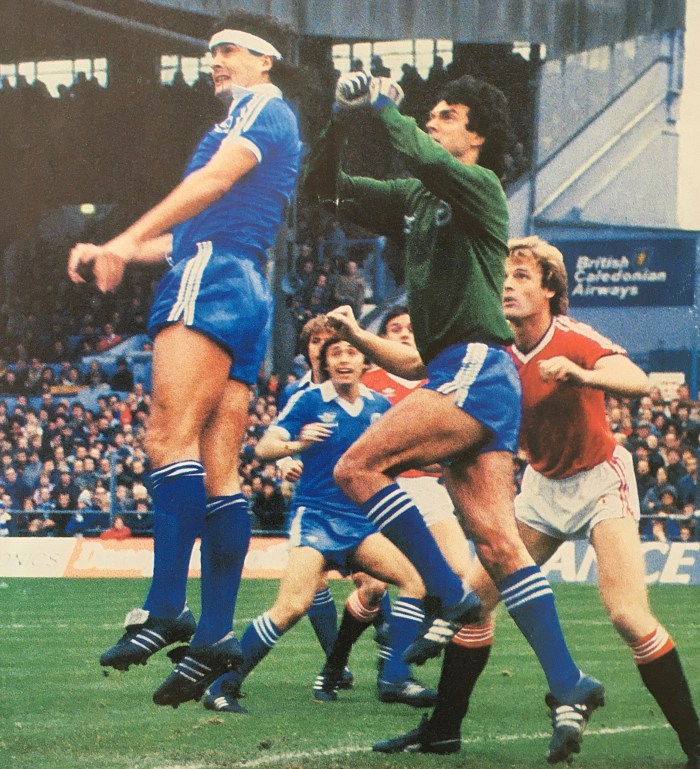
Foster became – and, to older fans, still is – synonymous with Brighton & Hove Albion, and football followers the world over could readily identify the captain with the white headband.
In several interviews over the years, he has explained how the distinctive headpiece was actually a piece of padded white towel designed to protect a forehead split open in collisions with centre forwards Andy Gray and Justin Fashanu.
I wonder if physio Mike Yaxley’s wife Sharon, who made up the dressing before every game, realised at the time the key role she played in helping to make Foster one of the most identifiable characters in football.
Foster’s illustrious career is warmly documented in Spencer Vignes’ excellent 2007 book A Few Good Men (Breedon Books Publishing), featuring an interview with the player himself and those who played with him.
For example, Gerry Ryan told Vignes: “Fozzie was a huge player with a huge personality, a real leader and deceptively quick for a big man.
“When he played against the best, like Ian Rush and Kenny Dalglish, he was the best. People talk about giving 100 per cent, but Fozzie gave 150 per cent in everything he did, and I mean off the field as well.”
Gordon Smith added: “He was a fantastic person, great fun and a terrific centre half.”
Vignes himself observed: “Steve’s willingness to put his neck on the line for the cause earned him hero status among the fans, together with the complete respect of the dressing room.”
Unsurprisingly, Foster pulls no punches in describing the various characters and events surrounding his colourful career, for instance describing Chris Cattlin as “definitely the wrong man. I told him the truth and what I thought of him.” And, of predecessor Jimmy Melia: “When Jimmy took over it was more like a circus than a football club.”
Foster said the two biggest influences on his career were Frank Burrows, the manager of his first club, Portsmouth, who taught him about balance as the key to strength on the pitch, and Brian Horton, the dynamic midfield driving force he succeeded as Albion captain.
“He shouted and screamed for 90 minutes to help us get results, and to keep everyone on their toes,” said Foster. “If he made a mistake, 10 other people would shout and scream at him, and he would take it. When I was captain at Brighton, and my other clubs, that’s how I tried to be.”
Such a recognisable figure as Albion’s centre-half
Fortunately, sufficient archive film footage remains for fans of different generations to see what a dominant force Foster was at the heart of Brighton’s defence, while I retain plenty of now-yellowing cuttings from the numerous columns of newsprint he filled during his pomp.
Born on 24 September 1957 in Portsmouth, Foster went to St Swithin’s Junior School before moving on to St John’s College. A centre-forward in the early days, he played for the Portsmouth Schools under-12s side but it was Southampton who took him on as an associate schoolboy.
He played in the same youth team as Steve Williams and Nick Holmes, who both went on to have long careers.
But Saints boss Lawrie McMenemy let Foster go at 16, urging him to go elsewhere and prove him wrong. After Foster won his first England cap, McMenemy sent him a congratulatory telegram. “That was class, nothing but class,” Foster told Vignes.
Southampton’s loss was Portsmouth’s gain, courtesy of a tip off from local schoolteacher Harry Bourne to Pompey youth team coach Ray Crawford (who’d previously held a similar role under Pat Saward at Brighton). Bourne ran the Portsmouth and Hampshire schools teams.
Crawford describes in his excellent autobiography Curse of the Jungle Boy (PB Publishing 2007) how he called at the family’s house in Gladys Avenue, Portsmouth, but Foster’s mother was at a works disco at the local Allders store. Wasting no time, he immediately went in pursuit and, against a backdrop of deafening music and flashing lights, shouted above the din that they were interested in signing her son.
Foster called the club the following day and he was invited to play in a youth team game for Portsmouth – against Southampton! “I scored twice because I was playing as a centre-forward then, and they ended up offering me an apprenticeship on £5 per week which was my entry into the professional game,” said Foster.
Reg Tyrell, a respected former chief scout from Crawford’s time at Ipswich, watched the young striker in a youth team training game and declared: “That no.9, he’s no centre-forward but he’d make a good number 5.” A few weeks’ later, manager Ron Tindall’s successor, Ian St John (later Saint and Greavsie TV show partner of Jimmy Greaves), gave Foster his debut as a centre half!
Foster played more than 100 games during Pompey’s slide down through the divisions, and, at 21, had developed something of a fiery reputation. But Brighton boss Alan Mullery saw him as “big and brave, strong in the tackle and good in the air” providing “much-needed stability at the back” as the Seagulls began their first adventure into the top-flight of English football in 1979. He was signed for £150,000.
A couple of disciplinary issues in the early days of the new season looked like proving the doubters right to have warned Mullery off signing him, but an injury to first choice centre back Andy Rollings forced the manager to backtrack on a temporary ban he’d handed out. Foster made the most of his reprieve and never looked back.
By the end of a season in which the side grew collectively Foster was named Player of the Year and he earned international recognition, gaining an England under 21 cap as a substitute for Terry Butcher in a 1-0 defeat against East Germany in Jena on 23 April 1980 (Peter Ward was playing up front).
While the 1980-81 season saw Albion struggle and flirt with relegation, Foster’s tussles with some of the top strikers in the game saw his reputation grow, and he even chipped in with a vital goal in the final home game of the season against Leeds.
When Horton and Mullery departed at the end of that season, Foster took over the captaincy under new boss Mike Bailey, and, even though fans didn’t much like the way Bailey set up his side, Foster thrived with the emphasis on defence first.
England boss Ron Greenwood, who lived in Hove, was in the process of shaping his squad for the 1992 World Cup in Spain and, with injuries affecting some of the other centre backs in contention, Foster was given a chance to prove himself.
I can remember travelling to Wembley on 23 February 1982 to watch him make his debut against Northern Ireland, a game England won 4-0 courtesy of goals from Ray Wilkins, Kevin Keegan, Bryan Robson and Glenn Hoddle.
I had been to the stadium 10 years before to watch another Albion player – Willie Irvine – make his international comeback in a 1-0 win for the Irish, but it was something special – and rare – to see a Brighton player line up for England.
To break through to the senior team in a World Cup year was a notable achievement, although, by his own admission, he accepted his good fortune directly correlated to injuries ruling out other players.
Although the record books show Foster earned three caps, in fact he represented the country four times that year.
A month after his debut against Northern Ireland, on 23 March, Foster played for an England XI in Bilbao against Athletic Bilbao. The game finished 1-1 with Keegan scoring for England. It didn’t qualify for a cap because it was a testimonial match for retiring Bilbao player Txetxu Rojo, but Greenwood used the fixture to familiarise the players with what was the venue for England’s opening round matches at the World Cup.
Foster also featured in a 2-0 friendly win over the Netherlands (goals by Tony Woodcock and Graham Rix) on 25 May as Greenwood continued to assess his options.
Foster (circled) in Ron Greenwood’s 1982 World Cup squad
When it was clear neither Alvin Martin nor Dave Watson would be fit for the tournament in Spain, Foster was selected as back-up to first choice centre back pairing Terry Butcher and Phil Thompson. Ahead of the third group match, Greenwood didn’t want to risk a ban for the already-booked Butcher, so Foster played alongside Thompson and England won 1-0 against Kuwait; Trevor Francis getting the England goal.
When England didn’t progress past the second phase, Greenwood’s spell as boss came to an end and he was replaced by Bobby Robson who, for his first game in charge, partnered Russell Osman with Butcher – both having played under him at Ipswich Town.
Foster didn’t play for England again.
Much has been written already about the 1982-83 season and Albion’s path to the FA Cup Final. Foster demonstrated real heroism in the semi-final at Highbury, playing through the pain of a septic elbow, and, memorably, towards the end of the game, launched into an overhead kick to clear a goal-bound shot to safety (pictured above).
History records Foster being suspended for the Cup Final – a well-documented appeal to the High Court against a two-game ban for accumulated bookings couldn’t get the decision reversed – but, as is often the case in football, his misfortune presented a golden opportunity for stand-in Gary Stevens who capped a man-of-the-match performance with the equalising goal. What he did that day persuaded Spurs to sign him.
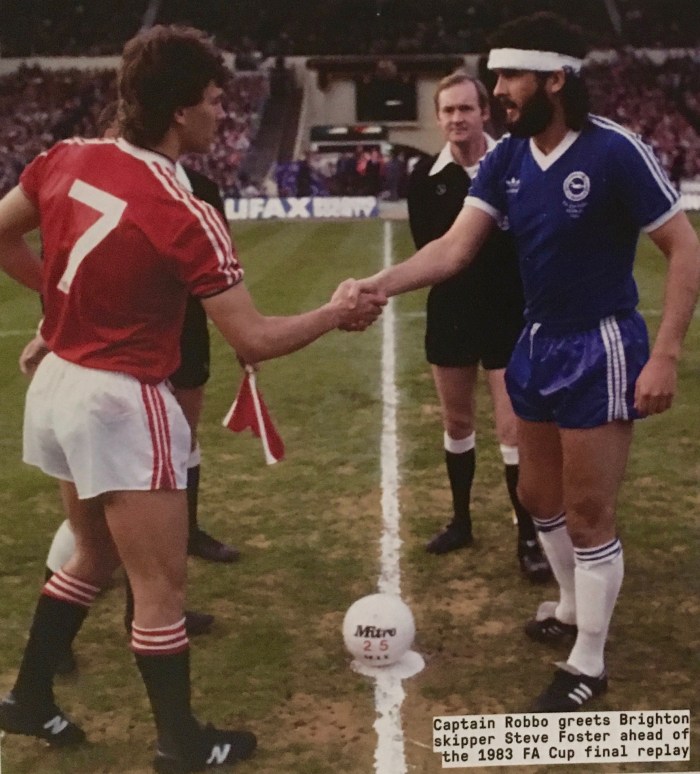
Foster, of course, eventually got his Wembley chance in the replay but with a rampant Manchester United running out easy 4-0 winners, their fans also rather cruelly derided the Albion skipper with the chant I can still hear ringing around Wembley that evening: “Stevie Foster, Stevie Foster, what a difference you have made!”
In truth the whole defence lacked balance in the replay because manager Melia had elected to fill the right-back berth vacated by injury to Chris Ramsey with the left-footed Steve Gatting. He figured Stevens couldn’t be moved from the centre where he had performed so well on the Saturday, but it was a mistake, especially as Stevens had often played right back previously.
The relegation that went in tandem with Albion’s Wembley loss sparked the beginning of a big clear-out of the best players. First to go was Stevens, closely followed by Michael Robinson.
It wasn’t until the following March that Foster followed them through the exit, although, according to Foster, he might have gone sooner – even though he didn’t want to leave; a point he made clear in an interview with Match Weekly shortly after he signed for Villa for £150,000.
“I never wanted to move,” he said. “I had nearly seven years of my contract to run at Brighton and would have quite happily played out my career there. It’s a great little club.
“But economies dictated otherwise and, although manager Chris Cattlin wanted to keep me, he was under pressure to sell me and help ease the club’s financial problems.
“It was a wrench to leave Brighton because the club has treated me tremendously well and I’ve had some great times there – not least the FA Cup run last season.”
Cattlin had a slightly different take about the transaction in his matchday programme notes. “I feel that Steve Foster has been a fine player during his four-and-a-half years at the Goldstone, but I felt that the time was right and the offer good enough to let him go,” he said.
“I hope the move will benefit both Steve and the club. I hope it rejuvenates his career because he has been unlucky with injuries this season. It gives me breathing space for Eric Young to develop and it will also allow me to strengthen other positions if necessary.”
In a rather oblique reference to the need to get rid of high-earning players, Cattlin added in another matchday programme article: “Certain players have left Brighton in moves which I feel are important for our future. Salaries and bonuses of individual players are confidential and obviously I cannot disclose details, but the moves I have made I am certain are right.”
He added: “I can’t explain all the matters that have been considered but I will once again emphasise that we are building for the future and every move I make in the transfer market is being made with this in mind.”
Foster revealed that Villa boss Tony Barton, a former coach at Foster’s first club, Portsmouth, had tried to sign him twice before, but the clubs hadn’t been able to agree on a fee. Eventually, the transfer saw defender Mark Jones (who’d made seven top-flight appearances for Villa that season) move in the opposite direction, in addition to a £150,000 fee.
Barton wanted Foster to tighten up a leaky defence, to fill the position previously occupied by former European Cup winning centre-half Ken McNaught, who had moved to West Brom.
The relatively inexperienced Brendan Ormsby had been playing alongside McNaught’s former partner, Allan Evans, and the signing of Foster put his nose well and truly out of joint. “It’s obvious that I’m just going to be used as cover for Steve Foster or Allan Evans now and so it’s probably in my best interests to try and find another club,” he told Match Weekly.
As it turned out, it was Barton who was ousted; Ormsby stayed, and new manager Graham Turner decreed it would be Foster who was the odd one out. But I jump ahead too soon.
Foster’s arrival at Villa Park as featured on a matchday programme cover
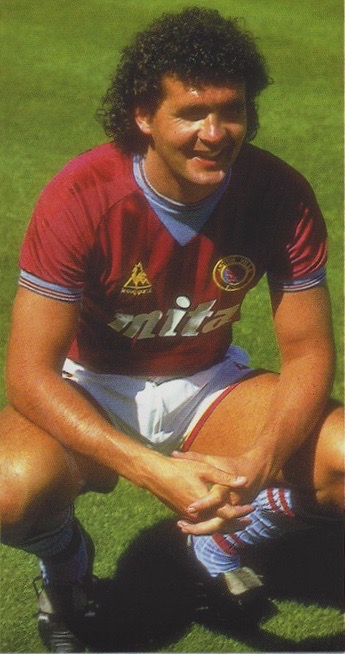
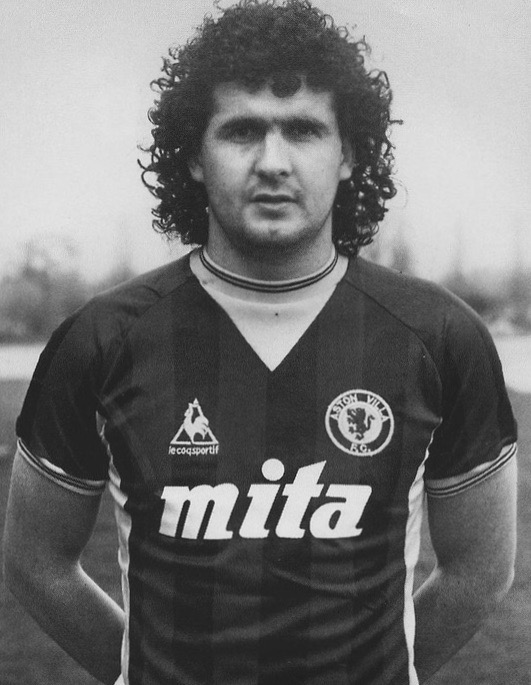
A picture of Foster being introduced to the Villa faithful appeared on the front cover of the programme for the 17 March home game against Nottingham Forest although he didn’t make his Villa debut until 14 April 1984, away to Leicester City, which ended in a 2-0 defeat.
Foster made seven appearances by the end of the season and he got on the scoresheet in only his third game, netting together with future Albion player Dennis Mortimer, in a 2-1 win over Watford on 21 April.
Villa finished the season in 10th place but it wasn’t good enough for the erratic chairman Ellis. Suddenly Foster found the man who signed him had been sacked, and the side Barton had led to European Cup success was gradually dismantled.
To the astonishment of the Villa faithful, Barton was succeeded by former Shrewsbury Town boss Turner.
Foster played 10 games under the new boss, and scored twice, once in a 4-2 win over Chelsea on 15 September and then again the following Saturday in a 3-3 draw away to Watford.
He’d started the season alongside Evans but Turner then offered a way back to Ormsby. While Foster played a couple of games alongside Ormsby, Turner preferred Evans and Ormsby together, making the new man surplus to requirements.
His last game for Villa was away to Everton on 13 October and the following month he was sold to Luton for £70,000 – less than half the fee Villa had paid for him eight months earlier. Foster simply put it down to his face not fitting with the new man.
It was a completely different story with Luton boss David Pleat and Foster’s time at Kenilworth Road coincided with the club’s most successful period in their history, even though Pleat left to manage Spurs.
Alongside representing his country, Foster said the best moment of his career was captaining the Hatters as they won the League Cup (then sponsored by Littlewoods) at Wembley in 1988 with a 3-2 win over Arsenal, his former Brighton teammate Danny Wilson scoring one of their goals (Brian Stein got the other two).
They reached the final of the same competition the following year too, but on that occasion lost 3-1 to Nottingham Forest. By then Foster was assistant manager to Ray Harford, and it looked like he was on a path to become a boss in his own right.
But that summer, when his old Albion captain, Horton, who had taken over from Mark Lawrenson as the manager of Oxford United, asked him to join him as a player at the Manor Ground, he was unable to resist and a new chapter in his career began.
It meant a drop down a division but Foster accepted the challenge and went on to play more than 100 games for United, many being quite a struggle as the side fought for survival at the foot of the second tier.
In the autumn of 1991, injury sidelined Foster from the U’s team and he believed it could have been the end of his career.
However, when the following summer he was contemplating whether or not to retire, he gave Brighton boss Barry Lloyd a call and asked if he could keep his fitness going by joining in pre-season training with the Seagulls.
Lloyd could see that the former skipper was still able to perform and, although the club was in a downward spiral, Foster seized the opportunity to extend his career and help out his old side.
Another veteran of that side, Clive Walker, told Vignes for A Few Good Men: “Fozzie might not have been so mobile then but his positional sense was absolutely brilliant, as was his ability in the air.”
Foster said: “Funnily enough during that second period I played probably some of my best football. I had to because of the position the club was in. There was no money so you had to pull out all the stops.”
Foster continued to play after Lloyd had departed, and he vented his anger publicly about the off-field shenanigans new boss Liam Brady was having to operate under.
Foster eventually called it a day at the end of the 1995-96 season, saddened at the club’s plight. He was granted a testimonial match against Sheffield Wednesday, played as a pre-season friendly in July 1996. Throughout Foster’s career he had continued to live in Hove and he retains his affection for the Albion to this day.
During his second spell at the club, Foster was the PFA rep and he had to deal with the heartbreak of telling the parents of a young player (Billly Logan) that an ankle injury was going to end his career. The youngster got just £1,500 compensation.
As a result, after his own playing days were over, Foster set up an insurance business (Pro-Secure) which continues to this day, making sure players are properly covered and get suitably recompensed if things don’t turn out as they’d hoped.
Although Foster hasn’t always been popular with the Albion’s hierarchy (courtesy of suggested involvement in potential takeovers), his association with the club hasn’t dimmed and Seagulls fans of two generations took him to their hearts for his on-field performances and leadership spanning a total of 332 games.
• Pictures from my scrapbook, the Albion matchday programme over several seasons, and some online sources.
DEFENDER Gary Borrowdale couldn’t have been more aptly named for a loanee which is just as well because he found himself in that situation half a dozen times over five years.
He made a temporary switch to Brighton from QPR in March 2009 to fill the spot vacated when Albion’s regular left-back Jim McNulty suffered a shocking injury in a 4-0 home defeat to Crewe Alexandra.
While McNulty needed an operation to remove a kidney, former England under 20 international Borrowdale had the chance to resurrect his flagging career with the Seagulls.
For a player who’d clocked up 100 appearances for Crystal Palace by the time he was 21, there was the inevitable ‘noise’ about helping out the arch rivals, but Borrowdale just wanted some game time, and he was one of five debutants who pulled on Albion’s sky blue second kit for the game at Brisbane Road on 7 March 2009.
Brighton lost that match 2-1 but, under Russell Slade’s astute stewardship, Borrowdale acquitted himself well during 12 matches through to the end of the season and the Albion just managed to retain their third-tier status.
“I made my debut for Palace at 17 and played my first game in the Premiership at 18, so it was a great start and Palace will always be dear to me as a result,” Borrowdale told Spencer Vignes for a matchday programme article.
“The highlight of my career would be the promotion I had with Palace when we went from the Championship to the Premiership,” he said, referring to the play-off win over West Ham, the day before Albion beat Bristol City in their own divisional play-off.
Borrowdale returned to west London after his spell on the south coast but in March 2010 he went on loan to Charlton Athletic and the following year had temporary spells at Carlisle United and Barnet.
His league career seemed to be over when QPR released him in June 2012 and he went over to Northern Ireland to join second tier outfit Carrick Rangers.
In January 2014, he looked to have got a foothold back in the English professional game when loaned by Margate to Gillingham, but he didn’t play any first-team games and was released at the end of the season.
Former Albion boss Peter Taylor told the club’s official website: “He’s done very well, lost weight every week and looked fitter every week.
“I just don’t think he’s ready for League One football, especially considering if we have to play Saturday and Tuesday. As a result, I have decided to let him go.”
Borrowdale then linked up with Greenwich Borough, initially as a player, before becoming a coach.
Born in Worcester Park, south London, on 16 July 1985, Borrowdale came through the youth ranks at Selhurst Park and Trevor Francis handed him his debut for Crystal Palace in December 2002.
When Iain Dowie took over as manager, Borrowdale quickly became a regular in the first team. He also represented England at each of the age groups from 16 to 20, playing alongside the likes of Gary Cahill in defence.
In a 2-2 draw with the Netherlands, played at Turf Moor, Borrowdale’s teammates included fellow Palace youngster Scott Flinders in goal and future Albion player Will Hoskins.
Borrowdale won Palace’s Young Player of the Year award in 2006-07, but, when Dowie moved on to manage Coventry City, Borrowdale joined him there, a tribunal fixing the transfer fee at £650,000.
The move didn’t work out, though, and, with Dowie gone, Borrowdale was sidelined, eventually being sent out on loan to Colchester United and then QPR.
Paulo Sousa took him on loan in November 2008 and, although he didn’t feature, made the move permanent in January 2009 on a three-and-a-half-year deal. He made just 22 appearances for QPR during that time.
• Pictures as featured in the Albion matchday programme.
BRIGHTON boss Brian Clough turned up at Burnley to capture the signings of two of their fringe first team players – and ended up having pie and chips with the groundsman!
When Clough arrived at Turf Moor, he found manager Jimmy Adamson, chairman Bob Lord and secretary Albert Maddox were nowhere in sight, it being lunchtime.
In their absence, as recounted to respected writer Dave Thomas, groundsman Roy Oldfield made the famous visitor a cup of tea, popped to a nearby chippy to get them both pie and chips and chatted all things football until the office re-opened after lunch.
Although Clough hadn’t got quite what he expected on arrival, his journey did bear fruit. In exchange for £70,000, he secured the services of left-back Harry Wilson, a 20-year-old who had made 12 appearances for the Clarets, and midfielder Ronnie Welch, 21, who had played one game.
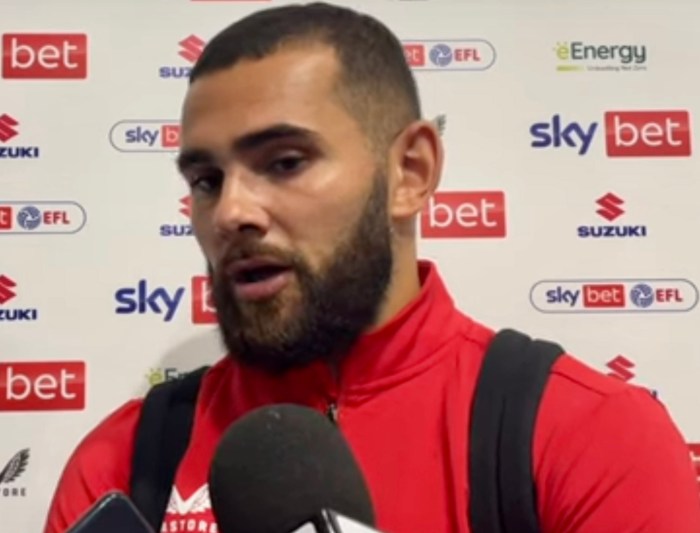
At the time, Clough was desperately trying to bring in new recruits to a beleaguered Brighton side that he and sidekick Peter Taylor had taken on in October 1973, a period covered in detail in a recent book, Bloody Southerners, by author and journalist Spencer Vignes.
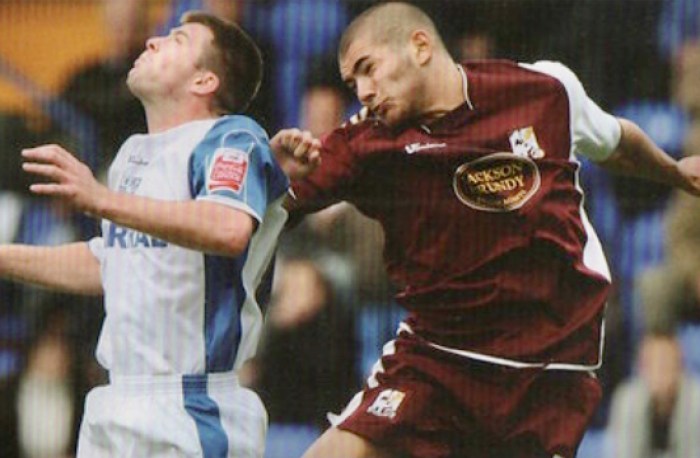
The man who only the season before had led unfashionable Derby County to the First Division Championship, couldn’t quite believe what he had inherited at Third Division Albion.
The players seemed bewildered by what the new celebrity boss expected of them.
Heavy defeats – 4-0 to non-league Walton and Hersham in the FA Cup; 8-2 at home to Bristol Rovers and 4-1 away to Tranmere Rovers in the league – reflected the disarray.
Clough and Taylor weren’t slow in pointing the finger. Their only solution was to find replacements – and quickly.
Former Manchester United reserve Ken Goodeve was first to arrive, from Luton Town, although he failed to impress and made only a handful of appearances before joining Watford at the end of the season.
Goalkeeper Brian Powney was axed in favour of former England under 23 international, Peter Grummitt, initially on loan from Sheffield Wednesday.
Experienced left-back George Ley never played for the Albion again after the defeat at Tranmere, while utility man and former captain, Eddie Spearritt, also lost his place (although he eventually forced his way back into the side briefly).
Lammie Robertson, who knew the pair from his early days at Burnley, was asked to introduce them to their new teammates in the dressing room before an away game at Watford (they’d not been signed in time to play).
Robertson told Spencer Vignes in a matchday programme interview how Wilson was sporting a rather loud checked suit at the time and, in his own inimitable style, Clough boomed out: “Flipping hell, I never want to see that suit again.”
Needless to say the players laughed out loud, only for Clough to say: “What the hell are you all laughing at? They’ll be in the team next week.” And sure enough, they were.
Wilson and Welch made their debuts against Aldershot in a home game on Boxing Day when a crowd of 14,769 saw Albion slump to their fifth successive defeat, although at least the deficit this time was only 1-0.
A win finally came in the next game, a 1-0 success at home to Plymouth Argyle – Ken Beamish scoring the solitary goal.
In a 2010 matchday programme article, Wilson said: “I really didn’t want to go to Brighton. No disrespect but I loved it up at Burnley.
“The people there had been so friendly and helpful when I arrived from the North East so it broke my heart to leave. That said, I thoroughly enjoyed my time at Brighton and met some fantastic people, so, looking back now, I’m glad that Jimmy Adamson let me go.”
In the Evening Argus, reporter John Vinicombe purred about the impact of the new recruits from Burnley, saying Wilson “is looking something of a fire-eater. He has a rare zest for the game and relishes the close, physical contact that is synonymous with his position.
“He knows how to destroy and create, and does both in a manner befitting a five-year background at the academy of fine footballing arts (editor’s note: at the time, Burnley had a reputation for producing highly-talented young players).
“His colleague from Turf Moor, Ronnie Welch, is not so completely extrovert, but is no less involved in midfield, and has a fine turn of speed. He made one mistake through trying to play the ball instead of hoofing it away, but this can only be described as a ‘good’ fault.”
Further signings followed and the ship was steadied. Wilson kept the no.3 shirt through to the end of the season. But Welch made only 36 appearances for Albion before Taylor, by then under his own steam, traded in him and fellow midfielder Billy McEwan as a makeweight in the transfer that brought full-back Ken Tiler to the Goldstone from Chesterfield.
Wilson, meanwhile, became a mainstay in Albion’s left-back spot for three years, including being ever-present in the 1975-76 season.
Ever-present Wilson in action against Millwall at The Den
Suited for England!
Born in Hetton-le-Hole, near Durham, on 29 November 1953, Wilson played for Durham County Schools and made four appearances for England schoolboys (under 15s) in the 1968-69 season. He was taken on as an apprentice at Burnley before signing professional forms in December 1970.
In 1971, he earned an England Youth cap going on as a sub for Coventry’s Alan Dugdale in a 3-2 defeat against Spain in Pamplona. Don Shanks also played in that game.
He made his first-team debut at home to Chelsea on 26 April 1971 and the last of his 12 appearances for the Clarets was on 3 April 1972: away to Sunderland.
Young apprentice Wilson with experienced pros John Angus and Colin Waldron
He was part of Alan Mullery’s Third Division promotion-winning squad in 1976-77, although he was restricted to 22 appearances. The arrival of the experienced Chris Cattlin meant he was no longer first choice left-back, although in several games they both played – the versatile Cattlin being equally at home as right-back.
A bare-chested Wilson was pictured (above) in the Albion dressing room alongside Mullery enjoying the celebratory champagne after promotion was clinched courtesy of a 3-2 win over Sheffield Wednesday on 3 May 1977. But that game was his Goldstone swansong.
He’d made a total of 146 appearances for the Albion – as well as chipping in with four goals – but when Mullery signed Mark Lawrenson and Gary Williams from Preston that summer, Wilson went in the opposite direction along with Graham Cross.
Only six months after arriving at Preston, Wilson was badly injured in a road accident after his car skidded on black ice and collided with a transit van. He suffered a punctured lung and damage to his knees. Doctors told him he wouldn’t play again, but he proved them wrong and ended up spending three years at Preston, playing 42 games.
“I suppose I was lucky to be alive,” he said in an Albion matchday programme article. “I lost a couple of yards of pace, but then again I ws never exactly the quickest of players.”
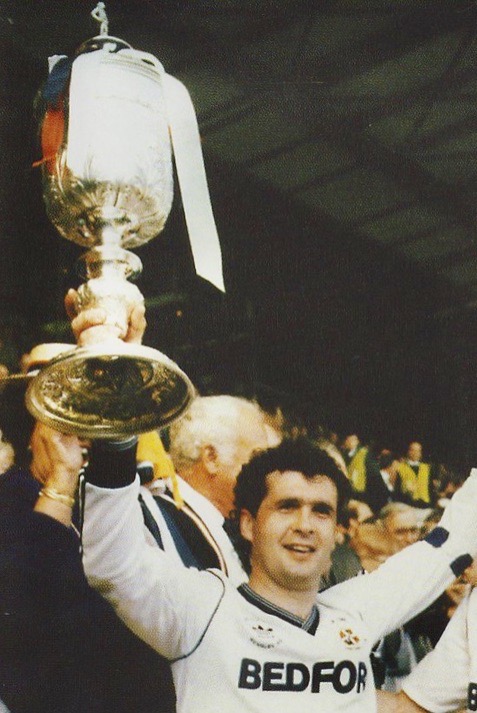
With his best days behind him, he moved back to his native north-east in 1980 to play for Darlington, making 85 appearances in three years.
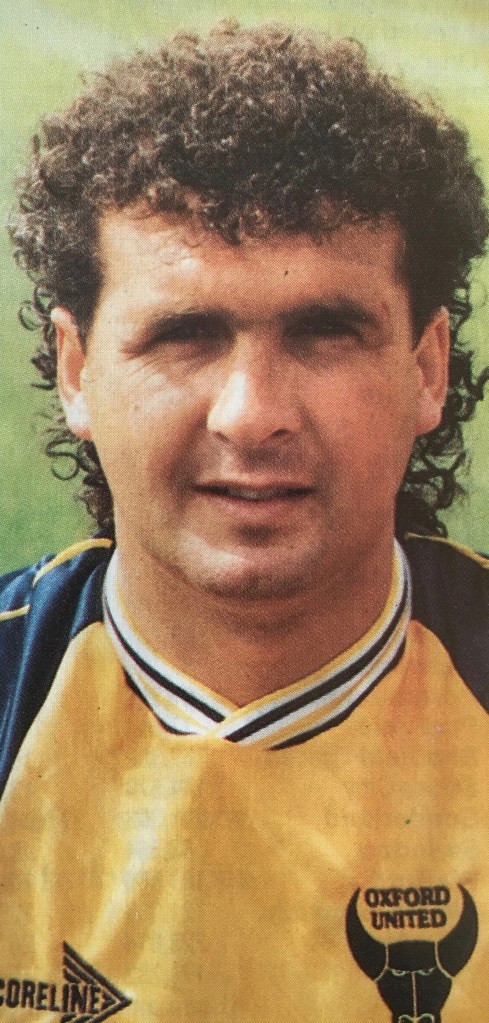
He stayed in the north east in 1983, switching to Hartlepool for a season, but only played 16 times for them before dropping out of the league to play for Crook Town.
According to The Football League Paper, Wilson stayed in the game as manager of Seaham Red Star and, in 1988-89, Whitby Town.
He then worked as a community officer for Sunderland before joining the coaching staff at Burnley in the 1990s.
When Chris Waddle took over as manager, Wilson was sacked but he took the club to an industrial tribunal, which found in his favour.
He later worked for his long-term friend, Stan Ternent, at Bury, and as a monitor for the Football League, a job that saw him checking that the right procedures were being followed by the youth development set-ups of clubs in the north-west.
Wilson was in the news in 2007 when Ternent appeared at Lancaster Crown Court accused of assaulting Wilson’s son, Greg, on the steps of Burnley Cricket Club (a venue familiar to visiting supporters as a popular watering hole before games at the neighbouring football ground).
Greg Wilson required hospital treatment for a deep cut above his left eyebrow and needed nine stitches in his forehead.
Ternent said he had accidentally clashed heads, denied causing actually bodily harm, and was cleared by a jury.
A CARTILAGE operation when he was just 17 changed Gary Williams’ career, but, after success at Brighton, it eventually brought his playing days to a premature end at Crystal Palace.
Originally a winger, the operation, when he was an emerging player at Preston North End, took the edge of his pace and led to him converting into an overlapping left back.
Thankfully, as Brighton fans would witness, his ability to score important goals never left him.
Born in Litherland, Liverpool, on 8 March 1954, Gary Peter Williams had unsuccesful trials with Liverpool and Coventry City before starting his career with non-league Marine. He caught the eye of a scout who’d gone to watch a different player and ended up signing for Preston in April 1972.
Williams made his Preston debut in the final game of the 1971-72 season as Preston drew 2-2 at home to Swindon.
He then played in the opening match of the following season, against Aston Villa, but had to wait until the end of March at Brighton for his next appearance.
After his cartilage op, and just when he thought he was set to be released aged 18, Preston’s reserve team left-back got injured, Williams filled in, did a good job, and it was the platform he needed to launch his career.
“Because I used to be a winger, I knew which way to shepherd them to make it difficult to cut inside,” he told the journalist and author Spencer Vignes in his 2005 book, A Few Good Men.
It was the legendary Bobby Charlton, briefly trying out management at North End, who gave Williams his big break into first team football, selecting him at left back for the final eight games of the 1974-75 season.
Young Gary Williams with former England World Cup winner, Nobby Stiles, at Preston, and scoring the winner at Sunderland.
Former Everton boss Harry Catterick took over from Charlton and made Williams the first choice left back in 1975-76. The following season his outstanding performances earned him the Player of the Season award and on 22 March 1977, he made his 100th league appearance in a 1-0 defeat at Selhurst Park.
By then, Williams was catching the eye of clubs higher up the league and his final game for Preston was the season-ending fixture at Shrewsbury on 14 May, which North End won 2-1.
In July 1977, Preston accepted a £45,000 fee from Brighton to sign Williams shortly after his teammate Mark Lawrenson joined for £100,000. Albion’s Graham Cross and Harry Wilson moved in the opposite direction to fill the positions they’d vacated.
Williams told Vignes how he’d always enjoyed playing against Brighton because of the size of the crowds they got.
“To run out in Division 3 at the Goldstone in front of a full house was amazing. You knew you were in for a hard time but the atmosphere was just infectious,” he said.
Manager Alan Mullery had called him and asked him to get himself down to Brighton and the club booked a room in the Metropole Hotel, the sea view helping to make up his mind about the move.
“I wanted to better myself and get into the First Division but football is such an up and down game that it’s not too wise to look too far ahead,” Williams told Football Weekly News magazine in 1980.
The start to his Albion career was somewhat inauspicious. Although he came on as a substitute in the opening game, a league cup tie away to Cambridge United which finished 0-0, injury then prevented him making his league debut for two months.
It finally came in a 2-0 win away to Sunderland on 1 October 1977 and he then missed only one game through to the end of the season, appearing a total of 34 times as the Seagulls finished fourth, missing promotion on goal difference to Tottenham.
The following season saw Williams play every game, scoring twice, as Brighton were runners-up to Palace gaining promotion to Division One for the first time.
In Albion’s first season amongst the elite, Williams was again ever present – indeed, he remarkably played 146 consecutive games during his time at the club.
The Everton-supporting full-back got the chance to play against his boyhood side in December 1979 and three months later he scored the first of two cracking, memorable Brighton goals in the top division as the Seagulls finished in 16th position.
On 29 March 1980, at the Goldstone, he lashed a shot from 30 yards that flew past England goalkeeper Peter Shilton to earn Albion the double over European Cup holders Nottingham Forest.
Williams beats Nottingham Forest full back Viv Anderson at the Goldstone and, together with Gary Stevens, tries to thwart Liverpool’s Kenny Dalglish.
Williams admits he was about to pass it until skipper Brian Horton urged him to ‘hit the ****ing thing!’
“When you hit the ball that sweetly, you don’t even really feel a thing,” he recounted to Vignes, in that 2005 interview. “By the time I looked up, it was heading for the top corner.”
Although Forest boss Brian Clough declared it a fluke in a post-match interview, because the game took place in front of the TV cameras, it was selected as one of the goals of the season.
Thirteen months after that goal, Williams struck another beauty, this time to silence the Sunderland faithful at Roker Park.
It clinched Albion a 2-1 win and was part of a late flurry of good results which saw the Seagulls escape the clutches of relegation.
Describing it to Vignes, he said: “It was our last attack of the game. Gordon Smith knocks a good ball into the penalty area and I’ve just taken a gamble and gone up from the halfway line. I say so myself but it was a really good volley.
“It fell to me around 10 yards out and you hear the net ripple because the crowd went silent.”
While it contributed to Albion staying up, that summer saw the departure of Mullery, Lawrenson and Horton and the arrival of Mike Bailey into the manager’s chair. It was to signal the end of Williams’ Brighton career.
Bailey favoured a far more defensive approach to his predecessor and brought in the experienced Northern Ireland international Sammy Nelson, who had been displaced at Arsenal by the arrival of Kenny Sansom.
Williams only learned about the signing through The Argus and, when he confronted the manager about it, was told Nelson was only going to be a squad player.
“I’m thinking ‘bollocks’ but he didn’t play him straightaway,” Williams recounted. “He couldn’t drop me because I wasn’t doing anything wrong.”
Ironically, however, he lost his place after bombing forward and scoring in a 4-1 win over Manchester City. Astonishingly, Bailey was annoyed that he had been too adventurous!
With Nelson keen to carry on playing and earn a place in Northern Ireland’s 1982 World Cup squad, it meant Williams was left to languish in the reserves.
By the end of the season, though, Mullery, by now manager of Crystal Palace, came to Willams’ rescue and gave him a chance to resume first team football.
In a swap deal that saw winger Neil Smillie arrive at the Goldstone, Williams moved to Selhurst.
But after only 10 games he was forced to have an operation on his troublesome knee. Expert advice steered him towards a painful decision but he took it and retired from the game aged just 29.
Williams told the Argus: “The trouble with my knee is really wear and tear. I had a cartilage out at 17, and I was told after the operation last October a lot of harm might be caused if I went on playing.”
In A Few Good Men, Vignes gained a great insight into a northern lad who fell in love with the Albion and remains a fan to this day.
“I was very lucky in that I played right at the beginning of the era of overlapping full-backs,” Williams told him. “It was beginning to creep in when I first came onto the scene, and I had an advantage as I’d started my career as a left-winger. I knew all about coming forward.”
MARK LAWRENSON was without doubt in my mind the best player ever to play for Brighton and Hove Albion. Peter Ward was exceptional but Lawrenson did it for Brighton and went on to have a glittering career with Liverpool, the top club in the country at the time.
And, whatever your thoughts about his contribution as a pundit – and many are very disparaging – you can’t take away his longevity on our TV screens and across our media.
Although now slightly less prominent as a TV pundit, for a good many years, Lawrenson reprised his successful Liverpool central defensive partnership with Alan Hansen in the BBC Match of the Day studios.
But where did it all begin? Born on 2 June 1957 in Penwortham, Lancashire, Lawrenson joined nearby Preston at 17 in 1974, who at the time were managed by the legendary Bobby Charlton.
Lawrenson made his full debut for the Lilywhites the following year, two months before his 18th birthday. However, it was Charlton’s fellow World Cup winner, Nobby Stiles, to whom Lawrenson was most grateful.
“I was a winger when I joined Preston, while he was coach, and he was the one who converted me to my present position – in the middle of the back four,” Lawrenson told Keir Radnedge in Football Weekly News.
“Nobby was very good with the youngsters. He was almost like a father-figure. He commanded respect not only because of what he’d achieved himself but because of the way he’d help iron out your faults.”
At the age of 19, and thinking he’d never be good enough to play for England, Lawrenson opted to play for the Republic of Ireland when player-manager Johnny Giles (perhaps not coincidentally, Nobby’s brother-in-law) found out that he qualified to play for them through his grandfather.
That debut for Ireland in April 1977, in a 0-0 draw with Poland, came at the end of a season in which he was voted Preston’s Player of the Year.
Within weeks, he joined the Albion for £112,000 (£100,000 + VAT @ 12 per cent) after Brighton manager Alan Mullery persuaded Albion to outbid Liverpool to get their man.
Mullery recalled in his 2006 autobiography how he had taken the board of directors to see Lawrenson perform superbly in an end-of-season game at Crystal Palace, where he marked their new star striker Mike Flanagan out of the game.
Lawrenson recollects how he was on an end-of-season ‘jolly’ in Spain with his Preston team-mates when Brighton chairman Mike Bamber and director Dudley Sizen turned up and ‘sold’ the club to him in a Benidorm beachside bar.
There was nearly a hitch in the deal when his medical showed high sugar levels in his blood – but it turned out he had been drinking blackcurrant-flavoured Guinness while on the Spanish holiday.
Mullery was building on the success of guiding the Seagulls to promotion from Division Three in his first season in charge, and the young defender replaced the experienced Graham Cross, who went to Preston in part-exchange.
Shortly after signing Lawrenson, Mullery told Shoot magazine: “I know a lot of people have not heard too much about him yet. But they will – believe me, they will. He is only 20, is big and strong and will make his mark in a big way.”
And, in his autobiography, Mullery said: “Any manager would love to have a player of Mark’s ability in their side. He had a calm, strong temperament, he never caused any problems and he always performed brilliantly on the field. His presence helped to lift the team to a whole new level of performance in the 1977-78 season.”
Lawrenson made his Brighton debut on the 20 August 1977 in a 1-1 draw against Southampton at The Dell and went on to make 40 league appearances by the end of his first season at the club.
The following season, when Albion went one better and earned promotion to the top division for the first time, Lawrenson was a stand-out performer. In his book, A Few Good Men, author Spencer Vignes said: “His timing in the tackle and ability to read the game belied his relative youth, but what really caught the eye was his skill on the ball, which, for a centre-back still earning his wages in English football’s second tier, was little short of remarkable.”
Skipper Brian Horton told Vignes: “The way he used to bring the ball out from the back had to be seen to be believed.”
In a special Argus supplement of April 1997, to mark Albion’s departure from the Goldstone, Lawrenson was interviewed by Mike Donovan, and told him: “The Goldstone was a great place to play and I was extremely happy there.
“It was an excellent team that played good football the way it should be played – by passing it around. Also, we had a great team spirit, mainly because a lot of the team were outsiders coming in and stuck together. We all played and socialised together.”
Unfortunately, Albion’s first season amongst the elite was only five games in when Lawrenson received a serious injury in a clash with Glenn Hoddle at White Hart Lane.
Badly torn ankle ligaments and a chipped bone was the diagnosis and it sidelined Lawrenson for 12 matches, although his absence created an opportunity for young Gary Stevens.
When Lawrenson was fit to return, Mullery sprung a surprise by utilising him in midfield, but it was an inspired decision and he stayed there for the rest of the season, helping Albion to finish a respectable 16th of 22.
He went on to make 152 league appearances by the end of 1980-81.
It was his sale to Liverpool in the summer of 1981 that was part of the reason Mullery’s reign at the club came to an end. Mullery had negotiated with Ron Atkinson to sell him to Manchester United with two United players coming to Brighton as part of the deal.
But, behind his back, chairman Bamber had been talking to Liverpool and, in exchange for what was then a Liverpool club transfer record of £900,000, he was destined to be heading back to the North West with midfielder Jimmy Case coming South as part of the deal.
Interestingly, though, Lawrenson revealed in his autobiography how new manager Mike Bailey had actually made him Albion captain, but then asked him how he saw his future, which sowed a seed of doubt about the club’s intentions.
“I don’t know if there was a financial crisis and they were looking for a big transfer fee from my sale to sort themselves out, but the uncertainty did unsettle me,” he wrote. Lawrenson was sent off in an ill-tempered pre-season friendly (against FC Utrecht in the Dordrecht Tournament) and put it down to his personal frustration.
“On our return flight, there was a message that Terry Neill of Arsenal was waiting to meet the chairman at Gatwick,” Lawrenson recalled. “Somehow they missed each other and the next day there was talk of me going to Manchester United.
“But then Mike Bailey asked me if I would meet Liverpool, and I travelled to the Aerial Hotel at Heathrow to meet Bob Paisley, Peter Robinson and Liverpool chairman John Smith.
“Terry Neill was, at the time, waiting in the next hotel in case discussions broke down. He missed out because it only took me 15 minutes to agree to move to Liverpool.
“I travelled North and had a medical at 11.30 at night. I even took the registration forms to the League offices myself, because they are only a few doors away from my mother’s home at St Annes.”
Lawrenson went on to form a formidable central defensive partnership with Hansen after England centre back Phil Thompson suffered an injury, but, as he had showed at Brighton, he was versatile enough also to play at full back or in midfield.
Indeed, Lawrenson made his first start for Liverpool at left-back in a 1-0 league defeat to Wolves. In his first season, Liverpool won the League championship and the League Cup. They won it again in 1982 and retained both for another two seasons, becoming only the third club in history to win three titles in a row. They also added the club’s fourth European Cup in 1984.
Many believed Lawrenson and Hansen were the best central defensive partnership in English football by the time Liverpool clinched the League and FA Cup “double” in 1986.
But Lawrenson was being put under pressure by young centre back Gary Gillespie and an Achilles tendon injury in 1988 prematurely ended his career after 332 appearances and 18 goals, although he earned a fifth and final title medal when that season ended.
Lawrenson tried his hand at management at Oxford United in 1988 but, in almost a mirror image of the situation over his own transfer from Brighton, he resigned after their star striker Dean Saunders, the former Albion player, was sold by the board of directors without Lawrenson’s blessing.
Lawrenson later managed Peterborough United for 14 months between September 1989 and November 1990, but it was a largely unsuccessful tenure.
Apart from one brief foray back into football as a defensive coach at Newcastle during Kevin Keegan’s first reign in the North East, Lawrenson’s involvement since has been one step removed as a pundit and newspaper columnist.
At the 2018 World Cup, Lawrenson particularly hit the headlines when many observed his cantankerous and sarcastic observations were just too much.
Never shy of voicing his opinions, they once led to him losing what at the time was a trademark moustache!
He was so convinced that Bolton would be relegated that he said live on Football Focus that he would shave it off if they proved him wrong, which they did!
In 2003, my friend Andrew Setten somehow blagged tickets which gave us the opportunity to go into the exclusive Football Association area at the FA Cup Final between Arsenal and Southampton at the Millennium Stadium and, all those years later, I finally got the chance to meet Lawro and to get his autograph.
• Pictures from Shoot magazine, cuttings from the Evening Argus and the matchday programme.