Through his Irish father Jim, Wythenshawe-born Byrne qualified to play for the Republic of Ireland and he won 13 of his 23 Republic of Ireland caps while a QPR player playing in the old First Division.
His place in the annals of QPR’s history was etched courtesy of following two other greats (Rodney Marsh and Stan Bowles) into the no. 10 shirt.
“I was always conscious of the traditions at Rangers and so I was dead proud to wear the Number 10,” he told qprreport in 2008. “I think I did the shirt justice most of the time.”
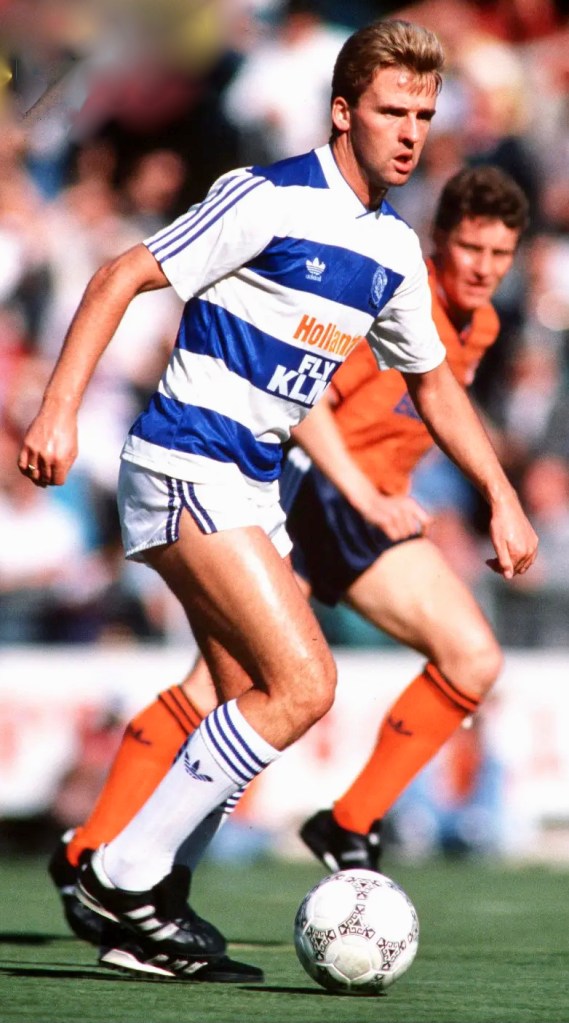
In the same way Brighton fans remember his highly effective striking partnership with Mike Small in the 1990-91 season, so QPR supporters recall his combination up front with Gary Bannister.
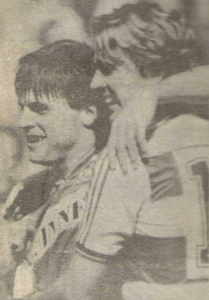
Bannister and Byrne
“I enjoyed playing up front with ‘Banna’,” he said. “He was a great centre-forward, right out of the top drawer. I don’t know how our partnership worked but we just seemed to have a good understanding.
“He was more of a prolific goalscorer than I was. He also had superb quality and awareness for bringing people into the game.”
Byrne, who later became a familiar voice as an expert summariser for BBC Radio Sussex coverage of Albion matches, has always been happy to indulge requests from Rs writers to look back on his four years at Loftus Road.
As would become something of a pattern in his career, it was an impressive performance playing against QPR that led them to sign him. He featured in a two-legged League Cup game for York City against Rangers, and he recalled the game at Loftus Road when talking to qprnet.com in 2013:
“It was so brilliant to play in that stadium under the floodlights and coming from York to run out at QPR was something to remember.
“Afterwards I said to our assistant manager Viv Busby that I would love to play here every week. Lo and behold a couple of weeks later I was!”
The man who took him to west London was none other than Alan Mullery, the former Brighton manager, during his unhappy six months as QPR manager.
It’s now generally recognised that some of the senior pros at the club were none too pleased with Mullery taking over from Terry Venables, who had moved to Spain to manage Barcelona. Byrne admitted: “It was difficult for me to fully understand having been signed by Mullery but you could feel it with some of the senior pros.
“The likes of Terry Fenwick, John Gregory and Steve Wicks were big Venables men and, understandably, as he was obviously a great coach. You got a feeling that a few of them weren’t overly impressed with Mullers at the time.”
As it turned out, Mullery’s time in charge came to an abrupt end and Byrne remembered playing under caretaker manager Frank Sibley before Jim Smith got the job permanently.
“Frank was lovely; he was a really nice man and probably too nice for football management,” said Byrne. “He really helped me a lot, he would always welcome a chat with you and put his arm round you to talk about your game. I had a lot of time for Frank.”
And of the former Birmingham and Oxford boss Smith, who went on to manage Newcastle and Portsmouth, among others, he said: “Smithy was brilliant. I loved playing for Jim. He loved you, he hated you but he would never ignore you or freeze you out.”
It was in 1986 when Byrne suffered the first of three losing experiences in Wembley finals. QPR went down 3-0 to Smith’s former club Oxford United
“Unfortunately we never turned up for the final,” Byrne told QPRnet. “I just remember that after we were introduced to the dignitaries I went off for the warm up and I had nothing in the tank. I had heavy legs before the game and I think a lot of the players felt like that.
“At the end of the day we didn’t perform and Oxford were better than us but there should be no excuses we were a better side on paper and we should have won.”
A far happier memory from that spring of 1986 happened three weeks previously when the Rs thrashed Chelsea 6-0 and Byrne scored twice (Bannister netted a hat-trick and Michael Robinson the other).
“I’ll never forget that day,” said Byrne. “It was just one of those occasions when everything went right for us.
“I remember one of my goals where I picked up possession on the halfway line. It was funny on that plastic pitch, because bodies would fall all around you if you got into your stride. So eventually I wriggled free and slotted a shot into the bottom corner.”
Another of his favourite QPR memories was scoring in two home games against Manchester United, the team he had supported as a boy. Recalling a 1-0 win in March 1986, he said: “I remember lobbing the ball over two defenders’ heads in the box. Then I flicked it back before shooting past Chris Turner in goal at the Loft End. It was great for me – especially being a Manchester lad as well.”
In much the same way as his move to QPR came about, it was in a couple of friendly matches against Le Havre that the French side liked what they saw of him and QPR were happy to accept their bid for the player.
“It was disappointing to leave QPR but I think it was probably the right time to go,” he recalled. Unfortunately, he broke a leg only three weeks into his stay with Le Havre. But when he was fit again, a few English clubs started watching his recovery with interest.
And it was following a friendly Brighton played against Le Havre that prompted Albion boss Barry Lloyd to bring Byrne back to England to play in early September 1990. He made his Seagulls debut for the reserves in a 1-1 draw with Charlton Athletic and then went on as a sub for the first team in Albion’s 3-2 home win over the same opponent 10 days later.
He scored on his first start, in a 2-1 win away to Blackburn Rovers, and on his first start at home he netted in a 3-3 draw with Swindon Town, who were managed by Ossie Ardiles.
Crocked in the last game of the league season against Ipswich
How the rest of that season panned out was covered in my previous post about Byrne, as were his subsequent moves, the most successful of which saw him play for Sunderland in the 1992 FA Cup final when Liverpool beat the Wearsiders 2-0.
“I scored in every round except the final then missed a sitter on roughly thirteen minutes twenty seconds; I see that one every day!” he told QPRnet.
Byrne’s future work as a podiatrist came about largely through the network provided by the Professional Footballers’ Association.
“When I finished playing football in the late 1990s, I was hoping to become a physio but couldn’t get a place at university to study it,” he explained. “Then the ex-Manchester United star Norman Whiteside advised me to look at the PFA’s course for podiatry, because he was a podiatrist himself. The PFA said they would help me with finance and backing.”
He went on to graduate from university in 2001 – gaining his BSC Honours degree was the hardest thing he’d done in his life, he said.
“My brain had been dormant for twenty years playing football, but I’ve been qualified now for nearly 10 years,” he said in a 2010 interview with Sussex Life. “I love my NHS career and also the private work I do and I get a lot of job satisfaction improving patients’ foot problems.”
And in his interview with QPRnet, he added: “I was lucky, I look back now and I had a good career, I played for some great clubs and whilst I might have had disappointments with finals I have got plenty of great memories.”
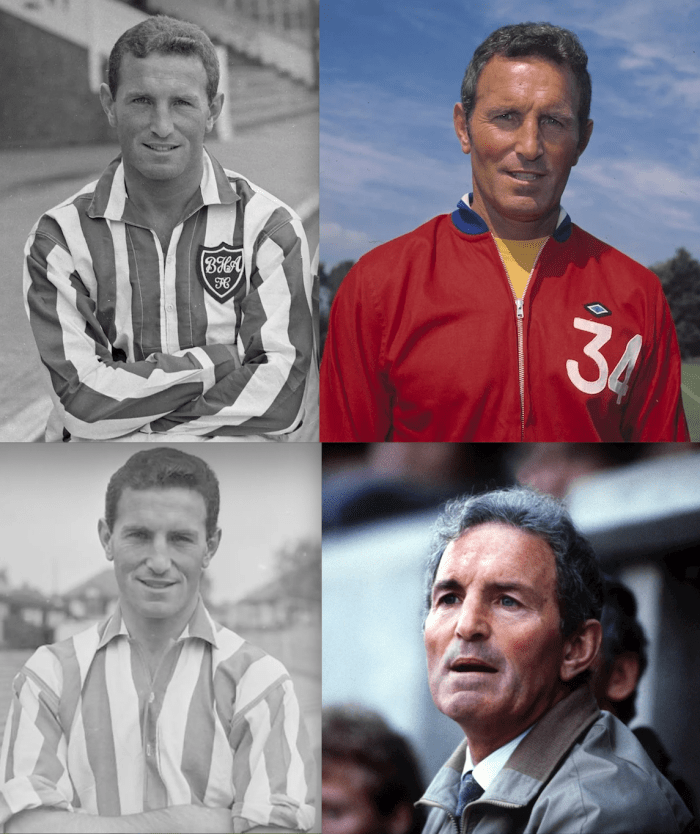
ALTHOUGH I wasn’t even born when Dave Sexton was winning promotion with Brighton, I remember him well as a respected coach and manager.
The record books and plenty of articles have revealed Sexton scored 28 goals in 53 appearances for Brighton before injury curtailed his playing career.
As a manager, he took both Manchester United and Queens Park Rangers to runners-up spot in the equivalent of today’s Premier League and won the FA Cup and European Cup Winners’ Cup with Chelsea.
On top of those achievements, he was the manager of England’s under 21 international side when they won the European Championship in 1982 and 1984, and worked with the full international squad under Ron Greenwood, Bobby Robson, Terry Venables, Glenn Hoddle, Kevin Keegan and Sven-Göran Eriksson.
Sexton coached under several England managers
On his death aged 82 on 25 November 2012, Albion chief executive Paul Barber said: “I know Dave was an extremely popular player during his days at the Goldstone Ground and, as a friend and colleague during my time working at the FA, I can tell you that he was held in equally high esteem.
“He was a football man through and through. I enjoyed listening to many of Dave’s football stories and tales during our numerous hotel stays with the England teams and what always came through was his great love and passion for the game.
“Dave was a true gentleman and a thoroughly nice man.”
Former West Ham and England international, Sir Trevor Brooking, who worked as the FA’s director of football development, said: “Anyone who was ever coached by Dave would be able to tell you what a good man he was, but not only that, what a great coach in particular he was.
“In the last 30-40 years Dave’s name was up there with any of the top coaches we have produced in England – the likes of Terry Venables, Don Howe and Ron Greenwood. His coaching was revered.”
Keith Weller, a £100,000 signing by Sexton for Chelsea in 1970, said: “I had heard all about Dave’s coaching ability before I joined Chelsea and now I know that everything said about his knowledge of the game is true. He has certainly made a tremendous difference to me.”
And the late Peter Bonetti, a goalkeeper under Sexton at Chelsea, said: “He was fantastic, I’ve got nothing but praise for him.”
One-time England captain Gerry Francis, who played for Sexton at QPR and Coventry City, said: “Dave was quite a quiet man. You wouldn’t want to rub him up the wrong way given his boxing family ties, but you wanted to play for him.
“Dave was very much ahead of his time as a manager. He went to Europe on so many occasions to watch the Dutch and the Germans at the time, who were into rotation, and he brought that into our team at QPR, where a full-back would push on and someone would fill in.
“He was always very forward-thinking – a very adaptable manager.”
Guardian writer Gavin McOwan described Sexton as “the antithesis of the outspoken, larger-than-life football manager. A modest and cerebral man, he was one of the most influential and progressive coaches of his generation and brought tremendous success to the two London clubs he managed.”
Born in Islington on 6 April 1930, the son of middleweight boxing champion Archie Sexton, his secondary school days were spent at St Ignatius College in Enfield and he had a trial with West Ham at 15. But, like his dad, he was a boxer of some distinction himself, earning a regional champion title while on National Service.
Sexton played 77 games for West Ham
However, it was football to which he was drawn and, after starting out in non-league with Newmarket Town and Chelmsford City, he joined Luton Town in 1952 and a year later he returned to West Ham, where he stayed for three seasons.
In 77 league and FA Cup games for the Hammers, he scored 29 goals, including hat-tricks against Rotherham and Plymouth.
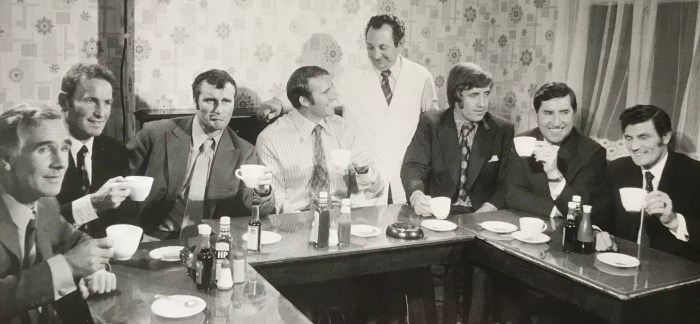
It was during his time at West Ham that he began his interest in coaching alongside a remarkable group of players who all went on to become successful coaches and managers.
He, Malcolm Allison, Noel Cantwell, John Bond, Frank O’Farrell, Jimmy Andrews and Malcolm Musgrove used to spend hours discussing tactics in Cassettari’s Cafe near the Boleyn ground. A picture of a 1971 reunion of their get-togethers featured on the back page of the Winter 2024 edition of Back Pass, the superb retro football magazine.
One of the game’s most respected managers, Alec Stock, signed Sexton for Orient but he had only been there for 15 months (scoring four goals in 24 league appearances) before moving to Brighton (after Stock had left the Os to take over at Roma).
Albion manager Billy Lane bought him for £2,000 in October 1957, taking over Denis Foreman’s inside-left position. Sexton repaid Lane’s faith by scoring 20 goals in 26 league and cup appearances in 1957-58 as Brighton won the old Third Division (South) title. But a knee injury sustained at Port Vale four games from the end of the season meant he missed the promotion run-in. Adrian Thorne took over and famously scored five in the Goldstone game against Watford that clinched promotion.
Nevertheless, as he told Andy Heryet in a matchday programme article: “The Championship medal was the only one that I won in my playing career, so it was definitely the high point.
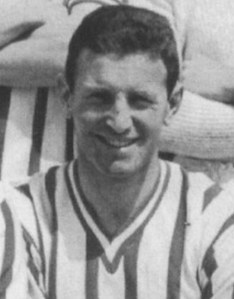
Sexton in Albion’s stripes
“All the players got on well, but a lot of what we achieved stemmed from the manager’s approach. It was a real eye-opener for me. We were a free-scoring, very attacking side and I just seemed to fit in right away and got quite a few goals. It was a joy to play with the guys that were there and I thoroughly enjoyed those two years.”
Because of the ongoing problems with his knee, he left Brighton and dropped two divisions to play for Crystal Palace, but he was only able to play a dozen games before his knee finally gave out.
“I suffered with my knee throughout my playing career,” said Sexton. “In only my second league game for Luton I went into a tackle and tore the ligaments in my right knee.
Knee trouble curtailed his Palace playing days
“I also had to have a cartilage removed. The same knee went again when I was at Palace. We were playing away at Northampton, and I went up with the goalkeeper for a cross and landed awkwardly, my leg buckling underneath me, and that sort of finished it off.”
In anticipation of having to retire from playing, he had begun taking coaching courses at Lilleshall during the summer months. Fellow students there included Tommy Docherty and Bertie Mee, both of whom gave him coaching roles after he’d been forced to quit playing.
Docherty stepped forward first having just taken over as Chelsea manager in 1961, appointing Sexton an assistant coach in February 1962. “I didn’t have anything else in mind – I couldn’t play football any more – so I jumped at the chance,” said Sexton. “It was a wonderful bit of luck for me as it meant that my first job was coaching some brilliant players like Terry Venables.”
The Blues won promotion back to the top flight in Sexton’s first full season and he stayed at Stamford Bridge until January 1965, when he was presented with his first chance to be a manager in his own right by his former club Orient.
Frustrated by being unable to shift them from bottom spot of the old Second Division, Sexton quit after 11 months at Brisbane Road and moved on to Fulham to coach under Vic Buckingham, who later gave Johan Cruyff his debut at Ajax and also managed Barcelona.
Perhaps surprisingly, Sexton declared in 1993 that the thing he was most proud of in his career was the six months he spent at Fulham in 1965. “Fulham were bottom of the First Division. Vic Buckingham was the manager. He had George Cohen, Johnny Haynes . . . Bobby Robson was the captain. Allan Clarke came. Good players, but they were bottom of the table, with 13 games to go.
“I did exactly the same things I’d been doing at Orient. And we won nine of those games, drew two and lost two – and stayed up. It proved to me that you can recover any situation, if the spirit is there.”
When Arsenal physiotherapist Mee succeeded Billy Wright as Gunners manager in 1966, he turned to Sexton to join him as first-team coach. In his one full season there, Arsenal finished seventh in the league and top scorer was George Graham, a player the Gunners had brought in from Chelsea as part of a swap deal with Tommy Baldwin.
When the ebullient Docherty parted company with Chelsea in October 1967, Sexton returned to Stamford Bridge in the manager’s chair and enjoyed a seven-year stay which included those two cup wins.
In a detailed appreciation of him on chelseafc.com, they remembered: “Uniquely, for the time, Sexton brought science and philosophy to football: he read French poetry, watched foreign football endlessly and introduced film footage to coaching sessions.”
In those days Chelsea’s side had a blend of maverick talent in the likes of centre forward Peter Osgood and, later, skilful midfielder Alan Hudson. No-nonsense, tough tackling Ron “Chopper” Harris and Scottish full-back Eddie McCreadie were in defence.
As Guardian writer McOwan said: “Sexton was embraced by players and supporters for advocating a mixture of neat passing and attacking flair backed up with steely ball-winners.”
I was taken as a young lad to watch the 1970 FA Cup Final at Wembley when Sexton’s Chelsea drew 2-2 with Leeds United on a dreadful pitch where the Horse of the Year Show had taken place only a few days earlier.
Chelsea had finished third in the league – two points behind Leeds – and while I was disappointed not to see the trophy raised at Wembley (no penalty deciders in those days), the Londoners went on to lift it after an ill-tempered replay at Old Trafford watched by 28 million people on television.
Sexton added to the Stamford Bridge trophy cabinet the following season when Chelsea won the European Cup Winners’ Cup final against Real Madrid, again after a replay.
But when they reached the League Cup final the following season, they lost to Stoke City and it was said Sexton began to lose patience with the playboy lifestyle of people like Osgood and Hudson, who he eventually sold.
The financial drain of stadium redevelopment, and the fact that the replacements for the stars he sold failed to shine, eventually brought about his departure from the club in October 1974 after a bad start to the 1974-75 season.
Sexton wasn’t out of work for long after parting company with Chelsea
He was not out of work for long, though, because 13 days after he left Chelsea he succeeded Gordon Jago at Loftus Road and took charge of a QPR side that had some exciting talent of its own in the shape of Gerry Francis and Stan Bowles.
Although the aforementioned Venables had just left QPR to work under Sexton’s old Hammers teammate Allison at Crystal Palace, Sexton brought in 29-year-old Don Masson from Notts County and he quickly impressed with his range of passing, and would go on to be selected for Scotland. Arsenal’s former Double-winning captain Frank McLintock was already in defence and Sexton added two of his former Chelsea players in John Hollins and David Webb.
Sexton said of them: “The easiest team I ever had to manage because they were already mature . . . very responsible, very receptive, full of good characters and good skills. They were coming to the end of their careers, but they were still keen.”
Sexton was a student of Rinus Michels and so-called Dutch ‘total football’ – a fluid, technical system in which all outfield players could switch positions quickly to maximise space on the field.
Loft For Words columnist ‘Roller’ said: “Dave Sexton was decades ahead of his time as a coach. At every possible opportunity he would go and watch matches in Europe returning with new ideas to put into practice with his ever willing players at QPR giving rise to a team that would have graced the Dutch league that he so admired.
“He managed to infuse the skill and technique that is a hallmark of the Dutch game into the work ethic and determination that typified the best English teams of those times.
“QPR’s passing and movement was unparalleled in the English league and wouldn’t been seen again until foreign coaches started to permeate into English football.”
His second season at QPR (1975-76) was the most successful in that club’s history and they were only pipped to the league title by Liverpool (by one point) on the last day of the season (Man Utd were third).
Agonisingly Rangers were a point ahead of the Merseysiders after the Hoops completed their 42-game programme but had to wait 10 days for Liverpool to play their remaining fixture against Wolves who were in the lead with 15 minutes left but then conceded three, enabling Liverpool to clinch the title.
Married to Thea, the couple had four children – Ann, David, Michael and Chris – and throughout his time working in London the family home remained in Hove, to where he’d moved in 1958. They only upped sticks and moved to the north when Sexton landed the Man Utd job in October 1977.
He once again found himself replacing Docherty, who had been sacked after his affair with the wife of the club’s physiotherapist had been made public.
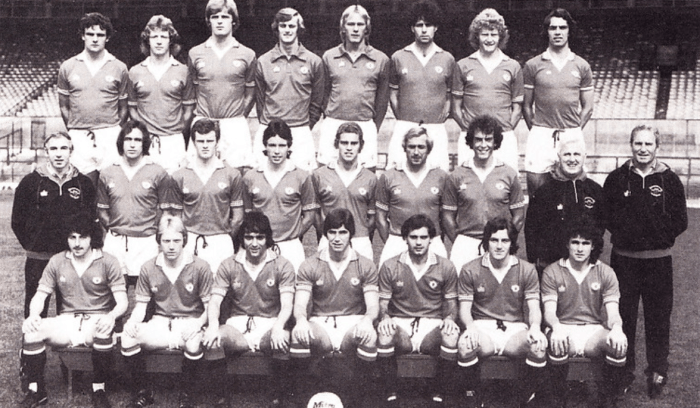
Sexton (far right) and the Manchester United squad
It was said by comparison to the outspoken Docherty, Sexton’s measured, quiet approach didn’t fit well with such a high profile club which then, as now, was constantly under the media spotlight.
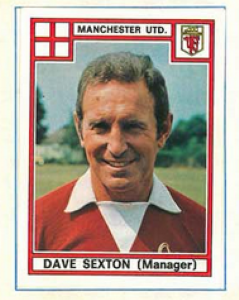
The press dubbed him ‘Whispering Dave’ and although some signings, like Ray Wilkins, Gordon McQueen and Joe Jordan, were successful, he was ridiculed for buying striker Garry Birtles for £1.25m from Nottingham Forest: it took Birtles 11 months to score his first league goal for United.
Sexton took charge of 201 games across four years (with a 40 per cent win ratio) and he steered United to runners-up spot in the equivalent of the Premier League, two points behind champions Liverpool, in the 1979-80 season. United were also runners-up in the 1979 FA Cup final, losing 3-2 to a Liam Brady-inspired Arsenal.
As he said in a subsequent interview: “I really enjoyed my time at United. You are treated like a god up there and the support is fantastic. I had mixed success but it’s something that I wouldn’t have missed for the world.
“It’s tough at the top however and while other clubs would have been quite happy in finishing runners-up, it wasn’t enough for Man Utd. That’s the name of the game and I bear no grudges over it at all.”
As it happens, Sexton’s successor Ron Atkinson only managed to take United to third in the league (although they won the FA Cup twice) and it was another seven seasons before they were runners-up again under Alex Ferguson’s stewardship.
But back in 1981, United’s loss was Coventry’s gain and their delight at his appointment was conveyed in an excellent detailed profile by Rob Mason in 2019.
The new Coventry boss saw City beat United 2-1 in his first game in charge
“By the time the name of Dave Sexton was being put on the door of the manager’s office at Highfield Road the gaffer was in his fifties and a highly regarded figure within the game,” wrote Mason. “That sprang from the style of pass and move football he liked to play. His was a cultured approach to the game and Coventry supporters could look forward to seeing some attractive football.”
One of the happy quirks of football saw his old employer take on his new one on the opening day of the 1981-82 season – and the Sky Blues won 2-1! They won by a single goal at Old Trafford that season too, but overall away form was disappointing and in spite of a strong finish (seven wins, four draws and one defeat) they finished 14th – a modest two-place improvement on the previous season.
On a limited budget, Sexton struggled to get a largely young squad to make too much progress but he did recruit former England captain Gerry Francis, who’d been his captain during heady days at QPR, and he was a good influence on the youngsters.
Sexton’s second season in charge began well but ended nearly disastrously with a run of defeats leaving them flirting with relegation, together with Brighton. One of his last league games as City manager was in the visitors’ dugout at the Goldstone. Albion beat the Sky Blues 1-0 courtesy of a Terry Connor goal on St George’s Day 1983 – but it was Sexton’s side who escaped the drop by a point. Albion didn’t.
Coventry’s narrow escape from relegation cost Sexton his job (although he remained living in Kenilworth, Warwickshire) and it proved to be his last as a club manager, although he was involved as a coach when Ron Atkinson’s Aston Villa finished runners up in the first season (1992-93) of the Premier League – behind Ferguson’s United, who won their first title since 1967.
Sexton was happy to be working with the youth team, the young pros and the first team. “Mostly I’ve been concerned with movement, up front and in midfield. Instead of the traditional long ball up to the front men, approaching the goal in not such straight lines,” he explained.
The quiet Sexton had a valid retort to the reporter’s surprise that he should be working in the same set-up as the flamboyant Atkinson. “It’s like most stereotypes,” he said. “They’re never quite as they seem to be. Ron’s got a flamboyant image, but actually he’s an idealist, from a football point of view.
“He’s got a vision, which might not come across from the stereotype he’s got. I suppose it’s the same with me. I’m meant to be serious, which I am, but I like a bit of fun, too. And, obviously, the thing we’ve got in common is a love of football.”
Relieved to be more in the background than having to be the front man, Sexton told Williams: “The reason I’m in the game in the first place is that I love football and working with footballers, trying to improve them individually and as a team.
“So, to shed the responsibility of speaking to the press and the directors and talking about contracts, it’s a weight off your shoulders. Now I’m having all the fun without any of the hassle.”
Atkinson had invited his United predecessor to join him at Villa after he had retired from his job as the FA’s technical director of the School of Excellence at Lilleshall, and coach of the England under 21 team.
It had been 10 years since Bobby Robson had appointed him as assistant manager to the England team (Sexton had coached Robson at Fulham). He had previously been involved coaching England under 21s alongside his club commitments since 1977 leading the side to back-to-back European titles in 1982 and 1984. The 1982 side, who beat West Germany 5-4 on aggregate over two legs, included Justin Fashanu and Sammy Lee, and in a quarter final v Poland he had selected Albion’s Andy Ritchie, somewhat ironically considering he had sold him to the Seagulls when manager at United.
In April 1983, Albion’s Gary Stevens played for Sexton’s under 21s in a European Championship qualifier at Newcastle’s St James’ Park, which was won 1-0. The following year, Stevens, by then with Spurs, was in the side that met Spain in the final, featuring in the first of the two legs, a 1-0 away win in Seville. Somewhat confusingly, his Everton namesake featured in the second leg, a 2-0 win at Bramall Lane. England won 3-0 on aggregate. Winger Mark Chamberlain, later an Albion player, also played in the first leg.
After the Robson era, Sexton worked with successive England managers: Venables, Hoddle and Keegan. When Eriksson became England manager in 2001, he invited Sexton to run a team of scouts who would compile a database and video library of opposition players – a strategy Sexton had pioneered three decades previously.
Viewed as one of English football’s great thinkers, Sexton had a book, Tackle Soccer, published in 1977 but away from football he had a love of art and poetry and completed an Open University degree in philosophy, literature, art and architecture. He was awarded an OBE for services to football in 2005.
Sexton was always a welcome guest at Brighton and here receives a reminder of past glories from Dick Knight
FULL-BACK Graham Howell spent two and a half years as a professional at Manchester City but was released without making the first team.
Eighteen months after leaving Maine Road, he was one of several new signings made by manager Pat Saward in an effort to strengthen his newly-promoted Brighton side.
Recent players-of-the-season Stewart Henderson (1969-70) and Bert Murray (1971-72) had previously occupied the right-back berth but Saward believed a change was needed at the higher level.
At only 21, Howell was certainly a younger model who’d been trying to make his way at City when they won the league in 1968 and the FA Cup in 1969. After his release, he had played 43 games for Bradford City in the Third Division, which Albion had triumphantly left in runners-up spot in the spring of 1972.
Howell unveiled to the press by Pat Saward
A fee of £18,000 – the equivalent of just over £200,000 in today’s money – prised him from Valley Parade.
“Only 18 months ago, I was released by Manchester City. I thought the bottom had fallen out of my world,” Howell told the matchday programme shortly after signing that August. “I had no hesitation in deciding to join Brighton. It meant Second Division football and was just the chance I wanted.”
He said he’d thought Brighton were “a very useful outfit” in the two games he’d played against them for Bradford (he made his debut for the Bantams in the opening day fixture at the Goldstone when Albion won 3-1 and played in the Valley Parade match on 18 March 1972 when Bradford won 2-1) and said he was determined to prove City had been wrong to let him go.
“I am looking forward to helping Brighton move forward to the First Division. It has always been my ambition to play First Division football.
“I had hoped to achieve this with Manchester City, but it was not to be.”
He pointed out: “I could see that my way forward was limited because of Tony Book, Arthur Mann and several other youngsters like Willie Donachie.
“It was a tremendous blow when I had to leave Manchester City. But I can look back on that all now believing that it was all a blessing in disguise.
“I know that it made me try much harder at Bradford City. And I intend to go on playing it hard for Brighton.
“I am very ambitious, and I want to do really well in football.”
Unfortunately for Howell, Saward struggled to find the right formula for success in the higher division, chopping and changing the line-up and bringing in too many players on short-term loans.
Howell made his debut in a 2-2 home draw against Sunderland on 26 August but, after 15 games at right-back, Saward moved him into midfield and, according to my scrapbook of the time, he became “a destroyer in the Peter Storey mould”.
John Templeman, who’d started the season in the no.2 shirt, reverted to that position as Saward shuffled his pack trying to end a losing streak that eventually extended to 13 matches.
Howell was dropped to the subs bench for the home game against Luton Town on 10 February – and Albion promptly won 2-0, their first win since 14 October the previous year!
He continued as no.12 in the following two matches (both defeats) and was restored to the side at home to Huddersfield, a game which ended in a 2-1 win for the Albion.
In the final game of the season, by which time relegation was confirmed, Howell was once again selected at right-back as Brighton drew 2-2 with Nottingham Forest.
Stern-faced Howell in the pre-season line-up photo
He retained the shirt at the start of the following season back in the third tier but as Saward’s tenure of the hotseat moved into its final days, so did Howell’s game time.
He was out of the side when Brian Clough and Peter Taylor arrived at the Goldstone at the start of November although he has a somewhat unwitting claim to fame by appearing in an oft-used photo of Clough sitting on a park bench at the Stompond Lane ground of non-league Walton & Hersham.
Howell looks rather awkward next to the centre of attention!
Albion had been drawn away to them in the FA Cup first round and the park bench was the somewhat primitive and squashed pitchside seating arrangement for the visiting manager, trainer and substitute – who that day was Howell.
In the picture, he looks rather awkward to be sharing the perch next to the man who only a few months earlier had led Derby County to the top division title. The park bench image was ideal ‘fodder’ for the newspapers, depicting as it did how far from previous glory Clough had descended.
Howell didn’t get on in that game (Albion drew it 0-0 and ignominiously lost the replay at the Goldstone 4-0) and his first action under the dynamic duo came in the infamous 8-2 defeat to Bristol Rovers.
He was sent on as a substitute for left-back George Ley and got his first start under the pair when he took over from John Templeman at right-back in the following game, a 4-1 defeat at Tranmere Rovers.
That match proved to be Ley’s last game in an Albion shirt – and when Howell replaced the former Portsmouth player away to Watford (a 1-0 defeat), it would be his own last outing for Brighton.
By Boxing Day, Clough and Taylor had brought in young midfielder Ronnie Welch and left-back Harry Wilson from Burnley, and they both made their debuts against Aldershot. Howell was an unused sub that day and he didn’t feature for the first team again.
More new faces arrived at the Goldstone as Clough and Taylor brandished chairman Mike Bamber’s chequebook with abandon: the likes of Paul Fuschillo and Billy McEwan increasing the competition for places.
Come the end of the season, Clough made no apologies for clearing out a number of players signed by his predecessor along with long-servers like Brian Powney and Norman Gall. Howell was one of twelve players released.
Howell had made 40 appearances (plus four as sub) for Brighton and he moved on to Cambridge United where he played 71 matches between 1974 and 1976.
Born in Salford on 18 February 1951, Howell grew up a fan of Manchester United and hoped to play for them. “But when City showed interest in me while I was playing for Altrincham and Sale Boys I was happy enough to go on the Maine Road apprentice staff,” he said.
After signing as a professional, Howell spent two and a half seasons playing in City’s Central League side
There were certainly plenty of positive signs for Howell to think he might make it at City.
In January 1969, their matchday programme reported how he’d been for trials for the England Youth side with Tony Towers and Ian Bowyer but was unluckily left out when the squad was selected.
Elsewhere in the programme, a mid-season report on the progress of Dave Ewing’s reserve side declared: “Players like Graham Howell, Tony Towers and Derek Jeffries made great strides.”
It explained that because of injuries to more experienced reserves, several youth team players had been promoted to turn out for the Central League side.
Although they lost eight of their opening 11 matches, they’d turned things round and the report said: “By the end of September, the policy of putting faith and responsibility on the younger players began to pay off.”
While they were bolstered by the return of experienced goalkeeper Ken Mulhearn and George Heslop, youngsters like Bowyer and Stan Bowles were contributing to a turnround in fortunes.
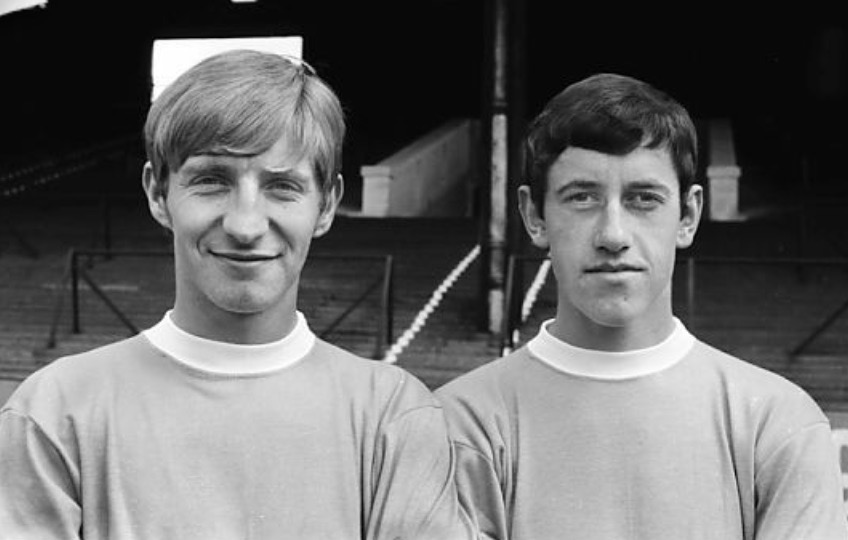
There’s a photo to be found on the internet (above, left) of a young Howell with Paul Hince who played a handful of games for City in 1967-68 and later reported on the side for the Manchester Evening News.
After leaving Cambridge, Howell quit the UK and continued his career in Sweden. He spent six seasons with Swedish club Västerås SK and also played for Irsta IF. He remained in Sweden after his playing career finished.
FOOTBALL things came in threes for striker John Byrne. He had three different spells playing up front for the Albion and he featured for three different clubs under manager Denis Smith.
Add to that, on three occasions, he was signed by clubs who he’d played well against. And, for QPR fans, he was also the third no.10 who got the crowd off their feet at Loftus Road, following in the footsteps of Rodney Marsh and Stan Bowles.
Ironically, it was former Albion boss Alan Mullery who took Byrne to Rangers, in 1984, during his six turbulent months as manager. Mullery took over from his former Spurs teammate Terry Venables, who’d left to manage Barcelona.
While Mullers’ reign at Loftus Road was brief, the skilful forward he brought in stayed four years and won plenty of admirers amongst the Hoops supporters.
Alongside former Albion striker Michael Robinson, he was part of the QPR team that lost to Oxford (a club he would play for later in his career) in the 1986 League Cup Final (QPR’s sub that day was Liam Rosenior’s dad, Leroy).
Wembley wasn’t to be a happy hunting ground for Byrne, though. That 1986 defeat was the first of three occasions he made it onto the iconic turf, each time ending up on the losing side.
Byrne’s career had begun with basement side York City at 16 after Mike Walker, a taxi driver pal of York’s boss, the former Manchester United manager Wilf McGuinness, spotted him playing local football in Manchester (he was born on 1 February 1961 and raised in Wythenshawe).
Charlie Wright, the former Bolton and Charlton goalkeeper took over as manager and gave Byrne his first pro contract but it was his successor, Denis Smith, the ex Stoke City stopper, who arrived in 1982, together with his coach, former striker Viv Busby, who set Byrne on the road to success.
He scored an impressive 55 goals in 175 appearances for York between 1979 and 1984 and his signing by Mullery for QPR came after he did well in a two-legged Milk Cup tie against the Hoops.
In an odd symmetry, his later move from QPR to Le Havre came after the sides had met in a friendly, and the pattern continued when his eventual move to Brighton came after they too had played Le Havre pre-season.
But back to London where, in his four years at Loftus Road, he scored 30 times in 126 appearances.
QPR fans recall fondly a game when Byrne scored twice in a 6-0 thrashing of Chelsea and, some years later, in an interview with QPRnet, he explained how the drubbing riled the Chelsea, and later Brighton, defender Doug Rougvie to the extent that Byrne and fellow striker Gary Bannister finished the game playing out wide to avoid getting a kicking!
He also scored a winner against Manchester United, the team he’d followed as a boy, and in an interview with Sussex Life in 2010, he said: “I felt a bit like a traitor!”
It was in the year following his move to QPR that he made his international debut for the Republic of Ireland – he qualified to play for them because his dad, Jim, was from County Carlow.
He was an international teammate of Chris Hughton and Mark Lawrenson and between 1985 and 1993 collected a total of 23 caps, scoring four goals, two of which came in a 3-1 win over Turkey.
Although part of Eire’s Euro 88 and 1990 World Cup squads, he didn’t play a game.
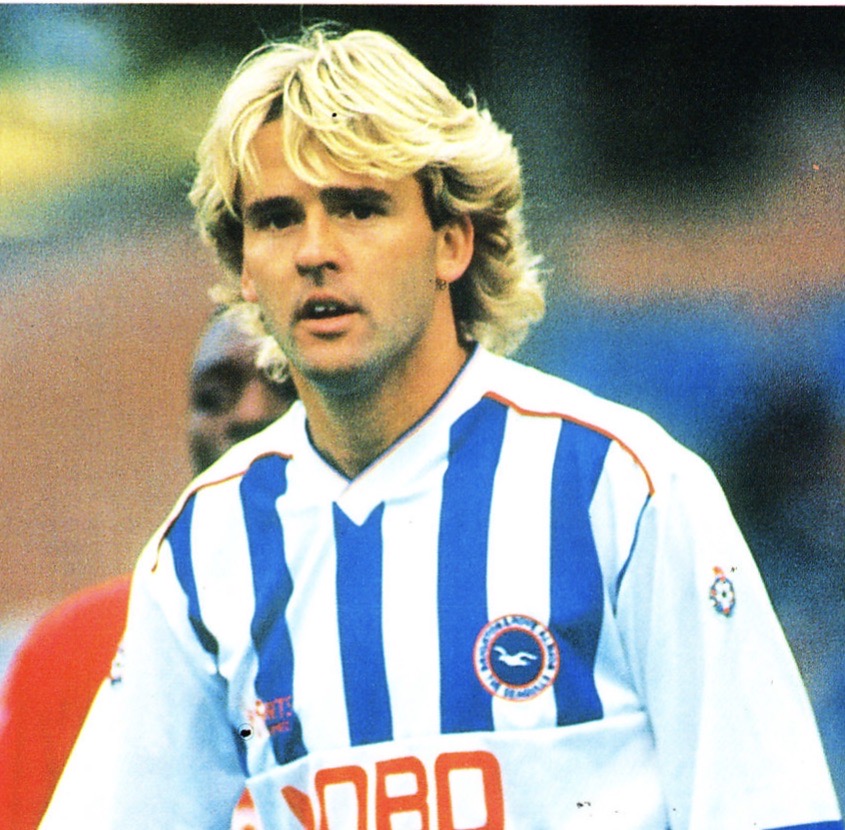
Byrne had three spells with Brighton but undoubtedly the most memorable was in the season that ended in heartbreak in the Wembley play-off final against Neil Warnock’s Notts County.
Manager Barry Lloyd had brought him back to the UK from Le Havre for £125,000, shortly after he had been to the World Cup in Italy with the Republic, and successfully partnered him up front with the prolific Mike Small.
Byrne admitted in a 2010 matchday programme interview how he thought he was joining Sunderland that summer but his agent Paul Stretford’s demands put off the Wearsiders and the striker ended up writing to all the English First and Second Division clubs looking for an alternative club.
Surprisingly, he didn’t get many replies, but Brighton did. “Barry Lloyd got in touch and the rest is history,” said Byrne.
It turned out Lloyd had long been an admirer. He wrote in the matchday programme: “I first tried to sign him two years ago, before he went to Le Havre. He was at QPR then and I was vying with Sunderland for his signature when he finally decided to broaden his footballing experience by moving to France.”
Lloyd revealed how he had consulted with Republic of Ireland boss Jack Charlton to check Byrne had lost none of his old skills and ambition. “He is an intelligent player who moves well across the line and I am sure he is looking on his move to us as an ideal opportunity to regain his place in the Republic’s squad for the European Championships in two years’ time,” said Lloyd.
Albion have had some decent striking partnerships over the years but not since Ward and Mellor in the Seventies had a pair captured the imagination in quite the same way as Byrne and Small. Between them they spearheaded Albion’s push for promotion to the elite.
The climax to the season was a classic case of ‘if onlys’ where ‘Budgie’ was concerned: if only he hadn’t been injured in that final game against Ipswich, he would have been fit to play from the start in the final.
There again, if he hadn’t been fouled on the edge of the box, Albion wouldn’t have won the free kick from which Dean Wilkins scored to earn Albion the play-off spot!
With his right leg heavily strapped, Byrne appeared as a substitute in the final. When the Albion story came to an unhappy ending, and the expected financial boost of playing in the top division didn’t materialise, Lloyd had to cash in his prize assets: Small went to West Ham for £400,000 and Byrne was sold to Sunderland for twice what Brighton had paid for him.
Reflecting on Byrne’s impact, Lloyd told Albion’s matchday programme: “He was outstanding for us, he really was. His workrate was excellent.
“He could pass a ball, cross a ball and he knew where the back of the net was. We didn’t have a lot of money to spend but we got something special with him which very nearly got us into what is now the Premier League.”
Byrne famously scored in every round of the FA Cup as Sunderland marched to the final in 1992, and, almost as famously, missed a great chance from six yards as the Wearsiders lost to Liverpool.
After a season at Sunderland, Byrne moved to Millwall, where things didn’t work out for him, and in 1993 he returned to Brighton on loan for a brief seven-game spell in which he scored twice.
He then had two seasons at Oxford, when he scored 18 times in 55 appearances, before returning once more to the Albion to play 39 games in the 1995-96 season. He scored six times, but, it would be fair to say, he was a shadow of the player who graced that 1990-91 season.
Byrne didn’t let the grass grow under his feet when he packed up playing – he learned how to take care of other people’s by becoming a podiatrist.
Followers of the Albion also got to hear his dulcet Mancunian tones on the radio as a summariser on the local radio station’s coverage of Brighton games.















 The climax to the season was a classic case of ‘if onlys’ where ‘Budgie’ was concerned: if only he hadn’t been injured in that final game against Ipswich, he would have been fit to play from the start in the final.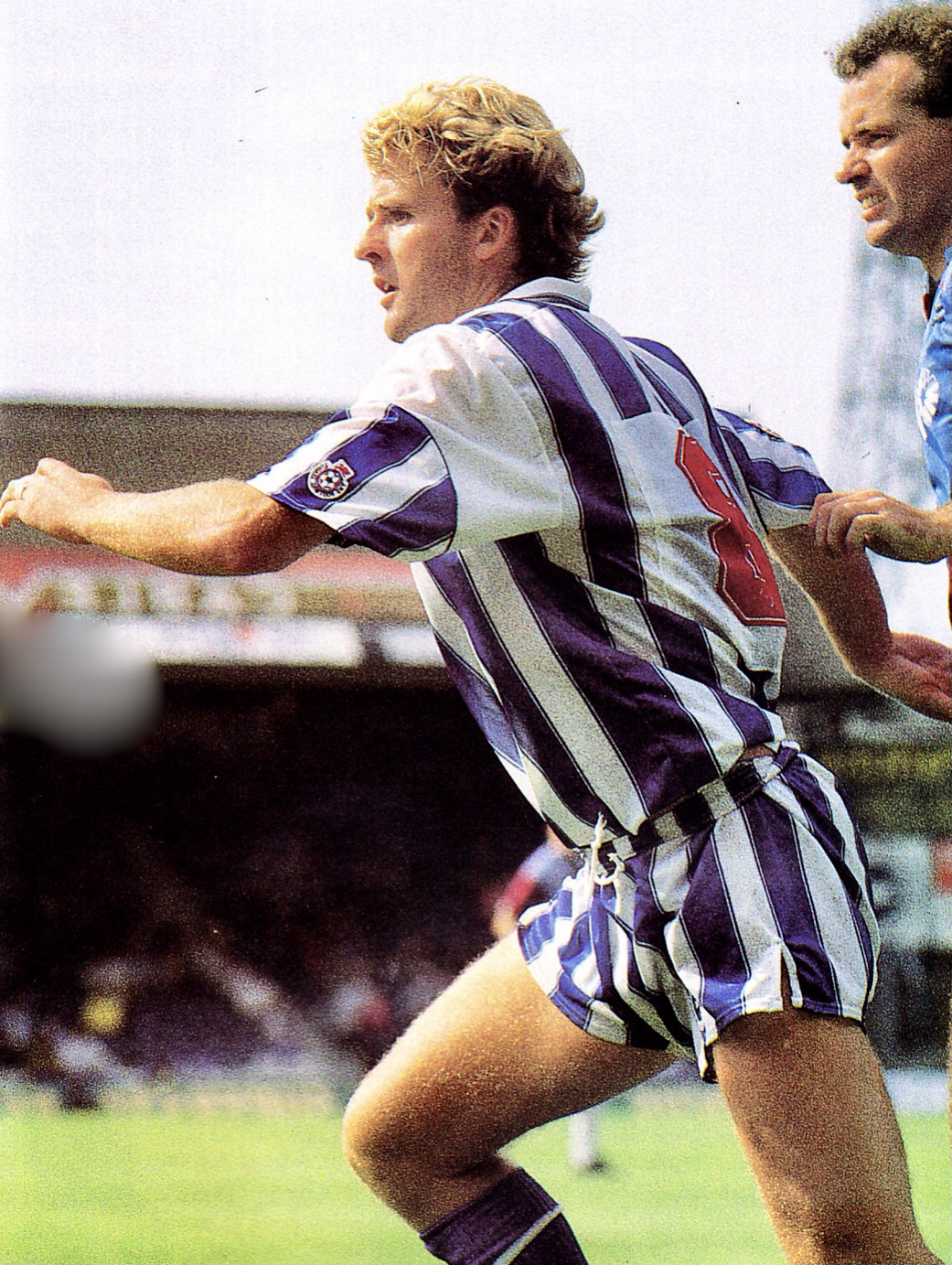


 In parallel lines