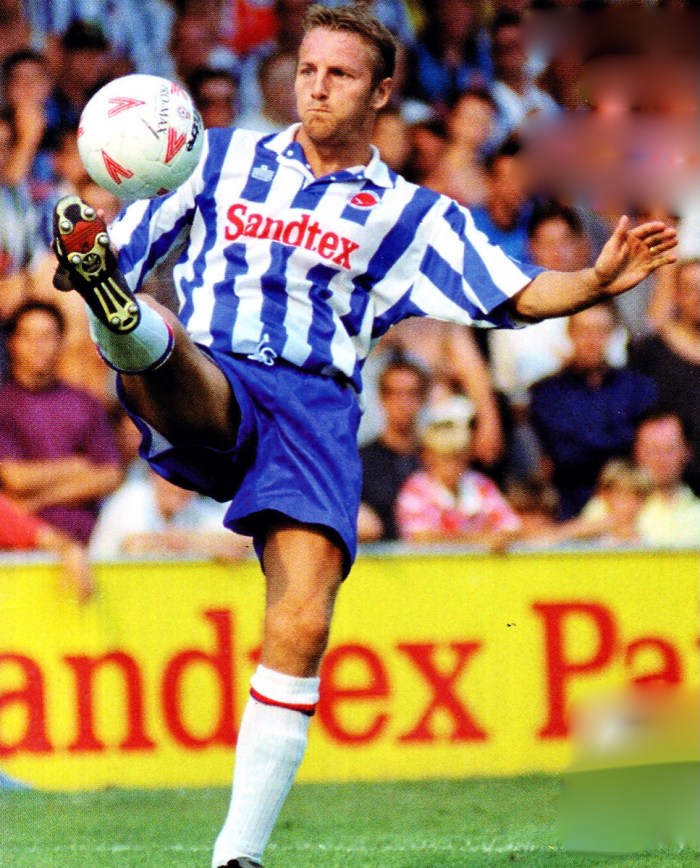
‘Goal machine’ Bully’s place in Premier League history

GARY BULL had good family connections to offer hope to Liam Brady’s Brighton at the start of the 1995-96 season.

Unfortunately, the Nottingham Forest loanee was often in the shadow of his cousin Steve, a Wolves goalscoring legend who went on to play for England.

Gary arrived at the Goldstone in August 1995 against the backdrop of off-the-pitch disquiet caused by the underhand machinations of the despised directors of the club at that time.
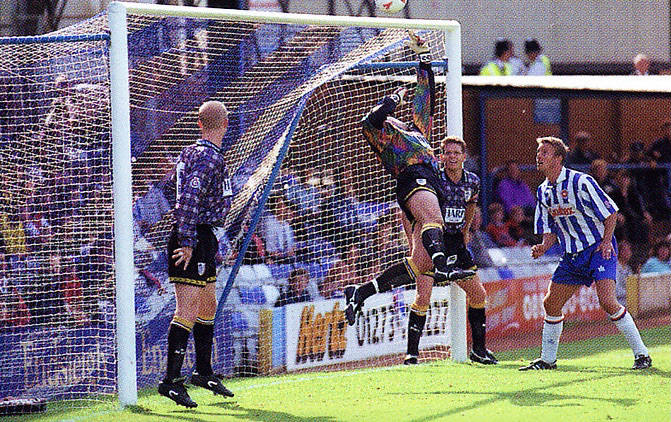
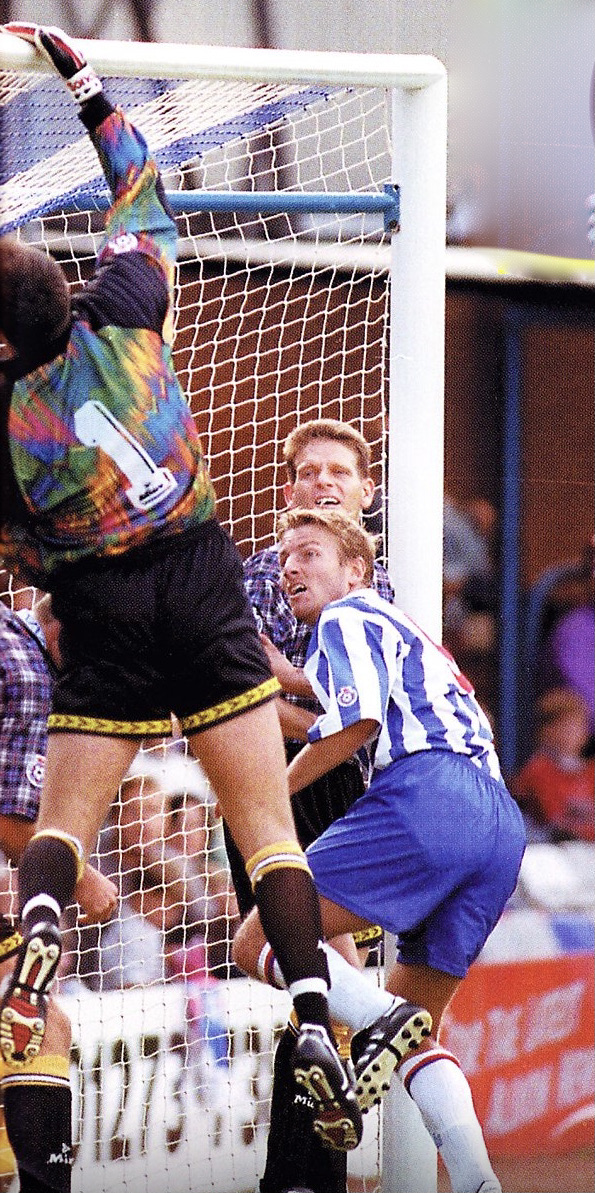
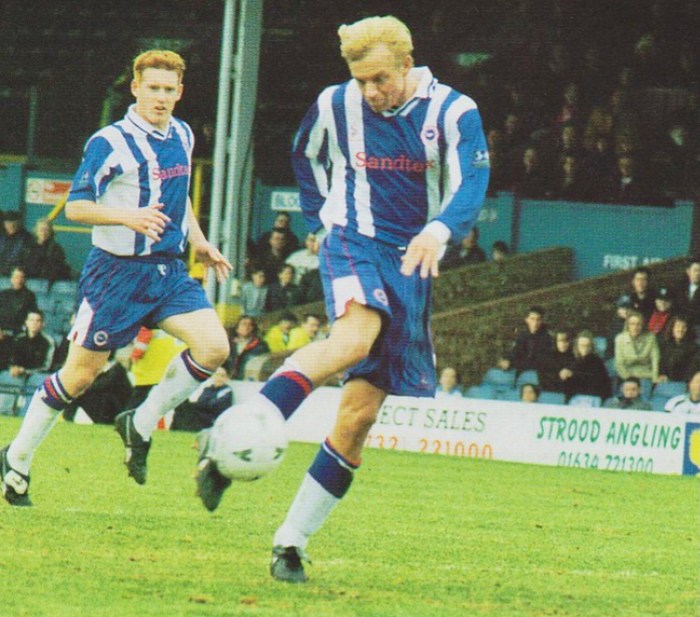
Bull scored three times in 11 appearances for the Seagulls but the cash-strapped club couldn’t afford to keep him on.

Although Bull had made a name for himself as a goalscorer lower down the football pyramid, he had made only four starts plus eight appearances as a sub for Forest over the previous two seasons, scoring just the once.

However, that goal did put him amongst an elite group of players: he was the second of only four players to score on their single Premier League appearance.

Perhaps it was all the sweeter because it secured Forest a 1-0 home win over Crystal Palace that took them up to fourth place in the table.

Interviewed by premierleague.com, Bull said: “It was fate, I would imagine. I was in the right place at the right time.

“It was an inswinging corner. A couple of people missed it and I was about three yards out. It was unmissable really, although I tell my kids it was a screamer.”

Bull had his brief moment in the limelight because first choice striker Stan Collymore pulled out of the match on 2 January 1995 due to illness.

The striker had spent three months on loan at Birmingham City the previous autumn, scoring an impressive six goals in 10 matches (he was in the City side who won 1-0 at the Goldstone in October 1994).

Bull only had one more sniff of first team action for Forest that season, once again against Palace, when he went on as a substitute for Scot Gemmill in a 2-1 fourth round FA Cup defeat on 28 January.

With Collymore in fine scoring form (24 in 43 matches that season), and Dutchman Bryan Roy also a regular up front, manager Frank Clark didn’t turn to Bull again, and Forest finished in an impressive third place in the Premier League.

Bull had to be content with a cameo role in an end-of-season fixture, netting Forest’s third goal in a 3-1 win over Singapore’s national team in an exhibition match in Singapore in May 1995.

Even though Collymore was sold to Liverpool for £8.5m that summer, Bull had to look elsewhere for first team chances and Brady was happy to bring him in to boost Albion’s attacking options.

He got off the mark in his third game, although Albion lost 2-1 at home to Wycombe Wanderers in front of just 5,360 fans.

Bull later scored twice away at Cambridge United in a 4-1 win in the Auto-Windscreens Shield trophy (it was the game in which former Ipswich and England centre back Russell Osman made his debut for the Albion).

But a 1-0 defeat at Rotherham on 7 October was his last game in the stripes and, not long after his return to the City Ground, he was given a free transfer and joined Birmingham on a permanent basis.

Born in West Bromwich on 12 June 1966, his first club was Paget Rangers in the Midlands League but in 1986 he joined Southampton as a trainee under youth team boss Dave Merrington. Jimmy Case and Craig Maskell were in the Saints first team at the time; Kevan Brown in the reserves.

It wasn’t until Bull moved on to Chris Turner’s Cambridge United in March 1988 that he made his professional breakthrough, scoring four in 19 games.

His prowess in front of goal really began to flourish when he dropped out of the league to help Barnet FC win the Conference. Tony Hammond – a Barnet FC devotee known as ‘Reckless’ – reckoned the £2,200 fee manager Barry Fry paid for him was “one of the bargains of the century”.

In four seasons at Barnet, Bull netted an impressive 121 goals in 219 appearances, becoming an Underhill icon. In his blog, Hammond quoted Fry as saying: “He was bloody good that Bully, I never had to worry about him being in the right place at the right time in front of goal it was always just pure instinct.”
Bull was buzzing for Bees

When Bees finally won promotion to the Football League in 1990-91, Bull scored 35 goals – including two four-goal hauls and a hat-trick – and was voted Player of the Year.

Bull’s scoring form continued during Barnet’s first season in the Fourth Division. He bagged 33 as the Bees reached the play-offs where they only narrowly lost a two-legged tie against Blackpool.

In 1992-93, Bull and strike partner Mark Carter were prominent again, as Barnet finished third in the table, clinching promotion to what was then a reorganised Division Two.

Sadly, Barnet were in deep financial trouble and were forced to shed players. Bull was signed by Premier League Forest’s newly appointed manager Frank Clark in July 1993.

“I would have stayed at Barnet but I had a family to look after and had no choice but to move on,” Bull told Hammond. “It was a memorable four years and certainly a period that I look back on with pride,” he added.

The subsequent move to Birmingham reunited Bull with his old boss Barry Fry, although a somewhat cynical view of the move was espoused by writer John Tandy in When Saturday Comes.

“It took Fry 18 months of sustained and public pressure to talk the board into signing Gary Bull. Eventually, in November 1995, we landed the Tipton Tyke. Six games and some time on the bench later he was on his way to York,” he wrote.

Bull spent two seasons at York. The highlight of his stay came in a second round League Cup tie at home to Everton. Bull put the Minstermen 2-1 ahead in the 57th minute, tapping in a rebound off the post and York went on to win it 3-2.

It was one of 11 goals Bull scored in 84 games for City before spending time in Lincolnshire. While he only scored once in 31 games for Scunthorpe, his scoring boots were well and truly back on at Grantham Town: 68 goals in 125 games.

He then moved on to Lincoln United for two years before finishing his career with a flourish at United Counties League Boston Town. During the 2006–07 season, he scored a club record 57 goals! He later went on to become their all-time top scorer with over 200 goals,

Bull only retired from playing aged 45 in 2012.

He then became a postman and told premierleague.com: “I’m one of those people who gets up and actually enjoys going to work and getting the physical aspect of it.

“We probably do between 10 and 12 miles a day. Some would say I do more now than I did on the pitch.”
Albion offered temporary refuge to winger Scott Thomas

A PLAYER seen by only a few hundred loyal Albion supporters played under Brian Horton for Manchester City and Brighton.

Scott Thomas was spotted by City as an 11-year-old, joined them straight from school and was on the club’s staff for six years.

But he only ever featured for the first team on two occasions, in successive matches during Horton’s Maine Road reign.

Thomas in City’s sky blue

A serious injury while playing on loan in America dealt a devastating blow to his hopes of a top flight career, and when City overlooked Thomas during the club’s slide towards the third tier, Horton threw him a brief lifeline.

Albion’s former captain, back at the club as manager when they played home games in exile at Gillingham, inherited a side in turmoil when he took over from Steve Gritt in February 1998.

Albion were second from bottom of the basement division and had endured a 12-game winless home run under Gritt. A Valentine’s Day nightmare 0-0 draw at home to bottom club Doncaster Rovers followed by successive away defeats against Rochdale and Exeter saw chairman Dick Knight wield the axe on a man who had delivered the miracle escape from relegation less than a year earlier.

Horton wheeled and dealed as best he could with limited resources and, after one of many loanees, Steve Barnes, returned to parent club Birmingham City, he remembered the youngster who he’d given a couple of outings to at the end of the 1994-95 season.

Paul Dickov and Scott Thomas

It seems extraordinary to say it now, but Manchester City were in a pretty desperate plight themselves between 1996 and 1998. Five different managers took charge over the course of the 1996-97 season. Alan Ball was in charge at the beginning, he was followed by Asa Hartford. Then Steve Coppell took the reins, before deciding after six matches that it wasn’t for him. Former Liverpool full-back Phil Neal succeeded his former England teammate. Eventually, former Nottingham Forest player and boss Frank Clark took over.

Clark was still in charge at the start of the following season, but a run of poor results saw him off, replaced by former Everton and City centre-forward Joe Royle. He couldn’t stop the rot and City were relegated to the third tier for the first time in their history.

Although a total of 38 players saw action in that desperate but ultimately fruitless attempt to avoid relegation, Thomas wasn’t one of them.

There had been a succession of players not wanted at other clubs who pulled on Albion’s stripes that season and Horton turned to blond-haired winger Thomas on the eve of the March transfer deadline day as he shuffled his pack trying to steer the side away from the bottom of the fourth tier.

“He can play on either wing or down the middle,” said Horton, by way of introduction in his Albion matchday programme notes.

Scott Thomas (front row, second from right) in a pre-match Albion line-up

After making his debut in a 0-0 draw at Cardiff City on 28 March 1998, skipper Gary Hobson declared: “Scott Thomas did well on the right of midfield.” And Horton said: “I was pleased with the first game for Scott Thomas, he looked lively and he came off with a bit of cramp late on.”

It was the first of seven games Thomas played for the Seagulls as the season drew to a close, and in his second game Albion earned their first win in six matches, beating Scunthorpe United 2-1 in front of a Priestfield crowd of 2,141.

Thomas took over the no.9 shirt v Scunthorpe

He switched wings and played on the left in that match and Horton made a point of mentioning in his programme notes how the youngster had been unlucky to have been denied by a fantastic save by Iron ‘keeper Tim Clarke.

Unfortunately, that was the only game in which he was on the winning side: Albion drew three and lost two in the remaining matches. And Thomas was sent back to City at the season’s end.

It has since emerged that a serious injury the winger sustained two years earlier ultimately put paid to him continuing to play professionally.

He had been sent on loan to the United States to play for Richmond Kickers in Virginia. He told the Bolton News: “It was a brilliant opportunity being in the States but I shattered my left leg in four places and had to come back. I was gutted.”

As part of his recovery, he was sent to his local gym, Phoenix Health and Fitness in Bolton, and, four years after the injury forced him to retire, he bought it.

Gym owner

“Football will always be my main love,” he told the newspaper. “Keeping fit has played such a big part of my life — I’ve done various marathons and two Ironman triathlons too — so owning a gym was a natural choice.”

Born in Fairfield, Bury, on 30 October 1974, Thomas told the newspaper his father reckoned he started kicking a football against a wall or fence as soon as he could walk.

He was playing for Radcliffe Juniors when he was seven and, at 11, was scouted by City while he was playing in the Bury League.

“I thought it was brilliant at the time – it was a really big deal,” he said. “I did trials in the school holidays and then trained after school, so I’d get a bus from Bolton, through Bury and into Manchester to meet my dad before going to the grounds.”

Thomas’ son, Luca, has followed in his father’s footsteps. He worked his way through City’s academy sides but when he turned 16 switched to Leeds United’s scholarship scheme.

In the 2021-22 season, he scored 15 goals in 17 matches in the Under-18s Premier League North, and in August 2022 signed a two-year professional contract with Leeds.

“It has changed from when I was younger,” Thomas Snr told the Bolton News. “They have to grow up a lot quicker these days. It’s such a cut-throat industry: you can be flavour of the month one minute, winning Young Player of the Year like me, then out with an injury the next.”

Both of Scott’s City first team appearances were as a substitute. The first was on 6 May 1995 when he went on for Maurizio Gaudino on the hour mark at the City Ground, Nottingham. Forest won by a single goal, scored by Stan Collymore in the first half.

Matchday programme

Eight days later, Thomas only got on in the 83rd minute when he replaced Paul Walsh as City went down 3-2 at Maine Road to QPR, for whom Les Ferdinand scored twice.

The winger also played in America for Richmond Kickers founder Bobby Lennon’s other club, Palm Beach Pumas, and he is quoted on the US Soccer Academy website as saying: “The level of football was excellent. Even though my career was cut short due to an injury, I will always have great soccer memories of my time in Florida.”