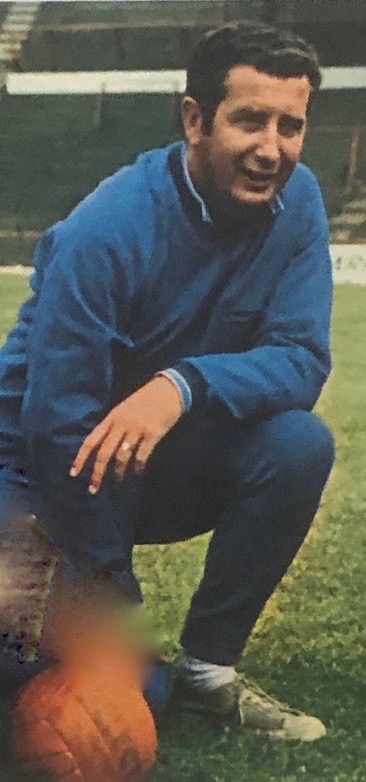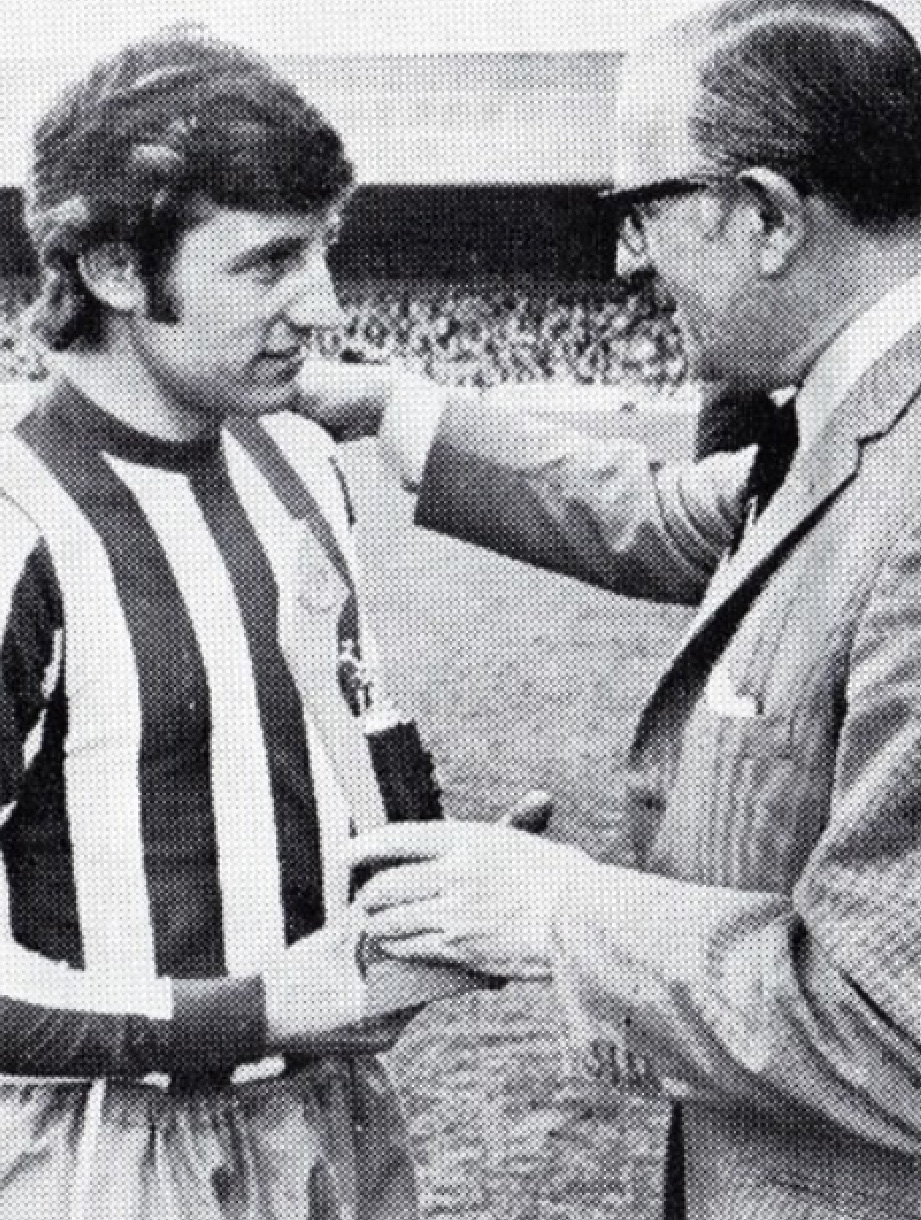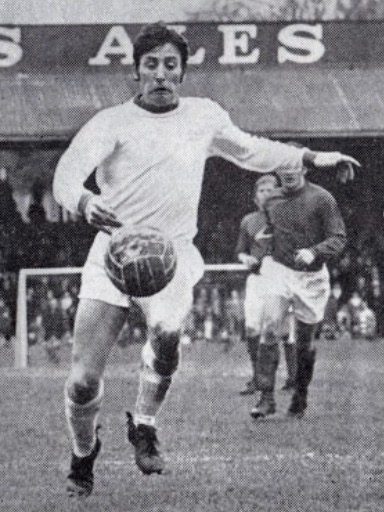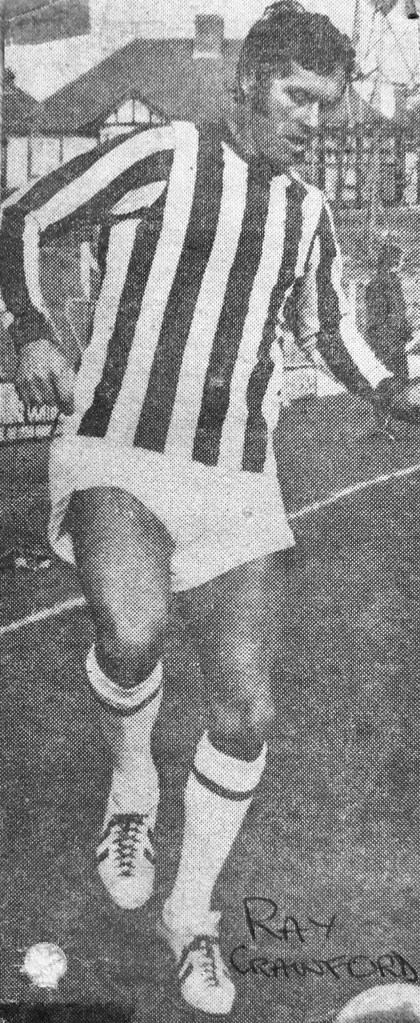
Goalscorer Ray Crawford took on Brighton backroom role

RAY CRAWFORD, one of the foremost goalscorers of the 1960s, came close to a swansong with the Albion and ended up coaching the club’s youngsters.

Crawford had been a key player in Alf Ramsey’s First Division title-winning Ipswich Town side having begun at hometown club Portsmouth and later netted 41 goals in 61 appearances for Wolverhampton Wanderers.

He joined Brighton in the autumn of 1971 after he had read they were struggling to score goals. Earlier the same year, he’d hit the headlines at the age of 35 when he scored twice for Fourth Division Colchester United as they sensationally beat Don Revie’s First Division Leeds United 3-2 in the FA Cup.

After a subsequent short stint playing in South Africa, homesickness brought him and his family back to the UK and the search began for a way to continue his celebrated career in the game.

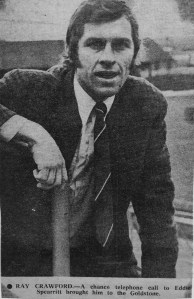
He got in touch with his former Ipswich teammate, Eddie Spearritt, a key member of Albion’s squad, and the utility player persuaded manager Pat Saward to offer Crawford a trial.

“I did well enough in my trial week for Pat to ask me to stay for another month and to see how things went,” Crawford recalled in his eminently readable autobiography Curse of the Jungle Boy (PB Publishing, 2007).

Crawford found the net for the reserves, but a contractual issue with his last club, Durban City (who wanted a fee the Albion weren’t prepared to pay) prevented him joining as a player.

Meanwhile, the previous goalscoring slump that had first drawn him to the club was remedied by a decent run of goals from Peter O’Sullivan to supplement a revival in the form of strikers Kit Napier and Willie Irvine.

It meant Crawford, at 36, hung up his boots (although he still managed a cameo 15 minutes for the reserves in October 1973) to concentrate on coaching.

In the days before large teams of scouts and analysis tools, he would also run an eye over Albion’s future first team opponents to highlight their strengths and weaknesses.

“His dossiers on opposing styles and individual players have proved of great value in the team talks,” reported John Vinicombe in an Evening Argus supplement celebrating Albion’s promotion from the Third Division.

“When I returned to England after a spell with Durban City my only thoughts were of playing,” Crawford recalled. “Before I went to South Africa, I had a good season with Colchester United scoring 32 goals, and, of course, there were the two goals that I scored against the great Leeds United, knocking them out of the FA Cup, which still made me believe that my career was in playing.

Crawford scores v Leeds in the FA Cup

“But when my month’s loan from Durban City expired, and Pat Saward asked me if I would like to join the staff, I jumped at the chance.”

It didn’t stop Saward continuing to search for someone to supplement the strikeforce as the Albion went neck and neck with Aston Villa and Bournemouth for promotion.

Saward even brought in on trial another former England striker, the ex- Everton, Birmingham and Blackpool striker Fred Pickering from Blackburn Rovers. Like Crawford, he scored for the reserves but he wasn’t deemed fit enough for the first team.

Eventually, in March 1972, Saward found the missing piece of his jigsaw in Ken Beamish, a record transfer deadline day signing from Tranmere Rovers.

Beamish chipped in with some vital late goals to help Albion edge out the Cherries to secure Albion’s promotion as runners up to Villa.

The new man’s contribution earned Crawford’s approval in Brighton & Hove Albion Supporters’ Club’s official souvenir handbook, produced to celebrate the promotion.

Crawford as coach

He said: “I don’t like to single out players because football is a team game, but I must on this occasion. Ken Beamish added the final bite up front, and those vital goals that he scored helped us into Division II. What a player this boy is – he never gives up!”

It emerged in Crawford’s autobiography that he also had a friend in Albion chairman Mike Bamber, having got to know him when the Colchester team stayed at Bamber’s Ringmer hotel before a FA Cup tie.

Ever one for rubbing shoulders with stars, Bamber had subsequently invited Crawford back to Sussex to open a local fete in exchange for a weekend stay at the hotel with his family.

“Since that time, I had regarded Mike as a friend and a man I could trust,” said Crawford.

The former striker’s work with the club’s youngsters was evidently appreciated; for instance by Steve Barrett (below left) who said in 2011: “Ray was my coach when I was an apprentice and a young pro. Always had a great enthusiasm for the game and, even in training at the age of about 40, had a good touch and great eye for goal.

“Was great fun on our annual youth trips to tournaments to Holland or Germany. Was very modest in general but loved to remind everyone of his two goals for Colchester against the then mighty Leeds in the FA Cup. A really nice man.”

When Saward was sacked in the autumn of 1973, Crawford assisted caretaker manager Glen Wilson for the home fixture against Southport, which Albion won 4-0.

As for his relationship with Bamber, it counted for nothing as soon as the chairman astonished the football world by appointing Brian Clough and Peter Taylor to succeed Saward.

Crawford was angered by Clough’s “abrasive and stubborn” shenanigans, for instance being bought a pint in a Lewes hotel bar and then left waiting with Wilson as the former Derby duo disappeared for two hours.

“I wasn’t prepared to be treated like that and I soon found out that the way he spoke to people was as I’d expected,” Crawford recalled. “One day he left the players sitting in the dressing room for two hours before training. I don’t know why. It left a sort of threatening pressure on the players that I didn’t agree with.”

It probably didn’t help matters that Crawford’s outspoken wife Eileen also took issue with Clough when he tried to stop the players’ wives having a smoke while socialising before a match. “I don’t smoke, but if I did, it wouldn’t be anything to do with you!” she told him.

Crawford had heard that his first club, Portsmouth, were looking to revive a youth set-up that had been abandoned under a previous manager, so he applied to take on the role of setting it up and running it and headed back to Fratton Park in December 1973.

Born just a mile away from Portsmouth’s famous home ground, the eldest of four children, on 13 July 1936, Crawford initially looked unlikely to follow the sporting prowess of his dad, who had been a professional boxer, because of asthma.

Nevertheless, his enthusiasm for football was sparked by a display of skill from Pompey player Bert Barlow when he did a coaching session at his school, and he joined a local football club called Sultan Boys.

Then he was taken to see Portsmouth play at Fratton Park and he set his heart on stepping out onto that turf himself.

At 14 he started to fill out in height and weight. “I changed quickly from a skinny, shy, asthmatic youth into a strong, young athlete, representing Hilsea Modern School and Portsmouth Schools in cross country running and in the 440 yards,” he said.

He also excelled at cricket and was offered the chance to have a trial with Hampshire County Cricket Club. But his heart was set on football.

Eventually a break came courtesy of a friend who was already in Portsmouth’s youth team. Crawford was invited to twice-weekly training and, after impressing, was taken on as a junior.

In the meantime, he worked by day for the Portsmouth Trading Company making concrete and breeze blocks, which involved spending around eight hours every day lifting 500 heavy blocks onto pallets to dry. It certainly got him fit.

The football club eventually offered him a contract after two years of training with them, but then (as was the case with all young men at the time) he had to do two years’ National Service in the army.

That’s where the title of his book comes in because he was posted to Malaya where word of his footballing ability had already spread. He was invited to play for Selangor Rangers, the biggest club in Kuala Lumpur, and the army also gave him permission to play for the Malayan Federation on a tour of Cambodia and Vietnam.

“Whilst I took part in many more football matches in Malaya than military exercises, I did go out into the jungle on a few occasions with the battalion,” he recalled.

Back at Portsmouth in the autumn of 1956, Crawford resumed his football career, initially in Pompey’s reserve team. After scoring 33 goals in 39 reserve team games, he finally got a first team call-up, making his debut in a 0-0 draw against Burnley at Fratton Park on 24 August 1957.

In the following game, he scored two in two minutes as Spurs were beaten 5-1 at home, but the following month he suffered a broken ankle that sidelined him for two months.

The beginning of the end of his fledgling Pompey playing career came in December that year when he lost it with the club chairman, Jack Sparshatt, who puzzlingly decided to enter the dressing room at half-time during a game, voicing his disapproval at the performance. Crawford told him to f*** off!

Perhaps not surprisingly he was left out of the side for a month.

He did get selected again in the new year, playing up front with Irishman Derek Dougan, but, that summer, Eddie Lever, the manager who’d given him his debut, was sacked and it wasn’t long before his replacement, Freddie Cox, sold Crawford to Ipswich.

Although he hadn’t wanted to move, future England boss Ramsey was persuasive and Crawford admitted: “I had no idea at the time that this would eventually turn out as one of the best decisions I ever made in life.”

The Hampshire lad adapted well to Suffolk and by the end of his first season at Town had scored 25 goals in 30 league games. Not a bad return but even better was to come and with Crawford and strike partner Ted Phillips rattling in the goals, Ipswich won back-to-back titles, winning the second tier championship in 1960-61 and the elite title in 1961-62.

Crawford scored 40 and Phillips 30 as Ipswich won promotion in 1961 and, at the higher level the following season, Crawford bagged another 37 goals.

Such prolific scoring inevitably brought him to the attention of the international selectors and, at the age of 25, he won two England caps. The mystery was why he didn’t win more.

Crawford made his England debut in a Home International against Northern Ireland at Wembley on 22 November 1961. He was credited with setting up England’s goal, scored by Bobby Charlton in the 20th minute, and the game ended in a disappointing 1-1 draw.

The 30,000 crowd for the Wednesday afternoon match was a record low for Wembley at that time. The prolific Ipswich striker only won one more cap, and then only because of a fractured cheekbone injury to first choice Alan Peacock of Middlesbrough.

Nonetheless, Crawford seized his chance and got on the scoresheet after only seven minutes against Austria in a friendly at Wembley on 4 April 1962.

He turned and buried a shot to give England an early lead which Ron Flowers increased with a penalty before half-time. Roger Hunt scored a third for England in the second half. Hans Buzek pulled one back for the visitors in the 76th minute.

As well as Hunt, future World Cup winners Ray Wilson and Bobby Charlton were also in the England line-up, together with 1966 squad members Jimmy Armfield and John Connelly. The team was captained by Fulham’s Johnny Haynes. Jimmy Melia was part of the squad but didn’t play.

Jimmy Magill, who later joined Brighton from Arsenal, was in the Irish side whose equaliser was scored by Burnley’s Jimmy McIlroy. Spurs’ Danny Blanchflower won his 50th cap for his country that day.

Having scored 33 goals in the First Division, Crawford was gutted not to be selected in the England squad for the 1962 World Cup in Chile and future England boss Ramsey was mystified too. “I just don’t understand it and I will go as far as saying it is downright unfair,” he said.

Crawford reckoned it was because England coach Harold Shepherdson, who also held a similar role at Middlesbrough, always advanced the claims of Boro’s aforementioned Peacock, who was chosen ahead of him despite scoring fewer goals, and in the Second Division.

Although Crawford was selected three times for the Football League representative side, he didn’t win any more full international caps.

Probably more surprising was that his old club boss Ramsey, who had seen him at close quarters for Town, didn’t turn to him after he’d taken charge of England in October 1962. But Ramsey had an embarrassment of riches at his disposal, not least in the shape of Jimmy Greaves and Bobby Smith along with Liverpool’s Hunt and later Geoff Hurst.

Crawford’s first meeting with Jackie Milburn, who took over from Ramsey as Ipswich boss, simply involved the former Newcastle and England centre-forward saying: “Nice to meet you Ray, you won’t be here long.”

Sure enough, he wasn’t. Despite his past successes, Ipswich cashed in and sold him to Wolves for £55,000 in September 1963.

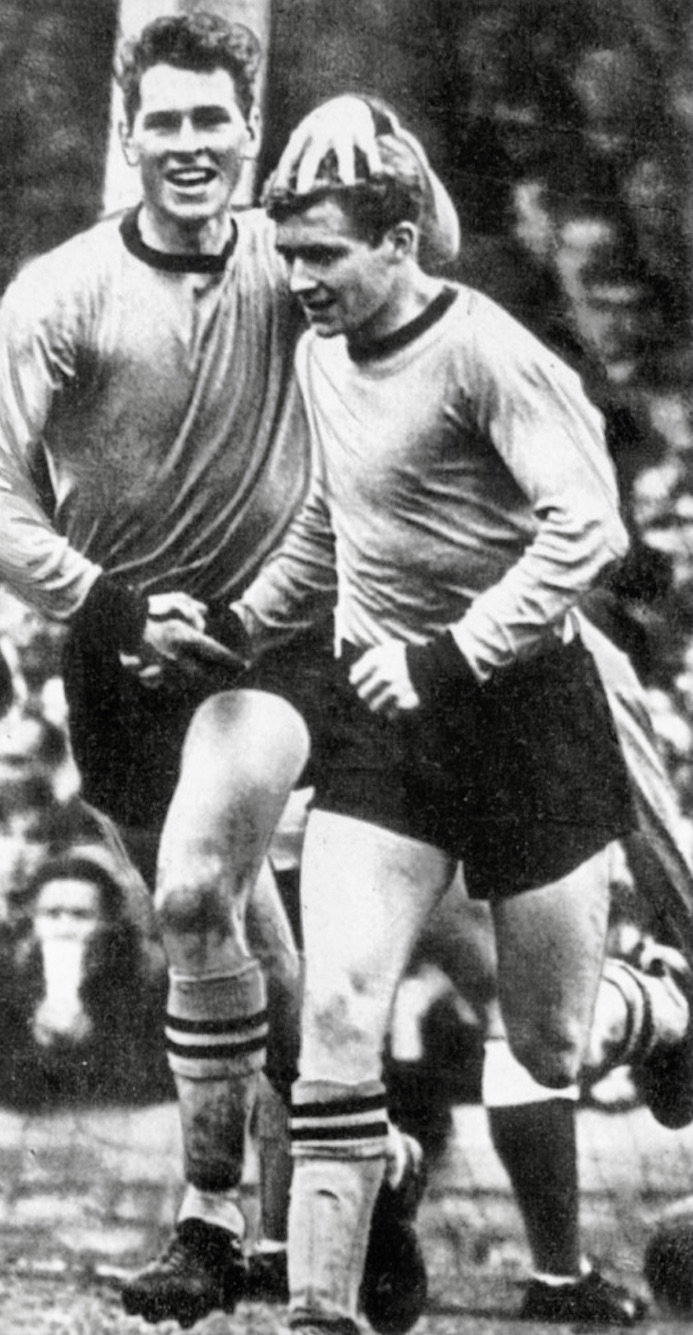
His debut was somewhat ignominious as Wolves succumbed 6-0 at Liverpool (their ‘keeper Malcolm Finlayson was forced off injured) but Crawford scored twice in his second game as Wanderers won 2-1 at Blackpool (for whom Alan Ball scored).

Crawford went on to finish that first season with 26 League goals to his name in 34 games and was named Player of the Year, although Wolves finished in a disappointing 16th place.

Crawford, who is remembered fondly on the website wolvesheroes.com, had been joined at Molineux by Liverpool’s Melia (“a fine passer of the ball”) but when Stan Cullis, the manager who signed them both, was sacked, neither of them saw eye to eye with his successor, Andy Beattie.

Melia was sold to Southampton and the rift with the new boss saw Crawford switch to Black Country rivals West Brom in February 1965 for a £35,000 fee. He later reflected it was a case of jumping out of the frying pan into the fire because he didn’t enjoy a good relationship with Baggies boss Jimmy Hagan.

The striker played only 16 matches for Albion, scoring eight goals, before asking for a transfer in March 1966 and being granted his wish. “I did my best but never had a decent run of games in the first team,” he said. “It never quite worked out but I enjoyed most of my time there and the fans could not have been better.”

It was former club Ipswich, battling at the wrong end of the Second Division, who rescued him and, even though it meant dropping down a division, he was happy to return to Portman Road under Bill McGarry.
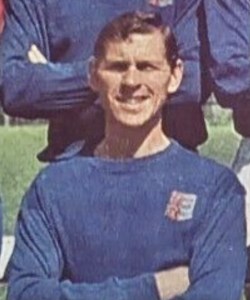
Crawford struck up a useful striking partnership with prolific American-born Gerry Baker. By the end of the season, he’d scored eight goals in 13 appearances and Town managed to avoid relegation.

He was part of the Ipswich side that won the Second Division championship the following season, netting 25 goals in 48 appearances, and by then was approaching his 32nd birthday.

The goals continued to flow with Ipswich back amongst the elite, Crawford scoring 21 in 42 games in the 1967-68 season. But more managerial upheaval was around the corner, when McGarry left to become manager of Wolves.

“When McGarry left for Wolves, I had lost my master and mentor, leaving a psychological gap for me that wasn’t going to be filled by anyone else however qualified or good they were as a manager,” said Crawford.

Even before Bobby Robson succeeded McGarry, Crawford started to weigh up his options and he decided he fancied a move to South Africa, where his old Ipswich teammate Roy Bailey had settled.

Although Town chairman John Cobbold initially agreed to give him a free transfer, the Board later changed their mind and decided they wanted some compensation for his services. Instead of going to South Africa, he ended up moving to Charlton Athletic for £12,000.

The move to The Valley turned sour after he refused to join a training camp organised by manager Eddie Firmani because his family were ill and he needed to be at home to look after them. He was sacked after playing just 22 games for the Valiants, during which time he scored seven goals.

Southern League Kettering provided a short-term means of getting back into playing but it was Fourth Division Colchester United who took him on and he repaid their faith by scoring 31 goals in 55 matches under Dick Graham, the most memorable being that pair against Leeds.

Crawford eventually got his move to South Africa in August 1971, joining Durban City, but his family couldn’t settle and they returned to the UK three months’ later.

During his time as youth coach at Portsmouth, he was responsible for signing Steve Foster and, in his autobiography, recalls how a tip-off from Harry Bourne, a local schoolteacher set him on the path of the future Albion and England centre-back.

Foster had been released by Southampton and Crawford went to the family home in Gladys Avenue, Portsmouth, to invite him to train with Pompey. Foster’s mother was at a works disco at Allders and Crawford went to find her there and had to shout above the sound of the music that Portsmouth were interested in signing her son.

The youngster, 18 at the time, got in touch the next day and, before long, was switched from a centre-forward to a centre-back, after Crawford’s former Ipswich teammate Reg Tyrrell told him: “That no.9, he’s no centre-forward, but he’d be a good number 5.”

After he left Portsmouth in 1978, Crawford took over as manager at Hampshire league side Fareham Town and later managed Winchester City before finally retiring from the game in 1984 to become a merchandising rep.

Villa cup winner and captain Pat Saward led Albion to promotion

A FORMER Aston Villa captain and 1957 FA Cup winner steered Brighton to the first promotion I witnessed on my Albion journey.

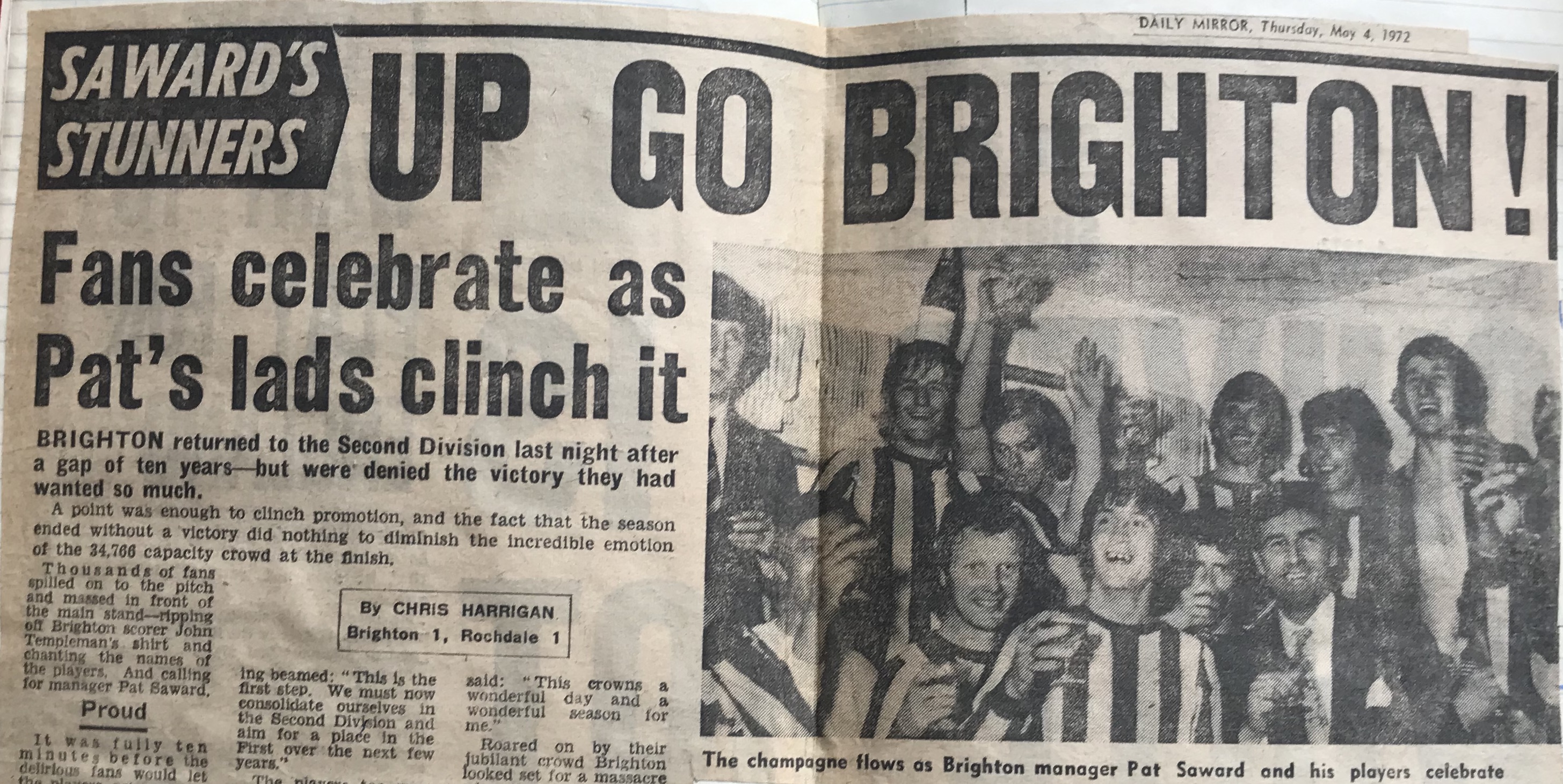
Genial Irishman Pat Saward, who lived in my hometown of Shoreham during his time as Albion boss, galvanised a squad not expected to be promoted from the third tier and took them up as runners up behind his former club in 1972.

As the champagne flowed in the Goldstone Ground home dressing room, Saward took centre stage surrounded by his blue and white stripe-shirted heroes.

When the promotion tilt had looked like faltering, he’d been bold enough to make drastic changes to the side before a top of the table clash with Villa in front of the Match of the Day cameras. After a memorable 2-1 win in which Willie Irvine scored a goal later judged as the third best in the programme’s Goal of the Season competition, Saward added to his squad on transfer deadline day, bringing in Northern Ireland international Bertie Lutton from Wolves and Ken Beamish from Tranmere Rovers, described in the Official Football League Book as “stocky and packed full of explosive sprinting power, a terrific shot and great appetite for the game”.

Saward told the publication: “They were both last ditch signings and Ken made an astonishing difference. I spent only £41,000 in getting my promotion side together so we were very much Villa’s poor relations in that sense.”

The manager put the success down to: “Dogged determination to succeed from all the players. We stamped out inconsistency. I got rid of ten of the players I inherited and got together a team built on character. That’s the key quality, apart from skill of course.”

However, hindsight reveals the club wasn’t really ready for the higher division and some have suggested Saward broke up the promotion-winning squad rather too hastily. Players he brought in who were used to the level now known as the Championship struggled to gel, and the manager turned to rather too many loan signings.

A mid-season run of 13 consecutive defeats was Albion’s undoing and a glamour FA Cup tie at home to First Division Chelsea in early January 1973 gave a welcome respite from the gloom.

Ahead of the match, Saward opened his heart to Daily Mirror reporter Nigel Clarke, revealing that he couldn’t understand why the side had struggled so much.

“I wish I knew. But I’ve learned more about football these last few weeks than at any other time in my career.

“We are five points behind the next club but I must be the luckiest man in the league. There are no pressures on me,” he said, explaining that supporters were still writing to him, backing him and the team.

“When we came up from the Third Division, I was so big-headed, so confident. I thought with the right results we could go straight through to the First Division. I really did.

“There was spirit and ambition here – and there still is….that’s how this club gets you. My heart is in the place.”

Saward revealed that he had turned down two better paid jobs in the First Division to stay at Brighton after the promotion win, telling Clarke: “What I want is importance, appreciation, understanding and love…not being kicked up the backside and put under the lash.

“Adulation is false. I’ve found my oasis at Brighton and I’m wealthy the way I want to be – in feeling.”

Although the Chelsea game ended in another defeat, fortunes eventually changed the following month – but the damage had been done and Brighton went straight back down.

A defiant Saward promised to blood more youngsters like Steve Piper and Tony Towner, who’d done well when drafted in and Piper, in a matchday programme article, said of him: “Saward was more of a coach than a man-manager, very suave and sophisticated. He knew his football from his days at Coventry.”

However, when results didn’t improve on the return to third tier level, and with a new, ambitious chairman – Mike Bamber – at the helm, Saward was sacked and replaced with the legendary Brian Clough.

Albion’s hierarchy had turned to the untried Saward in the World Cup summer of 1970 after Birmingham City poached Freddie Goodwin from Brighton to replace Stan Cullis as their manager. It was second time lucky for Saward, who’d applied to succeed Archie Macaulay two years previously when Goodwin pipped him to the post.

“Give me ten years and I’ll have Brighton in the First Division,” Saward declared when appointed. Prescient words considering they made it within nine – although it came six years after he’d parted ways with the club.

There’s little doubt Saward was an innovative football man and a popular figure during the first two years of his reign.

Apart from success on the pitch in the 1971-72 season, the way he involved fans in helping him to improve the side also proved a winner.

His buy-a-player appeal was a direct attempt to involve the supporters in the affairs of their club and Saward led a sponsored walk on Brighton seafront as one of the initial events geared towards generating funds to help him compete in the transfer market.

“Too many people spend too much time shouting about how hard up their club is, and too little time fighting to improve the situation,” Saward said in an article for the April 1971 edition of Football League Review. “You never get success if you sit around. You must have courage, even audacity, and work hard for survival.”

The first funds generated provided Saward with the money to bring in experienced Bert Murray from Birmingham City, initially on loan, and then permanently. Murray would go on to be voted Player of the Year in 1971-72.

Another player who signed on loan at the same time as Murray was Preston’s Irvine, who recalled in his autobiography, Together Again, how Saward wooed him.

“Pat sold me the place with his charm and persuasive ways,” he said, describing the former male model as “extrovert, infectious and bubbly”.

He added: “Pat Saward was a gem of a manager and a pleasure to play for. He said what he thought, but never offensively; in a matter-of-fact, plain-speaking kind of way, rather than aggressively.”

Irvine continued: “Saward had the knack of making people feel important. He instilled pride and a sense of identity…..Pat loved attacking, entertaining football and worked tirelessly for the club. I would have run through that proverbial brick wall for him.”

As Brighton neared promotion, Irvine said: “Saward, with a joke or a smile, an arm around the shoulder or a bit of geeing up, knew just how to keep a dressing room happy or dispel any tension or nerves.”

Sadly, Irvine’s opinion of Saward shifted dramatically when, during the summer, the manager told him he intended to bring in a replacement – although it was three months before he eventually signed Barry Bridges from Millwall.

Saward and new signings Barry Bridges (left) and Graham Howell

Irvine was in the starting line-up at the beginning of the season and scored six times in 13 league and cup games, but, once Bridges arrived in October, his days were numbered, and, before the year was out, he was sold to Halifax Town in part exchange for Lammie Robertson.

Saward had already dispensed with the services of Albion’s other main promotion season scorer, Kit Napier, along with his former captain, John Napier.

Irvine said that once Albion were promoted, Saward changed. “He seemed to become unapproachable, or at least he did to me, and where once I could see him whenever I wanted, now I seemed to have to book an appointment two or three days in advance. We all had to.”

Teammate Peter O’Sullivan, who had repaired his relationship with Saward after some difficult early exchanges which saw the Welshman transfer-listed, also witnessed a change in the manager.

“We had one or two players who were over the hill and Pat just lost the plot. It was grim,” he told Spencer Vignes in A Few Good Men.

Albion’s tier two fortunes were picked over in some detail in a feature reporter Nick Harling compiled for Goal magazine.

“I didn’t foresee the snags and the type of league the Second Division was,” Saward told him. “It’s the hardest division of the four. Everyone is fighting either to stay in or get out.

“It’s a hell of a hard division. It’s a mixture of the First and Third. It’s good and very hard football. They don’t give you an awful lot of time to play.

“It’s a division governed by fear because to drop out of it is not good, while to get out at the top is fantastic. I didn’t believe the gap would be so different.

“Teams are so well organised and supplement their lack of ability with tremendous defensive play. It’s very hard to get results.”

While open and honest, they didn’t sound like the words of a manager very confident of finding a solution, and Saward sought to explain part of the problem when he said: “To me the most important thing is the attitude of mind. Players should have an arrogant attitude, an attitude that they’re going to do well even when the chips are down. But some types are destroyed. These are the ones who succumb and want to rely on other people.

“Here we’ve got some great boys, but I wish to God some of them had more determination.”

Bamber was resigned to relegation but nonetheless confident of where the club was heading. “There’s no doubting it – First Division here we come,” he told the magazine.

Saward added: “I haven’t lost any enthusiasm. I’ve had my hopes dampened slightly, but one overcomes that.

“This club has got to be built for the future. I want to put Brighton on the map.”

Sadly, when Albion’s poor form at the start of the 1973-74 season continued, Saward publicly admitted: “I haven’t any more answers. I am in a fog.”

Unsurprisingly, the Albion’s directors interpreted it as a loss of confidence and sacked him.

It’s front page news on the Evening Argus as Saward is sacked

Saward never managed in the English game again, although he coached in Saudi Arabia for a while.

Born in Cobh, County Cork, on 17 August 1928, Saward lived in Singapore and Malta during his childhood, before the family moved to south London.

His first club was Beckenham FC before he turned professional with Millwall in 1951. He made 118 appearances for the Lions in the next four years.

Saward was 26 when Eric Houghton signed him for Villa for £7,000 in August 1955. The legendary Joe Mercer took over as Villa manager in 1958.

Pat enjoyed a goalscoring debut with his new club, hitting the final equalising goal in a 4-4 draw with Manchester United at Villa Park on 15 October 1955. But he struggled to oust left half Vic Crowe and made only six appearances that season.

In Crowe’s absence through injury the following season, Saward became a regular, making 50 appearances.

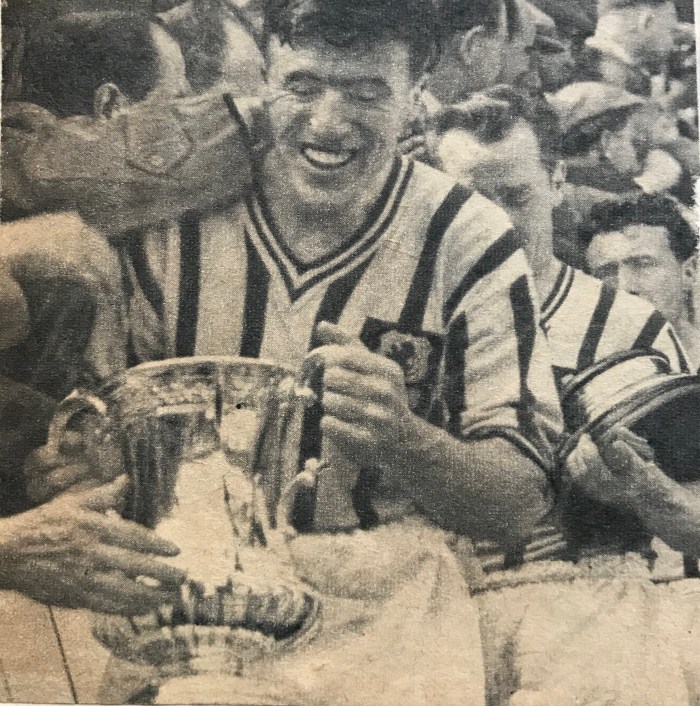
Saward (right) descends the steps at Wembley as a FA Cup winner with Aston Villa

In total, Saward played 170 games for Villa between 1955 and 1960, most notably featuring in their FA Cup winning team in 1957. Villa beat Manchester United 2-1 in the final at Wembley Stadium in front of a crowd of 99,225, Peter McParland scoring twice to win Villa the Cup for a seventh time.

Saward made only 14 appearances as Villa were relegated from the top-flight in 1959 but he was back in harness as captain when they made a swift return as Second Division champions in the 1959-60 season.

In his final season, he made just 12 appearances, his last coming on 22 October 1960 in a second city derby, Villa beating Birmingham 6-2. The following March, he was given a free transfer and moved on to Huddersfield Town.

Saward in the stripes of Huddersfield Town

He had first been selected for the Republic of Ireland on 7 March 1954 in a World Cup qualifier in which Luxembourg were beaten 1-0, and he went on to make 18 appearances for his country, the last, on 2 September 1962, coming when he was 34: a 1-1 draw away to Iceland in Reykjavík.

He played twice against England in World Cup qualifiers in 1957, a 1-1 draw and a 5-1 defeat, when he was up against the likes of Duncan Edwards, Johnny Haynes and Stanley Matthews, and in the same competition against Scotland, in 1961, when the Irish lost 4-1, and his teammates included Johnny Giles.

After 59 appearances for the Terriers, he dropped out of the league but acquainted himself with Sussex when moving to Crawley Town.

Jimmy Hill signed him for Coventry as a player-coach in October 1963 and although he made numerous reserve team appearances, he really made his mark as a coach and was responsible for the rapid development of City’s youth team in the 1960s.

Saward (left) with assistant manager Alan Dicks and Jimmy Hill at Coventry City

Willie Carr and Dennis Mortimer were just two of several first teamers who made it under his guidance. He stepped up to first team assistant manager when his former Eire teammate, Noel Cantwell, was appointed boss in 1967.

Not long after his switch to the Goldstone, Saward picked up one of his former Sky Blues proteges, Ian Goodwin, initially on loan, and then permanently, and eventually made him Albion captain. The rugged defender’s arrival was remembered in an Argus article.

When Saward died on 20 September 2002 following a period when he’d suffered with Alzheimer’s, an excellent Villa website pieced together a detailed obituary. His career is also recorded on the avfchistory.co.uk site.

Saward was laid to rest in the same Cambridge cemetery as his brother Len, a forward who played a total of 170 games for Cambridge United between 1952 and 1958, scoring 43 times. He went on to serve the club behind the scenes in their commercial department.

Pictures from my schoolboy Albion scrapbook and various online sources.

Liverpudlian Melia etched a never-to-be-forgotten place in Brighton’s history

IT WAS the stuff of dreams when Liverpool born and bred Jimmy Melia saw his underdog Seagulls side beat the mighty Merseyside giants en route to Brighton’s one and only FA Cup Final appearance.

In fact, it wasn’t the first time Melia had taken a side to Anfield to play in the competition. On 2 January 1971, as player-manager of lowly Aldershot, he returned to the ground where he’d been an inside forward under Bill Shankly and gave them a scare in the third round, the Fourth Division side only losing 1-0.

Even Liverpool’s wideman, Steve Heighway, admitted: “I suppose we were lucky to win. It was a frosty day and the ball was playing quite a few tricks. I don’t think we were in any danger of losing. But Aldershot were playing well that day. They could have sneaked a draw.”

How satisfying, then, to return in 1983 and pilot Albion’s unlikely 2-1 win, with a winning goal courtesy of that other former Anfield favourite, Jimmy Case.

In the run-up to the game, Melia, raised in Liverpool’s Scotland Road, told the Daily Mail: “I’ve got 11 brothers and sisters in the Liverpool area and they’ll all want to be there.”

He clearly didn’t fear the game, pointing out that Brighton had been the last team to win at Anfield, and telling the Argus: “It is a great tie for us. When I was manager at Aldershot we lost 1-0 to them and I think we will do better this time. Remember, the Cup is full of all sorts of upsets. It wouldn’t be the Cup otherwise.”

After the famous victory, Melia told Alex Montgomery of The Sun: “I’ve been involved in some great Liverpool victories but this is without doubt the greatest win.

“The great thing about it is that we didn’t just nick a win. We deserved what we got. A lot of people said that if we attacked them we would just set ourselves up for a hiding. That is not the way it worked out.”

It emerged after the game that John Manning, an old footballing friend of Melia’s, had been key to plotting the victory. Former Crewe, Bolton and Tranmere striker Manning, Albion’s scout in the north at the time, gave the players a pre-match rundown on what to expect.

“Best team talk we’ve ever had,” defender Gary Stevens told the Daily Mail. “Liverpool played exactly the way he said they would and he was even right about which side (Phil) Neal would send his penalty (which went wide of goalkeeper Perry Digweed’s post).”

Born in Liverpool on 1 November 1937, Melia attended the city’s St Anthony’s School and didn’t play his first organised football match until the age of 11. He quickly demonstrated a talent for the game and after shining for the school side was picked to play for Liverpool Boys.

At 14, he was selected for England Schoolboys but a broken collarbone meant he was unable to play. A year later, though, after captaining Liverpool Boys, he got another chance with the national schoolboy side, making his debut against Eire in a team that included Bobby Charlton and Wilf McGuinness.

Liverpool offered him a place on the groundstaff as soon as he left school and, at the age of 17, he was taken on as a professional by former Brighton manager Don Welsh, who took over as Liverpool boss in 1951. Ahead of a Brighton v Portsmouth game in 1983, Melia mentioned his closeness to their manager at the time, Bobby Campbell.

“We virtually grew up together in the same street in Liverpool and we both signed for Liverpool as youngsters on the same day,” he wrote in his matchday programme notes. “We literally have a lifelong friendship.”

Melia scored on his Liverpool debut against Nottingham Forest in a 5-2 win when the famous Billy Liddell scored a hat-trick, and he was making a name for himself at a national level too. Melia scored twice for the England Youth side as they romped home 9-2 winners over Denmark at Home Park, Plymouth, on 1 October 1955. The following month he was on target again as England beat the Netherlands 3-1 at Carrow Road, Norwich.

Between the 1955-56 and 1963-64 seasons, Melia played 287 games for Liverpool, scoring 78 goals. It might have been more but for the fact he had to do National Service although the consolation was that he got to play in the British Army side with the likes of Duncan Edwards, Bobby Charlton, Dave Mackay, Peter Swan, Cliff Jones and Alan Hodgkinson.

One of his Liverpool goals came in a home game against Brighton on 10 October 1959. Phil Taylor’s Liverpool were 2-1 down to the Albion that Saturday afternoon and, in the 85th minute, Melia stepped up to take a penalty…and missed. Nevertheless, he atoned for the mistake by slotting home a last-gasp equaliser. A month later, Shankly took over as manager.

In a series of profiles of the leading Liverpool players of the era, journalist Ivan Ponting said: “Jimmy Melia was the principal midfield ideas man as Liverpool rose from the second tier in 1961-62 and he was capped twice in 1963 ahead of sparkling creatively in the opening half of the Reds’ first title campaign under Bill Shankly.”

In only the second game of Alf Ramsey’s reign as England manager, he selected Melia to play for the national side in a 2-1 defeat to Scotland at Wembley on 6 April 1963.

Then on 5 June 1963, in Basle, he was one of the goalscorers in the side that hammered Switzerland 8-1; Bobby Charlton scored a hat-trick but remarkably Jimmy Greaves didn’t get on the scoresheet.

Although he didn’t win another full cap, he was in a FA squad Ramsey took to Gibraltar in May 1965 when the Rock’s representative XI were soundly beaten 7-1 on 22 May and 6-0 the following day.

In the 1963-64 season, when Melia was sidelined by a minor ankle injury, Shankly reshuffled his line-up, moved centre-forward Ian St John into a more deep lying role and put Alf Arrowsmith up top. The change worked so well that Melia never did regain his regular place in the team.

“It was a stunning blow and a surprise to the balding Merseysider whose flair, industry and intelligence had been so productive, with his through-passing an exquisite speciality, even if some fans disliked what they saw as over-elaboration on the ball,” Ponting wrote for Back Pass magazine.

Melia was sold to Wolves for a then record fee of £48,000 in March 1964, but because he had played a certain number of games for Liverpool earlier in the season, was awarded a medal when the Reds were crowned champions.

It was the legendary Stan Cullis who had taken him to Molineux and, Melia told Charlie Bamforth for wolvesheroes.com, it was with the intention of him subsequently moving into a coaching role. But, when Cullis was sacked before the end of the year, his replacement, Andy Beattie, swiftly dispensed with Melia’s services, offloading him to Southampton in December 1964 for £30,000.

At The Dell, Melia (pictured below in Saints’ famous stripes) joined forces with the likes of Terry Paine and Martin Chivers and, in 1965, helped Ted Bates’ side to promotion to the top division.

Melia Saints

He was an ever present in the side during their first top division campaign, notable as a provider of crosses for Ron Davies and Chivers.

Eventually, the emerging Mike Channon took his place and, in 1968, after making 152 Saints appearances, on the strength of a recommendation from his old boss Cullis (by then manager of Birmingham), Aldershot paid £9,000 for him to become player-coach. The following April he became player-manager.

When he was sacked in January 1972, having made 134 league appearances for the Shots, he moved back to the north west as player-manager of lowly Crewe Alexandra but finally hung up his boots in May that year to concentrate on the manager’s job.

As a lowly league manager, Melia seldom came to the wider public’s attention, but when the opportunity arose, he was quick to seize it. Before another FA Cup third round match, this time against Huddersfield, he told Goal magazine any success he’d had as a manager could be put down to the influence of Shankly and his managers at Wolves and Southampton, Cullis and Bates.

“I was lucky,” said Jimmy. “You can’t help but learn from men such as these and I consider myself very fortunate to have served under them.”

In his first season as manager of Crewe Alexandra, his inexperienced team finished bottom and had to seek re-election to the league (in those days relegation was not automatic).

“I believe some of the youngsters we have here are destined for great futures. But perhaps you need a little more than just skill and enthusiasm to be successful,” he told Goal in July 1973.

Melia was clearly scarred by his treatment at Crewe. He told Ian Jarrett of The Sun: “We finished in the bottom four and were in danger of getting kicked out of the league so I spent days ringing around all my mates to get the votes to save us at the annual (league) meeting.

“I succeeded and went away feeling pretty happy until a phone call from the chairman warned me that I had only narrowly survived a vote of confidence.

“The following September I was made manager of the month but the club called an extraordinary meeting, got rid of the chairman, and soon after that I was out on my ear.

“The experience taught me a lesson.”

In 1975, Melia had three months as manager of Southport, before ending the same year coaching in the Middle East.

He then moved to the USA and linked up with a former Wolves teammate Laurie Calloway to become his assistant coach at NSL side Southern California Lazers. In 1979, Melia moved to Ohio to become coach of Cleveland Cobras.

A window back into the English game opened in April 1980 when Brighton boss Alan Mullery appointed him as the club’s chief scout.

Looking back now, it seems a tad ironic that Albion chairman Mike Bamber was all for sacking him and other members of Mullery’s backroom staff in the summer of 1981 to save money. Mullery refused – and subsequently left the club himself.

Melia retained his position under Mullery’s successor, Mike Bailey, who, despite taking the Albion to their highest ever finishing position (13th) in 1982, failed to win over fans with a style of football that saw them stay away in their thousands.

A concerned Bamber finally brought down the curtain on the Bailey era in December 1982, handing the first team managerial reins on a caretaker basis jointly to Melia and loyal backroom ‘boy’ George Aitken (himself a former manager who, like Melia, had been a player under Shankly during his time at Workington).

From the outset, it was Melia who put himself forward to handle interviews with the press, TV and radio, and, as the club progressed in the FA Cup, so the spotlight began to shine brighter on the Liverpudlian, especially with that tie at Anfield.

Inevitably, the question kept arising as to whether Melia would land the manager’s job on a permanent basis and, in one of many interviews, he somewhat tellingly said: “I’d love the job and, if we stay up, that will improve my chances. But I’m not going to attempt to survive by playing boring, safety-first football.”

In a comment that was something of an oxymoron, Melia told Paul Weaver of the News of the World: “I don’t want to say anything against my predecessor, Mike Bailey, but I wouldn’t have paid money to watch Brighton in the first half of the season.”

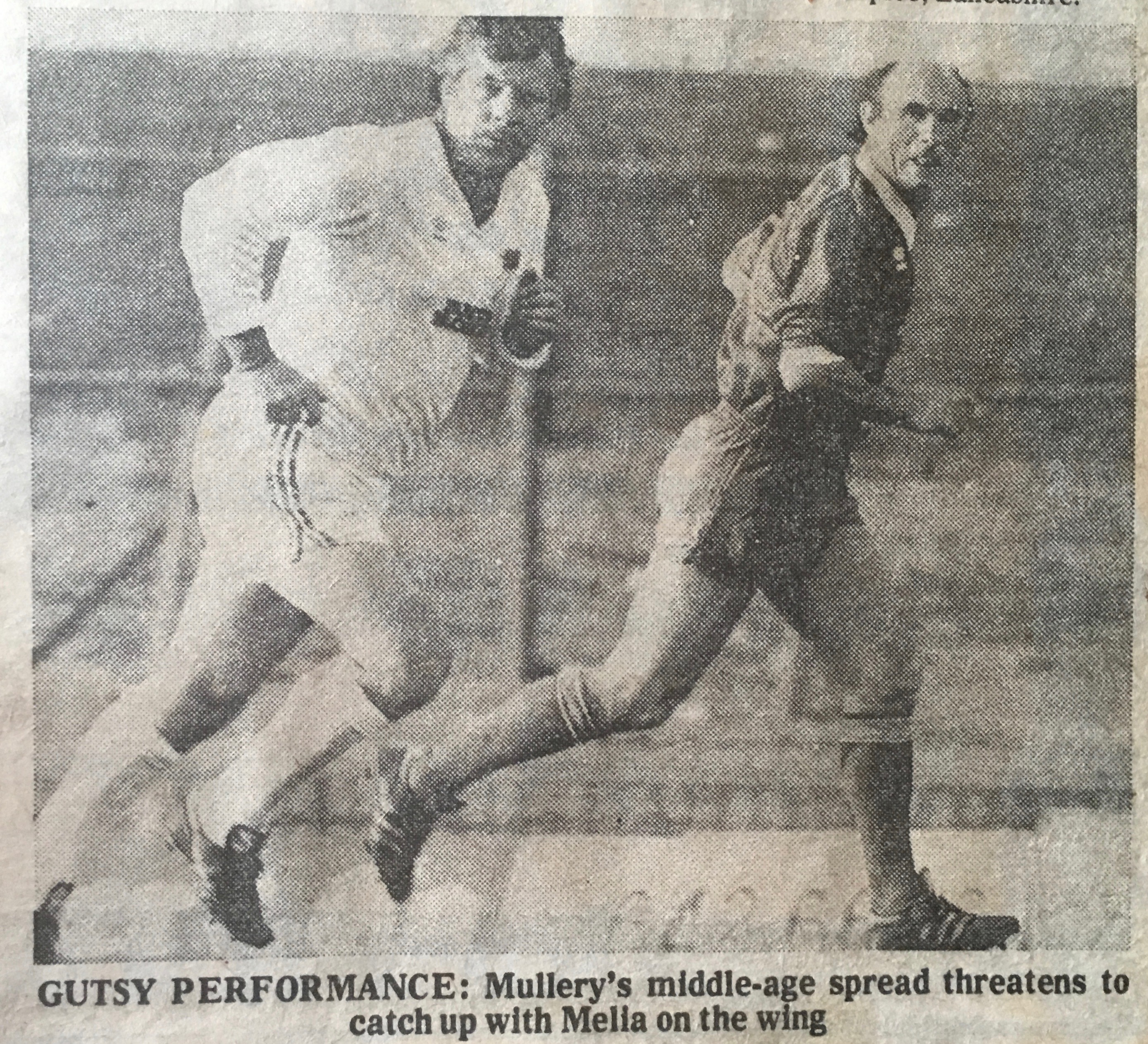
mullers + meia

Perhaps not surprising, then, that in a veterans’ charity match played at Selhurst Park just before the semi-final, Bailey refused a request to be photographed with Melia, albeit he was happy to pose alongside Mullery.

By then, Melia had indeed finally been given the manager’s role on a permanent basis (once Norwich had been defeated in the quarter final). On 16 March 1983, Bamber took him out to lunch at a Hove hotel to break the news.

In a front-page splash on the Argus, Melia said: “This is the happiest day of my life. It is a dream to be manager of a First Division club with also the possibility of taking them to Wembley.

“I am just pleased the chairman has given me the opportunity, and I hope to stay at the club for the next 20 years.” It would, of course, turn out to be closer to 20 weeks!

As excitement built in the run-up to the Cup Final, Bamber told Argus reporter Phil Mills: “Jimmy knows the game from A to Z but what I particularly like is that he’s always bubbling. He’s lively and looks on the positive side of things – even when we lose.

“The Jimmy Melia story is a fairy tale – three months ago he was our chief scout. Now he’s leading the Albion to Wembley for the FA Cup Final.

“You couldn’t get a better fairy tale than that.”

There’s no doubting Melia milked the moment, but who could blame him?

He told Ian Jarrett in The Sun: “I must make this situation count because I might never be involved in anything like it again.

“I have felt like the President of the United States in the past couple of weeks. Everyone has wanted to shake my hand and cars have beeped me in the street. It’s heaven to be in this position and I think everyone in the club should make the most of it.”

The Daily Mail even went as far as describing the opposing managers for the 1983 final as “Liberace meets Max Wall”, rather playing on the fact United’s Ron Atkinson had a penchant for bling and the follicly-challenged Melia bore something of a resemblance to the comedian and actor renowned for a silly walk. John  Roberts wrote: “Little Jim has given his usual 110 per cent in the discos, a chest-revealing Tom Jones shirt, black leather trousers, white dancing shoes and glamourous girlfriend offsetting a glistening dome that is just made for the Seagulls.”

The writer continued: “Brighton’s progress to Wembley for the first time in their history has made a relegation season tolerable and enabled the 46-year-old Melia to recapture a measure of the prestige he enjoyed as a player.

“As a nimble, intelligent inside forward he won Second and First Division championship medals with Liverpool and played for England. Some of his friends consider that he suffered to a degree for being a home-produced player rather than a fashionable big-money signing.”

Roberts even quoted comedian Jimmy Tarbuck, a boyhood friend of Melia’s, who said: “To use an old showbusiness saying, Jimmy’s been there and back.”

Who knows what might have happened had Albion actually won that Cup Final?

Melia will forever be associated with taking the club to what was then a globally-watched event and raising their profile to heights never previously achieved.

The cold, hard reality, though, was that Brighton’s brief stay among the elite of English football was over. Melia’s open, expansive style of play had been punished in the league, resulting in relegation and a loss of status that took 33 years to restore.

Melia had designs on boosting his coaching staff in the summer of 1983 with the introduction of the aforementioned Calloway, but Bamber had other ideas and, without consulting his manager, instead installed former Albion defender Chris Cattlin as first team coach.

From the outset, it was evident the two were not going to see eye to eye and it wasn’t long into the new season before it emerged publicly that Cattlin was actually picking the team.

Eventually Melia couldn’t continue with what was clearly an untenable position and resigned, but, in a rather tawdry denouement, appeared being carried shoulder-high on the north stand terrace at the next home game amid cries of ‘Bamber out, Melia in’.

At the time, there were rumblings of an Albion takeover from businessman Jeffrey Kruger and Bamber described Melia as “a disgrace” and claimed he had been operating as a mole for Kruger.

Nothing came of the takeover and the dust had not long settled on the end of Melia’s Albion association when he moved to Portugal and spent three years as boss of Belenenses, taking them to a top five finish.

Former Argus Albion reporter John Vinicombe reflected on Melia’s career in a wistful piece for the newspaper in 2001, and recalled: “Back in England Jimmy had a brief spell in charge at Stockport, then it was time to move on to Kuwait and Dubai, San Francisco, San Jose and Dallas.”

He subsequently settled in Dallas and became technical director for Liverpool’s academy in Texas.

Pictures from various sources including the Argus, The Sun, The News of the World, Shoot! and Goal magazines and the matchday programme.


Freddie Goodwin left Albion in lurch after missing promotion

Screen Shot 2021-05-01 at 19.13.47

FOLLOWING Archie Macaulay’s decision to stand down as Albion manager two months into the 1968-69 season, former Busby Babe Freddie Goodwin, still only 35, was brought in as his successor.

Goodwin had already managed Scunthorpe United and had recently been in the United States at the helm of New York Generals. The then Third Division Brighton side responded positively to his arrival, going 15 games unbeaten at home.

Utility player John Templeman, who was at the Albion throughout Goodwin’s reign, told the Argus: “When I heard he was taking over I thought the news was brilliant. His youth was a really big plus for the players.

“For many of us, we were working with someone from the same age group. We talked about the same things after training or on away trips.”

Goodwin was Albion’ manager when I first started watching them and it hadn’t been long into his reign when he populated his side with players whose attributes he had witnessed first hand in other settings.

Two former Manchester United teammates were already at the Albion before he arrived: Nobby Lawton, who was captain, and former United reserve Bobby Smith who’d played for him at Scunthorpe United.

Centre forward Alex Dawson, a teammate in United’s losing 1958 FA Cup final side, was one of his first signings at the Goldstone, and Brighton were the third club for who he signed former Wolves and Villa goalkeeper Geoff Sidebottom.

At the start of the 1969-70 season, he brought in his former Leeds teammate Willie Bell as player-coach from 1969 FA Cup finalists, Leicester City.

freddie goodwinIf Goodwin appeared to be relying on experienced pros on the way down the football pyramid, he wasn’t afraid to blend them with talented younger players, signing utility player Eddie Spearritt from Ipswich Town and bustling striker Alan Duffy from Newcastle United, both of whom went straight into the side and kept their places.
Before he arrived at the Goldstone, Goodwin had already given a league debut to goalkeeper Ray Clemence, who went on to play for Liverpool and Tottenham Hotspur and won 61 caps for England. And, after he left Brighton, Goodwin gave a Birmingham City debut to 16-year-old Trevor Francis who was England’s first £1 million player when transferred to Nottingham Forest in 1979, and he played 52 times for England.

As young lads, we always got to the Goldstone as the gates opened at 1.30pm and as we claimed our places at the front of the perimeter wall near the players’ tunnel, Goodwin would have a few words with us as he came out to inspect the pitch, one time in particular I recall him commenting how heavy going it would be after an almighty downpour.

In his only full season in charge, 1969-70, Brighton were looking good bets for promotion to Division Two. They were top after a cracking 2-1 Good Friday win over Reading but lost 1-0 the following day at Halifax and 4-1 at Fulham on Easter Monday.

With three games to go, they lost two of them, away to Rochdale and home to Mansfield (only managing to beat Rotherham 2-1 at the Goldstone) and ended up fifth, seven points behind champions Orient.

Goodwin’s last signing for the Albion saw him return to his old club, Manchester United, to bring exciting young Welshman Peter O’Sullivan to Hove. Although he didn’t stay to see the youngster flourish, O’Sullivan ended up staying for 10 years.

In the summer after narrowly missing out on promotion, Goodwin still had 18 months left on his contract but Birmingham came in an offered him a three-year deal to succeed Stan Cullis.

“Albion’s board were stunned,” wrote Evening Argus Albion reporter John Vinicombe. “They felt Goodwin was the man to take them up, and initially tried to prevent his release.

“The atmosphere was strained for a day or two. When the Albion board realised it was unrealistic in attempting to hold Goodwin, they came to a financial arrangement with City.”

When Birmingham played Albion in a First Division match at The Goldstone on 7 November 1981, Vinicombe wrote about his memories of Goodwin’s time at the helm.

“I recall him telling me that during his time at New York Generals he occupied his spare time by studying Spanish, book-keeping and accountancy,” wrote Vinicombe. And when he arrived at the Albion he told the players: “Results are nothing to do with you. They are my problem. Forget them and just give me 90 minutes effort, whatever the score.”

Templeman told the Argus: “He was a success for Brighton because he represented a fresh start. Who knows what would have happened if he had stayed at the club? He won promotion with Birmingham and I think he would probably have done the same at Brighton.”

Albion’s stuation with Birmingham was further soured because Goodwin decided he wanted to take Bell and youth coach George Dalton with him. So eager was he to hire them that he made an illegal approach while they were still under contract at Brighton and Birmingham were later fined £5,000 for a breach of regulations.

Born in Heywood, Lancashire, on 28 June 1933, Goodwin came to the attention of Manchester United when playing for Chorlton County Secondary School and became a professional under Matt Busby in October 1953. He made his senior debut for the club on 20 November 1954 against Arsenal in a 2-1 home win.

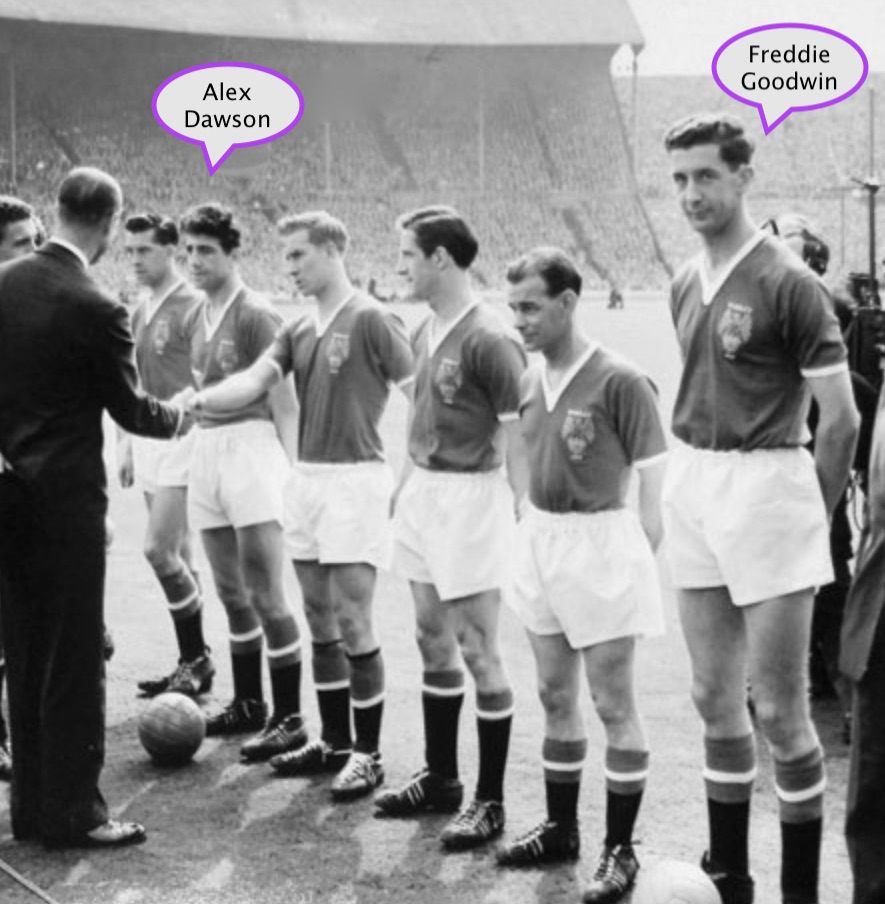
However, he wasn’t able to hold down a regular spot until the Munich air disaster in February 1958 decimated the United first team. Alongside Dawson, Goodwin was given a chance to establish himself and he played in the side which lost 2-0 in that year’s FA Cup Final to Bolton Wanderers (pre-match line-up at Wembley, below).Wembley line-up

By the time United decided to sell him for £10,000 to Leeds United in March 1960, he’d played 107 games over five seasons.

From being a teammate of Bobby Charlton, Goodwin partnered Bobby’s brother Jack in the Leeds defence and captained the side until the arrival of Bobby Collins in 1962.

After 120 games for Leeds, his playing career was virtually ended when a tackle, ironically by former Leeds legend John Charles, playing for Cardiff, on 4 January 1964, fractured a leg in three places.

Goodwin went on to become player-manager at Division Three Scunthorpe (his injury restricted him to just six appearances) where he first signed Sidebottom whose place was eventually taken by the emerging Clemence.

When Goodwin tried his luck in America in 1967-68, Sidebottom was one of his first signings at New York Generals, and the ‘keeper played 44 games over there.

Birmingham fans will always remember how Goodwin launched the career of teenager Francis. In 1972, Francis, Bob Latchford and Bob Hatton spearheaded promotion for the Blues and a place in the FA Cup semi finals.

The 1973-74 season saw Birmingham escape relegation from the elite by a single point. They were marginally safer the following season, and reached the semi-final of the FA Cup again (losing in a replay to Fulham).

With Blues struggling at the foot of the table at the start of the 1975-76 season, Goodwin was sacked in September and Bell took over.

In 1976 Goodwin returned to America to become the first coach and president of the Minnesota Kicks where he remained until the early 1980s before retiring.

He settled in the US and lived there until his death from cancer aged 82 in Gig Harbour, Washington, on 19 February 2016.

In paying tribute to the man who gave him his big break, Francis told the Birmingham Mail: “I will forever be indebted to him for having the courage to put me into the team at such a young age – that tends to be overlooked.

“I had only had a season of youth football and not even a handful of reserve team games but he still gave me my opportunity.

“I held him in very high regard and had enormous respect for him. I was most saddened the day he was sacked.

“He looked after me and took care of me. He was like a father figure to me. He knew when to play me and when to take me out and give me a little bit of a rest – not that I understood that at 16 years old.

“Just before I went to Detroit, Freddie was already in the States coaching the Minnesota Kicks and he put a very lucrative offer in front of me to go out there and play.

“That alerted a lot of other NASL clubs and in the end I went to Detroit, who were managed by Jimmy Hill. I owe much of that to Freddie’s foresight.”

Read more here:

http://www.ozwhitelufc.net.au/players_profiles/G/GoodwinF.php

Pictures from the Albion matchday programme and online sources; Goodwin in a Leeds team line-up from 1962-63 alongside Billy Bremner and Jack Charlton.

Cup winner Bert Murray: Brighton’s People’s Player

5-bert-v-villaON HOLIDAY in Jersey in 2016 my eyes were drawn to a picture on a display in St Helier’s Fort Regent entertainment complex.
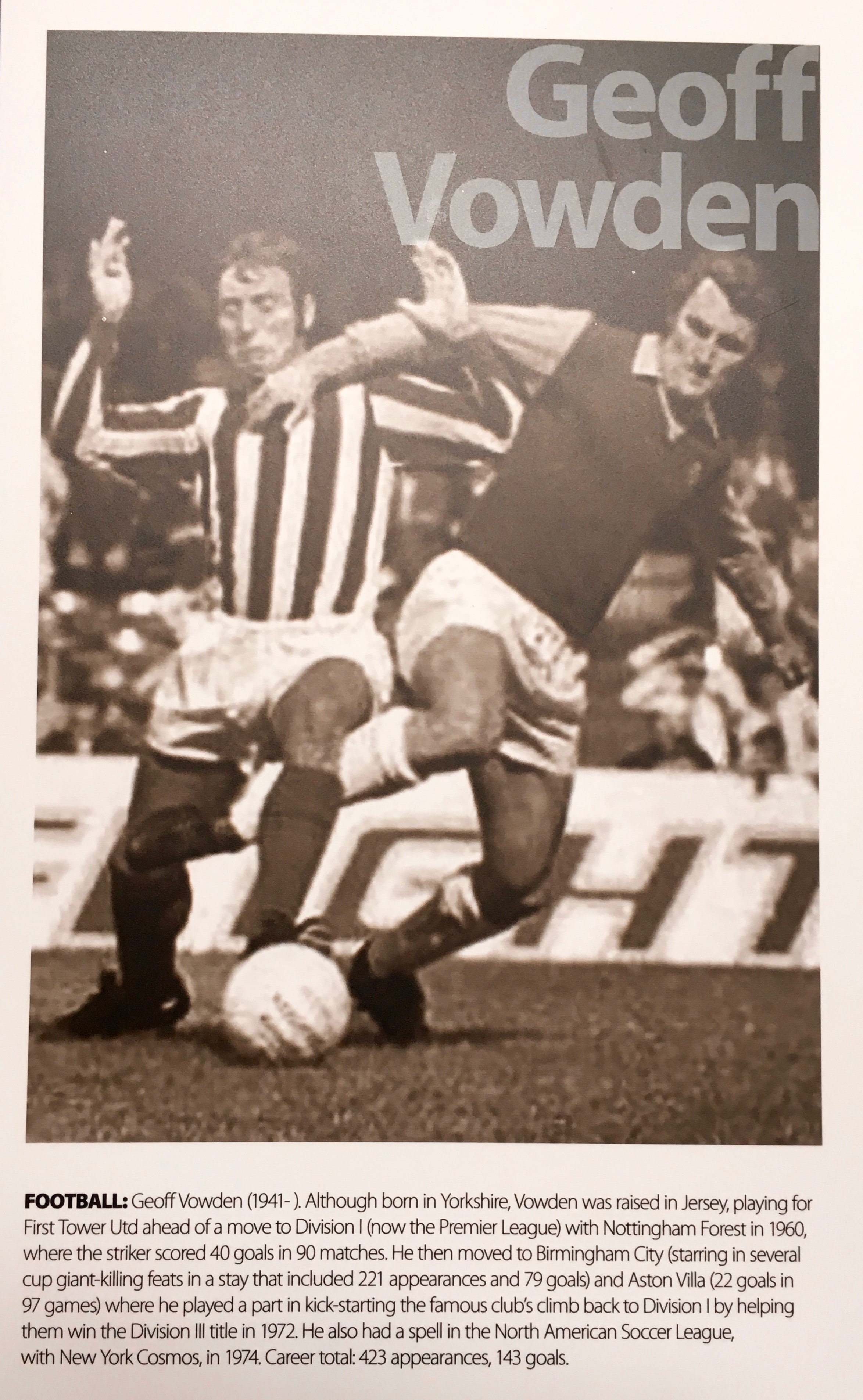
“That’s Bert Murray,” I declared to my bemused wife, and, let’s face it, who would have thought Brighton & Hove Albion’s combative former Chelsea and Birmingham City winger would still be on a public display 45 years after the picture was taken?

The display featured sports stars from Jersey who had gone on to make a name for themselves – and, ironically, the picture in which Bert appeared (below) was about Geoff Vowden (born in Barnsley but raised in Jersey), then with Aston Villa, but a player who had been a teammate during Murray’s five years at St Andrew’s.

1-jersey-posterVersatile Murray – mainly a winger but equally adept at right back – wrote himself into the Albion’s history books when he was bought from Birmingham with funds raised by fans.

But let’s go back to the beginning. Born in Hoxton, London, on 22 September 1942 Murray started his football career with Chelsea in 1958 and scored in the first leg of their 1960 FA Youth Cup Final win against Preston as part of a team which spawned many future star players, such as Peter Bonetti, Terry Venables and Bobby Tambling.

Bert made his Chelsea first team debut in 1961 and in 1963 was part of the squad that won promotion from Division 2. His form for Chelsea attracted the England selectors and in the 1964-65 season he played in six of England under 23s’ seven games, scoring on his debut.

That was on 25 November 1964 in a 5-0 romp over Romania at Coventry’s old Highfield Road ground when Alan Ball, Mick Jones, Alan Hinton and Martin Chivers also scored.

Sadly for Bert, that was the only win he experienced as an England player: in the remaining games there were four 0-0 draws and a 1-0 defeat to West Germany. Other big name players who were part of the same team included Nobby Stiles, Norman Hunter and George Armstrong

Murray’s final international was in front of 70,000 fans in Austria on 2 June 1965 when his Chelsea colleague Bonetti had taken over in goal from Gordon West and Ball, who, like Stiles would become part of the following year’s England World Cup winning team, was sent off.

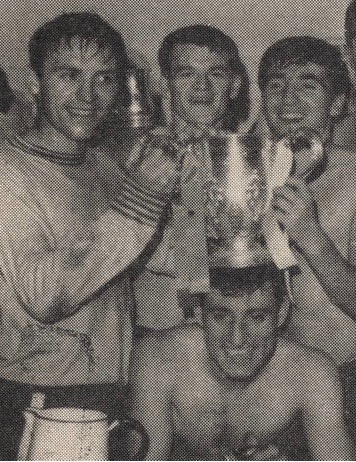
2-1965-lge-cup-winnersAt least at club level in 1965 Murray won some silverware (above image discovered on The Shed End Chelsea fans website), playing alongside Bonetti, Venables, Eddie McCreadie, Barry Bridges and John Boyle as Tommy Docherty’s Chelsea won the League Cup in April via a narrow 3-2 aggregate win over Leicester.
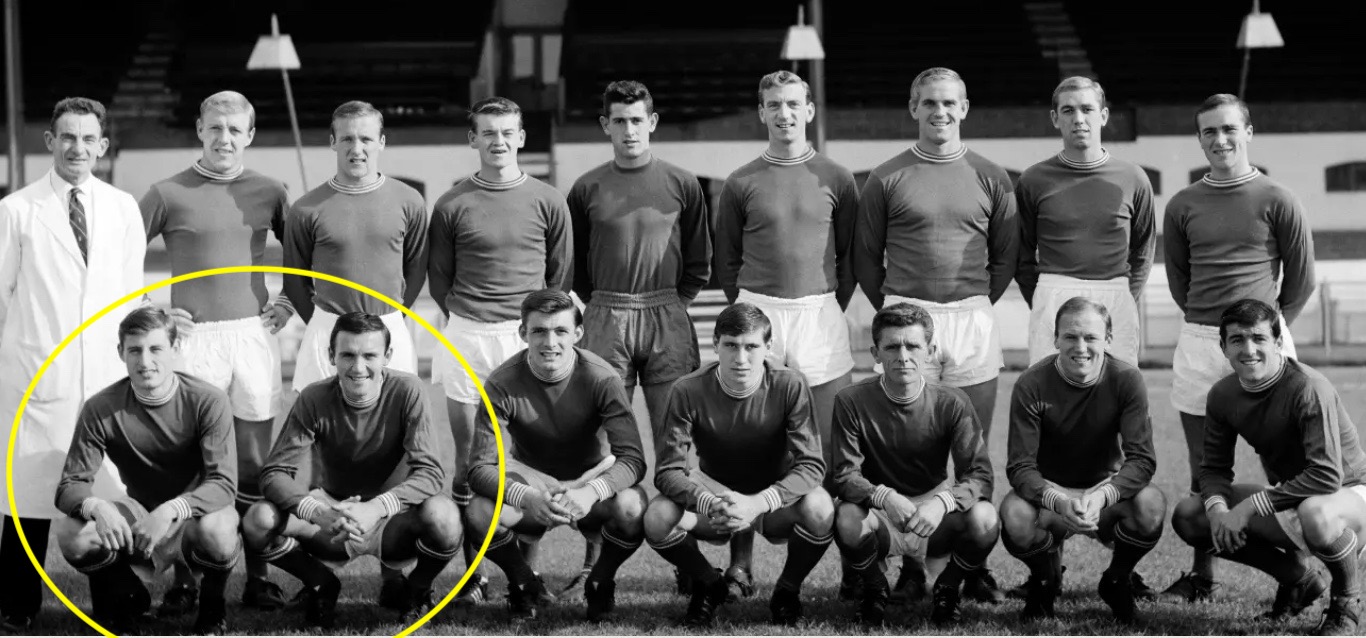
Murray + Bridges ChelseaMurray and Bridges alongside each other in a 1963-64 Chelsea team picture.
In the same season, Chelsea were top of Division One for nearly the whole season, and were looking good for the domestic treble but lost 2-0 to Liverpool in the FA Cup semi-final.

The young team started to show signs of strain and slipped to third in the league. Murray and Bridges were amongst a group of eight players who defied a curfew when the team were staying in Blackpool prior to a game against Burnley and the manager sent them home. The team Docherty put out capitulated 6-2.

According to ‘Bluebeard’ on theshedend.com the following nearly-but-not-quite season – fifth in the league, beaten FA Cup semi-finalists again and Fairs Cup semi-finalists – led to Docherty breaking up the team and selling Murray, Venables, Bridges and George Graham.

So, in 1966, having scored 44 goals in 183 games, Murray was transferred to Birmingham for £25,000 and Bridges went too, as Birmingham’s new wealthy owner, Clifford Coombs, splashed the cash for manager Stan Cullis.

3-brumbertThe pair were part of the side which in successive seasons got to the semi-final of the League Cup (in 1967) and FA Cup (in 1968) only to lose on both occasions. Because these things are important in the Midlands, joysandsorrows.co.uk remembers Murray as part of the 1968 Blues side who beat rivals Villa home and away. In five years, he played 132 games scoring 22 goals.

murray brum

It was the Blues former Brighton manager Freddie Goodwin who loaned him to his old club in early 1971. The loan became a permanent move thanks to £10,000 raised through innovative manager Pat Saward’s famous Buy-a-Player scheme which saw fans respond to the club’s lack of cash to bring in new players by coming up with sponsored walks and suchlike to raise the necessary money to enable Saward to bring in new faces. Thus Murray was swiftly dubbed the People’s Player.

4-bertwillie1971Saward brought in Willie Irvine on loan from Preston at the same time and the pair combined well on 10 March 1971 (pictured above by the Evening Argus before the game) as high-flying Fulham were beaten 3-2. In Irvine’s 2005 book with Dave Thomas, Together Again, he recalls how the pair hit it off and began a friendship that endures.

Murray was an influential right winger who made and scored goals and he became a reliable penalty taker too, notably keeping a cool head from 12 yards in the 12-game unbeaten run in 1972 which culminated in promotion as runners up behind Aston Villa.

In the famous game televised by BBC’s Match of the Day at home to Villa in April 1972, Saward moved Murray to right back to replace previously ever-present Stewart Henderson. It wasn’t completely alien to him, though, because he’d slotted into that role on occasion at Birmingham.

The photographers were busy during that tightly-fought 2-1 win against Villa and several different shots of Bert’s tussle with Villa’s talented winger Willie Anderson appeared in the newspapers and magazines following the game (see pic at top of article).

While others might have been grabbing the bulk of the goals and the headlines, Murray’s consistent performances earned him the player of the season award (below, receiving the award from chairman Tom Whiting).

murray poy

The newly-promoted side struggled badly and Saward chopped and changed the line-up, bringing in a host of new faces – including Bert’s old Chelsea colleague Bridges – as he tried in vain to find the right formula to keep the Albion up. But Murray was one of the few who kept his place at the higher level, mainly back in midfield. He took over the captaincy from Ian Goodwin and contributed nine goals in 39 appearances.

Although eventually the side clicked in the final third of the season, the damage had been done early on and the recovery wasn’t enough to avoid an immediate return to Division 3.

Murray wrote in the matchday programme: “The last two months have been amazing and although I say it myself I beleive that we have played some really good football recently. I also believe we deserve a better fate.”

He added: “We must hope we have learned our lessons well for next season.” Murray appeared in the front row of the 1973-74 team line-up but his time on the south coast was drawing to a close – along with manager Saward. Murray was involved in only two games as a substitute in October and after a total of 102 games and 25 goals he moved on to Peterborough United, initially on loan and then signing permanently.

It was Noel Cantwell, the man Saward had served as assistant manager at Coventry City, who signed Murray for Posh. “He needed a right midfielder,” Murray said in a 2012 interview with the Argus. “I went up there and had four wonderful years. I still see some of the lads now.”

Saward, with his own days at the Goldstone numbered and, without naming any names, wrote some cryptic programme notes for the 13 October home game against Halifax. “In deciding that a player can leave a club, the manager must consider the player’s contribution to the club and decide whether he fits into his plans for the future,” he wrote.

“When a manager decides it is time for the player and club to part he is not necessarily governed solely by the ability of the player but he has to look at his squad as a whole and assess whether there are younger players with longer futures waiting their chance to come through.

“A governing factor must be that the strongest possible team should be fielded at all times and the manager must decide when other players should take over from established favourites.”

In the programme for the 24 October game with Southport – by which time Saward himself had been sacked – there was a brief paragraph under the headline ‘Bert Murray Leaves’.

At 31, Bert still had plenty of football left in him and he went on to make 123 appearances for Posh, scoring another 10 goals, before retiring and going into the pub trade, in Market Deeping, nine miles north of Peterborough.

Many have been the occasions Albion fans following the team at London Road have taken a detour to pop in to see Bert and chat over old times over a pint.

In 2013, when he had his 70th birthday, The Society of Independent Brewers did an article about his 20 years running Everards pub The Bull in Market Deeping with his wife Eileen. They had also spent 17 years at two other pubs in the town, The Winning Post and The White Horse.

“Everards have been good and seem happy with what we are doing here. So if they are happy, Eileen and I plan to keep on going for a few more years yet as we really enjoy running the pub,” he said.

In September 2013, Bert returned to Stamford Bridge for a 50th anniversary reunion with the Chelsea ‘class of ‘63’ – chatting over old times over dinner with Terry Venables, John Hollins, Peter Bonetti, Barry Bridges, Ken Shellito and Bobby Tambling.

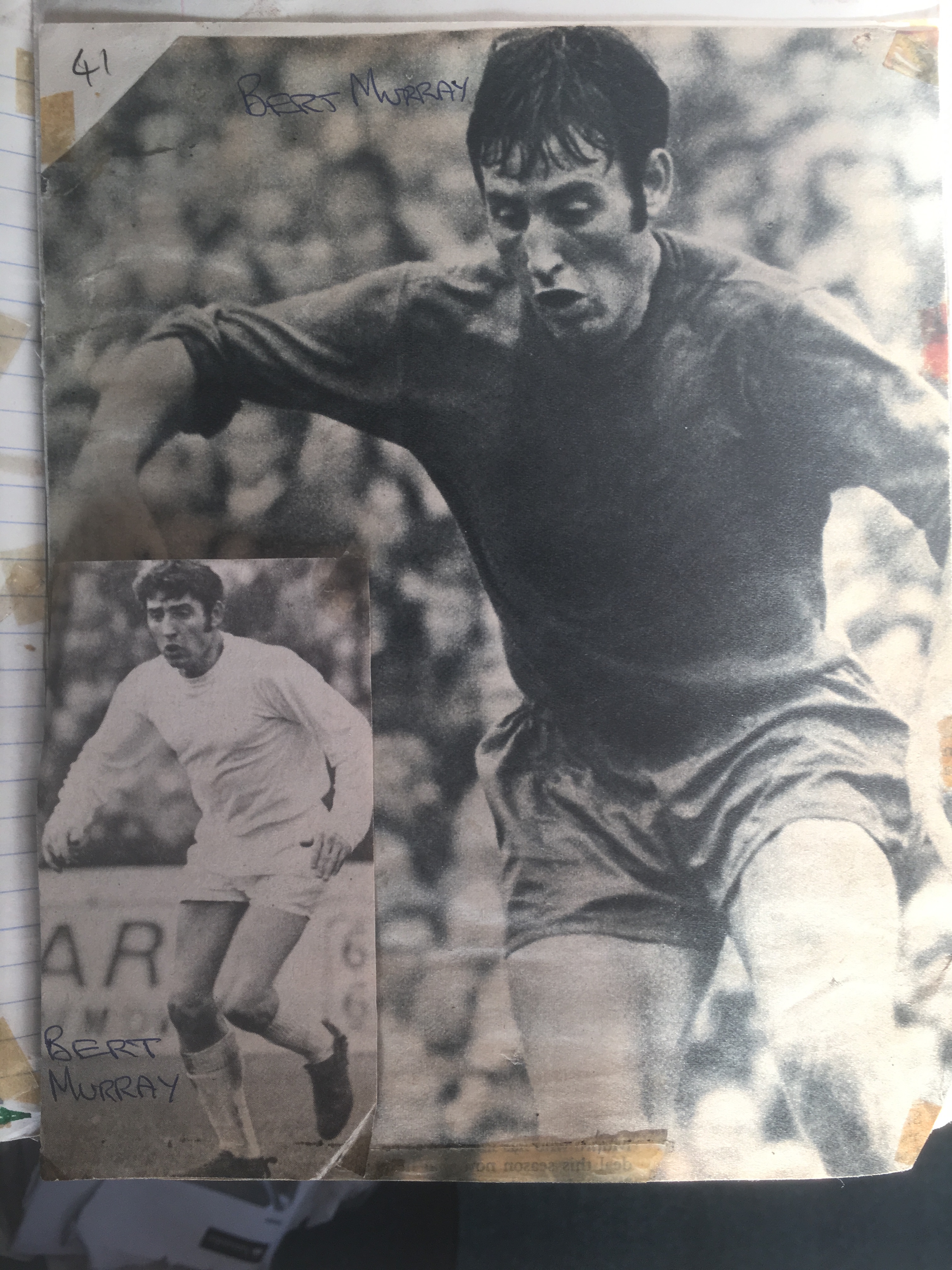
Pictures from my scrapbook , the internet and the Albion matchday programme.

Below, the Goal magazine feature ‘The Girl Behind The Man’