Promotion-winning full-back Paul Watson delivered for Zamora

DEPENDABLE full-back Paul Watson will best be remembered by Brighton fans for a sweet left foot that invariably created goalscoring chances for Bobby Zamora

.Previously, Watson made 57 appearances in a season-and-a-half with Fulham, and was a mainstay in their famous 1996-97 side that earned promotion from Division Three under Micky Adams.

.Born in Hastings on 4 January 1975, Watson began his playing career with Gillingham, where he spent five years before following Adams to Fulham in July 1996.

He teamed up with Adams once more, at Brentford, where he played for 20 months before signing for the Albion in a joint deal with Bees teammate Charlie Oatway.

Watson was a key member of the side that won back-to-back championships, helping the Seagulls from the fourth to the second tier.

The left-footed right back was particularly accurate from dead ball situations and his pinpoint passing proved ideal for Zamora to thrive on.

In Paul Camillin’s Match of My Life book (knowthescorebooks.com, 2009), Zamora said: “Whenever Watto got the ball I knew precisely where I needed to run to and he knew where to deliver it to.

“It was just such a great connection: Watto has an absolutely wonderful left foot and it made my job as a striker so much easier when you get deliveries like that.”

At the time of the interview, Zamora had moved on to Premiership Fulham and had played several seasons at the highest level. He said: “I don’t think I have come across anybody with a better left foot than Watto’s.

“I was very lucky to have played in the same team as him: he created numerous goals for me; not only with his deliveries but with his intelligent play as well.”

When the Seagulls finished top of the third tier under Adams’ successor Peter Taylor, Watson was one of four former Fulham players in the side: Danny Cullip, Simon Morgan and Paul Brooker the others.

img_4424

The disastrous run of 12 defeats under Martin Hinshelwood, after such a promising start in the second tier, took the players by surprise, as Watson revealed in an extended interview with Jon Culley for the Wolverhampton Wanderers matchday programme on 11 November 2002.

“Obviously we were aware it was a step up but we thought we would at least do okay,” he said. “Nobody was suggesting we would win promotion for a third season in a row, but, with a couple of new signings and the quality that was already in the side, we didn’t think we would struggle as we have.

“Everything started off all right. We had a good win at Burnley and then a 0-0 draw against Coventry and the way we were playing seemed to be working but after that nothing would go right.

“Every bit of luck, even the referees’ decisions, seemed to go against us and we could not get a point for love nor money.”

Watson conceded that the squad Peter Taylor had led to the Second Division title before his resignation faced a steeper learning curve than anticipated.

“You have to appreciate that 80 per cent of the squad had never played in the First Division before and it is a big jump in terms of the technical quality of some of the people you are up against,” he said.

Watson admitted the loss of Taylor had come as a big blow, and said: “Peter Taylor had been the England coach, even if it was only for one game, and to attract a manager of that quality to a club such as ourselves was very exciting.  Lots of players were gutted when he left.”

The arrival of Steve Coppell as manager gave the team renewed hope, although at the time Watson also spoke about the return to fitness and form of Zamora.

“Bobby was out for a while at the beginning of the season and you are always going to miss a player of his quality,” he said. “Now that he is beginning to get his fitness back, hopefully he will be able to make a difference to our fortunes.

“Nobody here is talking about relegation despite the start we have made. The arrival of players like Dean Blackwell and Simon Rodger have given a bit more know-how to the squad. We think we have what it takes to stay up.”

Obviously, it didn’t quite turn out that way, although they came mighty close to avoiding the drop. Watson stayed with the club the following season when Mark McGhee came in and steered the Seagulls to play-off victory in Cardiff against Bristol City, but his regular right-back slot was taken over by Adam Virgo.

After six years with the Seagulls, Watson left in July 2005, once again following ex-boss Adams, this time to Coventry City.

“I’ve got a lot of respect for him,” Watson told fulhamfc.com. “He’s made my career, basically! I’ll always have good things to say about him. Wherever he’s been he’s always been able to get the best out of his players, and he got the best out of me as well.”

However, Watson only played three games in a six-month spell with the Sky Blues, before going non-league with Woking, playing 15 games and, in the 2006-07 season, appearing in 44 games for Rushden & Diamonds.

He then had a season with Crawley and finally finished playing with Bognor. After hanging up his boots, Watson undertook a physiotherapy degree and was subsequently taken on by the Albion.

“It kind of started when I was at Brighton,” Watson told fulhamfc.com. “I had a couple of injuries towards the end of my time there and the physio at the time, Malcolm Stuart, helped me along and pointed me in the right direction.

Watto phys

“I did a couple of courses while I was still playing which helped me get onto my degree when I retired.”

Watson spent just short of nine years with the Albion’s physio team, initially with the development squad and then with the first team, during which time he earned a first class honours degree in physiotherapy at Brunel University, graduating in 2012.

Since June 2017 he has been head physio at Sheffield United and is currently studying for a Master’s degree in Sports Physiotherapy with Bath University.

Pacy Paul Brooker an in-and-out talent on the wing

PAUL BROOKER, a winger at one time mentioned in the same breath as Ryan Giggs, played more games for Brighton – 147 – than any of his other clubs but only managed a Premier League cameo with Leicester City.

Brooker certainly had the capacity to excite fans but there could be frustration in equal measure and, although he won back-to-back promotions with the Albion, his career didn’t come close to the achievements of the great Manchester United winger.

The national football fanzine, When Saturday Comes, ran a superb piece about Brooker in April 2002, in which Adam Powley talked about his “conspicuous talent” and maintained: “Brook­er was in­deed very good, blessed with real pace and an ability to keep con­trol while run­ning at full pelt.”

Born in Hammersmith on 25 November 1976, Brooker was with Chelsea as a schoolboy but it was Fulham who picked him up and gave him his professional opening.

Ian Branfoot handed him his first team debut –  in a 0-0 draw away to Bury on 14 October 1995 – and he was part of Micky Adams’ promotion-winning Fulham side of 1997.

Amazingly, he made just 18 starts for Fulham, but came off the bench 54 times. Across those 72 appearances, he scored six goals. He was eventually frozen out in the Kevin Keegan era, playing his last first team game in September 1998, and then spent time on loan at Stevenage, where he played eight games.

In February 2000, he joined his former Fulham boss, Adams, on loan at Brighton and, after a 15-game spell, he joined Albion permanently for a £25,000 fee.

Screen Shot 2021-05-20 at 20.29.32Brooker scored after only three minutes in a 2-0 win away to Plymouth Argyle on 14 April 2001 (celebrating above) which secured promotion for the Seagulls, and he was a regular on the wing that season, making a total of 41 appearances. He remained a key member of Albion’s third tier promotion-winning squad in 2001-02, Argus reporter Andy Naylor summing up his contribution thus: “Most wingers have an inconsistent streak and ‘Bozzy’ is no exception, but he is a matchwinner on his day.

“Quick and an elusive runner with the ball, he hit scoring form as well towards the end of the campaign with three goals in eight games. The First Division should suit his style.”

Brooker also featured in Steve Coppell’s 2002-03 side – I remember seeing him score in a 2-1 away win at the Madjeski Stadium – but as Brighton exited the second tier at the wrong end in 2003, so Brooker ended his association with the club.

Coppell had hoped he would stay, telling The Argus: “We obviously want to keep him at the club. I think he is a terrific asset. He has still got a lot to add to his game and improve but he makes us that little bit different.

“He is hard to tie down. Teams cannot afford to leave him and yet they don’t really want to assign somebody to him.”

For his part, Brooker told Howard Griggs of The Argus in an April 2011 interview: “I absolutely loved my time at Brighton; it was the best three years of my career.

“By nature I am a Chelsea fan but I always look out for Brighton and so do a lot of my family and friends.”

A free transfer move to Leicester City, once again working under Adams, finally gave Brooker a Premier League platform to display his talent but his chances were limited and he ended up starting just two League Cup games as well as getting on as a substitute in three League games and a FA Cup match.

With his top tier opportunities limited, he elected to play under Coppell again and joined Championship side Reading on loan. He made 11 appearances in 2004 before joining the Royals permanently in July 2004.

After just one season at Reading, when he played 34 games, Martin Allen signed him on a free transfer for Brentford.

He had two seasons with the Bees but his time at Griffin Park came to an end shortly after the start of the 2007-08 season.

“When Terry Butcher came in, I think he’d made his mind up about me before he’d even seen me play,” Brooker told fulhamfc.com. “We just didn’t see eye to eye about things, and that was the end of it for me there.”

A Brentford blog, the entertaining BFC Talk, spoke about Brooker in a July 2015 piece. “Paul Brooker was another who flattered to deceive and throughout his career never did justice to his vast ability,” it said.

“He scored a goal of sheer brilliance after running the length of the pitch at Swindon, but on other days he appeared to be lethargic, disinterested and peripheral to the action.

“He did not take criticism well, either from fans, or indeed, his manager, Terry Butcher, and reacted badly before having his contract cancelled.” Although Brooker started taking his coaching badges, he admitted to the Fulham website: “I’ve not really kicked a football since I left Brentford; I lost a lot of my passion and love for the game.

“I’ve set up a carpet cleaning business with a friend just for something to do and that’s going quite well. I’m enjoying doing something different from football.”

Brooker played non-league for Chertsey Town in 2008-09 although he did have a short spell back training at the Albion, during Adams’ brief return as manager.

He also turned out for Havant & Waterlooville and Dorking Wanderers. After his playing days ended, he took up after school sports coaching in the Kingston, Twickenham and Hounslow areas.red Brooker

Pictures from the matchday programme; Simon Dack in the Argus, and the Reading website.

Oatway took off with Bluebirds and soared with Seagulls

CHARLIE Oatway had not long earned his break in professional football with Cardiff City before he found himself behind bars in Pentonville Prison.

Up on a charge of GBH for his part in a fight, when an Afro-Caribbean friend was racially abused, Oatway didn’t expect to get incarcerated but ended up serving two months of a four-month sentence.

Before he headed off to court in London on a Monday morning, he had told Cardiff’s general manager, the former Leeds and Wales international Terry Yorath (broadcaster Gabby Logan’s dad), to expect him for training on the Tuesday morning!

The story is explained in detail in Tackling Life, the book Oatway published about how he turned his life round to become captain of Brighton and part of three promotion-winning sides.

The tale reveals how imprisonment was just one of the hurdles Oatway had to overcome in a life that’s taken many colourful twists and turns.

It was sadly ironic that his career as a player with Brighton was cut short in a Boxing Day clash against Queens Park Rangers, the team he followed home and away from an early age.

The family lived a stone’s throw from Loftus Road and Charlie – a nickname given to him by an aunt – was named by his Rs-daft dad after the whole of the promotion-winning 1973 QPR team: Anthony, Phillip, David, Terry, Frank, Donald, Stanley, Gerry, Gordon, Steven, James.

He was even starstruck at an Albion Legends event when he saw John Byrne who had been a hero of his during his days playing up front for the Rs alongside Gary Bannister.

Albion reaching the Division 2 play-off final in Cardiff in 2004 was the highlight of Oatway’s career – but a feature in the match programme was angled on the disappointment he had suffered the year before, when he had gone as a spectator with all his family to see QPR lose to Cardiff.

“Everything about the day was perfect apart from the result,” Oatway told reporter Alex Crook. “Being a QPR fan at heart, I felt the pain of the defeat just as much as the other 35,000 fans. But this time I am going up there as a player and not as a fan and I am determined our supporters will not go through what I did last season.”

The youngest of five kids, Oatway grew up in Shepherd’s Bush and even though he started to struggle in school from an early age, he displayed quite a talent for football.

“I knew by the time I was eight that I was as good as any of the eleven-year-olds I was playing with,” he recalls in Tackling Life. He had trials for the West London District schools team and played for Harrow Boys Club and Bedfont Eagles.

Oatway reveals how it was Wally Downes, the former Wimbledon player and later loyal assistant manager to Steve Coppell, who helped to get him noticed, along with his cousin, Terry Oatway.

The young Oatway joined up with Wimbledon in the year they won the FA Cup – 1988 – and played for the youth team, but he was let go at the end of the 1989-90 season because they thought he was too small. He went to Sheffield United on trial but was homesick so he returned to London and joined non-league Yeading on semi-professional terms. Off the field, life was by no means straightforward. “By the age of 19, I had two children with two different mothers,” he said.

After helping to get Yeading promoted in 1993-94, Oatway found a pathway back into the professional game when a community worker (Ritchie Jacobs) on the estate where he lived organised a trial at Cardiff City for him and two pals.

He was the only one of the three invited back and he said: “When Cardiff asked me back for another month, I knew it was the chance I’d been waiting for, and I was going to grab it with both hands.”

Not surprisingly, the two months he spent in Pentonville didn’t greatly help his cause but remarkably he was welcomed back to the club and accepted by the fans. However, in his absence there was a change in team management and ownership and, before long, new team manager Kenny Hibbitt was instructed to send Oatway out on loan to Coleraine in Northern Ireland.

On his return to Cardiff the following season, they had by then been relegated to the Fourth Division. Still he was unable to get back in the first team and he happened to play a reserve team game against Torquay United, who were managed by his old Cardiff boss, Eddie May. May asked if he fancied a move for first team football and, although he only joined just before Christmas in 1995, by the end of the season he had been voted Player of the Year.

When May moved on to become manager of Brentford, he put in a bid for the combative midfielder and took him back to west London to play in the Bees’ third tier side.

In 1998, Oatway had a brief loan spell with Lincoln City but on his return to Griffin Park he came under the managership of Micky Adams for the first time.

Adams had taken over the manager’s chair at Griffin Park but he was sacked when owner Ron Noades thought he could make a better job of running the team. Oatway was sent on a month’s loan to Lincoln, somewhat against his wishes, but on his return to the Bees he forced his way into the side and worked well with coach Ray Lewington.

Adams then took the reins at Brighton and, as the Albion began life back in Brighton & Hove after the two-year exile in Gillingham, Oatway and Bees teammate Paul Watson joined the Seagulls for a combined fee of £30,000.

Adams wanted the pair to join a nucleus of players who’d all played under him previously at Brentford and Fulham.

In an Albion matchday programme profile of Oatway to coincide with the visit of his former club, Torquay, on 2 September 2000, it noted: “Despite getting sent off rather stupidly in one of his earliest games for the Seagulls – he bit a Darlington player’s face – he soon became a great favourite with the Brighton crowd, who hadn’t seen a midfield scrapper like him since Jimmy Case retired.”

oatway prog cover

He went on to be a vital midfield cog in the back-to-back league title winning sides of 2001 and 2002. Although he was in the team that was relegated from the second tier in 2003, he was full of praise for the effort made to avoid the drop. “Steve Coppell was one of the best managers I’ve ever played under because of his attention to detail,” he said. “Steve’s team talks on the day before a game were brilliant.”

When the departed Coppell was replaced by Mark McGhee, Oatway remained a cornerstone of the Albion line-up and described that 2004 play-off final at the Millennium Stadium as “the best day of my career”.

But at one point it was touch and go whether he was going to be able to carry on. In October 2003, he underwent major back surgery to repair a slipped disc and trapped nerve.

He was out for nearly three months and he admitted in an Argus interview: “There was a good chance I wouldn’t play again.”

When the Albion cashed in on captain Danny Cullip in December 2004, selling him to Sheffield United, Oatway took over the skipper’s armband full-time, a role he had previously embraced as a stand-in.

The following season’s Boxing Day clash with QPR at Withdean was only two minutes old when Marcus Bean tackled Oatway from behind and escaped without even a booking.

Oatway was stretchered off and McGhee later told the mirror.co.uk: “Charlie has been a tremendous leader and captain and this is a huge blow. I’m very upset about it.”

Oatway had four different operations to try to fix the ankle injury, but he never recovered sufficiently to return to the required level to play league football.

“I tried to get back to playing again but by the pre-season of 2007 I had to call it a day,” he said.

However, even when he was out injured, Oatway was always a strong influence on the dressing room.

Stand-in skipper Dean Hammond said in an Argus interview in November 2006: “Charlie has been out injured but he has been fantastic for everyone. He comes in, he gets everyone up for it, he’s always laughing and joking. He’s got the enthusiasm and he is still determined, even though he is not playing.

“His personality is fantastic for everyone and I think he deserves a massive pat on the back.”

He also used the time productively, studying how the coaches worked with the youth team players and starting to take his coaching badges. When it was clear he wouldn’t be able to return to play full-time professional football again, he got involved with the Albion in the Community scheme as a community liaison manager.

Rather than give up the game completely, Oatway took the opportunity to become player-coach at Havant and Waterlooville and, in January 2008, he found himself in the national media spotlight when the Blue Square South minnows played away to Liverpool in the fifth round of the FA Cup.

Oatway wasn’t fit to start the game but he got on as a substitute in the 74th minute and later recounted how his former teammate Bobby Zamora fixed it for him to swap shirts with Liverpool’s Yossi Benayoun, who scored a hat-trick in the Reds’ 5-2 win that day.

Then, in 2009-10, Oatway began helping Brighton manager Russell Slade to coach the first team and, after Slade’s departure, continued in the role under Gus Poyet.

When Poyet left the Seagulls to join Sunderland, Oatway went with him and he was also in the dug-out alongside Poyet and his assistant Mauricio Taricco at Chinese Super League team Shanghai Greenland Shenhua, AEK Athens and Seville-based Real Betis.

Pictures: matchday programme; The Argus; Tackling Life (Quick Reads, 2011).

Fluctuating fortunes for Guy Butters after beginning alongside Spurs stars

GUY BUTTERS saw plenty of highs and lows in a 20-year playing career that started with great promise at Tottenham Hotspur and included six years at Brighton, where he still works.

Butts coaches for Albion in the Community, he’s scouted players, hosted hospitality lounges and still turns out to play in charity matches, not to mention sharing a constant flow of corny jokes with his 3,700+ followers on Twitter!

Promotion via the play-offs at Cardiff in 2004 and being chosen as player of the season would be up there in terms of highs with Brighton.

My personal favourite came on 13 November 2004, when Butters scored the only goal of the game as Albion committed daylight robbery in front of 29,514 packed into West Ham’s Boleyn Ground.

BZ GBBrighton were up against it going into the game and had taken veteran Steve Claridge on for a month to help them out of a striker crisis. Hammers threw everything at the Albion that afternoon but somehow the Seagulls kept the ball out and, on 68 minutes, Butts, up for a Richard Carpenter free kick, got his head on the end of it to send the ball into the back of the net in front of the Seagull faithful.

Even after versatile Adam Virgo and Hammers’ Haydn Mullins were sent off for a scrap on 74 minutes, and West Ham bought on substitute Bobby Zamora, the scoreline remained 1-0 to the Albion.

A couple of months later, it was obviously a special day for Butters when, on 8 January 2005, he was given the captain’s armband to lead the Albion in their third round FA Cup tie against Spurs at White Hart Lane.

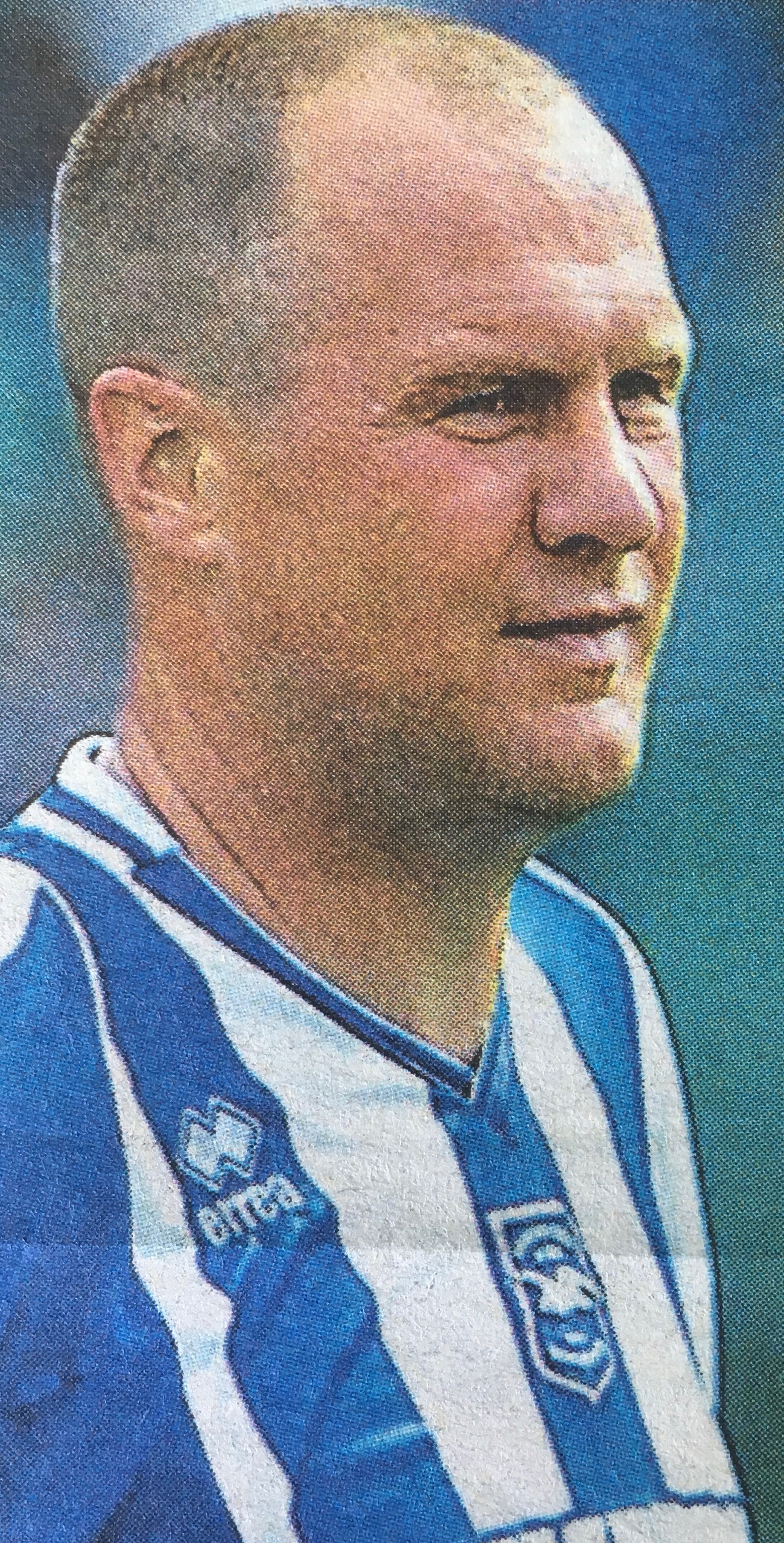
  • A programme portrait and skipper for the day in the FA Cup at White Hart Lane.

The matchday programme recalled how Butters “was very much the discovery of the 1988-89 season when manager Terry Venables lifted the tough tackling former Spurs trainee from our reserves to the first team to play alongside Gary Mabbutt and Chris Fairclough in a back three.

“Guy was also in there alongside such names as Paul Gascoigne, Chris Hughton, Chris Waddle, Paul Walsh, Terry Fenwick, Paul Stewart, (former Brighton Cup Final hero) Gary Stevens and Paul Allen. And he kept his regular place the following season when Gary Lineker was added to the squad.”

Born on 30 October 1969 in Hillingdon, he made his debut shortly after his 19th birthday in a League Cup game against Blackburn, and suffered the agony of scoring an own goal. But on his full league debut as a sub against Wimbledon on 12 November 1988, he made amends with a goal in the right end.

“We won that one 3-2 but it’s probably better remembered by Spurs fans as the game in which Gary Stevens was injured following a tackle by Vinnie Jones,” Butters told the Spurs programme.

“I’ve got great memories of my time at Tottenham but, looking back, I recall spending much of my time trying to avoid Gazza who was always up to something! But it was the players around me that I will never forget – I was in there with men who had appeared in World Cups, and that’s my abiding memory.”

The year after his Spurs debut, Butters also earned international honours. In June 1989, he was involved in three England under 21 tournament matches in Espoirs de Toulon matches.

He started in the 3-2 defeat to Bulgaria on 5 June, and was replaced by substitute Neil Ruddock. Two days later, he came on as a sub for Dean Yates in England’s 6-1 thrashing of Senegal in Sainte Mazime. Two days after that, he came on as a sub for Ruddock, as the under 21s drew 0-0 with the Republic of Ireland in Six-Fours-les-Plages.

Of that side, Carlton Palmer, David Batty and David Hirst went on to gain full England caps, but those three games were Butters’ only representative appearances.

After limited game time at Spurs in the 1989-90 season, Butters went out on loan to Fourth Division Southend United, scoring three times in 16 games.

Steve Sedgley, Fenwick and Gudni Bergsson were all ahead of him as potential partners for Mabbutt so, on 28 September 1990, he was transferred to Portsmouth for a fee of £375,000, having made a total of 35 league appearances for Tottenham.

At Pompey, he played at the back alongside Kit Symons and colleagues included Mark Chamberlain on the wing and Warren Aspinall up front, together with his ex-Spurs teammate Paul Walsh, now better known as a Sky Sports pundit.

But there were mixed fortunes for Butters at Pompey, which he spoke about in a November 2016 interview for the Portsmouth website. He was there six years and enjoyed some good times when Jim Smith was manager.

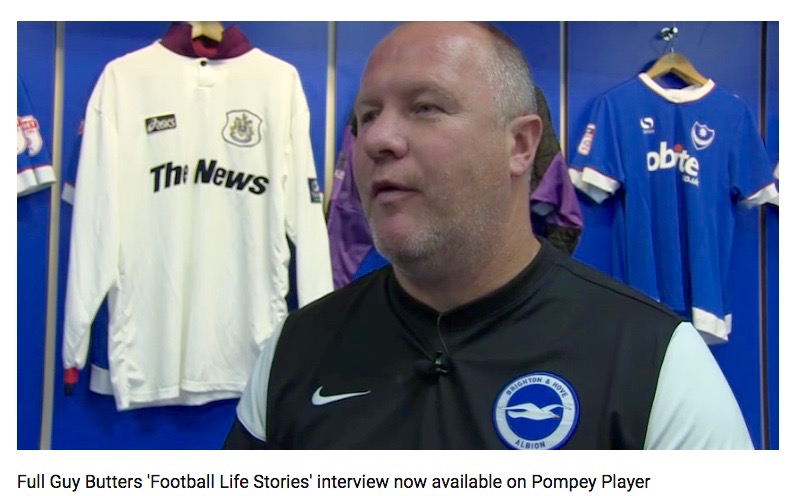
guy butters YouTube

He had a brief spell on loan with Oxford United in 1994 and he eventually realised his time at Fratton Park was up when a regime change saw the arrival of Terry Venables, who was the Spurs boss when he was sold to Portsmouth.

Tony Pulis signed him for Gillingham for £225,000 on 18 October 1996 and, in six years at Priestfield, one game in particular stands out for the unfortunate pivotal moment Butters played in it.

It was 30 May 1999, the Football League Second Division play-off final to determine the third and final team to gain promotion and Gillingham were up against Manchester City, remarkably, at that time, struggling to get out of the third tier of English football.

Goals from Carl Asaba and Bob Taylor on 81 and 87 minutes looked to have given Pulis’ side victory. But Kevin Horlock had pulled one back for Joe Royle’s City and, as normal time expired, former Albion loanee Paul Dickov equalised for City in the fifth minute of added on time to level the scores at 2-2.

With no further scoring in extra time, it went to penalties. City scored three of their first four; Gills had scored only one of their three. So, the pressure was on Butters, the fourth penalty taker, to bury it to keep the Gills in it.

When Butters stepped up and hit it low to ‘keeper Nicky Weaver’s left…. it was within the 20-year-old’s reach, and he pushed it away. Cue wild celebrations as City won the shoot-out 3-1.

“Missing that penalty was one of the worst moments of my life but you have to move on and I am not afraid to have another go,” Butters told interviewer Alex Crook in an article for the 2004 Division Two play-off final match programme. “At the time, I just wanted the ground to swallow me up but nobody blamed me because it was just one of those things.”

Consolation for Butters came the following year when Gillingham returned to Wembley and on that occasion won 3-2 in extra-time against Wigan Athletic. As with Pompey, Butters had six years in total with the Kent club and played 159 league games before being released in the summer of 2002.

IMG_6010The 2002-03 season was already under way by the time Butters joined Albion on a free transfer and, in the September, he was doing his own personal pre-season workout programme in a bid to get fit.

“When I first came here I had to do a lot of extra work with Dean White,” Butters told Brian Owen, of the Argus. “It was a case of trying to cram a lot of stuff into a little space of time. I wasn’t really getting too much time to recover after it.”

The managerial change from Martin Hinshelwood to Steve Coppell didn’t do Butters any favours either. Virgo and Butters were the centre back pairing for Coppell’s first match – a 4-2 home defeat to Bristol City – and both were then discarded into the wilderness.  Virgo went on loan to Exeter and, after Coppell brought in Dean Blackwell to play alongside Danny Cullip, Butters was sent out on loan to Barnet.

But when injury meant Blackwell’s career was over, the door opened again for Butters and he seized the opportunity to such an extent that as Albion won promotion back to the second tier via the play-offs, he was voted player of the season.

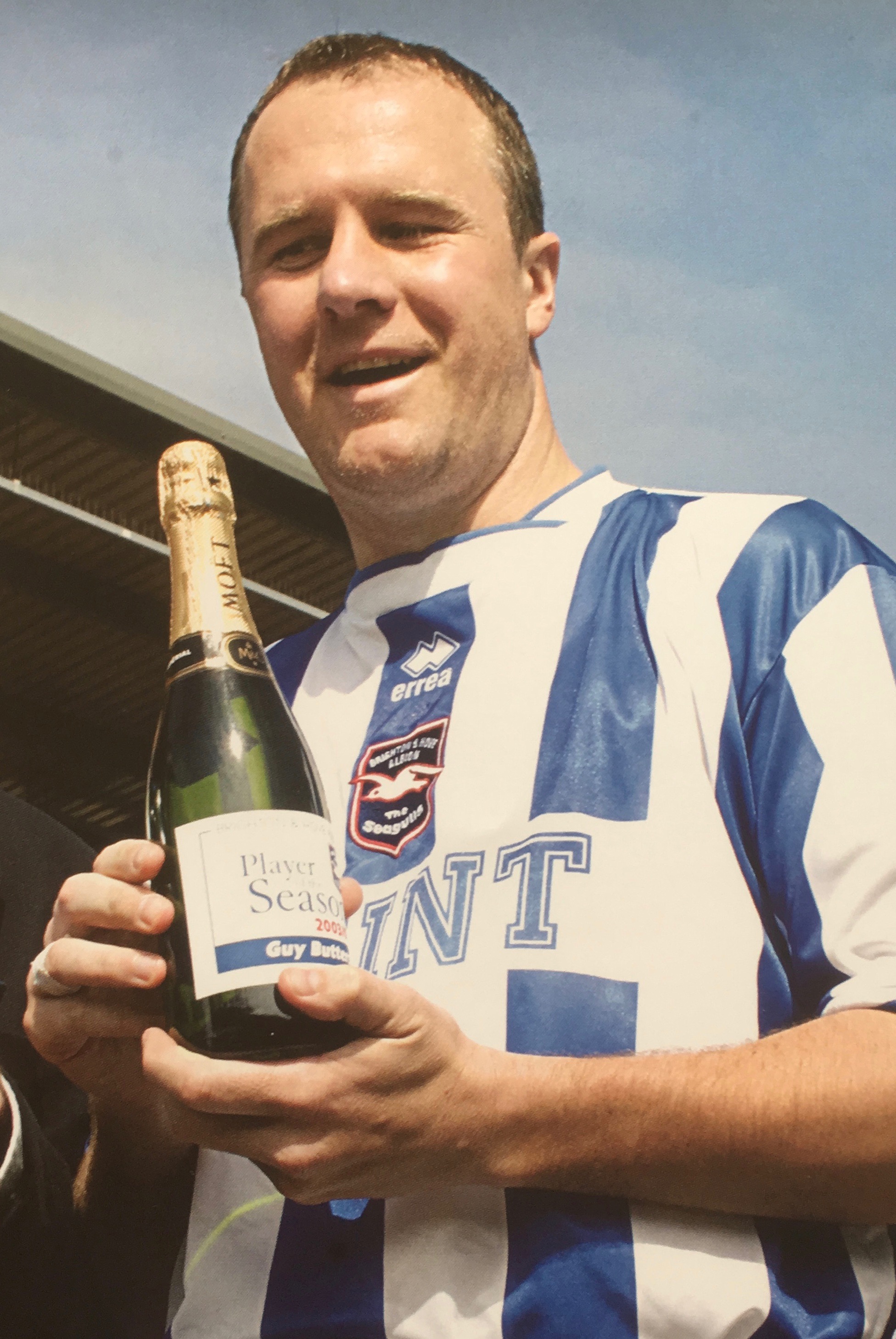
GB potseas by Bennett Dean• 2004 Player of the Season pictured by Bennett Dean.

In fact, it was the arrival of Mark McGhee to succeed Coppell that was very much a turning point in Butters’ career because he had previously been considering hanging up his boots.

In Match of My Life (www.knowthescorebooks.com), he said: “Mark was a real breath of fresh air as manager. Straight away he helped me with a special diet and fitness programme aimed at improving my general match fitness, but, more importantly, helping me work towards prolonging my professional football career.

“He was the first manager to do that and under his guidance I began to thrive and really enjoy my football again.”

As the Argus previewed the 2004-05 season with a special publication, they declared: “Buoyed by a great run of form in last season’s run-in and looking in good shape in training, Butters is ready for another stab at the second tier of English football.”

And Butters said: “This year I did a bit in the summer when I was on holiday and the gaffer put us through our paces so I’m sure that when the season starts I’ll be pretty match fit.

“It’s a big step up but, if we can get a few results away from home, not too many of those big teams are going to fancy coming to Withdean.”

  • The Argus spots a lighter refreshing moment!
  • Butters and Cullip were opponents when the Seagulls won at Sheffield United, another moment captured by the Argus.

Three years later, at the age of 37, Butters was still with the Seagulls and looking forward to what would ultimately turn out to be his last in the stripes.

“I thoroughly enjoyed it last year,” Butters told Andy Naylor. “It is probably one of the most enjoyable seasons I’ve had.

IMG_6014“I missed out on pre-season last year through injury. The gaffer was amazed I played as many games as I did.

“I cannot see why, with a decent pre-season under my belt and, as long as I look after myself, that I cannot do the same again.

“I just want to go on playing as long as I can and along the way enhance my CV with coaching badges.”

Manager Dean Wilkins finally released Butters at the end of the 2007-08 season, during which he had been sent off for the first time in his career.

He’d played a total of 187 games for the Seagulls and carried on playing with Havant & Waterlooville briefly plus a seven-game spell on loan at Lewes before trying his hand at management with Winchester City and Eastleigh.

Guy + Nick

  • I got the chance to meet Guy when he kindly presented an award at an event I was involved in organising: what a great bloke!

Saint Dean a sinner in some Albion fans’ eyes

HASTINGS-born Dean Hammond enjoyed two spells with the Albion having joined the club aged 11 and progressed from the school of excellence though the youth team and reserves to become a first team regular and captain of the side.

He also went on to captain Southampton as they rose from League One to the Premiership.

However, it’s a pretty surefire bet to say fans would be divided if asked to judge his contribution.

An over-the-top celebration in front of the Albion faithful after scoring for Southampton at Withdean made him public enemy number one in many people’s eyes.

The way he left the club under a cloud, suggesting they lacked ambition, was another catalyst for rancour.

Personally, I struggled with his penchant for missing some unbelievable, gilt-edged chances to score. There was one away at Leicester (one of his future employers) – a proverbial ‘easier to score than miss’ – that was particularly galling in a game that finished 0-0.

Putting all these things to one side, there is no denying that he ultimately enjoyed a decent career and, while his most successful years were spent in the second tier of English football, he also got to play at the highest level.

Albion have struggled for a good many years to bring through promising local talent from schoolboy level but Hammond was one of the few who made it.

Born a couple of months before Brighton’s 1983 FA Cup Final appearance, he made his Albion bow in December 2000 when former Saints full-back Micky Adams put him on as a substitute in a 2-0 Football League Trophy win over Cardiff, but it was only when former youth coach Martin Hinshelwood briefly held the first team manager’s role that he got his next chance.

That came as an 85th minute substitute for Nathan Jones in a 4-2 defeat at Gillingham in September 2002 and 10 days later he made his first start and scored his first Albion goal (celebrating below right) after only eight minutes in a 3-1 League Cup defeat to Ipswich.

When Hinshelwood was sacked, new boss Steve Coppell opted for experience over youth and Hammond’s next competitive action came during two spells out on loan in 2003 – at Aldershot (seven games) and Orient (eight games).

In an Argus interview in November 2006, Hammond said: “It’s been up and down for me at Brighton. I loved it when I came through the youth team and then broke into the first team at quite a young age.”

Hammond watched from the sidelines at the Millennium Stadium in May 2004 as the Albion won promotion to the Championship via play-off victory over Bristol City. A couple of months later, the Argus was reporting how he had been given three months to prove he had a future with the club.

He did enough in a handful of games to be offered a contract until the end of the season and, although he was mainly used from the bench between October and March, by the season’s end he was playing a pivotal role in helping to steer Albion clear of the drop zone, scoring the equaliser in a 1-1 draw away to Burnley and getting both goals in a vital 2-2 draw at home to West Ham.

Before the 2006-07 season got under way, manager Mark McGhee obviously felt players like Hammond needed toughening up and sent him and a few others to some boxing sessions with former world heavyweight title contender Scott Welch, from Shoreham, at his Hove gym.

Hammond told Andy Naylor of the Argus: “When the gaffer mentioned it, I think the boys were thinking ‘Boxing? How is that going to help us’. But he worked on the mental side, as well as the power and strength stuff.

“If we felt tired or felt we couldn’t go on, he was pushing us and he said it would help us in a game. I think he’s right. When we went back for pre-season training you tended to push yourself that bit more, so I think it will help in the long run.”

Unfortunately, it didn’t help enough because the season saw Albion relegated back to the third tier. It wasn’t long before former youth coach Dean Wilkins was installed as manager and youngsters were given a chance to flourish in the first team, with Hammond appointed captain.

“I would say it is the best time of my career and I am really enjoying it,” he told Naylor. “It’s brilliant at the moment.”

In the same interview, however, there were perhaps the first rumblings of his discontent with the progress of the club.

“I’ve been here since the age of 11. I’m like every other player. I’m ambitious and I want to do the best I can in my career and play as high as I can. Hopefully that will be with Brighton.”

A career-ending injury to Charlie Oatway and Richard Carpenter’s departure from the club in January 2007 led to Hammond taking over the captain’s armband and 2006-07 was undoubtedly his best Albion season. He finished with 11 goals from 39 appearances and the award of Player of the Season.

D Ham v W HamIt was in the 2007-08 season that it turned sour between player and club, even though before a ball had been kicked he told the Argus he thought Brighton had it in them to make the play-offs.

“We can beat anyone in the division. It’s just about being consistent. Realistically we can push for the play-offs,” he told Brian Owen.

Considering he had been at the club from such an early age, what happened next clearly rankled with chairman Dick Knight, who talked about it in his autobiography, Mad Man: From the Gutter to the Stars, the Ad Man who saved Brighton.

Knight accused Hammond’s agent, Tim Webb, of touting his client around Championship clubs while there was an offer on the table from the Albion that would have made him the highest paid player at the club.

“Hammond kept telling the local media that he wanted to stay and sign a contract, but I think he was being told to hold out for more money,” said Knight.

Because Hammond could have walked away from the club for nothing at the end of the season, the pressure was on to resolve the situation one way or another by the close of the January transfer window.

All the off-field stuff was clearly affecting Hammond’s head and I can remember a game at Oldham in the second week of January when he lunged into a reckless challenge after only nine minutes which certainly appeared to be a deliberate attempt to get himself sent off. That early dismissal was his last action for the Seagulls until his return to the club in 2012.

“I didn’t want to sell Dean but I was forced to,” said Knight, who persuaded Colchester United to buy him for £250,000, with a clause added in that Brighton would earn 20 per cent of any subsequent transfer involving the player. “In normal circumstances, I might have got more, but time was running out,” Knight added.

The move to Colchester wasn’t an unbridled success because his arrival couldn’t prevent them being relegated from the Championship, but, with Paul Lambert as manager, Hammond took over the captaincy in December 2008 and by the season’s end was voted Player of the Season.

Throughout the season there had been speculation that Southampton wanted to sign him and a deal duly went through in August 2009. At the time, Alan Pardew was the Saints manager and Hammond’s former Albion youth team coach and first team manager, Dean Wilkins, was Southampton first team coach, and played a part in him deciding to make the move. “His knowledge of the game and his passion for football is second to none and he was really good for Southampton – he had a good partnership there with Alan,” said Hammond.
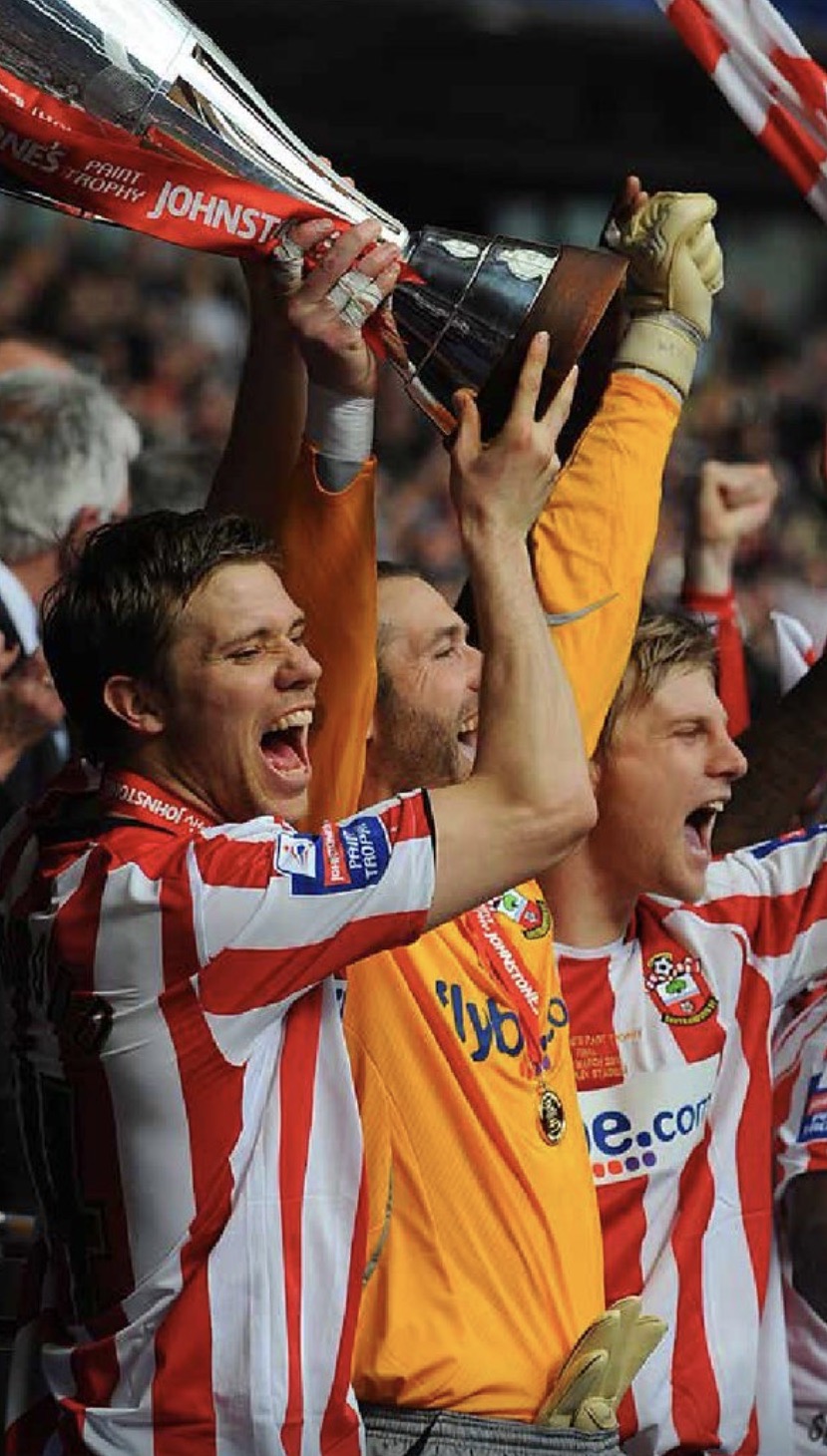
D hammo trophyAs had happened at his previous two clubs, it wasn’t long before Hammond was taking on the captaincy and he got to lift the Johnstone’s Paint Trophy at Wembley on 28 March 2010 (above) when Pardew’s team beat Carlisle United 4-1 – the first piece of silverware Saints had won since the 1976 FA Cup.

“I was really enjoying my football and it was like a new beginning for everyone connected with the club,” he said in an Albion matchday programme article. “Nicola Cortese came in off the field and a raft of new signings had been made, the likes of Rickie Lambert, Jason Puncheon, Lee Barnard, Radhi Jaidi, Dan Harding, Michail Antonio and Jose Fonte. When you add the likes of Morgan Schneiderlin and Adam Lallana, we had the makings of a really good team. It took us a little time to gel, but once we clicked we had a really good season.”

When Albion travelled to St Mary’s on 23 November 2010, the matchday programme inevitably featured their captain and former Seagull. It said: “Hammond was barely out of nappies when he first started supporting the Seagulls. He can even recall the days they played in front of 20,000 crowds at the old Goldstone Ground.

“The new Brighton stadium will hold just over 22,000 and the Saints midfielder said: ‘There’s no doubt they’ll fill it, certainly for their early games. That’s just about the size of their fan base and, if anyone deserved a bigger ground, it’s them’.”

Reflecting that he had certainly made the right career move, Hammond said: “I’ve developed as a player. I have a slightly deeper midfield role which means I pass the ball more and get involved in the game more.”

After two seasons in the third tier, Southampton famously finished runners up to Brighton in 2010-11 to regain their place in the Championship. Hammond was a regular throughout the 2011-12 season, although at times contributing from the bench, as Saints won promotion back to the Premier League, runners up behind Reading.

However, manager Nigel Adkins obviously didn’t see Hammond as top tier material and on transfer deadline day (31 August 2012) the midfielder agreed a season-long loan deal back at Brighton.
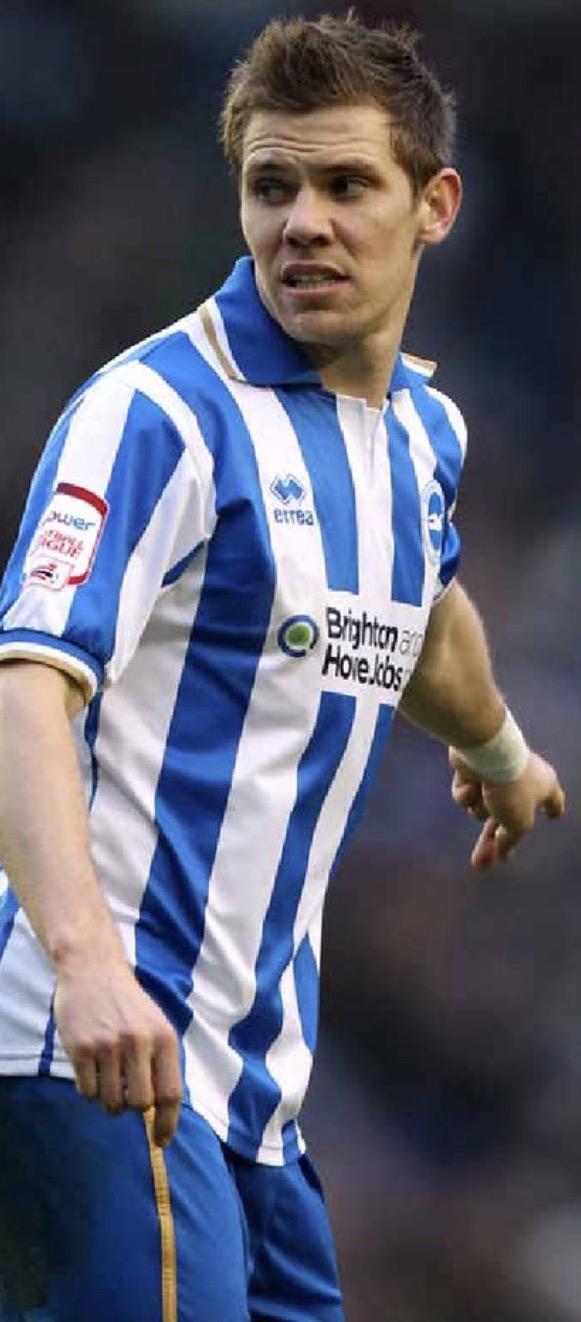
D Hammo 2By then 29, Hammond told the Argus: “It’s a different club now. The stadium is amazing and I can’t wait to get going.

“I saw the plans when I was 15 and it’s amazing to see it come to life. It will be a dream to play at this stadium as a Brighton player and I have been dreaming of that since a boy.”

Hammond made 33 appearances plus five as a sub during that season, alongside fellow loanees Wayne Bridge and Matt Upson, and said: “I loved my year back at the club. It was brilliant.

“I’d been sold the dream of the new stadium since I was 15 coming through the ranks, so to walk out of that tunnel for the first time as an Albion player was a fantastic feeling and one I’ll always cherish.”

Hammond reflected that the side did well to reach the play-offs but drew too many games. “We were only four points off automatic promotion and just didn’t do ourselves justice in that play-off game against Crystal Palace.

“Having drawn 0-0 at Selhurst Park, we really fancied finishing off the job at the Amex, but it just didn’t happen for us on the night. That has to rate as one of the biggest disappointments of my career.”

When manager Gus Poyet departed the Albion in the wake of the play-offs loss, Hammond returned to parent club Southampton, but, three months later he signed a two-year contract with Championship side Leicester City. Manager Nigel Pearson told the club’s website: “We’re really pleased to be able to add a player of Dean’s quality and experience to the squad.

“As well as having played a considerable number of games in his career, he also arrives with promotion credentials and will be a very positive influence on the squad both on and off the pitch.”

DHLCFC

Hammond added: “Once I knew of Leicester’s interest I wanted to come. My mind was made up. There was some interest from other clubs, but once Leicester was mentioned, and I spoke to the manager, I wanted to come here.

“It’s a massive football club. They came close last year in the play-offs and they’ve got a good history. It’s a club that’s going places and wants to push to the Premier League. It’s very exciting to be here.”

While facing midfield competition from Danny Drinkwater and Matty James, Hammond nevertheless played 29 games as Leicester were promoted and he finally got to play in the Premiership, albeit competition and injury restricted his number of appearances to 12.

Not all Saints fans felt it right that he had been abandoned as soon as the club reached the Premiership and, on the eve of his return to St Mary’s as a Leicester player, Saints’ fansnetwork.co.uk considered supporters might like to “thank him for his contribution to our resurgence in the game …. without Dean Hammond perhaps none of what they are enjoying in the Premier League would have been possible”.

Although Hammond earned a one-year extension to his contract in July 2015, he was not involved in the side that surprised the nation by winning the Premier League.

He had gone on loan to Sheffield United, then managed by his old Saints boss Adkins, and made 34 appearances for the Blades by the season’s end. However, he didn’t figure in new boss Chris Wilder’s plans and left the club in the summer of 2016.

Russell Slade gave him a trial at Coventry City in January 2017 but he didn’t get taken on and eventually he returned to Leicester to work with their under 23s. He later became loans manager for the Leicester City Academy.

Hammond opened up about his career, and some of the difficulties he’s faced since stopping playing, in an interview with James Rowe for The Secret Footballer.

  • Most photos from Argus cuttings; plus Southampton programme, Albion programme and Leicester City website.

Boyhood Brighton fan Simon Rodger’s 11 seasons at Palace

S Rodger v Ivor IngimarssonSHOREHAM-born Simon Rodger was a boyhood Brighton fan but spent the bulk of his professional playing career with arch rivals Crystal Palace.

It was only at the end of his career he finally got the chance to play for the Seagulls having been rescued from football’s scrapheap by the man who had given him his chance with Palace.

Rodger in fact was on Albion’s books as a youngster and a report appeared in a matchday programme when, as a 14-year-old, he won a Soccer Skills competition run by Bobby Charlton Schools in association with The Trustee Savings Bank.

“Simon has been training with our own youngsters for two years but he is a guest today at Manchester United, where he will be seeing the match between United and Ipswich at Old Trafford,” the programme reported.

young RodgerHe didn’t progress through the levels at Brighton, though, and instead joined non-league Bognor Regis Town as an apprentice in 1989. Palace manager Alan Smith snapped him up from there for £1,000 in 1990.

It was Smith’s successor in the managerial chair, Steve Coppell, who gave Rodger his first team debut in 1993 away to Sheffield Wednesday. Although that game ended in a 4-1 defeat, Rodger was part of the side who went on to secure the Division One title in 1994.

Gordon Law on holmesdale.net summed up his Palace contribution thus: “His workrate, professionalism and unsung, gritty, performances in the midfield engine room contributed to Palace’s success in the 1990s. He was never one of the club’s high earners and missed out on lucrative signing-on fees to stay in SE25.”

He did leave Selhurst Park temporarily in the mid 90s, though, having fallen out with Coppell’s successor, Dave Bassett. He went on loan to Manchester City for three months in 1996 and to Stoke for a month in 1997.

When Coppell returned to Palace, so did Rodger and was part of the 1997 promotion-winning squad.

His Palace career came to an end after 11 seasons and 328 games  – all in the top two divisions – when manager Trevor Francis released him aged 31 in 2002.

It was a worrying time for a lot of players because the collapse of ITV Digital meant football finance was in a state of flux and clubs didn’t have the money to retain large squads.

Rodger had earned decent money from football and also had the financial cushion of being married to QVC TV presenter Alison Young, but she talked about her husband’s concerns in an interview with football reporter Matt Hughes.

After Brighton’s disastrous run of 11 defeats under Martin Hinshelwood during the early part of the 2002-03 season, ex-Palace boss Coppell was brought in by Dick Knight and Rodger, together with Dean Blackwell from Wimbledon, were among his first recruits to try to salvage the season.

He came off the bench in Coppell’s second game in charge, when Albion were thumped 5-0 at Selhurst Park, but the following week he scored on his home debut against Bradford City on 2 November 2002, a volley which wearebrighton.com described as the best goal of the season.

Later the same month he scored again, along with on-loan Steve Sidwell, away at Preston North End, as the Seagulls clawed back to draw 2-2 having gone 2-0 down.

Rodger talked about the shock of his Palace departure in an interview with The Guardian in January 2003, but said: “I’m just grateful to be back in professional football with Brighton, doing something that I love.”

Rodger had become a regular in the side but, despite a sterling effort in the latter part of the season, relegation was confirmed following a 2-2 draw away to Grimsby Town.

The defensive midfielder began the following season in the third tier but the league cup tie away to Middlesbrough at the Riverside in September 2003 was the last of his 38 games for Brighton.

He was stretchered off early in the second half following a tackle by current England manager Gareth Southgate and never recovered sufficiently to resume his professional career.

Albion physio Malcolm Stuart said Rodger couldn’t have worked harder to try to return to his previous level of fitness. However,  he explained that the player had developed a rare growth on a skin graft called Cyclops Legion and, although it had been cut away, it returned. Stuart said it wasn’t felt fair to put him through a fourth operation.

Captain Danny Cullip told the matchday programme: “We’ve seen Simon working in the gym to get back, and he’s been working his socks off. We’re gutted for him after he fought hard to get back; he’s a very good footballer and a really nice lad.”

After his playing days ended, Rodger became a private hire chauffeur.

Screen Shot 2018-03-08 at 08.45.12

Main picture (top) shows Rodger putting in a slide tackle on Ivar Ingimarsson, who later joined Albion on loan from Wolves. Also (above), from the Argus, after scoring away at Preston.

Injury-plagued ‘keeper Ben Roberts part of ‘Boro Cup folklore before Brighton promotion

2 pen shoot-outBEN ROBERTS might only have played a handful of games for Middlesbrough in seven years on their books but one of them will never be forgotten.

He was between the sticks for ‘Boro when Chelsea’s Roberto di Matteo scored one of the quickest ever FA Cup Final goals.

Thankfully, Brighton fans prefer to remember him as the ‘keeper who helped the Seagulls to promotion from the third tier via the play-offs in 2004.

“That season at Brighton remains one of my best experiences in football,” Roberts told beatsandrhymesfc.com’s Christian Brookes, in a 2011 interview.

“Apart from enjoying living in the city, I remained relatively injury-free and played the most games of my career. So for a full season’s work to come down to one day in the Millennium Stadium with a full house in attendance was a very special memory.”

No-one knew at the time, of course, but it was also Roberts’ last game in goal for the Albion because a back injury forced him to retire from the game prematurely in 2005, aged just 29.

In an extended interview with Dominic Shaw for gazettelive.co.uk in December 2017, Roberts looked back on his time at ‘Boro and a playing career that was beset with injury.

Born in Bishop Auckland on 22 June 1975, the young Roberts was spotted playing for South Durham Boys by Dennis Cooper, father of ‘Boro legend Colin Cooper, and the club took up his recommendation. Roberts would set off by bus from his home in Crook at 6am each day to get to training on time in Middlesbrough, nearly 30 miles away.

At one point, it looked like he wouldn’t get the chance to continue his career because he was deemed too short, but he fed his face throughout the summer, shot up the required inches, and was rewarded with a two-year scholarship.

In fact, he was still a YTS scholar when he got his first involvement with the first team, being named on the bench for two of Boro’s first three games in the inaugural season of the Premier League (1992-93).

However, it was another two seasons before he actually got into first-team action, making his debut in an Anglo-Italian Cup game against Ancona, with Bryan Robson by then in the managerial hotseat.

In the 1994-95 season, Roberts got league experience under his belt during loan spells with Hartlepool and Wycombe Wanderers and the following season he went on loan to Bradford City before returning to Middlesbrough to help out a goalkeeping crisis.

Injury to Gary Walsh presented Roberts with his chance, and, aged 21, he made his ‘Boro league debut on 18 January 1997 in a 4-2 win at home to Sheffield Wednesday.

Although Mark Schwarzer arrived at the club, he was also hit by injury – and was cup-tied in the FA Cup – leaving Roberts, 21 at the time, as the stand-in No.1.

On 1 April that year, he also earned his one and only international cap, coming on as a sub for Chris Day as England under 21s drew 0-0 with Switzerland at Swindon’s County Ground. Also in the team for that friendly were Rio Ferdinand, Jamie Carragher, Darren Huckerby and Lee Bowyer.

Two of Roberts’ 17 appearances for ‘Boro that season were in cup finals: in the replay of the League Cup Final against Leicester City, and then the FA Cup Final against Chelsea at Wembley.

Roberts started the following season as first choice because Schwarzer was still out injured, but his final appearance of the season – at home to Birmingham in the September – was his final appearance for the club.

Several treatments for a back injury were unsuccessful and at one stage, still only 24, he feared he’d be forced to retire, until he underwent surgery in London. As well as operating on problematic discs, the surgeon found a blood clot in his back.

In between back operations, Roberts went out on loan again and in 1999 played 14 games for Division Two side Millwall, including another Wembley appearance, this time against Wigan in the Auto Windscreens Shields Trophy. The Latics won 1-0 with the winning goal scored by future Albion captain, Paul Rogers.

The following season, Roberts had another loan spell, this time at Lennie Lawrence’s Luton Town and in the summer of 2000 he finally left ‘Boro and joined Charlton Athletic. However, he played only once for the Addicks, coming on as a sub in the final game of the 2002-03 season after regular no.1 Dean Kiely had been sent off.

Roberts greenPrior to that, Roberts had been out on loan again, initially at Reading and then returning to Luton. His first association with Brighton also came in that season, as Steve Coppell’s Seagulls were battling hard to avoid relegation from the second tier.

He played three times and I remember one of those games was one I went to away at Bradford City (a 1-0 win) on 15 February 2003, when he pulled off some terrific stops on a rock-hard pitch. The most memorable came early in the game and Roberts rated it as his best as a Brighton player.

“It was only after five minutes and Ashley Ward had a clear header inside the six yard box, but I got to it. I shouldn’t have, but I did,” he recalled in a matchday programme interview. “It (the game) shouldn’t have been played because the goalmouth was like a skating rink and that kind of set the tone.”

Unluckily for Roberts, he then picked up a dose of ‘flu and veteran Dave Beasant took over and kept the shirt until the end of the season.

However, Coppell saw enough to persuade him to sign Roberts permanently and, as referred to earlier, the 2003-04 season was to be the one time when he finally made his mark, culminating in the 1-0 win over Bristol City at the Millennium Stadium in Cardiff.

When his back injury problems returned and ruled him out of the whole of the 2004-05 season, he quit the game and went travelling to South America, Asia and India before returning to the UK and going to Roehampton University to take a sports science and coaching degree.

Not only did he achieve first class honours, his dissertation on biomechanics (which applies the laws of mechanics and physics to human performance) earned him a ‘Pursuit of Excellence’ award from Adidas.

Although he intended to stay in the world of academia, his old Brighton teammate, Nathan Jones, persuaded him to join the coaching staff at Yeovil Town.

“I was at a stage where I missed the banter, the day-to-day interaction and being outside,” he said. “I went down and loved it and that turned into my career. ”

While at Yeovil, he worked with Alex McCarthy, who later played for Southampton in the Premier League, and the much-travelled Stephen Henderson, who has played for Charlton, Nottingham Forest and Crystal Palace.

Roberts himself had the briefest of returns to league action when in October 2010 he appeared as a substitute in a 3-3 draw against Swindon, replacing the injured Henderson at half-time and conceding two late goals.

At the end of that year, he followed Jones to Charlton Athletic and in four and a half years at The Valley worked with Rob Elliot (later with Newcastle), Ben Hamer (Leicester), David Button (who became Mat Ryan’s deputy at Brighton) and Nick Pope (Burnley).

When, in the summer of 2015, the goalkeeping coach role at Brighton was vacated by Antti Niemi, who returned to Finland for family reasons, Roberts jumped at the chance to link up once more with coach Jones, then part of Chris Hughton’s management team.

Skysports.com quoted Roberts at the time, saying: “I’m ecstatic to be back at Brighton. I’ve made no secret that my happiest years as a professional footballer were spent down here, as I had a special affinity with the fans at Withdean.”

While that role continues it would be remiss not to mention THAT ‘Boro v Brighton Championship clash at the Riverside in May 2016. He told gazettelive.co.uk: “Obviously you want to win and it was so, so tight. My best mate and best man, Adam Reed, is a physio at ‘Boro and seeing him in the tunnel afterwards so happy with his kids, that levelled out the disappointment a little bit for me.

“It was still so hard to take, though. Adam said he felt a bit awkward as well and didn’t want to celebrate too much, but we were on holiday together a couple of weeks later and I was philosophical about it.”

Roberts continued as Albion’s senior goalkeeping coach after Hughton was succeeded by Graham Potter and, somewhat controversially, followed Potter to Chelsea when the manager took almost all of his backroom team to Stamford Bridge in September 2022. He retained the goalkeeper coach role at Chelsea after Potter was sacked.

Brighton pictures from Bennett Dean / Pitch Publishing’s We Are Brighton / Play Off Special;  from online, celebrating ‘Boro promotion with Bryan Robson and Nigel Pearson; flying the flag for Reading, and the Albion matchday programme.

Cup Final hero Dave Beasant was Brighton’s oldest player

Beasant BHA

THE FIRST goalkeeper to save a penalty in an FA Cup Final – and the first to captain his team in the historic end of season finale – played between the sticks for Brighton at the ripe old age of 44.

Admittedly Dave Beasant is better known for his years playing for Wimbledon, during which time he laid down those FA Cup milestones in the 1988 final against Liverpool.

Nicknamed Lurch after the butler in The Addams family, Beasant’s heroics to keep out John Aldridge’s spot kick and preserve the 1-0 lead given to the humble south west London club by Lawrie Sanchez, led to the giant goalkeeper lifting the cup.

It also turned out to be the last ever game he played for Wimbledon. A month after that Wembley triumph, Newcastle paid £750,000 for his services – a transfer fee record for a goalkeeper at that time.

Not a bad return on Wimbledon’s £1,000 investment ten years earlier after he had impressed Dario Gradi playing for Edgware Town against the Dons in a pre-season friendly.

Beasant made his league debut against Blackpool in January 1979, and, remarkably, between August 1981 and the end of that 1987-88 season, made 304 consecutive league appearances for the Dons as they rose through the leagues.

When Newcastle sold Paul Gascoigne to Spurs for £2.2 million, they decided to splash £750,000 of it on the big Wimbledon goalkeeper.

Sadly, it was not money well spent. Beasant’s spell on Tyneside lasted just five months and certainly didn’t match the fairytale ending at Wimbledon.

Newcastle struggled at the foot of the table in 1988-89, and were relegated, but before the trapdoor opened Beasant had already departed after just 20 appearances.

He moved back to London in January 1989 to join Chelsea, where he played 193 times, initially under Ian Porterfield, until falling out of favour in 1992.

It was towards the end of 1989 that Beasant won two England caps, playing against Italy and Yugoslavia, and an injury to David Seaman saw Beasant selected for Bobby Robson’s 1990 England World Cup squad, although he didn’t play.

When Glenn Hoddle took over at Stamford Bridge, Beasant was relegated to number three ‘keeper behind Dmitri Kharine and Kevin Hitchcock, so he went out on loan for brief spells at Grimsby Town (six games) and Wolves (four games) before securing a £300,000 move to Southampton in 1993 to succeed Tim Flowers as their no.1.

He played 105 times for Saints but several managerial changes saw his fortunes fluctuate and, in 1997, he once again found himself third choice – this time behind Maik Taylor and Paul Jones – and he was on the move again.

By this time he was 38, but retirement was still not on his agenda. After joining on loan initially, Beasant moved permanently to Nottingham Forest in November 1997 and played 139 games in four years.

It was back to the south coast again in 2001, when Portsmouth needed a goalie following the death in a road accident of their regular ‘keeper, Aaron Flahavan. Beasant played 27 times for Pompey.

Emergency loan spells then followed successively at Tottenham, Bradford City and Wigan Athletic, although he didn’t play any first team games for any of them.

It was from Wigan, just a few weeks before his 44th birthday in 2003, that he once again headed south, this time to join Brighton’s brave but ultimately unsuccessful attempt under Steve Coppell to stave off relegation from Division One.

With Michel Kuipers out of the side with a thigh injury and loan replacement, Ben Roberts, suffering from ‘flu, Beasant was drafted in.

In the Bradford City v Brighton programme in February 2003, Colin Benson wrote almost poetically about the legendary goalkeeper.

Beasant landsc“The unmistakeable figure of Dave Beasant stood tall under the Brighton crossbar at the Bescot Stadium a fortnight ago marking his debut for his 11th club at 43 years of age by brilliantly saving from Leitao’s shot on the rebound after beating out an effort from Corica,” he wrote. “Unfortunately he could not crown the day with a match winning clean sheet for Walsall pinched a 1-0 victory but it amply demonstrated that after 20 years between the posts he has lost none of his technique or resilience.”

In a 2018 interview with Spencer Vignes, Beasant said: “Stevie Coppell gave me a bell. I think you’d lost 12 straight games. I remember looking at the table thinking ‘They’re going down’. But there was also something about it that I quite liked. It was a challenge.”

Beasant said that morale was good despite the league position, and he added: “Wherever I go, I can add something on the field and off it. And that’s what happened. We clicked really well together.”

He played 16 games through to the end of the season and although ultimately the bid to stay up was not successful, no blame could be laid at Beasant’s door for lack of effort.

Never was it more evident than in the final game of the season away to Grimsby. With the score 2-2 and all hope virtually extinct, Beasant was still giving his all when other players’ heads had dropped.

I chatted briefly to Beasant at the club’s end of season dinner and remarked how I had been impressed by his never-say-die attitude right to the very end of that game, even though it was a lost cause.

Obviously the consummate professional, he said to me that however unlikely a win would be, you had to continue to play in the hope things might change round.

What a pro and exactly the sort of attitude that meant Beasant endeared himself to the Albion faithful. In a prophetic assessment after the Grimsby game, he told the Argus:

“You feel for those fans because they have been superb. They are gearing themselves for next season already and hopefully the players can set the same target as the fans and, obviously, that is to bounce straight back.”

Beasant cemented his place in the record books as Albion’s oldest-ever player while Albion, of course, went on and did just as he thought they might on that glorious day at the Millennium Stadium in Cardiff.

Although Coppell offered Beasant the chance to stay on with the Seagulls, he didn’t want to drop down to the third tier and instead took up Chris Coleman’s offer to become a player-coach at Fulham. He was proud to say that on his 45th birthday he was on the bench when Fulham played Chelsea.

Beasant remained on the Fulham coaching staff after Coleman’s departure under his old Wimbledon teammate Lawrie Sanchez (he had already worked with Sanchez in his previous role as Northern Ireland manager). But when Sanchez was fired, Beasant went too.

He subsequently worked for his son, Sam, at Stevenage, and at the age of 55 was famously registered as part of the squad for the 2015 play-off final, even though he didn’t play.

Between 2015 and 2018, Beasant was goalkeeping coach at Reading.

Key building blocks for Steve Sidwell’s Premiership future

seagull-sidWHEN a flame-haired midfield player called Steve Sidwell joined the Albion on loan from Arsenal in 2002, it wasn’t the first – or last – time he would link up with manager Steve Coppell.
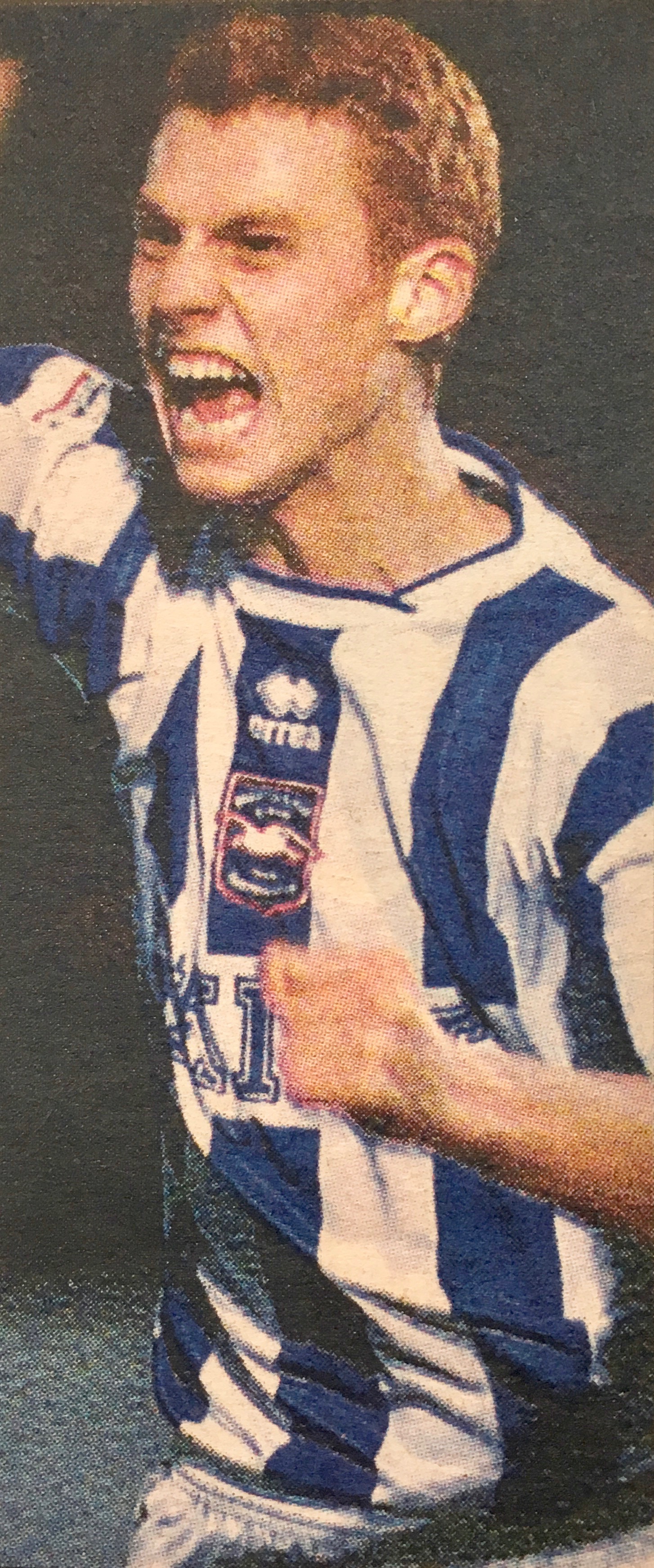
Coppell had organised a similar arrangement the season before when he was in charge at Second Division Brentford, and Sidwell played 30 times for the Bees.

When Coppell acquired his services for the bottom-of-the-second-tier Seagulls, it was instantly apparent that here was a talent destined to perform on a much bigger stage. In a 12-game spell, he scored five goals. They were the building blocks of a career that saw him go on to play in the Premiership for 11 seasons, and against Huddersfield in early 2017 made his 500th career appearance.

So many things are easy in hindsight but presumably if Albion had already been playing at a new stadium at Falmer, Sidwell may have stuck with the Albion rather than moving on to Reading where the Madejski Stadium was already a reality.

In the Royals matchday programme for the Reading v Albion Championship clash in 2005-06, cover boy Siddy was interviewed at great length and recalled his time with Brighton with fondness.

“It was the first time I had played at this level – before then I had been in Arsenal’s youth team and on loan at Brentford in the Second Division – so I was grateful for that opportunity,” he said. “The best description of my time there would be ‘short but sweet’.

“The fans at Brighton were fantastic, especially away from home,” he continued. “”At the time we were bottom of the league and battling against relegation, but they still turned up every week and always backed us.”

Sidwell recounted how it was during that time that he forged his long term friendship with Bobby Zamora and he also spoke of how he played in the same Colliers Wood Sunday football team as fellow midfielder Alexis Nicolas.

Eleven months after Sidwell went to Reading, Coppell made the same choice and enjoyed the best of Sidwell as his scintillating partnership with James Harper in the centre of midfield helped to take Reading out of the Championship and into the Premiership.

Let’s just go back to the 2002-03 season, though, and recall the impact Sidwell made in Brighton’s valiant effort to defy the relegation odds.

A disastrous run of 12 defeats in the first part of the season had dumped Albion at the foot of the table and manager Martin Hinshelwood had been replaced by Coppell, who rung the changes and started turning round the fortunes on the pitch.

Sidwell came in from Arsenal and scored the first of his five goals in a 2-2 draw away to Preston. He scored the only goal of the game in a Boxing Day win at Norwich and two days later scored both the goals in a 2-2 home draw with Burnley (celebrating in this Argus picture below).

Siddy youthfulOne of my favourite memories came at Highfield Road, Coventry, on January 11 2003 when Albion probably deserved to win but had to settle for a point in a 0-0 draw. Before the kick off, Albion fans were chanting his name during the warm-up, urging him to stay, because there had been speculation linking him with moves to other clubs.

Sidwell’s performance that day was acknowledged by no less an authority than the Scotland midfield maestro Gary McAllister, who was player-manager of Coventry at the time.

McAllister told the press after the game: “I was very impressed with Brighton. They passed it well. The front two were always a threat to us, joined by Steve Sidwell creating in the middle of the park and the two guys wide.

“Brighton were as good a side as we have seen at Highfield Road this season.”
Two days later, the Argus was reporting on the clubs interested in signing the promising youngster, including Stoke and Reading. Coppell told them: “What will be will be. I personally think the level of his performance will almost demand Arsenal not letting him go because he has done so well.

“Alternatively, they are going to move him on and take what money they can now. There will, I’m sure, be a lot of people in for him.

“He just wants to play football. I think the more we take these kind of decisions off his shoulders and just let him turn up and play then we are going to get the best out of him.”

siddy arseSidwell, who was out of contract at Arsenal at the end of the season, said: “Stoke put a bid into Arsenal. I went up there and it’s a great set-up and a fantastic club but we will see what happens.”

Interesting then, that the Potters did eventually get their man several years later.

However, in 2003 Reading was his destination and he spent four and a half years with them, helping them to win  promotion from the Championship and playing in their debut Premier League season.

In July 2007, at the end of his contract, Sidwell moved on a free transfer to Chelsea, the team he’d supported as a boy. “People think that because I was with Arsenal from the age of nine to 20 that I support them, but I’ve always been Chelsea. I was born in Tooting, my mum and dad are from Tooting Bec and Balham, so I was born into a Chelsea-supporting family,” he said in an Albion matchday programme article.

So, he said it was a “no-brainer” to go there. “I was joining a club that had won back-to-back titles under a manager who was a breath of fresh air in the game and I’d be playing and training with some of the best players in the world.”

Screen Shot 2021-04-23 at 07.31.27

The wealth of talent meant competition for places at Stamford Bridge restricted Sidwell’s game time, although he did clock up 25 games for the Blues. With the benefit of hindsight, he said: “It was the right move, it just came at the wrong time. I was only 24 so it came too soon. I’d only had one season of Premier LEague football under my belt and wasn’t quite ready for such a big jump from Reading.

“Maybe if I’d gone to Newcastle or West Ham (they’d both been interested) for a couple of years and played really well there, then I would have been better equipped but, like I said, when Chelsea comes knocking you don’t turn the opportunity down.”

He added that off-field issues, such as Mourinho leaving in the September to be replaced by Avram Grant, caused unrest amongst the players. But he added: “In hindsight, I wished I’d stayed another six months because Luiz Felipe Scolari came in and you never know what might have happened then.”

However, in the summer of 2008, in search of more regular playing time, he moved on to Aston Villa on a three-year deal. His time at Villa Park was often interrupted by injury and he made 64 appearances in two and a half years before Mark Hughes ended up signing him twice – for Fulham and Stoke City.

In 2011, Sidwell returned to London and scored 17 goals in 115 appearances over three and a half years, before leaving Craven Cottage when Fulham were relegated from the Premiership in 2014. “I went there on the back of their Europa League run and they were still riding the crest of a wave,” he said in an Albion matchday programme article.  He reckoned he played the best football of his career there and said: “In my first year we finished eighth in the Premier League.

“When I first went there, our home record was phenomenal. It didn’t matter who came to the Cottage, we always thought we would get the win. In the season we got relegated, it was surprising how quickly that mentality had changed.”

siddystokeHughes took him on a free transfer to Stoke but he managed only 13 appearances so jumped at the chance once again to link up with his old pal Zamora to join Albion on loan in early 2016 to supplement their efforts to get promoted from the Championship.

Although the form of Beram Kayal and Dale Stephens meant he struggled to nail down a regular spot, he was a great option to bring off the bench and memorably got the last-gasp winner in a televised away match at Nottingham Forest. “When I was getting taped up, I said to the bench I was going to score, it was just fate,” he said. “I managed to pop up with the goal, and it was a great feeling to see the ball hit the back of the net and you could see from the celebrations what it meant to us all.”Screen Shot 2021-04-04 at 17.19.48

I was in the away end that evening and despite a persistent Nottingham drizzle making the post-match walk back to my hotel pretty unpleasant, I dried off in the company of some other Albion followers in the hotel bar and reflected on a great skin-of-the-teeth win.

As we know, Siddy signed permanently in the summer of 2016, and has had a lot more game time this season. I was also fortunate to be at Ashton Gate on Bonfire Night that year when he scored that magnificent long range effort from inside the centre circle.

Footnote: I didn’t have to join in the last line of the Stevie Sidwell song….because I’m already in possession of similarly-coloured locks. We gingers have to stick together!

sidwell-reading

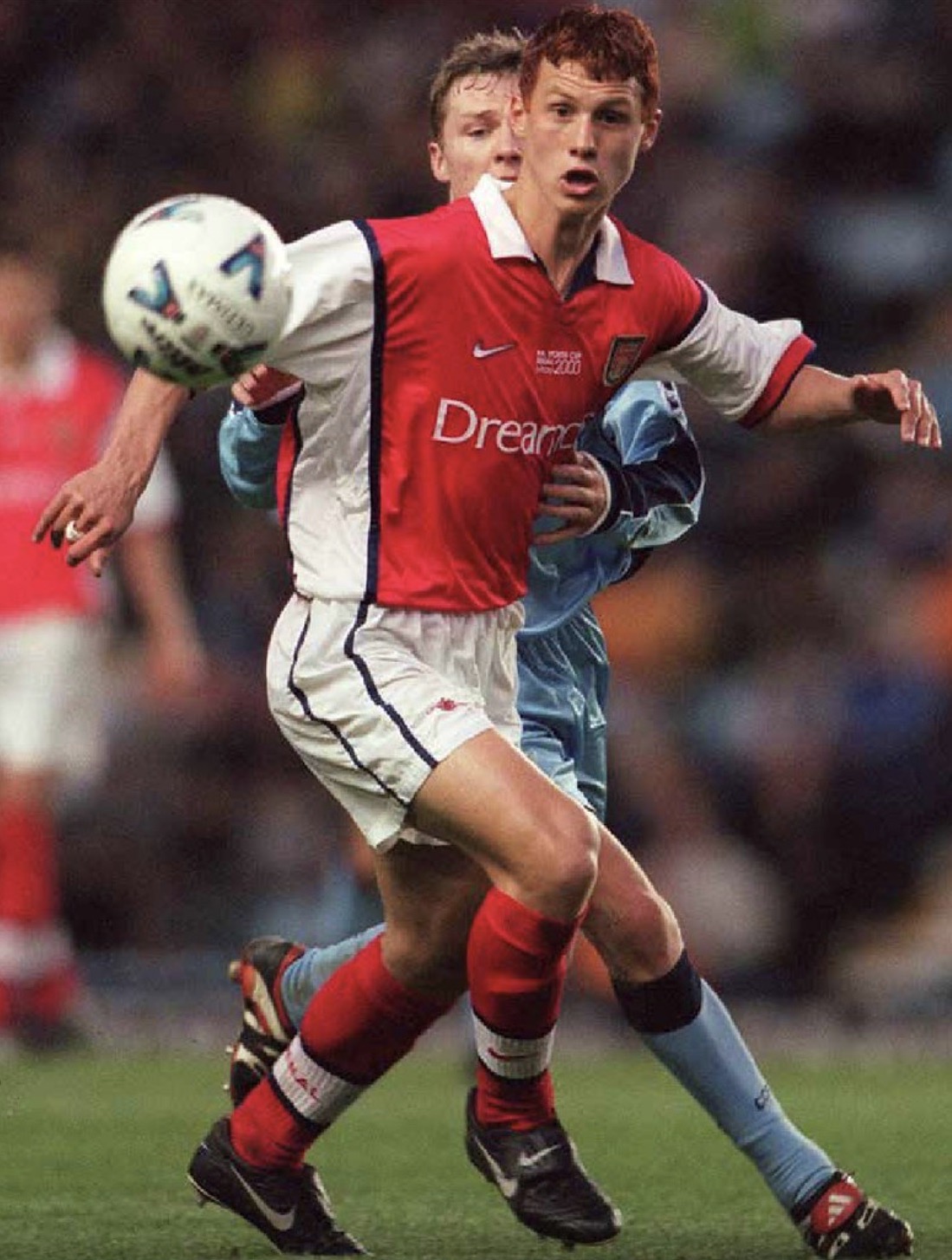
Pictures show the young Sidwell in Brighton’s away kit in 2002-03, as he appeared in the Coventry programme, and a portrait from Reading’s programme for the 10 December 2005 game v Brighton.