‘Rooster’ became pivotal to developing young players

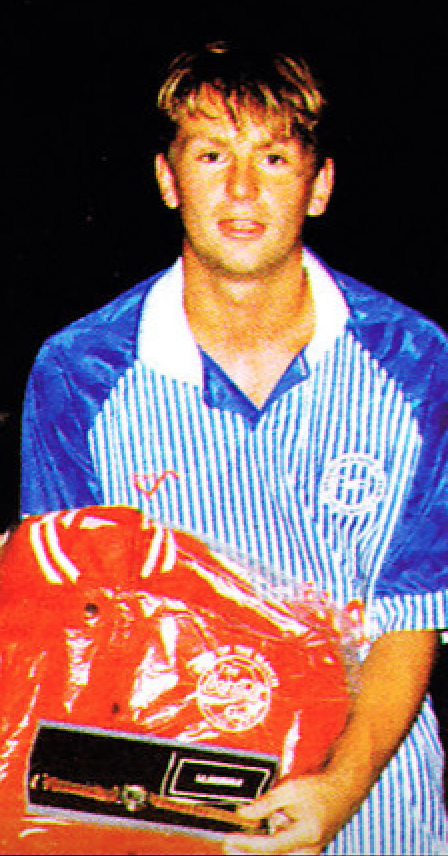
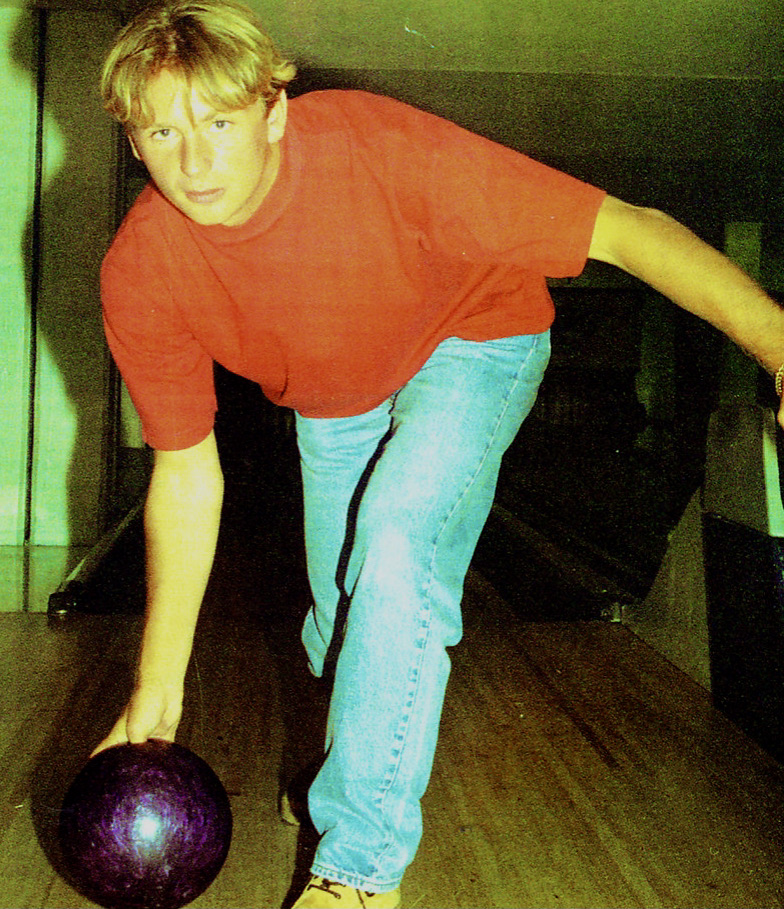
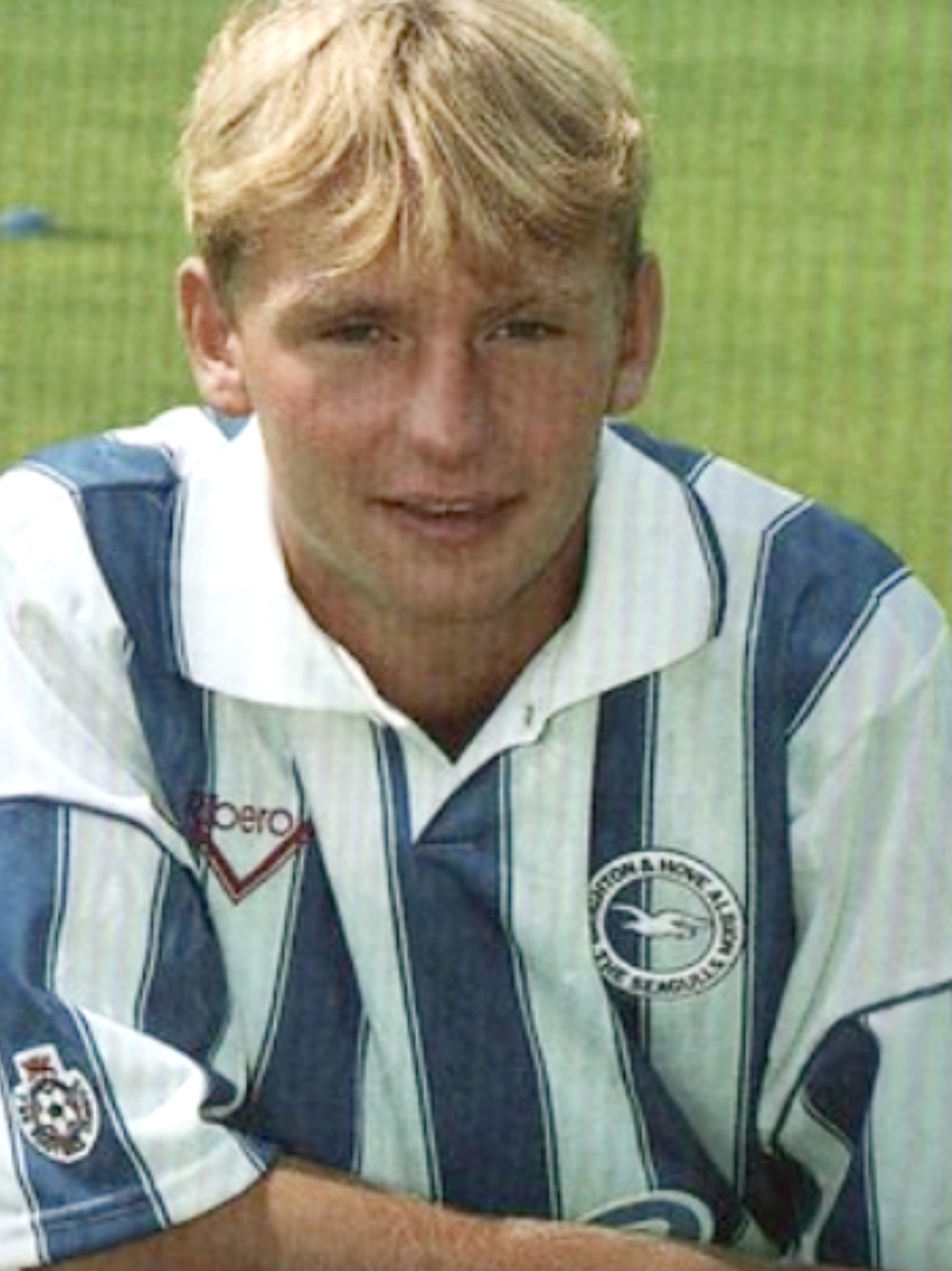
FORMER BRIGHTON apprentice Kevin Russell enjoyed a 20-year playing career in which he scored 105 goals in 552 games but he had forgettable spells at three South Coast clubs.

As we learned in my previous blog post, England Youth international Russell scored goals for Albion’s youth team and reserves but moved on before making the first team after a falling out with manager Chris Cattlin.

He got on better with Alan Ball at Portsmouth but only played eight games in three years at Pompey.

In March 1994, he was back in the south after a £125,000 move from Burnley to AFC Bournemouth. Unfortunately, his time at Dean Court coincided with dismal form on the pitch and financial pressures off it.

Russell was signed by Tony Pulis, who, it turned out, was in the final throes of his first spell as a manager, having succeeded Harry Redknapp at Dean Court.

The side had a dreadful run of form the month after Russell joined, suffering five defeats and three draws in eight matches. It was in the last of these that Russell finally got on the scoresheet for the Cherries as they picked up a point in a 1-1 draw at Hull City (his only goal in 17 matches).

While Mark McGhee won the Division Two title with Reading and Russell’s former club Burnley won promotion via a play-off final win over Stockport County, the Cherries finished a disappointing 17th in the table.

Portsmouth-born Russell had joined a squad (above) that included a number of players with past or future Brighton connections: Gary Chivers, Mark Morris, Paul Wood, Steve Cotterill and Warren Aspinall.

Cotterill recalled in a 2023 interview with gloucestershirelive.co.uk: “I know Rooster very well. I played with him at Bournemouth and he’s a great guy and a good coach.

“I liked him when I played with him because he used to stick crosses on a sixpence for me. I remember scoring a few goals from his crosses.”

Back in 1994, Pulis was sacked early on in the new season and former player Mel Machin took over, but the Cherries had managed only one win and a draw in their first 14 matches by the time they met the Albion at the Goldstone on 2 November 1994.

The game ended in a 0-0 draw and, although they won their next game, by Christmas they’d only got nine points from 21 games. Staring down the barrel of relegation, a last ditch revival in fortunes saw the season go down in memory as ‘The Great Escape’ because Bournemouth managed to avoided the drop by two points.

Russell, who had scored twice in 18 matches, had moved on by then and according to Aspinall, in a September 2011 interview with the Bournemouth Daily Echo: “Mel wanted rid of myself and Kevin Russell.”

Russell, who later had a habit of scoring against the Cherries – he hit four in 10 games against them – said after a 2001 encounter between Wrexham and Bournemouth: “The club was in a bad state when I was there, but Mel Machin and Sean O’Driscoll have turned things round and you know you’re always going to have a hard game against them.

“I don’t try any harder than normal when I play against them, but because I am playing up front and not in midfield or out wide, I get more chances to score.”

Aspinall had a couple of trial matches for the Albion before being packed off to Carlisle, while in February 1995 Russell joined First Division strugglers Notts County where he was reunited with former Leicester teammates Gary Mills and Phil Turner.

Howard Kendall was in charge at the time but County, who got through four managers that season (including Russell Slade for four months), finished bottom of the table having won only nine matches all season.

Russell then returned to his spiritual home in north Wales and, over the next seven years, played a further 240 matches for Wrexham, scoring 23 goals along the way.

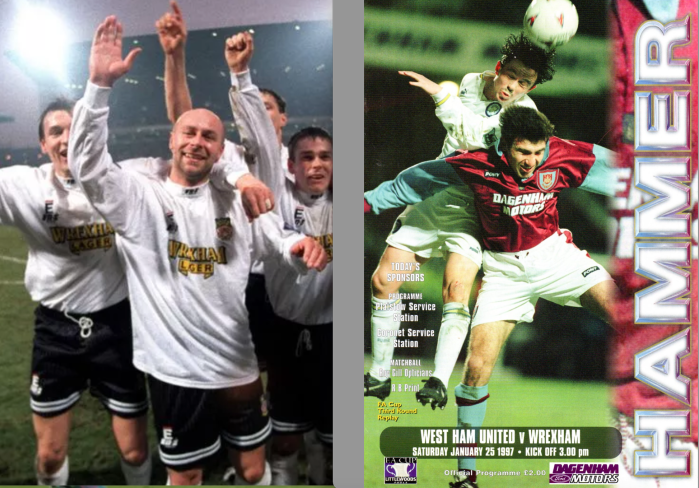
One of the most memorable was a last-minute winner at the Boleyn Ground in January 1997 as Wrexham pulled off a FA Cup giant-killing against West Ham. Having held the Hammers to a 1-1 draw at the Racecourse Ground, Russell went on as a 75th minute sub in the replay and scored a screamer in the dying seconds against a side that included Rio Ferdinand and Frank Lampard.

While the Dragons fans were elated, protesting home supporters spilled onto the pitch in anger at Harry Redknapp’s side’s performance and lowly Premier League position.

Slaven Bilic, later West Ham’s manager, was playing alongside Ferdinand and remembered the game thus: “We were struggling. We weren’t conceding a lot of goals but we couldn’t score and then Wrexham came and they scored at the end of the game, a great goal from 25 yards. After that we signed Johnny Hartson and Paul Kitson and we stayed up.”

When Russell’s playing days were over, he stayed on as a coach and worked as assistant manager under Denis Smith, taking Wrexham to promotion from the Third Division in 2002-03 and winning the LDV (English Football League) trophy in 2005.

That same year his loyalty and service to the club were rewarded with a pre-season testimonial against Manchester United – managed by his former teammate and captain Darren Ferguson’s dad!

Russell played the first 14 minutes of the match against a largely youthful United before being replaced by Ferguson. United won the game 3-1 with goals from Giuseppe Rossi, Liam Miller and Frazier Campbell and one of their subs that day was Paul McShane.

“I can’t speak highly enough of Alex for bringing his side here for me,” said Russell. “I’ve been treated to a special team with a lot of quality. I know there were a lot of young players out there, but you could see the potential they’ve got is immense.”

A crowd of nearly 6,000 watched the match and Wrexham secretary Geraint Parry said: “It just shows how well respected Kevin Russell is after his many years in the game.”

Smith and Russell were sacked in January 2007 but he went straight to Peterborough with Ferguson, who had been appointed Posh player-manager.

“We had an unbelievable time at Peterborough,” Russell told John Hutchinson. “We took them from the bottom league to the Championship in successive seasons in 2008 and 2009.”

There was a brief and unsuccessful spell for the managerial duo at Preston North End in 2010 – they were sacked four days after Christmas with Preston bottom of the Championship – but they weren’t out of work for long because they were re-appointed at Peterborough the following month.

They lost their first game back in charge though – to Brighton. Albion, on course to be league one champions under Gus Poyet that season, beat Posh 3-1: Chris Wood two and Elliott Bennett the scorers while Craig Noone made his home debut for the Seagulls.

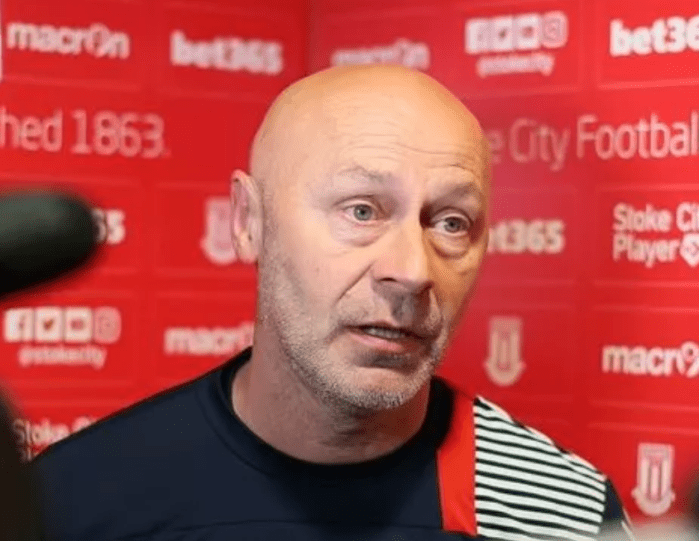
After three years at Peterborough, Russell moved back to the Potteries to join the coaching staff at Stoke (below) and stayed for nine years! He mainly worked with the under 18s and under 21s but also helped with the first team in between managerial changes in 2018 and 2019.

In May 2023, Russell joined Cheltenham Town as assistant manager to Wade Elliott. He was in caretaker charge for two matches when Elliott was sacked four months later but didn’t want the job on a permanent basis and left the club in October 2023 when Darrell Clarke was appointed.

Robins chairman David Bloxham said: “I am extremely grateful to Kevin for all his hard work and dedication and for his willingness to step in to manage the side in an extremely difficult period between Wade leaving and Darrell’s appointment.”

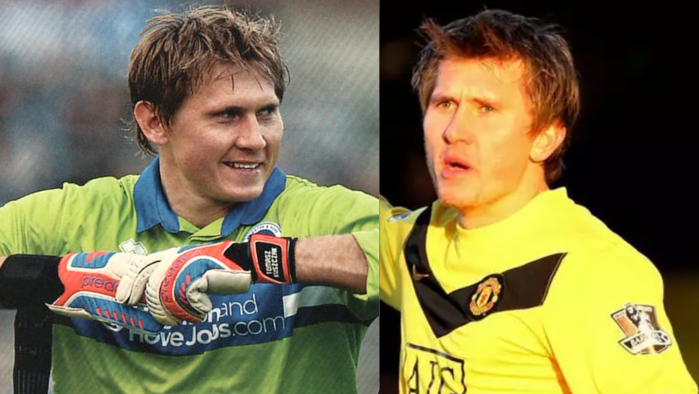
Once again, Russell wasn’t out of work for long. In January 2024, he was reunited with former Stoke technical director Mark Cartwright, a former goalkeeper who played 15 matches in Brighton’s 2000-01 promotion winning side, at Huddersfield Town.

Back in the game at Huddersfield Town

He was appointed as B team manager with a glowing endorsement from Cartwright, now Town’s sporting director, who said: “Not only is Kevin a great coach, but he also has a brilliant ability to develop relationships with young players.

“He’s a lively character and he knows how to relate to individuals to get the best out of them. Whilst at Stoke City, he played the pivotal role in developing players such as Nathan Collins, Harry Souttar, Tyrese Campbell, and Josh Tymon, alongside many others.

“He’s been so successful in doing that because he has a great understanding of the qualities that senior coaching staff want to see in young players.”

Edwards stole the limelight when Beckham made his debut

THE STORY of Matthew Edwards scoring for Brighton against Manchester United in the same cup match in which David Beckham made his debut has been told many times, and who wouldn’t be proud of that memory.

The history books can’t take it away from him, nor should they. “Scoring that goal against Manchester United was certainly the highspot of my career. Everyone wanted to talk about it and I was mentioned in all the papers and (I was) interviewed on television,” he said.

While that second round League Cup game on 23 September 1992 stands out, Edwards actually played 78 matches for the Albion after being released by Tottenham Hotspur, where his only first team outings were in testimonials or friendlies.

Albion were a very different proposition in September 1992, just beginning to reacquaint themselves to life back in the third tier of English football barely 16 months after having come close to returning to the top flight.

Big name players had been sold to try to balance the books and manager Barry Lloyd had to turn to free transfers, loanees and young hopefuls to put out a side.

Edwards was in that category and he probably only played in that United match because the respective parent clubs didn’t want loan forwards Steve Cotterill and Paul Moulden to be cup tied. He played alongside Scot Andy Kennedy, a recent arrival from Watford.

The youngster seized his chance and made a name for himself by heading home an Ian Chapman cross to cancel out Danny Wallace’s 35th-minute opener for the illustrious visitors.

Beckham had been sent on for his United bow in place of Andrei Kanchelskis (serenaded by a familiar North Stand chant of ‘Who the f****** h*** are you?’) but the game finished 1-1 at the Goldstone Ground, setting things up nicely for the second leg at Old Trafford (which United won 1-0).

Edwards once again earned a place in the headlines four months later when he scored the only goal of the game in a FA Cup third round win over south coast rivals Portsmouth, a side playing in the division above the Seagulls, and who had reached the previous season’s semi-finals.

Born in Hammersmith on 15 June 1971, the family lived in Brighton for a time and the young Edwards, who first started kicking a football around the age of six, played for local side Saltdean Tigers. At 13, he was on the Albion’s books under the guidance of Colin Woffinden, a former player who became youth coach.

But the family relocated to Surrey and it was while playing schoolboy football for Elmbridge Borough that he was spotted by Tottenham. In an extended interview with Lennon Branagan, Edwards explained how he got his big break courtesy of Fred Callaghan, Fulham’s left-back for 10 years who managed Brentford in the 1980s.

His son was playing in the same side as Edwards and Callaghan recommended Edwards to his friend Ted Buxton, a renowned coach and scout, who was working for Spurs at the time.

“I didn’t know that Ted had come along to watch me and then after one of the games they said: ‘Do you want to come to Spurs?’” Edwards recounted.

Young Spur Matthew Edwards

He signed associate schoolboy forms and while at Hinchley Wood Secondary School, Esher, travelled up to White Hart Lane on a Tuesday and Thursday night for training on an indoor pitch next to the main reception area.

On leaving school, he was taken on as an apprentice at Spurs and worked through his YTS under the auspices of youth team manager Keith Blunt and coach (and Blunt’s successor) Keith Waldon.

At 17, he signed on as a professional and he was on the books for three and a half years.

“We were quite successful in the reserves and I think that we used to win the league pretty much every season,” Edwards recalled.

It was tours abroad that he remembered most fondly from his time at Spurs, playing in Hawaii and Japan, and he also joined up with the first team squad for tours to Norway, Ireland and Italy.

A rare first team opportunity came in Billy Bonds’ testimonial at West Ham on 12 November 1990.

“I was young and had long blond hair and I can remember getting absolutely slaughtered by the West Ham fans that day,” he said.

In his final year, he went on loan to Reading, where he played eight games before returning to Spurs, and later the same season went to Peterborough on a similar arrangement, although he only played in one cup match for Posh.

He sensed his days at Spurs were drawing to a close, telling an Albion matchday programme: “I knew it was time for me to go when (manager) Peter Shreeves forgot my name!”

He said: “I had three months on loan at Peterborough but didn’t get a league game. Martin Hinshelwood rang me up in May and asked if I would be interested in coming to Brighton.”

Edwards marked by ex-teammate Justin Edinburgh

One of the first matches he played for the Seagulls was in a pre-season friendly against his former club, a 1-1 draw at the Goldstone on 29 July 1992. In a shocking excuse for a programme for the visit of Croatian side FC Inker Zapresic, a barely recognisable picture of the new signing was included. Thankfully a more professional programme appeared for the opening home league game, against Bolton Wanderers, and Edwards was pictured (left) in action up against his former teammate Justin Edinburgh

After Cotterill and Moulden had returned to their parent clubs because Albion couldn’t afford to make their moves permanent, Edwards started to forge a fledgling forward partnership with Kennedy. But Kurt Nogan took over and his prolific goalscoring saw Edwards have more of a peripheral role, although he ended the season taking over from soon-to-depart Clive Walker on the left wing.

Edwards was in the starting line-up for the first half of the 1993-94 season, won a man-of-the-match award for his performance against Gillingham in the League Cup and scored in a 2-2 draw at home to Huddersfield.

He was the programme cover boy for the Exeter City home game on 2 October (0-0) but, with Albion dangerously close to the drop zone, Liam Brady took over from Lloyd and it soon became quite a different picture for the former Spurs youngster.

He played in the first seven games under the new boss, and scored in a 3-3 FA Cup tie v Bournemouth, but Brady had his own ideas and started looking elsewhere for solutions.

“Me and him didn’t really see eye to eye, or he didn’t particularly fancy me as a player,” Edwards told Branagan.

Although Edwards was a sub three times in March, his appearance off the bench in a home 1-1 draw with Burnley was his last involvement with the first team.

A regular in the reserves in the latter part of the season, at the end of it he was released and joined Conference side Kettering where he had barely got his shorts dirty before suffering a cruciate ligament injury.

“That that was the start of the end of my career as such,” he confessed. “I had a year out of the game.”

On his return to fitness, he had two good seasons for Walton & Hersham, and then Enfield. “My knees just kept on going for me,” he recounted. Over the course of another couple of years, he appeared for Carshalton Athletic, Sutton United, Molesey, Yeading, Bognor and Egham.

But he said: “My knees just weren’t up to playing football, so I had to call it a day and that was the end of the career.”

Interviewed for an Albion matchday programme article in 2019, he told journalist Spencer Vignes he had developed a career in computer software sales and had been a visitor to the Amex on behalf of a ticketing company that worked with the club.

He had subsequently moved on to providing similar expertise for visitor attractions such as zoos, museums, aquaria and cathedrals.

Reflecting on his all too brief career, he said: “I suppose I’m lucky in that I was in the right place at the right time to play for the Albion at the Goldstone, rather than Withdean. Saltdean Tigers to Spurs to Brighton; there can’t have been many people who have done that!”

Stockdale’s key role in Albion’s rise to the Premier League

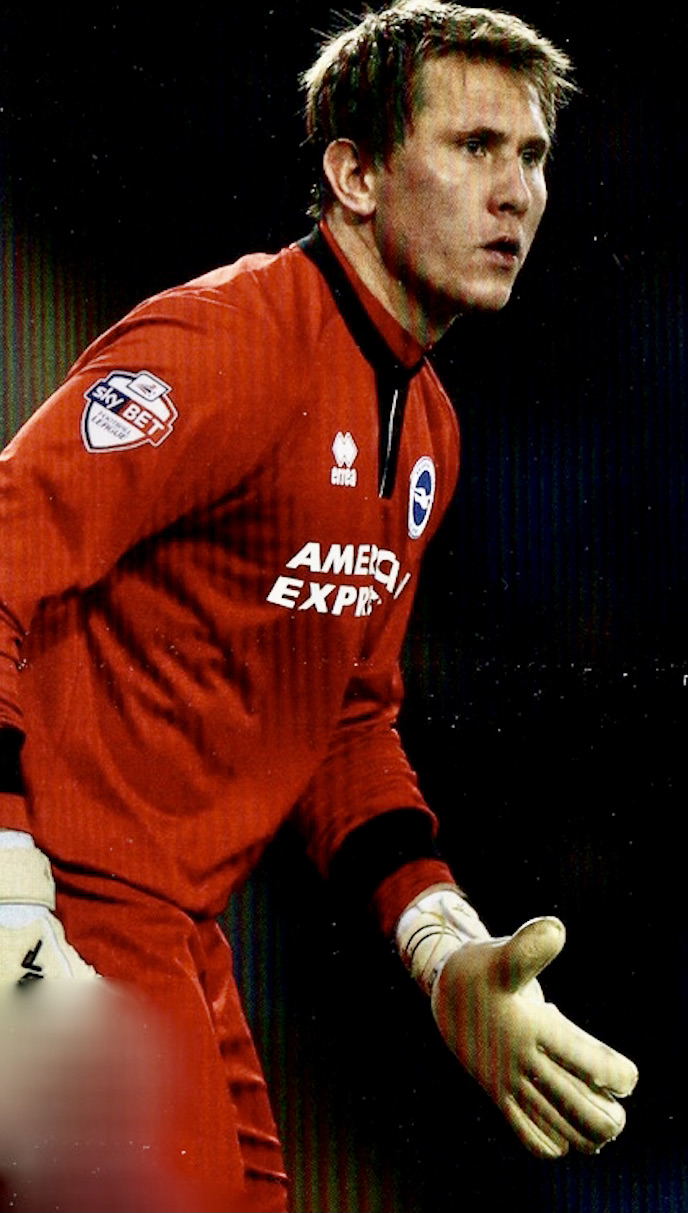
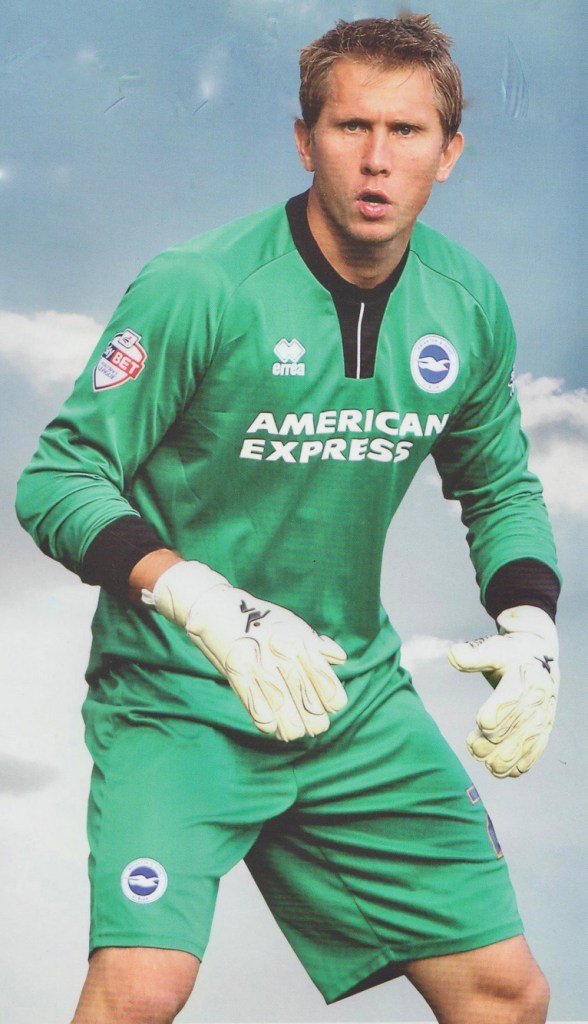
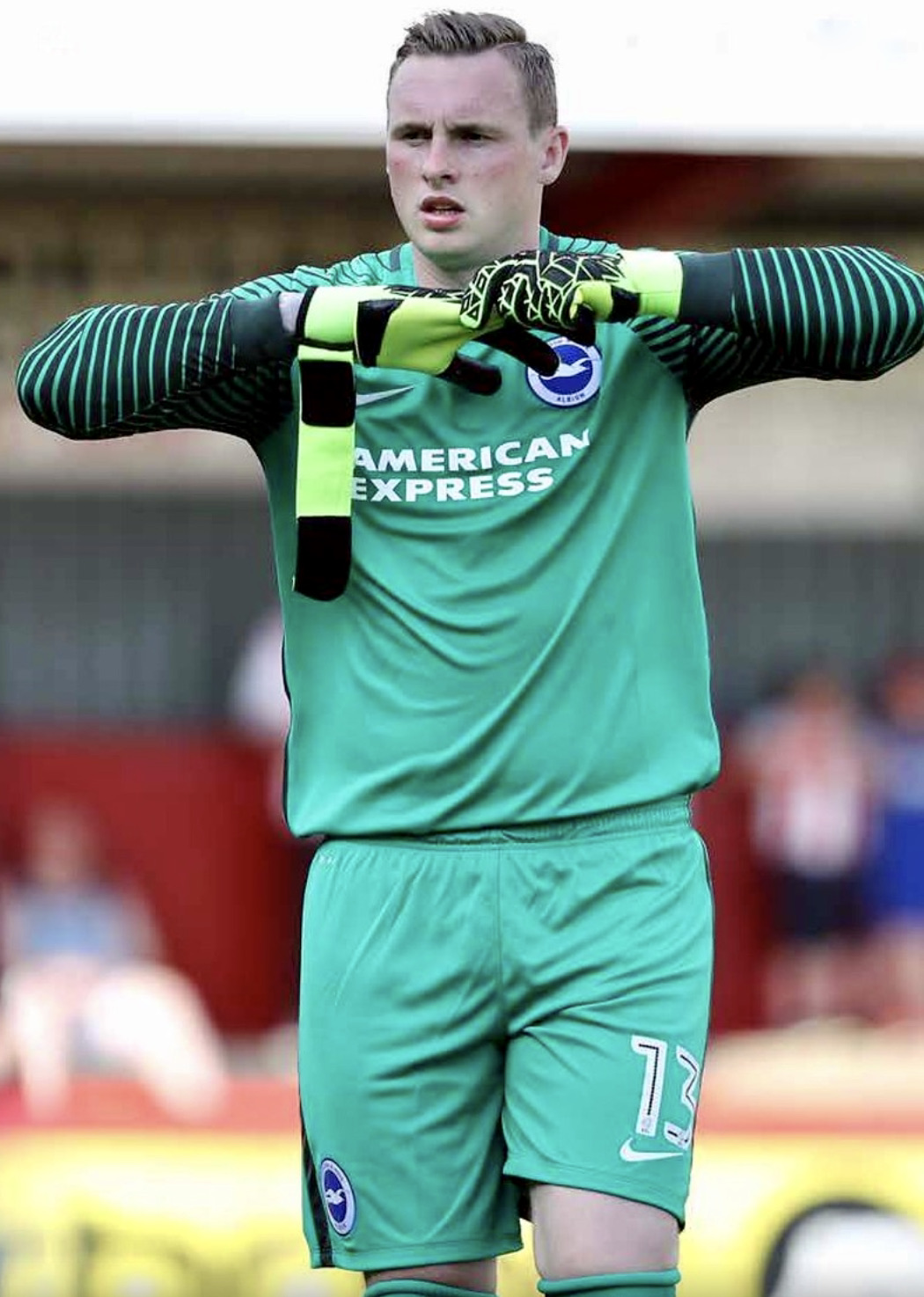
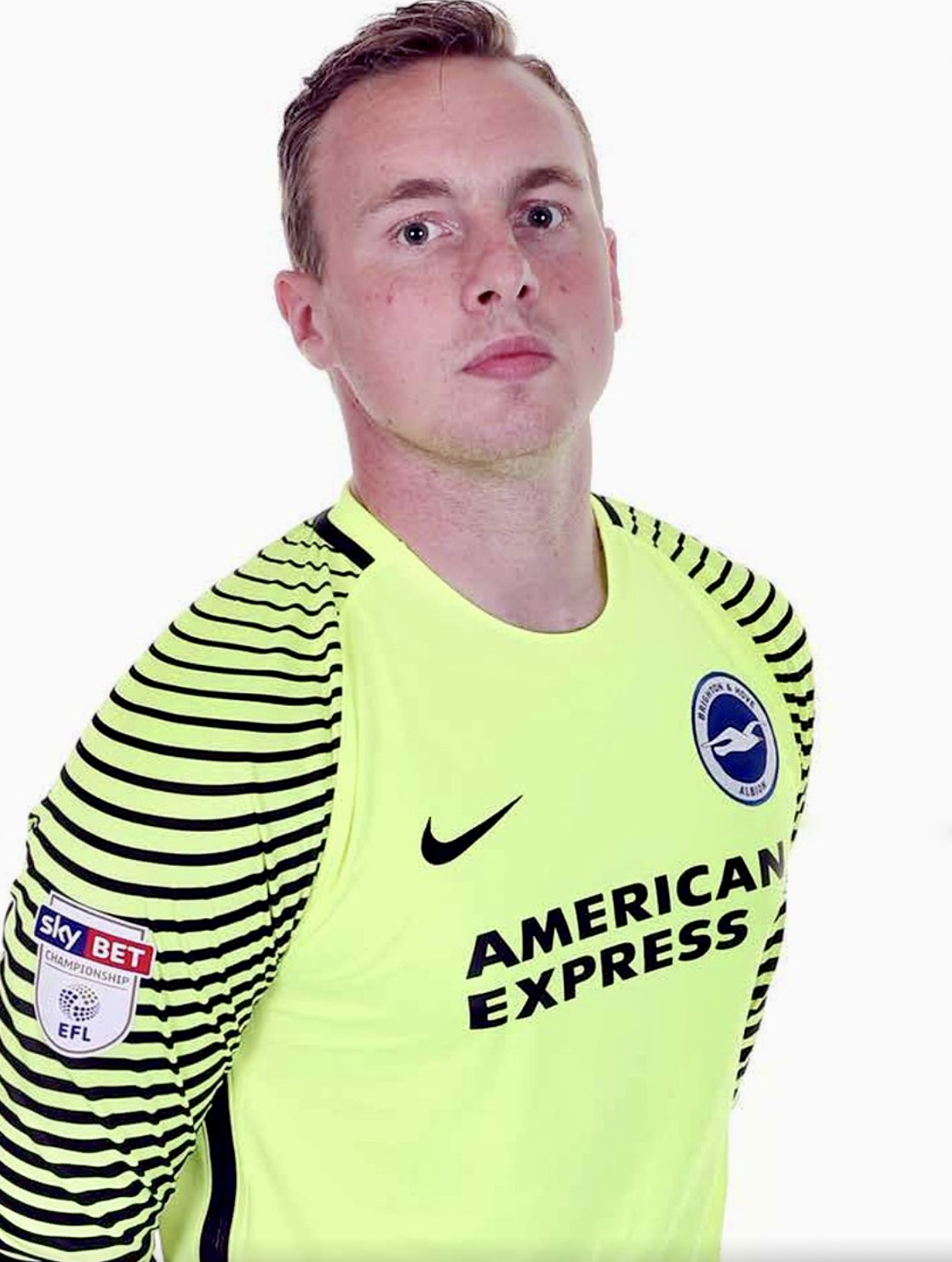
DAVID STOCKDALE kept 20 clean sheets as Brighton were promoted from the Championship to the Premier League.

He was chosen by his peers in the PFA Championship team of the year and was runner up to Anthony Knockaert as player of the season.

What seemed like a mystery at the time, though, was that he then remained in the Championship by signing a three-year contract with Birmingham City (at the time managed by Harry Redknapp).

“I’m not ashamed to say I put my family first and football second for a change,” Stockdale explained, referring to his desire to sign a longer term deal than the Seagulls offered because he didn’t want the upheaval of a move that might have unsettled his daughter’s education at a time she was about to take exams.

Stockdale had joined the Seagulls from Fulham in the summer of 2014 and was first choice ‘keeper for three seasons, playing a total of 139 matches for the club.

Remembered for some notable performances between the sticks, Stockdale impressed off it too. In the wake of the Shoreham air crash, he showed great compassion for the victims.

Before the next game, away to Ipswich Town, he wore personalised gloves and a training top bearing the names of two of them, Albion groundsman Matt Grimstone, who was Worthing United’s goalkeeper, and his teammate Jacob Schilt.

He also spent time talking to Matt’s family, visiting with Albion ambassador Alan Mullery. “We are all guilty of complaining about the little things in life but there are far more important things to worry about and I wish more people realised that,” he told the matchday programme.

At the end of the season, Stockdale’s support was recognised by the award of the PFA Community Champion trophy. “A lot of tears were shed,” he told Albion reporter Andy Naylor, when he got the inside track on Stockdale’s story in an interview for The Athletic on 17 November 2019.

“I’d spoken to Matt a few times, with him being a goalkeeper. We used to shout across at each other. I’d joke, ‘You come and train with us and I’ll do that (groundskeeping)’.”

The way the club rallied round didn’t surprise the goalkeeper because he’d heard good things from Fulham teammate and all time Albion legend Bobby Zamora when he was mulling over the move.

“I knew it was a good club, a very progressive club, but when Bobby told me it was the best club, that was good enough for me,” he said.

There was a familiar face waiting for him at training too because the goalkeeping coach when he arrived was Antti Niemi, who had taken him under his wing in his early days at Fulham.

“I was only 21 at the time, at a big Premier League club, and he spoke to me a lot in those early days,” he said. “Although he’s the goalkeeping coach here now, it sometimes feels the same as it did back then.

“He’s the one putting on the sessions now, and I’ve enjoyed them like I did when I trained with him before,” he said.

Even so, Stockdale was even more impressed by Niemi’s successor, Ben Roberts. “There’s no better goalkeeping coach than him,” he said. “Ben and I had tried to work together at previous clubs and it hadn’t come off. So, when we finally did at Brighton, he said ‘this is what I want you to work on, stay with me and trust me and the process’.

“It wasn’t always easy, I was 30 at the time trying to adapt my style, sometimes it’s hard. But I trusted him and it worked. He’s shown with numerous keepers that he can help anyone improve. That’s why people hold him in such high regard.”

A personal highlight for Stockdale came in January 2017 at the Amex when he made a double save from a Fernando Forestieri penalty against Sheffield Wednesday that helped put Brighton top of the division.

Less memorable were two own goals in a 2-0 defeat at Norwich City when Alex Pritchard shots rebounded off the woodwork, hit him and went in.

And when Albion had a chance to clinch the Championship title at Villa Park, Stockdale fumbled a long-range Jack Grealish shot to concede a late equaliser which meant Newcastle finished top instead.

“I left with great memories, on a high, apart from the Villa game,” Stockdale told Naylor. “It was one of those when everyone knows it was a mistake. It just wasn’t meant to be, but as a player you feel the responsibility.

“We got what we wanted, got promoted, but I think it left a bit of a bad feeling.”

Born in Leeds on 20 September 1985, Stockdale stayed in Yorkshire in the early part of his career, initially in the youth sides of Huddersfield Town and York City.

It was York who took him on as a trainee, in 2000, and in the last game of the 2002-03 season, aged just 17, Terry Dolan gave him his first team debut as a half-time substitute for Michael Ingham, who was suffering a shoulder injury, although City lost 2-0 to Oxford United.

By then in the Conference, Stockdale made 19 consecutive appearances for the Minstermen between August and December 2004 before being dropped by caretaker manager Viv Busby.

It was during that run of games that Stockdale first gained international recognition, being selected for the England C (non-league) squad for a friendly v Italy (he went on as a sub for Nikki Bull).

After his club disappointment, he told the York Evening Press: “I was gutted when I was taken out of the team but I’ve just gone back to the training ground and worked as hard as I can.

“I have got my best years to come. I am only 19 and I hope I can get a contract for next year and stay at the club.”

When former Albion midfielder Billy McEwan took charge, he offered Stockdale his first professional contract, although the youngster prevaricated over signing it, much to the manager’s dismay.

McEwan told the York Evening Press: “If the players don’t want to sign, then it’s up to them. They can go because I want players who want to play for York City Football Club.

“But David Stockdale is the biggest disappointment to me and I have told him that. He’s a young apprentice getting his first professional contract and the last thing in his mind should be money. That should be of secondary importance and he should be grateful York City are offering him a contract.

“On the evidence of his last performance of the season, he has to do better if he wants to get into the team.

“At the moment, he has potential but so have a lot of players. Maybe he feels he can get an automatic number one spot but that’s up for grabs this summer.”

Shortly after signing the contract, Stockdale went on loan to Northern Premier League club Wakefield-Emley and the following March joined Worksop Town on a temporary basis.

Stockdale was released by York at the end of the 2005-06 season with some more harsh words from McEwan about his weight ringing in his ears. After signing for League Two Darlington, Stockdale told the York Evening Press being released had been the incentive he needed to save his career.

“I have done well in pre-season and got back into shape after letting myself go at York, which was well-documented,” he said. “I accept now that was the case and agree with the manager but I would have preferred not to have been criticised in public.

“It has probably given me a kick up the backside though to get me going again and I feel a better person now. I would have loved to have stayed at York because I was there for a long time and have a great affection for the club.

“I would like to thank everybody there for all the help they have given me. The fans were always great and I learnt everything there so it was a bit of a shock to go.”

Clearly benefiting from full-time goalkeeping coaching from former Darlington, Bristol Rovers and Middlesbrough no.1 Andy Collett, Stockdale became manager Dave Penney’s preferred first choice ‘keeper, ousting former Derby and Bolton stopper Andy Oakes.

Scouts from Birmingham and Newcastle were said to be monitoring his development but it was Fulham who stepped in and signed him in April 2008 for an undisclosed sum (thought to be £350,000 rising to a possible £600,000). He was loaned back to Darlo to finish the season when they lost out in the League Two play-off semi-finals.

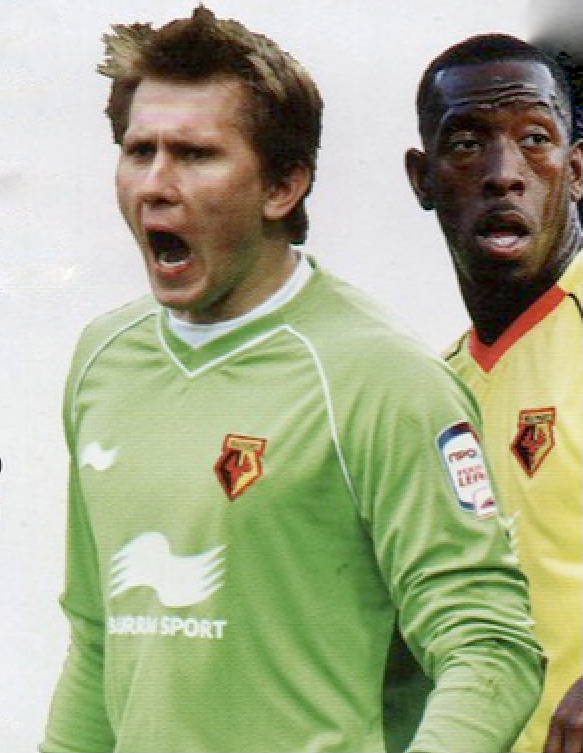
Although he was at Fulham for six years, much of Stockdale’s time on their books was spent out on loan: in League Two with Rotherham United, League One at Leicester City, and in the Championship with Plymouth Argyle, Ipswich Town and Hull City.

Temporary Tractor Boy

Nevertheless, his parent club did give him a reasonable sprinkling of first team outings: he played a total of 52 games, 39 in the Premier League.

Indeed in 2011, when he was covering for the injured Mark Schwarzer, Fabio Capello, the England boss at the time, called him up for international duty, although he didn’t get to play.

His best run of games for Fulham in the Premier League came in the 2013-14 season when he made 21 appearances (he also played five cup games).

After he left Brighton, Stockdale was Birmingham’s first choice ‘keeper throughout the 2017-18 season (apart from two months out with an injured wrist). He played 39 games, having replaced the previous season’s no.1, Tomasz Kuszczak, who had also moved to City from Brighton.

Blues only narrowly avoided relegation from the Championship with Redknapp only lasting until mid-September as manager; Lee Carsley briefly in temporary charge, Steve Cotterill for five months and then Garry Monk.

Monk brought in Lee Camp as his first-choice ‘keeper and Stockdale was sent out on loan to three different League One clubs: Southend United (on an emergency seven-day arrangement), Wycombe Wanderers and Coventry City.

After making a single appearance for Birmingham under Monk’s successor Pep Clotet at the start of the 2019-20 season, Stockdale rejoined Wycombe in January 2020 on a half-season loan.

He then moved to Wycombe on a permanent contract in September 2020 but only played twice, with Ryan Allsop the preferred no.1. In February 2021, he linked up with League Two Stevenage on loan and played five matches before having to return to Wycombe when Allsop was injured.

He kept the shirt until the end of the season, when Wanderers were relegated to League One, and, with Allsop having been released, Stockdale stepped up and was ever-present throughout the 2021-22 season. His 18 clean sheets earned him the League One Golden Glove award, jointly with Michael Cooper of Plymouth.

Nevertheless, with his contract up, he then returned to Yorkshire, signing for Darren Moore’s Sheffield Wednesday, where he played 27 games in the 2022-23 season.

They say what goes around comes around, and at the start of the 2023-24 season Stockdale went back to York City, although he sustained an injury early on in the season that caused him to be sidelined from the National League team.

As well as his familiar playing role, Stockdale began to look towards a time when he hangs up the gloves by also being appointed York’s head of recruitment. However, he was let go from the role in April 2024.

Away from his direct involvement in club football, he began a postgraduate diploma in Global Football Sport Directorship with the PFA Business School.

Lowe and behold, the centre back who couldn’t get a game

KEITH LOWE is one of those curious cases of a player who joined the Albion on loan but didn’t kick a ball in anger!

He played one game for the reserves and sat on the first team bench for five matches without getting on.

Lowe was just 20 and well down the centre half pecking order at Wolves when Mick McCarthy had just taken charge.

At the beginning of the 2006-07 season, Albion’s first choice centre backs, Adam Hinshelwood and Guy Butters, were both out injured, and Joel Lynch was a doubt after picking up a niggle in a pre-season game. So, manager Mark McGhee took the opportunity to get Lowe on loan for a month.

Candid former Wolves manager McGhee told the Albion matchday programme how the club had done its homework on the youngster, who he described as a “no frills central defender who gets in where it hurts to head it and boot it. Obviously, that’s something we need – a big lad in our box to head it away. With the absence of Guy Butters, we’ve missed that sort of height in pre-season so I hope he will do well for us.

“Obviously I know people well at Wolves, so we don’t think for a minute that we are signing Rio Ferdinand, but we’ve signed a steady young player who’s determined to make a career for himself and wants to do well.”

For his part, Lowe told the Argus: “I’ve found out that there are a few injuries in the defence here so hopefully I’ll get into the team as soon as possible and play as much football as I can.”

Born in Wolverhampton on 13 September 1985, Lowe had progressed through the Wolves academy and was given a first team debut by Dave Jones in the League Cup at the beginning of the 2004-05 season, three weeks before his 19th birthday. Two months later Lowe was awarded a three-and-a-half-year contract and he said:“My family are all Wolves supporters so it’s a bit of a dream come true.”

Although he made 13 appearances at either right-back or centre-back that season, he only played three matches for them under Glenn Hoddle the following season although he gained experience out on loan, at Burnley (under Steve Cotterill), and QPR in the Championship, and Swansea in League One.

“A lot of people have left Wolves but the one thing they have got is a lot of defenders and they have scrapped their reserve team now so it was best to go and play somewhere else,” Lowe told Andy Naylor of the Argus. “I’m looking to play as many games as I can. I wasn’t getting the opportunity I would have liked at Wolves so I jumped at the chance to come and play some football.”

Lowe said that even though McCarthy had not long been in charge, he had already got his starting eleven in mind. “I hadn’t asked to go out on loan yet, but from what I can gather the manager here ‘phoned up our manager and it seemed like the ideal place to come,” he said. “I’ve not been down to Brighton before but my first impressions, even from the drive in, were it seems really nice and I’m really looking forward to it.”

He added: “My aim is to get noticed at Wolves but I’m open to anything that happens. If it’s not going to happen for me at Wolves then I’ll stay here as long as the management staff want me.”

Unfortunately for Lowe, Lynch recovered from a pre-season thigh injury in time to make the starting line-up for the season opener at Rotherham, and he never did manage to force his way into the side.

By mid-August, he confessed in another Argus interview: “I’m very disappointed. I came down here to play football but it hasn’t happened. You’ve got to be professional about it, keep working hard and hopefully it will come.

“We kept clean sheets in our first two games and, when things like that happen, you can’t really go knocking on the gaffer’s door and say: ‘Why am I not in the team?’ The lads have done really well but I’ll just keep working hard in training and hopefully he’ll take note.”

Lowe pressed his claims for a place by scoring on his debut for the Reserves, heading an equaliser from a Tommy Fraser corner on 54 minutes, in front of McGhee, in a 2-1 win away to QPR. He said: “It was nice to get 90 minutes under my belt and it was a good performance and result, so I was pretty pleased.

“Hopefully I’ve caught the gaffer’s attention. I thought I did well enough and I’m just trying to push to get into the team.”

It didn’t happen, though, and McGhee was at pains to point out the circumstances. “We brought him here to play but then Joel got fit and suddenly looked absolutely fine.

“By the time we got Keith down here we weren’t sure he had trained with us enough and done enough work with us. Joel was there and we decided not to gamble with Keith but to play Joel, who has then played so well, so things have conspired against him a wee bit.”

McGhee added: “He did fine at QPR. In the second half, particularly, when we pushed them up the park and asked them to defend in behind, he did it well.”

Lowe might have got a chance in the Carling Cup against Boston United but Wolves were only prepared to allow him to be cup-tied if Albion intended keeping him longer – and McGhee had decided to add to his defensive options by signing veteran Georges Santos.

Lowe headed back to the Black Country, but the following month he went on loan to Cheltenham Town, where he finally saw some league action, playing in 18 matches. It sowed the seed for a later period in his career: he played 133 games for League Two Cheltenham between 2010 and 2014 in a career that ultimately embraced 617 appearances for 13 different clubs.

Lowe spent the final season of his Wolves contract on loan at League One Port Vale. Signed by Martin Foyle, Lowe also featured under his successors Dean Glover and Lee Sinnott, playing in 31 matches. But Vale were relegated in 23rd spot and the defender finally bade farewell to his boyhood club in May 2008.

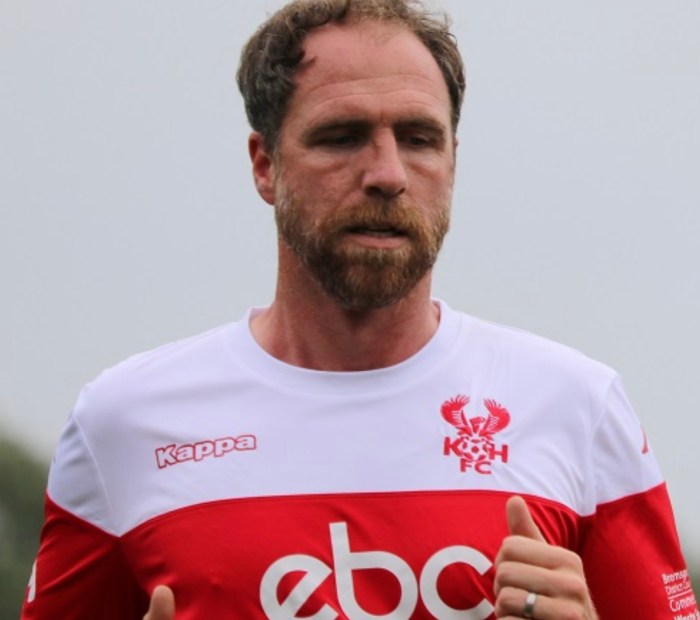
He dropped out of the league for the 2008-09 season, appearing in 52 games for Conference Premier League side Kidderminster Harriers.

Budget issues meant he was released at the end of the season and the following campaign he was back in the league with Hereford United, playing 26 games for the League Two Bulls under John Trewick and former Wolves boss Graham Turner. That spell at Cheltenham came next.

During two years at York City, Lowe collected no fewer than four Player of the Year awards in 2014-15 – three from supporters’ groups and one from local newspaper The Press.“Keith deserves the awards for his consistency,” City boss Russ Wilcox told the newspaper. “To play every league game is always an achievement. It shows you are doing things right on and off the pitch. It means you look after yourself, train properly and are a good professional.”

Released by new York boss Jackie McNamara, Lowe returned to Kidderminster, by then in the National League, where he spent another 18 months, much of it as club captain.

National League Macclesfield Town was his next port of call and he played in all of their matches as they won promotion back into the league in 2017. However, it ended on a sour note in 2019 when he was one of six players to issue the club with a winding up order for unpaid wages.

The 2019-20 season saw him turn out for three different clubs: Southern League Nuneaton Borough, National League North side Bradford Park Avenue and latterly (until the Covid pandemic called a halt to the league) Kidderminster for a third spell.

At the end of the 2021-22 season, he announced his intention to concentrate on developing a career as a teaching assistant. He told the Kidderminster club website: “I’m not ready to stop yet and am very much planning to play part-time next year, but it feels like now is the time to move away from the full-time game and think about the future and the career I’ve been building in schools.”

Benno’s quick route to the top after ‘fantastic’ Albion chapter

SEVENTEEN GOALS in 100 appearances don’t tell the whole story of Elliott Bennett’s two seasons as a Brighton player.

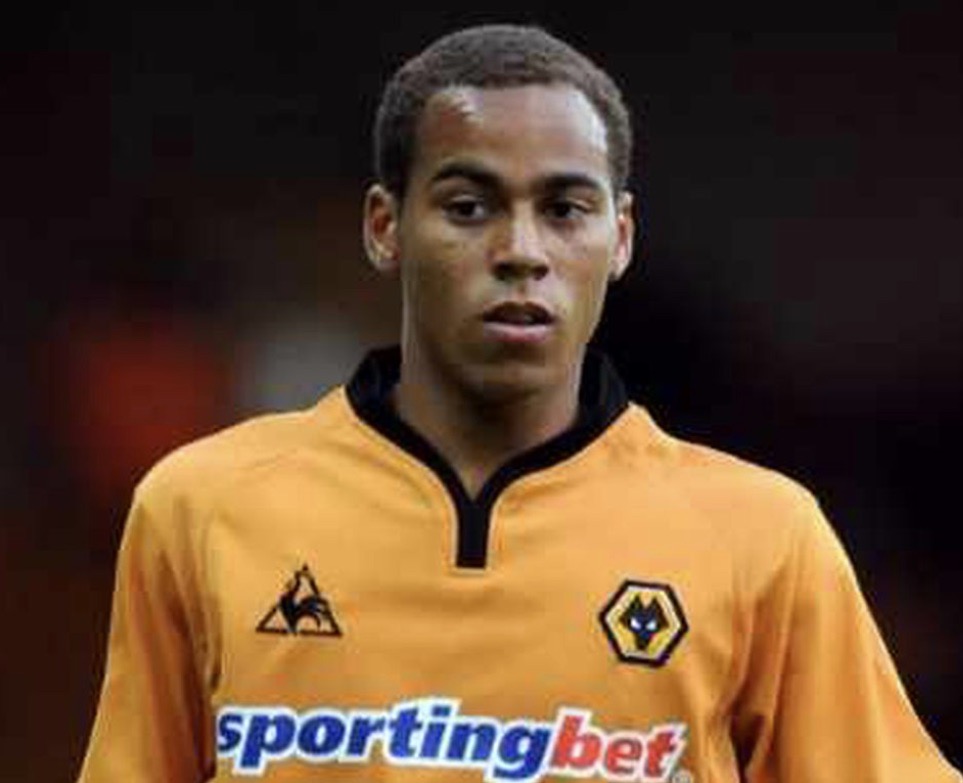
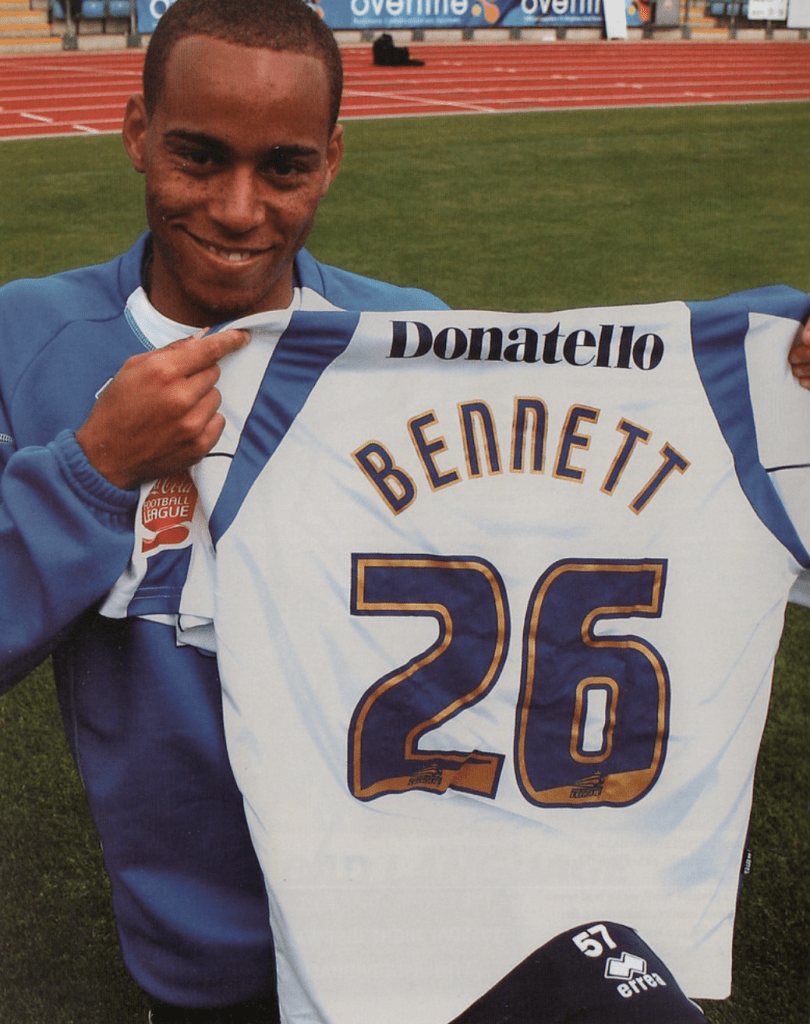
Russell Slade signed him in August 2009 from Wolverhampton Wanderers for £200,000, but it was under the guidance of Gus Poyet that he flourished and was a stand-out performer when Albion won promotion from League One in 2011.

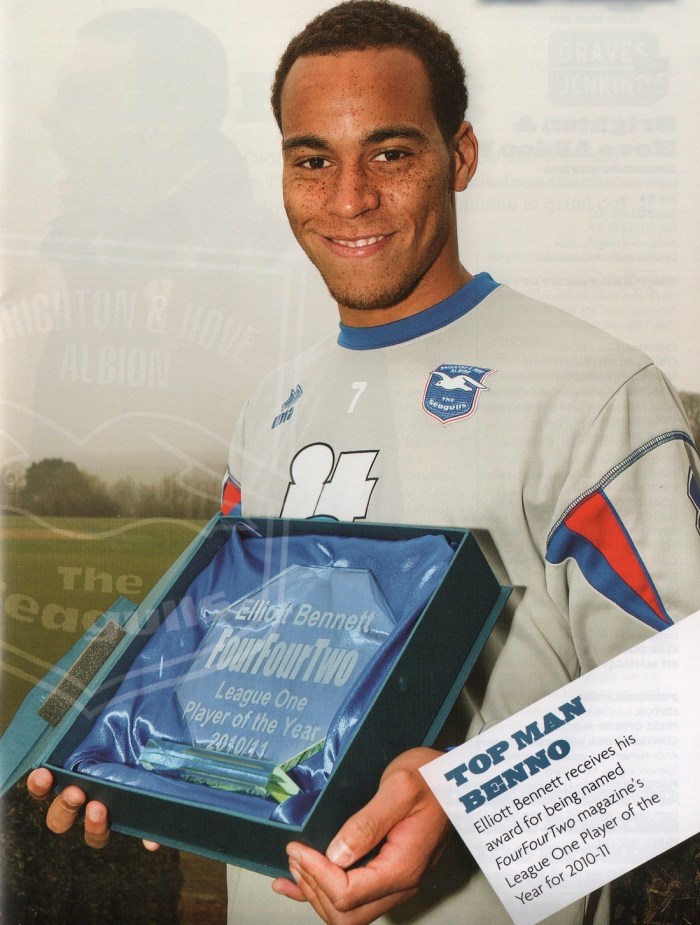
Not only was he chosen by his fellow professionals in the PFA League One team of the year (along with teammates Gordon Greer and Inigo Calderon), he was Four Four Two magazine’s League One Player of the Year.

Always diplomatic in interviews about personal achievements, typically he said: “If you win awards, it’s nice personally but you have to remember you can’t win them without your teammates. If I’m setting up goals, then it means our strikers are on their game as well as they’re getting on the end of my crosses.”

In a matchday programme feature, he added: “These individual awards really are not possible unless you have a good team around you, so this award is really on behalf of the whole squad and coaching staff.”

Bennett acknowledged the impact Poyet made on improving him as a player. “Gus has given me different roles to play throughout the season. I’m a lot more aware as a player as a result and I’m better with the ball now. There’s still lots for me to work on, but the gaffer has really brought my game on. I definitely owe him a lot.”

In another matchday programme article, he once again paid tribute to Poyet, his assistant Mauricio Taricco and coach Charlie Oatway. “I feel like I’m improving all the time and I owe so much to the coaching staff: the gaffer and Tano, while Charlie has got my head right. I used to beat myself up if I gave the ball away but Charlie has stamped that out of me. Technically, all three have helped me and I’ve also been playing in the middle a bit more, which has added another string to my bow.”

Bennett continued: “While I’m known for being a winger, my link-up play has also improved this season, which has really pleased me. I’m now more involved and it’s important that I keep on learning. The gaffer will always pull me to one side if he sees something that can help improve me – which he does with everyone – and then it’s a case of trying to replicate that on a match day.

“When you’ve got a gaffer who’s played the game at the highest level, you can only learn from him – and if you didn’t listen you’d be pretty stupid.

“I’ll play anywhere for the good of the team – I’ve even played right-back this season, but I must admit that I do prefer playing in a more advanced role where I can create things for the team. Whether that’s right wing, the left wing or even behind the strikers I don’t mind. I just love being involved.”

Bennett’s impact wasn’t confined to games, either. He and Liam Bridcutt used to visit Westdean Primary School, near Withdean, where they listened to youngsters reading. His wife, Kelly, worked for the club too.

Aware they had a hit property on their books, Albion awarded Bennett a new three-and-a-half-year deal in November 2010, when Poyet told the club website: “Elliott has been a good pro and has earned this new contract.

“He has shown he is capable of playing in a number of positions, he enjoys playing our style of football and I think he will continue to get better as a player.”

For his part, Bennett said: “Gus is a big factor for me. I will always be grateful to Russell Slade for signing me, but the current gaffer has brought his own style of play.

“I have really taken to the club ever since I arrived from Wolves last summer. I feel I have grown up as a person and developed as a player.”

Unfortunately for Brighton, Bennett’s superb contribution drew plenty of admirers and, when Norwich City offered £1.9million to give him the chance of Premier League football, the lure was too great to resist for player and club.

While his promoted teammates looked forward to Championship football in the brand new Amex Stadium, Bennett joined Paul Lambert’s Canaries to test his talent at the highest level.

Bennett told HITC Sport’s Alfie Potts Harmer: “Brighton was a fantastic part of my life and a fantastic chapter of my career, I loved every minute of it.

“When we won the title there, League One was full of teams who are now flying, you look at Southampton, Bournemouth and Huddersfield, it was a strong League One that year, and we played some fantastic stuff.

“The stadium coincided with promotion and I’d just signed a new contract. I think I would have stayed there for many years had it not been a Premier League move, but I don’t regret moving to Norwich. When an opportunity like that comes you have to take it as a player. You don’t know if it will come again.”

Lambert was delighted to land the youngster having previously had a bid to sign him in January that year rejected. “He is a young and exciting player with plenty of pace,” Lambert told the Norwich website. “He can play in a wide position or in behind the forwards, he’s a quick lad and he’s got a winning mentality.

“He played his full part in what Brighton achieved last season and that desire to succeed will stand him in good stead here.”

Bennett declared: “It’s an unbelievable opportunity for me to fight for a place in a team which will be playing in the Premier League.

“I like the mentality at Norwich City that has seen them get back-to-back promotions and I’m grateful to Paul Lambert for giving me the chance to be part of what’s happening at the club.

“I didn’t make it through at Wolves, which was my home-town club, and Brighton gave me the opportunity and I’m grateful for that.

“Now I’m just really excited about the chance to try to help Norwich in the Premier League.”

Bennett certainly seized the opportunity and in his first season was delighted to score the winning goal in Norwich’s 2-1 win over Spurs at White Hart Lane. He’d played 57 games in the Premier League when his career suffered a major hiatus. In the first home game of the 2013-14 season, against Everton, he sustained a cruciate injury which ruled him out of all but the last game of that campaign, as City were relegated.

Frustrated by the lack of starts at Norwich as they began life back in the Championship, Bennett was happy to return to the Seagulls on loan as Sami Hyypia tried various permutations to get some wins on the board.

Bennett received a warm reception from the Seagulls supporters as he stepped out at the Amex for a home game against Wigan Athletic on 4 November and helped the side to their first win in eight matches.

Unfortunately, the upturn in fortunes was all too brief and, although Bennett’s loan was extended by a second month, six winless games saw Hyypia exit the hotseat. “I had nothing but respect for him,” Bennett later told The Athletic. “He gave me an opportunity, after a big injury, to get out and play some football. He didn’t have to bring me back. I was thankful for that. Unfortunately, it didn’t work out.”

Bennett’s final appearance came in the memorable 2-0 win over Fulham under caretaker manager Nathan Jones.

He returned to Norwich just as Alex Neil was taking over from Neil Adams as manager and was part of the squad who won promotion back to the Premier League via a play-off win over Middlesbrough.

But back in the elite, first team opportunities were limited and during the first part of the 2015-16 season Bennett went out on loan again, this time to Bristol City, where Steve Cotterill was the manager.

Bennett made 14 appearances for the Robins but soon after his deal expired in January 2016, a £250,000 fee saw him move permanently to Blackburn Rovers, where, from the start of the 2019-20 season, he became club captain, and he continued to be a well-respected part of Tony Mowbray’s set-up.

Bennett has certainly endeared himself to the Rovers supporters and has even been hailed as a modern-day ‘Mr Blackburn’ by website roverschat.com, who lauded his contribution to the club.

“Elliott Bennett’s evergreen positivity, fan interactions, and trademark fist pump were key in improving the culture at Rovers, as the dark, grey clouds over Ewood Park that had called it home since 2011 ever so slowly began to dissipate.

“His leadership has been a key contribution, as even when he is not playing for Rovers, he still is managing to inspire others to become the best version of themselves.”

One of those times spent out of the side came when Bennett tested positive for Covid-19 in May 2020 although the player said he didn’t feel unwell, and typically was thinking of others when interviewed about it.

“There seems to have been a lot of hysteria about footballers returning to training, but it’s not a big deal at all,” he said. “It’s the people who are seriously ill in hospital that we need to worry about, not footballers who are fit and healthy, and who aren’t showing any signs of being unwell.”

The popular Bennett is an active participant on social media and has 76,000 followers on Twitter.

In the summer of 2021, he moved to League One Shrewsbury Town, just 15 miles from Telford where he was born on 18 December 1988,

Bennett first showed his talent playing for local Telford team Hadley Juniors. Wolves scouts Les Green and Tony Lacey spotted him and invited him to train with the club’s under sevens and under eights. Remarkable as it sounds, he was offered a contract at the age of nine! “From then I just worked my way up through the age groups,” he told wolves.co.uk in a January 2019 article.

“The coaching was fantastic, the level of care we got was outstanding and we had the chance to travel the world. We got to go to Holland, we went to Japan, and it was a fantastic experience for me. Going to Japan and winning the under-12 World Cup was probably one of my favourite memories I have from the playing side of the academy.”

At Thomas Telford School, Bennett captained the school team as they won the county cup five years in a row. He was also a talented 200m runner who represented Shropshire at sprinting.

After leaving school to go on a scholarship at Wolves, he signed professional in 2007.

“The biggest moment for me was being given my professional contract,” he said. “I always dreamt of one day being able to pull on that gold and black shirt and play at Molineux, and thankfully I did.”

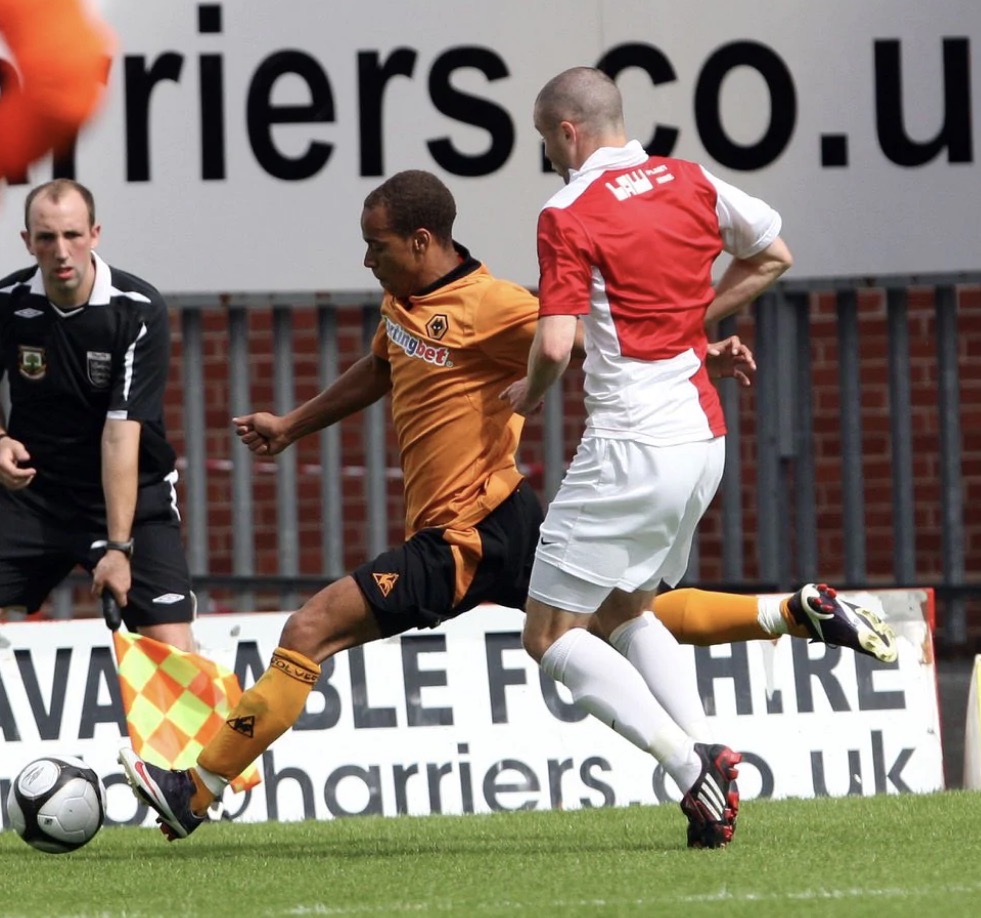
He got a taste of first team action in pre-season matches, scoring after only five minutes in a 3-2 win at Hereford United, and in 2007-2008 he made two appearances for the first team in the League Cup.

Mick McCarthy gave him his first competitive start in a 2-1 win over Bradford City on 15 August 2007 but he was replaced by Stephen Ward at half-time, and on 28 August was in the Wolves side humbled 3-1 after extra time by lowly Morecambe.

Although he was involved with the first team squad for some league matches, he didn’t get any game time, but gained experience going out on loan, initially playing 11 games at League One Crewe Alexandra, and later featuring in 19 League Two games for Bury.

He spent the whole of 2008-09 on loan with Bury, scoring three goals in 52 matches.

It must have been quite a wrench for Bennett to contemplate moving away from the club he’d been associated with for 14 years, but it was a former Brighton striker, the then Wolves assistant manager Terry Connor, who persuaded him to spread his wings and move to the Albion, as he revealed in a Football the Albion and Me interview.

He explained that he’d still got two years left on his contract at Wolves and being very much “a home person” he’d not considered leaving home in Telford, 20 minutes away from Wolverhampton.

“I remember Terry pulling me into his office and saying ‘Look, I went to Brighton in a similar position to yourself, you’ve got to go out and forge your own career. Become a man, become a person, don’t be Elliott Bennett from the academy at Wolves. You’re Elliott Bennett the professional footballer, create your own path.’

“And from that conversation I thought ‘You have to take the shackles off and go and try something different’ and you can’t really get a much better place to live than Brighton, as I later found out. It turned out to be the best decision I have made since I started playing.”

The week before he signed, he went to watch Albion away at Huddersfield…..and saw his new employer thrashed 7-1. Luckily, he’d made up his mind to join before the game!

“I was a guest of Tony Bloom,” he said. “I had a good chat with him before the game and he told me the vision. He told me where he wanted to take the club. I was blown away to be honest. I couldn’t wait to get started.”

Pictures from Albion matchday programmes and various online sources.

It was chirpy Chiv of the Cherries after six years with the Seagulls

THESE DAYS Gary Chivers is a familiar face around the hospitality lounges at Brighton’s Amex Stadium and Chelsea’s Stamford Bridge, the two clubs where he spent most of his playing days.

His association with Chelsea goes back to the tender age of 10, when he joined their academy, and he went on to play in their first team for five years. After six years with Brighton, he played out the final two years of his 16-year career at AFC Bournemouth under fledgling boss Tony Pulis. Among his teammates were Mark Morris, Warren Aspinall, Paul Wood and Steve Cotterill, all of whom also played for the Seagulls.

Born in Stockwell, London, on 15 May 1960, Chivers started supporting Chelsea at the age of eight, and, like many future professionals, got a foothold in the game at Stepney-based development club Senrab.

He told journalist Nick Szczepanik in a 2018 Backpass magazine article (below): “My brother had been training with Chelsea and my dad took me along when I was ten, and I went into their academy about two years before I should have.”

Chiv in BackpassAlthough initially a midfielder, coach Ken Shellito turned him into a defender and Chivers’ versatility in defence meant he could play centrally or in either full-back berth. Among his early contemporaries were John Bumstead, Colin Pates and Micky Fillery: Pates would later join him at Brighton.

With Chelsea already relegated, Chivers made his first team debut on 21 April 1979, aged 18, as he recounted in a December 2017 interview on the Chelsea website. Irish legend Danny Blanchflower was the manager who handed him his debut, at Stamford Bridge against Middlesbrough, which finished in a 2-1 win in front of just 12,007.

Chivers did enough to keep his place for the last four games of the season, and he told Szczepanik how in one he had to mark Arsenal’s Malcolm Macdonald and another Manchester United’s Joe Jordan.

In the second tier the following season, an injury to first choice right-back Gary Locke gave Chivers a chance to establish himself under new manager Geoff Hurst, and he retained the shirt for much of the season.

In total he made 148 appearances for Chelsea, scoring four goals, one of which was voted runner-up in Match of the Day’s Goal of the Season competition in 1980-81.

He got on the end of a Clive Walker cross following a delightful flowing move as top-of-the-table Newcastle were beaten 6-0 by second-placed Chelsea.

Chivers deputised at left-back for the injured Chris Hutchings towards the end of the 1982-83 season, by which time John Neal had taken over as manager. Chelsea were at a low ebb and only a point from a goalless draw against Middlesbrough on 14 May 1983 saved from them from relegation to the old Third Division. Neal overhauled the playing staff, and Chivers was amongst the casualities.

Explaining how he didn’t see eye to eye with Neal, he added: “I didn’t want to go, but you have to play games.”

He briefly switched to relegated Swansea City, under John Toshack, but only stayed six months as managers came and went in rapid succession. Seeking a move back to London, he joined QPR under Terry Venables – “the best manager I ever played for” – where he played alongside John Byrne, another player he’d be reunited with at the Albion.

At the end of his contract, he moved on to Watford during the uncomfortable spell when former Wimbledon boss Dave Bassett was in charge, but he got the feeling he didn’t fit in. Brighton boss Barry Lloyd, himself a former Chelsea player, agreed a £40,000 fee with the Hornets as Chivers dropped down a division to third-tier Albion, where he linked up with some familiar ex-Chelsea faces in Doug Rougvie, Robert Isaac and Keith Dublin.

He explained to Szczepanik: “I decided to go to Brighton because I had a look at their fixtures and I even asked for a promotion bonus because I was so confident they would go up.”

The confidence was well-placed because promotion was duly gained, and Chivers went on to become part of the furniture for the next six years, including playing in the play-off final at Wembley in 1990-91.

An incident that led to a Notts County goal still rankles with Chivers. “At 0-0, I played the ball off Tommy Johnson for a goal kick and David Elleray, the referee, gave a corner that they scored from. I saw him a few years ago and went over to set the facts straight. He said: ‘You’re not still going on about that from 20 years ago?’ and I said: ‘Too right I am!’ I walked away from him because it was winding me up, but it was because of how much it would have meant to the club.

“We would have gone on from there if we had got into the First Division but instead we ended up having to sell Mike Small and Budgie (John Byrne) and we went down at the end of the next season.”

Albion played a  benefit match for Chivers against Crystal Palace just before the start of the 1992-93 season and Chivers left the club in 1993, not because he wanted to, but because players on “decent money” had to go.

His enthusiasm for the club continues to this day, bantering with supporters in corporate hospitality and the Albion club website carried an article about the former defender’s divided loyalties when the Albion entertained Chelsea on New Year’s Day.


  • Pictures mainly from the club programme.

‘Mad Dog’ Kennedy’s eyes weren’t always on the ball!

A Ken shot

IN A ‘10 worst Albion strikers you’ve seen’ list, Andy Kennedy would be a leading contender.

On the rare occasions he scored, he would celebrate with an exaggerated swagger befitting scoring the winning goal in a cup final – all rather out of place in a humdrum third tier league match!

The disdain in which the supporters of Watford hold him is hilariously summed up by Darren Rowe in an article on Blind, Stupid and Desperate.

“If an opposing team wanted to keep him under control, they did not need to mark him, merely make sure that he was offside, which, for long spells of the game, he would be,” opined Rowe. “Andy always seemed to have forgotten to put any studs in his boots. If ever he felt he could get away with it, his legs would give way at the edge of the box.”

In the same online title, author Chris Stride is a little more appreciative, before putting the knife in!

“He had good control, strength, ball skills and packed a powerful shot. In his early days at Blackburn, I saw him score a magnificent 25-yard curler and have an all-round blinding game against Aston Villa in the FA Cup.

andy kennedy - wat“When he signed for Watford I was hoping for more of the same. All we ever got was one long range effort away to Southend in the First Round of the Coca-Cola, and a couple of seasons of strolling around the pitch preserving his hairstyle and energy for (page three model girlfriend) Maria Whitaker.”

A Blackburn Rovers fan, posting in February 2018 under the name Drog on roversfans.com, also shared an amusing recollection of Kennedy’s time at his club.

“My main memories of Walsall though are from an occasion at homely former ground Fellows Park where Andy Kennedy netted a brace in a 2-1 win.

“My travelling companions and I managed to gain admission to the less than Babylonian splendour of something exotically named the Terry Ramsden Suite, after a colourful but ill-fated owner, where I was hoping to perhaps pass my congratulations on to Andy and his then-paramour, a lass named Maria Whittaker whom I greatly admired but sadly she had not made the trip to the Midlands.

“I can’t remember exactly what she looked like but the captions which accompanied her frequent newspaper appearances always made me think she’d make a sparkling conversationalist.”

It seems the shapely Ms Whitaker must have occupied Kennedy’s mind quite a lot. Non-League Paper contributor Liam Watson, once a player with Witton Albion, recalled in a 2013 article: “We also signed the striker Andy Kennedy – long dark hair, good looking fella – and he was knocking off the page three girl, Maria Whittaker, at the time. That was all he talked about.”

Born in Stirling on 8 October 1964 the son of an engineer father and beautician mother, Kennedy went to Wallace High School in the town and first gained football representative honours at under 13 level. It was his performances for Stirling Boys Club that caught the eye of Glasgow Rangers scout Davie Provan.

In those days he was a winger but after going through the ranks at Ibrox and signing professional at 17, he was converted into a central striker. He eventually broke through into the first team in 1982.

He mustered 20 games for the Scottish giants, scoring three times, but also spent some time on loan at Seiko in Hong Kong. Clearly it was time to move on from Glasgow!

In March 1985, Birmingham City were faltering as promotion candidates in the chasing pack at the top of the old Second Division when manager Ron Saunders took on the 20-year-old Kennedy at St Andrews.

Andy-Kennedy           Kennedy displays a more conventional goalscoring celebration for Birmingham

On 8 April, with regular striker David Geddis suspended and Blues trying to end a run that had seen just one win in the previous six games, Kennedy was called up for his debut at home to Sheffield United.

And what a start he made! Not only did he score with a header past former Villa ‘keeper John Burridge, he also set up Wayne Clarke to make it 3-0 and Blues went on to win 4-1.

Kennedy’s good form continued as he scored four in seven appearances and the stuttering Blues went from fourth to second and won automatic promotion back to the elite.

Kennedy was leading goalscorer the following season….but with just nine goals that didn’t say much, as the Blues went straight back down!

Throughout the course of his three-year contract with Birmingham he made 76 league appearances but scored just 18 goals and, in March 1987, was loaned to Sheffield United, where he scored once in nine games.

In the summer of 1988, he was on the move again, this time to Blackburn Rovers for a £50,000 fee. To be fair, the Ewood Park faithful probably saw the best of him as he netted 25 goals in 59 appearances during his two years at the club.

Watford were his next club and he joined for a fee of £60,000 in August 1990. But he failed to make an impact and was loaned out to Third Division Bolton Wanderers. Unfortunately, a back injury curtailed his time with the Trotters and he only managed one game before returning to Vicarage Road.

In his unhappy time with the Hornets, he made just 25 league appearances and scored only four goals.

A KenIt was a ‘phone call from Barry Lloyd‘s no.2 Martin Hinshelwood that heralded his arrival at the Goldstone. He joined Brighton for a nominal fee in September 1992, making his debut as a substitute for Steve Cotterill in a 1-0 home defeat to Reading on 26 September 1992.

“I am delighted to be here with a great bunch of lads and now I am determined to play my part in scoring goals and getting the club promotion,” he told the matchday programme.

A skip through recollections of Kennedy on North Stand Chat hardly stand as a ringing endorsement to his contribution in the stripes, the most complimentary coming from Austrian Gull, who maintained: “He wasn’t always that bad – we’d been spoilt by the beast that was Mike Small and Kennedy could never come close to reaching that level. Wasn’t the most hardworking but him and (Kurt) Nogan were okay. We certainly had a lot worse than Kennedy to come.”

Meanwhile backson reckoned: “Frustrating player. When we played United in the cup at Old Trafford, I seem to remember he was genuinely fouled in the box but went down so damn theatrically, like he’d been shot, it wasn’t given.”

Others recall him through that nickname ‘Mad Dog’ (first coined in a News of the World article about his affair with Ms Whittaker). Gwylan said: “Mad Dog wasn’t that bad – he was just lazy and looked unfit. If he had the attitude of Gary Hart, say, he’d have been an excellent player for us as he had a fair degree of ability.”

Pinkie Brown also observed: “Certainly had ability when he felt inclined. Sadly, as he had a bad attitude and was lazy, supporters saw little of that ability. One of those players who could have gone further had he been more focused.”

Several fans remember how he didn’t react well to observations from the terraces pointing out his shortcomings. Bladders was amused to recall: “One time, when he lazily chased a ball that went out of play, my old man told him to ‘put some bloody effort in Kennedy’. Kennedy then threatened to jump into the South Stand and smash his face in if he gave him any more lip.”

I must say on checking with the record books, I am staggered to discover he scored 10 times in 42 games for Brighton – although I do remember those over the top celebrations.

It’s said he left the club in 1994 after Liam Brady told him he wasn’t good enough to play for the reserves in the Sussex Senior Cup Final.

He ended his English league career with a cameo at Gillingham and at the age of 30 tried his luck in Hong Kong again, this time with Tsing Tao, before returning to the British Isles to play in Northern Ireland with Portadown and Shelbourne in Dublin.

As he was not the sort of player likely to be invited back to the club to reminisce over old times, he appears to have slipped below the radar in recent times.

However, Kennedy has linked up as a coach with the Rangers Soccer Schools programme at home and in North America. In 2005, Kennedy was part of a team of Rangers coaches who ran soccer schools in Canada. According to a Birmingham Mail report in 2015, Kennedy stayed in Canada at Ajax FC.

Paul Moulden chipped in with goals for Bournemouth and Brighton before batter days

MouldyWORLD RECORD youth level goalscorer Paul Moulden now runs a successful chippy in Bolton but he was once in the firing – rather than frying – line for AFC Bournemouth and Brighton & Hove Albion.

The career of the prodigious goalscoring wonderkid tailed off early although it may have taken a new direction in Sussex if the cash-strapped Seagulls had been able to afford to buy him.

Born in Farnworth, near Bolton, on 6 September 1967, Moulden went to the town’s Thornleigh Salesian College where, having excelled for the school football team, he went on to play for England Schools. He also played for Bolton Lads Club under-15s: his staggering personal goal tally of 289 goals in 40 games in a single season earned him a place in the Guinness Book of Records.

He was snapped up by Manchester City as an associate schoolboy during John Bond’s reign as manager and signed on as an apprentice before turning professional on his 17th birthday. He was part of City’s FA Youth Cup winning side in 1986, although manager Billy McNeill had already blooded him in the first team on New Year’s Day that year in a 1-0 home win over Aston Villa.

Moulden CityHe made two further substitute appearances for the first team that season and finished top scorer for City’s reserves. By late 1986, he had earned a regular place but a broken leg sustained in training restricted him to just three appearances in 1987-88.

In the 1988-89 season, Moulden was City’s top scorer with 13 goals as they won promotion from the old First Division back to the elite. But the young striker elected not to take up the offer of a new contract in the summer of 1989 and ended up joining Bournemouth, where Harry Redknapp was beginning his managerial career. Moulden was valued at £160,000 as the makeweight in a deal which saw Bournemouth’s Ian Bishop move to Maine Road.

City boss Mel Machin, himself something of a legend at Bournemouth (a Cherries player, manager and director of football) spelled the end of Moulden’s career at City.

Moulden told FourFourTwo magazine: “Machin just didn’t fancy me. I was offered a contract but it was a contract you’d have been a fool to sign, so I didn’t sign it and I became for sale. All the backroom staff and everyone else concerned was upset that I was going but to have tied yourself down for three years on the contract they were offering, you would have been a fool. That was the lever to get me out.” The Lancashire lad’s move to Dorset proved to be a success on the pitch – but was brief.

He scored six goals in his first three home league matches, including a hat-trick in a 5-4 win over Hull and both goals in a 2-1 win over Newcastle. “I remember the two goals against Newcastle,” Moulden told the Bournemouth Echo in 2016. “One was a three-inch tap-in and the other was a run from the halfway line.”

While he said in the Echo interview how much he enjoyed his time with the Cherries, he told efl.com: “Moving to Bournemouth was a huge move for me. At the time, I was single and it was exciting, but the novelty soon wore off and I found it hard to settle.

“It was a lovely club but I was delighted to return home and back to Oldham.”

Moulden told FourFourTwo: “Bournemouth had some good players, like Luther Blissett, Paul Miller and goalkeeper Gerry Peyton. The thing that struck me was how many old players they had – I was 22 at the time – but Harry was just starting out and I suppose for his first job he wanted security around himself.

“It was a small club and I’d imagine he had to get success quickly. Harry was a nice guy, a decent manager.”

SOCCER
PAUL MOULDEN – OLDHAM ATHLETIC

After just seven months at Bournemouth, and with 13 goals in 37 starts to his name, he was snapped up by Oldham Athletic on transfer deadline day in March 1990.

A £225,000 fee meant a decent profit for Bournemouth but, with Oldham flying high at the time, and Moulden struggling with injuries, he only managed 19 games for the Latics in two and a half seasons. He spent two months at Molde in Norway restoring his match fitness and when Oldham manager Joe Royle suggested he look for a new club, the move to Brighton looked like the ideal opportunity to resurrect his career.

Newly-relegated back to the third tier, Albion desperately needed some inspiration up front and manager Barry Lloyd thought he’d hit the jackpot in securing on loan the services of strike pairing Moulden and Steve Cotterill, from Wimbledon.

Each got themselves a goal in an opening 3-2 defeat to Orient so the signs were promising and the new men duly delivered the goods on the pitch.

The two goals Moulden scored as Albion beat Preston North End 2-0 in September 1992 were especially sweet, as he explained to Brian Owen of the Argus in 2016.

In total, Moulden scored five goals in 11 league appearances and Cotterill four, but the Albion couldn’t afford to sign either of them permanently.

The void was ultimately filled by the arrival of free transfer Kurt Nogan, who subsequently became a prolific goalscorer for the Seagulls. Moulden, meanwhile, ended up being sold to Birmingham later the same season for £150,000 and Cotterill, also deemed too expensive for Albion, was sold to Bournemouth for £80,000 the following summer.

In an interview with Howard Griggs of the Argus, in January 2011, Moulden explained how he would dearly have liked to have made the move to Brighton permanent.

“I played at Bournemouth two seasons before,” he said. “I liked the south coast and I had the chance to go to either Brighton or Plymouth. I jumped at the chance to go to Brighton and I thoroughly enjoyed my time there. I struck up a good understanding with Steve Cotterill.”

Moulden spoke particularly highly of assistant manager Martin Hinshelwood – “he was different class, absolutely brilliant” – and said: “It felt just right from the start. I did well with Steve Cotterill. We both scored goals for the team.”

As an ex-City player, Moulden was particularly miffed that Oldham boss Joe Royle would not let the outcast striker play for Albion against Manchester United in the League Cup that autumn, and he added: “If Brighton had had the money I certainly would have signed.”

He told Griggs: “Manchester City was certainly good, and I enjoyed my time at Birmingham under Terry Cooper, but there were plenty of good times and I can honestly say my two months at Brighton was up there.”

One of Moulden’s best games came in a 2-1 home win over Huddersfield as Albion won 2-1. Steve Foster, back at the club for a second spell, put Albion ahead on 17 minutes with a header from a John Robinson corner. Although Huddersfield equalised through a Iwan Roberts penalty, livewire Moulden popped up with the winner six minutes from time.

The Terriers would ultimately be Moulden’s next destination after leaving Birmingham in 1995 but he made only two appearances before switching to nearby Rochdale where he played 16 times in the 1995-96 season.

In total, Moulden suffered four broken legs and his league career came to a premature end at 28, although he played non-league with Accrington Stanley and Bacup Borough.

He later coached at his old boys’ club and also spent three years with the Manchester City academy but sensibly he had an eye for a career outside of football too and followed in his mum and dad’s footsteps by opening up Paul’s Chippy in Bolton.

Pictures: Albion matchday programme and online sources.

Booed on his Burnley debut, Gifton Noel-Williams was the centre forward Brighton craved

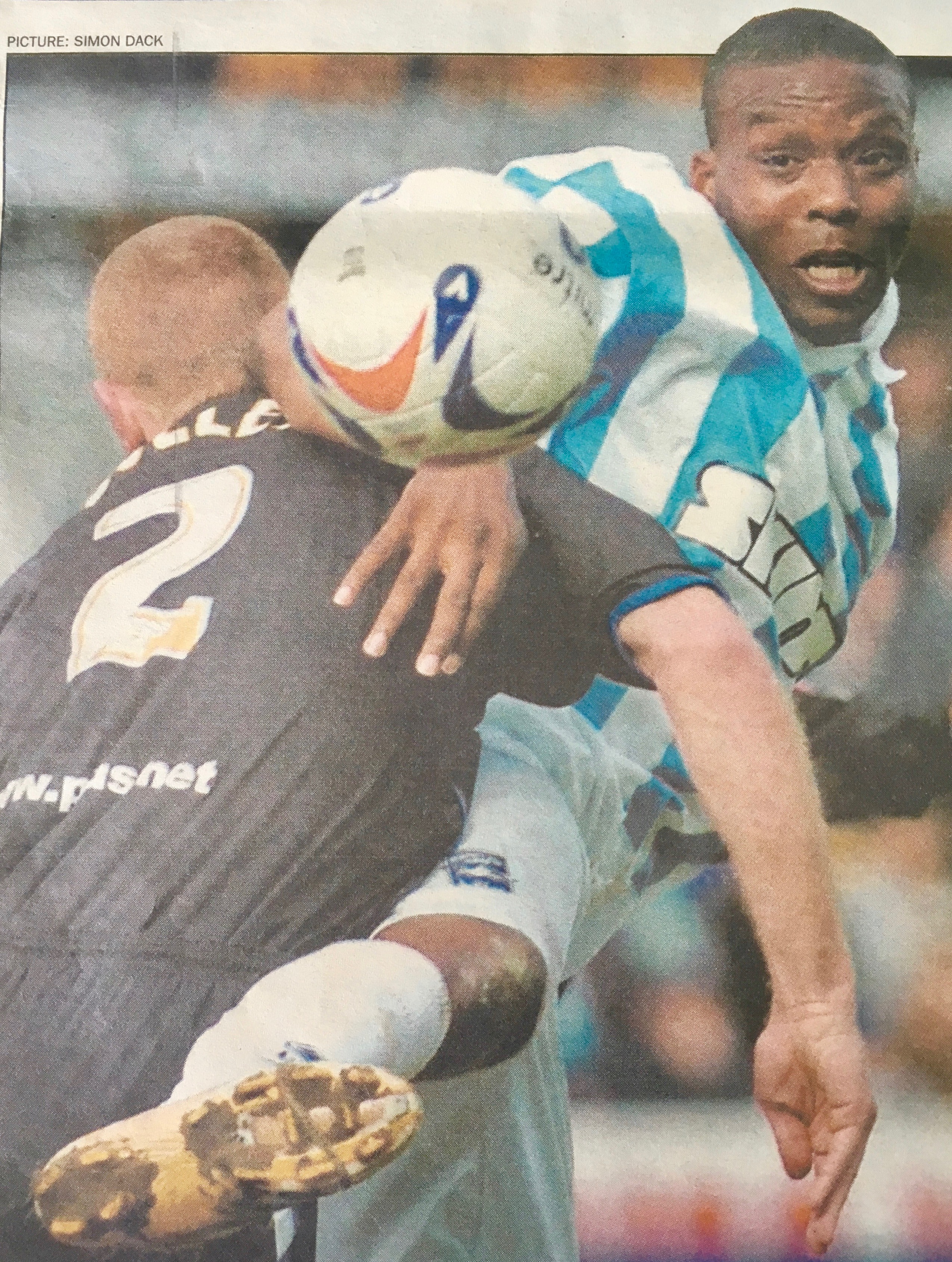
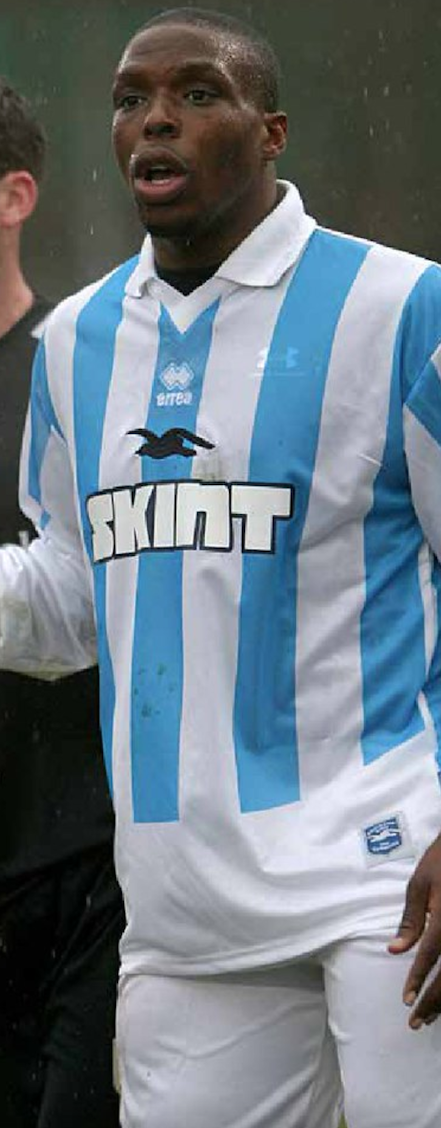
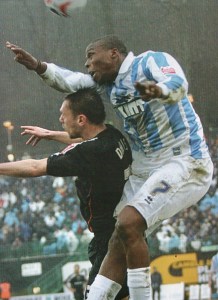
GNW DackFOR ALMOST the whole of Championship seasons 2004-05 and 2005-06, Albion manager Mark McGhee spoke about how the side desperately needed an old-fashioned hold-up centre forward.

In the first season, he converted defender Adam Virgo to the role with some degree of success, but after Virgo’s summer 2005 departure to Celtic, the problem returned, in spite of the occasional promise of the inexperienced Colin Kazim-Richards.

It wasn’t until March 2006 that McGhee finally landed his man in the shape of 6’ 3” Gifton Noel-Williams, on loan to the end of the season from Burnley.

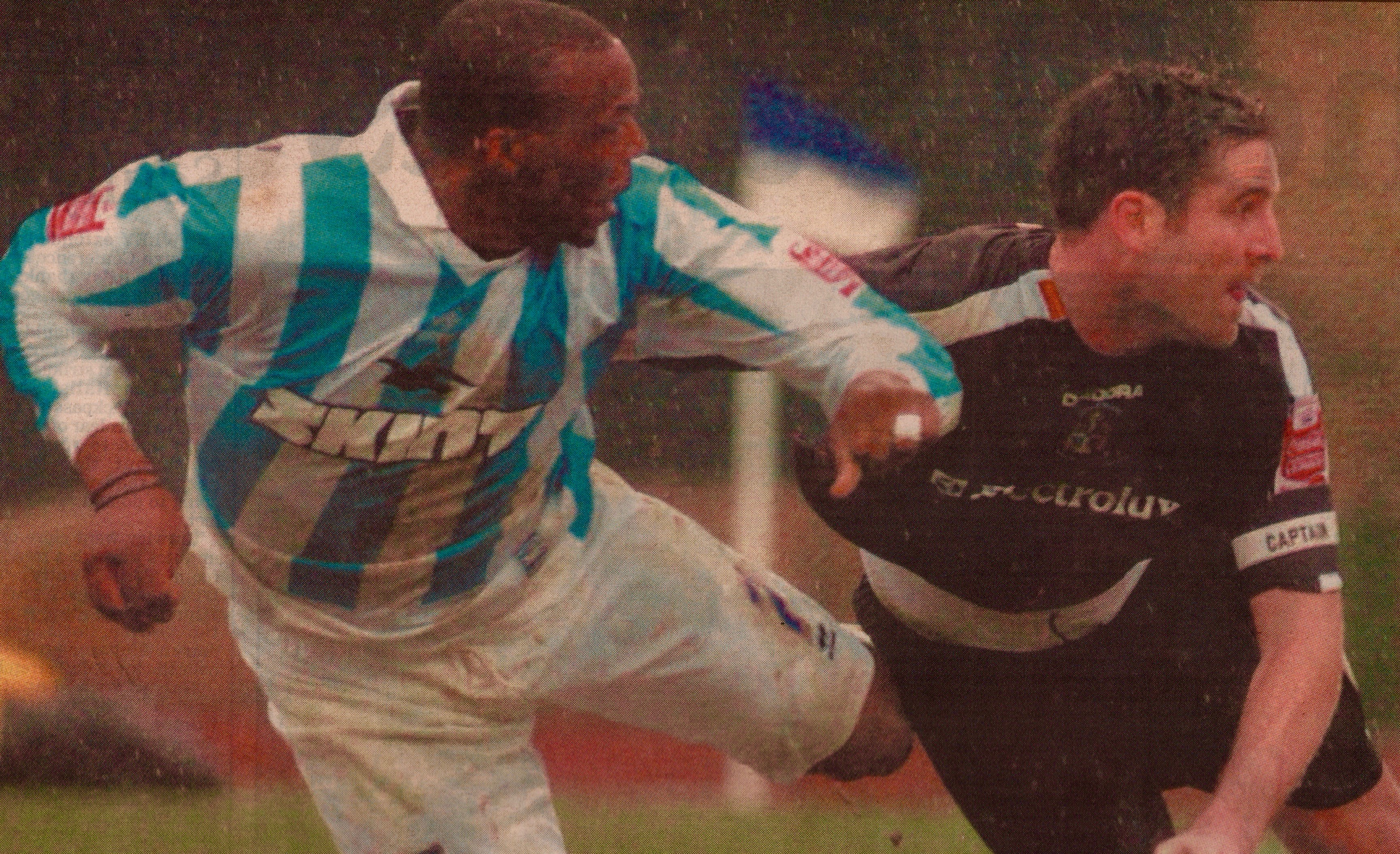
The omens were good when he made his debut against Luton on 25 March because he had scored on his debut for both Burnley and previous club Stoke City. Sure enough, he did it again, netting with a brave diving header from an Adam Hinshelwood cross after 18 minutes.

It demonstrated only too emphatically what Albion had been missing for so long.

Unfortunately a glaring miss by midfielder Dean Hammond saw the chance to go 2-0 up squandered and Luton went straight back down the other end and equalised when ‘keeper Wayne Henderson could only parry Warren Feeney’s shot and the rebound went into the open net off on-loan defender Paul McShane running back.

Luton were destined to join Albion and Leeds as the fall-guys from the division but they hung on that afternoon on a quagmire of a pitch to earn a point.

GNW BHAGary Hart came close to nicking it for the Albion with a volley that struck a post but the points were shared, which was no good for either side.

McGhee was philosophical after the game, recognising it would “take something astonishing” for Albion to stay up with only six games remaining. It would. They didn’t.

Nevertheless, before the inevitable happened, Noel-Williams scored again  – on Easter Saturday 2006.

Brittle old Ipswich, with Joe Royle in charge, stood in the way of Albion notching some desperately needed points, but somehow I just fancied their chances that day and I made a late decision only on the morning of the match to travel up to Ipswich with my son Rhys.

Wearing the all-burgundy away strip, Albion had a new-found confidence in their play thanks to the arrival of Noel-Williams, who, after scoring against Luton, had got an assist by laying on a goal for Paul Reid in a 2-0 win at Millwall two weeks before.

McGhee made an interesting choice in playing Hart at right back rather than Reid, who slotted in ahead instead. The decision was justified when Hart’s strong challenge on Alan Lee midway inside the Albion half enabled Hammond to release Kazim-Richards down the right.

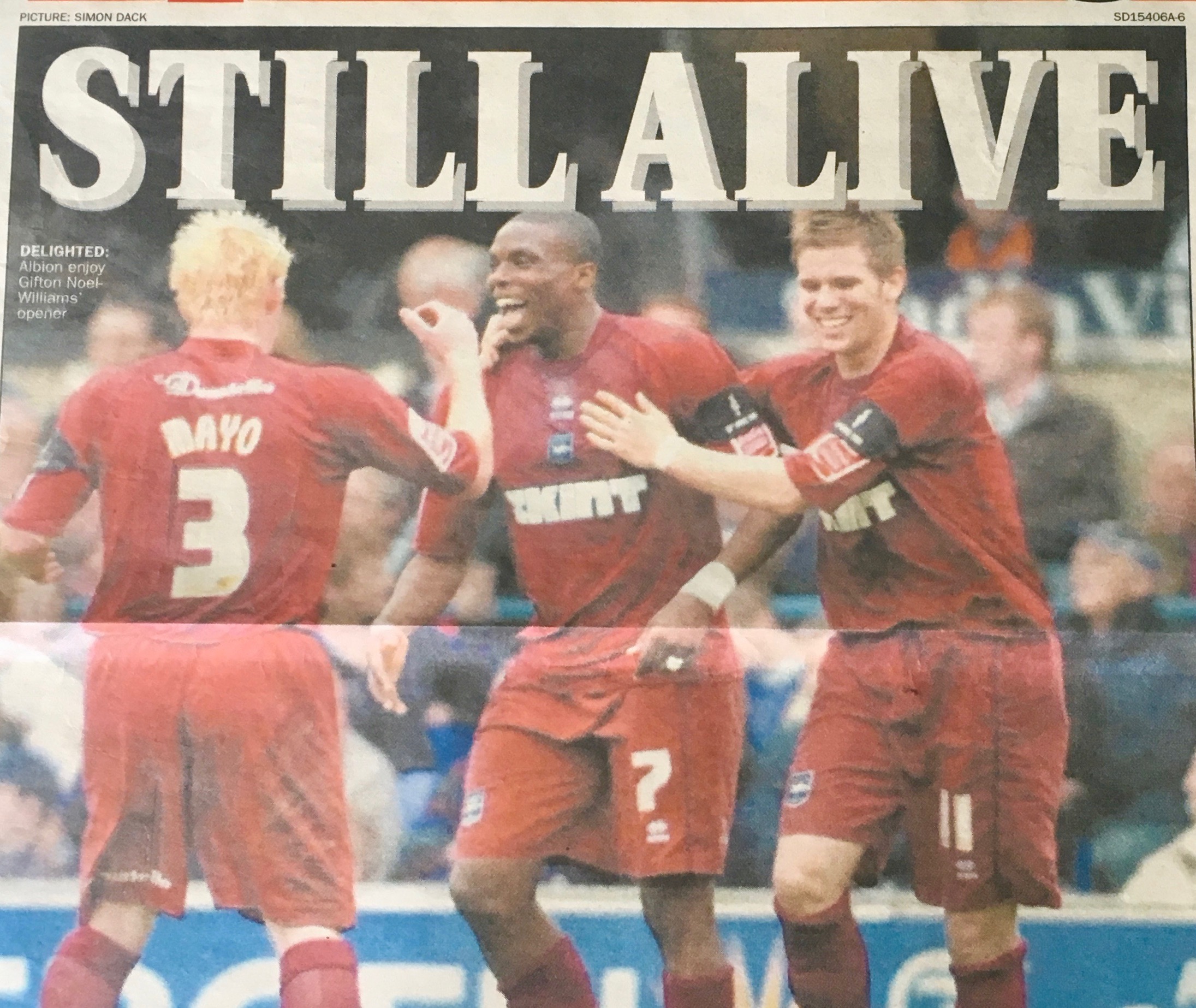
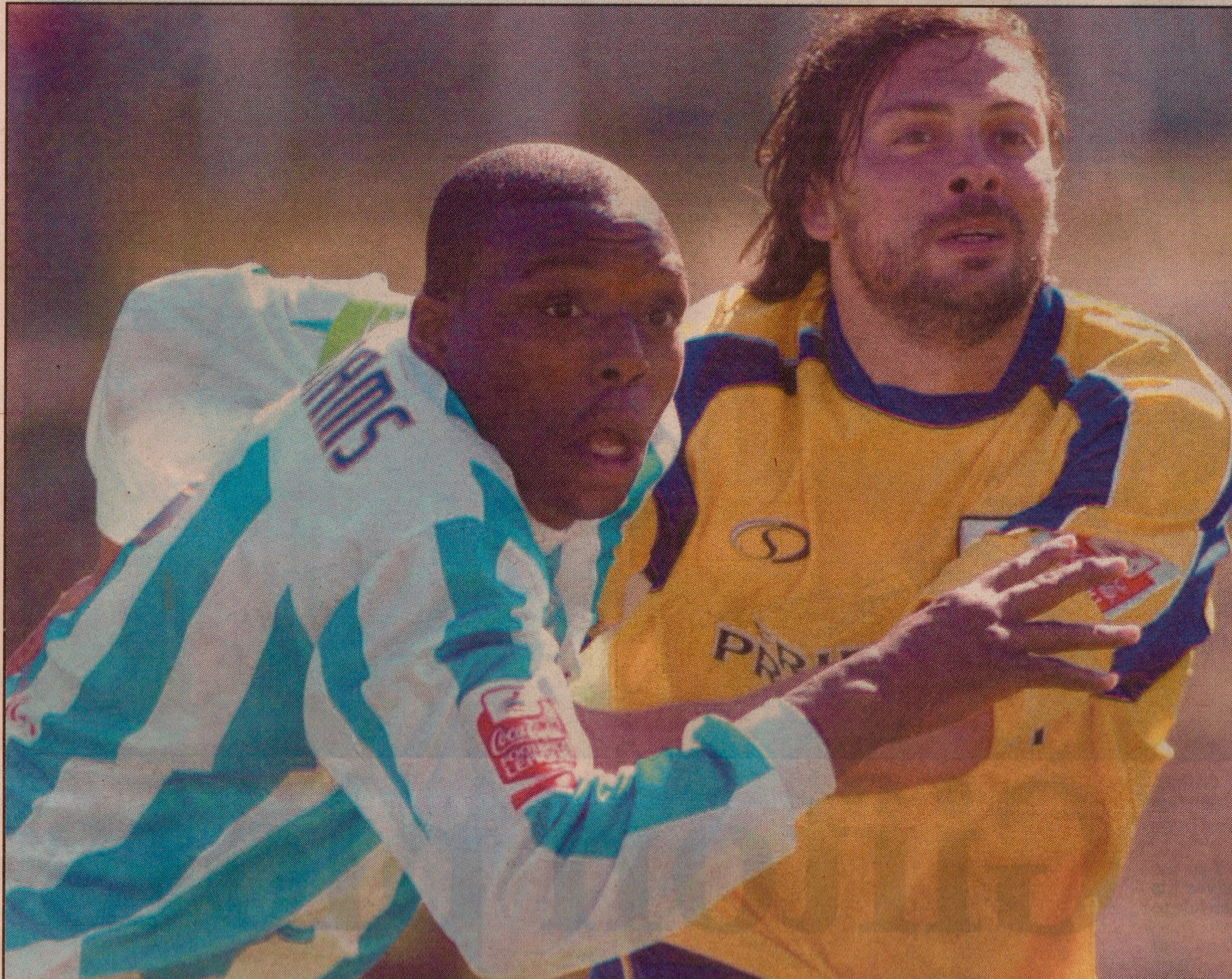
He crossed into the left back area, where the lurking Noel-Williams seemed to have acres of space to turn on the cross and drive the ball home from ten yards. Photographer Simon Dack captured the goal celebration for the front page of the Sports Argus (below).

GNW IpsIf that delight was not enough, teenage defender Joel Lynch made sure our trip was a memorable one by scoring his first-ever goal for the club.

Albion, never wanting to make life too easy for themselves or their fans, allowed Ipswich to pull a goal back when Lee flicked on from former Seagull Darren Currie’s cross for substitute Nicky Forster – a future £75,000 signing for Albion – to score. But thankfully it was too late for Ipswich to salvage anything from the game.

It was all to turn pear-shaped on the Easter Monday at home to Sheffield Wednesday, but for a couple of days at least the Great Escape still seemed a possibility.

Nevertheless, Noel-Williams seemed to enjoy his brief time with the Seagulls, telling Andy Naylor in The Argus: “I like the way the team plays football. They play my type of football.

“It is not only in the air for me to flick it on, they get the ball on the deck and want to knock it about a bit as well. That suits me, that’s what I like.

“The manager hasn’t asked me to be tearing around the pitch, he’s asked me just to use my movement and get into the channels when I have to. I appreciate that, so I’m enjoying my football, and, when I’m enjoying my football, I think I’m not a bad player.”

The downside of not having played regularly at Burnley was a lack of match fitness, and he admitted: “I play all right for maybe the first hour and then that’s it, my legs are gone.”

Certainly a fascinating character, Noel-Williams was still only 26 when he pitched up at the Albion, and was already a father of six children.

But how did he end up at Brighton?

An article on the excellent Burnley supporters website,claretsmad.co.uk, gives a great insight into the background. Published in June 2013, Tony Scholes wrote: “There was heavy criticism of his signing and he was booed by his own fans during his league debut for us at Crewe on the opening day of the 2005-06 season.

“He was one of Steve Cotterill’s five summer signings during that 2005 summer, and the plan was to partner him up front with his old Stoke City team mate Ade Akinbiyi, a partnership people were quick to say hadn’t worked when they had played together for Stoke.”

Scholes continued: “He must have wondered what he’d come to when he was roundly booed in that first match of the season at Crewe. He scored our equaliser, then hit the woodwork in the last minute which would have earned us a point.”

A week later, he missed a penalty against Coventry, and, even though he scored in a home draw against Derby, the poor start to the season saw Cotterill tinker with the line-up, and he lost his place.

He was then a peripheral figure and, just before the end of the loan window in March, Cotterill, who had once been on loan to Brighton himself, loaned him to struggling Albion.

Burnley fans thought they had seen the last of him but, despite being placed on the transfer list, and missing the club’s pre-season trip to Italy, he was still a Burnley player when the season began.

Then, remarkably, he went from zero to hero during the space of a few days in September. When he came on as a substitute against Colchester, yet again he was met by a chorus of boos from the Burnley faithful.

Scholes said: “The booing that greeted him was shameful. How he could go on and play in those circumstances is hard to believe, but he did and by the end of the game he’d turned those boos to cheers. We lost, but he’d played well.

“Three days later we went 2-0 down against Barnsley and he was brought on to replace the injured Alan Mahon. This was without doubt Gifton’s night. He never turned in a better performance for Burnley, and after Jon Harley pulled one back to give us hope, he scored a hat trick as we ran out 4-2 winners.”

Taken off the transfer list, over the next couple of months he became one of the most influential players in the side as Burnley climbed to third in the table.

Sadly, it didn’t last. The team and player’s form dipped from November.

“As the results went against us, the rumblings of discontent about him were being heard in the stands again,” said Scholes.

Meanwhile, Akinbiyi returned to the club which further reduced the chances of his former strike partner getting games. As the January transfer window came to a close, Noel-Williams was sold to Real Murcia in Spain for £50,000.

“Burnley fans will remember him as a player who struggled with pace and movement, a player who didn’t score enough goals, and a player they just loved to criticise,” said Scholes.

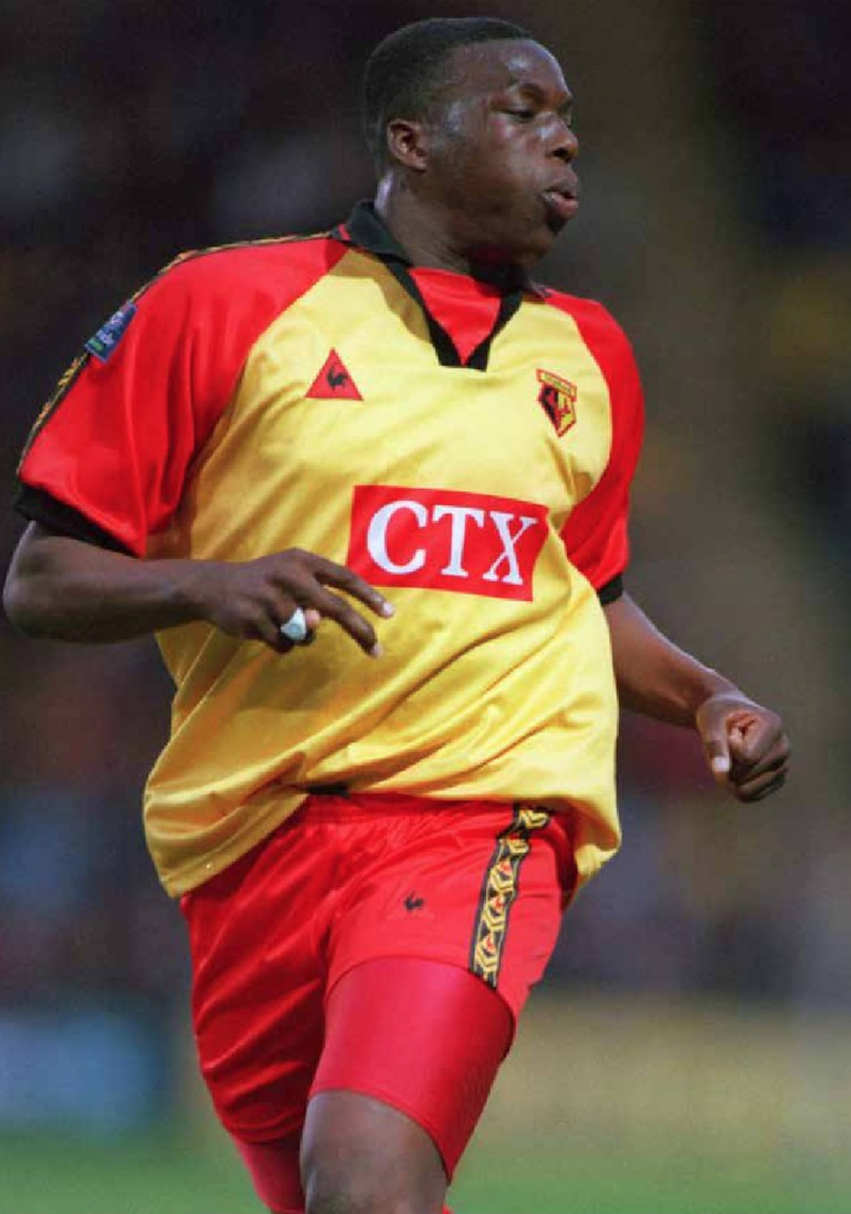
How different it all was from the early promise he had shown when blooded in the Watford first team at the tender age of 16.

Born in Islington on 21 January 1980 to Jamaican parents, the young Noel-Williams played for district and county representative sides and Carl Dixon, a coach at his local Sunday side Apex Arvensdale, recommended him to Watford.

When he played in a national cup final fo Islington and Camden at Highbury, he scored a hat-trick in front of the Sky Sports TV cameras and Arsenal, Spurs and Chelsea all took an interest in him but he stuck with Watfod, and it paid off when, in 1996, Kenny Jackett gave him his first team debut at just 16.

A serious knee injury sustained in a tackle by Sunderland’s Paul Butler in 1999 put him out of the game for the best part of 18 months and he subsequently developed rheumatoid arthritis in both knees.

In an interview with itv.com on 4 April 2016, the striker revealed how he might never have had a career at all if it hadn’t been for former Watford chairman Elton John.

GNW WatHe was told he would have to give up the game, but Watford’s pop icon chairman was living in America at the time and saw an article about a drug that could save his career. He contacted Graham Taylor and they paid for him to get the necessary treatment.

The injury and illness came just as Noel-Williams had received a call-up to the England Under-21 squad. At 18, he had been playing in junior England teams alongside Michael Owen and Michael Bridges.

Noel-Williams told interviewer Will Unwin: “Even though I had rheumatoid arthritis I was still able to play at Championship level and abroad.”

After seven years and 33 goals in 169 appearances for Watford, Noel-Williams signed for Stoke City; Tony Pulis taking him on a Bosman free transfer in 2003.

Across two seasons, he scored 23 goals in 88 games for The Potters banishing all thoughts that he wasn’t fit to play.

Then, in 2005, he joined Burnley because he was encouraged to by his former Stoke teammate, Akinbiyi (another striker who had impressed on loan from Norwich to Brighton earlier in his career, when he scored four times in seven games).

As an aside, Akinbiyi had distinctly mixed fortunes throughout his career and after he completed a £600,000 move to Burnley was sent off on his debut within two minutes for head butting Sunderland’s George McCartney!

But back to Noel-Williams, who told itv.com: “I did not want to go to Burnley, to be honest. What happened was that Tony Pulis left Stoke at the end of the season, he went to Plymouth – so as he was leaving and a new manager coming in, I didn’t want to stay at Stoke.

“Ade Akinbiyi was at Burnley at the time and he was with me at Stoke so he kept phoning me, saying ‘come to Burnley, they want us to play up front together’, so that’s why I went to Burnley, but then six months later Ade left to go to Sheffield United, so my time at Burnley crashed a little bit and that’s why I didn’t stay there for so long.”

Noel-Williams said he didn’t really see eye-to-eye with Cotterill, which hastened his departure to Spain.

The Spanish lifestyle suited him but his game time was restricted mainly to substitute appearances and when Real Murcia were promoted he was told he would not be guaranteed a place.

So he switched to Elche, where he said he enjoyed his football but they didn’t pay him for a year because of financial issues. He ended up having to take action via FIFA to get the money he was owed, and left after just one season.

His old Watford mentor, Jackett, gave him a short-term contract with Millwall, but he played just the one game whilst Tresor Kandol and Neil Harris were unavailable. On 5th November 2008, he signed for Yeovil Town on a month’s loan.

He played eight times for Yeovil, the last coming on the Saturday before Christmas. But 2009 saw him once again without a club and on 8th January it was confirmed that he was signing a two-year deal with American USL club Austin Aztex, a club managed by former Burnley boss Adrian Heath.

He was released at the end of the 2009 season and signed for American fourth-tier side DFW Tornados (based in Dallas).

After he packed up playing in 2010, he became a coach at the Brentwood Christian School in Austin, Texas.

He returned to the UK and linked up with his former Watford teammate Allan Smart at Daventry Town and subsequently had various coaching and managing roles with non-league sides – Northwood, Burnham and Codicote. In November 2017, he was sacked after Hertfordshire-based Codicote, who play in the 10th tier of English football, lost 12 of their first 14 league matches.

1 GN-W Argus2 GN-W Argus main3 G N-W PA (watford)

Pictures published by The Argus show THAT diving header to score on his Albion debut, and a study in determination to get to the ball. Also a Press Association image of a youthful Gifton in Watford colours.


Kurt Nogan’s phenomenal goalscoring record for Brighton

Screen Shot 2023-03-06 at 08.26.32KURT NOGAN is right up there as one of my favourite all time Brighton & Hove Albion players. The ‘No, no; No, no, no, no; No, no, no Nogan’ fans’ chant still rings around my head when I think about his goalscoring exploits in the stripes.

One of my favourite Albion memories involved Kurt scoring at Filbert Street when he rounded off one of Albion’s best ever performances to give Division 2 Albion a 2-0 League Cup victory over Premiership Leicester.

It was the autumn of 1994 and I had travelled halfway across the country to Cheltenham to meet up with my then exiled Albion-supporting friend Colin Snowball to travel up to Leicester together to watch the game.

Before the match, we parked in a side street near the university and found a tiny back-street boozer where they served a magnificent pint of Everard’s Tiger, the local ale.

In those days, League Cup games were played over two legs and Albion, with Liam Brady as manager, went into the away game leading 1-0, courtesy of another Nogan goal, which had given us optimism rather than confidence that Albion could progress.

Leicester got their Nogans in a twist in the match programme, mistakenly identifying the first leg scorer as Kurt’s older brother Lee who played for Watford at the time: they knew which one it was by the end of the game!

With one of the best away displays I have seen, Brighton took the game to their supposedly more illustrious opponents and caused a major shock when a stunning long range strike from young defender Stuart Munday (celebrating above with Nogan) sailed past Kevin Poole in Leicester’s goal.

There was a curious cameo towards the end of the game when Jimmy Case, who was hard of hearing, trotted over to take a corner and seemed to be wasting time. The ref also thought so and promptly sent him off but Case later claimed he had been waiting for the whistle but hadn’t heard it above the din of the crowd!

With Leicester pushing up for a goal to get themselves back in it, Nogan was left unmarked to seal the win and stun the majority of the crowd into silence.

None of the faithful knew at the time, of course, but it was the last goal Nogan would score for the club.

He subsequently went on a 20-game barren run and, at the end of February 1995, with Albion desperately needing funds, they persuaded Burnley to part with £250,000 for his services.

He might have finished on a downer, but Nogan’s Albion record was 60 goals in 120 games, making him one of the club’s great all-time goalscorers.

Born in Cardiff on 9 September 1970, Nogan arrived at the Goldstone having been released at the end of the 1991-92 season by David Pleat during his second spell as manager of Luton Town. At Luton, Nogan celebrated  his top flight debut in 1990 with a goal in a 2-2 draw against Liverpool at Anfield.

The young Welshman was quickly called up for his country’s under-21s for whom he also scored on his debut. However, competing for a place alongside the likes of established forwards Mick Harford and Brian Stein, he struggled to gain a starting berth in the Luton first team, mainly being used as a substitute.

He had just turned 22 when he signed for the Seagulls, and he told the matchday programme in 2020: “I’d been at Luton since I was 16 – cleaned Steve Foster‘s boots as an apprentice, so I did.”

On reflection, he realised it was a crossroads moment in his life. “You can either drop out of the professional game altogether, or something comes along and you get lucky. For me, Brighton came along and I got lucky.”

If Albion had been able to retain the services of the on-loan strike pair Steve Cotterill and Paul Moulden, who started the 1992-93 season up front, Nogan’s chances of making the breakthrough might have been limited.

But finances dictated otherwise and Nogan eventually made his debut in October 1992, taking over up from another free transfer signing, Matthew Edwards, although much of the season he played alongside Edwards, who moved out to the wing, and Andy Kennedy.

nogan saluteAfter a slow start Nogan scored his first goal in one of those lower league meaningless cup matches and then started finding the net regularly in the league, ending the season with 22 goals in all competitions.

For part of the 1993-94 season he enjoyed a particularly fruitful partnership with a young Paul Dickov, the diminuitive Scottish striker on loan from Arsenal for eight matches.

Nogan ended the campaign with 26 goals to his name, and was voted player of the season, even though the team finished in a disappointing 14th place.

Nogan continued to have a variety of strike partners – often it was Junior McDougald but twice in late 1994 he was alongside the legendary Frank Stapleton who was doing his old Arsenal teammate Brady a favour by turning out for the Seagulls.

nogan ballIn fact, one of Stapleton’s two games in a Brighton shirt was away to Cardiff on 5 November 1994. In the Bluebirds line-up that day were future Seagulls Charlie Oatway and Phil Stant, the latter scoring twice in a 3-0 win.
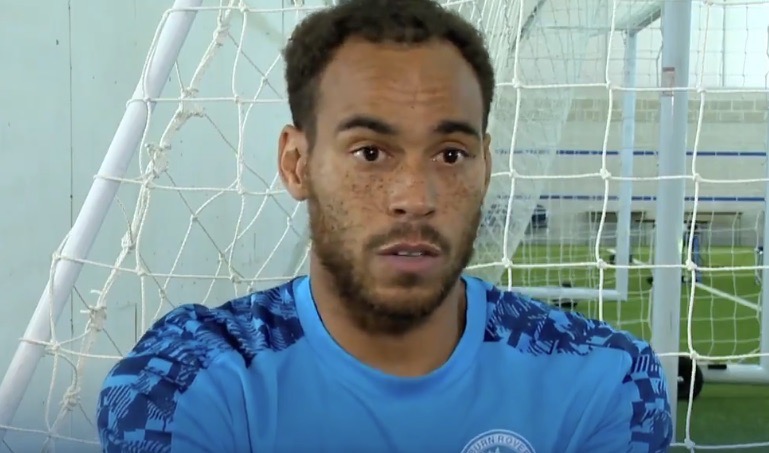
Nogan’s career was detailed brilliantly in a profile by Tony Scholes on clarets-mad.co.uk and he noted that Burnley boss Jimmy Mullen’s gamble on Nogan wasn’t enough to prevent them being relegated. The Welshman scored just three times and got involved in an altercation with the manager after being substituted at Bristol City.

However his goal touch returned in the 1995-96 season when he racked up 26 goals, 20 of them in the league, and got on well with Mullen’s successor Adrian Heath – until halfway through the following season when he was suddenly out of favour.

A move was inevitable after Nogan aired his differences with the manager on local radio. “All of a sudden the crowd hero had become public enemy number one,” said Scholes.

That he moved to near neighbours Preston in February 1997 was somewhat galling and Burnley fans of a certain age recall the inevitability of him scoring against them for his new club.

Three years later he moved to home town club Cardiff but, after only four full games and a few substitute appearances, a ruptured hamstring ended his league career prematurely at the age of 32. He did subsequently turn out for some Welsh League clubs but he wasn’t able to return to the previous level.

  • Matchday programme pictures include various shots of Nogan in action and, from the Leicester programme for that cup tie, he is wrongly captioned with his brother’s name.