Elite career eluded Darren Hughes after cup-winning start

HughesDARREN Hughes won the FA Youth Cup with Everton but it was lower down the league where he built a long career which included a season with second tier Brighton & Hove Albion.
Born in Prescot on Merseyside on 6 October 1965, left-back Hughes played for Everton in two successive FA Youth Cup finals.

He was on the losing side against Norwich City in 1983 (when among his Everton teammates was centre forward Mark Farrington, who later proved to be a disastrous signing for Barry Lloyd’s Brighton).

The tie went to a third game after it was 5-5 on aggregate over the first two legs. The Canaries won the decider 1-0 at Goodison Park. The following year, Hughes was a scorer, and collected a winners’ medal, as Everton beat Stoke City 4-2 on aggregate.

Meanwhile, the young Hughes had broken into Everton’s first team as an understudy to stalwart John Bailey, making his Everton debut two days after Christmas in 1983.

Unfortunately, the game ended in a 3-0 defeat away to Wolverhampton Wanderers, for whom former Albion winger Tony Towner was playing.

It wasn’t until May 1985 that Hughes next got a first team opportunity, featuring in a 4-1 defeat to Coventry City at Highfield Road and a 2-0 defeat to Luton Town – manager Howard Kendall resting some of the first-choice players after the League title had already been won and ahead of the European Cup Winners’ Cup Final against Rapid Vienna.

With the experienced Bailey and Pat Van Den Hauwe in front of Hughes in the pecking order, Kendall gave the youngster a free transfer at the end of the season, and he joined Second Division Shrewsbury Town, where he made 46 appearances.

Hughes played against Albion for Shrewsbury at Gay Meadow on 16 September 1986, and, two weeks’ later, Alan Mullery, back in charge of the Seagulls for a second spell, signed the 21-year-old for a £30,000 fee.

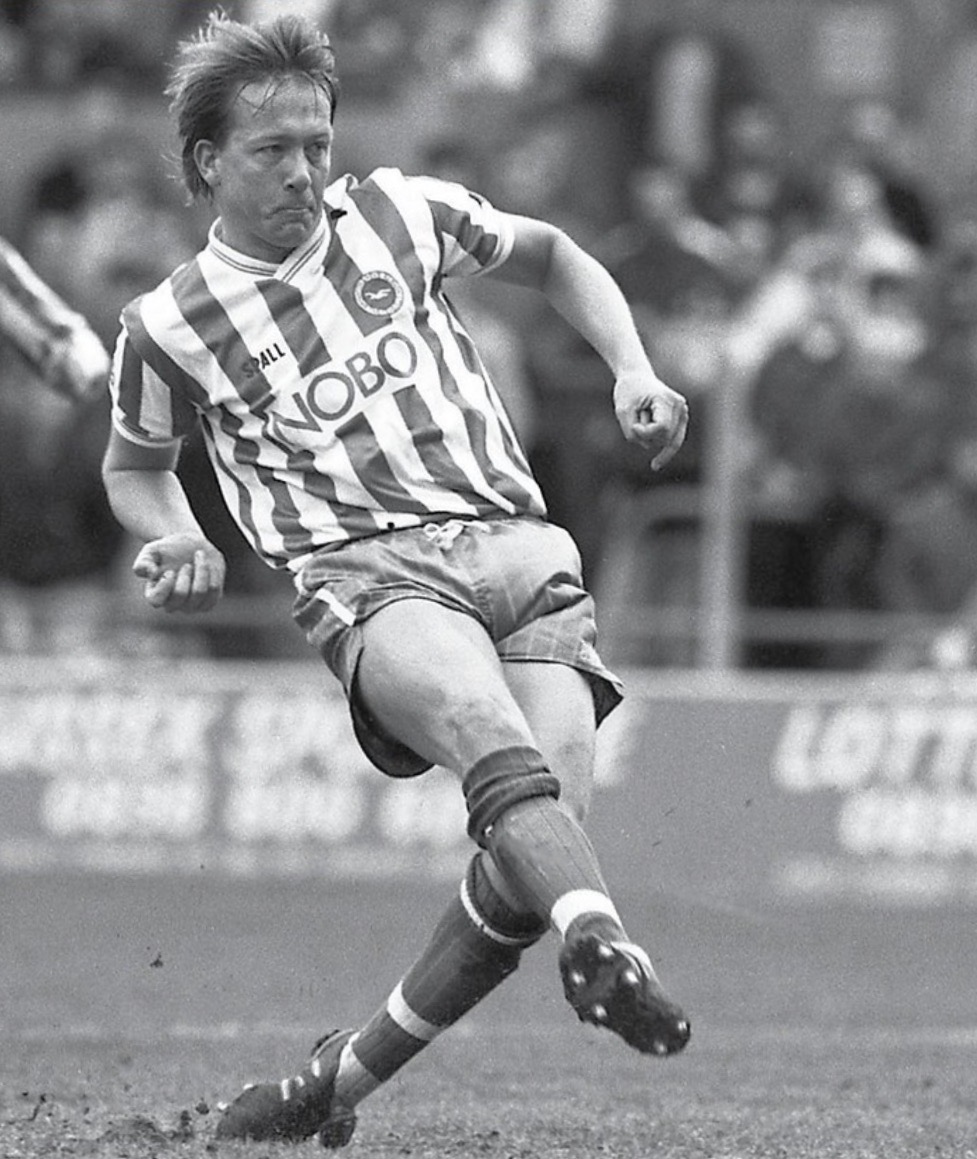
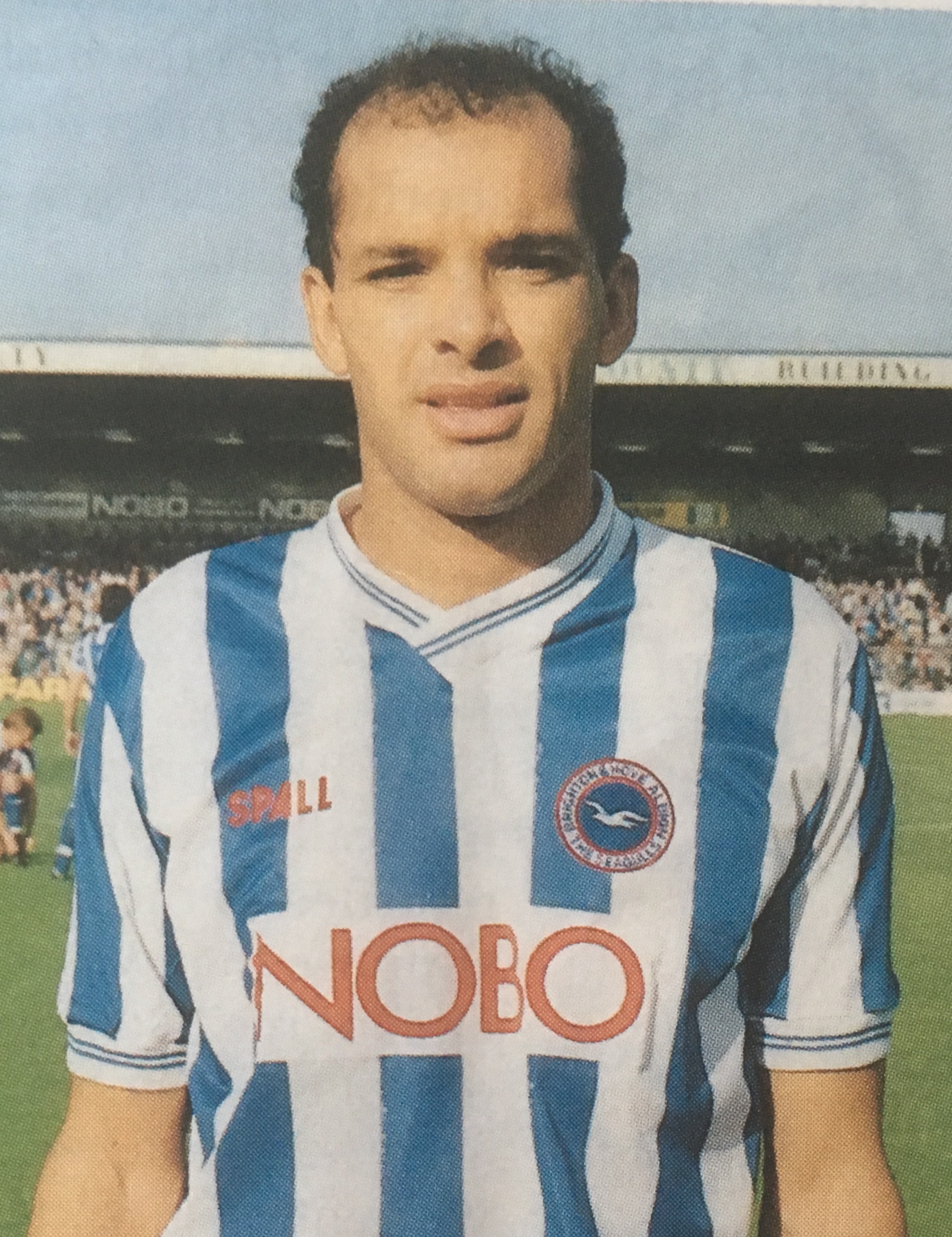
D Hughes blue

Not for the first time, hard-up Albion had devised a scheme to raise transfer funds from supporters, and the money for the purchase of Hughes came from the Lifeline fund which also helped Mullery to buy goalkeeper John Keeley for £1,500 from non-league Chelmsford and striker Gary Rowell, from Middlesbrough.

Hughes made his Albion debut in a 3-0 defeat at home to Birmingham in the Full Members Cup on 1 October 1986 and his first league match came in a 1—0 home win over Stoke City three days later.

“I was quite happy at Shrewsbury,” Hughes told matchday programme interviewer, Tony Norman. “But when the manager told me Brighton were interested in signing me I thought it would be another step up the ladder. It’s a bigger club with better prospects and it’s a nice town as well.”

The single lad, whose parents were living in Widnes, moved into digs in Hove run by Val and Dave Tillson. He was later joined there by Kevan Brown, another new signing, from Southampton.

Hughes said away from football he enjoyed golf and had played rounds with Steve Penney, Dean Saunders and Steve Gatting.

Brown, in a similar programme feature, said Hughes had been a big help in him settling into his new surroundings. “He has been showing me around the area and we’ve become good friends,” he said. “I’m glad I wasn’t put in a hotel on my own.”

Unfortunately for Hughes, life on the pitch didn’t go quite according to plan.

Mullery was somewhat controversially sacked on 5 January 1987 and, although Hughes played 16 games under successor Lloyd, those games yielded only two wins and the Albion finished the season rock bottom of the division.

The only consolation for Hughes was scoring in a 2-0 home win over Crystal Palace on 20 April. His final appearance in a Seagulls shirt came in a 1-0 home defeat to Leeds when he was subbed off in favour of youngster David Gipp.

Having played only 29 games, mostly in midfield, for Brighton, Hughes joined Third Division Port Vale in September 1987, initially on loan, before a £5,000 fee made the deal permanent.

It must have given him some satisfaction to score for his new employer in a 2-0 win against Brighton that very same month.

Hughes spent seven years with the Valiants, helping them to win promotion from the Third Division in 1989, making a total of 222 appearances, mainly as a left back.

His time with Vale was punctuated by two bad injuries – a hernia and a ruptured thigh muscle – and they released him in February 1994.

However, he gradually managed to restore his fitness and in 1995, between January and November, he played 22 games for Third Division Northampton Town.

He then moved to Exeter City, at the time managed by former goalkeeper Peter Fox, where he made a total of 67 appearances before leaving the West Country club at the end of the 1996-97 season.

He ended his career in non-league football with Morecambe and Newcastle Town but could look back on a total of 388 league and cup appearances for six clubs over a 14-year career.

After his playing days were over, according to Where Are They Now? he set up a construction business.

D hughes by tony gordon

Pictures: matchday programme.

Irish international pals brought wing wonder Steve Penney to Brighton

BRIGHTON & Hove Albion can thank former Middlesbrough goalkeeper Jim Platt for landing one of the most exciting players ever to play for the Seagulls.

Platt was the Teesside club’s man between the sticks for 12 years. During his call-ups on international duty with Northern Ireland, he struck up a friendship with Arsenal defender Sammy Nelson, who joined Brighton towards the end of his career.

When Platt took over as manager of Ballymena United, he quickly recognised that a talented teenage winger at his disposal –  Steve Penney – could make a career for himself in England.

Platt tipped the wink to his old pal Nelson, newly-appointed as Albon’s assistant manager to Chris Cattlin at the time, and the youngster was invited for a trial.

Penney was put up in a house near the Goldstone recently vacated by the sacked Jimmy Melia. His housemate was another young triallist: Ian Wright! Penney was taken on while Wright was released. Whatever happened to him?!

Penney’s Albion story is told in fine detail by journalist Spencer Vignes who devotes 12 pages of his excellent book A Few Good Men (Breedon Books) to a player who, for the record, played 148 games (plus 14 as sub) in eight years with Brighton.

Unfortunately, that rather low figure tells its own story, a succession of injuries robbing him of probably twice as many games as you might have expected him to have played over that length of time.

“He was, in short, a breath of fresh air, a flying winger whose close control and devastating pace left opponents and spectators alike lost for words,” said Vignes.

Among former teammates who voiced their appreciation of Penney, full back Graham Pearce told Vignes: “I always thought of Steve as a bright young winger, very naturally talented, who had all the attributes you need in that position, especially pace.”

Born in Ballymena on 6 January 1964, the son of a teacher and a nurse, although he played football at primary school, he went to what he described himself as “a fairly posh grammar school” where rugby was the preferred sport for boys, and he was a scrum half.

He got the chance to play football in the Boys Brigade, where Nigel Worthington, who later managed Northern Ireland, also played.

“I had to choose between rugby and football and when I decided to join Ballymena United, the school were so furious they suspended me,” he told interviewer Dave Beckett in a matchday programme feature.

“Playing for my home town was excellent, although I had the chance to join Linfield who were one of the best teams in the country.

“I guested for them in Holland a couple of times so I knew they were interested and that’s where I expect I’d have ended up if I hadn’t moved abroad.”

Instead, Platt alerted Nelson and, bearing in mind Albion’s high profile having only recently played against Manchester United in the Cup Final, Penney didn’t take much persuading.

Beckett recounted: “Penney, at 19 years old, made his debut in a 3-1 defeat by Barnsley but was soon a hot favourite on the terraces. Even in his opening match he set up the goal goal for Alan Young, and John Vinicombe wrote in the Evening Argus: ‘The eye for an opening that Penney unquestionably has will serve Albion well. The Goldstone are going to like him’.”

It wasn’t long before he was playing to a much bigger gallery when he was part of the Albion side who toppled Liverpool in the FA Cup (for the second season running), winning 2-0 in front of a live television audience.

Penney tormented the experienced Liverpool left-back Alan Kennedy and his perfectly-flighted pass over the top of the Liverpool defence played in Terry Connor to score the decisive second goal.

His first goal came in a 3-0 win at Derby County in March 1984 and such was his impact in that first season that he was voted runner-up to Jimmy Case as player of the season.

Away from football, Penney was a decent golfer, his regular companions on the golf course being Dean Saunders, Chris Hutchings, Steve Gatting and former Albion favourite Peter O’Sullivan.

During the winter, he loved nothing more than playing snooker at a club in Hove, especially taking on Saunders and competing for a trophy awarded each week to the winner.

So, life was sweet for the young Irishman and it got even better when his form with Brighton led to full international honours.

SP w Irish shirt

At the time of writing, he remains the highest-capped Albion player, all of his 17 caps for Northern Ireland being won while with the Seagulls.

After making his debut on 16 October 1984 in a 3-0 friendly win over Israel in Belfast, he was a regular for four years, playing his last game on 21 December 1988 in a 4-0 defeat to Spain in a World Cup qualifying match. He scored twice for his country, in a 1-1 draw with Israel on 18 February 1987 and in a 3-0 win over Malta on 21 May 1988.

The highlight of his international career was playing for Northern Ireland at the 1986 Mexico World Cup.

“The whole experience of going to the World Cup was something I’ll never forget,” he said three months later, in a matchday programme interview.

“Six weeks away from home is a long time, but the spirit in the squad was very good and I wouldn’t have missed it for the world.”

Steve had been in the side that qualified for that World Cup by drawing 0-0 against England at Wembley. “We only needed a draw to get to Mexico and we got it,” he said.

“(Manager) Billy Bingham had been a right winger and obviously appreciated what I could do, which was a source of great strength to me. He’d been part of the team that had played in the World Cup in Sweden in 1958, a lovely man who was very good at getting the best out of his players and encouraged me no end, something I’ll always be grateful to him for.”

Unfortunately, Steve’s World Cup came to a juddering halt after Spain’s hard man Emilio Butragueno went over the top in a tackle and did his ankle in only the second group game.

On his return to Brighton, Penney found himself sufficiently impressed by Cattlin’s successor, Alan Mullery, that he was persuaded to sign a new, three-year contract.

However, it wasn’t long afterwards that Penney started having problems with his left knee and, although he played through the pain barrier, in a game against Derby County in March 1987 a bad tackle damaged his ankle ligaments, sidelining him for the rest of the season.

Barry Lloyd had succeeded Mullery and Penney was in the team at the start of the next season but, after only two games, found himself back on the treatment table after a chip of bone was found floating in a knee.

That kept him out for an agonising seven months before he was able to return to the side in March 1988 to play a crucial part in the final 11 games, scoring three times as the Seagulls earned promotion in second place behind Sunderland.

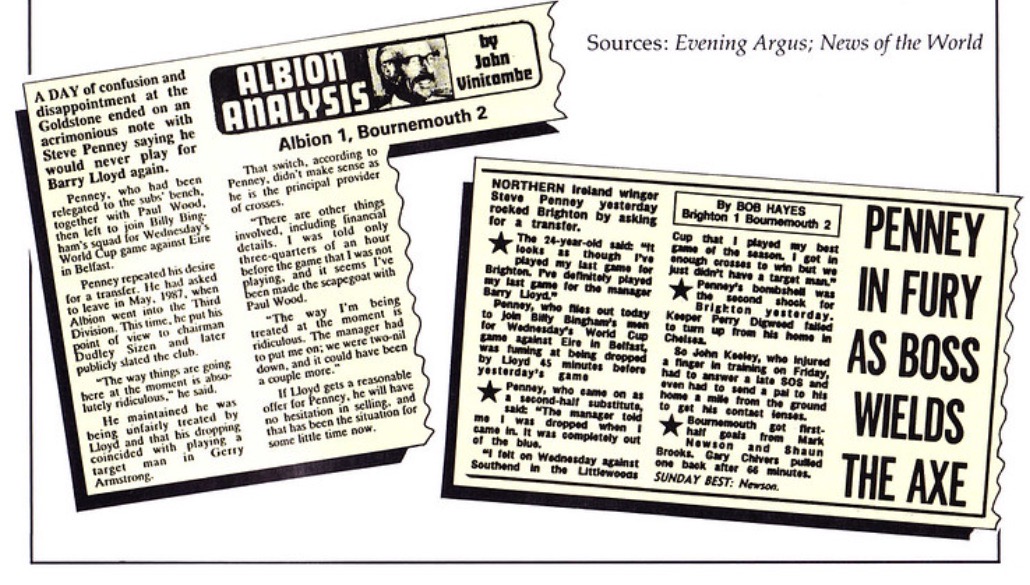
Penney told Vignes: “At that time, playing for Barry was great. The two of us were getting on even though I always thought there was something not quite right between us. To be honest, he had to play me because I strengthened the team and made a difference.”

Halfway through the 1988-89 season, Crystal Palace tried to sign Penney but weren’t prepared to meet Albion’s £175,000 asking price. And then his left knee went again.

Vignes tells the whole gory story in detail, which I won’t repeat here, but, suffice to say, the wrong treatment by one doctor had to be put right by a Harley Street expert.

Penney rowManager Lloyd and Penney also fell out, principally over Penney putting country before club. “He’d play for them, then come back injured. That didn’t please me,” said Lloyd. “It was a crying shame. He just wanted to play but was so plagued with injuries it was beyond belief.”

The split came in 1991 when Lloyd clearly thought the player’s level of fitness didn’t merit a new contract. Interest was shown in him by Heart of Midlothian, managed by Joe Jordan, and Charlton Athletic, where the joint manager was his ex-Albion teammate Alan Curbishley.

Having played a couple of trial games for Hearts, he plumped for them but suffered a groin strain early on and only played 14 games all season.

A 15th game would have triggered the award of another one-year deal – and it quickly became apparent that it wasn’t going to happen. Freed at the end of the season, he signed for Burnley, newly-promoted from the old Fourth Division, in August 1992. Continue reading “Irish international pals brought wing wonder Steve Penney to Brighton”

Sammy Nelson’s glittering career came to an end at Brighton

2 Sam NelsonEXPERIENCED Northern Irish international full-back Sammy Nelson was an Arsenal legend who joined Brighton towards the end of his career.
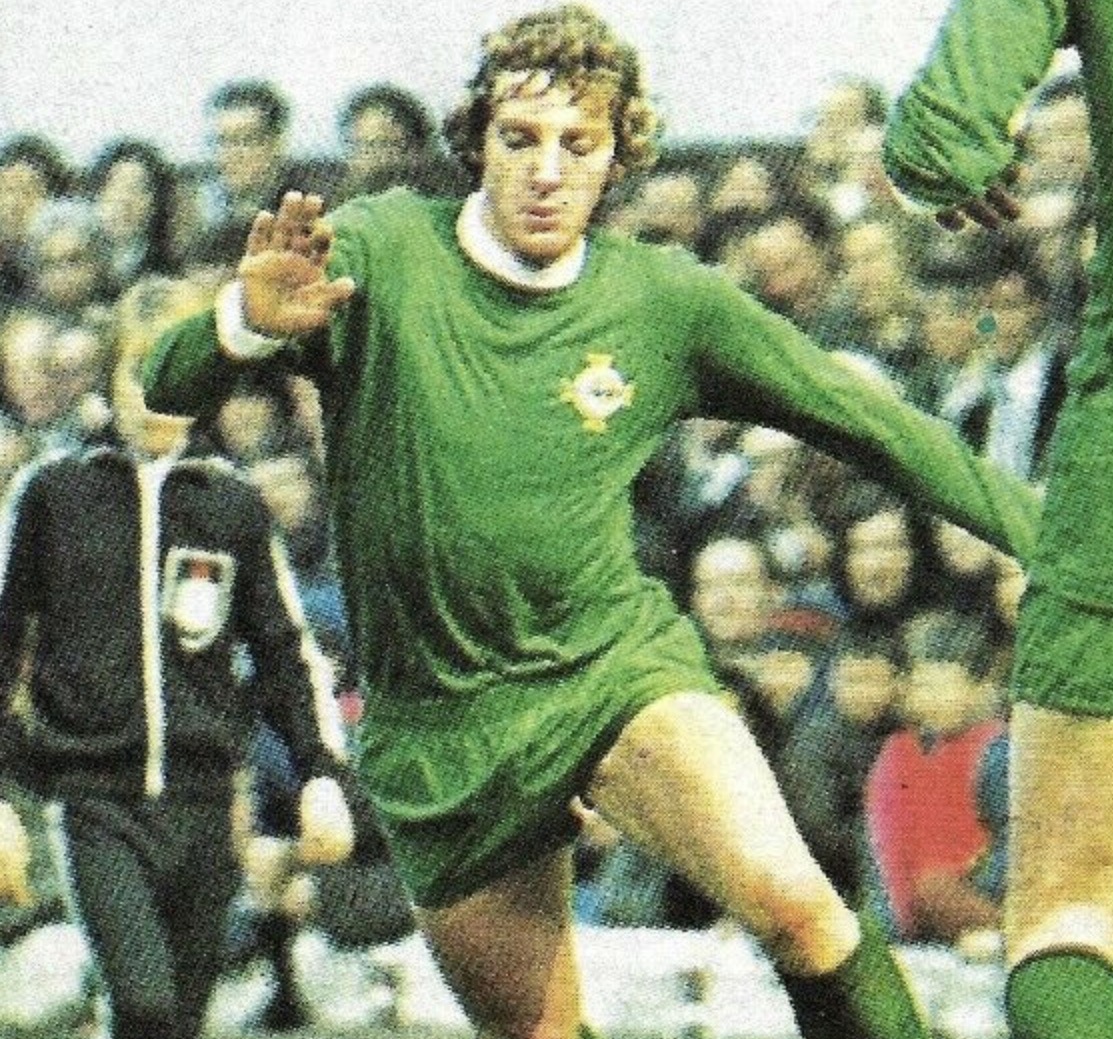
The last four of his 51 international caps came while with the Seagulls. One was a 4-0 defeat to England at Wembley when Albion teammate Steve Foster made his England debut, another was a substitute appearance at the 1982 World Cup against Spain. His last appearance for his country came in a 2-2 draw with Austria at that tournament.

nels NI colLeading up to that competition, Nelson had played a significant part in helping Albion to what remained their highest ever finish in the football pyramid – thirteenth place – until the 2022-23 season.

A lot of fans didn’t like manager Mike Bailey’s style of play, but, with some degree of resonance to Chris Hughton’s philosophy, he built his side on a solid defence and preferred experience over youth.

Nelson was a key player in that defence after ousting long-serving Gary Williams a third of the way into the 1981-82 season.

He played alongside his former Arsenal teammate Steve Gatting, who Bailey had signed for £200,000 as a replacement for Mark Lawrenson (the famous departure to Liverpool having been the trigger for Alan Mullery to quit as manager).

Nelson had made only one substitute appearance for Arsenal in the previous season but he enjoyed a bumper testimonial game when a crowd of 20,000 turned up at Highbury for a game against Celtic.

Bailey declared on paying £35,000 for a 32-year-old player who had made 339 league and cup games for the Gunners: “The signing of Sammy Nelson has now given me the sort of squad I feel we need to compete with the best in the division.

“Sammy is a fine player and a very good professional but, like everyone else, he will have to compete for a team place.”

He did indeed have to wait for his chance, largely because he had a foot strain at the time of signing. But the chance came in a league cup second leg game at home to Huddersfield at The Goldstone.

Williams was restored for the following two league games but Nelson got the nod for a third round league cup game away game at Barnsley (which ended in a 4-1 defeat) and kept the shirt for all but two games through to the end of the season, making 32 appearances in total.

After only seven games, he gave an interestingly candid interview to the Argus. He admitted he was struggling with the daily commute from his home in Brookmans Park in Hertfordshire, being that it necessitated a 6am wake up.

“Towards the end of a week, it is only natural to start feeling tired at that sort of routine when, instead, I should be fresh for the coming game,” he said.

In the same interview, Nelson went on to take a bit of a swipe at a small section of the Albion following. “They expect the championship to come overnight. Some of them, instead of getting behind the team, have begun to get abusive, even vindictive,” he maintained. “I would have expected a little more loyalty from the crowd, but I must stress that I am only talking about a small section.”

It must have given Nelson some pleasure in April 1982 to be on the winning side as Albion beat Arsenal 2-1 in the top flight for the first time in nine attempts since gaining promotion in 1979.

Especially as former boss Terry Neill was up in arms about a challenge Nelson had made that went unpunished. The News of the World declared: “Arsenal boss Terry Neill last night blames former Highbury hero Sammy Nelson for his team’s defeat.

“Neill claimed the Brighton fullback should have been booked for bringing down Raphael Meade as the striker closed in for a goal which would have sewn up the match for the Gunners.”

Nelson was born in Belfast on April Fools Day 1949 and joined Arsenal on his 17th birthday in 1966, just as all eyes in England were focused on the World Cup.

His first silverware came as a member of Arsenal’s FA Youth Cup winning side that year, when they beat Sunderland 5-3 over two legs.

At that time he was a left winger but coach Don Howe converted him to a full back. The established first choice left back was Bob McNab and in the famous 1970-71 Double winning side, Nelson only got to play four games.

In fact he understudied McNab for the best part of five years, until the former Huddersfield man left the Gunners in 1975. Then Nelson made the position his own, with fellow Irish international Pat Rice on the opposite flank.

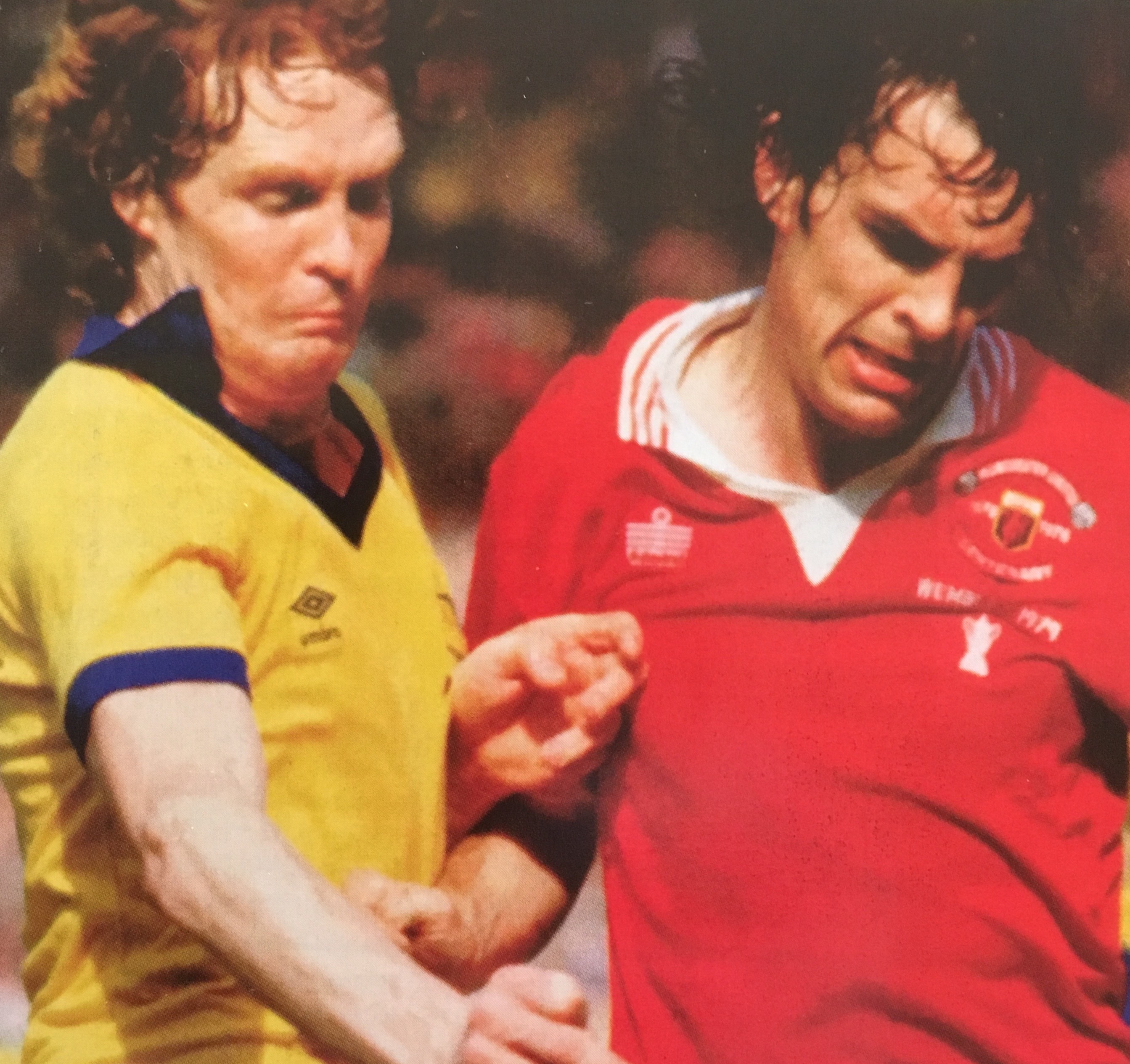
Nelson was almost ever present for five seasons and was part of the Arsenal team which reached three successive FA Cup Finals: 1978, 1979 and 1980, picking up a winners’ medal in the 1979 win over Manchester United. The Arsenal 1-2-3 that day were all Ulstermen: Pat Jennings, Rice and Nelson.

I particularly like this story from Arsenal fan Paul Reynolds, published on untold-arsenal.com: “In 1980 I took on a paper round and one of the houses I delivered newspapers to was where the Arsenal left-back Sammy Nelson lived. I didn’t see him often because I delivered the papers very early, but I’ll never forget the morning of the Arsenal v West Ham final.

“At about 10am I got a phone call from the paper shop owner to tell me that Sammy had popped in the night before and dropped off two tickets to give to the lad who delivered his papers. I was thrilled to bits and my girlfriend and I rushed off to Wembley and just about made it in time for kick-off – we didn’t care that we had to stand right at the back.

“Although, sadly, we lost the game 1-0 I’ll never forget that generous and thoughtful gesture by my former Arsenal hero and will always be grateful to have been supporting the club during an era when the players genuinely had a connection with the supporters and cared enough to go out of their way ahead of a massively important game to help a fan like me. Arsenal ‘til I die.”

arsenal.com remembers Nelson as one of their top 50 players, describing him as “a funny and endearing individual, the Ulsterman was held in genuine affection by team-mates and supporters alike”.

It also recalls the time he dropped his shorts and bared his backside to the North Bank – which earned him a fortnight’s ban by the FA. It was his response to scoring an equaliser after he’d earlier been barracked for scoring an own goal in a league game against Coventry.

The website adds: “A fine strike in a League Cup trouncing of Leeds United in 1979 was the pinnacle of his goalscoring feats, but Nelson was always willing to venture into enemy territory. At the back his obdurate tackling and bravery was complemented by a sure touch on the ball.”

Arsenal’s signing of Kenny Sansom spelled the beginning of the end of Nelson’s time at Highbury and he moved to Albion in September 1981.

Although he started the 1982-83 season in the Albion first team, he picked up an injury and retired at the end of the season having played a total of 45 games for the Seagulls.

On retirement he initially became Albion’s reserve team manager and then first team coach when Chris Cattlin took over as manager from Jimmy Melia. But he left after only one season and took up a City consultant job in life assurance and pensions.

Funnily enough, as a regular commuter to London myself at that time, I’d frequently see Sammy joining the train at Hove in the mornings and then relaxing in the buffet car on the return journey in the evenings.

He told the Independent in a ‘where are they now?’ feature in March 1994: “It’s funny, I never saw myself being part of the rat race but now I find myself standing on the platform in the right place for ‘my’ seat, just like everyone else.”

Pictures from my scrapbook and matchday programmes

A Goal magazine action shot of Nelson in Arsenal’s colours and the full-back in action for the Albion at the Goldstone, pictured in the matchday programme.

Also pictured: Nelson in full flight against Southampton; with young Gary Stevens captured by the Argus singing In Brighton at Busby’s disco in Kings Road; making the headlines in the News of the World; in action against Wolves.

Midfielder Alan Curbishley helped Seagulls to promotion

Screenshot

ALAN Curbishley completed a hat-trick of promotions with new clubs when he was part of Brighton’s successful third tier side in 1988.

He’d previously been promoted after switching from West Ham to Birmingham City and also when moving from Aston Villa to Charlton Athletic.

Curbishley was what you might call West Ham through and through.

Born at Forest Gate on 8 November 1957, within a mile of West Ham station, he was one of five children (elder brother Bill famously promoted and managed The Who and Led Zeppelin and was producer of the films Tommy and Quadrophenia).

Curbishley first played in Brighton at under 11 level, in a Newham Boys side against Brighton Boys at Longhill School, in May 1967. He was later capped for England Boys aged 15 and after joining the Hammers straight from school played for England Youth.

Curbishley won nine England Youth caps under Ken Burton, scoring on his debut in a 1-1 draw against Poland in Las Palmas on 21 January 1975 when England went on to win the Atlantic Cup. Among his teammates were future England captain Bryan Robson, Peter Barnes and Keith Bertschin.

He vied for a starting berth with Mark Nightingale (Palace, Bournemouth, Norwich, Peterborough), making six starts and three appearances off the bench. His last appearance was in a 1-0 win over Wales in Cardiff on 11 February 1976, playing alongside Glenn Hoddle and Gary Owen.

Almost a year earlier, on 29 March 1975, he had made his first team Hammers debut at the tender age of 17, lining up in midfield alongside Trevor Brooking and Graham Paddon in a 1-0 home defeat against Chelsea. Mervyn Day was in goal for West Ham and guarding the opposition net was John Phillips.

At the time, Curbishley was the youngest to play in the senior team although that record was subsequently eclipsed by Paul Allen.

A contemporary of Geoff Pike, Paul Brush and Alvin Martin, they were all in the West Ham youth team defeated 5-1 on aggregate by Ipswich in the 1975 FA Youth Cup Final.

In a midfield dominated by Brooking, Paddon and Pat Holland, and later Alan Devonshire and Pike, Curbishley found first team chances limited, although in 1977-78 he made 36 appearances.

After 85 matches for the Hammers, in 1979 he moved to Birmingham for £275,000. Manager Jim Smith used the proceeds of the £1m transfer of Trevor Francis to Nottingham Forest to buy Curbishley, Frank Worthington, Colin Todd and Archie Gemmill. Curbishley was still only 21 when he made his debut for the Blues on 18 August 1979 in a 4-3 defeat at home to Fulham and he went on to be ever present for Birmingham in that 1979-80 season.

Curbishley earned his one and only England Under 21 cap in a 5-0 thrashing of Switzerland at Portman Road when Justin Fashanu was among the scorers. He had hopes of going to the 1982 World Cup with England, having broken into the England B squad but fractured a kneecap sliding into a tackle with Albion’s Brian Horton. “I missed the rest of the season and the start of the next, and the World Cup squad which I might have broken into otherwise,” he said. “It was the worst disappointment I’ve ever faced.”

He was on the front cover of the matchday programme for a game I went to watch at St Andrew’s on 27 March 1982 when he played for Ron Saunders’ Blues in a 1-0 win over Brighton. But financial issues meant the side was broken up and, the following year, after a total of 155 games, he committed what today seems to be viewed as a cardinal sin by signing for Villa for £100,000, ironically making his debut against Birmingham in a 1-0 win on 4 April 1983.

“I had high hopes of success there with them just having won the European Cup,” he told Dave Beckett in an Albion matchday programme article. “It was soon obvious though that Tony Barton was under pressure from the moment he took over and all the players thought it was just a matter of time before he was sacked.

“He got a raw deal. That season we finished ninth in the league, got to the semis of the League Cup and were knocked out of the UEFA Cup in the last minute on the away goals rule. Villa have never been near that form since, but Tony Barton’s face didn’t fit and he was soon on his way along with all the men he signed.”

After only 36 appearances, scoring once, Curbishley returned to London, dropping back down to the 2nd division, to begin what would be a long association with Charlton Athletic, punctuated only by his spell at Brighton.

Amazingly, although homeless at the time and playing at Selhurst Park, Charlton won promotion back to the 1st Division. Unfortunately Curbishley sustained an achilles tendon injury and only played 10 games in the 1986-87 season.

“I knew I had an achilles injury but the operation was delayed until a week before the start of the new season and consequently I wasn’t fit again until December,” he said. “The manager bought two new midfield players, which I understood, but when I was fit again I couldn’t get back into the side.

“It became apparent that I wouldn’t get much of a chance unless something drastic happened so I’m pleased to have a fresh start.”

After 13 seasons playing in the top two divisions, he left Charlton having scored six times in 63 games and dropped down to the Third to join the Albion for £32,500.

He made his debut in a goalless draw at Chesterfield on 22 August 1987 in front of a crowd of just 2,286.

After the departure of Jimmy Case in 1985, the centre of Albion’s midfield had been crying out for someone who could put their foot on the ball and pass it, and Curbishley stepped neatly into that role, scoring six goals – mostly penalties – in 34 appearances as Brighton won promotion.

“Alan was a very level-headed guy, an excellent passer and really disciplined,” Albion boss Barry Lloyd told Spencer Vignes in a matchday programme article.

In total, over three years on the south coast, Curbishley played 127 games (plus five as sub)  – making his 400th league appearance during the 1988-89 season – and scored 15 goals.

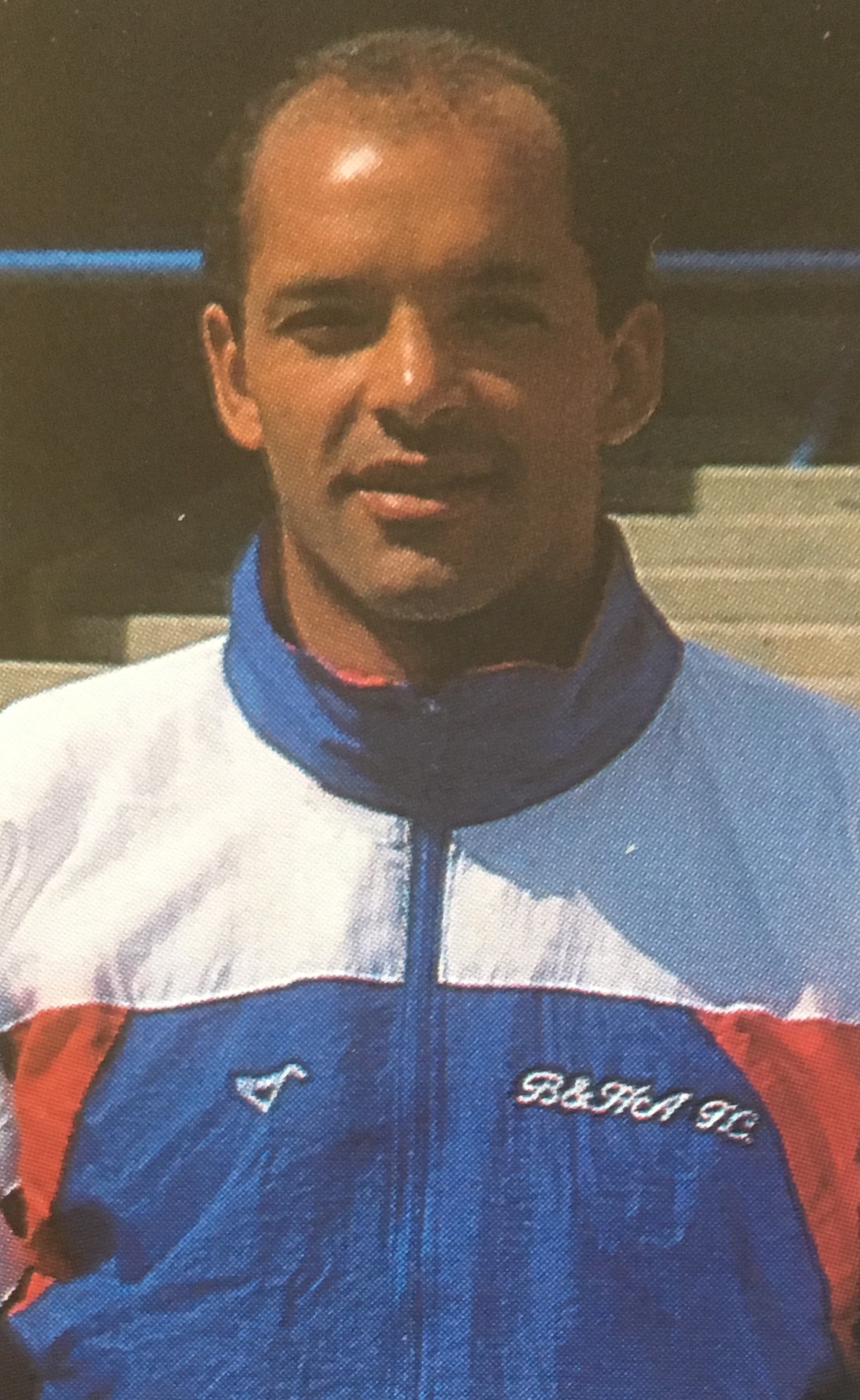
curbs penThe Albion matchday programme featured Curbishley when the Seagulls hosted the Hammers for a Barclays League Division 2 game on 16 September 1989. Describing his time with the East London club, he said: “It was a brilliant set up although I was definitely a bit headstrong in my early days.

“I didn’t really grow up until I moved to St Andrew’s and that’s where I had my best playing days.”

Lou Macari’s side in 1989 included Curbishley’s old pal Alvin Martin and future Albion manager Liam Brady but the Seagulls ran out 3-0 winners (goals from Kevin Bremner, Robert Codner and Garry Nelson).

In 1990, Curbishley began his coaching career, returning to Charlton initially as player-coach under Lennie Lawrence. When Lawrence left in 1991, Charlton made the somewhat unusual decision to appoint joint managers: Curbishley and Steve Gritt (who would later be at the helm when Albion narrowly escaped dropping out of the league).

Curbishley’s first signings for Charlton were former Albion teammates Nelson and Steve Gatting and he later plundered young winger John Robinson from the Seagulls. After four years, Curbishley took sole charge at The Valley and led Charlton to some of the most successful times in their history.

Considering their resources, Curbishley turned Charlton into a steady top flight club and model of stability, consistently securing a mid-table finish.

Sean Cole in The Bleacher Report described him as “one of the most promising managerial talents of the new millennium” and in 2006, in the wake of Sven-Goran Eriksson’s departure as England manager, Curbs had ‘tea and biscuits’ with then chief executive Brian Barwick – but Steve McLaren got the job instead.

In December 2006, Curbishley landed what surely would have been considered his dream job – manager of West Ham.

It was quite a reunion of old pals when Brighton visited Upton Park for one of his first games in charge, in the third round of the FA Cup in January 2007. Albion boss Dean Wilkins and coach Ian Chapman had both been teammates while physiotherapist Malcolm Stuart was still wielding the magic spray.

In front of 32,874, Hammers ran out fairly comfortable 3-0 winners with Mark Noble scoring his first senior West Ham goal and Carlos Tevez a real handful up front. These were the respective line-ups:

West Ham: Carroll, Dailly, Ferdinand (Spector 45), Gabbidon, McCartney, Benayoun, Mullins, Noble, Boa Morte (Newton 73), Cole (Bobby Zamora 68), Tevez.
Subs not used: Green, Sheringham. Goals: Noble 49, Cole 58, Mullins 90.

Brighton: Wayne Henderson, Joe O’Cearuill, Joel Lynch, Guy Butters, Kerry Mayo, Tommy Fraser (Gary Hart 51), Adam El-Abd, Dean Hammond, Alexandre Frutos (Sam Rents 67), Alex Revell (Joe Gatting 84), Jake Robinson. Subs not used: Michel Kuipers, Richard Carpenter.

Fans’ website westhamtillidie recalled: “Perhaps Curbs’ greatest legacy at the club was the £7m signing of his former Charlton protégé Scott Parker, who went on to win the Hammer of the Year prize three times and pick up a Football Writers’ Player of the Year Award during his time at the club.”

Sadly, though it was to all end in tears and Curbishley quit in protest at the then Icelandic owners’ failure to consult him over the sale of defenders Anton Ferdinand and George McCartney.

In what must have been a tough heart-v-head decision, he resorted to a legal resolution of the situation and eventually won a case for constructive dismissal, eventually receiving £2.2m in compensation. But it was the last manager’s job he had.

“It took me a year to sort out my problem at West Ham,” he told The Independent. “And then, after that, I was perhaps a little too picky. I was told by other senior managers ‘don’t be out too long’ but I was waiting for a job that I thought was the job for me.”

Job vacancies came and went, Curbishley’s name was generally on all the shortlists, but he never again made it through to the manager’s chair. There was a brief moment at Fulham when he was technical director assisting Rene Meulensteen but when Meulensteen was swiftly axed, new manager Felix Magath brought in his own people.

He rejoined the Fulham coaching staff in March 2015 and took charge of training in November 2015 when Kit Symons was relieved of his managerial duties but Stuart Gray took charge of the team before Slavisa Jokanovic was appointed.

In 2016, Curbishley brought out a book, Game Changers: Inside English Football: From the Boardroom to the Bootroom (published by HarperSport) and was a regular pundit on the Football on 5 programme covering Football League games.

Further reading

https://www.westhamtillidie.com/posts/2014/11/07/preview-aston-villa

http://bleacherreport.com/articles/1415997-the-curious-case-of-alan-curbishley-footballs-forgotten-man

https://www.whufc.com/club/history/managers/alan-curbishley#C1vPoA9yPR1kYluJ.99

  • Pictures show westhamtillidie’s image of Curbishley in West Ham colours; the midfielder on the front of a Birmingham matchday programme 1982; in Villa’s colours from a Match Weekly annual, an Argus shot of Curbs scoring a penalty for Brighton against Man City, and other images from the Albion match programme.

Gary Lineker cleaned defender Larry May’s boots

larry may wednesINJURY cut short Larry May’s playing career at Brighton but, during a purple patch of his four-year spell at Barnsley, he impressed his peers to the extent he was in the 1986-87 PFA team of the year.
Alongside him in that selection were Lee Dixon, the ITV football pundit who in those days played for Stoke City prior to his move to Arsenal, and former Albion full back John Gregory, who was playing in midfield for Derby County at the time.

Centre back Larry began his career with Leicester City and played over 200 games for them between 1977 and 1983. When given a run in the first team by former Rangers manager Jock Wallace, Larry’s boots were looked after by none other than Gary Lineker: the Match of the Day host being a Filbert Street apprentice at the time.

Leicester’s club historian John Hutchinson – who said of May: “He was very strong in the air, a powerful tackler and had pace” – drove down to Brighton in 2015 to interview Larry about his time with the Foxes and published the story on foxestalk.co.uk.

Leicester had spotted him playing for a local youth team in Birmingham and invited him for a trial. Aged 17, he made his debut in the top division against Bristol City when one of his teammates was Frank Worthington, another who later played for the Albion.

In the following season, Jimmy Bloomfield, the manager who gave him his debut, departed and was replaced by Frank McLintock, who didn’t give May much of a look-in.

Screenshot
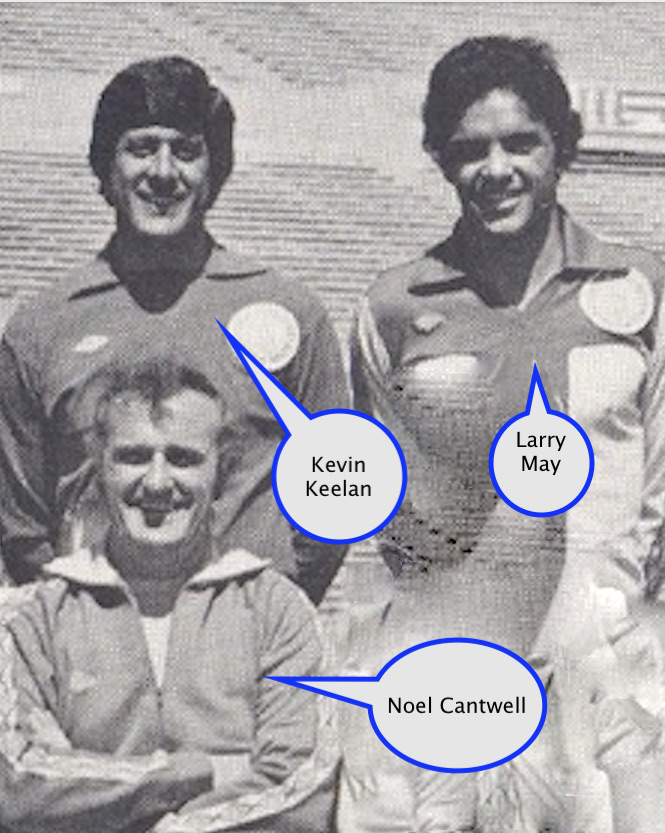
May played in front of ex-Norwich goalkeeper Kevin Keelan for the Tea Men

He went to play for New England Tea Men (a franchise owned by the Lipton tea company) in America under ex-Coventry manager Noel Cantwell to get some games but ruptured a cruciate ligament which some thought might end his career before it had even got off the ground.

Back at Leicester, McLintock was succeeded by Wallace and he paired May at the back with John O’Neill – a partnership that endured for the best part of five years.

In those early times, though, May admitted he had to play through pain and regularly ice his knee.

Not only was May ever-present in the 1979-80 side that won promotion from Division 2, he headed the only goal of the game at Leyton Orient on the last day of the season to clinch the title. Striker Alan Young, who played for Albion in the 1983-84 season, was another ever-present.

Leicester only survived a season in the top flight and following relegation Gordon Milne replaced Wallace as manager, guiding them to promotion in his first season. May, though, didn’t see eye to eye with the former Liverpool midfielder and ended up handing in a transfer request.

In an Albion matchday programme, May said: “”We fell out over something and nothing really but at 24 you think you know it all and there was no future for me once I’d asked for a transfer. “Thinking back, I realise that I should have got on with it.”

As it was, in August 1983 he dropped a division and joined Barnsley for a fee of £110,000, signed by the legendary former Leeds hard man, Norman Hunter.

larry may bw“For a man with a reputation of being one of the fiercest characters in football it was unbelievable – I’d say he was definitely the nicest fellow I’ve ever played for,” said May.
While on the books at Oakwell, with a nod towards a longer future in the game, May took his full FA coaching badge.

He told foxestalk.co.uk: “I was happy at Barnsley but, in retrospect, I should have bided my time and stayed at Leicester really. But I was a bit young and naïve. I loved it at Leicester. Leicester were the best club I ever played at. It was my best time in football and I loved it there.”

After three years with Barnsley, former Albion winger Howard Wilkinson took May to Sheffield Wednesday. He had just turned 28 and the move represented a step back up in standard.

“It was an important move at that stage in my career but looking back it was never brilliant for me at Hillsborough,” he said.

Amongst the competitors for his place was Nigel Pearson, later to be better known for some eccentricities in management with various clubs.

At the start of the 1988-89 season, a move south to Brighton was mooted but Wilkinson held onto him because of some early season injury problems. However, Barry Lloyd got his man towards the end of September 1988 and May joined Brighton for £200,000.

His debut in a 2-1 Goldstone win over Leeds brought to an end a run of eight defeats at the beginning of the season but it was back to losing ways – both 1-0 – in the following two games which, ironically, were against his former clubs, Barnsley, at home, and Leicester, away.

monoMay

The return fixture with Leicester was a happier outcome for May, though, because he was the sponsors’ man of the match in a 1-1 draw.

In his programme notes for the Barnsley game, manager Lloyd said: “I know he’ll have a big impact on the way we play….at 29, we know he has a lot of football left in him.”

Captain Steve Gatting had a programme column that season and he also welcomed the central defender, adding: “His experience in the top two divisions is bound to rub off onto some of younger players. When we’ve played against Larry in the past he’s tended to be the man of the match and I’m sure everyone at the Goldstone wishes him and his family every success.”

Understandable sentiments, of course, and such a shame that before the season’s end, after only 25 games, the cruciate ligament in his right knee was shattered in an accidental collision with teammate Paul Wood during a magnificent 2-1 home win over Man City.

“I knew straight away, having had knee trouble before, how serious it was,” he said. “It wasn’t Paul’s fault. It was just one of those things.” He was carried off on a stretcher and it was his last game for the club.

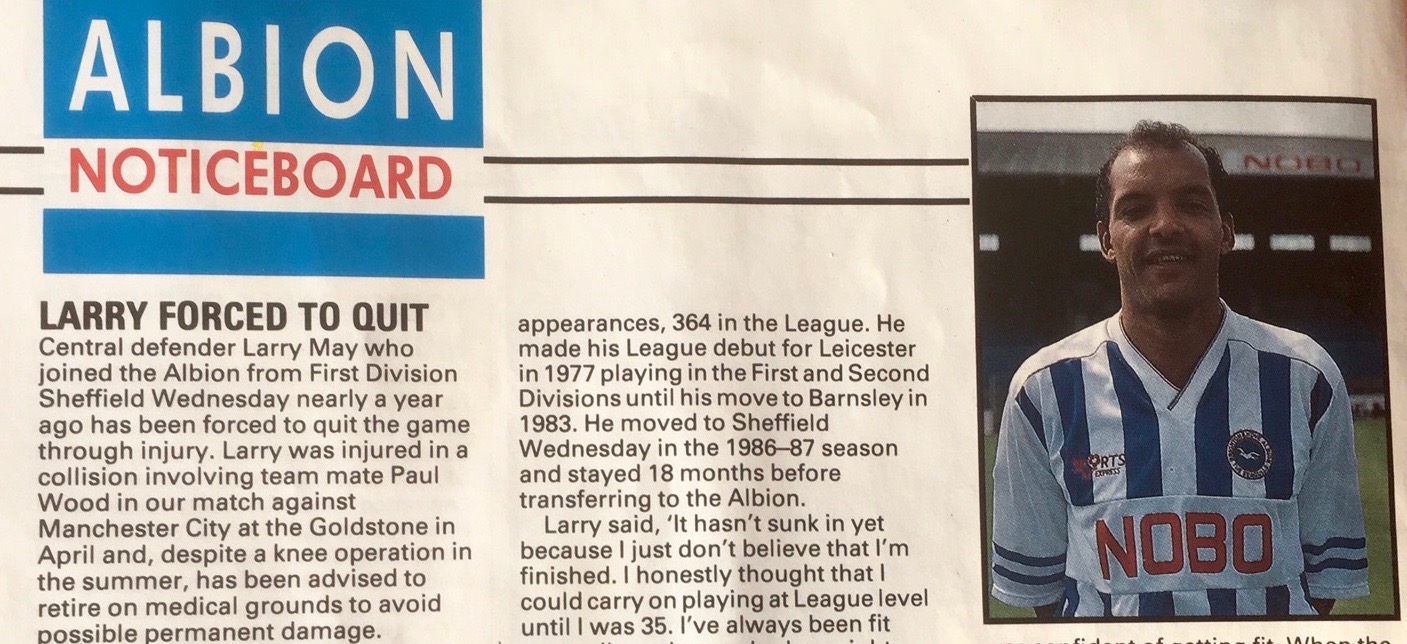
It was in the matchday programme for Albion’s game v Ipswich Town on 27 September 1989 that news of his forced retirement was announced.

“The sudden decision has stunned 30-year-old Larry and his family who were beginning to settle in the Brighton area after moving from Wakefield last year,” the announcement read. “In a 12-year career in the game, Larry has made more than 400 senior appearances, 364 in the league.”

A dejected May told the programme: “It hasn’t sunk in yet because I just don’t believe that I’m finished. I honestly thought that I could carry on playing at league level until I was 35. I’ve always been fit generally and never had a weight problem and this has really hit me.

“When the specialist told me that I shouldn’t play again my first reaction was that it had to be wrong. Now I’ve got to rethink and I’m not really sure about my future.”

Manager Lloyd added: “The announcement that Larry May had been forced to retire from playing was a particularly sad one. He performed very well for us last season and put heart and soul into everything around the club.”

Thankfully Larry was able to put that coaching badge to good use when Lloyd made him reserve team coach and, after a time working for the Surrey FA, he later returned to the club as Head of Sports Participation for Albion in the Community.

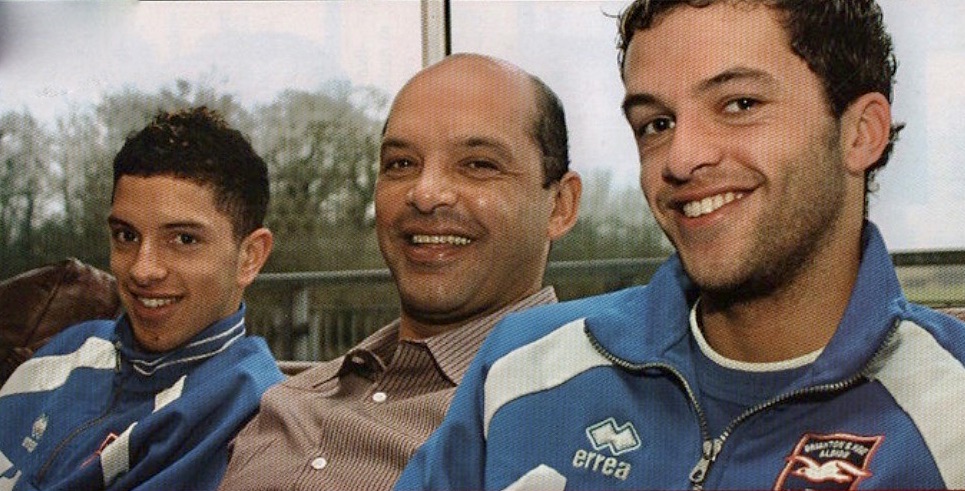
His links to the club also extended to his sons: Chris was a young goalkeeper who once had to replace the injured Michel Kuipers during a game and Steve was a centre-back who was in the youth set-up.

1-larrymaystripes2-argusmayintheface3-may-quits4-coach-may

Larry and his sons Steve (left) and Chris

Pictures include Larry May in matchday programmes; captured by an Evening Argus cameraman getting a hand in the face; the programme announcement of his retirement; in an Albion team line-up as a coach, and with his sons.