Managerial turnover played havoc with goalscorer Bent’s career

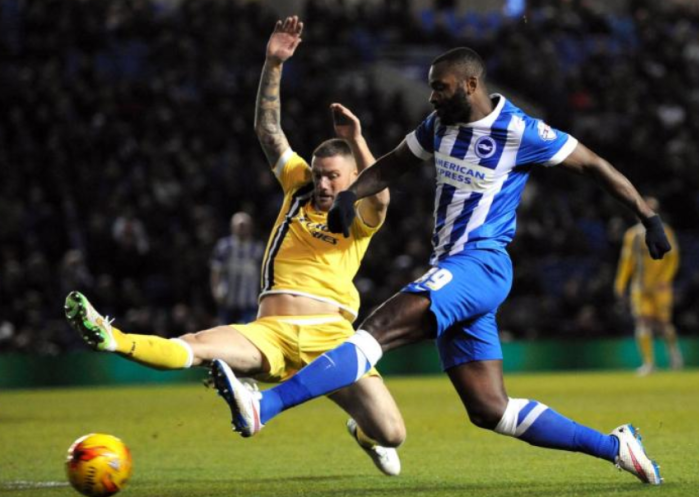
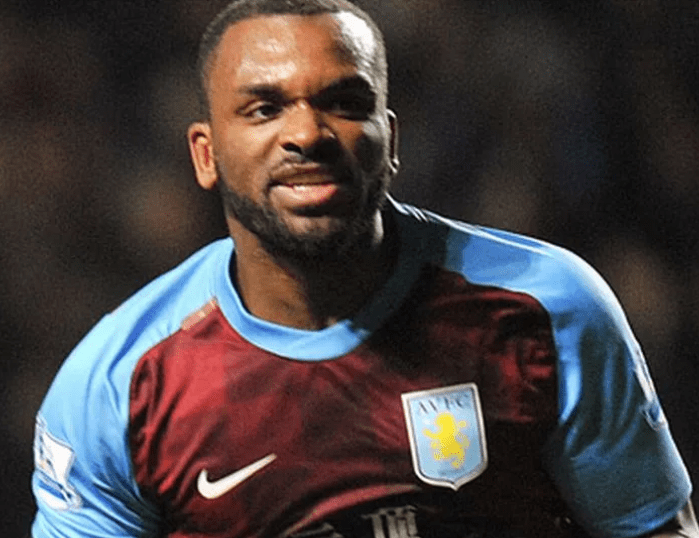
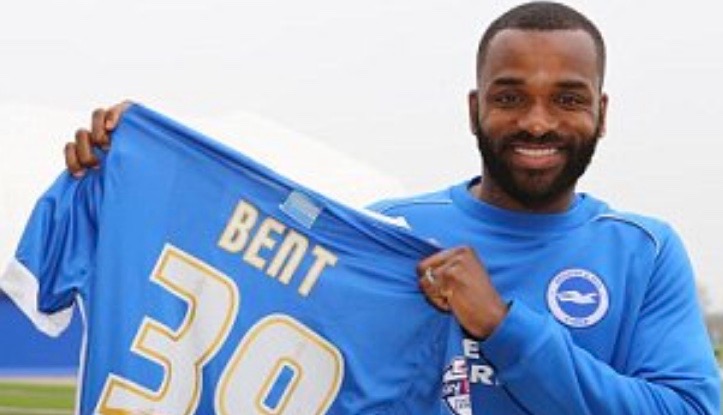
FORMER England striker Darren Bent, who now shares his opinion of the game with listeners to talkSPORT, was still only 30 when he pulled on the stripes of Brighton, one of nine clubs he represented in the Premier League and Championship.

He couldn’t have got off to a better start when he scored on his debut at the Amex, netting against one of his former clubs, Fulham. Unfortunately, the visitors turned the game on its head and won 2-1.

Timing is everything in football and perhaps if Bent had joined the Albion in happier circumstances, there may have been a better story to tell. The Seagulls were about the ditch the manager who brought him to the club – an all-too-familiar scenario Bent encountered on many occasions throughout an 18-year playing career.

At Spurs he played under three different managers – he later described it as “the worst two years of my career” – and his temporary move from Aston Villa to Brighton came about because he’d been frozen out by Paul Lambert even though Gerard Houllier had smashed Villa’s transfer fee record to sign Bent from Sunderland for £18m in January 2011.

Bent arrived at the Amex in November 2014 with 184 goals in 464 career appearances behind him, and only three years earlier had won the last of 13 caps for England, for whom he scored four goals.

“His record speaks for itself,” said Albion boss Sami Hyypia. “He is a top-class striker with more than 100 Premier League goals with Charlton, Spurs, Sunderland and Aston Villa. I hope he will score plenty of goals for us during his time with us.

“There is no doubting his ability to score goals. He also wants to play regular games and that is evident in his willingness to step down from the Premier League to the Championship.”

The player himself told the matchday programme: “Anyone who knows me knows that all I care about is football.

“It has never been about money or anything like that. It has always been about playing football. I’m always at my happiest when I’m playing.”

Bent added: “Brighton felt like the perfect place to come and play football, especially for someone like Sami Hyypia, who I’ve played against many times over the years.

“As a manager, I think he is the right man. He is the kind of guy I want to play for.”

It was a generous assessment in the circumstances because Brighton had managed only two wins in 16 matches before Bent’s arrival.

The experienced striker’s second goal for the Albion looked like it might have earned the beleaguered coach a reprieve from the inevitable. He scored in the 10th minute away at Wolves, stooping to head Inigo Calderon’s first-time cross past goalkeeper Carl Ikeme. It was a lead that lasted until the 88th-minute but was cancelled out by a Danny Batth equaliser after Albion had played 30 second half minutes with 10 men following a red card shown to Bruno. Brighton parted company with the big Finn shortly afterwards.

Bent played one more game, under caretaker Nathan Jones, when Albion fought back from 2-0 down (both scored by on-loan Glenn Murray against his old club) to earn a home draw against Reading, but he was forced off injured after less than half an hour and the knock kept him out of the next game at Fulham, when Brighton won 2-0.

Hyypia’s replacement, Chris Hughton, spoke at his first press conference of trying to keep the player, but Bent had the chance to join a side at the opposite end of the Championship and he moved to promotion-seeking Derby County instead, scoring 12 times in 13 starts as the Rams missed out on a play-off spot by one point.

Released by Villa at the end of the season, he subsequently joined the Rams on a permanent basis in the summer of 2015. He saw even more managerial churn at Pride Park – Paul Clement and Darren Wassall in 2015-16 and three – Nigel Pearson, Steve McLaren and Gary Rowett – in 2016-17. Across the two seasons in the Championship, Bent scored 14 in 67 matches, but a hamstring injury sidelined him for the start of the 2017-18 season.

In January 2018 he went on loan to Championship strugglers Burton Albion under Nigel Clough where he scored twice in 14 appearances (nine starts + five off the bench) including netting the equaliser against his old club Sunderland when Burton’s 2-1 win relegated the Black Cats to the third tier of English football for only the second time in the club’s history. Burton also went down.

Released by Derby in the summer of 2018, he announced his retirement at 35 in July 2019.

Funny that he should end his career at Derby County because it was against them that he scored his first competitive goal for Tottenham in a 4–0 home victory in August 2007.

Bent had previously scored 37 goals in 79 matches over two seasons at Premier League Charlton Athletic before making what at the time was a record £16.5m move to White Hart Lane, where Dutch boss Martin Jol greeted him enthusiastically.

On target for Spurs

Although he already had Robbie Keane, Dimitar Berbatov, Jermain Defoe and Mido as forward options, Jol said of the new signing: “Darren’s strength is his stamina. Normally players will make runs three or four times in 45 minutes, he will do it all the time and if you manage to play balls behind the defence, he will be there.

“He has pace, he links play well and can see a pass – he can exploit the space and play as well.”

What happened subsequently is covered superbly in a 2019 article by Jack Beresford on Planet Football, but, to fast forward a little, Jol was shown the White Hart Lane exit and his replacement, Spaniard Juande Ramos (assisted by Gus Poyet) was a lot less enamoured by the big money signing.

Indeed, Beresford writes: “Bent later recalled how Tottenham became ‘a horrible place to be’ under Ramos, who regularly lambasted players over a lack of professionalism in regards to training and nutrition, demoting several senior figures to the reserves.”

Although Bent struggled to cement a regular starting spot in his first season at White Hart Lane, he was Spurs’ top scorer at the end of the 2008-09 campaign with 17 goals.

While things initially looked good under Bent’s third Spurs boss, Harry Redknapp, the manager’s decision to publicly humiliate the striker eventually brought an unhappy spell to an end.

Bent missed a golden chance to score in a match against Portsmouth and Redknapp told reporters after the game: “You will never get a better chance to win a match than that. My missus could have scored that one.

“Bent did not only have part of the goal to aim for, but he had the entire net – and he put it wide. Unbelievable. I was just so frustrated.”
Bent put in a transfer request and said: “No one goes out to deliberately miss. When you miss a chance and your manager comes out and supports you rather than criticises you, it’s a big help.”

Ironically, circumstances meant Bent went on to make 12 more appearances for Tottenham, scoring five times and his 12 league goals made him the club’s top scorer.

Although Redknapp said Bent had a future at the club, he signed Peter Crouch and Beresford reported Bent later said: “I didn’t feel Redknapp wanted me there. It’s massive to have the support of your manager and that’s not been the case for the last two years.

“My career stood still at Tottenham. There’s a lot of politics going on there. I scored a lot of goals, but it was the hardest two years of my life.”

In those two years, he scored 25 goals in 79 games for Tottenham, but 36 of those appearances had been as a substitute.

Born in Tooting, south London, on 6 February 1984, Bent seemed always destined to be a footballer because his dad Mervyn had been on the books of Wimbledon and Brentford as a youngster.

The family moved to Cambridgeshire when the young Bent was only 10 and his early football career was nurtured at Godmanchester Rovers.

Ipswich Town picked him up as a 14-year-old and nurtured him through their youth ranks until he signed his first professional deal on 2 July 2001. George Burley gave him his debut five months later as a sub in a 3-1 UEFA Cup win away to Helsingborgs IF.

He scored twice in seven league and cup appearances that first season but the Tractor Boys were relegated from the top flight. Burley was soon replaced, temporarily by Tony Mowbray, then Joe Royle, under whom he cemented a regular starting berth in the second tier over the next three seasons.

By the time he left Ipswich in 2005, he’d scored 56 goals in 141 appearances. Former Brighton midfielder Alan Curbishley was at the helm of the Addicks when they paid a fee of £2.5m to take him to The Valley.

He scored five goals in Charlton’s first four league games (including two in the opening day 3-1 win over future employer Sunderland), finished his first season with 22 league and cup goals and was named Charlton’s Player of the Year.

Bent top scored again the following season, with 15, but under three different managers – Iain Dowie, Les Reed and Alan Pardew – they were relegated to the Championship along with Watford and Sheffield United.

As described earlier, Spurs presented the opportunity for him to continue playing in the Premier League, and he continued playing at that level when Sunderland bought him for £16.5million in the summer of 2009. Demonstrating the knack he had at several clubs, he scored on his debut, giving the Black Cats a 1-0 win at Bolton.

Bent went on to score 24 league goals for the Black Cats in his debut season at the club – and you can only imagine how delighted he was (pictured below) to net two in a 3-1 win over Spurs at the Stadium of Light!

The first came after just 34 seconds of the game on 3 April 2010, and a 29th-minute penalty gave him his 23rd goal of the season, although incredibly Bent also saw two other penalties saved by Spurs ‘keeper Heurelho Gomes. He had also missed a penalty in the reverse fixture at White Hart Lane the previous November, when Spurs won 2-0.

He obviously wasn’t the most reliable from 12 yards: I witnessed a Bent penalty miss myself back in 2003 when he’d gone on as a sub for Ipswich against Brighton at Portman Road. With the score at 1-1, Richard Carpenter’s foul on Chris Makin gave Bent the chance to restore the home side’s advantage from the spot. But he blasted the ball over without goalkeeper Dave Beasant needing to make a save. Tony Rougier then put Albion ahead but a Martin Reuser thunderbolt evened it up.

Bent’s 18-month stay with Steve Bruce’s Sunderland proved to be his most prolific goalscoring spell in football, netting 38 goals in just 52 appearances.

In the first half of the 2010-11 season, his partner up front was young Manchester United loanee Danny Welbeck, but in the January 2011 transfer window Bent was on the move again, this time to Villa.

Once again, he got off to a great start for a new club, marking his debut with the only goal of the game in a win over Manchester City. It was the first of nine goals in 16 league appearances which put him joint top scorer with Ashley Young, even though he’d only arrived at the club in January.

After health issues forced Houllier to step down as Villa boss, Alex McLeish took over for what was a tumultuous and under-performing season when relegation was only avoided by two points, although Bent was top scorer with 10.

McLeish’s successor Lambert not only took the captaincy off Bent, he also froze him out, only selecting him for 13 Premier League appearances. If he thought it was difficult enough to have three different managers in three seasons at Villa, when he spent the whole of the 2013-14 season on loan to Fulham, they had three different managers in one season!

Bent’s old Spurs boss Jol was in charge as the campaign got under way but, with only two wins in 14, he was replaced by former Man Utd no.2 René Meulensteen in December before Felix Magath took over in February. All the upheaval saw Fulham relegated with a team that included David Stockdale, Steve Sidwell, Aaron Hughes and Dan Burn. Bent scored six in 14 starts + 15 sub appearances.

If Bent was used to managerial change at club level, it wasn’t much better with the England national team: he played under three different managers in five years!

He had previously earned selection for his country at under 15, 16, 19 and 21 levels – he scored nine in 14 matches for the under-21s – and he was first called up to the full squad by Sven-Goran Eriksson shortly after he’d made the move from Ipswich to Charlton, although he didn’t play in a 4-1 defeat to Denmark.

“Making my Premiership debut for a new club, scoring my first brace in the Premiership and then to get the England call-up on the back of that was just a dream come true,” he told the FA website.

It was another six months before he made his full England debut, in a 2-1 win over Uruguay but he didn’t do enough to stake a claim for a place in the World Cup squad.

His next cap came as an 80th minute substitute for Joe Cole in the 3-2 defeat to Croatia in November 2007 that cost Steve McLaren his job when England failed to qualify for the Euro 2008 tournament.

By the time he made his second start for England, on 14 November 2009, Fabio Capello was in charge. England lost 1-0 in a friendly to Brazil in Qatar when Bent’s teammates included Matthew Upson, Wayne Bridge and James Milner.

“Bent was struggling to make an impact as he attempted to convince Capello of his worth, not helped by a lack of service that rendered his task almost impossible,” reported the BBC’s Phil McNulty. “He had one opportunity, but could not direct a header on target from Milner’s cross.”

He didn’t make the cut for the 2010 World Cup squad but in September was back in the fold and scored his first England goal after going on as a 70th minute sub for Jermain Defoe as England beat Switzerland 3-1 in Basle.

By now at Villa, it was the first of three goals in three games (he also netted against Denmark and Wales) after which he told the Birmingham Mail: “I’d love to be No 9 for as long as possible, there are a lot of top strikers about but Fabio keeps picking me and hopefully I can keep producing the goods.

“Even when the goals weren’t going in, I always believed I was good enough to score at this level and hopefully it’s showing now. I’m finally getting my chance and getting a good run in the side. I’m delighted with it.

“It has been years since my first chance and it’s certainly been a long, long wait but it’s finally come.”

He started the 2-2 Euro 2012 qualifier with Montenegro in October 2011 and the following month was in the side that beat World Cup holders Spain 1-0 at Wembley; it was his header from Milner’s cross that rebounded off a post for Frank Lampard to nod in.

Three days later, he played what turned out to be his – and Capello’s – last game for England as a 70th minute sub for Bobby Zamora when England beat Sweden 1-0 at Wembley.

Yet another man was at the helm when it came to selection for the Euro 2012 tournament and Roy Hodgson didn’t reckon Bent had recovered sufficiently from an injury to merit inclusion.

For all the highs and lows of a lengthy playing career, nothing came close to what he suffered in front of a nation of TV quiz viewers: he scored only three points over two rounds of Celebrity Mastermind and admitted to talkSPORT listeners: “Honestly? It was probably the worst experience of my life!”

He explained: “As a footballer you get nervous before games, when you take a penalty in front of thousands of people, when you join a new club, but when you’re sitting in that chair opposite John Humphrys, it’s pitch black in there and all you can see is him, his eyes looking at you and he’s asking you questions and you just go blank.”

Grant Hall owed second chance to mentor Danny Cullip

TALENTED defender Grant Hall has suffered plenty of slings and arrows in a career that might not have got off the ground but for the influence and encouragement of former Albion captain Danny Cullip.

When he got a second chance at Brighton, he seized it, made it to the first team, was signed by Tottenham Hotspur and is still playing tier two football more than 10 years later.

In one of those strange quirks of football, Neil Warnock, the manager who signed Cullip for Sheffield United, made Hall his first signing when he took charge at Middlesbrough.

Warnock infamously dumped Cullip within three months of signing him for the Blades but he was a lot more complimentary about Hall, who had faced his demons at one of Cullip’s old clubs, QPR.

“Grant is a smashing lad and I’m sure the fans will really take to him,” Warnock told Boro fans after signing him in July 2020.

Born in Brighton on 29 October 1991, Hall was with the Albion as a schoolboy but was released when he was 16. That’s when he went to play for non-league Lewes where Albion’s former captain was seeing out the remaining days of his career.

“He (Cullip) was a massive influence on me,” the young defender told Albion’s matchday programme. “Danny talked to me every time I played. He gave me advice on what to do and he never had a go at me, which might not have helped me as a youngster. He was always positive and encouraging me.

“He was a great pro when he was playing so was a great person to be mentored by.”

Together with input from another former pro, Anthony Barness, and manager Kevin Keehan, Hall said: “I felt their belief and that gave me confidence and I became a better player. They helped me so much; I owe a massive thanks to them.”

The changed Hall brought Albion’s director of football Martin Hinshelwood back to his door with an invitation to return to the club two years after he’d left.

Hall was part of a hugely successful development squad under youth team coach Luke Williams, and eventually made it to the first team, joining Gus Poyet’s squad for training over Christmas 2011.

Although a centre back by preference, his debut was at left-back as a second-half substitute for assistant manager Mauricio Taricco in a memorable New Year’s 3-0 win over 10-man Southampton at the Amex. Saints’ Rickie Lambert was shown a red card and Matt Sparrow scored two belting goals for the Albion.

“I’ve waited a long time but it’s a great feeling to have finally made my debut,” said Hall. “Obviously there were a few nerves as I was getting my shirt on but once you step onto the pitch you just block everything out.

“You are just so focused on your game that you can’t even hear the crowd but I really enjoyed the experience.”

Hall did well enough to be given his full debut the following Saturday in the FA Cup against Wrexham, although Poyet couched his words of praise carefully after the youngster put in a composed display, suggesting certain representations on Hall’s behalf were not welcome.

“I would stay calm if I was anyone connected to Grant,” he said. “He played for half-an-hour against Southampton when we were eleven v ten, and then 90 minutes against Wrexham, with all respect to Wrexham, so we’ll see.”

Albion fans liked what they saw though, with correspondent ‘4everaseagull’ saying on the Argus discussion forum: “Hall’s performance was very assured against Wrexham and he looked very comfortable. For me he was MoM. He didn’t miss a header all game, and his positional play and passing were excellent. It really showed how important it is for all the respective teams at the club to play the same way. Feet on the ground for Hall but what a great prospect.”

Hall played alongside versatile Frenchman Romain Vincelot against the Welsh Conference side but there was plenty of competition at centre back with captain Gordon Greer usually featuring alongside Adam El-Abd, and a rookie Lewis Dunk beginning to emerge. Steve Cook, also 20, had returned from a loan spell at Bournemouth to help out during an injury crisis but he soon departed to Dean Court on a permanent basis, joining Tommy Elphick whose own Albion progress had been blighted by a serious injury.

Whatever had narked Poyet in January resurfaced when Hall rejected a three-year deal offered by Albion before his contract expired at the end of June. Hall chose to join Spurs instead, although Poyet was baffled and, in a convoluted but contorted way, went public with his criticism of the youngster’s move.

“The only disappointing side with Grant Hall is that what he told us was the reason for not signing a contract was not true,” Poyet told the Argus. “He didn’t accept our contract for a reason but that reason is not happening.

“There was a clear reason he gave us as to why he did not want to stay here. I know what he said and it’s not happening, so it’s disappointing, no doubt.”

Albion clearly felt Hall had a future, and with the seven substitutes rule coming in it was felt his chances of being involved in the first team squad were pretty good.

Nevertheless, Poyet added: “Sometimes we try to advise players knowing the game, but my point of view is probably not the same as the player’s point of view. I just wish him well. I hope he can make it and can be playing at the highest level.

“I am not against him. He made a decision, nothing else, but I think it’s important to know the reason.”

While Hall went straight into Tottenham’s academy team and made his debut in a 2-1 friendly victory over Kingstonian, Albion began a drawn out wrangle over compensation, which was due because Hall was still under 24.

It wasn’t until the following January that Albion finally reached an undisclosed settlement with Spurs to prevent it going to a tribunal.

Hall featured in Spurs’ under 21 side from the start of the 2012-13 season but in three years on their books, he didn’t make a first team appearance. He had three loan spells away from White Hart Lane – at League One Swindon Town under the aforementioned Luke Williams – and at Birmingham City and Blackpool, both in the Championship.

In 2015 he made a permanent move to Queens Park Rangers, signed by former Albion full-back Chris Ramsey who had coached him at Tottenham.

“He’s an old-fashioned defender who can head the ball, tackle and he doesn’t mind putting his foot in when he needs to,” said Ramsey. “But he can play as well from the back, and that’s what we’ll be looking to do when the opportunities present themselves this season.

“He’s still a young boy and centre-half is a very responsible position, but he’s got experience in the Championship and that’s vitally important for us.”

Hall won the supporters’ Player of the Year award in his first season but suffered a serious knee injury towards the end of the 2016-17 season.

He started drinking heavily because he couldn’t cope with the pain of tendonitis in his knee, and two years later spoke out about the mental health issues he went through.

Hall encouraged others to talk about such problems in the way he did after he broke down in a meeting with QPR director of football Les Ferdinand and then manager Steve McLaren.

Ferdinand put him in touch with the Professional Footballers’ Association and he was able to understand that it was OK to speak about his issues.

“I had a really good conversation with them and they helped me understand that it’s okay to speak about your mental health. No-one is going to judge you for it and opening up about your mental well-being is a strength and not a weakness,” he told qpr.co.uk. “It was exactly what I needed. It felt like a huge release, a weight off of my shoulders and it allowed me to re-focus and start to look after myself again.”

Explaining how things unravelled, Hall said: “I went from a place where life was perfect, I had a great relationship with the QPR supporters and everything was going right on and off the pitch. Then all of a sudden everything seemed to come crashing down. It was a huge reality check for me and I now realise that you can never anticipate what is around the corner in life.”

Hall managed to turn that corner and worked hard to restore his fitness to the extent that he featured in 30 matches during the 2019-20 season. “Deep down it’s just a relief for me to be playing football again,” he said.

But after 128 appearances across five years at Loftus Road, where he had become club captain, he was unable to agree a new contract with QPR in the summer of 2020 and upped sticks at the age of 28 to become Warnock’s first signing at Middlesbrough.

“I’ve known Grant for a few years now,” said Warnock. “Everyone knows I’m looking at the spine of the team, and he’s the right fit for what we need.”

Unfortunately, not for the first time in his career, injury sidelined him for several of those early months on Teesside but on his return he proved a bright spot in a disappointing second half of the season.

“It’s been a massive plus because I didn’t personally think he’d be able to come back like he has, if I’m totally honest,” Warnock told Craig Johns, of gazettelive.co.uk. “I was worried he’d put a bit of weight on and I couldn’t see enough mobility.

“And yet he’s proven me entirely wrong. He’s come back fitness-wise better than I’ve ever seen him and he’s using his experience at the back for us to the point where he’s been a breath of fresh air for us.”

Warnock also told the reporter: “The thing I’ve been most impressed with, more than his heading or his contribution in that respect, has been his reading of the game against quick players. You would probably question how he would get on against a quick player, but he’s just revelled in it really.

“His quickness of thought has put him a long way ahead of some of these quick strikers that he’s been playing against. That’s what I’ve been pleased with more than anything.

“I always know he’ll chip in with an odd goal here and there, but his reading of the game has been outstanding.”

After Warnock’s departure, Hall was on the outside looking in under Chris Wilder although the new manager sought to give him public encouragement by saying he could still have a role to play. “He’s had a couple of little issues but he is back involved now and back part of the group,” he told gazettelive.co.uk. “Grant has an important role to play between now and the end of the season,” he said. “I think they all know they have to be ready when called upon.”

In July 2022, it was announced Hall was joining newly-promoted Championship side Rotherham United on a season-long loan.

Krul luck as Ryan kept Dutch penalty ‘master’ at bay

AN international goalkeeper whose prowess at saving penalties took his country through to the World Cup semi-finals barely got a look-in between the sticks for Brighton.

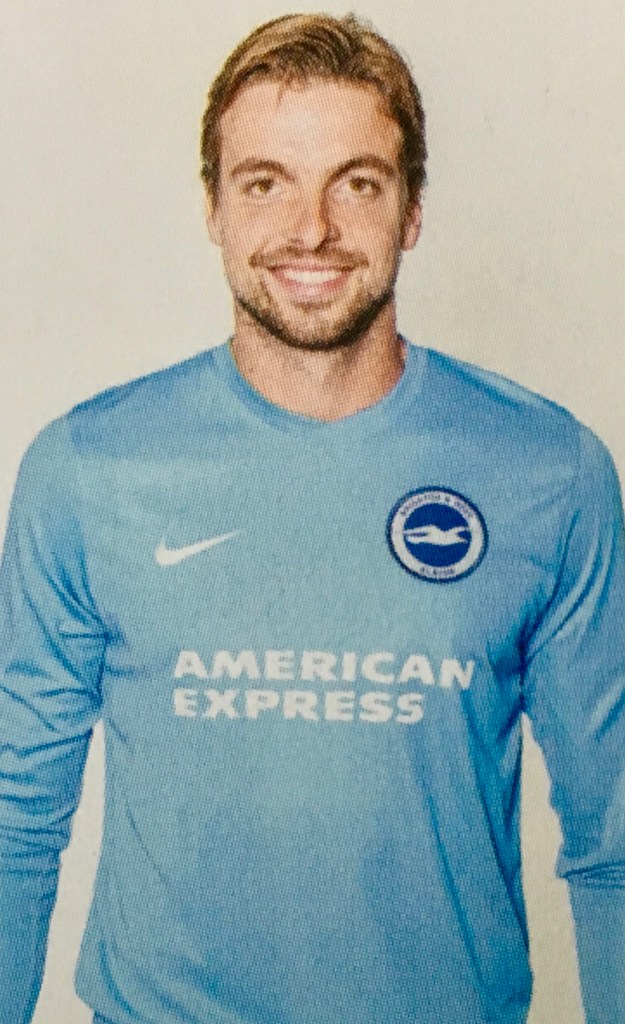
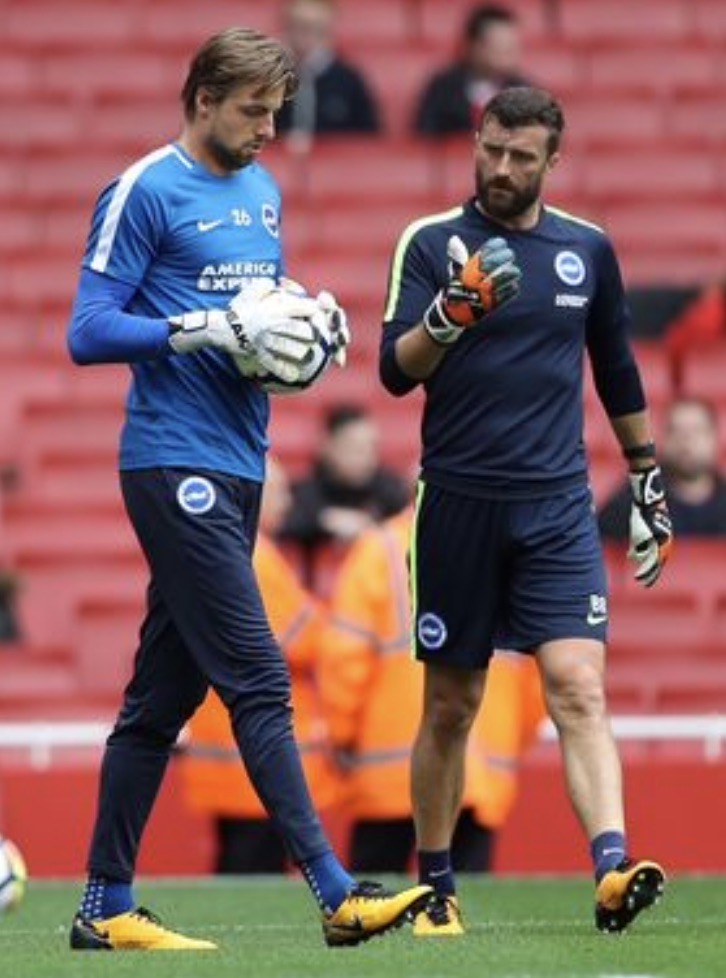
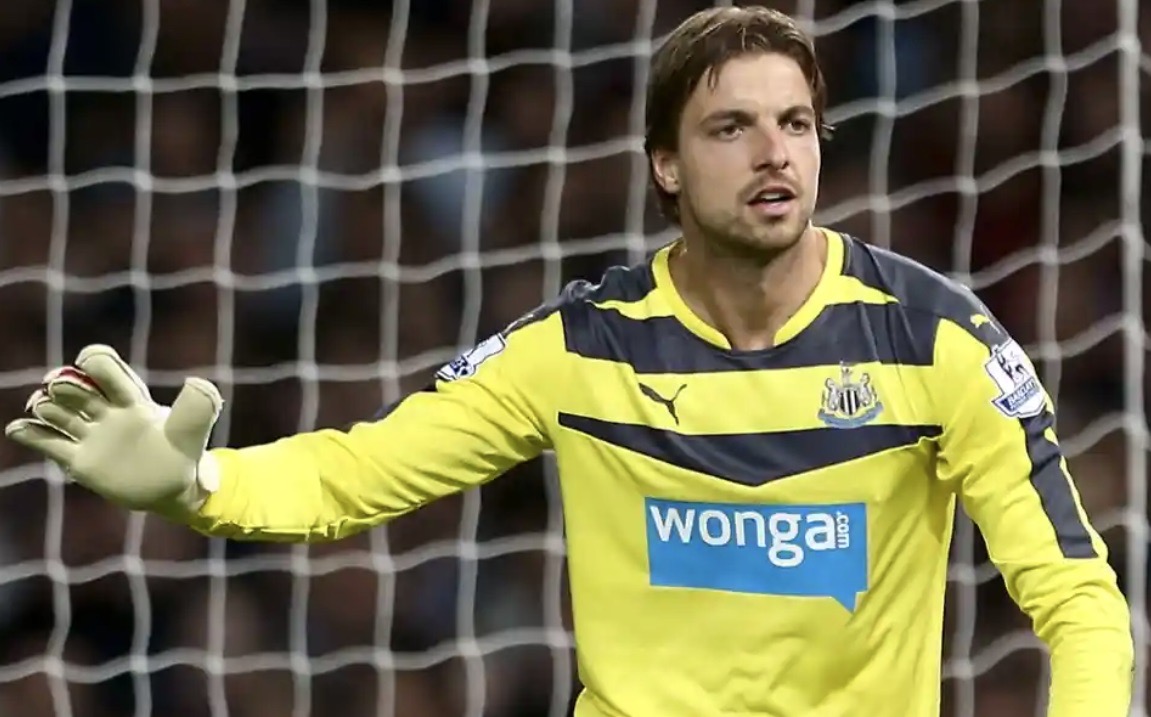
Experienced Dutchman Tim Krul, who played 184 games for Newcastle United over 12 years, kept goal for the Seagulls on only five occasions during the 2017-18 season.

The form of Mat Ryan, himself an Australian international, meant Krul’s involvement was restricted to cup matches and a watching brief from the substitute’s bench.

Krul initially signed on a season-long loan deal on deadline day in August 2017 but the move was made permanent the day after he made his Albion first team debut in a 1-0 League Cup defeat at Bournemouth.

Manager Chris Hughton said: “I know Tim from my time at Newcastle and he is an excellent professional that has a vast amount of experience at both club and international level.

“He’s played an extensive amount of games in the Premier League, as well as playing in the Europa League and his experience will also help benefit the other keepers in the squad.”

Having experienced some in and out spells during his time on Tyneside, Krul understood the situation when interviewed by The Argus in November 2017.

“I’m working hard every day to push Mat Ryan. He’s done great so far and we’re picking up points, that’s what it’s all about.

“If the gaffer needs us or Mat got injured, I need to be ready and literally it can happen any second.”

Krul admitted: “It’s a different position for myself, because I’m used to playing week in, week out.”

The move to Albion had been the chance to reignite his career after a long spell on the sidelines having suffered a cruciate knee ligament injury on international duty in 2015.

Krul is powerless to stop Romelu Lukaku’s winning goal for Manchester United in Brighton’s FA Cup fifth round tie at Old Trafford

Before he made the move, he consulted Steve Harper, who’d been on loan at Brighton during the Gus Poyet era. Harper told the matchday programme: “I told him it woud be a great move for him and it will also be a great signing for the club. He was outstanding in the season Newcastle finished fifth in the Premier League and he’s an international ‘keeper for the Netherlands who has played at the World Cup.”

After he’d played in Albion’s FA Cup fifth round defeat to Manchester United at Old Trafford, Krul told The Argus: “Obviously when I came, I was hoping to get a bit more (game time) maybe, but at the time I walked through the door Maty’s performances went up a level, so that is testament to him.

“The level we are training at with Ben Roberts every day is really high. He has been showing that in the games. I’ve been around long enough to see when a goalkeeper is playing well you take that. I’m 29, I’m back fit, I’m feeling better than I’ve ever done so I’m ready to play. I just have to be patient again.

“I had to be patient at the start of my career and you have to do that again now. But my chance will come. There’s a lot of years left.”

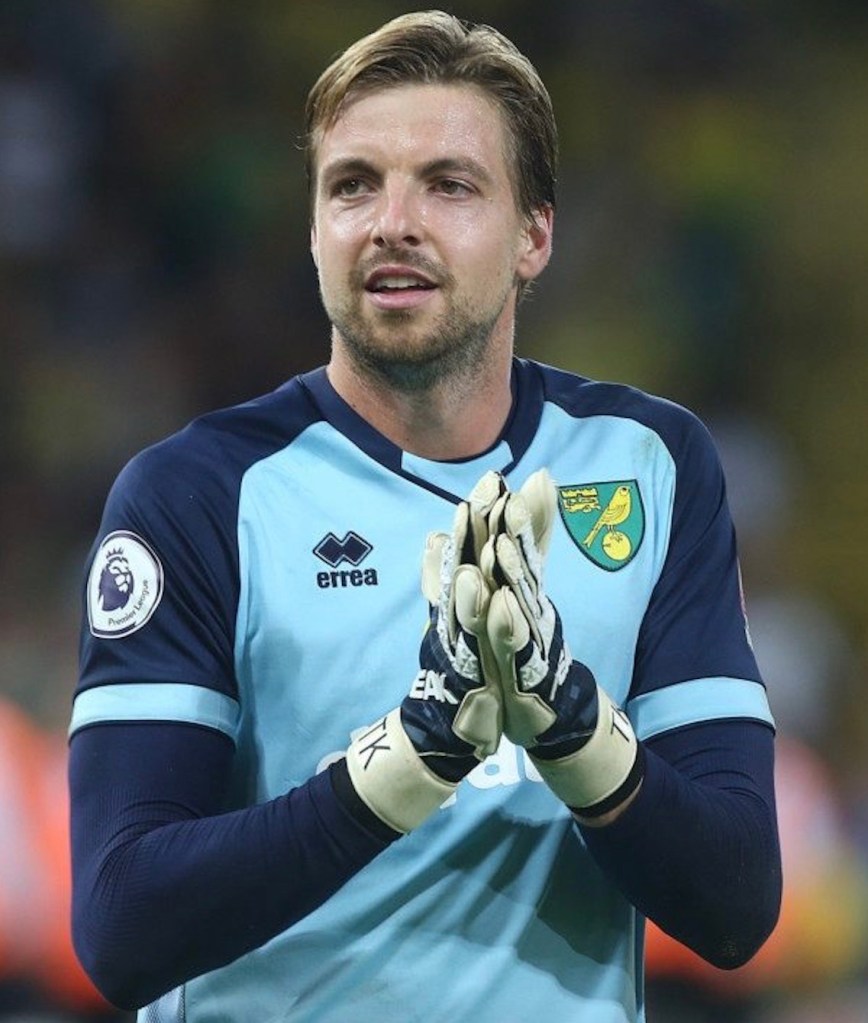
Krul finally got regular playing time again when he moved to Norwich City

Unfortunately, that didn’t happen with the Albion but Krul certainly resurrected his career with Norwich City and, after signing an initial two-and-a-half-year deal in the summer of 2018, earned a further three-and-a-half-year contract in December 2020.

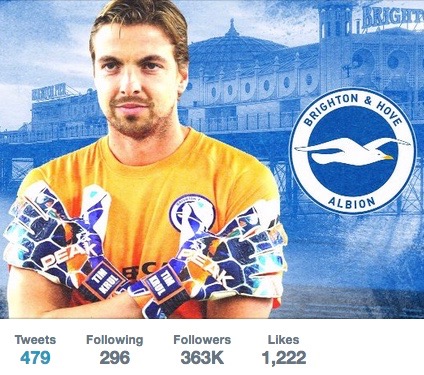
He then contracted Covid-19, announcing it on Twitter, where he has a huge following of more than 349,000. “I feel under the weather and fatigued,” he wrote. “It’s an important reminder to stay safe, this virus is not a hoax.”

Thankfully, by the end of January, he had recovered and returned to the side to clock up 100 appearances for the Canaries.

Born in The Hague, Holland, on 3 April 1988, from a young age Krul played for his hometown club RAS and was with ADO Den Haag between the ages of 12 and 17. Graeme Souness was still boss when Krul joined Newcastle in the summer of 2005. Shay Given and Steve Harper were the established ‘keepers in those days.

Shortly after making his debut in a UEFA Cup match in November 2006, he suffered injuries which ruled him out of action for six months. After returning to playing in the spring of 2007, he earned a new four-year deal with Newcastle.

An eventful loan spell in Scotland followed as Krul sought to gain league experience at Falkirk. He conceded 11 goals in two games early on (four to Celtic, seven to Rangers), he was sent off in a game on 2 January 2008, and then dislocated a shoulder in a cup match against Aberdeen, bringing the loan to a premature end.

When Given left St James’ Park for Manchester City, Krul was no.2 behind Harper in Newcastle’s 2009-10 season in the Championship. He deputised if Harper was injured and was given starts in cup matches. By the season’s end, when the Toon had won promotion back to the Premier League, Krul was awarded a new four-year deal and made his debut at that level when replacing the injured Harper in a 1-0 win away at Everton in September 2010.

He ended that campaign having played 25 first team matches, and the following season, established himself as the no.1, with Rob Elliot as his deputy. Out-in-the-cold Harper was allowed to spend a month on loan with the Albion.

Under Alan Pardew, Krul was the preferred first choice ‘keeper, and he signed a five-year contract with the Magpies in 2012. Several different injuries in 2012-13 restricted him to 30 appearances.

Another six-week injury lay-off over Christmas 2014 interrupted a period when there was yet another managerial change on Tyneside and the 2015-16 season under Steve McLaren was only a couple of months old before Krul was ruled out for the remainder of the season when he ruptured an anterior cruciate ligament in his right knee playing in the Netherlands’ 2-1 European Qualifiers win in Kazakhstan.

McLaren was sacked in March 2016 and his replacement Rafa Benitez couldn’t prevent them from being relegated. Krul signed a one-year contract extension in the summer of 2016 but, with Elliot and Karl Darlow ahead of him, he was sent on loan to Ajax as Newcastle successfully bounced back to the elite, pipping Albion to the Championship title.

Meanwhile, things didn’t work out as planned for Krul. He only got a handful of games for the Ajax reserve side and he spent the second half of the season at AZ Alkmaar instead.

Krul has played for his country at every age level and made his full international debut in a friendly against Brazil in 2011. Maarten Stekelenburg and Jasper Cillessen have normally been ahead of him but he has won 11 caps, including three in 2020 after a five-year absence from the side. However, it was what happened at the 2014 World Cup in Brazil that most fans will remember.

Head coach Louis van Gaal took off Cillessen in the final seconds of extra time with the Dutch still drawing 0-0 with Costa Rica and sent Krul on because of his reputation for saving penalties. Sure enough, he made two saves in the subsequent shoot-out and Holland went through to the semi-finals (where they went out 4-2 on penalties to Argentina).

The story behind the decision emerged in an article by Michael Bailey for The Athletic on 5 March 2020. The Dutch goalkeeping coach at the tournament, Frans Hoek, explained how Krul had responded best of the three ‘keepers to special training he put them through.

“When we came together with the national team, the three goalkeepers were more or less at the same level in stopping penalties. And that level was low,” Hoek told The Athletic. “We decided to do things in a different way and when you do that you have to believe in it, practice it and then show it. Basically, Tim responded best to that.

“He had some advantages. He’s very big, he has an enormous reach. He is impressive when you’re standing the other side of him and maybe because he’s from Den Haag area, he can be a little bit provocative. Michel Vorm is too nice a guy, so is Cillessen. But Tim can get away with it. It’s just something he has.”

A look back through the archives reveals Krul was displaying his prowess saving penalties as far back as his youth playing days. In an FA Youth Cup match for Newcastle against Brighton, he made saves from Tommy Fraser and Scott Chamberlain as Toon edged it 3-2 on penalties.

Albion goalkeeper coach Roberts was full of praise when asked about the big Dutch ‘keeper. “He has an aura about him and the self-belief to think he will save everything,” said Roberts. “I’m delighted for him as lots wrote him off when he had his bad knee injury. He’s since shown how much his hard work and dedication has paid off.”

After putting pen to paper on his new Norwich contract, Krul told the club website: “Proud is the big word. I’m excited to commit my future to Norwich and have had an amazing two and a half years already at this club, so I’m excited to add another three and a half years to that.

“The plan the club has got for the next few years is exciting and there’s some young, exciting talent coming through the ranks as well. From top to bottom, it’s a club I want to be at; one that’s run really well from Michael and Delia to the kitman. It’s an exciting time for the club, for sure.

“As a player, you want to be loved and I’ve got a great relationship with the fans. The club giving me this three-and-a-half-year contract shows the belief they’ve still got in me.”

Manager Daniel Farke added: “It’s fantastic news for us to have a player of Tim’s quality and personality. He’s by far the best goalkeeper in this league and was impressive in the Premier League.

“He’s still in a really good age for a goalkeeper and can play many more years. It’s good news he was willing to sign a long-term contract because there is lots of interest in a player of his quality and experience.”

Krul was a key part of Norwich’s Championship-winning sides of 2018-19 (when he was ever-present) and 2020-21. But in August 2023 he returned to the Premier League when he was signed by newly-promoted Luton Town.

Town boss Rob Edwards said: “Tim’s a leader and a top goalkeeper who is still very and ambitious and very hungry. He wants to play.

“It’s great to have someone of his level in the group with that ambition and to be that driven, and it’s going to add great competition to the goalkeeper department, which is what we’ve wanted.”

Pictures from online sources and matchday programmes.

Jesse Lingard took steps to stardom at Brighton

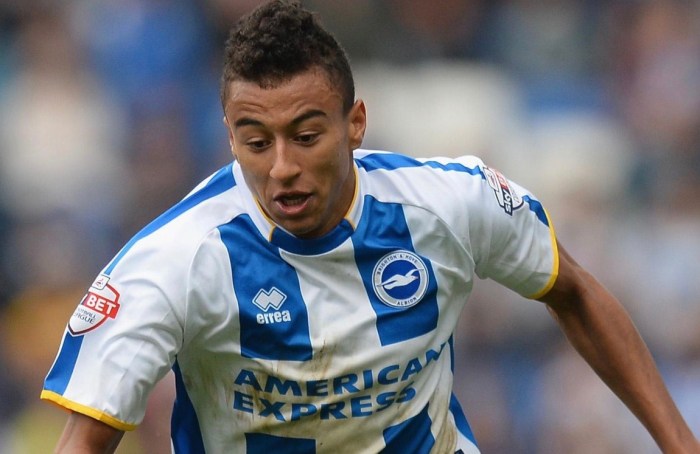
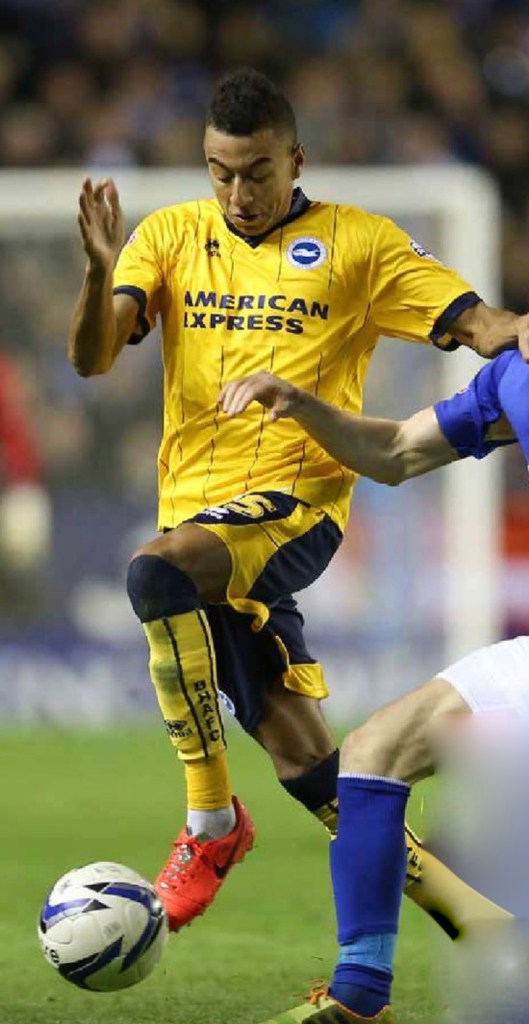
MANCHESTER United youngster Jesse Lingard scored four goals in 17 appearances for Brighton in their 2013-14 Championship season.

As well as helping the Seagulls to reach the play-offs, the move proved a useful development step for Lingard, who later become a regular at United and played for England at the 2018 World Cup.

Former United boss Jose Mourinho spoke about the value of the experience in an interview with manutd.com ahead of a Brighton v Man Utd Premier League game in May 2018.

Although Sir Alex Ferguson involved him in the first team squad a couple of times in the 2011-12 season, his real senior football education began during a three-month loan to Leicester City (he was sent with Michael Keane) in November 2012.

And, although Lingard went on United’s pre-season tour Down Under in the summer of 2013, he joined Birmingham City on loan in September 2013.

He scored a total of six goals in 13 games for the Blues, including a debut four goals at home to Sheffield Wednesday.

Birmingham hoped to keep Lingard

They’d been hoping to re-sign him for the rest of the season but Albion nipped in at the end of February 2014 and he headed south to join Oscar Garcia’s promotion-chasing side until the end of the season.

Garcia told the club website: “We are delighted we have finally secured Jesse until the end of the season. He is one of the most exciting young English players and has already created a lot of interest following his successful loan spell at Birmingham.

“We worked hard to secure a talent who has already shown that he can play at Championship level, and I am very pleased to have added Jesse to our striking options.

“He has an excellent pedigree, having come through the academy at Old Trafford, and there is no doubt that he has a lot of talent and ability. I am really looking forward to working with him.”

Lingard got on the scoresheet in the 4-1 away win at already-crowned champions Leicester City, and four days later also found the net in a 3-0 win over Charlton.

In the third minute of added on time at home to Yeovil Town, Lingard added to Kazenga LuaLua’s opener to secure a 2-0 win in the last home league fixture.

He then scored Albion’s goal in the play-off first leg at home to Derby, but, with Albion losing the game 2-1, they were always on the back foot going into the second leg when County ran riot against the injury-ravaged Seagulls to win 4-1.

Lingard went back to United and got his first competitive first team start under Louis van Gaal in the season-opener against Swansea at Old Trafford, but the occasion was marred by him having to go off with a knee injury after only 24 minutes – and United lost 2-1.

The injury set his career back six months and, on his recovery, Lingard was sent out on loan again in February 2015 when former United assistant manager Steve McLaren took him to Derby County.

Back at Old Trafford the following season, he got his first United goal in November 2015 when United beat West Brom 2-0, and he began to establish himself, making a total of 40 appearances by the season’s end.

In fact, that season ended on a particularly high note for Lingard when he came off the bench to score the winning goal for United in the 2016 FA Cup Final against Crystal Palace.

The 2017-18 season saw him involved even more, when he made 48 appearances, and, even through managerial upheaval, he continued to be a regular member of the United first-team squad.

Born in Warrington on 15 December 1992, Lingard went to the town’s William Beaumont Community High School and was on United’s books from the age of seven.

He progressed through the different age groups but, as a slow developer physically, was still playing at under 16s level when he was 18.

Nevertheless, as a youth player at Manchester United, he helped them to win the FA Youth Cup in 2010-11.

An extended feature on Lingard’s development appeared in the matchday programme for Albion’s game at Old Trafford in November 2017.

One of the coaches involved in his development, academy advisor Tony Whelan, said: “Jesse has had to be patient throughout his career. As a younger player, he was physically under-developed so he had to play a younger age group. That wasn’t easy, but he had the patience, intelligence and trust in the coaching staff to know that those decisions were made in his best interests, that we knew at some point he was going to grow. At some point, all that ability would be able to come out.

“He’s got a wonderful mindset, so his ability to come on and make an impact on the game is down to the fact he’s resilient, he has a wonderful mentality, and he is a great observer of the game. That comes out all the time in the way he deals with things. And on top of that, he has his excellent technical ability.”

Whelan added: “He’s only of slight build, so he’s developed great technical ability, good passing, dribbling, he’s a really good mover – very fluid, a wonderful mover – and he’s athletic without looking that athletic.”

The coach said: “You don’t get in our first-team squad without being a very accomplished player. He’s also playing for the national team fairly regularly. That’s testimony to Jesse’s abilities as an all-round footballer now.”

Lingard was 23 when he made his full England debut, at Wembley against Malta, on 8 October 2016, and he went on to become part of the England squad that reached the World Cup semi-finals in 2018.

He scored his first England goal in a 1-0 win away to the Netherlands in March 2018, and has since scored three more times in 24 matches; against Panama at the World Cup, against the USA at Wembley in November 2018 and three days later also at home against Croatia.

He’d already appeared on the international stage earlier in his career, playing three times for England under 17s in 2008 and scoring twice in 11 games for the under 21s between 2013 and 2015.

Coach Whelan summed up Lingard thus: “From the day he first walked into this football club at seven years of age, he always had a smile on his face. He’s always loved playing, always loved the game, always had wonderful enthusiasm, and in some ways he’s inspired the coaches with his love of the game and love of the ball.

“You never had to ask him to work hard, he was always running around, always energetic, always mischievous, and those are the qualities he brought.”

In an interview with the Albion matchday programme for Brighton’s home game with United in 2017-18, Lingard reflected on his loan spell with the Seagulls and said: “I wanted to go to the club because I knew they were a good club with a great stadium and great fans – it was the perfect club to go on loan to.”

He added: “The stadium, the staff, the fans, you could see the ambition of the club. I always knew that the club would make it into the Premier League. It was heading in that direction for a couple of seasons.”

The 2019-20 season saw a marked decline in Lingard’s fortunes with his starts for United under double figures, and most of his involvement coming off the bench. He also lost his place in the England squad.

It was revealed a business venture had performed badly and, sadly, trying to cope with personal issues involving his family impacted Lingard’s form and demeanour.

After United boss Ole Gunnar Solskjaer challenged him publicly over his declining performances, he decided to talk about the problems publicly.

After the curtain came down on the season, Lingard told his 6.6 million Instagram followers: “This season has been difficult for so many reasons. I lost who I was as a player and person, but I never wanted to give up.

“I knew who I really was on and off the pitch and knew that having been there before I could get there again.”

“This meant working harder than I’d ever done before and trusting in those around me that they knew how to best help me achieve that.

“I know the fans have been frustrated but in all this time my love for this club and everyone connected to it has never left me.”

“This team, this club is my family and I will continue to keep working harder than ever to help this team achieve its goals.”

However, with several new faces arriving at Old Trafford prior to the start of the 2020-21 season, football’s rumour mill was busy suggesting Solskaer was looking to offload Lingard.

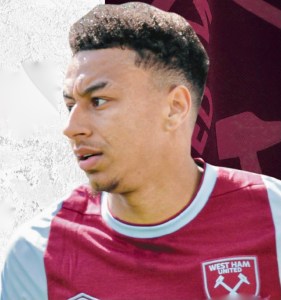
In January 2021, Lingard joined West Ham on a half-season loan and the change of scene seemed to give his career a boost. He scored twice on his debut in a 3-1 win over Aston Villa and finished the season with nine goals in 16 appearances for the Hammers.

He returned to Man Utd for the 2021-22 season, playing in 22 league and cup games but only scoring twice.

When his contract wasn’t renewed at Old Trafford, in the summer of 2022, Lingard signed a one-year deal with newly promoted Nottingham Forest on a reported £200,000 a week.

The multi-million pound striker who scored on his Albion debut

STRIKER Darren Bent spent the last month of 2014 with Championship-struggling Brighton as the hapless Sami Hyypia tried to bring a halt to a dismal run of form.

Unable to command a regular starting spot at Aston Villa, Bent made an encouraging enough start, scoring on his debut against Fulham.

But the game ended in a 2-1 defeat and his only other goal came at Molineux two days before the axe fell on Hyypia’s time in the hotseat as Albion drew 1-1 with Wolves.

Bent told BBC Radio Sussex he’d reached “boiling point” in his frustration at the lack of starts under Paul Lambert at Villa. Previous boss Gerard Houllier had smashed Villa’s transfer fee record to take Bent from Sunderland for an initial £18m in January 2011, but, after Lambert became manager in 2012, he made just 13 Premier League appearances.

albion D BentAt the time he headed to the Amex, Bent had scored 184 goals in 464 career appearances, not to mention scoring four while winning 13 caps for England.

“I hope he will score plenty of goals for us during his time with us,” Hyypia had told the club website. “His record speaks for itself. He is a top-class striker with more than 100 Premier League goals with Charlton, Spurs, Sunderland and Aston Villa.

“Three years ago, he was a regular in the England squad under Fabio Capello; there is no doubting his ability to score goals.

“He also wants to play regular games and that is evident in his willingness to step down from the Premier League to the Championship.”

Bent told the matchday programme: “It doesn’t bother me that I’ve had to drop down a division to play football. Anyone who knows me knows that all I care about is football.

“It has never been about money or anything like that. It has always been about playing football. I’m always at my happiest when I’m playing.”

At least Bent found some familiar faces in the Albion dressing room in fellow Villa loanees Joe Bennett and Gary Gardner and former Fulham teammates David Stockdale and Aaron Hughes.

“Brighton felt like the perfect place to come and play football, especially for someone like Sami Hyypia, who I’ve played against many times over the years,” Bent added. “As a manager, I think he is the right man. He is the kind of guy I want to play for.”

Bent goalBent returned to Villa after playing in five games and although new boss Chris Hughton indicated a willingness to bring him back, the striker was soon on his way to Derby County for the remainder of the season.

He scored 12 in 17 games for Steve McLaren’s Rams and subsequently joined them on a permanent basis in the summer of 2015. After two seasons in the Championship with Derby, scoring 14 in 67 matches, a hamstring injury sidelined him for the start of the 2017-18 season and in January 2018 he went on loan to Championship strugglers Burton Albion.

Having been without a club since released by Derby in the summer of 2018, he announced his retirement at 35 in July 2019.

Since then, he has joined the football pundit circuit, although not everyone is convinced he’s making that good a job of it!

pundit D BentNevertheless, Talksport and Sky Sports are happy to give him a platform and, in an interview with Metro, he suggested what might be the most difficult aspect of it. “I played with some of these guys and regard them as friends so, when they have had a bad game, will I be able to dig them out? It’s finding the line between being objective and respectfully constructive.”

Only in January 2020, Bent could be found arguing the case for Lewis Dunk to be recalled by England. The former striker is also active on Twitter with @DarrenBent attracting just short of 492,000 followers.

Born in Tooting, south London, on 6 February 1984, Bent was probably destined to be a footballer because his dad Mervyn had been on the books of Wimbledon and Brentford as a youngster.

The family moved to Cambridgeshire when the young Bent was only 10 and his early football career was nurtured at Godmanchester Rovers.

Ipswich Town picked him up as a 14-year-old and nurtured him through their youth ranks until he eventually made it to the first team in November 2001.

In four seasons with Ipswich, he scored 56 goals in 141 appearances before then Premier League Charlton Athletic paid a fee of £2.5m to take him to The Valley.

After two successful seasons in which he bagged 37 goals in 79 games for the Valiants, he made another big money move, this time to North London to join Spurs.

It was in June 2007 they paid a club record £16.5m and he scored 25 in 79 games for them before a similar fee saw him move to Sunderland, then in the Premier League, in the summer of 2009.

After 18 months in the North East, Bent put in for a transfer and Aston Villa paid £24m to sign him on a four-and-a-half year contract. He marked his debut with the only goal of the game in a win over Manchester City.

In his second season with Villa, Bent took on the captaincy for a while but managerial changes meant his face didn’t always fit and he spent the whole of the 2013-14 season on loan to Fulham, where he scored six in 30 matches.

Brighton’s heroic captain Cullip clashed with Warnock

AFTER three promotions and one relegation in five years, Danny Cullip left Brighton for Sheffield United in December 2004.

Hard-up Albion needed the cash at the time and Cullip was keen to join a side who were pushing for promotion to the Premier League.

“They were a massive side and I felt that it was too good an opportunity to miss,” Cullip said in Match of My Life (knowthescorebooks.com), edited by Paul Camillin. “I felt if I didn’t take the opportunity, I would end up regretting it, and although things didn’t work out, I don’t regret it, as I would have lived the rest of my life wondering what might have happened.”

Cullip was virtually ever-present during his three months with the Blades but a clash of personalities with fiery manager Neil Warnock saw him offloaded on loan to Watford before the end of the season.

DC focusThe player who had been an inspirational captain for the Seagulls has chosen not to go into detail about what happened although Warnock had plenty to say in his autobiography, ghostwritten by journalist Oliver Holt.

“At Sheffield United I bought a centre-half, Danny Cullip, with a view to him being my leader on the pitch, my captain,” he said. “I thought he was a good talker. I realised within a week he talked a better game than he played. The only answer was to get shot of him quickly.”

Cullip swerved the controversy in an Albion matchday programme interview in 2019-20, saying instead: “We won my first three games in succession and ended up taking maximum points from five of the first six games.

“It was a great start and I was really enjoying my football but then, out of the blue, Neil said he wanted to bring in another striker, Danny Webber from Watford.

“Ray Lewington, who was coach at Watford at the time and knew me from out time together at Brentford, said they would only sanction it if they could get me in return. It was going to be a permanent move but ended up being a loan as Ray was sacked the following week, which wasn’t ideal.

“My Sheffield United career was over though before it had even begun, which was so disappointing because I’d been playing well and we’d been getting results.”

butts + DC Sheffield United’s Cullip gets to grips with ex- Albion teammate Guy Butters
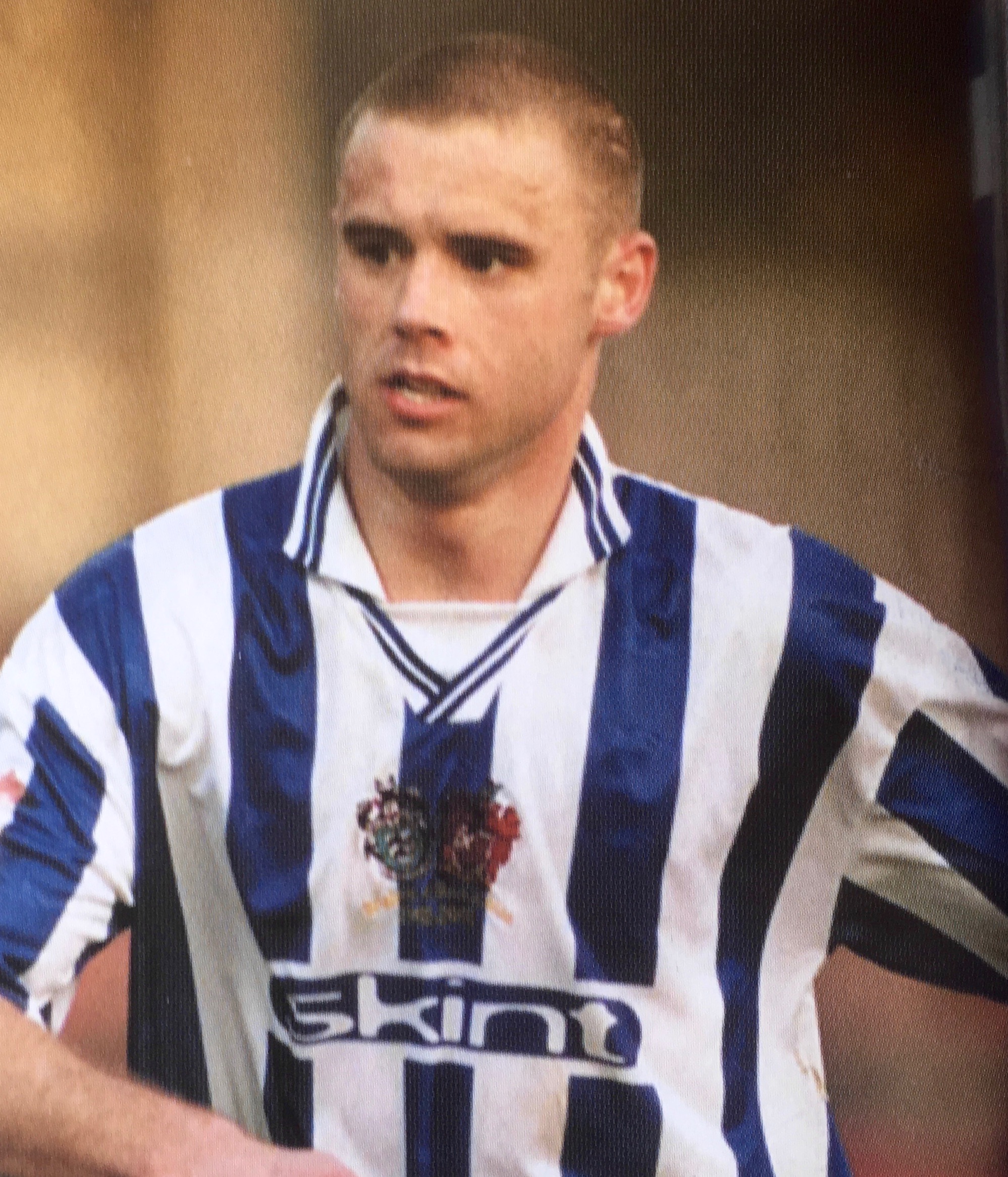
Lee Connor on footballleagueworld.co.uk reckoned Cullip was one of the top 5 most pointless signings in Sheffield United’s history which seems a harsh assessment of a player who made 216 appearances for Brighton.

The £250,000 fee Brighton received for their captain was certainly much needed at the time and was a good return on the £50,000 they invested in signing him from Brentford for £50,000 on 13 October 1999.

Born on 17 September 1976 in Bracknell, Berkshire, Cullip was scouted by Oxford United while playing Sunday football and shone during a set of trial games. After getting into their under-16s, he then earned a two-year YTS apprenticeship where he was coached by future England manager Steve McLaren.

Oxford were managed by that redoubtable former centre half Denis Smith at the time and Cullip was given a one-year professional contract but faced stiff competition to make the breakthrough to the first team, where future Leicester City stalwart Matt Elliott was excelling.

“I went out on loan to Kettering Town in the Conference,” Cullip told fulhamfocus.com. “Gary Johnson was their manager and I learned a lot from him and played well there.”

Cullip had a trial at Shrewsbury and could have joined them or Kettering. But he chose to join then Fourth Division Fulham because his dad was a Fulham fan, he told fulhamfc.com in an April 2016 interview. Micky Adams had been newly appointed in his first managerial job and handed Cullip his league debut in the first game of the 1996-97 season.

It was a season fondly remembered by Fulham fans because they won promotion but the regime change the following year, when Mohammed Al Fayed took over, saw Adams dumped in favour of Kevin Keegan and Ray Wilkins and eventually Cullip rejoined Adams at Brentford in exchange for a £75,000 fee in February 1998.

Cullip found himself back in the basement division when the Bees were relegated and then on the treatment table for much of the season after suffering a cruciate knee ligament injury.

Having not played a first team game for 13 months because of the injury, Cullip was thrown a lifeline when Adams, by now in charge at Brighton, took him on a month’s loan in September 1999.

CullipHe impressed sufficiently for Adams to persuade chairman Dick Knight to make the transfer permanent, beginning an association with the club which continues to this day.

Cullip became a mainstay of the defence during the back-to-back promotions of 2001-02 and 2002-03 and famously scored the headed winner in a 1-0 win over Chesterfield at Withdean that clinched the third-tier championship.

Cullip took over the captaincy from Paul Rogers and recalls the “unbelievable day” he lifted the play-off final trophy at the Millennium Stadium, Cardiff, in 2004.

After his Blades spell was cut short, and his brief Watford loan came to an end, Cullip joined Nottingham Forest where his manager was Gary Megson. “I really liked him,” said Cullip. “He was an honest guy; what you see is what you get with him.

“Unfortunately, I missed my first pre-season with Forest due to what was ongoing at United, so I was playing catch-up with the rest of the lads and ended up suffering a hamstring injury. It was a problem that would dog me for the rest of my career.”

He was restricted to a handful of appearances in his first season with Forest but he eventually became a regular in a three-man defence alongside Wes Morgan and Ian Breckin.

DC Forest Cullip in action for Forest, marking Albion’s Alex Revell
In January 2007, he was on the move again, to Queens Park Rangers, where former Albion player John Gregory was in charge. But his 18-month deal was terminated early after one of their many managerial changes saw him surplus to requirements.

With his family based in Sussex, Cullip looked for an opening in the south and spent six weeks training with Millwall before linking up with Gillingham, where he played from February 2008 to the end of the 2007-08 season.

He then played non-league with Lewes but, after a season, the hamstring injury forced him to retire.

Alongside his former Albion centre half partner Guy Butters, Cullip is now a coach with the Albion in the Community scheme.

Goalkeeping guru Eric Steele: a promotion talisman at Brighton

1 ES action v Mansfield

GOALKEEPER Eric Steele was involved in an incredible six promotions as a player before becoming one of the country’s top goalkeeping coaches.

Two of those promotions came in his three years with Brighton & Hove Albion and another during a five-year spell at Watford.

His penchant for coaching began during his time at Brighton who he joined in February 1977 for £20,000 from Peterborough United.

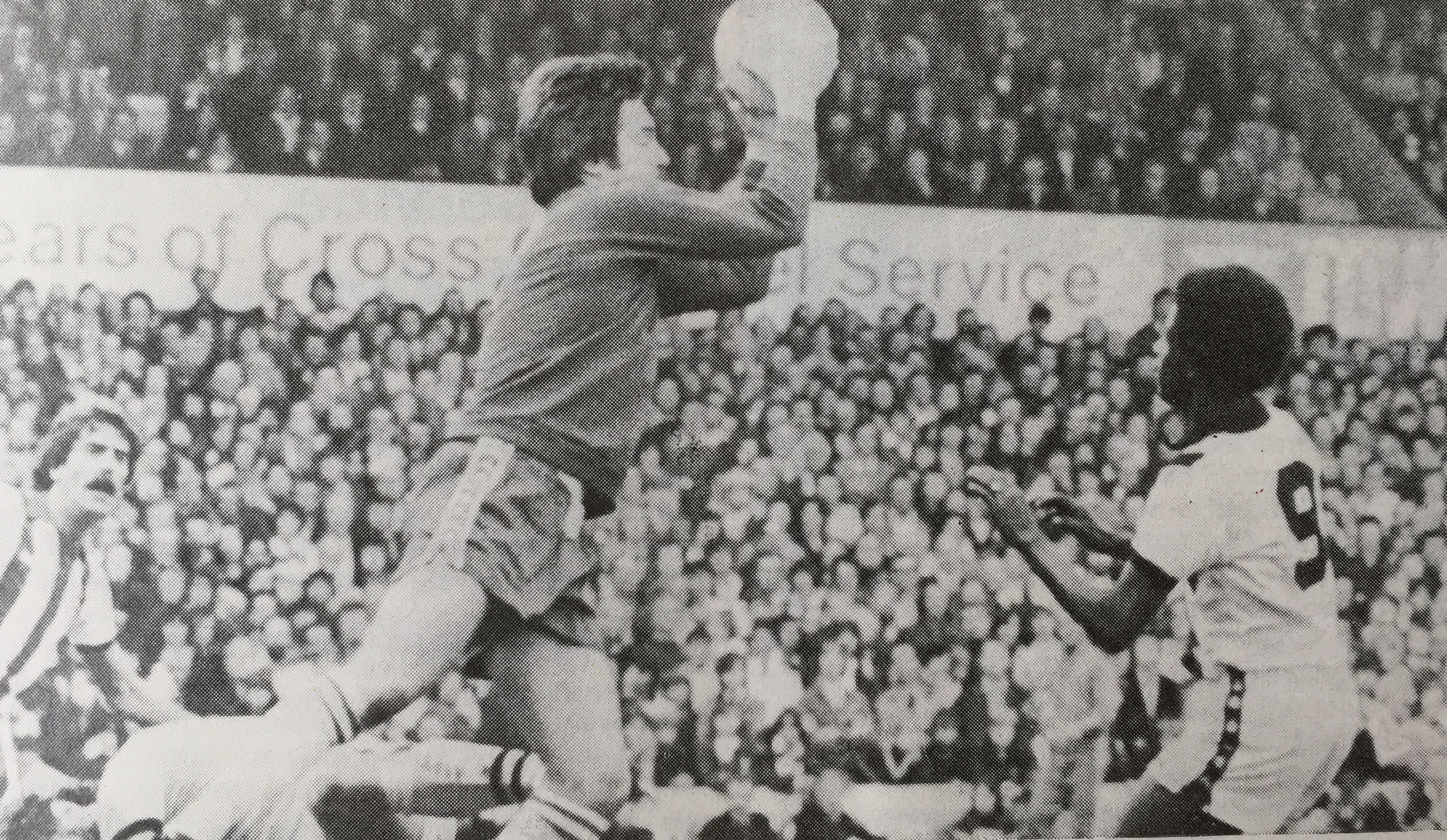
As a replacement for the injured Peter Grummitt, Steele made his debut in a 3-1 defeat away to Crystal Palace but the season was to end in triumph. With Peter Ward making the headlines at one end, Steele kept the ‘keeper’s jersey to the end of the season as Albion won promotion to the old Second Division in runners up spot behind Mansfield Town.

As Albion chased a second successive promotion in 1977-78, Steele’s terrific form meant new signing Graham Moseley had to wait five months to make his debut. Steele played 38 matches but Moseley took over for the final four games of the season, as Albion just missed out.

The following season, manager Alan Mullery opted for Moseley as his first choice but the accident-prone former Derby ‘keeper twice caused himself damage – once with a hedge trimmer and then by falling through a plate glass window – which opened the door for Steele, who, by the season’s end, played 27 times compared to Moseley’s 20.

Steele 4 AlbionSteele was between the posts as the Seagulls won 3-1 at St James’ Park to win promotion to the elite for the first time in their history, a particularly sweet moment considering Newcastle had discarded him early on in his career.
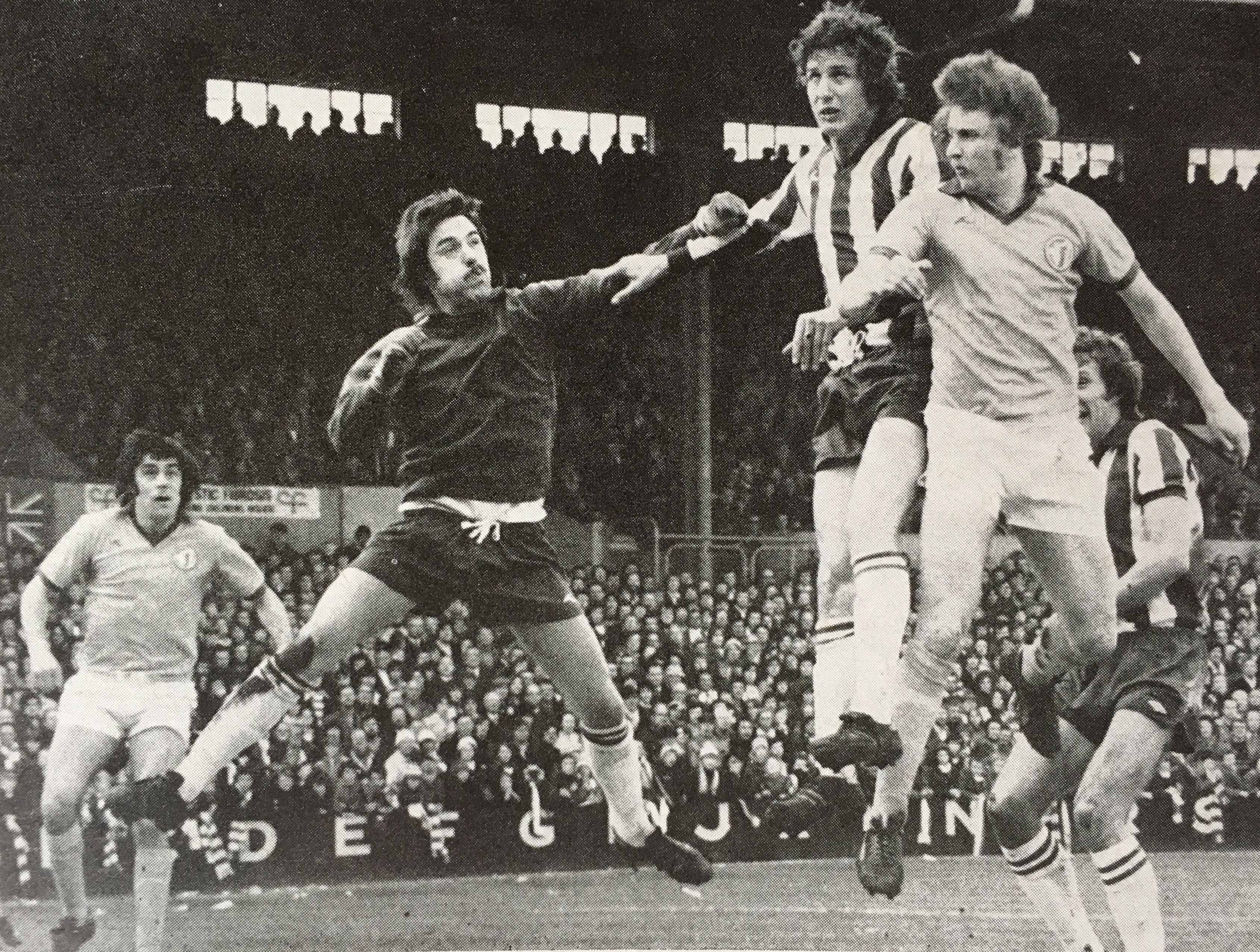
“It was important to go back as part of something, to show that I should have been given a chance,” he said in a 2019 Albion matchday programme article. And rather than join the infamous promotion party train ride back to Brighton, after the match Steele stayed over in Newcastle.

“I wanted to be with my family,” he said. “They’d supported me all the way from when I was a kid. To actually do it at my hometown club as well was a bit special. It was a great day for me, a really great day.”

In Spencer Vignes’ excellent book A Few Good Men, it’s interesting to hear Moseley’s view about his rival for the shirt. “He was very dedicated, much more so than I ever was. He would train every day after everybody else had finished.”

Nevertheless, at the higher level, it was not long before Mullery decided to dispense with Steele’s services, and it came within a matter of days of an amazing incident at Old Trafford when Steele exchanged punches with his own defender, Gary Williams, in a 2-0 defeat.

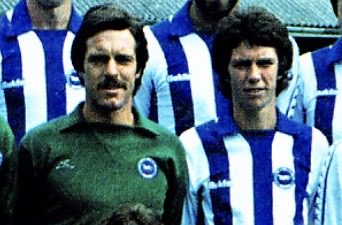
Steele and Williams together in the 1979-80 Albion squad photo

Argus reporter John Vinicombe produced a book (Super Seagulls) to document the history of Albion’s memorable first season in the first tier and covered in detail Steele’s somewhat acrimonious departure.

“Mullery knew from the beginning that one day he would have to choose between the lightning-on-the-line reflexes of Steele and the aerial domination of his great rival, Moseley,” said Vinicombe.

Mullery told the reporter: “Eric is an exceptionally good goalkeeper on the line, there’s no doubting that. But I feel he is not as commanding in the air as Graham, especially on crosses.”

Steele’s departure was felt quite keenly by the fans who, as much as his contribution on the pitch, had applauded his coaching in local schools and support for Sussex charities, in particular Chailey Heritage.

Regardless of that, in October 1979, Mullery turned a sizeable profit on his original investment and sold Steele to Second Division Watford for £100,000.

The articulate Steele shared his thoughts with the readers of Shoot! magazine.

“I didn’t want to leave Brighton,” he said. “That’s the first and most important point. It wasn’t my decision, it was Alan Mullery’s. I think he was wrong and I’ll be proved right in time. Once he’d made up his mind, I had to resolve myself to leaving.

“But it hurt. It took me a long time to get to the First Division and I think that in the ten games I played, I proved I was good enough to keep my place at that level. But once I knew I was on the move, I wanted to get away as quickly as I could.

“I went on the list on a Thursday and Watford came straight in for me the next day. I’d signed for them within a week. I was very happy to join such a progressive club. I would never have come here if I didn’t believe we would be a First Division side in a couple of years.”

Steele maintained he was taking one step back to take two forward and must have remembered those thoughts when Watford won promotion to the top division for the first time in their history in 1981-82.

However, vying for the no.1 jersey with Steve Sherwood, he made just 65 appearances in five years and said it was when watching from the stands as Watford played in the 1984 FA Cup Final that he realised he needed to move on.

Born on 15 May 1954, Steele’s path to professional football was the one taken by many talented Geordies – via Wallsend Boys Club to Newcastle United.

He never made it to the first team at St James’ Park but put that right when he joined Peterborough, setting a record of 124 consecutive appearances, including being part of the side that won the Fourth Division championship in 1974.

After those spells with Brighton and Watford, he linked up with former Newcastle United boss Arthur Cox at Derby County, and was part of their promotions from the third tier through to the first.

When he retired in 1988, it was to run a pub, but he also set up Eric Steele Coaching Services and began an illustrious career in which he has been instrumental in the development of some of the country’s top goalkeepers, working with ‘keepers at Manchester City, Aston Villa, Leeds United, Derby County, and Barnsley, as well as overseas in Australia, Switzerland, Norway, Germany and the United States.

When another former Watford ‘keeper, Tony Coton, was forced to retire as Manchester United’s goalkeeping coach because of injury, he recommended Steele as his successor.

Coton told the Republik of Mancunia website: “Eric Steele was my goalkeeping coach when I was a player at Manchester City, and it soon became evident after just a couple of training sessions that Eric was a unique and talented coach.

“Eric was different due to his innovative teaching style. Every session was challenging and interesting, and his breadth and depth of knowledge was second to none. Because of this I decided to call Eric ‘The Guru’, a name that he is now known by throughout the Premier League.”

As well as former Brighton ‘keeper Wayne Henderson at Villa, Steele also coached Kaspar Schmeichel at Manchester City. And at Man Utd, he famously played a part in Ben Foster successfully saving a penalty in the 2009 League Cup Final penalty shoot-out after the game ended 0-0.

Foster explained: “We went into the shootout as well prepared as possible. We have had things to look at over the last couple of days and before the shootout you can see me looking at an iPad with Eric Steele.

“It had actual video on it and showed where players put things. It is a new innovation for us. Eric brought it when he came to the club. I have never seen anything like it. It is a fantastic tool for us.”

Steele was part of Sir Alex Ferguson’s team at United between 2008 and 2013 and helped to recruit long-standing no. 1 David de Gea.

When Ferguson stood down at Old Trafford, Steele returned to Derby – where he’d previously worked as a coach for four years – under Steve McLaren and then went on to coach young goalkeepers for the English FA. He’s also an ambassador for Evolution Goalkeeper Coaching.

2 Steele claims v Palace
3 Steele Pat Partridge Pipes
4 steele farewell
5 Steele + De Gea
Steele has coached young England goalkeepers

Scrapbook photos from the Albion matchday programme, the Argus, and the republikofmancunia.com.

  • Top one shows Steele in action in one of his early Albion matches, a top-of-the-table clash against Mansfield Town in front of a packed Goldstone. I am one of those supporters crammed into that south west corner terrace!
  • Peter O’Sullivan (left) looks on as Steele claims a cross in a home game against Crystal Palace.
  • Steele and ref Pat Partridge see the funny side of it as spongeman Glen Wilson fixes a facial injury to Steve Piper.
  • A thumbs up to the crowd as Steele says his farewell at the Goldstone.
  • Steele working at Man Utd with David de Gea.

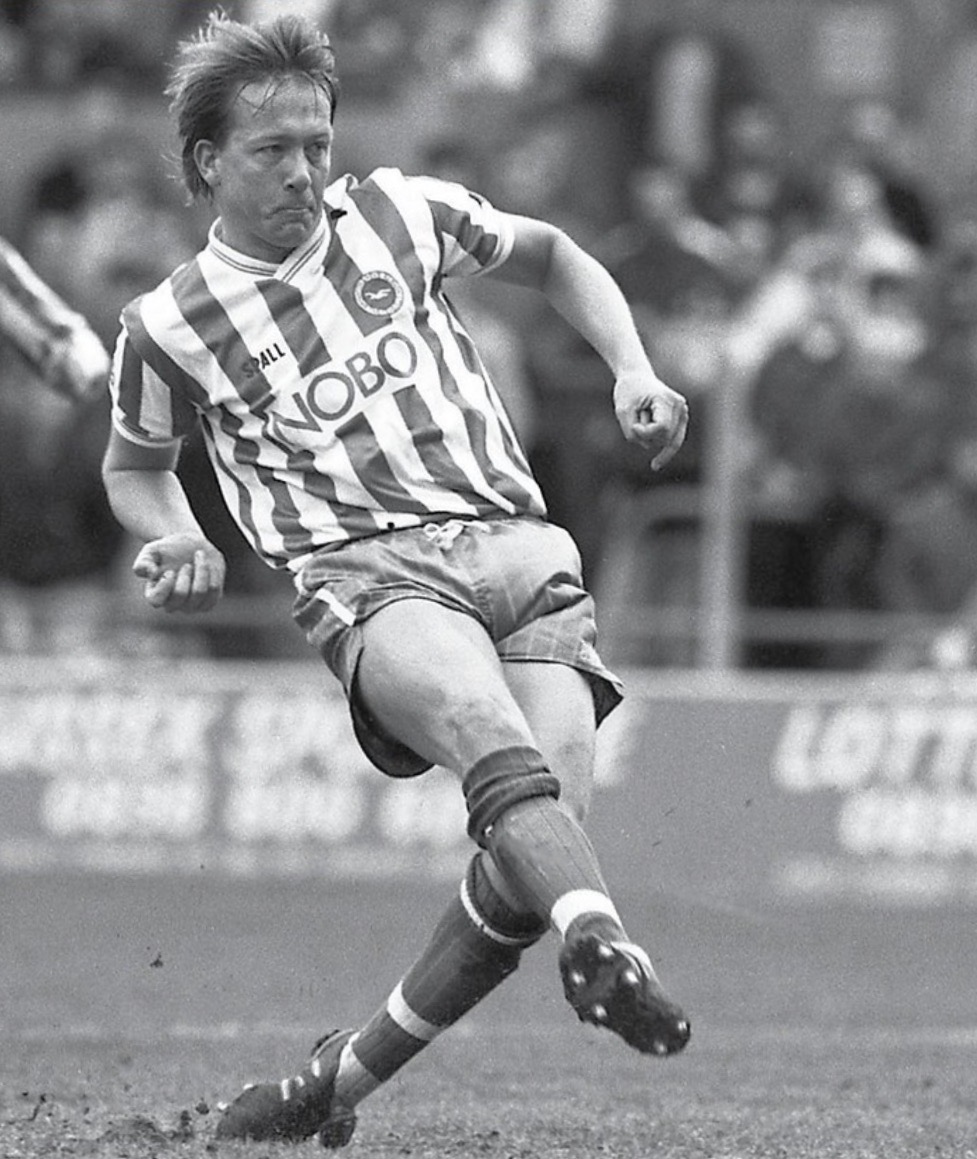
Midfielder Alan Curbishley helped Seagulls to promotion

Screenshot

ALAN Curbishley completed a hat-trick of promotions with new clubs when he was part of Brighton’s successful third tier side in 1988.

He’d previously been promoted after switching from West Ham to Birmingham City and also when moving from Aston Villa to Charlton Athletic.

Curbishley was what you might call West Ham through and through.

Born at Forest Gate on 8 November 1957, within a mile of West Ham station, he was one of five children (elder brother Bill famously promoted and managed The Who and Led Zeppelin and was producer of the films Tommy and Quadrophenia).

Curbishley first played in Brighton at under 11 level, in a Newham Boys side against Brighton Boys at Longhill School, in May 1967. He was later capped for England Boys aged 15 and after joining the Hammers straight from school played for England Youth.

Curbishley won nine England Youth caps under Ken Burton, scoring on his debut in a 1-1 draw against Poland in Las Palmas on 21 January 1975 when England went on to win the Atlantic Cup. Among his teammates were future England captain Bryan Robson, Peter Barnes and Keith Bertschin.

He vied for a starting berth with Mark Nightingale (Palace, Bournemouth, Norwich, Peterborough), making six starts and three appearances off the bench. His last appearance was in a 1-0 win over Wales in Cardiff on 11 February 1976, playing alongside Glenn Hoddle and Gary Owen.

Almost a year earlier, on 29 March 1975, he had made his first team Hammers debut at the tender age of 17, lining up in midfield alongside Trevor Brooking and Graham Paddon in a 1-0 home defeat against Chelsea. Mervyn Day was in goal for West Ham and guarding the opposition net was John Phillips.

At the time, Curbishley was the youngest to play in the senior team although that record was subsequently eclipsed by Paul Allen.

A contemporary of Geoff Pike, Paul Brush and Alvin Martin, they were all in the West Ham youth team defeated 5-1 on aggregate by Ipswich in the 1975 FA Youth Cup Final.

In a midfield dominated by Brooking, Paddon and Pat Holland, and later Alan Devonshire and Pike, Curbishley found first team chances limited, although in 1977-78 he made 36 appearances.

After 85 matches for the Hammers, in 1979 he moved to Birmingham for £275,000. Manager Jim Smith used the proceeds of the £1m transfer of Trevor Francis to Nottingham Forest to buy Curbishley, Frank Worthington, Colin Todd and Archie Gemmill. Curbishley was still only 21 when he made his debut for the Blues on 18 August 1979 in a 4-3 defeat at home to Fulham and he went on to be ever present for Birmingham in that 1979-80 season.

Curbishley earned his one and only England Under 21 cap in a 5-0 thrashing of Switzerland at Portman Road when Justin Fashanu was among the scorers. He had hopes of going to the 1982 World Cup with England, having broken into the England B squad but fractured a kneecap sliding into a tackle with Albion’s Brian Horton. “I missed the rest of the season and the start of the next, and the World Cup squad which I might have broken into otherwise,” he said. “It was the worst disappointment I’ve ever faced.”

He was on the front cover of the matchday programme for a game I went to watch at St Andrew’s on 27 March 1982 when he played for Ron Saunders’ Blues in a 1-0 win over Brighton. But financial issues meant the side was broken up and, the following year, after a total of 155 games, he committed what today seems to be viewed as a cardinal sin by signing for Villa for £100,000, ironically making his debut against Birmingham in a 1-0 win on 4 April 1983.

“I had high hopes of success there with them just having won the European Cup,” he told Dave Beckett in an Albion matchday programme article. “It was soon obvious though that Tony Barton was under pressure from the moment he took over and all the players thought it was just a matter of time before he was sacked.

“He got a raw deal. That season we finished ninth in the league, got to the semis of the League Cup and were knocked out of the UEFA Cup in the last minute on the away goals rule. Villa have never been near that form since, but Tony Barton’s face didn’t fit and he was soon on his way along with all the men he signed.”

After only 36 appearances, scoring once, Curbishley returned to London, dropping back down to the 2nd division, to begin what would be a long association with Charlton Athletic, punctuated only by his spell at Brighton.

Amazingly, although homeless at the time and playing at Selhurst Park, Charlton won promotion back to the 1st Division. Unfortunately Curbishley sustained an achilles tendon injury and only played 10 games in the 1986-87 season.

“I knew I had an achilles injury but the operation was delayed until a week before the start of the new season and consequently I wasn’t fit again until December,” he said. “The manager bought two new midfield players, which I understood, but when I was fit again I couldn’t get back into the side.

“It became apparent that I wouldn’t get much of a chance unless something drastic happened so I’m pleased to have a fresh start.”

After 13 seasons playing in the top two divisions, he left Charlton having scored six times in 63 games and dropped down to the Third to join the Albion for £32,500.

He made his debut in a goalless draw at Chesterfield on 22 August 1987 in front of a crowd of just 2,286.

After the departure of Jimmy Case in 1985, the centre of Albion’s midfield had been crying out for someone who could put their foot on the ball and pass it, and Curbishley stepped neatly into that role, scoring six goals – mostly penalties – in 34 appearances as Brighton won promotion.

“Alan was a very level-headed guy, an excellent passer and really disciplined,” Albion boss Barry Lloyd told Spencer Vignes in a matchday programme article.

In total, over three years on the south coast, Curbishley played 127 games (plus five as sub)  – making his 400th league appearance during the 1988-89 season – and scored 15 goals.

curbs penThe Albion matchday programme featured Curbishley when the Seagulls hosted the Hammers for a Barclays League Division 2 game on 16 September 1989. Describing his time with the East London club, he said: “It was a brilliant set up although I was definitely a bit headstrong in my early days.

“I didn’t really grow up until I moved to St Andrew’s and that’s where I had my best playing days.”

Lou Macari’s side in 1989 included Curbishley’s old pal Alvin Martin and future Albion manager Liam Brady but the Seagulls ran out 3-0 winners (goals from Kevin Bremner, Robert Codner and Garry Nelson).

In 1990, Curbishley began his coaching career, returning to Charlton initially as player-coach under Lennie Lawrence. When Lawrence left in 1991, Charlton made the somewhat unusual decision to appoint joint managers: Curbishley and Steve Gritt (who would later be at the helm when Albion narrowly escaped dropping out of the league).

Curbishley’s first signings for Charlton were former Albion teammates Nelson and Steve Gatting and he later plundered young winger John Robinson from the Seagulls. After four years, Curbishley took sole charge at The Valley and led Charlton to some of the most successful times in their history.

Considering their resources, Curbishley turned Charlton into a steady top flight club and model of stability, consistently securing a mid-table finish.

Sean Cole in The Bleacher Report described him as “one of the most promising managerial talents of the new millennium” and in 2006, in the wake of Sven-Goran Eriksson’s departure as England manager, Curbs had ‘tea and biscuits’ with then chief executive Brian Barwick – but Steve McLaren got the job instead.

In December 2006, Curbishley landed what surely would have been considered his dream job – manager of West Ham.

It was quite a reunion of old pals when Brighton visited Upton Park for one of his first games in charge, in the third round of the FA Cup in January 2007. Albion boss Dean Wilkins and coach Ian Chapman had both been teammates while physiotherapist Malcolm Stuart was still wielding the magic spray.

In front of 32,874, Hammers ran out fairly comfortable 3-0 winners with Mark Noble scoring his first senior West Ham goal and Carlos Tevez a real handful up front. These were the respective line-ups:

West Ham: Carroll, Dailly, Ferdinand (Spector 45), Gabbidon, McCartney, Benayoun, Mullins, Noble, Boa Morte (Newton 73), Cole (Bobby Zamora 68), Tevez.
Subs not used: Green, Sheringham. Goals: Noble 49, Cole 58, Mullins 90.

Brighton: Wayne Henderson, Joe O’Cearuill, Joel Lynch, Guy Butters, Kerry Mayo, Tommy Fraser (Gary Hart 51), Adam El-Abd, Dean Hammond, Alexandre Frutos (Sam Rents 67), Alex Revell (Joe Gatting 84), Jake Robinson. Subs not used: Michel Kuipers, Richard Carpenter.

Fans’ website westhamtillidie recalled: “Perhaps Curbs’ greatest legacy at the club was the £7m signing of his former Charlton protégé Scott Parker, who went on to win the Hammer of the Year prize three times and pick up a Football Writers’ Player of the Year Award during his time at the club.”

Sadly, though it was to all end in tears and Curbishley quit in protest at the then Icelandic owners’ failure to consult him over the sale of defenders Anton Ferdinand and George McCartney.

In what must have been a tough heart-v-head decision, he resorted to a legal resolution of the situation and eventually won a case for constructive dismissal, eventually receiving £2.2m in compensation. But it was the last manager’s job he had.

“It took me a year to sort out my problem at West Ham,” he told The Independent. “And then, after that, I was perhaps a little too picky. I was told by other senior managers ‘don’t be out too long’ but I was waiting for a job that I thought was the job for me.”

Job vacancies came and went, Curbishley’s name was generally on all the shortlists, but he never again made it through to the manager’s chair. There was a brief moment at Fulham when he was technical director assisting Rene Meulensteen but when Meulensteen was swiftly axed, new manager Felix Magath brought in his own people.

He rejoined the Fulham coaching staff in March 2015 and took charge of training in November 2015 when Kit Symons was relieved of his managerial duties but Stuart Gray took charge of the team before Slavisa Jokanovic was appointed.

In 2016, Curbishley brought out a book, Game Changers: Inside English Football: From the Boardroom to the Bootroom (published by HarperSport) and was a regular pundit on the Football on 5 programme covering Football League games.

Further reading

https://www.westhamtillidie.com/posts/2014/11/07/preview-aston-villa

http://bleacherreport.com/articles/1415997-the-curious-case-of-alan-curbishley-footballs-forgotten-man

https://www.whufc.com/club/history/managers/alan-curbishley#C1vPoA9yPR1kYluJ.99

  • Pictures show westhamtillidie’s image of Curbishley in West Ham colours; the midfielder on the front of a Birmingham matchday programme 1982; in Villa’s colours from a Match Weekly annual, an Argus shot of Curbs scoring a penalty for Brighton against Man City, and other images from the Albion match programme.