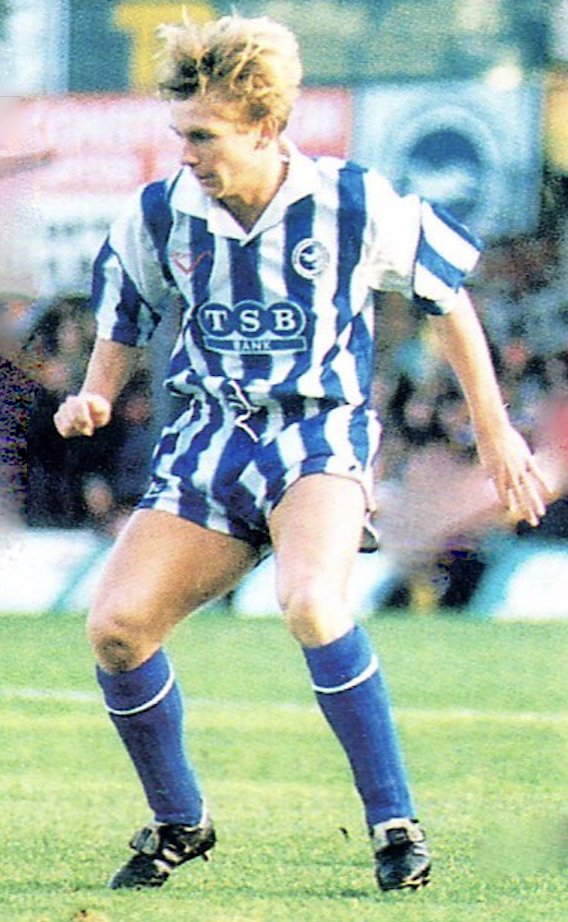
Edwards stole the limelight when Beckham made his debut

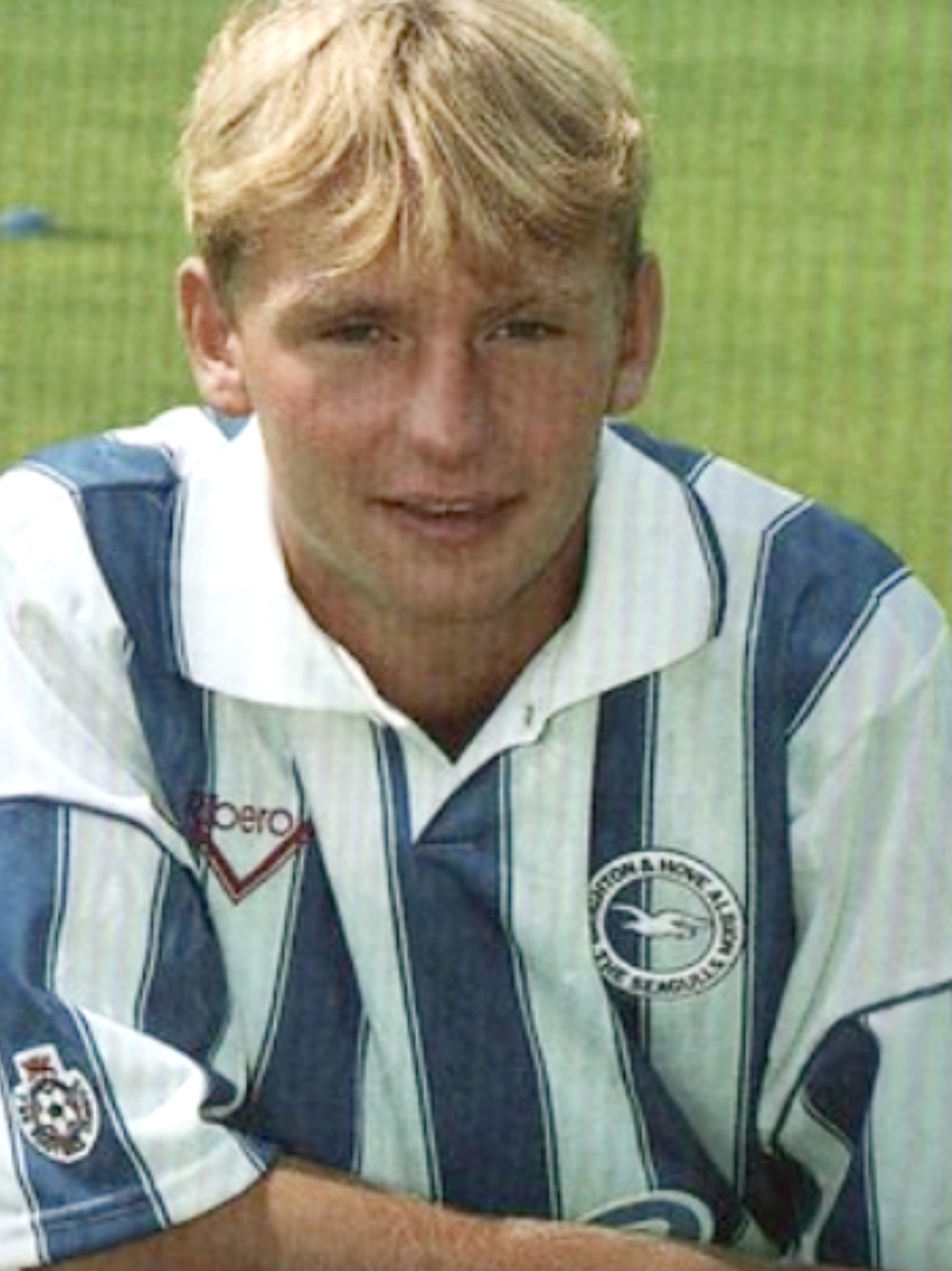
THE STORY of Matthew Edwards scoring for Brighton against Manchester United in the same cup match in which David Beckham made his debut has been told many times, and who wouldn’t be proud of that memory.

The history books can’t take it away from him, nor should they. “Scoring that goal against Manchester United was certainly the highspot of my career. Everyone wanted to talk about it and I was mentioned in all the papers and (I was) interviewed on television,” he said.

While that second round League Cup game on 23 September 1992 stands out, Edwards actually played 78 matches for the Albion after being released by Tottenham Hotspur, where his only first team outings were in testimonials or friendlies.

Albion were a very different proposition in September 1992, just beginning to reacquaint themselves to life back in the third tier of English football barely 16 months after having come close to returning to the top flight.

Big name players had been sold to try to balance the books and manager Barry Lloyd had to turn to free transfers, loanees and young hopefuls to put out a side.

Edwards was in that category and he probably only played in that United match because the respective parent clubs didn’t want loan forwards Steve Cotterill and Paul Moulden to be cup tied. He played alongside Scot Andy Kennedy, a recent arrival from Watford.

The youngster seized his chance and made a name for himself by heading home an Ian Chapman cross to cancel out Danny Wallace’s 35th-minute opener for the illustrious visitors.

Beckham had been sent on for his United bow in place of Andrei Kanchelskis (serenaded by a familiar North Stand chant of ‘Who the f****** h*** are you?’) but the game finished 1-1 at the Goldstone Ground, setting things up nicely for the second leg at Old Trafford (which United won 1-0).

Edwards once again earned a place in the headlines four months later when he scored the only goal of the game in a FA Cup third round win over south coast rivals Portsmouth, a side playing in the division above the Seagulls, and who had reached the previous season’s semi-finals.

Born in Hammersmith on 15 June 1971, the family lived in Brighton for a time and the young Edwards, who first started kicking a football around the age of six, played for local side Saltdean Tigers. At 13, he was on the Albion’s books under the guidance of Colin Woffinden, a former player who became youth coach.

But the family relocated to Surrey and it was while playing schoolboy football for Elmbridge Borough that he was spotted by Tottenham. In an extended interview with Lennon Branagan, Edwards explained how he got his big break courtesy of Fred Callaghan, Fulham’s left-back for 10 years who managed Brentford in the 1980s.

His son was playing in the same side as Edwards and Callaghan recommended Edwards to his friend Ted Buxton, a renowned coach and scout, who was working for Spurs at the time.

“I didn’t know that Ted had come along to watch me and then after one of the games they said: ‘Do you want to come to Spurs?’” Edwards recounted.

Young Spur Matthew Edwards

He signed associate schoolboy forms and while at Hinchley Wood Secondary School, Esher, travelled up to White Hart Lane on a Tuesday and Thursday night for training on an indoor pitch next to the main reception area.

On leaving school, he was taken on as an apprentice at Spurs and worked through his YTS under the auspices of youth team manager Keith Blunt and coach (and Blunt’s successor) Keith Waldon.

At 17, he signed on as a professional and he was on the books for three and a half years.

“We were quite successful in the reserves and I think that we used to win the league pretty much every season,” Edwards recalled.

It was tours abroad that he remembered most fondly from his time at Spurs, playing in Hawaii and Japan, and he also joined up with the first team squad for tours to Norway, Ireland and Italy.

A rare first team opportunity came in Billy Bonds’ testimonial at West Ham on 12 November 1990.

“I was young and had long blond hair and I can remember getting absolutely slaughtered by the West Ham fans that day,” he said.

In his final year, he went on loan to Reading, where he played eight games before returning to Spurs, and later the same season went to Peterborough on a similar arrangement, although he only played in one cup match for Posh.

He sensed his days at Spurs were drawing to a close, telling an Albion matchday programme: “I knew it was time for me to go when (manager) Peter Shreeves forgot my name!”

He said: “I had three months on loan at Peterborough but didn’t get a league game. Martin Hinshelwood rang me up in May and asked if I would be interested in coming to Brighton.”

Edwards marked by ex-teammate Justin Edinburgh

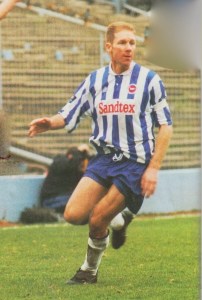
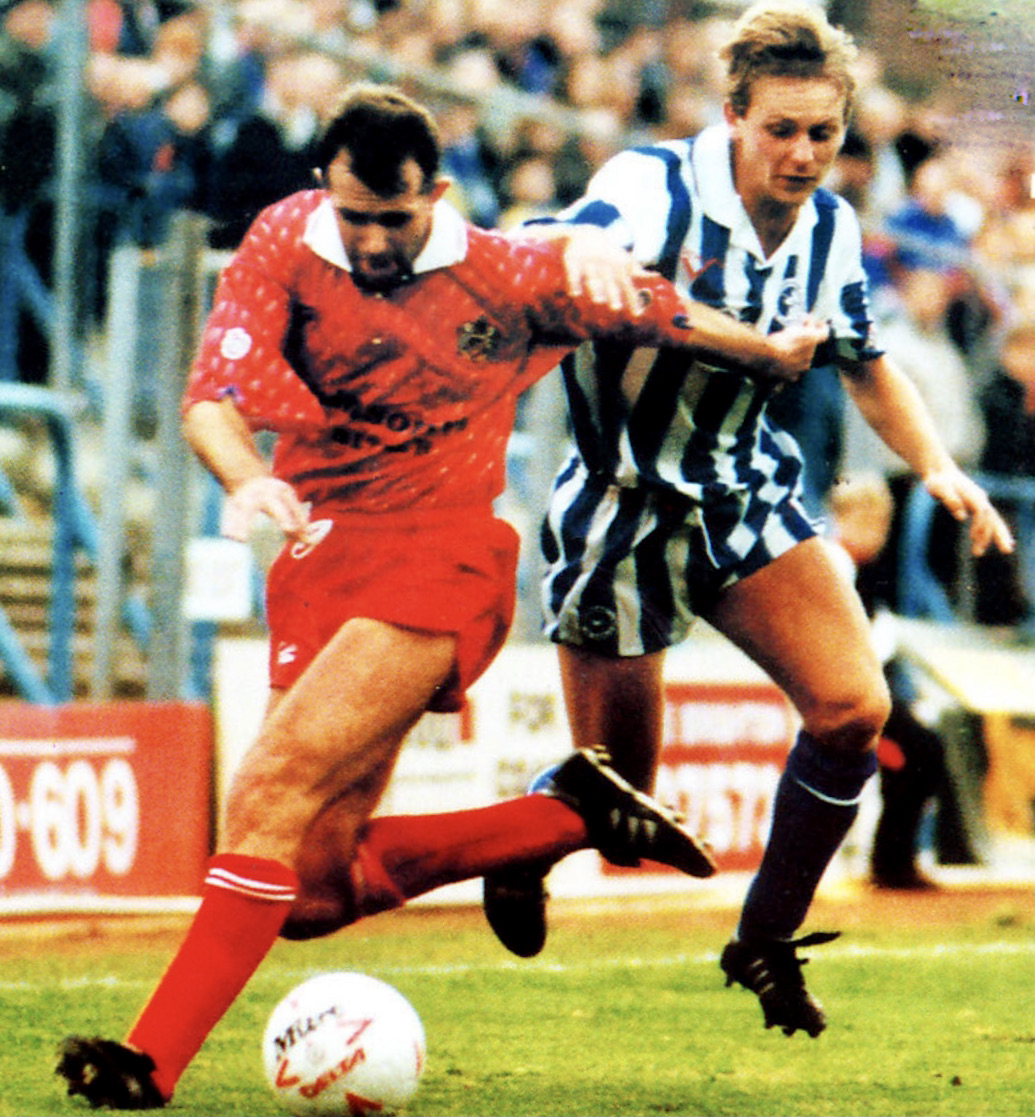
One of the first matches he played for the Seagulls was in a pre-season friendly against his former club, a 1-1 draw at the Goldstone on 29 July 1992. In a shocking excuse for a programme for the visit of Croatian side FC Inker Zapresic, a barely recognisable picture of the new signing was included. Thankfully a more professional programme appeared for the opening home league game, against Bolton Wanderers, and Edwards was pictured (left) in action up against his former teammate Justin Edinburgh

After Cotterill and Moulden had returned to their parent clubs because Albion couldn’t afford to make their moves permanent, Edwards started to forge a fledgling forward partnership with Kennedy. But Kurt Nogan took over and his prolific goalscoring saw Edwards have more of a peripheral role, although he ended the season taking over from soon-to-depart Clive Walker on the left wing.

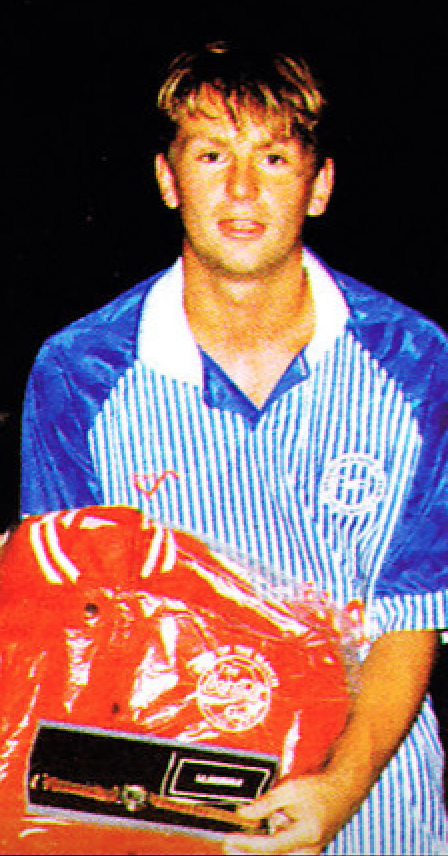
Edwards was in the starting line-up for the first half of the 1993-94 season, won a man-of-the-match award for his performance against Gillingham in the League Cup and scored in a 2-2 draw at home to Huddersfield.

He was the programme cover boy for the Exeter City home game on 2 October (0-0) but, with Albion dangerously close to the drop zone, Liam Brady took over from Lloyd and it soon became quite a different picture for the former Spurs youngster.
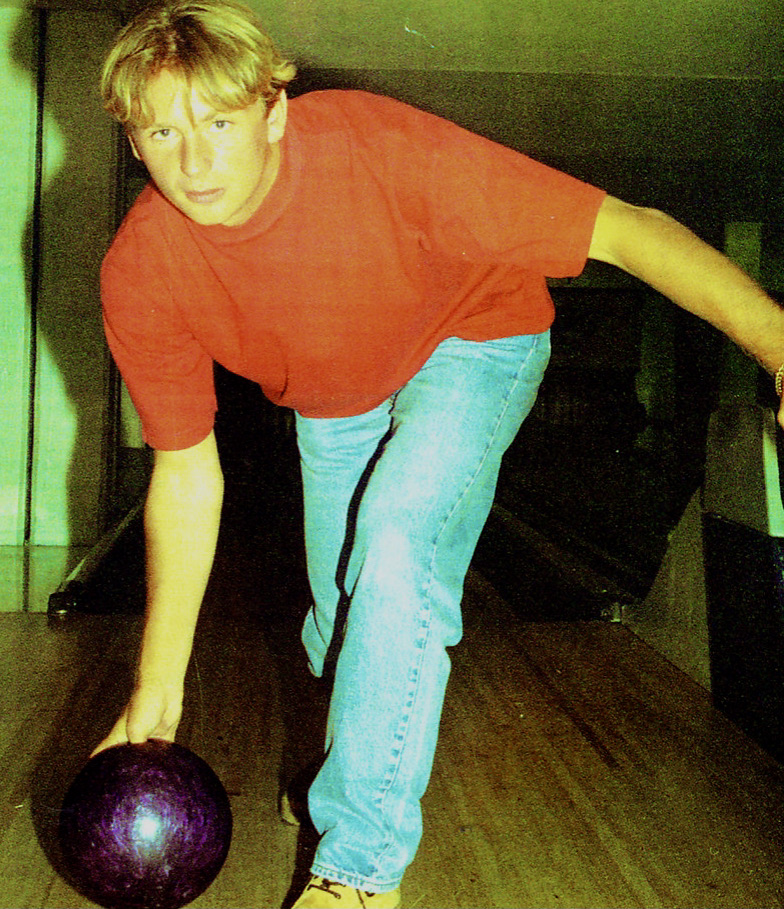
He played in the first seven games under the new boss, and scored in a 3-3 FA Cup tie v Bournemouth, but Brady had his own ideas and started looking elsewhere for solutions.

“Me and him didn’t really see eye to eye, or he didn’t particularly fancy me as a player,” Edwards told Branagan.

Although Edwards was a sub three times in March, his appearance off the bench in a home 1-1 draw with Burnley was his last involvement with the first team.

A regular in the reserves in the latter part of the season, at the end of it he was released and joined Conference side Kettering where he had barely got his shorts dirty before suffering a cruciate ligament injury.

“That that was the start of the end of my career as such,” he confessed. “I had a year out of the game.”

On his return to fitness, he had two good seasons for Walton & Hersham, and then Enfield. “My knees just kept on going for me,” he recounted. Over the course of another couple of years, he appeared for Carshalton Athletic, Sutton United, Molesey, Yeading, Bognor and Egham.

But he said: “My knees just weren’t up to playing football, so I had to call it a day and that was the end of the career.”

Interviewed for an Albion matchday programme article in 2019, he told journalist Spencer Vignes he had developed a career in computer software sales and had been a visitor to the Amex on behalf of a ticketing company that worked with the club.

He had subsequently moved on to providing similar expertise for visitor attractions such as zoos, museums, aquaria and cathedrals.

Reflecting on his all too brief career, he said: “I suppose I’m lucky in that I was in the right place at the right time to play for the Albion at the Goldstone, rather than Withdean. Saltdean Tigers to Spurs to Brighton; there can’t have been many people who have done that!”

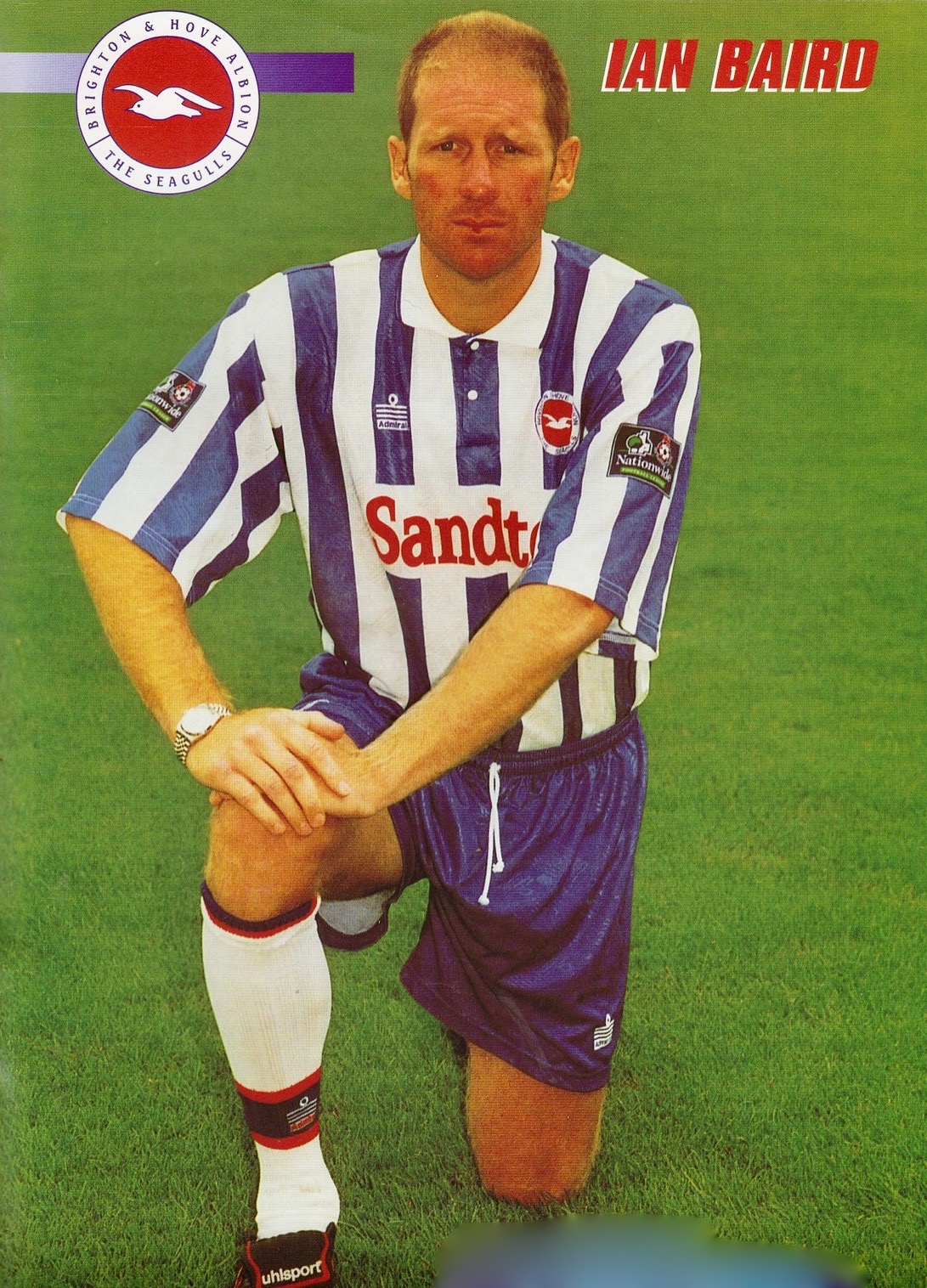
Fiery Ian Baird saw red in crucial last Goldstone game

FIERY Ian Baird was no stranger to yellow and red cards – in five games for Newcastle United he was booked three times!

And in Brighton’s last ever game at the Goldstone Ground, against Doncaster Rovers, Baird was sent off long before the game had even reached half time.

Something of a disciple of Joe Jordan, the tenacious centre forward who starred for Leeds United and Manchester United, Baird was his teammate at Southampton and played under the Scot at Hearts in Scotland and at Bristol City.

Baird didn’t fear incurring the wrath of supporters, happily playing for arch-rival clubs in his pursuit of goals. Indeed, on Teesside he earned a place in fans’ folklore by scoring two goals in an end-of-season clash that not only kept Middlesbrough up but prevented their noisy north-east neighbours Newcastle from getting automatic promotion to the elite (to make matters worse, they then lost a play-off semi-final to Sunderland).

Baird scored twice in that 4-1 win over United on the final day of the 1989-90 season at Ayresome Park, and earlier the same season he’d scored a winner for Leeds United against Newcastle at Elland Road.

Baird played on the south coast for both Southampton and Portsmouth before making the Albion his 10th and last English league club. He joined for £35,000 from Plymouth Argyle when the club was in turmoil off the field and floundering at the bottom of the basement division. But he went on to net 14 goals in 41 games.

He spoke about the move to Tim Ashton of the Sutton and Croydon Guardian in July 2016. “I was at Plymouth, and Jimmy Case took me on and explained all the problems to me about the likes of (David) Bellotti,” he said.

“To be honest, as a player, all you are bothered about is making sure you get your wage, and you’re not really taking any notice of what he is saying.

“I played at Brighton on many occasions, I have been there with Leeds and Middlesbrough, and it was always a favourite place of mine to go – and as soon as I got there as a player, I knew the importance of survival.”

Baird continued: “Brighton are a big club, and I could not believe what was happening. It took a strain on Jimmy, that’s for sure, and he was not the man he was normally with all the pressure.

“Then he was sacked and we were 12 points adrift at Christmas – they brought in Steve Gritt, and he brought a different kind of management.

“It got to February and March time, then all of a sudden Doncaster Rovers and Hereford were sucked into it – we had to beat Doncaster in the final (home) game.”

Sent off 11 times in his career, it was his dismissal just 18 minutes into that game in 1997 that threatened the very existence of the club – and he was captain that day!

Baird later told portsmouth.co.uk: “It was just a natural thing really. Sometimes my enthusiasm got the better of me. There were plenty of times I chinned someone or got into trouble.

“The most stupid one was when me and Darren Moore had a fight. He was playing for Doncaster and I was playing for Brighton in the last game at their old Goldstone Ground.

“He came through the back of me, there was a bit of afters and I ended up trying to give him a right hook, and there was a bit of a ruck.

“We had a bit of rough and tumble and I was just lucky he didn’t chase me up the tunnel because he’s huge!”

Thankfully, Albion famously still won that match courtesy of Stuart Storer’s memorable winner. Because red card bans were delayed for 14 days back then, Baird was able to play in what has since been recognised as the most important game in the club’s history: away to Hereford United.

As the history books record, it was Robbie Reinelt, on as a sub, who stepped into the breach to rescue a point for the Albion, enough to preserve their league status and to send the Bulls down.

In November of the following season, Baird still had six months left on his Brighton contract, but a surgeon told him he should not play pro football any more because of a troublesome knee, so he decided to retire.

But, when he had turned 35, he said: “I had a phone call from Mick Leonard (former Notts County and Chesterfield player) who played in Hong Kong, and he said they were desperate for a striker.

“I went for a month’s trial and ended up signing an 18-month deal. My knee flared up again and they offered me a coaching role, and it ended up with me managing the side.”

He added: “Then I was put in charge of the national side for the Asian Cup qualifiers and we played in Jakarta in front of 75,000 people, and then in Cambodia in front of 1,200 people – it was certainly an experience that is for sure.”

Over the 17 years of his league career, Baird commanded a total of £1.7m in transfer fees; £500,000 Boro paid Leeds being the highest.

Although born in Rotherham on 1 April 1964, the family moved first to Glasgow and then Southampton when Baird was small, his father having sailed from the south coast port when working on the Queen Mary.

The always comprehensive saintsplayers.co.uk notes the young Baird survived meningitis as a six-year-old and later came to the attention of Southampton when appearing in the same boys team, Sarisbury Sparks, as their manager Lawrie McMenemy’s son, Sean.

The excellent ozwhitelufc.net.au details how Baird’s footballing ability saw him play for Bitterne Saints, St. Mary’s College, Southampton, Southampton and Hampshire Schools, before earning England Schoolboy caps in 1978-79 alongside the likes of Trevor Steven and Mark Walters.

He was offered terms by Swindon Town but he chose to stay closer to home and Southampton took him on as an apprentice in July 1980. He turned professional in April 1982 but McMenemy’s preference for old stagers Frank Worthington and the aforementioned Jordan limited his opportunities and he made just 21 appearances for Saints, plus three as a sub, scoring five times.

He was sent out on loan a couple of times: to Cardiff City in November 1983, where he scored six goals in twelve League games, and that spell at Jack Charlton’s Newcastle in December 1984 where aside from a booking in each of his four starts and one appearance from the bench, he scored once – in a 2-1 defeat at West Brom on Boxing Day.

Taking the advice of former teammate Jordan, Baird signed for Eddie Gray at Second Division Leeds in March 1985 and undoubtedly his most successful playing years were there, in two separate spells.

He played more than 160 matches and scored 50 goals. In the 1986-87 season, Gray’s successor, Billy Bremner, made him captain. The Yorkshire Evening Post spoke of “the powerhouse striker’s fearless commitment, no-holds-barred approach and goalscoring ability”.

In the blurb introducing his autobiography Bairdy’s Gonna Get Ya! (written by Leeds fan Marc Bracha) it says “he’s best remembered for his spells at Leeds, where goals, endless running, will to win and fearless approach ensured he was adored by the fans”.

In the 1987-88 season, though, he was wooed by the prospect of playing at the higher level he had just missed out on with Leeds (they’d lost in end-of-season play-offs) and signed for Alan Ball at Portsmouth for £250,000; he later described it as “the worse move I ever made”.

The season was disrupted by injury and disciplinary problems, and he returned to Leeds the following season, being named their Player of the Year in 1989.

But when ex-Albion winger Howard Wilkinson, then manager of Leeds, signed Lee Chapman, Baird sought the move to Boro. He told Stuart Whittingham in 2013 for borobrickroad.co.uk:

“I felt a little aggrieved and basically I spat the dummy out and asked for a move.

“He (Wilkinson) said that he didn’t want me to go but I insisted and within 24 hours I was speaking to Bruce Rioch and Colin Todd and I was on my way to Middlesbrough.”

Curiously, though, when Leeds won promotion at the end of the season, Baird picked up a medal because he had played his part in the achievement.

At the end of the 1990-91 season, Baird spent two years playing for Hearts under Jordan, although a torn thigh muscle restricted the number of appearances he’d hoped to make and at the end of his deal he moved back to England and signed for Bristol City, initially under Russell Osman and then Jordan once again.

After his experience in Hong Kong, Baird returned to Hampshire to put down roots back in Southampton, and pursued business interests in vehicle sales/leasing and the sports gear industry. He also spent five years managing Eastleigh before becoming Paul Doswell’s assistant at Sutton United. He then followed him to Havant & Waterlooville in May 2019.

Teenage prodigy Newhouse quit game to teach maths

AIDAN NEWHOUSE scored twice on his Albion debut but only started two games for the Seagulls!

The former Fulham striker netted two of Brighton’s six goals in the 1999-2000 season opening match at the Withdean Stadium.

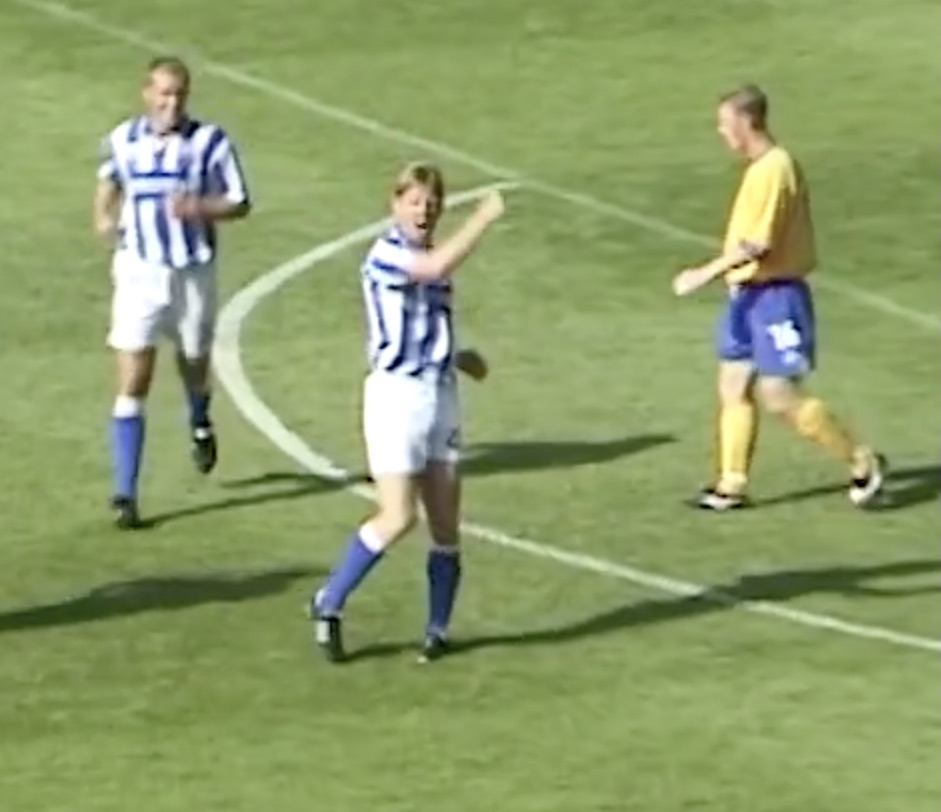
He replaced hat-trick man Darren Freeman with the Albion 4-0 up on 7 August 1999 and promptly added two more goals to complete a 6-0 rout of Mansfield Town (pictures below).

Newhouse, wearing the no.25 later worn iconically by Bobby Zamora, was given a start in a 2-0 league cup defeat away to Torquay United. Although he regularly went on as a substitute, often for Freeman, he only began one other game: a 1-0 home league win over Cheltenham Town.

Newhouse had limited opportunities in Albion colours

Newhouse had previously played under manager Micky Adams at Fulham in 1997, and, unluckily for him, Freeman and Gary Hart were the first choice forward choices in those opening months.

Competition for places intensified in the autumn with the arrival of Warren Aspinall and Lorenzo Pinamonte. Newhouse was swiftly on his way to Conference club Sutton United.

When they were relegated at the end of the season, he switched to Northwich Victoria in 2001, but only played one match before quitting and becoming a schoolteacher.

Born in the Wirral town of Wallasey on 23 May 1972, Newhouse showed so much early promise that he made his debut for Chester City before his 16th birthday.

He was just 15 years and 350 days old when he was sent on as a substitute by manager Harry McNally on the final day of the 1987–88 season as Chester won away at Bury 1–0 in the Third Division.

The talented teenager was in David Burnside’s 1988-89 England side for the UEFA Under-18 Championship preliminary matches against Greece (home and away), France and Czechoslovakia, scoring in the 3-0 win away to Greece on 8 March 1989. He played up front with Andrew Cole, later of Manchester United and Newcastle United fame.

The following season he went on as a sub for Cole in a 0-0 draw with Denmark at Wembley; a game which was played at Wembley before the England-Brazil full international. Three weeks later he scored England’s third when he started in a 3-0 win over Poland, another game played before a full international (England v Denmark).

In July the same year, he started all three of England’s matches (a draw and two defeats) when they finished fourth in the UEFA Under-18 Championship in Hungary.

Chester cashed in on their young prodigy, selling him to then First Division Wimbledon for £100,000 in February 1990.

First team opportunities for Wimbledon were few and far between for Newhouse and he is in the same exalted company as former Albion loanee Gary Bull in being one of only four players to have scored on their single Premier League appearance.

Wimbledon scorer

Ironically, it came in a match in 1992-93 against Aston Villa best remembered for Dalian Atkinson’s individual goal that won the BBC’s Goal of the Season award. “It was deflected past the goalkeeper,” Newhouse told premierleague.com. “It was a bit of a low-life goal compared to Dalian Atkinson’s.”

It was Bobby Gould who gave him his Wimbledon debut but a stomach injury halted his progress under Gould’s successor Ray Harford, as well as the form of John Fashanu and Terry Gibson.

In a 1990-91 season matchday programme article, Newhouse said: “I was really looking forward to this season. Bobby Gould had given me a taste of first team action and I felt I was ready to really stake a claim for a place.

“Then I picked up the injury and it took me months even to get back into full training let alone playing well.”

Although he was a Wimbledon player for seven years, he went out on loan on four occasions: to Tranmere Rovers, Port Vale, Portsmouth and Torquay United. He eventually left permanently for Fulham in 1997.

He scored four goals in only 12 league and cup matches for Fulham: three in a two-legged League Cup match against Wycombe Wanderers and one in the league in a 2-0 win away to Bristol City on 2 September 1997 (Richard Carpenter scored the other). But, only a few weeks’ later, Adams was controversially replaced by Ray Wilkins and Kevin Keegan under the new Mohammed Al-Fayed regime.

Scoring for Fulham

Before long, Newhouse was on his way too. A £30,000 fee took him to Swansea City although, by the time he had arrived, Adams’ short tenure as boss was already over, his role filled by his former no.2 Alan Cork.

It’s probably an understatement to say things didn’t work out for Newhouse in South Wales. Indeed, in a FourFourTwo magazine poll inviting supporters to name their club’s worst player, Newhouse earned the tag from Swansea fans.

He failed to score in 17 appearances across two seasons and Steven Carroll, of the SOS Fanzine, cited a particular game in February 1999, when Carlisle visited the Vetch Field, to back up the claim.

“Due to injuries and suspensions, Newhouse was awarded a rare start. Early on, he was put through on goal and fouled by the ‘keeper inside the box – but while the referee looked set to award a penalty, with said goalkeeper on the floor and both Newhouse/the ball free, our hapless striker shot from close range and missed an open goal. No penalty.

“In the second half, Stuart Roberts received the ball on the edge on the box and was about to shoot, only for Newhouse to kick him in the back of the leg. He never played again after that.”

After retiring from the game in 2001, Newhouse became a maths teacher and he told premierleague.com: “Not all of us are Stevie G and the likes of Neymar,” he said. “I played 13 years, made about £250 a week on average.

“It shows you that, you know, we can do all sorts of things and eventually, to do a job that you enjoy, you will need some education. You will need that to give you an option and a choice.

“Teaching…it’s one of those things. It’s like football, there’s a camaraderie between you and the class.

“Once the guys realise they’re part of a team, there are some similarities. You can have a laugh with the lads and they realise you are there to try and help them succeed.”

‘Yogi’ Baird knows about last game drama

A STRIKER who brought last-game-of-the-season smiles to the faces of Middlesbrough fans earned only notoriety in Brighton & Hove Albion’s final game at the Goldstone Ground.

Journeyman hard man forward Ian Baird earned his place in Teesside folklore by scoring two goals in an end-of-season clash that not only kept Boro up but prevented north east neighbours Newcastle from getting automatic promotion to the elite.

But Brighton fans witnessed Baird, captain at the time, being sent off just 18 minutes into the 1997 game against Doncaster Rovers which thankfully nonetheless ended up in victory courtesy of Stuart Storer’s memorable winner.

The dismissal meant, though, that Baird would not be able to play in what has since been recognised as the most important game in the club’s history: away to Hereford United.

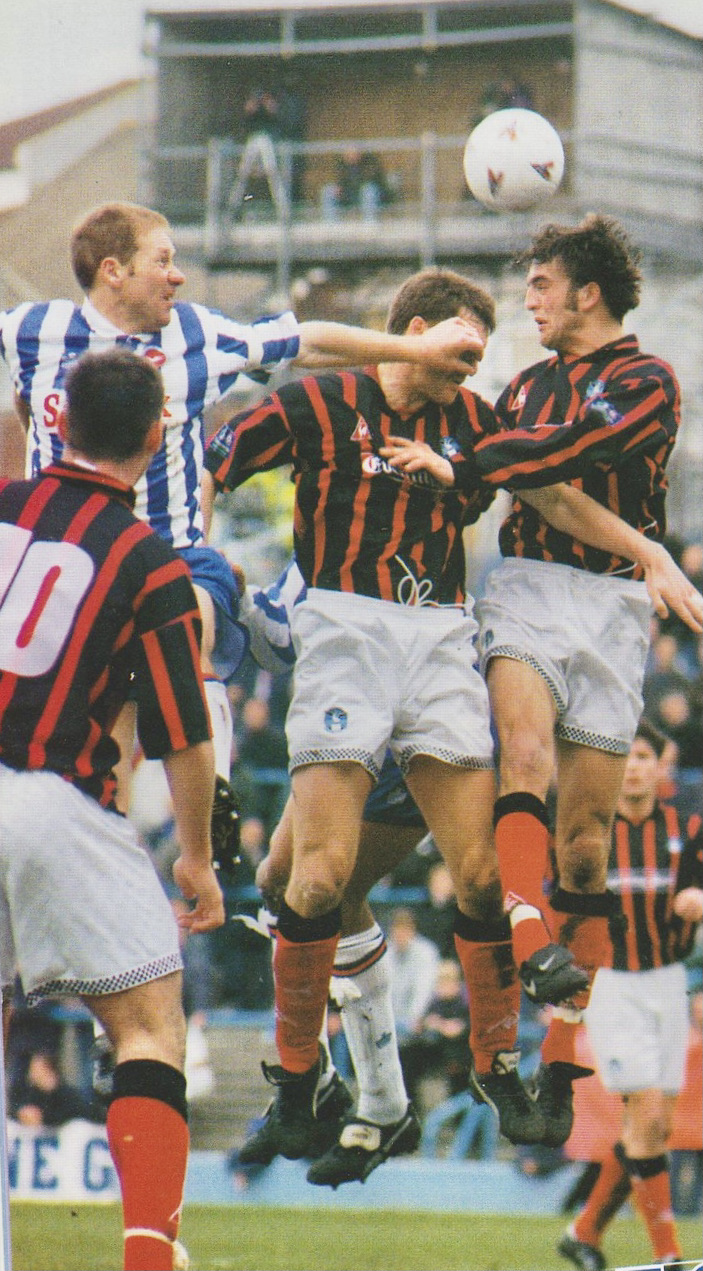
Perhaps we should not have been surprised. Baird was sent off 11 times in his career and he later told portsmouth.co.uk: “It was just a natural thing really. Sometimes my enthusiasm got the better of me. There were plenty of times I chinned someone or got into trouble.Bairdy leap

“The most stupid one was when me and Darren Moore had a fight. He was playing for Doncaster and I was playing for Brighton in the last game at their old Goldstone Ground.

“He came through the back of me, there was a bit of afters and I ended up trying to give him a right hook and there was a bit of a ruck.

“We had a bit of rough and tumble and I was just lucky he didn’t chase me up the tunnel because he’s huge!”

Screen Shot 2021-04-29 at 19.52.10To be fair, Baird had a reasonable goalscoring record at Brighton, netting 14 in 41 games following a £35,000 move from Plymouth Argyle.

Brighton was his 10th and last league club and over the 17 years of his league career he commanded a total of £1.7m in transfer fees, the £500,000 Boro paid Leeds being the highest.

At the start of the 1989-90 campaign, Baird scored the winner for Leeds against Newcastle at Elland Road and then, following his £500,000 January move to Teesside, scored twice in a 4-1 win over United on the final day of the season at Ayresome Park.

Those goals – along with a Bernie Slaven brace – helped prevent Boro going down and meant Newcastle missed out on automatic promotion (they then lost the play-off semi-final to Sunderland).

Years later Baird told chroniclelive.co.uk, ahead of the writing of his autobiography: “Yeah, I enjoyed that. That was some game, given what was at stake. And I loved playing for Boro. We had a great team eventually and Bernie Slaven and myself were a pretty decent partnership.”

Interviewed by Stuart Whittingham in 2013 for borobrickroad.co.uk, Baird explained how he moved to Boro because ex-Albion winger Howard Wilkinson, then manager of Leeds, signed Lee Chapman.

“I felt a little aggrieved and basically I spat the dummy out and asked for a move,” he said. “He (Wilkinson) said that he didn’t want me to go but I insisted and within 24 hours I was speaking to Bruce Rioch and Colin Todd and I was on my way to Middlesbrough.”

Undoubtedly his most successful playing years came at Leeds where in two spells he played more than 160 matches and scored 50 goals. In the 1986-87 season, manager Billy Bremner made him captain. The Yorkshire Evening Post spoke of “the powerhouse striker’s fearless commitment, no-holds-barred approach and goalscoring ability”.

The blurb introducing his autobiography Bairdy’s Gonna Get Ya! (written by Leeds fan Marc Bracha) says “he’s best remembered for his spells at Leeds, where goals, endless running, will to win and fearless approach ensured he was adored by the fans”.

On leaving Middlesbrough, Baird spent two years playing for Hearts in Scotland, persuaded to move north of the border by Joe Jordan, his former Southampton teammate, who was the manager there at the time.

A torn thigh muscle restricted the number of appearances he’d hoped to make and at the end of his deal he moved back to England and signed for Bristol City, initially under Russell Osman and then Jordan once again.

Baird was assistant manager at Sutton United under Paul Doswell for four and a half years between October 2014 and March 2019, and caretaker manager for a month after Doswell left. The pair were reunited as manager and assistant at Havant and Waterlooville in May 2019.

Pictures from the autobiography front cover and the Albion matchday programme.