ONE OF West Ham’s less well-known ‘Boys of ‘86’ tried to boost his stuttering career on a month’s loan with the Seagulls.
Hammers fans still laud the achievements of John Lyall’s title-chasing side of the 1985-86 season because they finished third, the club’s highest-ever position in the top division.
The form of twin strikers Frank McAvennie (26 goals) and Tony Cottee (20) meant chances were few and far between for Greg Campbell, a youngster trying to get a break into the first team.
However, by virtue of one start and two substitute appearances early on in that famous season, Campbell can claim a place amongst the ‘Boys of 86’ whose achievements have since been captured in a book and in a video.
The group of ex-players, that included George Parris who later played for Brighton, regularly get back together for social occasions to raise funds for various charities.
It was in the season following West Ham’s close finish behind champions Liverpool and runners up Everton that Campbell sought to get some first team football at Brighton.
In his matchday programme notes, manager Barry Lloyd said: “He is a young player who has learned the game at West Ham and I believe he has something to offer as a conventional target man.”
Unfortunately for him he joined a club that was sliding inexorably towards relegation from the second tier, Lloyd having taken over as boss the previous month after the controversial sacking of Alan Mullery only six months into his return to the scene of past glories.
When Campbell joined, Lloyd had presided over five straight defeats in which 10 goals were conceded and Albion had dropped to second from bottom in the table.
The manager shook things up for the visit to West Brom on 28 February, dropping goalkeeper John Keeley, Darren Hughes and Terry Connor and putting Campbell, who had made his debut in the Reserves against Norwich, on the substitute’s bench (in the days of only one sub).
A dour 0-0 draw was ground out to earn a much-needed point but Campbell didn’t get on. He led the line for the reserves in a midweek 2-0 defeat at home to Fulham and had to wait until the following Saturday to make his first team debut.
Then, he was sent on as a substitute for Steve Penney in the home game against Derby County but to no avail as Albion succumbed to a 1-0 defeat. It was Dean Saunders’ last game for Brighton; shortly afterwards he was sold to Oxford United for just £60,000 (four years later, Liverpool bought him for nearly £3m).
Four days later, Campbell scored for the reserves in a 4-1 defeat at Swindon Town, but it still wasn’t enough to gain a starting spot. Away to Barnsley the following Saturday, once again Campbell found himself on the bench, the restored Connor and ex-Worthing striker Richard Tiltman preferred up top. Tiltman scored but once again Albion were on the losing side, going down 3-1.
When Ipswich Town visited the Goldstone on 21 March, only 8,393 turned up (700 down on the previous home game) and the increasingly frustrated faithful saw the Albion lose again, 2-1.
Campbell once more only got on as a substitute, replacing right-back Kevan Brown, and that was his last involvement in a Seagulls shirt.
Born in Portsmouth on 13 July 1965, Campbell had footballing footsteps to follow into: his dad Bobby Campbell (a great friend of Jimmy Melia’s) played for Liverpool and Portsmouth, coached Arsenal and QPR, and was manager of Fulham, Pompey and Chelsea.
Campbell and George Parris line up for West Ham’s youth team
After progressing through West Ham’s youth and apprentice ranks, the young Campbell was given his first team debut by Lyall, up front alongside Cottee and Bobby Barnes in a 3-1 home win over Coventry on 4 September 1984.
He made his second start just four days later, in a 2-0 home victory over Watford, but a broken jaw put paid to his involvement in that game.
The injury meant he had a long wait before he was next on first team duty, making a return as a substitute in a 1-0 home defeat to Luton Town on 24 August 1985.
He appeared from the bench again two days later in a 2-0 defeat at Manchester United before making his only start of the aforementioned 1985-86 campaign in a 1-1 draw at Southampton.
He started alongside McAvennie but was replaced by Cottee and that appearance at The Dell on 3 September 1985 was Campbell’s last in the Hammers first team.
After he was released by West Ham, he tried his luck in Holland, playing 15 games for Sparta Rotterdam in the 1987-88 season, during Hans van der Zee’s reign as manager.
On his return from Holland in November 1988, Campbell joined Plymouth Argyle where the former West Ham defender and Norwich City manager, Ken Brown (see picture below), was in charge.
As the excellent greensonscreen.co.uk website records, Campbell’s first match was against his dad’s Chelsea side in the Simod Cup at Stamford Bridge.
It wasn’t a happy return to English football, though, because Chelsea ran out 6-2 winners.
Nevertheless, he celebrated his Argyle league debut two weeks later with a goal in a 3-0 home win over Oldham Athletic.
Campbell spent 18 months with the Devon side and scored six times in 24 starts plus 15 games as a sub.
He moved on to Division Four Northampton Town, where former Cobblers stalwart Theo Foley had returned as manager.
Campbell (circled) lines up for Northampton Town
Campbell teamed up with former West Ham teammate Barnes, who went on to become a respected administrator for the PFA for more than 20 years.
Campbell scored seven goals in 47 appearances for the Cobblers before retiring from the game at the age of 27 in 1992.
JUSTIN FASHANU, renowned for an iconic televised Goal of the Season for Norwich City against Liverpool in 1979, played 20 games for Brighton in the 1985-86 season.
Those bald facts tell only a fraction of the story of the short and complex life of a bustling centre forward who burst onto the football scene as a teenager, scoring 40 goals in 103 games for the Canaries.
Several books have been written about him, acres of newspaper column inches filled covering colourful tales of what happened to the first £1m black footballer, and there is no shortage of articles across the internet. There’s even been a theatre play about his life: Justin Fashanu in Extra Time.
Here I will focus mainly on the football, and, in particular, that time at Brighton, although some context is needed to explain how a player who only three years earlier had helped England win the UEFA Under 21 Championship ended up with the then second tier Seagulls.
Fashanu’s signing for Brighton in June 1985 seemed like a major coup for manager Chris Cattlin as the Seagulls sought to return to the elite level they’d been relegated from two years previously.
Why was he so convinced Fashanu would be a hit at Brighton? In an interview with Spencer Vignes for the matchday programme, he said: “We’d put a good side together with a tight defence, an exciting midfield and a forward line that included Dean Saunders and Terry Connor.
“I knew all about Justin and I went to see him play for Notts County against Manchester City and he was simply amazing. He battered the best defender in the league at that time – Mick McCarthy – and I mean he really battered him. I thought: ‘That’s our fella!’ With those three up front, we were going to have one hell of a chance of winning promotion.”
In his programme notes for the opening game of the season, Cattlin wrote: “With the right service I expect Justin to be the best centre-forward this club has had in a very long time.”
At the end of a season when Albion missed out on promotion by finishing sixth, Frank Worthington at 36 had demanded a signing-on fee to stay a second season with the Albion – money Cattlin said wasn’t available. There was no such demand from Fashanu, who at only 24 was trying to rebuild a career that had gone off the rails.
To make his own personal assessment of a player who had already attracted plenty of negative attention, Cattlin even had the player to stay at his house for four days before signing him.
Only the previous season, Fashanu’s aggression on the pitch for Notts County had put both Albion centre backs Eric Young and Jeff Clarke in hospital. He’d previously had an altercation with Albion’s former Canaries defender Andy Rollings while playing for Norwich at the Goldstone, resulting in Rollings’ dismissal for throwing a punch at the striker.
Nottingham Forest boss Brian Clough, who’d persuaded the board of the two-times European Cup winners to part with £1m to sign the 20-year-old from Norwich in 1981, had numerous clashes with the player when he was unable to replicate his previous goalscoring form (more of which later), and, after just 15 months, he cut the club’s losses and sold him to neighbours County for only £150,000.
More crucially, though, Fashanu had sustained an injury to his left knee on New Year’s Eve 1983 inflicted courtesy of the studs of Ipswich, and later Brighton, defender Russell Osman. The wound had become infected and the medics at the time were clearly concerned. It meant insurers inserted an exclusion clause into their cover. Any claim for subsequent injury would only be covered if he’d previously played 12 consecutive League games.
After his stay chez Cattlin, a fee of £115,000 was paid to Notts County, who’d just been relegated to the old Third Division, and the manager said: “Justin had a reputation of being a bit of a problem player with his other clubs but that is all in the past.
“In my dealings with him I’ve found him to be a smashing person and the sort of player our supporters will take to.”
He told the Evening Argus that Justin was “a dedicated player who has been asleep for a couple of years”, adding “I’m sure, with us, he will bring his talents to fruition”.
Meanwhile, Fashanu told The Times: “I only took this step after a good deal of thought and prayer. I am convinced Chris Cattlin can get the very best out of me.”
He got off to a great start when scoring twice as Albion thrashed Aldershot 5-0 in a pre-season friendly at the Recreation Ground on 29 July 1985.
Stiffer competition was promised in the shape of three Goldstone friendlies in a week against First Division sides Arsenal, Liverpool and Nottingham Forest. Arsenal won 2-1 on 2 August and Liverpool 4-1 on 5 August. Two days later, Fashanu netted one of Brighton’s successful spot kicks in a 5-4 penalty shoot-out against Oxford United at the Manor Ground which saw them win the Oxfordshire Benevolent Cup.
Fashanu (front row, third from left) all smiles after Albion won a trophy in Oxfordshire
The pre-season fixtures were rounded off on 9 August when second tier Albion walloped Forest 5-2, and the matchday programme captured the mood with some delight.
“The match was a real thriller for the fans, and no-one except perhaps for Brian Clough and his team, went home unhappy,” the programme crowed. “Justin Fashanu had an outstanding game against his former teammates.”
Fashanu was involved in setting up three of Albion’s goals and of the fifth the programme recorded: “The final goal came after just about the most powerful shot seen at the Goldstone for years. Fashanu connected from 15 yards out. Segers could only parry the ball, and (Gary) O’Reilly tapped it over the line.” Tellingly, Clough declined to be interviewed after the game.
Fashanu started in the no.9 shirt and was sent off in only his third game, a 2-1 home win over Bradford City. Cattlin was quick to leap to his defence, using his programme notes to tell supporters: “I understand that the referee sent him off for dissent after committing a cautionable offence. All Justin said was ‘Surely you’re not booking me for that ref’…and if that either brings the game into disrepute or deserves any punishment at all, surely there’s something wrong in the game.
“Justin has joined us this season and is a great professional. One hundred per cent effort is appreciated by the fans and our supporters know they are getting just that. There was nothing malicious in anything he did on Saturday.
“Justin is a ‘gentle giant’. He never swears and he tries all the time…that is just the sort of player we need in the game. I would like to go firmly on record as saying his sending off was a complete injustice.”
Disciplinary action took a little longer to come into effect back then and Fashanu didn’t have to serve his suspension until the sixth game of the season.
However, it turned out he would have missed the game anyway because he’d undergone surgery.
It emerged that during pre-season training, Fashanu had taken a whack on his knee and it was six weeks and several matches later before he underwent a procedure at the Royal Sussex County Hospital. Cattlin admitted: “Mr Fearn, the club surgeon, had to work on the bone.”
In hindsight, Cattlin’s programme notes about the injury could be viewed, at best, as insensitive. “I would like to explain the problem of Justin Fashanu,” he wrote. “He jarred his knee pre-season, there is apparently a floating body there somewhere….probably a piece of black pudding or something!”
Cattlin already had Gerry Ryan out long term injured and he also lost Fashanu’s strike partner Connor to injury in those opening weeks. That absence presented an opportunity for Mick Ferguson to stake a claim and he responded with three goals in three games – until he too got injured, as did Alan Biley. In the emergency, loanee Arsenal defender Martin Keown was put up front to play alongside Saunders.
Gerry Ryan, Chris Hutchings, Fashanu and Terry Connor were all out injured
In the programme for the 19 October home game against Charlton, Cattlin was pleased to report Fashanu had resumed training and was busy building up his thigh muscles after his period of inactivity.
He finally made his comeback in an away League Cup match at Liverpool and, as Albion were sent packing 4-0, Fashanu was booked after clashing with Craig Johnston.
However, at least he was back in the no.9 shirt and, after leading the line in a home 1-1 draw against his old club Norwich, he scored his first goal for the Seagulls the following week when Brighton lost 2-1 at Shrewsbury Town.
Defending Fashanu after yet another booking in a 2-1 defeat away to Sunderland, Cattlin said: “Justin is anything but a dirty player. He is certainly strong, but if he was dirty I can assure everyone he would not be wearing the blue shirt of Brighton. I can see all sorts of trouble in the game if referees cannot differentiate between dirty play and wholehearted endeavour.”
Later the same month, Fashanu scored his second and only other league goal for Brighton, at home to Hull City on 30 November, when the Albion won 3-1 (Danny Wilson and Connor also on the scoresheet).
That match came during an 11-game unbroken run at centre forward, including an influential display in a 2-1 Boxing Day win over Portsmouth (below) which gave Albion their first league victory at Fratton Park in 62 years.
Fashanu set up Saunders for Albion’s first and, 18 minutes from time, Fashanu’s close-range shot was parried by Alan Knight only to Connor, who buried the winner.
Although the shortage of goals was bad news for him personally, it was good news for Shoreham butcher Roy Parsons who promised the striker 2lb of steak for every goal he scored for the Albion!
After missing two matches at the start of February, Fashanu returned to the side for the memorable FA Cup fifth round tie against Peterborough on a snow-covered pitch at London Road. Substitute Steve Jacobs went on for him for the second half and scored Albion’s second equaliser to take the tie to a replay, Saunders having got Albion back in the game to cancel out the home side’s lead. But it proved to be Fashanu’s last game in an Albion shirt.
The striker had to undergo further surgery on his knee although, at the time, it wasn’t made to sound career-ending. The matchday programme for the game against his brother John’s Millwall side on 22 March 1986 said merely: “Our popular striker had a minor operation this week and we hope this will finally clear up his knee problem.”
Subsequent reports had it that Fashanu’s right knee had been nearly shattered and the prognosis from the medical people was that he would have to give up the game. The player got an insurance payout but he was reluctant to give up the game and spent money in the UK and America trying to get the knee fixed.
“I had been told by doctors and surgeons in England that I’d never walk again properly – let alone play,” Fashanu told the Los Angeles Times in July 1988. “They were proposing an operation to remove the lining from the inside of my knee.”
Fashanu was born in Hackney, London, on 19 February 1961, the son of a Nigerian barrister and a Guyanese nurse. The parents split up when Fashanu and brother John were five and four. Unable to support them, their mother, Pearl, sent them to a Barnardo’s children’s home.
The boys were eventually fostered and raised by Alf and Betty Jackson in the small rural Norfolk village of Shropham, near Attleborough.
Norwich City’s youth scout Ronnie Brooks identified 14-year-old Fashanu as a prospect while visiting Norfolk schools looking for talent. He was invited to train with the club during his holidays and then signed as an apprentice.
In a 2011 article, writer Juliet Jacques recounted: “Having persuaded Fashanu to play football rather than box (he was twice an ABA junior heavyweight finalist, aged 14 and 15), Brooks spent time with him in the gym at Norwich’s training ground at Trowse, wanting him to become less one-footed and learn how to strike the ball in the air.
“Endlessly, Brooks would throw a ball over Fashanu’s shoulder, demanding that he turn, volley it against the wall with one foot and then hit it back with the other.”
That practice would pay off big time, Jacques capturing in words the moment the 18-year-old Fashanu connected so sweetly from distance to draw Norwich level, 3-3, with Liverpool at Carrow Road on 9 February 1980, and, in the days of limited football coverage on TV, featured on BBC’s Match of the Day.
“With the impudence of youth, he flicked the ball up with his right foot, turned, and volleyed it into the tiny space between Ray Clemence’s head and the post. The strike was perfect – and so was the celebration. There was a split second while the crowd, and the commentator, processed its brilliance: as the fans roared, Fashanu stood alone, one finger raised to the skies as if to announce his genius,” she wrote.
“Norwich eventually lost 5-3, but the goal overshadowed the result: it made the perfect televisual image, coming as a generation of black footballers were breaking through at England’s top level, leaving Fashanu poised to become their leading light.”
One of his teammates back then, Greg Downs, recently told The Athletic: “We took the mickey out of Justin at the time because we maintained he miscontrolled it. We swore it bounced up and hit him on the ankle, which is why he then hit it.
“With all due respect to Justin, his greatest attribute wasn’t his feet. His strength was in the air. He was a magnificent header of the ball. I think that was why it surprised everybody.
“It was a magnificent strike. You couldn’t have hit a better shot. Ray Clemence had no chance. I don’t think any other keeper anywhere would have had any chance with it. Justin just caught it sweet.
“I got on great with Justin. I remember going to his 18th birthday in Attleborough with his family. He was a nice fella.
“He was so popular at Norwich. He was also probably the first local black footballer we had. He was famous, this lad from Norfolk, he had a personality, he was eloquent. I knew his parents and they raised him with very high morals, and he was a lovely lad.”
England under 21 cap
Two months after that Liverpool game, Fashanu scored England’s only goal in a 2-1 defeat to East Germany in a 1980 UEFA under 21 championship semi-final at Bramall Lane, playing alongside future full internationals Gary Bailey, Kenny Sansom, Bryan Robson, Russell Osman, Terry Butcher, Glenn Hoddle, Garry Birtles and Gordon Cowans.
In September the same year, he went on as a substitute for Paul Goddard as England beat Norway in a friendly at The Dell, Southampton. The following month he was a starter as England were thrashed 4-0 away to Romania in a 1982 UEFA under 21 championship preliminary match but on 18 November at Portman Road he was on the scoresheet as England swept aside Switzerland 5-0 in the same competition.
He featured as a sub in a 1-0 friendly win over the Republic of Ireland at Anfield in February 1981, then was on the scoresheet as England beat Hungary 2-1 in a friendly in Keszthely.
His seventh cap came as a starter in the 0-0 draw away to Norway in September and two months later he opened the scoring for England in another 1982 UEFA under 21 championship preliminary match when England beat Hungary 2-0.
The following March he started again as England won a quarter final away leg in Poland 2-1 and was in the semi-final second leg line-up that drew 1-1 with Scotland at Maine Road, Manchester.
In the first leg of the final of that competition, played at Bramall Lane, Sheffield, on 21 September,1982, Fashanu went on for David Hodgson and scored as England beat West Germany 3-1, although he didn’t feature in the second leg away when England lost 3-2 but ran out 5-4 aggregate winners.
At that time, Fashanu was on loan at Southampton having endured a nightmare time at the City Ground under Clough. The stories of what happened are legendary and varied.
Unfortunately for Fashanu, he joined Forest as the European Cup-winning side was being broken up and there were rumours of disagreements between Clough and his sidekick Peter Taylor, who eventually quit the City Ground. Clough had some health issues at the time too.
Peter Ward, who had moved to Forest from Brighton for £500,000, sometimes played alongside Fashanu and witnessed first hand the difficulties the manager had with him. He described various incidents in some detail in Matthew Horner’s He Shot, He Scored biography.
“It must have been very hard for Fashanu; he had signed for a lot of money and he really struggled to score goals,” said Ward. “In a way, it was similar to my situation but he had the added complication of his social life and constant rumours about his sexuality.
“Cloughie found it difficult to live with Fashanu’s lifestyle and he later admitted he wished that he had treated him differently.”
Forest were £1m in debt; three directors quit because they didn’t like the terms of a guarantee for the bank overdraft, and the Nottingham public weren’t turning up in sufficient numbers to help the club break even.
“At the heart of it was Fashanu, who was effectively the physical embodiment of that £1m overdraft,” wrote Jonathan Wilson in his Brian Clough biography, Nobody Ever Says Thank You.
“Goal statistics often don’t tell the full story, but in this case his record of three league goals in 31 appearances did. He was offering little to the team and, had he not been signed, Forest’s bank balance would have been a comforting nil. By the end of his unhappy 15 months at the club his confidence was so shot he almost scored an own goal from the halfway line in a reserve team game.”
Clough blamed Fashanu’s arrival for the breakdown in his relationship with Taylor. According to Wilson: “Clough said: ‘He used to burst into tears if I said hello to him’ and ‘He had so many personal problems a platoon of agony aunts couldn’t have sorted him out.’
Wilson details incidents such as Fashanu insisting on using his own towels rather than ones provided by the club amongst a number of issues that irritated the manager.
Clough maintained that the player’s homosexuality didn’t bother him (although the manager’s use of the word ‘poof’ might suggest otherwise), instead he said: “It was just that his shiftiness, combined with an articulate image that impressed the impressionable, made it difficult for me to accept Fashanu as genuine and one of us.”
Accusations of ill discipline prompted Clough to ban the player from training. When he turned up anyway there was more trouble and the manager called in the police to remove him from the training ground.
Those circumstances led to Fashanu being loaned to Southampton where he scored three goals in nine games under Lawrie McMenemy, but they couldn’t afford to make it a permanent deal.
Eventually in December 1982, Forest cut their losses and Fashanu was transferred across the Trent to Notts County for £150,000, being signed by former Brighton winger Howard Wilkinson, who had taken over as manager at Meadow Lane that August.
At least Fashanu got his goal touch back, netting 20 in 64 matches, but they weren’t enough to prevent back-to-back relegations. It probably didn’t help his reputation that he was sent off in a derby game against Forest for retaliating to a Paul Hart tackle just 11 minutes into the second half.
After heading to America in his battle to overcome his knee problem, Fashanu failed to recapture the spark that had made him such a huge talent in his teens and early 20s.
The record books show he played for 22 clubs in seven different countries. A brief attempt to recover past glory under Lou Macari at West Ham is remembered by Dan Coker on West Ham Till I Die.
He was playing at Leyton Orient when he went public about his sexuality and he later scored 15 goals in 41 games for Torquay United. He also played in Scotland for Airdrieonians and Hearts (below).
What led to him taking his own life in a deserted lock-up garage in Shoreditch in May 1998 is well documented, such as in this footballpink.net piece written by Paul Breen.
Fashanu’s memory certainly lives on in many ways. In February 2020, a tribute to his outstanding goal against Liverpool was unveiled in the form of a 20-metre long banner produced by supporters groups Along Come Norwich and Barclay End Norwich, led by Proud Canaries: the first club-affiliated LGBT+ fan group in the country.
“Two years ago I drew a massive artwork for Norwich Pride of LGBT+ icons nominated by the community,” said banner designer David Shenton. “The most voted-for person was Justin: a man so treasured in this city, especially by the football club for his artistry as a player, and by the LGBT+ community for his courage in not hiding who he was.”
• Pictures from Albion’s matchday programmes, the Argus, and various online sources.
ONES that got away always make for fascinating stories and a striker who went on to become a goalscoring legend slipped through the net at both Brighton and Burnley.
Ian Muir is hailed an all-time hero by fans of Tranmere Rovers for whom he scored 180 goals in all competitions during what many regard as the best period in Rovers’ history. If it hadn’t been for injury, he could have played in the Premier League and Europe for Leeds United.
But he’s barely remembered for the struggles he had to get games at Brighton, let alone in a month with the Clarets.
Success could have eluded himf it hadn’t been for the time he spent at Brighton alongside the legendary Frank Worthington. He was considering a move to non-league Maidstone United, but, when Worthington quit Brighton in the summer of 1985 to take his first step into management on the Wirral, he made Muir his first signing.
“Ian Muir was a fantastic forward with great touch,” Worthington told Spencer Vignes in an Albion matchday programme interview. “He did things in training you just wouldn’t believe, yet he wasn’t even making the side at Brighton under Chris (Cattlin).”
Cattlin had taken the youngster on after he had been given a free transfer by Birmingham City where he’d made just one League Cup appearance in the 1983-84 season under Ron Saunders. But competition for forward places was intense with the likes of initially Alan Young and Terry Connor, then Worthington, Mick Ferguson and later Alan Biley.
Muir’s first involvement with the Albion first team was as a non-playing substitute for the home 3-0 win over Leeds on 24 March 1984. He made his debut the following Saturday at Fratton Park in place of the injured Young and was brought down in the penalty area only 20 minutes into the game to earn Brighton a spot kick, which Danny Wilson successfully buried to put the Seagulls ahead.
Muir in his Brighton days
Connor had a chance to put Albion further ahead and, as the matchday programme reported, “Muir sliced wide as Connor made the opening” before Pompey began a devastating fight back.
Albion had been hoping to complete a fourth win in a row for the first time in six years, but it wasn’t to be, and, into the bargain, Muir couldn’t cap his debut with a goal, instead firing wide when set up by winger Steve Penney.
Unfortunately, this was the game when former Spurs and Arsenal centre back Willie Young, on loan from Norwich City, was given the runaround by Pompey centre forward Mark Hateley, and, courtesy of a second half blitz, the home side ran out 5-1 winners.
Alan Young was restored to the no.9 shirt in the next match and scored twice as Albion beat Grimsby Town 2-0 at the Goldstone, but Muir was drafted in to take Connor’s place in the away game at Shrewsbury Town.
That match ended in a 2-1 defeat, but the News of the World angled its report on an unlucky afternoon for the young forward.
“It just wasn’t Ian Muir’s day,” wrote reporter Brian Russell. “The Brighton teenager (actually he was 20) playing only his second league game could so easily have taken the limelight from Shrewsbury two-goal hero, 17-year-old Gerry Nardiello.
“Young Muir headed the ball home in the eighth minute from Jimmy Case’s corner, but it was ruled out (for a foul by centre-half Eric Young).”
Alan Young produced a powerful header from a Muir cross that Steve Ogrizovic (later of Liverpool and Coventry City fame, of course) saved brilliantly.
Russell continued: “With Brighton battling to cancel out Nardiello’s 23rd-minute opportunist goal, striker Muir suffered. His delicate chip left the ‘keeper clutching thin air, but Shrewsbury skipper Ross McLaren headed out.
“Brighton levelled it with 15 minutes to go (through Eric Young). But, five minutes later, Nardiello pounced on Chick Bates’s chested pass to beat Joe Corrigan.”
Muir was on the scoresheet when Albion’s reserve side began the 1984-85 season with a 1-0 win over reserve team boss George Petchey’s old club, Millwall. It was a very experienced team featuring Corrigan in goal, full-backs Chris Ramsey and Graham Pearce – who had both played for the Seagulls in the FA Cup Final the year before – along with Steve Gatting and Neil Smillie. Giles Stille and Alan Young were also in the line-up.
Muir had to wait until 13 October for his next first team opportunity when he was a non-playing sub as Albion went down 2-1 at Oxford United. He then got on as a sub for Connor in a 0-0 home draw with Barnsley, but the game was so dire that Cattlin very publicly forfeited a week’s wages.
After three goalless games straddling October and November 1984, Cattlin paired Muir with Worthington away to Blackburn on 10 November but still the drought couldn’t be breached, and Albion went down 2-0. The next game, Cattlin tried Ferguson and Connor as his front pair – same outcome: a 1-0 defeat at Leeds.
Muir didn’t get another chance with the Albion but in the spring of 1985 was sent out on loan to Lou Macari’s Swindon Town, where he played in three matches (and his teammates included Ramsey, who’d been released by Cattlin, and Garry Nelson, who would later become a promotion winner with the Seagulls).
Somewhat curiously, when commenting on Muir’s departure from the club that summer, Cattlin said in the matchday programme: “I am sure Ian will get goals at whatever level he plays.”
Sure enough, Prenton Park eventually became his spiritual home and, although Tranmere struggled to stay in the fourth tier initially, Muir’s goalscoring exploits were synonymous with four years in which Rovers were promoted twice and appeared at Wembley five times. Highlights saw Muir score in the FA’s centenary celebrations in 1988 and an acrobatic and precise volley in Tranmere’s Leyland DAF Trophy victory over Bristol Rovers in 1990.
Muir and strike partner Jim Steel
He particularly began to prosper after Worthington’s successor, Johnny King, brought in tall target man Jim Steel alongside him in 1987.
Steel, who later became a police officer on Merseyside, said King, a Bill Shankly devotee, would compare him and Muir to John Toshack and Kevin Keegan. “That’s the way football was at the time,” he told the Liverpool Echo. “You looked for a little mobile player to feed off a tall striker.
“Muiry was one of the best finishers in the game at the time. If I’m honest, the intelligence of the partnership was down to Muiry, who was very good at reacting to things off me,” he said.
“I wasn’t the most technically gifted of players compared to the likes of Johnny Morrissey and Jim Harvey. But things happened around me and Muiry was very good at picking up the crumbs.”
Muir was Tranmere’s leading scorer from 1986 to 1990 and, in the 1989-90 season, he scored 35 goals in 65 games.
Born in Coventry on 5 May 1963, Muir played for the City’s schools side and Bedworth Juniors and won four England Schoolboy caps (against Wales, Scotland and two v West Germany) featuring alongside the likes of Tommy Caton, Ian Dawes, Terry Gibson and Kevin Brock.
He joined QPR as an apprentice aged 17 in 1980 and was a Hoops player for four years in total during Terry Venables’ reign as manager. In October 1982, he went on a one-month loan to Burnley. The respected all-things-Burnley writer, Tony Scholes, takes up the story.
“When Burnley played on QPR’s plastic pitch at Loftus Road in 1982 we came home with more than we’d bargained for. Two Trevor Steven goals in front at half time, we’d suffered a 3-2 defeat in the end although we managed to acquire a striker.”
Scholes pointed out how Muir had progressed into the first team squad at Loftus Road, but after a goalscoring start had fallen out of favour.
“He made a dramatic start to his first team career, scoring twice on his debut in a 5-0 thrashing of Cambridge United in April 1981,” said Scholes. “He kept his place for the one remaining game of the 1980-81 season but by the time he arrived at Turf Moor, well over a year later, he was still looking for his third game.”
It eventually came with Burnley, when he went on as a substitute in a 2-1 defeat at Charlton, replacing skipper Martin Dobson. He then started and scored Burnley’s goal in a 3-1 defeat at Leeds.
“He impressed, but the home fans never saw him and. at the end of the month, he was dispatched back to West London, his Burnley career over,” said Scholes.
Ian Muir alongside Terry Fenwick when Terry Venables managed QPR
Unable to get back into Terry Venables’ side at Loftus Road, Muir joined Birmingham and subsequently Brighton.
Finally given a platform to shine, the striker scored the majority of his 180 Tranmere goals between 1985 and 1991 and spearheaded the side that vaulted two divisions in three seasons between 1988 and 1991, before eventually being edged out by the arrival of John Aldridge.
The Liverpool Echo remembered: “It was inevitable his subtle skills and clinical finishing would make him a target for a larger club. Muir knew of Leeds’s interest as Tranmere campaigned to secure a place in the Third Division playoffs in 1990-91.
Muir told the newspaper: “Howard Wilkinson was sending scouts to watch me and coming along himself. When I went along to the ticket office before games, the Leeds scout was sometimes at the kiosk and I’d chat to him. He told me what was happening.
“Mark Proctor, who joined us from Middlesbrough the following season and worked under Wilkinson, knew about the deal and told me.”
Muir was arguably in his prime at the age of 27, but he suffered what would be a fateful knee ligament injury in a game against Chester City on 23 March 1991.
When Tranmere visited Leeds in a League Cup tie early in the following season, Muir hobbled into Elland Road on crutches. Muir recalled: “Before the game Gordon Strachan asked our midfielder, Neil McNab, where I was. Neil pointed to me standing there on crutches.
“Then Strachan said: ‘Ian is the unluckiest man in the world because we were going to sign him’. Leeds went on to win the league that season and I could have been with them, playing at the highest level playing in Europe the following season.
“I was gutted. I was so close and the injury changed everything. But that’s football. You get your ups and downs.
“I could never complain about the fantastic career I had at Tranmere and I wouldn’t swap my memories of the years at Prenton Park for anything.”
He wasn’t granted a testimonial after a decade with Rovers, but in 2020 there were moves afoot amongst their supporters to help him publish his autobiography.
Adulation has not waned and a young writer who didn’t even get to see him play wrote warmly about the striker’s achievements in this tribute.
In 1995, Muir returned to Birmingham City for a £125,000 feebut he played only twice before he suffered a groin injury. In an effort to get fit, he spent a month on loan at Darlington, and scored a goal, but his league career was over.
He went to play in Hong Kong, scoring a hat-trick on his debut for Sing Tao, and later played for Happy Valley. In June 2011, he recalled in an interview with the Liverpool Post: “The warm climate was a big help. Then the medical people found the cause of the groin problem was my spine. The pelvis wasn’t lined up properly. It could get out of joint just by lying in bed.
“One of the lads on the medical side was able to click me back into place. I have to say I have not had many problems with it since.”
Muir returned to the UK, and his native West Midlands and joined Nuneaton Borough.
“We won the league by 20 points and got into the Conference,” Muir told the Post. “We were top of the league after three months of the following season then it all went pear-shaped.”
The newspaper reported that Muir stepped down a level to Stratford Town, where his football days finished.
He did some voluntary coaching in schools and took a job in a factory for a year, and subsequently joined a friend in a business fitting out pubs and shops.
SEVENTEEN GOALS in 100 appearances don’t tell the whole story of Elliott Bennett’s two seasons as a Brighton player.
Russell Sladesigned him in August 2009 from Wolverhampton Wanderers for £200,000, but it was under the guidance of Gus Poyet that he flourished and was a stand-out performer when Albion won promotion from League One in 2011.
Not only was he chosen by his fellow professionals in the PFA League One team of the year (along with teammates Gordon Greer and Inigo Calderon), he was Four Four Two magazine’s League One Player of the Year.
Always diplomatic in interviews about personal achievements, typically he said: “If you win awards, it’s nice personally but you have to remember you can’t win them without your teammates. If I’m setting up goals, then it means our strikers are on their game as well as they’re getting on the end of my crosses.”
In a matchday programme feature, he added: “These individual awards really are not possible unless you have a good team around you, so this award is really on behalf of the whole squad and coaching staff.”
Bennett acknowledged the impact Poyet made on improving him as a player. “Gus has given me different roles to play throughout the season. I’m a lot more aware as a player as a result and I’m better with the ball now. There’s still lots for me to work on, but the gaffer has really brought my game on. I definitely owe him a lot.”
In another matchday programme article, he once again paid tribute to Poyet, his assistant Mauricio Taricco and coach Charlie Oatway. “I feel like I’m improving all the time and I owe so much to the coaching staff: the gaffer and Tano, while Charlie has got my head right. I used to beat myself up if I gave the ball away but Charlie has stamped that out of me. Technically, all three have helped me and I’ve also been playing in the middle a bit more, which has added another string to my bow.”
Bennett continued: “While I’m known for being a winger, my link-up play has also improved this season, which has really pleased me. I’m now more involved and it’s important that I keep on learning. The gaffer will always pull me to one side if he sees something that can help improve me – which he does with everyone – and then it’s a case of trying to replicate that on a match day.
“When you’ve got a gaffer who’s played the game at the highest level, you can only learn from him – and if you didn’t listen you’d be pretty stupid.
“I’ll play anywhere for the good of the team – I’ve even played right-back this season, but I must admit that I do prefer playing in a more advanced role where I can create things for the team. Whether that’s right wing, the left wing or even behind the strikers I don’t mind. I just love being involved.”
Bennett’s impact wasn’t confined to games, either. He and Liam Bridcutt used to visit Westdean Primary School, near Withdean, where they listened to youngsters reading. His wife, Kelly, worked for the club too.
Aware they had a hit property on their books, Albion awarded Bennett a new three-and-a-half-year deal in November 2010, when Poyet told the club website: “Elliott has been a good pro and has earned this new contract.
“He has shown he is capable of playing in a number of positions, he enjoys playing our style of football and I think he will continue to get better as a player.”
For his part, Bennett said: “Gus is a big factor for me. I will always be grateful to Russell Slade for signing me, but the current gaffer has brought his own style of play.
“I have really taken to the club ever since I arrived from Wolves last summer. I feel I have grown up as a person and developed as a player.”
Unfortunately for Brighton, Bennett’s superb contribution drew plenty of admirers and, when Norwich City offered £1.9million to give him the chance of Premier League football, the lure was too great to resist for player and club.
While his promoted teammates looked forward to Championship football in the brand new Amex Stadium, Bennett joined Paul Lambert’s Canaries to test his talent at the highest level.
Bennett told HITC Sport’sAlfie Potts Harmer: “Brighton was a fantastic part of my life and a fantastic chapter of my career, I loved every minute of it.
“When we won the title there, League One was full of teams who are now flying, you look at Southampton, Bournemouth and Huddersfield, it was a strong League One that year, and we played some fantastic stuff.
“The stadium coincided with promotion and I’d just signed a new contract. I think I would have stayed there for many years had it not been a Premier League move, but I don’t regret moving to Norwich. When an opportunity like that comes you have to take it as a player. You don’t know if it will come again.”
Lambert was delighted to land the youngster having previously had a bid to sign him in January that year rejected. “He is a young and exciting player with plenty of pace,” Lambert told the Norwich website. “He can play in a wide position or in behind the forwards, he’s a quick lad and he’s got a winning mentality.
“He played his full part in what Brighton achieved last season and that desire to succeed will stand him in good stead here.”
Bennett declared: “It’s an unbelievable opportunity for me to fight for a place in a team which will be playing in the Premier League.
“I like the mentality at Norwich City that has seen them get back-to-back promotions and I’m grateful to Paul Lambert for giving me the chance to be part of what’s happening at the club.
“I didn’t make it through at Wolves, which was my home-town club, and Brighton gave me the opportunity and I’m grateful for that.
“Now I’m just really excited about the chance to try to help Norwich in the Premier League.”
Bennett certainly seized the opportunity and in his first season was delighted to score the winning goal in Norwich’s 2-1 win over Spurs at White Hart Lane. He’d played 57 games in the Premier League when his career suffered a major hiatus. In the first home game of the 2013-14 season, against Everton, he sustained a cruciate injury which ruled him out of all but the last game of that campaign, as City were relegated.
Frustrated by the lack of starts at Norwich as they began life back in the Championship, Bennett was happy to return to the Seagulls on loan as Sami Hyypia tried various permutations to get some wins on the board.
Bennett received a warm reception from the Seagulls supporters as he stepped out at the Amex for a home game against Wigan Athletic on 4 November and helped the side to their first win in eight matches.
Unfortunately, the upturn in fortunes was all too brief and, although Bennett’s loan was extended by a second month, six winless games saw Hyypia exit the hotseat. “I had nothing but respect for him,” Bennett later told The Athletic. “He gave me an opportunity, after a big injury, to get out and play some football. He didn’t have to bring me back. I was thankful for that. Unfortunately, it didn’t work out.”
Bennett’s final appearance came in the memorable 2-0 win over Fulham under caretaker manager Nathan Jones.
He returned to Norwich just as Alex Neil was taking over from Neil Adams as manager and was part of the squad who won promotion back to the Premier League via a play-off win over Middlesbrough.
But back in the elite, first team opportunities were limited and during the first part of the 2015-16 season Bennett went out on loan again, this time to Bristol City, where Steve Cotterill was the manager.
Bennett made 14 appearances for the Robins but soon after his deal expired in January 2016, a £250,000 fee saw him move permanently to Blackburn Rovers, where, from the start of the 2019-20 season, he became club captain, and he continued to be a well-respected part of Tony Mowbray’s set-up.
Bennett has certainly endeared himself to the Rovers supporters and has even been hailed as a modern-day ‘Mr Blackburn’ by website roverschat.com, who lauded his contribution to the club.
“Elliott Bennett’s evergreen positivity, fan interactions, and trademark fist pump were key in improving the culture at Rovers, as the dark, grey clouds over Ewood Park that had called it home since 2011 ever so slowly began to dissipate.
“His leadership has been a key contribution, as even when he is not playing for Rovers, he still is managing to inspire others to become the best version of themselves.”
One of those times spent out of the side came when Bennett tested positive for Covid-19 in May 2020 although the player said he didn’t feel unwell, and typically was thinking of others when interviewed about it.
“There seems to have been a lot of hysteria about footballers returning to training, but it’s not a big deal at all,” he said. “It’s the people who are seriously ill in hospital that we need to worry about, not footballers who are fit and healthy, and who aren’t showing any signs of being unwell.”
The popular Bennett is an active participant on social media and has 76,000 followers on Twitter.
In the summer of 2021, he moved to League One Shrewsbury Town, just 15 miles from Telford where he was born on 18 December 1988,
Bennett first showed his talent playing for local Telford team Hadley Juniors. Wolves scouts Les Green and Tony Lacey spotted him and invited him to train with the club’s under sevens and under eights. Remarkable as it sounds, he was offered a contract at the age of nine! “From then I just worked my way up through the age groups,” he told wolves.co.uk in a January 2019 article.
“The coaching was fantastic, the level of care we got was outstanding and we had the chance to travel the world. We got to go to Holland, we went to Japan, and it was a fantastic experience for me. Going to Japan and winning the under-12 World Cup was probably one of my favourite memories I have from the playing side of the academy.”
At Thomas Telford School, Bennett captained the school team as they won the county cup five years in a row. He was also a talented 200m runner who represented Shropshire at sprinting.
After leaving school to go on a scholarship at Wolves, he signed professional in 2007.
“The biggest moment for me was being given my professional contract,” he said. “I always dreamt of one day being able to pull on that gold and black shirt and play at Molineux, and thankfully I did.”
He got a taste of first team action in pre-season matches, scoring after only five minutes in a 3-2 win at Hereford United, and in 2007-2008 he made two appearances for the first team in the League Cup.
Mick McCarthy gave him his first competitive start in a 2-1 win over Bradford City on 15 August 2007 but he was replaced by Stephen Ward at half-time, and on 28 August was in the Wolves side humbled 3-1 after extra time by lowly Morecambe.
Although he was involved with the first team squad for some league matches, he didn’t get any game time, but gained experience going out on loan, initially playing 11 games at League One Crewe Alexandra, and later featuring in 19 League Two games for Bury.
He spent the whole of 2008-09 on loan with Bury, scoring three goals in 52 matches.
It must have been quite a wrench for Bennett to contemplate moving away from the club he’d been associated with for 14 years, but it was a former Brighton striker, the then Wolves assistant manager Terry Connor, who persuaded him to spread his wings and move to the Albion, as he revealed in a Football the Albion and Me interview.
He explained that he’d still got two years left on his contract at Wolves and being very much “a home person” he’d not considered leaving home in Telford, 20 minutes away from Wolverhampton.
“I remember Terry pulling me into his office and saying ‘Look, I went to Brighton in a similar position to yourself, you’ve got to go out and forge your own career. Become a man, become a person, don’t be Elliott Bennett from the academy at Wolves. You’re Elliott Bennett the professional footballer, create your own path.’
“And from that conversation I thought ‘You have to take the shackles off and go and try something different’ and you can’t really get a much better place to live than Brighton, as I later found out. It turned out to be the best decision I have made since I started playing.”
The week before he signed, he went to watch Albion away at Huddersfield…..and saw his new employer thrashed 7-1. Luckily, he’d made up his mind to join before the game!
“I was a guest of Tony Bloom,” he said. “I had a good chat with him before the game and he told me the vision. He told me where he wanted to take the club. I was blown away to be honest. I couldn’t wait to get started.”
Pictures from Albion matchday programmes and various online sources.
THERE WAS no shortage of tributes paid to Gerry Ryan when the former Albion winger died at the age of 68 on 15 October 2023.
Fellow Irish international Liam Brady, who appointed Ryan as his assistant when he took charge of the Seagulls in 1996, said: “Gerry was a wonderful team-mate. He was a very quick winger, very brave, and he took people on.
“We had some great games together and then we ended up on opposite sides, for Brighton and Arsenal, in the old First Division.”
Although Ryan and Brady’s time in charge happened during a turbulent time off the pitch, Brady pointed out: “We did a pretty good job in what were, of course, difficult circumstances, and I could see then just what Brighton meant to him – he was in love with the club so much.
“Off the pitch, Gerry was just a really nice guy. He was affable, unassuming and got on with everyone he came in contact with.”
That sentiment was echoed by teammate Gordon Smith who told the Albion website: “Gerry was always fired up to play.
“He was not always first choice, but he was still a very good player. He had this ability to be able to turn games around because he was quick and he could score goals.
“He was so reliable – he could fit into any position with his levels of fitness, ability and positional play.
“We were a very close group; we socialised a lot, we played golf, went to the races and Gerry was a key part of that – he was a really good laugh.”
Turlough O’Connor, another former team-mate, from his early days playing for Bohemians in Dublin, told the Irish Independent: “He was the most easygoing guy you’d ever meet, very laidback and always in a happy mood, and a very good footballer as well.
“He was comfortable both left and right, very good on the ball, and very quick, which helped. A very good crosser, he went by people, and was always a threat. He helped so many times laying on goals for me.”
Ryan was one of the most likeable Albion players for a huge number of fans, and I was one of them.
A versatile trier who was good enough to represent the Republic of Ireland on 18 occasions, the wholehearted Ryan might not make it into the all-time best Brighton XI but, if it was judged on affability, his name would be first on the team sheet.
A cruel twist of fate saw his career ended in a tackle made by his Irish teammate (and former Albion boss) Chris Hughton’s brother, Henry. Typically, Ryan bore no grudges, as stressed by former Argus Albion reporter John Vinicombe in an article published in May 1986 when the genial Irishman finally accepted that his career was over.
Describing “the immense dignity and true manliness that Ryan displayed in refusing to condemn or indeed utter any harsh word against the player responsible,” he added: “Where others have sued and raged, slandered, cursed and threatened, Ryan said nothing.”
It was 2 April 1985 when his career was ended by that Hughton tackle in a 1-1 draw with Crystal Palace at Selhurst Park.
“Never in his life has he shirked a tackle and the one that ended his career so unfortunately at Crystal Palace was typical of many he faced in his career,” said Alan Mullery, the manager who signed him for the Seagulls.
“As a person, he is a lovely and typical Irish personality,” Mullery said in the programme for the player’s testimonial game against Spurs at the Goldstone on 8 August 1986. “I can honestly say that I have never met a player who dislikes him or has a bad word to say about him. I will remember Gerry Ryan as being a special player and one of football’s nice people.”
Mullery also referred to a Sunday lunch he and his family had with Ryan and his wife at the time he signed. “When Gerry ordered roast beef and chips I must have known then that I had a very special sort of player. At the time, I was a little dubious but afterwards I had no regrets.”
Mullery had been over in Dublin watching Albion’s Mark Lawrenson playing for the Republic of Ireland and Derby’s Ryan was playing in the same side. He had been having talks about moving to Stoke City but Mullers persuaded him to join Brighton instead, and, in a strange quirk of fate, he made his debut in a 2-2 draw away to Stoke.
After they’d become teammates, Lawrenson was among those players appreciative of Ryan’s “mercurial” qualities. He said in a matchday programme: “He wasn’t the most confident of players but he had loads of ability. For a wide player, he would come in and get goals for you.”
A week after joining the Seagulls, Ryan became an instant hit with Albion fans when he scored on his home debut in a 5-1 win over Preston. He notched a total of nine goals in 34 appearances in that first season and went on to score 39 in a total of 199 games.
Born in Dublin on 4 October 1955, Ryan was one of eight children. His early education was at the local convent in Walkinstown, a suburb to the south of Dublin where the family lived. At the age of eight he moved on to Drimnagh Castle School (it covered primary and secondary age groups).
At that stage, he was playing Gaelic football and hurling, at which he was capped at under-15 level by Dublin Schools. He didn’t play competitive football until he was 16 when he was introduced to a Dublin football club called Rangers AFC. He played alongside Kevin Moran, who later played for Manchester United, and Pat Byrne, who later played for Leicester City. Byrne and Ryan also played together for Bohemians, the oldest football club in Dublin.
Ryan joined the Dublin Corporation as a clerical officer on leaving school and played for Bohs as an amateur initially before becoming a part-timer on professional terms. By 18, Ryan was a first-team regular and, after collecting a League of Ireland Championship medal, was watched by Manchester United boss Tommy Docherty.
Docherty didn’t pounce then but, after Ryan had stayed four years with Bohemians, the ebullient Scot eventually returned to take him to England as his first signing for Derby County for a fee of £55,000.
The newly-appointed Docherty was determined to shake-up the club and while long-serving goalkeeper Colin Boulton was discarded along with striker Kevin Hector, Ryan, Scottish internationals Bruce Rioch and Don Masson, and Terry Curran and Steve Buckley were all introduced.
“One minute you were the blue-eyed boy, the next he wouldn’t even talk to you,” he said. Ryan made a hamstring injury worse by playing when Docherty insisted he was fit enough, and ended up sidelined for three months. “He didn’t like me then! That’s the way he was, he would turn on you, and he turned on me.”
Within a year, Docherty accepted Brighton’s £80,000 offer for Ryan and, as he was weighing up whether to choose the Seagulls or Stoke City, Ryan consulted the legendary Republic of Ireland and ex-Leeds midfielder Johnny Giles to ask his opinion.
“Gilesy said ‘Stoke have been in and out of the First Division forever but there is something going on down at Brighton. They get great crowds and it’s a beautiful place.’ I went to Brighton that weekend and absolutely loved it,” Ryan told Owen.
It was on 25 September 1978 winger Ryan arrived, prompting the departure of popular local lad Tony Towner after eight years at the Albion.
Five months before Ryan arrived at the Goldstone, he made his international debut, featuring for the first time in April 1978 in a 4-2 win over Turkey at Lansdowne Road. He only scored once for the Republic, but it was a cracking overhead kick in a 3-1 defeat against West Germany.
He was one of four regular Eire internationals playing for Albion at the time: Lawrenson, Tony Grealish and Michael Robinson the others.
His final appearance for his country came in a 0-0 draw against Mexico at Dalymount Park in 1984.
Ryan was part of some all-time history-making moments during his time with the Albion – scoring at St James’s Park in the 3-1 win over Newcastle on 5 May 1979 to clinch promotion to the top division for the first time, and burying the only goal of the game as unfancied Albion beat Brian Clough’s European champions Nottingham Forest, who’d previously not lost at home for two and a half years.
My personal favourite came on 29 December 1979 at the Goldstone when he ran virtually the entire length of a boggy, bobbly pitch to score past Joe Corrigan in the goal at the South Stand end to top off a 4-1 win over Manchester City. Ryan himself reckoned it was “the best goal I ever scored” as he recounted in a May 2020 BBC Sussex Sport interview with Johnny Cantor.
It was one of the most superb individual goals I saw scored and, when he was trying to recuperate from the horrific leg break which ultimately ended his career, I wrote to him in hospital to say what a special memory it held for me.
I was delighted to receive a grateful reply from him, and he has held a special place in my Albion memory bank ever since.
There were other stand-out occasions, two of which came against Liverpool:
in February 1983 at Anfield when he opened the scoring in Albion’s memorable 2-1 FA Cup triumph en route to the final, and, in the following season, at the Goldstone when he and Terry Connor were on target in Second Division Albion’s 2-0 win over the Reds in the same competition, the first-ever live FA Cup match (other than finals) to be shown (previously any television coverage of FA Cup ties was only ever recorded highlights).
If the modern-day reader can’t quite put the feat in perspective, it is worth pointing out that Liverpool, managed by Joe Fagan, went on to win the League Cup, the League title and the European Cup that season.
Danny Wilson hadn’t long since joined the Albion and, in an interview with the Seagull matchday programme in 2003, he recalled: “That has to be my favourite memory from all my time at the Goldstone. Back then, Liverpool were just awesome, and to beat them like we did was virtually unheard of.”
Ryan’s involvement in the 1983 Cup run was hampered by a hamstring injury which meant he missed out on the semi-final. But, in the days of only one substitute, he was on the bench for the final and, when the injured Chris Ramsey couldn’t continue, Ryan went on at Wembley and did a typically thorough job at right-back.
Following Albion’s relegation, as the big-name players departed the Goldstone, Ryan’s versatility and play-anywhere attitude came to the fore and, in his last two seasons with the club he was often selected as a centre-forward, although he was not a prolific goalscorer from that position.
After he was forced to quit playing, Ryan took what was then quite a familiar route for ex-players and became a pub licensee, running the Witch Inn at Lindfield, near Haywards Heath. Ryan and goalkeeper Graham Moseley, who he’d known from his days at Derby, were neighbours in Haywards Heath.
However, when another of his former Republic of Ireland teammates, Liam Brady, was appointed Albion manager in 1994, it was an inspired choice for him to appoint Ryan as his assistant.
When that all-too-brief managerial spell came to a messy close, Ryan returned to his pub, and then moved back to the family home in Walkinstown. Ryan’s son Darragh played 11 games for the Albion in the late 1990s.
Sadly, in August 2007, Ryan suffered a stroke, and three years later he was diagnosed with kidney cancer. On his death, his family paid tribute to the care he was given by the staff of Our Lady’s Hospice, Harold’s Cross and to the staff of Lisheen Nursing Home, Dr Brenda Griffin, the Beacon Renal Unit, Tallaght, and Tallaght Hospital Renal Unit “for the excellent care given to Gerry over the past number of years”.
Pictures from a variety of sources but mainly from my scrapbook, the matchday programme and The Argus.
MICK FERGUSON was a prolific goalscorer for Coventry City but the goals dried up in spells with Everton and Brighton & Hove Albion.
Ferguson’s arrival at the Goldstone in the early autumn of 1984 was certainly not amid a great fanfare. The Albion, under new chairman Bryan Bedson, were wrestling with debt and, to bring in some much-needed funds, sold striker Alan Young to Notts County for £50,000 and full-back Mark Jones to Birmingham for £30,000.
Needing a cut-price replacement for Young, and with Ferguson unwanted at Birmingham having been responsible for getting them relegated (see below), he came to the Goldstone as part of the deal that took Jones to St Andrews.
In modern-day football, loan players don’t generally play against their parent clubs but, amazingly, at the end of the previous season, Ferguson was allowed to play against Birmingham while on loan at his old club Coventry, and ended up scoring a goal that kept the Sky Blues in the top division but sent Birmingham down.
As the article explains, shortly before the player’s 30th birthday, manager Ron Saunders offloaded him to Brighton, where the manager was Ferguson’s former Coventry teammate, Chris Cattlin. Just to prolong Saunders’ agony, Ferguson made his Seagulls debut in a 2-0 home win… over Birmingham! This time he didn’t score. And, for Brighton, that state of affairs existed for several months.
I remember his second game quite vividly. It was a midweek league cup tie away to Fourth Division Aldershot and I went to the game with my pal Colin Snowball, who at that time was living in nearby Bagshot. There wasn’t anything subtle about Albion’s tactics that night. Goalkeeper Graham Moseley would kick the ball long for Ferguson to get on the end of it.
But, as the striker tried to lay it off, all he succeeded in doing was heading it into touch – repeatedly. The new signing did not impress! Despite their superior status in the league, Albion succumbed 3-0 in what was a pretty humiliating exit. Ferguson was remarkably selected for the following Saturday’s game, an away defeat to Oxford, after which he was omitted for four games. Cattlin gave him another chance with a four-game spell but still the dismal form continued and he didn’t get another look-in for four months.
Freelance journalist Spencer Vignes did a retrospective article about Ferguson for the Albion matchday programme and discovered the striker didn’t have a high opinion of his former playing colleague. “Several of the players just didn’t get along with him, and I was one of them,” he said. “His man-management skills left a lot to be desired. As a manager you need to have the players on-side. Chris certainly didn’t have us on-side.”
Ferguson admitted to being frustrated by Cattlin chopping and changing the side and said there were times he turned out when only 80 per cent fit, which didn’t do justice to himself, the team or the supporters. “My ankles weren’t great and towards the end I did struggle with my back, but I felt when I was fit I could certainly do a good job.”
The striker felt with the ability in the squad at the time they should have achieved more but pointed the finger at Cattlin for it not happening. “Some people aren’t cut out for management and I don’t think Chris was. It doesn’t surprise me that he never worked as a manager again.”
The history books (many thanks to Tim Carder and Roger Harris) recall him as the goalscorer in a 1-1 draw away to Portsmouth on 6 April 1986 but, having been to that game too, I seem to recall it was a rather desperate claim for what looked more like an own goal by Noel Blake.
The start of the following season saw the arrival of former £1m striker Justin Fashanu from Notts County and Dean Saunders, a free transfer from Swansea City, so Ferguson’s prospects of a starting place looked bleak.
However, the 1985-86 season was not very old before Cattlin had a striker crisis on his hands. Gerry Ryan was out long-term with the horrific leg break from which he never recovered, Terry Connor and summer signing Fashanu were also sidelined with injury and a big man was needed to play alongside Alan Biley.
Cattlin had little choice but to bring back the previously mis-firing Ferguson, and to everyone’s surprise and delight his goal touch returned, albeit briefly.
“I was virtually forced into the team through injury,” Ferguson admitted in a matchday programme interview. “But, fortunately, things turned out quite well. It was nice to get a goal against Blackburn in my first match back. That seemed to pave the way.”
The programme article had tried to give some perspective to the dismal form when he had first arrived. It said: “Mick’s confidence was affected by his loss of form, but he never lost an inner belief that he would pull himself out of the bad patch. And what a difference the goals make. He has shown great character this season and did a marvellous job for the team while Justin Fashanu was out with injury.”
Ferguson himself said: “It took us quite a while to settle down. We were in a flat at first and I was having a lot of problems, one way and the other, so it wasn’t an easy time.”
Eventually Ferguson, his wife and two daughters settled into a house in Hove, and the striker admitted: “When you’re having a bad time there is a tendency to bring your problems home. It’s unfair on your family. I didn’t notice at the time, but, looking back, I think I probably was a little snappy with my wife and children.
“I think you can reach the stage where you really start to wonder, but I always knew I could score goals for Brighton. I’ve scored goals everywhere else I’ve played. It was just a question of time and waiting for the right break.”
Indeed, Ferguson scored in three successive matches in September 1985, prompting Cattlin to give him a special mention in his programme notes for the league cup game at home to Bradford City. “The form of Mick Ferguson is bound to improve even more with the confidence he is gaining through his three goals in three games,” wrote the manager. “His header against Wimbledon was a true indication of his ability; it was of the highest class.”
The renewed confidence saw him add another consecutive pair the following month – before on-loan Martin Keown took over the no.9 shirt and demonstrated he could score goals as well as defend!
Sadly, the revival in Ferguson’s fortunes were not to last. When Fashanu was fit again, Ferguson was dropped and only stepped in a couple more times. His goal in a 4-3 home win over Huddersfield on 16 November was the last he scored for the club.
Apart from a lone outing in January, in a 3-0 defeat at Sheffield United, Ferguson was on the outside looking in until, to everyone’s astonishment, after a five-week absence from first team action, he was selected by Cattlin to lead the line in a FA Cup Sixth Round tie against First Division Southampton on 8 March 1986.
Ferguson, sandwiched between Kevin Bond and Jimmy Case, is foiled by Southampton goalkeeper Peter Shilton in what turned out to be the striker’s final Brighton game.
A crowd of 25,069 packed into the Goldstone – when the average attendance at the time often dipped below 10,000 – but it ended in a disappointing 2-0 defeat and the manager admitted he had made a mistake with his selection. It turned out to be Ferguson’s last game for the club.
Just over three weeks later, he moved to fourth-tier Colchester United – whose manager Cyril Lea was promptly sacked!
United’s reserve team manager, Mike Walker (who would later manage Everton) took over the first team as caretaker and, as the team went on an unbeaten run of eight games, Ferguson scored seven times, the first of which came in a 4-0 win over Leyton Orient on 8 April.
The following season he played 19 games and scored four times before leaving on 7 November 1986 to join non-league Wealdstone.
It was quite a fall from the heady days of the early Seventies.
Born in Newcastle on 3 October 1954, Ferguson was picked up by Coventry City’s youth scheme in 1970 and, although he made his debut in 1975, shortly after the sale of Scotland international Colin Stein, it wasn’t until the start of the 1976-77 season that he became a Highfield Road regular.
The article reckoned he was strongly tipped for international honours at one point but injury and loss of form affected him over the next two seasons. Forest, Villa and Ipswich were all supposedly keen to sign him, with Brian Clough agreeing a £500,000 deal, then pulling out.
However, in the summer of 1981, he finally left City having scored 57 goals in 141 games (plus eight sub appearances) all in the top flight when Everton paid £280,000 for him. Ferguson scored six times in his first eight games – but the goals dried up after that and he was gone within less than a year having made only made 10 appearances (plus two as a sub).
Manager Howard Kendall initially loaned him to Birmingham City, before making the deal permanent, but injury disrupted his chances at St Andrews, hence the loan move back to Coventry.
After retiring from playing in 1987, Ferguson stayed in the game working in community development roles for Sunderland – for 10 years, until he fell out with manager Peter Reid – Newcastle United and Leeds United, where he was head of Football in the Community.
Pictures from Albion matchday programes and, via YouTube, from Coventry City’s Sky Blues TV.
“NEVER in my wildest dreams – or should that be nightmares? – did I think that, more than 20 years later, that miss in front of goal would still be getting replayed on television and mentioned in the media wherever I go.”
The words could only have been said by one man and they appear in the autobiography…And Smith Did Score (Black and White Publishing, 2005).
Gordon Smith’s football career included being a treble trophy winner with Glasgow giants Rangers, top scorer of the season for Manchester City, and becoming chief executive of the Scottish FA.
But it is what happened in the final seconds of extra time in the 1983 FA Cup Final that he is most remembered for.
Gordon Duffield Smith was born in Kilwinning (20 miles south of Glasgow) on 29 December 1954 and followed in his grandfather Mattha’s footsteps in becoming a pro footballer.
He was at Kilmarnock for five years, scoring 36 goals in 161 appearances, during which time he earned international honours with Scotland’s under-23 side, twice starting and three times going on as a substitute.
“It’s always a tremendous thrill to be selected in a squad for my country,” Smith said in a 1976 Shoot / Goal! magazine article. “It’s great to think Mr (Willie) Ormond considers me good enough for selection. I always do my very best for Scotland. I don’t need any further incentive other than pulling on that dark blue jersey.”
The item was highly complimentary of the player, saying: “The Kilmarnock dazzler is a player of poise and balance. He is one of the swiftest in Scotland and is certainly one of the most gifted. He has the talent to show the ball to the full-back then leave him helpless with astonishing acceleration.
“Smith can make and take goals. Some of his scores have been in the ‘unbelievable’ category. The flash down the wing, the cut-in, the race along the bye-line and then, with the ‘keeper expecting the cut-back, the explosive shot to finish the move in grandstand fashion – the ball zipping between the ‘keeper and the near post.”
In 1977, having joined Rangers for a fee of £65,000, he also collected an under-21 cap as an overage player, in a 1-0 defeat to Wales, but he was never selected for the full international side.
In his first season at Rangers, they won the domestic treble and he scored 27 goals from midfield. To cap it off he scored the winning goal in the 1978 Scottish League Cup Final against Celtic.
Alan Mullery paid £400,000 to take him to Brighton in 1980, and talked about the deal in his autobiography. “Sadly, Gordon Smith is remembered as the man who missed the last-minute chance to win the FA Cup in 1983,” said Mullers. “That’s a shame because he was one of the best players I ever worked with. He reminded me of Trevor Brooking. A midfield player with silky skills who could read the game perfectly.”
Smith played 38 games in his first season at Brighton and scored 10 goals. “I couldn’t ask for more than that,” said Mullery. But when Mullery quit the club in the summer of 1981, the rest of Smith’s time at the Goldstone could at best be described as turbulent.
He didn’t get on with Mullery’s replacement, Mike Bailey, or his assistant John Collins, mainly because of their more defensive style of play. In March 1982, the Argus reported Smith was pondering his future having been left out of the side, with Gerry Ryan and Giles Stille being selected ahead of him.
“I am just wondering what is happening now that I’m not even travelling with the team. I don’t know what my standing is at all,” he told reporter John Vinicombe.
Bailey accused some players of lacking commitment following a 4-1 reverse at Notts County, and Smith was dropped for the following game.
Smith voiced his displeasure at being made a scapegoat and told the Argus: “It seems that every time we lose, I get dropped. Then I read the manager’s remarks about lack of commitment. What other inference can I draw?
“He asked me to play defensively at Notts and I don’t think I let him or the team down. Throughout my career, I have never shown any lack of effort.”
In the 1981-82 season, Smith played 27 matches plus four as sub. He started 15 of the first 16 games of the 1982-83 season but, as Bailey and Collins tried to find the right formula, he lost his place to summer signing Neil Smillie and decided to take the opportunity to return to Rangers on loan.
He only played three matches, but one of them happened to be a League Cup Final defeat against Celtic at Hampden Park!
Almost as soon as Bailey and Collins had left, on Smith’s return to the south coast Jimmy Melia restored him to the first team, hence his subsequent involvement in the 1983 FA Cup Final.
“I had said I would never kick another ball for Brighton, but that was because I had been told there was no place for me as a regular first team player,” Smith said in the run-up to the big game.
“The change of manager altered that and obviously now I am looking forward to playing at Wembley within six months of taking part at Hampden Park. I just hope the result is different.”
Interestingly, the Express said: “The Wembley stage may just suit Smith’s style of game; he’s a studious player with a capacity to drift past people and quite capable of producing telling passes from the bye-line.”
It didn’t help Brighton’s striker options that Brian Clough had refused to allow Peter Ward’s loan from Nottingham Forest to continue until the end of the season, nor that Melia had organised a deal that saw striker Andy Ritchie swap places with Leeds United’s Terry Connor – who was already cup-tied, thus ineligible to play cup games for the Seagulls.
But, in an amazingly prescient pre-match comment, Melia said: “Gordon can be a matchwinner in his own right…he can play a very key part in this final.”
As the title of Smith’s autobiography reflects, the Scot silenced Manchester United followers the world over by opening the scoring for Brighton on that memorable May afternoon in 1983.
In only the 13th minute of the game, young midfield player Gary Howlett found Smith with a delightful chipped diagonal pass over United centre back Kevin Moran and Smith arched a header past Gary Bailey to put the Seagulls in dreamland (below, Smith celebrates the goal with Michael Robinson).
After United had taken the lead, and Gary Stevens had equalised for Brighton, the game went into extra time and the stage was set for one of the most talked about moments in the club’s history.
Interestingly, United ‘keeper Bailey believes Smith has been given a raw deal over the years.
He told the Argus: “It was not the best save I ever made and not the greatest ever seen in English football, but it was a decent one because of my reaction after I’d blocked it.
“I managed to keep my eyes open to make sure I got to the loose ball before Gordon. Often in those 50-50 situations your eyes close and the forward just taps it in but I watched and reacted quickly that time. I want to take credit for it because it came at such a vital time.
“Gordon has taken a lot of stick for what happened, and it was a crucial moment in Brighton’s history, but he shouldn’t get the blame. It is not justified at all. He didn’t score, but he didn’t miss the target.”
On the 25th anniversary of the 1983 final, Argus reporter Andy Naylor interviewed Smith at The Grand Hotel, Brighton, and asked if he ever got sick and tired of being asked about the incident.
“Not really. In life, you have to be able to get over things and deal with them,” Smith explained. “If you become famous for something you don’t do, a lot of people throw it in your face and take the mickey out of you, so you have to show a bit of character and I think I’ve done that.
“I am able to handle it and talk about it and I have no problem at all in taking full responsibility.
“I should have scored. I would love to have scored. I am sorry for the fans, my teammates, the management, everybody who suffered as a result. I suffered greatly too because I’m a perfectionist and I always wanted to be at my best. Everybody else’s disappointment can’t match my own.
“You just have to live with it. There are two choices, either hide away or come out and deal with it. I have put it into perspective. I swapped shirts with Alan Davies after the game. He got a winner’s medal and I didn’t. He’s dead now. He committed suicide. So winning didn’t change his life for the better.”
And, with the benefit of hindsight, would he have done anything differently? “I would have delayed my shot,” said Smith. “I thought Gary would come to me to shut me down. That is why I took a touch and hit it early, hard and low to his side, which meant he would never have got down to it. I scored a few goals in my time like that.
“For some strange reason, I don’t know why, Gary decided to dive. He dived the wrong way and it stuck in his legs. If I had delayed my shot for another split second, he was going down and I would have just chipped it over him.”
To personalise the situation just for a few short moments: Smith’s parents were travelling back to Sussex on the same coach as me that day, and I’ll never forget what happened. We had all gradually drifted back to our seats on the coach and there was understandably an excited hubbub of chatter mixed with the disappointment of seeing Brighton come so close and yet so far from winning the fabled trophy. As Gordon’s parents boarded the coach, an almighty silence descended. You could hear a pin drop. No-one quite knew what to say.
Of course, no-one would have known it at the time, but less than a year later, Smith was no longer with the club.
The new season back in the second tier of English football was barely a couple of months old before manager Melia was on his way, succeeded by Chris Cattlin, the former player who had been drafted in as coach by the chairman, Mike Bamber.
Smith fell out with Cattlin and was ostracised for five months – ordered to train with the youth team and banned from anything to do with the first team and reserve team.
Looking back many years later, Smith told journalist Spencer Vignes: “He (Cattlin) told me one day that I wasn’t passionate about football and I just found that unacceptable…and I told him so.He just misread me totally.”
During that time, I can remember travelling by coach to Brighton’s FA Cup tie at Watford on 18 February 1984 and, as we were headed along the motorway, Smith was sitting in the front seat of a minibus of fans heading in the same direction.
Nine months earlier, he had scored – and missed – for the Seagulls at Wembley, and, here he was, reduced to a minibus passenger travelling to watch his pals because the club wouldn’t allow him to use any of their official transport.
His first team exile was suddenly lifted unexpectedly for just one more game, and he scored in a 3-0 away win at Derby County on 17 March 1984. But, within days, he was sold to then second-tier Manchester City for just £45,000.
A tad ironically for an ex-Rangers player, it was legendary Celtic captain Billy McNeill who took him to Maine Road. He made his debut in a home game against Cardiff City on 24 March 1984.
Thirty-eight of his 46 appearances for City came in the 1984-85 season, when he was top scorer with 14 goals.
Smith recalls the details of his spell at the club in the autobiography but, in short, he fell out with McNeill and made his last appearance for City on 4 November 1985, at home to Sunderland. He eventually moved to nearby Oldham Athletic, where he played nine games.
In 1987, he had the chance to play for Austrian side Admira Wacker, where he featured in 38 games, and the following season he switched to FC Basel in Switzerland, playing 25 games.
Eventually, in 1988, he returned to Scotland and finished his playing career at Stirling Albion.
Smith subsequently became an agent, representing the likes of Paul Lambert and Kenny Miller, but relinquished that work when he was appointed the chief executive of the Scottish FA, a job he held for three years. He was later director of football at Rangers during the 2011-12 season.
In June 2018, the Daily Record reported Smith’s daughter Libby had given birth to a baby boy and she’d taken on board her dad’s suggestion to call him Edson Thunder after the legendary Pele!!
WHEN Michael Robinson died of cancer aged 61 on 28 April 2020, warm tributes were paid in many quarters to the former Brighton, Liverpool and Republic of Ireland international who became a big TV celebrity in Spain.
“We have lost a very special guy, a lovely person and someone I’m proud to have known both on and off the pitch,” his former teammate Gordon Smith told Spencer Vignes. “He was one of the boys, one of the good guys.”
It seemed like half a world away since Robinson had charged towards Gary Bailey’s goal in the dying moments of the 1983 FA Cup Final only inexplicably to pass up the opportunity of scoring a Wembley winner to lay the ball off to Smith.
“With Michael bursting forward and having turned the United defence inside out, I was genuinely expecting him to shoot and had put myself in a position to pick up any possible rebound,” Smith recounted. “Instead he squared it to me and we all know what happened next.”
Robinson’s next two competitive matches also took place at Wembley:
He once again led the line for Brighton when the Seagulls were crushed 4-0 by Manchester United in the cup final replay on 26 May. It turned out to be his last game for the Albion.
Three months later he was in the Liverpool side who lost 2-0 to United in the FA Charity Shield season-opening fixture between league champions and FA Cup winners, following his £200,000 move from relegated Brighton.
It was hardly surprising Robinson didn’t hang around at the Goldstone: the Seagulls had given him a platform to resurrect a career that had stalled at Manchester City, but the striker had several disputes with the club and the newspapers were always full of stories linking him with moves to other clubs.
Perhaps it was surprising, though, that champions Liverpool were the ones to snap him up, particularly as Ian Rush and Kenny Dalglish were in tandem as first choice strikers.
But at the start of the 1983-84 season, Joe Fagan’s Liverpool had several trophies in their sights and Robinson scored 12 times in 42 appearances as the Merseyside club claimed a treble of the First Division title, the League Cup, and the European Cup.
It took him a while to settle at the Reds because by his own admission he was in awe of the players around him but advice from Fagan to play without the metal supports he’d worn in his boots for six years previously (to protect swollen arches) paid off.
“It made a hell of a difference,” he said. “I felt a lot sharper and so much lighter on my feet.” In the first game without them, Robinson scored twice in a European game at Anfield, then he got one in a Milk Cup tie versus Brentford and scored a hat-trick in a 3-0 league win at West Ham.
Nevertheless, asked many years later to describe his proudest moment in football, he maintained: “Scoring the winning goal in the FA Cup semi-final that meant that a bunch of mates at Brighton were going to Wembley in 1983.”
One of two sons born to Leicester publican Arthur Robinson on 12 July 1958, Michael followed in his father’s footsteps in playing for Brighton. Arthur played for the club during the Second World War when in the army, and also played for Leyton Orient.
When he was four, Robinson moved to Blackpool where his parents took over the running of a hotel in the popular seaside resort. The young Robinson first played football on Blackpool beach with his brother.
After leaving Thames Primary School, it was at Palatine High School that he first got involved in organised football, and, before long, he caught the eye of the local selectors and represented Blackpool Schools at under 15 level, even though he was only 13.
Amongst his teammates at that level was George Berry, who ironically was Robinson’s opponent at centre half in his first Albion match, against Wolverhampton Wanderers.
The young Robinson also played for Sunday side Waterloo Wanderers in Blackpool and when still only 13 he was invited for trials at Chelsea, by assistant manager Ron Suart, who had played for and managed Blackpool.
Although he was asked to sign schoolboy forms, Robinson’s dad thought it was too far from home. Coventry, Blackpool, Preston and Blackburn were also keen and the North West clubs had the edge because he wouldn’t have to leave home.
Eventually he chose Preston and on his 16th birthday signed as an apprentice. At the time, Mark Lawrenson was also there, training with the youngsters, and Gary Williams was already on the books.
After two years as an apprentice, he signed professional and began to push for a first team place with the Lillywhites. With former World Cup winner Nobby Stiles in charge, in 1978-79, Robinson scored 13 goals in 36 matches, was chosen Preston fans’ Player of the Year and his form attracted several bigger clubs.
In a deal which shocked the football world at the time, the flamboyant Malcolm Allison paid an astonishing £756,000 to take him to Manchester City. It was a remarkable sum for a relatively unproven striker.
The move didn’t work out and after scoring only eight times in 30 appearances for City, Robinson later admitted: “I’d never kicked a ball in the First Division and the fee was terrifying. If I had cost around £200,000 – a price that at that time was realistic for me – I would have been hailed as a young striker with bags of promise.”
It was Brighton manager Alan Mullery, desperate to bolster his squad as Albion approached their second season amongst the elite, who capitalised on the situation.
“I received the go ahead to make some major signings in the summer of 1980,” Mullery said in his autobiography. Mullery, had the support of vice-chairman Harry Bloom – current chairman Tony Bloom’s grandfather – even though chairman Mike Bamber was keener to invest in the ground.
“I could see he’d lost confidence at City and I made a point of praising him every chance I got,” said Mullery. “I asked him to lead the line like an old-fashioned centre forward and he did the job very well.”
Robinson told the matchday programme: “When Brighton came in for me, I needed to think about the move…12 months earlier I had made the biggest decision of my life and I didn’t want to be wrong again.”
In Matthew Horner’s authorised biography of Peter Ward, He shot, he scored, Mullery told him: “When I signed Michael Robinson it was because I thought Ward was struggling in the First Division and that Robinson could help take the pressure off him. Robinson was big, strong, and powerful and he ended up scoring 22 goals for us in his first season.”
The first of those goals came in his fourth game, a 3-1 league cup win over Tranmere Rovers, and after that, as a permanent fixture in the no.9 shirt, the goals flowed.
With five goals already to his name, Robinson earned a call up to the Republic of Ireland squad. Although born in Leicester, his mother was third generation Irish and took out Irish citizenship so that her son could qualify for an Irish passport. It was also established that his grandparents hailed from Cork.
He made his international debut on 28 October 1980 against France. It was a 1982 World Cup qualifier and the Irish lost 2-0 in front of 44,800 in the famous Parc des Princes stadium.
Nevertheless, the following month he scored for his country in a 6-0 thrashing of Cyprus at Lansdowne Road, Dublin, when the other scorers were Gerry Daly (2), Albion teammate Tony Grealish, Frank Stapleton – and Chris Hughton!
In April 1982, Robinson, Grealish and Gerry Ryan were all involved in Eire’s 2-0 defeat to Algeria, played in front of 100,000 partisan fans, and for a few moments on the return flight weren’t sure they were going to make it home. The Air Algeria jet developed undercarriage problems and had to abort take-off. Robinson told the Argus: “I thought we were all going to end up as pieces of toast. But the pilot did his stuff and we later changed to another aircraft.”
Although not a prolific goalscorer for Ireland, he went on to collect 24 caps, mostly won when Eoin Hand was manager. He only appeared twice after Jack Charlton took charge.
But back to the closing months of the 1980-81 season…while only a late surge of decent results kept Albion in the division, Robinson’s eye for goal and his never-say-die, wholehearted approach earned him the Player of the Season award.
As goal no.20 went in to secure a 1-1 draw at home to Stoke City on 21 March, Sydney Spicer in the Sunday Express began his report: “Big Mike Robinson must be worth his weight in gold to Brighton.”
However, the close season brought the shock departure of Mullery after his falling out with the board over the sale of Mark Lawrenson and the arrival of the defensively-minded Mike Bailey.
Bailey had barely got his feet under the table before Robinson was submitting a written transfer request, only to withdraw it almost immediately.
He said he wanted a move because he was homesick, but after talks with chairman Bamber, he was offered an incredible 10-year contract to stay, and said the club had “fallen over themselves to help me”.
Bamber told the Argus: “I have had a very satisfactory talk with Robinson and now everybody’s contracts have been sorted out. It has not been easy to persuade him to stay.”
Even though Bailey led the Seagulls to their highest-ever finish of 13th, it was at the expense of entertainment and perhaps it was no surprise that Robinson’s goal return for the season was just 11 from 39 games (plus one as sub).
The 1982-83 season had barely got underway when unrest in the club came to the surface. Steve Foster thought he deserved more money having been to the World Cup with England and Robinson questioned the club’s ambition after chairman Bamber refused to sanction the acquisition of Charlie George, the former Arsenal, Derby and Southampton maverick, who had been on trial pre-season.
Indeed, Robinson went so far as to accuse the club of “settling for mediocrity” and couldn’t believe manager Bailey was working without a contract. Bamber voiced his disgust at Robinson, claiming it was really all about money.
The club tried to do a deal whereby Robinson would be sold to Sunderland, with Stan Cummins coming in the opposite direction, but it fell through.
Foster and Robinson were temporarily left out of the side until they settled their differences, returning after a three-game exile. But within four months it was the manager who paid the price when he was replaced in December 1982 by Jimmy Melia and George Aitken.
Exactly how much influence the managerial pair had on the team is a matter of conjecture because it became a fairly open secret that the real power was being wielded by Foster and Robinson.
On the pitch, the return of the prodigal son in the shape of Peter Ward on loan from Nottingham Forest had boosted crowd morale but didn’t really make a difference to the inexorable slide towards the bottom of the league table.
Albion variously tried Gerry Ryan, Andy Ritchie and, after his replacement from Leeds, Terry Connor, to partner Robinson in attack. But Connor was cup-tied and Ryan bedevilled by injuries, so invariably Smith was moved up from midfield.
Robinson would finish the season with just 10 goals to his name from 45 games (plus one as sub) – not a great ratio considering his past prowess.
The fearless striker also found himself lucky to be available for the famous FA Cup fifth round tie at Liverpool after an FA Commission found him guilty of headbutting Watford goalkeeper Steve Sherwood in a New Year’s Day game at the Goldstone.
The referee hadn’t seen it at the time but video evidence of the incident was used and the blazer brigade punished him with a one-match ban and a £250 fine. Robinson claimed it had been an accident…but it was one that left Sherwood needing five stitches. The ban only came into effect the day after the Liverpool tie, and he missed a home league game against Stoke City instead.
In the run-up to the FA Cup semi-final with Sheffield Wednesday, Robinson was reported to be suffering with a migraine although he told Brian Scovell it was more to do with tension, worrying about the possibility of losing the upcoming tie.
Nevertheless, he told the Daily Mail reporter: “When I was with Preston, I suffered a depressed fracture of the skull and have had headaches ever since. This week it’s been worse with the extra worry about the semi-final.”
Manager Melia, meanwhile was relieved to know Robinson would be OK and almost as a precursor to what happened told John Vinicombe of the Evening Argus: “Robbo is a very important member of our team and he’s the man who can win it for us.
“It is Robbo who helps finish off our style of attacking football and I know he’ll do the business for us on the day.”
Reports of the semi-final were splashed across all of the Sunday papers, but I’ll quote the Sunday Express. Under the headline MELIA’S MARVELS, reporter Alan Hoby described the key moment of the game.
“In a stunning 77th minute breakaway, Case slipped a beauty forward to the long-striding Gordon Smith whose shot was blocked by Bob Bolder.
“Out flashed the ball to Smith again and this time the cultured Scot crossed for Mike Robinson to rap it in off a Wednesday defender.”
Other accounts noted that defender Mel Sterland had made a vain attempt to stop the ball with his hand, but the shot had too much power.
When mayhem exploded at the final whistle, a beaming Robinson appeared on the pitch wearing a crumpled brown hat thrown from the crowd to acknowledge the ecstatic Albion supporters.
In one of many previews of the Final, Robinson was interviewed by Shoot! magazine and sought to psyche out United by saying all the pressure was on them.
“That leaves us to stride out from that tunnel with a smile and a determination to make everyone proud of us,” he said.
“Nobody seems to give us a prayer. They all seem glad that ‘little’ Brighton has reached the Final, but only, I suspect, because they expect to see us taken apart by United.”
Everyone knows what happened next and quite why the normally-confident Robinson didn’t take on his golden opportunity to win the game for Brighton in extra time remains a mystery.
However, as mentioned earlier, within months ‘little’ Brighton was a former club and Robinson had taken to a much bigger stage. This is Anfield reflected on his short time at Anfield as “a golden opportunity for him” and recalls that it turned out to be “the best and most successful season of his career”.
He had yet more Wembley heartache during a two-year spell with Queen’s Park Rangers, being part of their losing line-up in the 3-0 league cup defeat to Oxford United in 1986.
The move which would lay the foundations for what has become a glorious career on TV arose in January 1987 when Robinson moved to Spain to play for Osasuna, scoring 12 times in 59 appearances before retiring through injury aged 31.
Robinson completely embraced the Spanish way of life, learned the language sufficiently to be an analyst for a Spanish TV station’s coverage of the 1990 World Cup, and took Spanish citizenship.
His on-screen work grew and the stardom Robinson achieved on Spanish TV attracted some of the heavyweight English newspapers to head out to Spain to find out how he had managed it.
Meanwhile, in a truly remarkable interview Spanish-based journalist Sid Lowe did with Robinson for The Guardian in 2004, we learned how that FA Cup semi-final goal was his proudest moment in football and that Steve Foster was his best friend in football.
In June 2017, his TV programme marked the 25th anniversary of Barcelona’s first European Cup win at Wembley, with some very studious analysis. On Informe Robinson (‘Robinson Report), he said: “Wembley was a turning point in the history of football. Cruyff gave the ball back to football.”
BRIGHTON & Hove Albion can thank former Middlesbrough goalkeeper Jim Platt for landing one of the most exciting players ever to play for the Seagulls.
Platt was the Teesside club’s man between the sticks for 12 years. During his call-ups on international duty with Northern Ireland, he struck up a friendship with Arsenal defender Sammy Nelson, who joined Brighton towards the end of his career.
When Platt took over as manager of Ballymena United, he quickly recognised that a talented teenage winger at his disposal – Steve Penney – could make a career for himself in England.
Platt tipped the wink to his old pal Nelson, newly-appointed as Albon’s assistant manager to Chris Cattlin at the time, and the youngster was invited for a trial.
Penney was put up in a house near the Goldstone recently vacated by the sacked Jimmy Melia. His housemate was another young triallist: Ian Wright! Penney was taken on while Wright was released. Whatever happened to him?!
Penney’s Albion story is told in fine detail by journalist Spencer Vignes who devotes 12 pages of his excellent book A Few Good Men (Breedon Books) to a player who, for the record, played 148 games (plus 14 as sub) in eight years with Brighton.
Unfortunately, that rather low figure tells its own story, a succession of injuries robbing him of probably twice as many games as you might have expected him to have played over that length of time.
“He was, in short, a breath of fresh air, a flying winger whose close control and devastating pace left opponents and spectators alike lost for words,” said Vignes.
Among former teammates who voiced their appreciation of Penney, full back Graham Pearce told Vignes: “I always thought of Steve as a bright young winger, very naturally talented, who had all the attributes you need in that position, especially pace.”
Born in Ballymena on 6 January 1964, the son of a teacher and a nurse, although he played football at primary school, he went to what he described himself as “a fairly posh grammar school” where rugby was the preferred sport for boys, and he was a scrum half.
He got the chance to play football in the Boys Brigade, where Nigel Worthington, who later managed Northern Ireland, also played.
“I had to choose between rugby and football and when I decided to join Ballymena United, the school were so furious they suspended me,” he told interviewer Dave Beckett in a matchday programme feature.
“Playing for my home town was excellent, although I had the chance to join Linfield who were one of the best teams in the country.
“I guested for them in Holland a couple of times so I knew they were interested and that’s where I expect I’d have ended up if I hadn’t moved abroad.”
Instead, Platt alerted Nelson and, bearing in mind Albion’s high profile having only recently played against Manchester United in the Cup Final, Penney didn’t take much persuading.
Beckett recounted: “Penney, at 19 years old, made his debut in a 3-1 defeat by Barnsley but was soon a hot favourite on the terraces. Even in his opening match he set up the goal goal for Alan Young, and John Vinicombe wrote in the Evening Argus: ‘The eye for an opening that Penney unquestionably has will serve Albion well. The Goldstone are going to like him’.”
It wasn’t long before he was playing to a much bigger gallery when he was part of the Albion side who toppled Liverpool in the FA Cup (for the second season running), winning 2-0 in front of a live television audience.
Penney tormented the experienced Liverpool left-back Alan Kennedy and his perfectly-flighted pass over the top of the Liverpool defence played in Terry Connor to score the decisive second goal.
His first goal came in a 3-0 win at Derby County in March 1984 and such was his impact in that first season that he was voted runner-up to Jimmy Case as player of the season.
During the winter, he loved nothing more than playing snooker at a club in Hove, especially taking on Saunders and competing for a trophy awarded each week to the winner.
So, life was sweet for the young Irishman and it got even better when his form with Brighton led to full international honours.
At the time of writing, he remains the highest-capped Albion player, all of his 17 caps for Northern Ireland being won while with the Seagulls.
After making his debut on 16 October 1984 in a 3-0 friendly win over Israel in Belfast, he was a regular for four years, playing his last game on 21 December 1988 in a 4-0 defeat to Spain in a World Cup qualifying match. He scored twice for his country, in a 1-1 draw with Israel on 18 February 1987 and in a 3-0 win over Malta on 21 May 1988.
The highlight of his international career was playing for Northern Ireland at the 1986 Mexico World Cup.
“The whole experience of going to the World Cup was something I’ll never forget,” he said three months later, in a matchday programme interview.
“Six weeks away from home is a long time, but the spirit in the squad was very good and I wouldn’t have missed it for the world.”
Steve had been in the side that qualified for that World Cup by drawing 0-0 against England at Wembley. “We only needed a draw to get to Mexico and we got it,” he said.
“(Manager) Billy Bingham had been a right winger and obviously appreciated what I could do, which was a source of great strength to me. He’d been part of the team that had played in the World Cup in Sweden in 1958, a lovely man who was very good at getting the best out of his players and encouraged me no end, something I’ll always be grateful to him for.”
Unfortunately, Steve’s World Cup came to a juddering halt after Spain’s hard man Emilio Butragueno went over the top in a tackle and did his ankle in only the second group game.
On his return to Brighton, Penney found himself sufficiently impressed by Cattlin’s successor, Alan Mullery, that he was persuaded to sign a new, three-year contract.
However, it wasn’t long afterwards that Penney started having problems with his left knee and, although he played through the pain barrier, in a game against Derby County in March 1987 a bad tackle damaged his ankle ligaments, sidelining him for the rest of the season.
Barry Lloyd had succeeded Mullery and Penney was in the team at the start of the next season but, after only two games, found himself back on the treatment table after a chip of bone was found floating in a knee.
That kept him out for an agonising seven months before he was able to return to the side in March 1988 to play a crucial part in the final 11 games, scoring three times as the Seagulls earned promotion in second place behind Sunderland.
Penney told Vignes: “At that time, playing for Barry was great. The two of us were getting on even though I always thought there was something not quite right between us. To be honest, he had to play me because I strengthened the team and made a difference.”
Halfway through the 1988-89 season, Crystal Palace tried to sign Penney but weren’t prepared to meet Albion’s £175,000 asking price. And then his left knee went again.
Vignes tells the whole gory story in detail, which I won’t repeat here, but, suffice to say, the wrong treatment by one doctor had to be put right by a Harley Street expert.
Manager Lloyd and Penney also fell out, principally over Penney putting country before club. “He’d play for them, then come back injured. That didn’t please me,” said Lloyd. “It was a crying shame. He just wanted to play but was so plagued with injuries it was beyond belief.”
The split came in 1991 when Lloyd clearly thought the player’s level of fitness didn’t merit a new contract. Interest was shown in him by Heart of Midlothian, managed by Joe Jordan, and Charlton Athletic, where the joint manager was his ex-Albion teammate Alan Curbishley.
Having played a couple of trial games for Hearts, he plumped for them but suffered a groin strain early on and only played 14 games all season.
ALAN BILEY was a fans favourite at all six English league clubs he played for but the prolific goalscoring that made his name at Cambridge United and Portsmouth wasn’t replicated at Everton or Brighton.
His spiky, long blond hair reflected his devotion to singer Rod Stewart and, on the pitch, the way he wore his football shirt outside his shorts, clutched the cuffs, and saluted a goal with a raised forefinger was a tribute to Scottish footballing legend Denis Law, another of his heroes, .
Biley was quite the hero at Portsmouth, with a goalscoring record of more than a goal every other game, having been signed by Bobby Campbell in 1982.
But when he fell out of favour with Campbell’s successor, Alan Ball, Brighton’s Chris Cattlin stepped in and paid £50,000 to take the striker along the coast in March 1985.
Within a month of the move, he was back at Fratton Park in Albion’s colours for an Easter Saturday south coast derby when honours were even in a 1-1 draw.
Biley had made his Seagulls debut as a substitute for Frank Worthington in a 0-0 draw away to Barnsley, then got his first start the following game (another goalless draw, at home to Oxford) and kept his place to the end of the season.
The first of four goals during that spell came in a 2-0 win at home to Oldham, and the goal he scored in a 1-1 home draw with Leeds on 20 April was his 150th in league football (top picture). Although Albion finished with three wins, it wasn’t enough to reach the promotion places, and they finished sixth.
Biley made a great start to the 1985-86 campaign, scoring against First Division Nottingham Forest in a remarkable 5-1 pre-season friendly win, and then in the opening league fixture, a 2-2 home draw with Grimsby Town.
However, competition for places in Albion’s forward line had intensified. In addition to Terry Connor, £1m man Justin Fashanu arrived together with Dean Saunders, on a free transfer from Swansea, (Saunders went on to be named player of the season).
With the much-derided Mick Ferguson also managing a brief purple patch of scoring, it meant Biley struggled to hold down a regular spot, making 24 starts plus three appearances as a sub, and only managing to add three more goals to that season’s opener.
Cattlin’s dismissal as boss, to be replaced by the returning Alan Mullery, also spelled the end of Biley’s time at the club. He initially went back to Cambridge on loan, then tried his luck with New York Express in the States, had a spell in Greece before ending up in Ireland, playing for Waterford who were managed by his old Everton teammate, Andy King. He ended up back at Cambridge on a non-contract basis in November 1988 and made three more appearances for United before hanging up his boots.
But let’s go back to the beginning. Born in Leighton Buzzard on 26 February 1957, Biley was spotted by nearby Luton Town at the tender age of 10 and signed schoolboy forms aged 12. He was then offered an apprenticeship and professional forms as he worked his way through the different levels. But financial issues hit the club and when their chief scout left to link up with Cambridge, he recommended Biley to manager Ron Atkinson, and in 1975 he made the move to Fourth Division United.
Biley netted a total of 82 in 185 games as United rose from the Fourth Division to the Second between 1975 and 1979, when his eye for goal caught the attention of First Division Derby County, who paid £450,000 for his services.
Biley continued to find the net regularly in the top flight, scoring nine in 18 games for the Rams, but he couldn’t prevent them from being relegated. He stuck with them in the 1980-81 season and scored 10 playing in the second tier but was sidelined through injury for several months.
He recounted recently how he fell out with manager Colin Addison and there was talk of him being sold to West Brom, where his old boss Atkinson had moved, but instead, in July 1981, he became new Everton manager Howard Kendall’s first signing for a £300,000 fee. Everton fans who go back that far refer to the Magnificent Seven – because that’s how many players Kendall signed in a short space of time.
Biley was an instant hit, scoring on his Everton debut as Birmingham City were beaten 3-1. He scored again in his next game away to Leeds, but things quickly started to go wrong for him, as he explained in great detail to Everton fan website bluekipper.com.
“I was always appreciative of the Evertonians’ footballing knowledge and the support and gusto, particularly through the tough times,” said Biley. “They were very loyal through the tough times, and they are a different class.
“I would like to think they took to me but my only big regret was that I wasn’t there long enough to enjoy them.”
By October, Kendall had dropped his new signing and Biley was mystified.
“Years later, as I look back at it, I wasn’t Howard Kendall’s cup of tea. Whatever that was, I can’t put my finger on it because history tells you what I was and what I did and where I played, and he had a different opinion of that.
“I would have loved him to have had the faith in me he had in lots of other players.”
Eventually his lack of involvement in first team action saw him go out on loan to struggling Stoke City and in eight games he helped them to retain their status in the top division, but hopes of a permanent move fell through.
Instead he departed Goodison Park with just 18 appearances (plus three as sub) and three goals to his name and dropped down to the Third Division with Portsmouth.
The Pompey faithful had already had a taste of what they could expect when, at Christmas 1977, as a 20-year-old playing for Cambridge, Biley had scored twice for table-topping Cambridge at Fratton Park.
And, sure enough, when paired up front with Billy Rafferty, he became an instant hit and the duo scored 40 between them as Pompey won promotion. Biley’s performances earned him a place in the PFA select XI that included Gillingham’s Steve Bruce and Micky Adams, Portsmouth colleague Neil Webb and Kerry Dixon, then of Reading.
The following season saw Biley gain a new strike partner in the shape of Mark Hateley, who would go on to earn England international recognition. However, a series of 10 home defeats put paid to their promotion hopes and Campbell was sacked on the coach on the way back from the season’s penultimate game at Derby. In the final game of the season, with Alan Ball in temporary charge, Biley hit a hat-trick in a 5-0 demolition of Swansea.
Ball was installed as manager and Biley was very much a part of the side that began the 1984-85 season. He played in 22 games and came off the bench twice, scoring a total of 13 goals before Ball mysteriously sold him to Brighton in March.
Biley’s heart never left Fratton Park, though, and in 2015 he told Neil Allen, the author of a book Played Up Pompey: “Pompey was – and still is – my club.
“Pompey was a three-year box in time and if I could possibly open that box again and recover moments, a day even, then I would die happy. I fell in love with the club and it has never gone away.”
Biley has revelled in many opportunities to reminisce about his playing days, attending numerous reunions and enjoying all the memories.
In June 2017, he got together with other former players to talk about his goalscoring days at Cambridge and in October 2017, broadcaster and Albion fan Peter Brackley helped a number of former Pompey players, including Biley, recall a famous occasion when a fan ran on the pitch dressed as Santa Claus and, after the disruption, Biley scored two late goals to win a dramatic cup tie against Oxford.
After his playing days were over, he moved back to his Bedfordshire roots and got involved in non-league football with various sides in and around the Home Counties, alongside running his own gym in Biggleswade.
Pictures from the Albion programme / Evening Argus and various online sources.


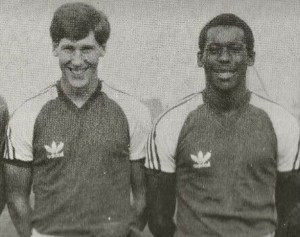
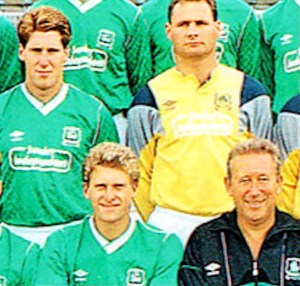

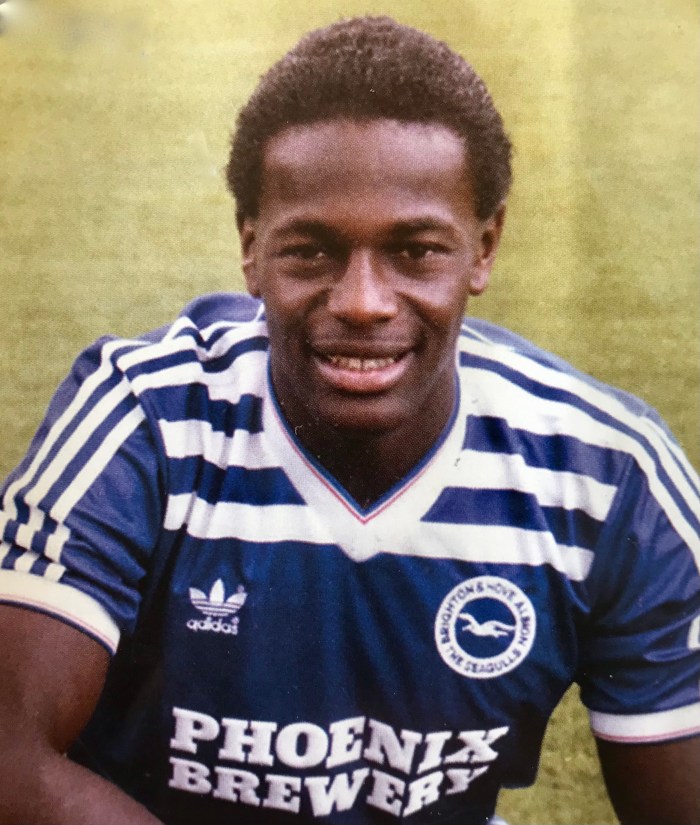


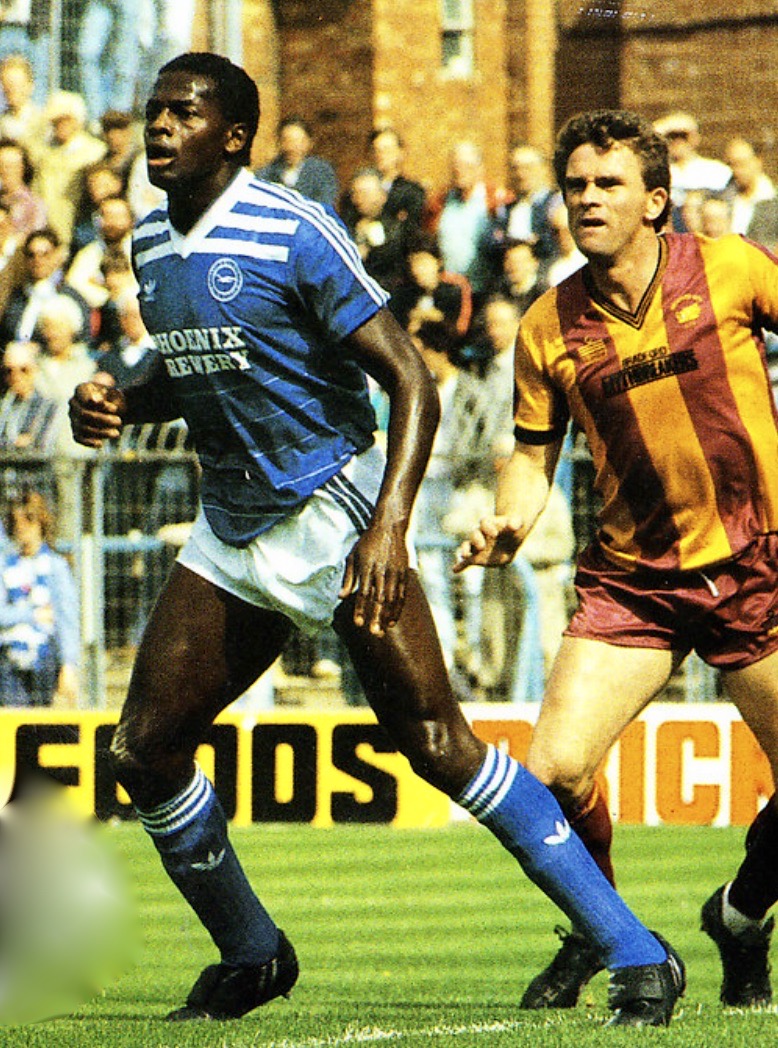

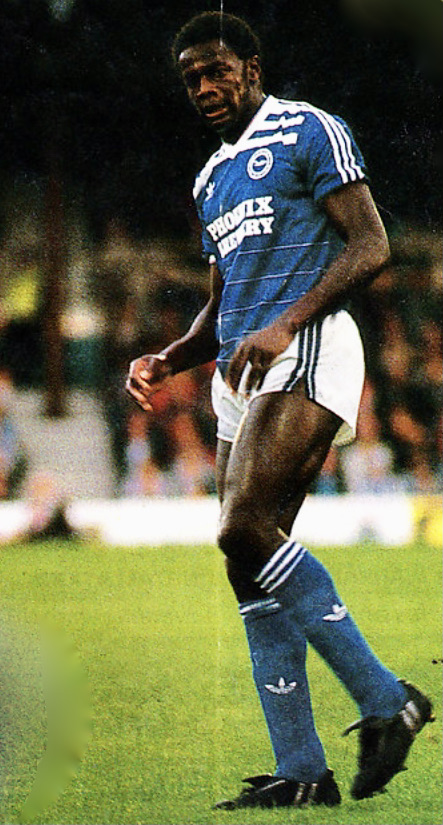

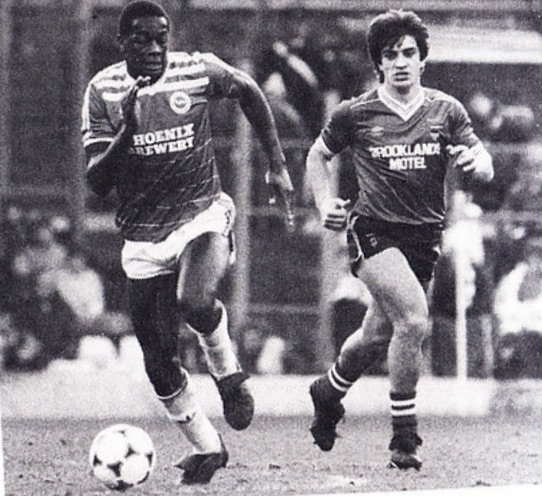
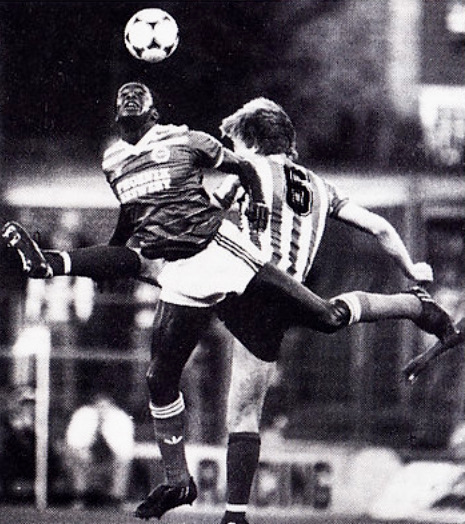


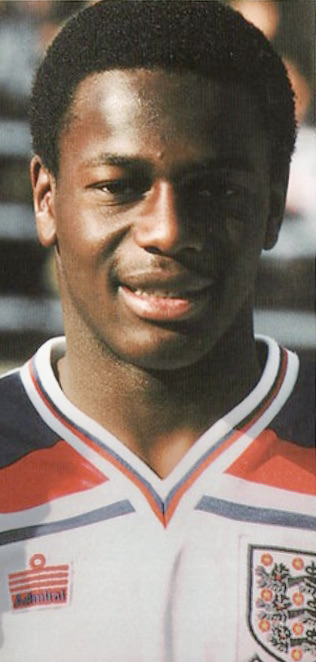


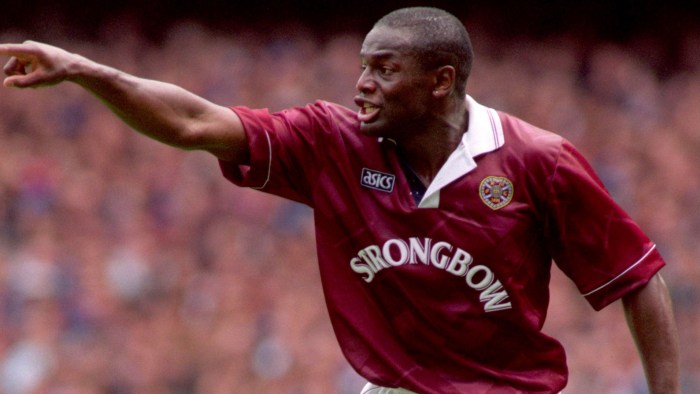


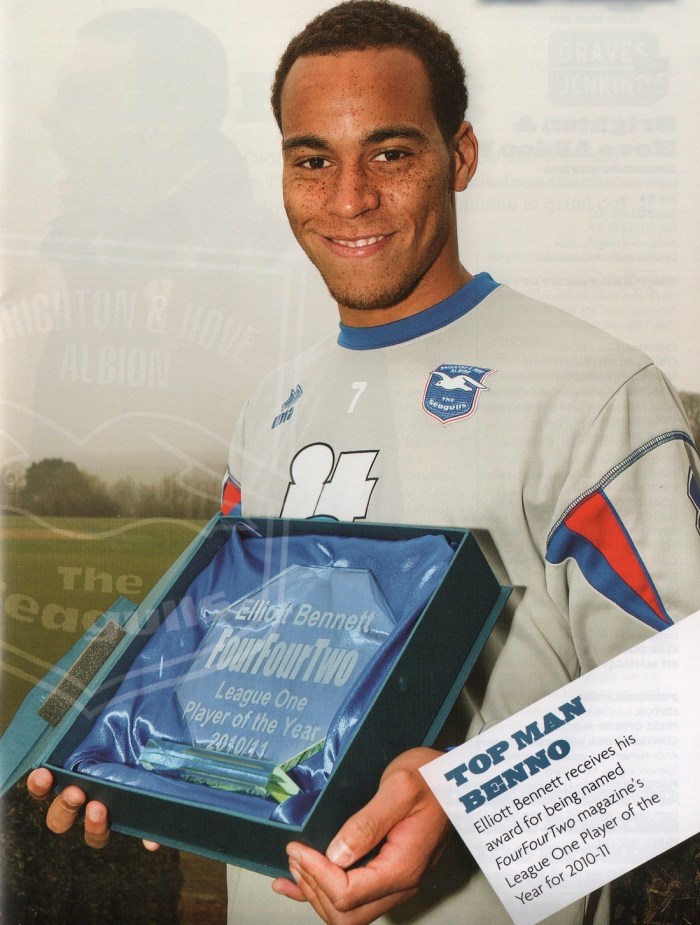


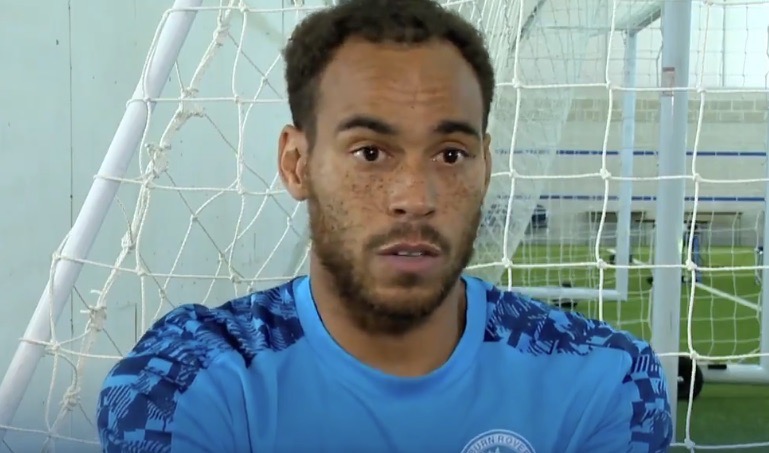

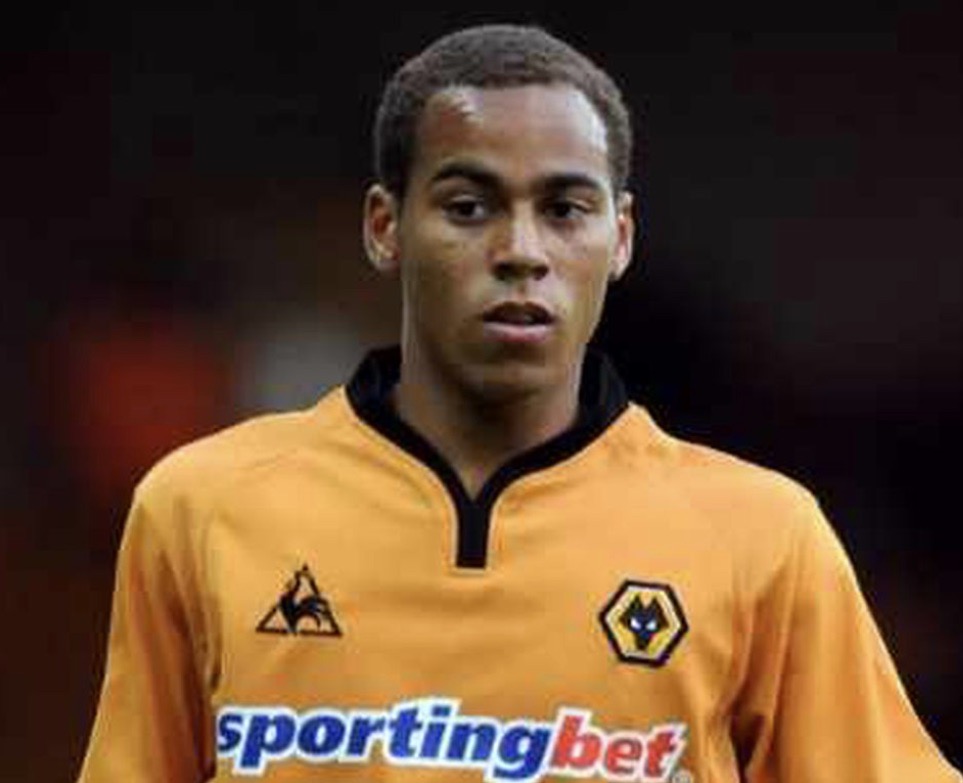
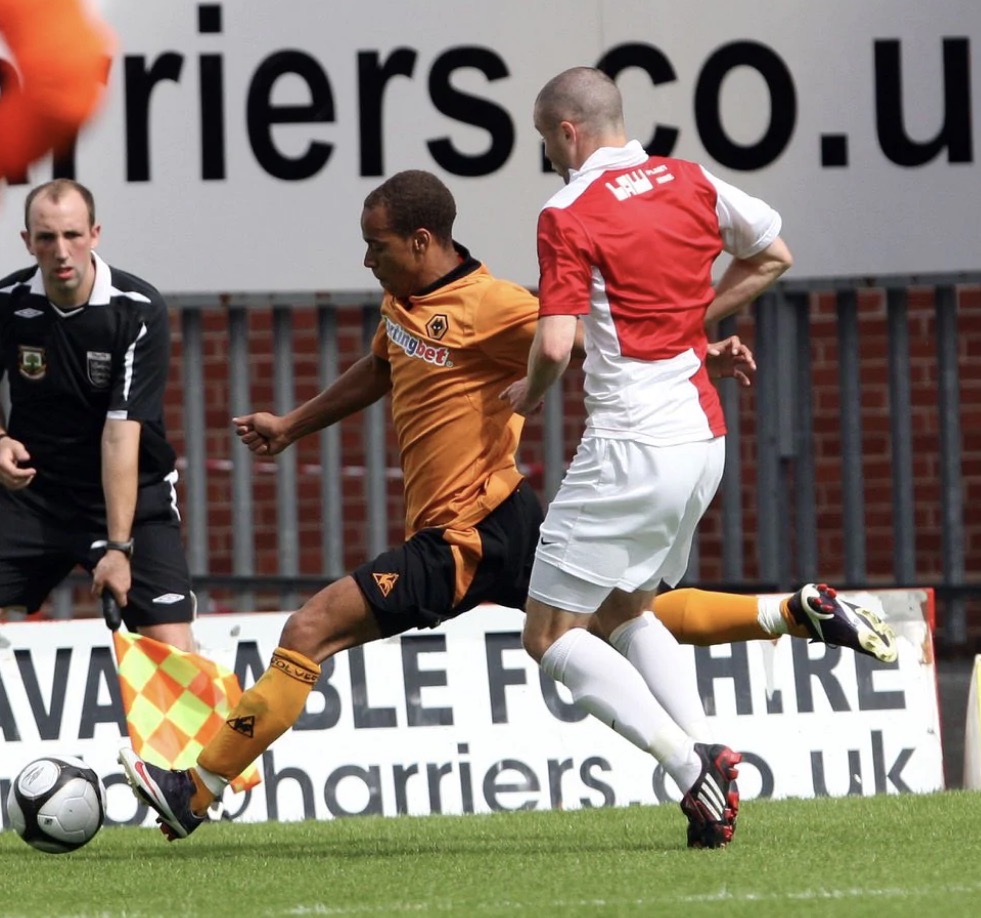
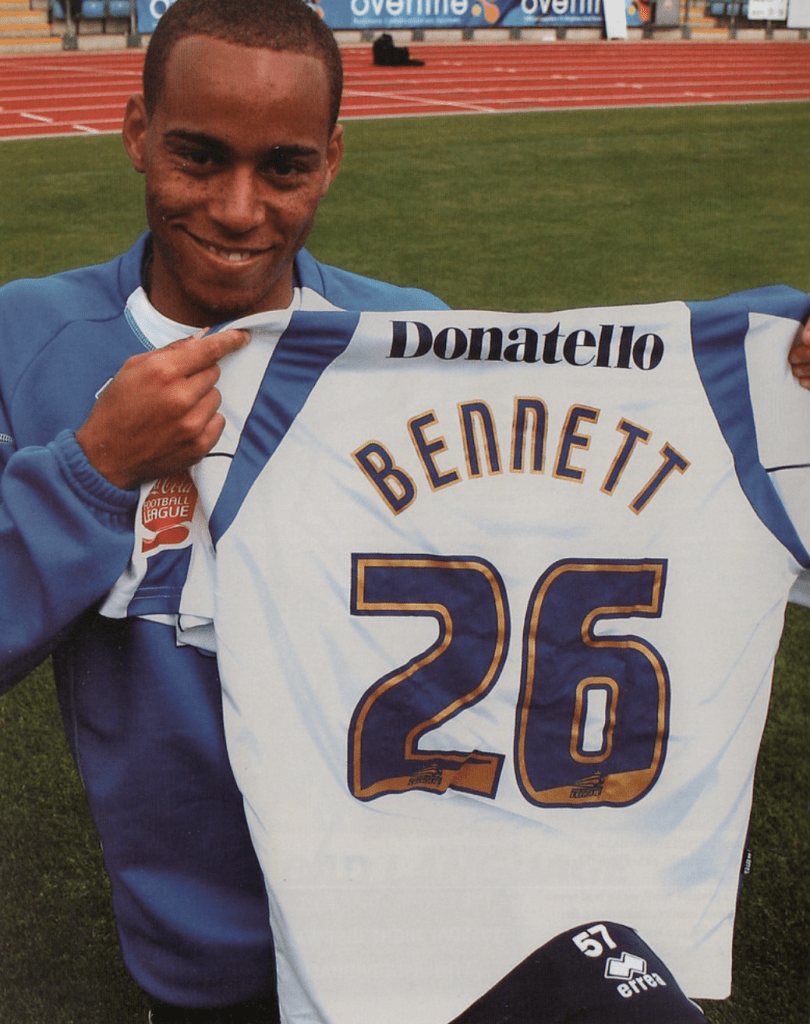




 A week after joining the Seagulls, Ryan became an instant hit with Albion fans when he scored on his home debut in a 5-1 win over Preston. He notched a total of nine goals in 34 appearances in that first season and went on to score 39 in a total of 199 games.


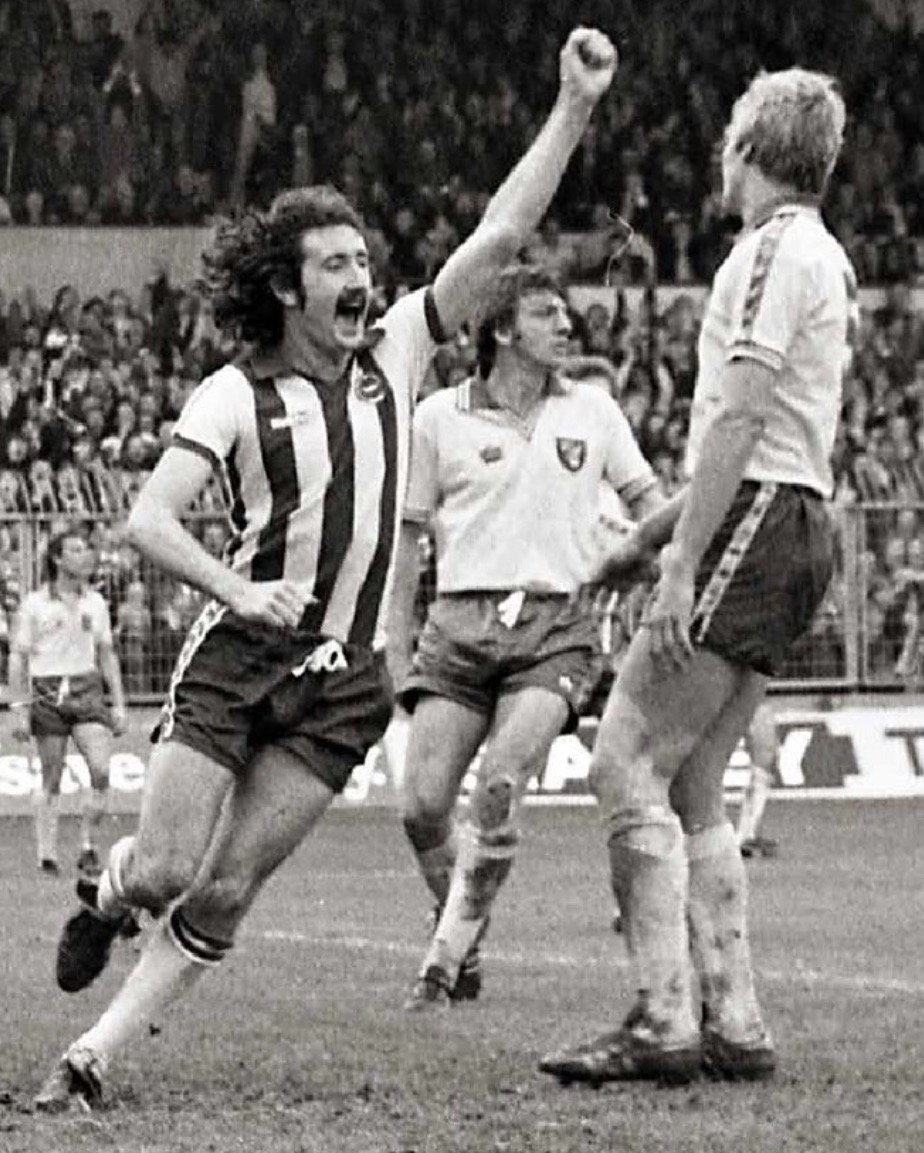 My personal favourite came on 29 December 1979 at the Goldstone when he ran virtually the entire length of a boggy, bobbly pitch to score past


 Ferguson, sandwiched between Kevin Bond and Jimmy Case, is foiled by Southampton goalkeeper Peter Shilton in what turned out to be the striker’s final Brighton game.


 “NEVER in my wildest dreams – or should that be nightmares? – did I think that, more than 20 years later, that miss in front of goal would still be getting replayed on television and mentioned in the media wherever I go.”
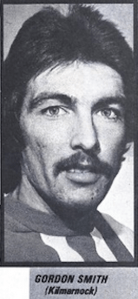 He was at Kilmarnock for five years, scoring 36 goals in 161 appearances, during which time he earned international honours with Scotland’s under-23 side, twice starting and three times going on as a substitute.

 After United had taken the lead, and Gary Stevens had equalised for Brighton, the game went into extra time and the stage was set for one of the most talked about moments in the club’s history.


 Thirty-eight of his 46 appearances for City came in the 1984-85 season, when he was top scorer with 14 goals.


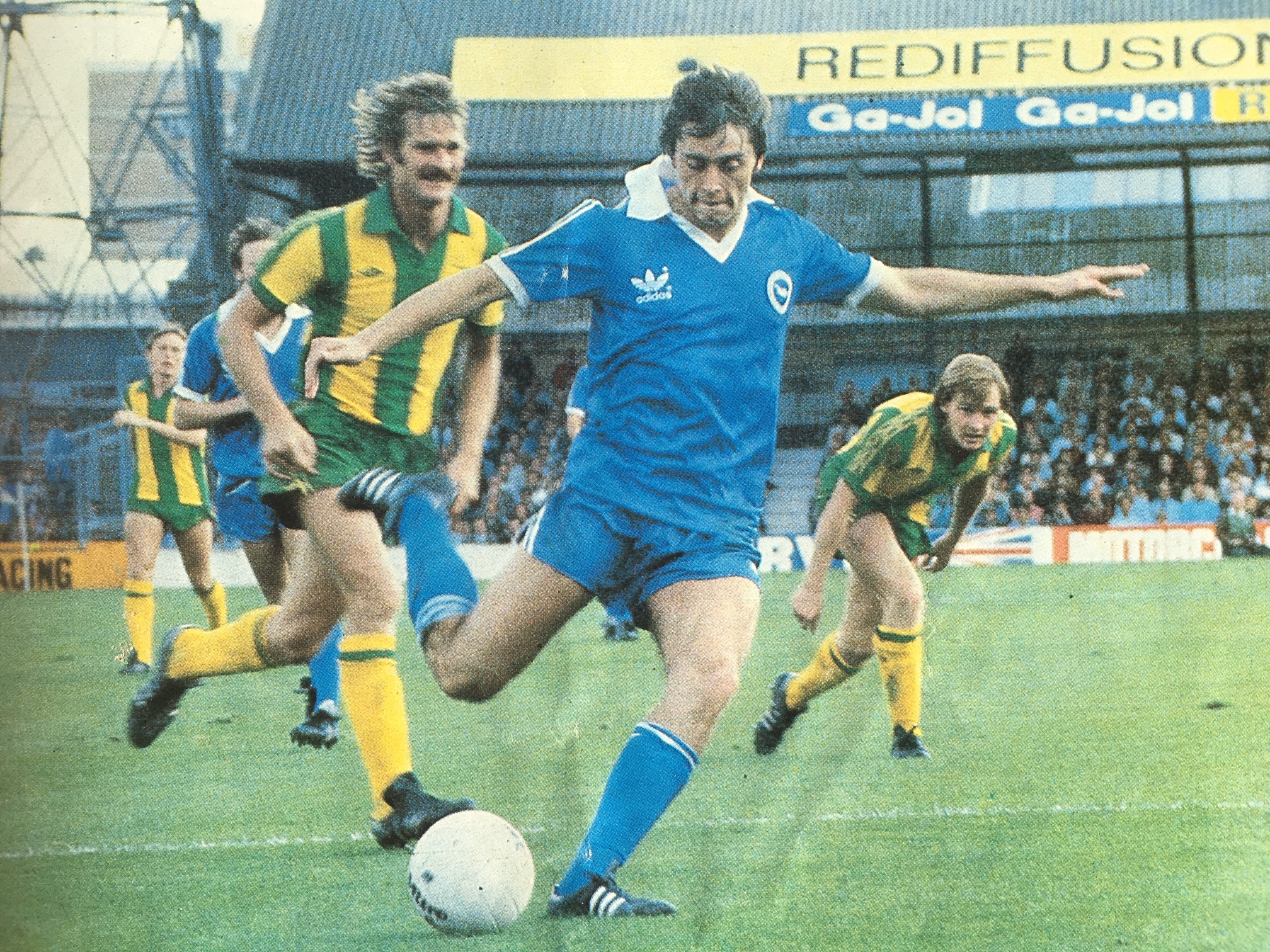
 Perhaps it was surprising, though, that champions Liverpool were the ones to snap him up, particularly as Ian Rush and Kenny Dalglish were in tandem as first choice strikers.
 Nevertheless, asked many years later to describe his proudest moment in football, he maintained: “Scoring the winning goal in the FA Cup semi-final that meant that a bunch of mates at Brighton were going to Wembley in 1983.”


 He had yet more Wembley heartache during a two-year spell with Queen’s Park Rangers, being part of their losing line-up in the 3-0 league cup defeat to Oxford United in 1986.


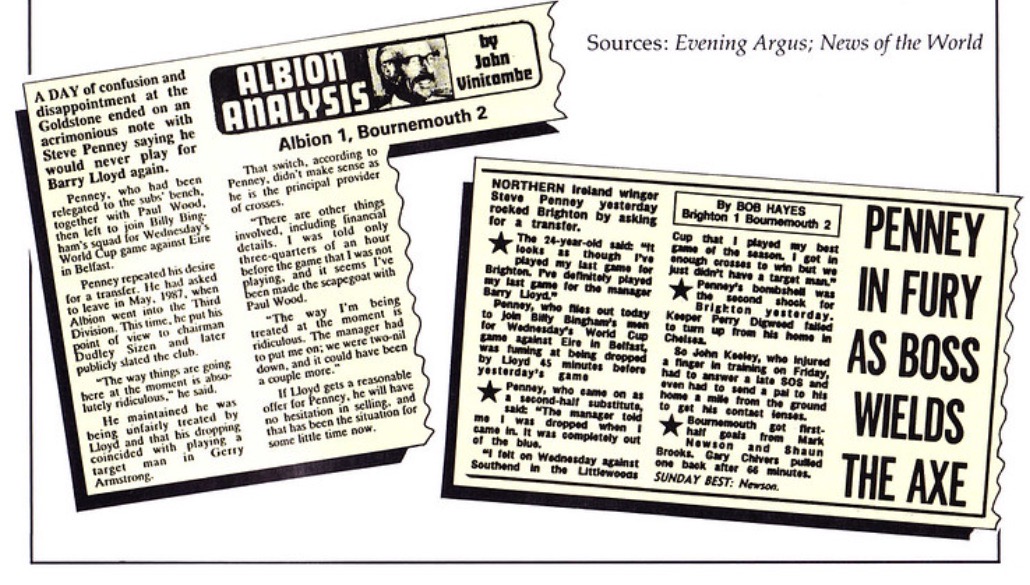 Manager Lloyd and Penney also fell out, principally over Penney putting country before club. “He’d play for them, then come back injured. That didn’t please me,” said Lloyd. “It was a crying shame. He just wanted to play but was so plagued with injuries it was beyond belief.”
 ALAN BILEY was a fans favourite at all six English league clubs he played for but the prolific goalscoring that made his name at Cambridge United and Portsmouth wasn’t replicated at Everton or Brighton.

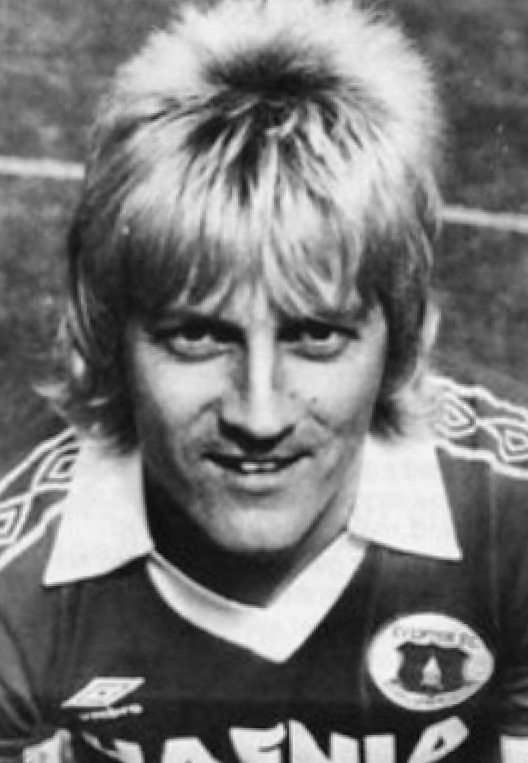 Biley was an instant hit, scoring on his Everton debut as Birmingham City were beaten 3-1. He scored again in his next game away to Leeds, but things quickly started to go wrong for him, as


 In parallel lines