200th Andy Ritchie goal at crumbling Goldstone Ground

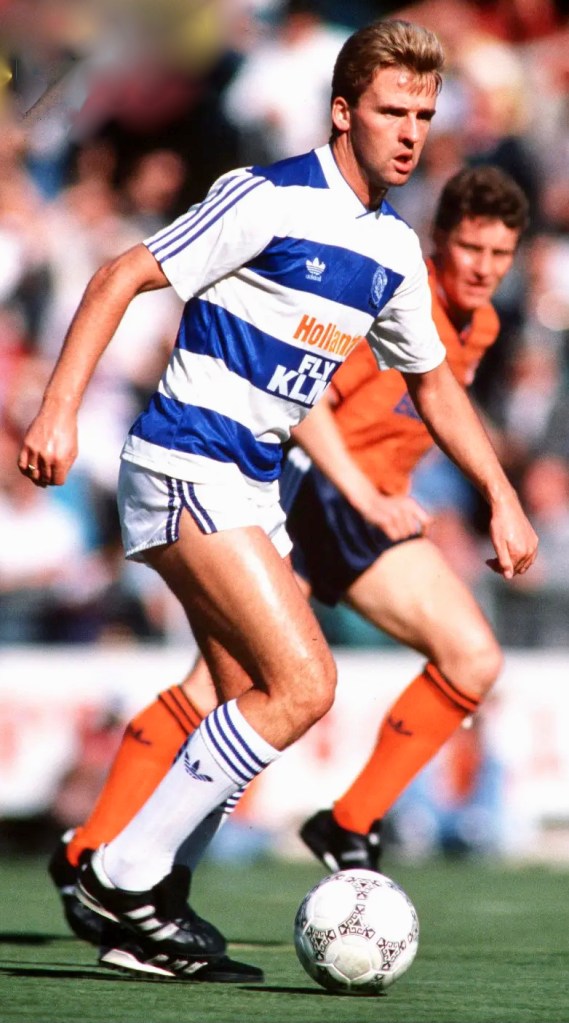
WHEN ANDY RITCHIE scored at the Goldstone Ground on 7 September 1996, it was a very different place to the stadium he’d graced as Player of the Year 14 years previously.

Ritchie was in his 20th season as a professional when he scored his 200th career goal for Scarborough against his former Albion teammate Jimmy Case’s Seagulls in a Nationwide Division 3 match.

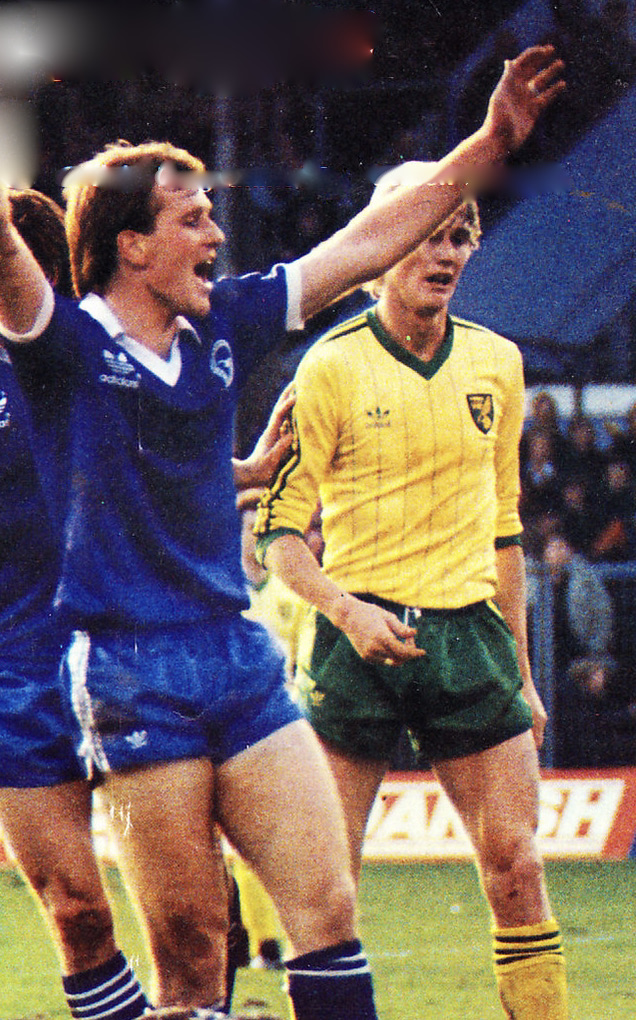
Just 4,008 hardy souls dotted around the crumbling old stadium supported the Albion that afternoon compared to the sell-out 28,800 crowd who packed in to see Ritchie’s last home match in Albion’s attack when they beat Norwich City 1-0, courtesy of a Case goal, in a quarter-final of the 1983 FA Cup.

Ritchie’s last endeavours in Albion’s colours came a week later and, ironically, were in front of 36,700 at Old Trafford on 19 March 1983 when he had a goal disallowed against the club who sold him to the Seagulls for what at the time was a record £500,000.
The curiosity of that deal was covered in my 2017 blog post about Ritchie and I’ve since discovered how a number of observers were dumbfounded by Dave Sexton’s decision to let him leave United.

That Sexton more often preferred the strike pairing of Joe Jordan and Jimmy Greenhoff baffled football writer Mike Anderson who, after Ritchie’s switch to the Albion, detailed how the departed forward’s numbers were more favourable.

“Since making his debut for United against Everton three seasons ago he has proved himself to be a more consistent marksman than the Scottish international,” wrote Anderson.

“By the end of the 1978-9 season Ritchie had scored 10 goals in only 20 full League appearances, compared with Jordan’s nine goals in 44 games. And when last season finished he had hit 13 goals in 23 full games (plus six substitute appearances), whereas Jordan had taken his tally to only 22 goals in 76 games.”

Anderson’s opinion was shared by Tony Kinsella, writing in When Saturday Comes in November 1997, he described Ritchie as “a muscular whippet of a striker with two scorching feet, a delicious first touch, and a bonce of solid granite”.

Kinsella wrote: “In four frustrating campaigns, Ritchie notched an admirable average of a goal every two games, a somewhat superior rate to his cohorts. In retrospect, I guess Ritchie was in the right place at the wrong time. He possessed more skill than Jordan and cut a more daunting physical presence than Greenhoff, but fell short of both when it came to vice versa.

“Sexton, notorious for fielding sides greyer than a Mancunian sky, had the courage to blood a teenage goalkeeper, Gary Bailey, but got cold feet when dealing with the loose cannon that was Andy Ritchie.”
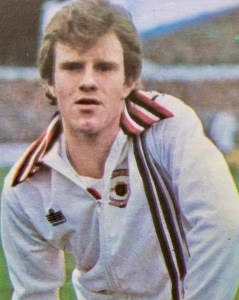
A young Ritchie at Manchester United

In a lengthy chat for the Fore Four 2 podcast, Ritchie revealed how it was Steve Coppell who took him under his wing as a newcomer to the United first team and ensured he got fixed up with a pension; something Ritchie hadn’t even considered.

And his roommate at United was wandering winger Mickey Thomas, who ended up following him to Brighton and also to Leeds!

While Sexton may have had reservations about Ritchie, plenty of other managers were keen to take him from United. Tommy Docherty, who had first signed Ritchie for the Red Devils, had wanted to take him to Queen’s Park Rangers but he was sacked as Rangers’ manager before a bid was in the offing. Chelsea and Newcastle made inquiries too.

Aston Villa offered United £350,000 for him but, after attending with his dad a face-to-face meeting with the glum-faced manager Ron Saunders, they turned down the move feeling he hadn’t conveyed that he really wanted him.

Ritchie also declared: “United were my home town team and I loved it at Old Trafford.

“It had been my aim since joining the United staff to be a success in their first team. I would have got a large amount of money had I gone to Villa, but I put self-satisfaction before money. I had received a lot of encouragement from the training staff at Old Trafford and I wanted to justify their faith in me by doing well at United.

“I knew that a transfer would mean adjusting to a side playing a different style of football. I felt that I might just as well spend that time proving I was worthy of a place at United where I was part of possibly the best club in the country. Unfortunately, I found myself playing reserve team football again until Brighton came in for me.”

In a 2019 interview with the Albion website, Ritchie remembered: “We always had a good team spirit and we all used to go out together. Everyone played golf and we’d be out in the nightclubs, Bonsoir and others where you had to wipe your feet on the way out.

“Great times, absolutely fantastic. And the spirit transferred itself onto the pitch. I used to joke at Q&As that we had so many great individuals but put us together and we were crap because the social life got in the way of our football. But no, it was a fantastic club to be involved in.”

Ritchie attended a rugby-playing grammar school and played cricket and hockey for Cheshire, only turning to football at 13 or 14. He played for Manchester and Stockport Boys and scored six goals in nine games for England schoolboys under skipper Brendan Ormsby, who went on to play for Aston Villa.

In the 1983 Shoot! album, Ritchie explained: “It was while I was playing for Stockport Boys that I first realised I had a chance of a career as a professional footballer.

“I was selected for the England Under-15 side and played at Wembley Stadium. The first was against Wales. We won 4-2 and I scored a couple of goals. I then scored another when England beat France 6-1. They were great moments for me and my family.

“Appearing for England was definitely the highlight of my young career but I also enjoyed playing for Stockport and in local Sunday football.

“I played for a team called Whitehill, who were sponsored by Manchester City. It was then that I realised I could play for the Maine Road club.

“I had trials with Leeds United, Burnley and Aston Villa, but I only wanted to play for City.”

It was while playing for Stockport Boys v Manchester Boys that former United captain Johnny Carey, scouting for his old club, spotted Ritchie and made an approach.

“I went down to The Cliff (United’s training ground) and never looked back,” he said. “It didn’t take me very long to soak in the atmosphere and appreciate the tradition and name of Manchester United and, in the end, I was quite happy to sign for the Old Trafford club.”

Ritchie was 15 when he put pen to paper, and he turned professional on 5th December 1977.

Handed his first start in United’s first team shortly after his 17th birthday, he played four matches without scoring but had caught the eye of the England Youth selectors. He made four appearances under joint managers Brian Clough and Ken Burton, making his debut in a 3-1 win over France on 8 February 1978. England drew the return leg of that UEFA Youth tournament preliminary match 0-0.

He went with the England squad to Poland for the 31st UEFA Youth tournament in May 1978, played in a 1-1 draw v Turkey and a 1-0 defeat v Spain but a trapped nerve in his hip meant he sat out the 2-0 defeat to Poland that meant England didn’t qualify from their group. That squad included Terry Fenwick and Vince Hilaire, Tony Gale and Ray Ranson.

“The following year I was selected for England Youth again for the Mini World Cup in Austria. Unfortunately, I went over on my ankle in training and could not make the trip,” Ritchie recalled.

Ritchie hoped his move to Brighton might boost his chances of gaining a full England cap, but he ended up winning a solitary England under-21 cap when he was called up by the same Dave Sexton who’d sold him from United! “That really was a bit bizarre,” Ritchie later recalled.

He featured in a 2-2 draw with Poland at West Ham’s Boleyn Ground on 7 April 1982. Fellow striker Mark Hateley scored both England’s goals.
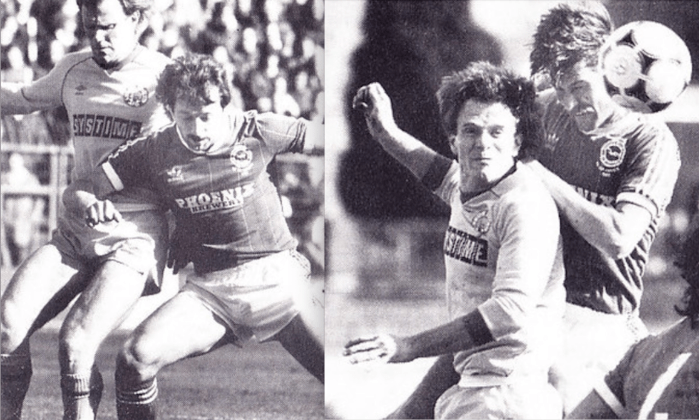
Ritchie in action for Leeds against Brighton

Ritchie’s time with Leeds was something of a mixed bag. The record books show he scored 44 times in 159 matches after he was signed by player-manager Eddie Gray. Playing in the second tier at the time, Leeds still had Gray, Peter Lorimer and David Harvey from the Revie era but Ritchie joined a mainly young side where the likes of John Sheridan, Tommy Wright and Scott Sellars were developing.

As Tony Hill observed on motforum.com: “Much of his time at Leeds was spent in dispute over his contract and for over a year he was on a weekly contract before moving to Oldham Athletic for £50,000 in August 1987.”

It was at Oldham where Ritchie really made his mark, scoring 82 goals in 217 league games (including 30 as a substitute) and helping them reach the League Cup Final and the FA Cup semi-final in 1990 and to win the old Second Division in 1991.

In 2020 the club’s official website declared: “Andy Ritchie is regarded as a club legend at Oldham Athletic and one of the greatest players to play for the club, having served Latics as a player as well as having a spell as manager.”

That goalscoring return to the Goldstone with Scarborough in early September 1996 came a year after he had joined the Seadogs as player coach on a free transfer. It was one of 17 he netted in the league from 59 starts and nine appearances from the bench.

By then a couple of months short of his 36th birthday, thankfully the Seagulls prevailed 3-2 courtesy of goals from Stuart Storer and two from Craig Maskell (the 99th and 100th of his career).

It certainly wasn’t the first time Ritchie had netted against the Seagulls. Twenty months after departing the Goldstone he scored the only goal of the game, tapping in from eight yards out, when Leeds beat the Seagulls at Elland Road.

He also scored for Oldham to knock Albion out of the FA Cup when the Latics won 2-1 in the fourth round on 27 January 1990. In a 1-1 draw at the Goldstone two months later, Ritchie missed a penalty but he made amends the following season scoring home and away against the Albion, netting twice in their 1 December 1990 6-1 thumping of the Seagulls on Oldham’s plastic pitch and scoring both when the Latics left the Goldstone 2-1 winners on 2 March.

He returned to Oldham on 21 February 1997 after Neil Warnock took him to Boundary Park as his player-assistant manager. He scored three times in 32 appearances, many of which were as a sub.

But when Warnock left to join Bury at the end of the following season, Ritchie was appointed as his successor. He managed 179 games, winning 59, drawing 45 and losing 75 with a win percentage of 32.96%.

After being sacked in 2001, he was out of work for three months before being appointed academy director at Leeds at a time when fellow ex-Man Utd player and coach Brian Kidd was head coach under Terry Venables and David O’Leary.

He found himself out of work again in 2003 when Peter Reid took charge but six months later he joined Barnsley, initially as academy manager before becoming first team coach under Paul Hart.

When Hart left Barnsley in March 2005, Ritchie was appointed caretaker manager and then landed the position permanently in two months later.

At the end of the following season, he led the club to a penalty shoot-out win over Swansea City in the League One play-off final at the Millennium Stadium, Cardiff.
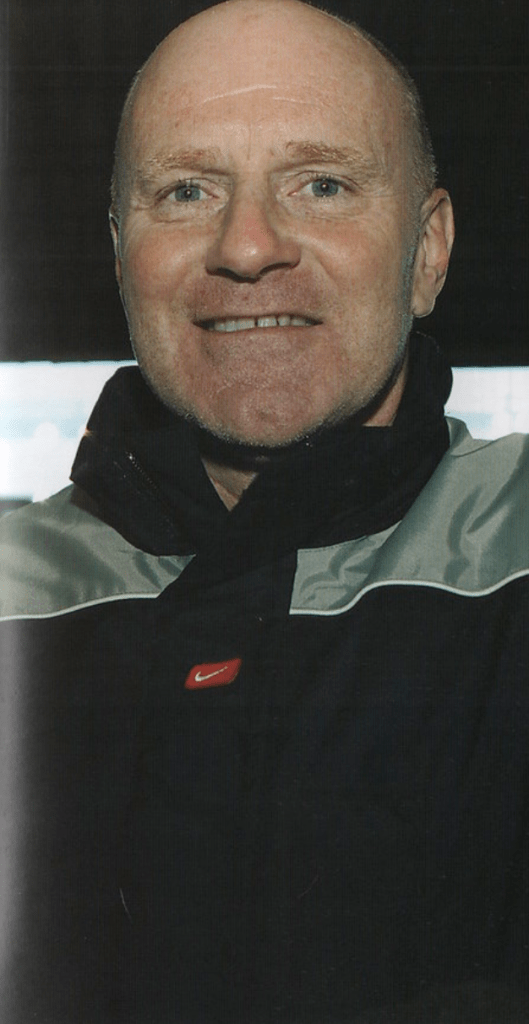
But the Championship season was only four months old when Ritchie was relieved of his duties with the Tykes struggling in the relegation zone.

Four months later, he was appointed manager of League One Huddersfield Town and told the club’s website: “There’s such massive potential here.

“There is no doubt that the club is geared up for promotion to the Championship and that has to be the aim now. It’s now a case of getting the players re-motivated and once we get into the Championship, we can reassess the situation.

“I tasted promotion last season and it was a great feeling – now I want to do it again as soon as possible.”

Unfortunately, he wasn’t able to steer the Terriers to that goal and, after a 4-1 defeat against his former employers Oldham, he parted company in April 2008.

They won only 22 of his 51 games in charge although they did enjoy their best FA Cup run for 10 years which only came to an end in the fifth round when they were beaten 3-1 by a Chelsea side under Avram Grant that included Wayne Bridge and Steve Sidwell.

After all that, Ritchie returned in a watching brief to where it all began: at Old Trafford.

On matchdays, he worked as an ambassador in a hospitality lounge, and contributed to MUTV and Radio Manchester.

Byrne made Hoops happy before taking flight with the Seagulls

JOHN BYRNE, who had three different spells as a Brighton player, is viewed as an all-time-great by QPR fans where he scored 36 goals in 149 appearances.

Through his Irish father Jim, Wythenshawe-born Byrne qualified to play for the Republic of Ireland and he won 13 of his 23 Republic of Ireland caps while a QPR player playing in the old First Division.

His place in the annals of QPR’s history was etched courtesy of following two other greats (Rodney Marsh and Stan Bowles) into the no. 10 shirt.

“I was always conscious of the traditions at Rangers and so I was dead proud to wear the Number 10,” he told qprreport in 2008. “I think I did the shirt justice most of the time.”

In the same way Brighton fans remember his highly effective striking partnership with Mike Small in the 1990-91 season, so QPR supporters recall his combination up front with Gary Bannister.

Bannister and Byrne

“I enjoyed playing up front with ‘Banna’,” he said. “He was a great centre-forward, right out of the top drawer. I don’t know how our partnership worked but we just seemed to have a good understanding.

“He was more of a prolific goalscorer than I was. He also had superb quality and awareness for bringing people into the game.”

Byrne, who later became a familiar voice as an expert summariser for BBC Radio Sussex coverage of Albion matches, has always been happy to indulge requests from Rs writers to look back on his four years at Loftus Road.

As would become something of a pattern in his career, it was an impressive performance playing against QPR that led them to sign him. He featured in a two-legged League Cup game for York City against Rangers, and he recalled the game at Loftus Road when talking to qprnet.com in 2013:

“It was so brilliant to play in that stadium under the floodlights and coming from York to run out at QPR was something to remember.

“Afterwards I said to our assistant manager Viv Busby that I would love to play here every week. Lo and behold a couple of weeks later I was!”

The man who took him to west London was none other than Alan Mullery, the former Brighton manager, during his unhappy six months as QPR manager.

It’s now generally recognised that some of the senior pros at the club were none too pleased with Mullery taking over from Terry Venables, who had moved to Spain to manage Barcelona. Byrne admitted: “It was difficult for me to fully understand having been signed by Mullery but you could feel it with some of the senior pros.

“The likes of Terry Fenwick, John Gregory and Steve Wicks were big Venables men and, understandably, as he was obviously a great coach. You got a feeling that a few of them weren’t overly impressed with Mullers at the time.”

As it turned out, Mullery’s time in charge came to an abrupt end and Byrne remembered playing under caretaker manager Frank Sibley before Jim Smith got the job permanently.

Frank was lovely; he was a really nice man and probably too nice for football management,” said Byrne. “He really helped me a lot, he would always welcome a chat with you and put his arm round you to talk about your game. I had a lot of time for Frank.”

And of the former Birmingham and Oxford boss Smith, who went on to manage Newcastle and Portsmouth, among others, he said: “Smithy was brilliant. I loved playing for Jim. He loved you, he hated you but he would never ignore you or freeze you out.”

It was in 1986 when Byrne suffered the first of three losing experiences in Wembley finals. QPR went down 3-0 to Smith’s former club Oxford United

“Unfortunately we never turned up for the final,” Byrne told QPRnet. “I just remember that after we were introduced to the dignitaries I went off for the warm up and I had nothing in the tank. I had heavy legs before the game and I think a lot of the players felt like that.

“At the end of the day we didn’t perform and Oxford were better than us but there should be no excuses we were a better side on paper and we should have won.”

A far happier memory from that spring of 1986 happened three weeks previously when the Rs thrashed Chelsea 6-0 and Byrne scored twice (Bannister netted a hat-trick and Michael Robinson the other).

“I’ll never forget that day,” said Byrne. “It was just one of those occasions when everything went right for us.

“I remember one of my goals where I picked up possession on the halfway line. It was funny on that plastic pitch, because bodies would fall all around you if you got into your stride. So eventually I wriggled free and slotted a shot into the bottom corner.”

Another of his favourite QPR memories was scoring in two home games against Manchester United, the team he had supported as a boy. Recalling a 1-0 win in March 1986, he said: “I remember lobbing the ball over two defenders’ heads in the box. Then I flicked it back before shooting past Chris Turner in goal at the Loft End. It was great for me – especially being a Manchester lad as well.”

In much the same way as his move to QPR came about, it was in a couple of friendly matches against Le Havre that the French side liked what they saw of him and QPR were happy to accept their bid for the player.

“It was disappointing to leave QPR but I think it was probably the right time to go,” he recalled. Unfortunately, he broke a leg only three weeks into his stay with Le Havre. But when he was fit again, a few English clubs started watching his recovery with interest.

And it was following a friendly Brighton played against Le Havre that prompted Albion boss Barry Lloyd to bring Byrne back to England to play in early September 1990. He made his Seagulls debut for the reserves in a 1-1 draw with Charlton Athletic and then went on as a sub for the first team in Albion’s 3-2 home win over the same opponent 10 days later.

He scored on his first start, in a 2-1 win away to Blackburn Rovers, and on his first start at home he netted in a 3-3 draw with Swindon Town, who were managed by Ossie Ardiles.

Crocked in the last game of the league season against Ipswich

How the rest of that season panned out was covered in my previous post about Byrne, as were his subsequent moves, the most successful of which saw him play for Sunderland in the 1992 FA Cup final when Liverpool beat the Wearsiders 2-0.

“I scored in every round except the final then missed a sitter on roughly thirteen minutes twenty seconds; I see that one every day!” he told QPRnet.

Byrne’s future work as a podiatrist came about largely through the network provided by the Professional Footballers’ Association.

“When I finished playing football in the late 1990s, I was hoping to become a physio but couldn’t get a place at university to study it,” he explained. “Then the ex-Manchester United star Norman Whiteside advised me to look at the PFA’s course for podiatry, because he was a podiatrist himself. The PFA said they would help me with finance and backing.”

He went on to graduate from university in 2001 – gaining his BSC Honours degree was the hardest thing he’d done in his life, he said.

“My brain had been dormant for twenty years playing football, but I’ve been qualified now for nearly 10 years,” he said in a 2010 interview with Sussex Life. “I love my NHS career and also the private work I do and I get a lot of job satisfaction improving patients’ foot problems.”

And in his interview with QPRnet, he added: I was lucky, I look back now and I had a good career, I played for some great clubs and whilst I might have had disappointments with finals I have got plenty of great memories.”  

The goalscoring legend who slipped through Brighton’s net

ONES that got away always make for fascinating stories and a striker who went on to become a goalscoring legend slipped through the net at both Brighton and Burnley.

Ian Muir is hailed an all-time hero by fans of Tranmere Rovers for whom he scored 180 goals in all competitions during what many regard as the best period in Rovers’ history. If it hadn’t been for injury, he could have played in the Premier League and Europe for Leeds United.

But he’s barely remembered for the struggles he had to get games at Brighton, let alone in a month with the Clarets.

Success could have eluded himf it hadn’t been for the time he spent at Brighton alongside the legendary Frank Worthington. He was considering a move to non-league Maidstone United, but, when Worthington quit Brighton in the summer of 1985 to take his first step into management on the Wirral, he made Muir his first signing.

“Ian Muir was a fantastic forward with great touch,” Worthington told Spencer Vignes in an Albion matchday programme interview. “He did things in training you just wouldn’t believe, yet he wasn’t even making the side at Brighton under Chris (Cattlin).”

Cattlin had taken the youngster on after he had been given a free transfer by Birmingham City where he’d made just one League Cup appearance in the 1983-84 season under Ron Saunders. But competition for forward places was intense with the likes of initially Alan Young and Terry Connor, then Worthington, Mick Ferguson and later Alan Biley.

Muir’s first involvement with the Albion first team was as a non-playing substitute for the home 3-0 win over Leeds on 24 March 1984. He made his debut the following Saturday at Fratton Park in place of the injured Young and was brought down in the penalty area only 20 minutes into the game to earn Brighton a spot kick, which Danny Wilson successfully buried to put the Seagulls ahead.

Muir in his Brighton days

Connor had a chance to put Albion further ahead and, as the matchday programme reported, “Muir sliced wide as Connor made the opening” before Pompey began a devastating fight back.

Albion had been hoping to complete a fourth win in a row for the first time in six years, but it wasn’t to be, and, into the bargain, Muir couldn’t cap his debut with a goal, instead firing wide when set up by winger Steve Penney.

Unfortunately, this was the game when former Spurs and Arsenal centre back Willie Young, on loan from Norwich City, was given the runaround by Pompey centre forward Mark Hateley, and, courtesy of a second half blitz, the home side ran out 5-1 winners.

Alan Young was restored to the no.9 shirt in the next match and scored twice as Albion beat Grimsby Town 2-0 at the Goldstone, but Muir was drafted in to take Connor’s place in the away game at Shrewsbury Town.

That match ended in a 2-1 defeat, but the News of the World angled its report on an unlucky afternoon for the young forward.

“It just wasn’t Ian Muir’s day,” wrote reporter Brian Russell. “The Brighton teenager (actually he was 20) playing only his second league game could so easily have taken the limelight from Shrewsbury two-goal hero, 17-year-old Gerry Nardiello.

“Young Muir headed the ball home in the eighth minute from Jimmy Case’s corner, but it was ruled out (for a foul by centre-half Eric Young).”

Alan Young produced a powerful header from a Muir cross that Steve Ogrizovic (later of Liverpool and Coventry City fame, of course) saved brilliantly.

Russell continued: “With Brighton battling to cancel out Nardiello’s 23rd-minute opportunist goal, striker Muir suffered. His delicate chip left the ‘keeper clutching thin air, but Shrewsbury skipper Ross McLaren headed out.

“Brighton levelled it with 15 minutes to go (through Eric Young). But, five minutes later, Nardiello pounced on Chick Bates’s chested pass to beat Joe Corrigan.”

Muir was on the scoresheet when Albion’s reserve side began the 1984-85 season with a 1-0 win over reserve team boss George Petchey’s old club, Millwall. It was a very experienced team featuring Corrigan in goal, full-backs Chris Ramsey and Graham Pearce – who had both played for the Seagulls in the FA Cup Final the year before – along with Steve Gatting and Neil Smillie. Giles Stille and Alan Young were also in the line-up.

Muir had to wait until 13 October for his next first team opportunity when he was a non-playing sub as Albion went down 2-1 at Oxford United. He then got on as a sub for Connor in a 0-0 home draw with Barnsley, but the game was so dire that Cattlin very publicly forfeited a week’s wages.

After three goalless games straddling October and November 1984, Cattlin paired Muir with Worthington away to Blackburn on 10 November but still the drought couldn’t be breached, and Albion went down 2-0. The next game, Cattlin tried Ferguson and Connor as his front pair – same outcome: a 1-0 defeat at Leeds.

Muir didn’t get another chance with the Albion but in the spring of 1985 was sent out on loan to Lou Macari’s Swindon Town, where he played in three matches (and his teammates included Ramsey, who’d been released by Cattlin, and Garry Nelson, who would later become a promotion winner with the Seagulls).   

Somewhat curiously, when commenting on Muir’s departure from the club that summer, Cattlin said in the matchday programme: “I am sure Ian will get goals at whatever level he plays.”

Sure enough, Prenton Park eventually became his spiritual home and, although Tranmere struggled to stay in the fourth tier initially, Muir’s goalscoring exploits were synonymous with four years in which Rovers were promoted twice and appeared at Wembley five times. Highlights saw Muir score in the FA’s centenary celebrations in 1988 and an acrobatic and precise volley in Tranmere’s Leyland DAF Trophy victory over Bristol Rovers in 1990.

Muir and strike partner Jim Steel

He particularly began to prosper after Worthington’s successor, Johnny King, brought in tall target man Jim Steel alongside him in 1987.

Steel, who later became a police officer on Merseyside, said King, a Bill Shankly devotee, would compare him and Muir to John Toshack and Kevin Keegan. “That’s the way football was at the time,” he told the Liverpool Echo. “You looked for a little mobile player to feed off a tall striker.

“Muiry was one of the best finishers in the game at the time. If I’m honest, the intelligence of the partnership was down to Muiry, who was very good at reacting to things off me,” he said.

“I wasn’t the most technically gifted of players compared to the likes of Johnny Morrissey and Jim Harvey. But things happened around me and Muiry was very good at picking up the crumbs.”

Muir was Tranmere’s leading scorer from 1986 to 1990 and, in the 1989-90 season, he scored 35 goals in 65 games.

Such is the esteem in which Muir is held in those parts that a mural depicting him and all-time-appearances record holder Ray Matthias adorns the side of a house close to Prenton Park. A lounge at the ground is also named after him.

Born in Coventry on 5 May 1963, Muir played for the City’s schools side and Bedworth Juniors and won four England Schoolboy caps (against Wales, Scotland and two v West Germany) featuring alongside the likes of Tommy Caton, Ian Dawes, Terry Gibson and Kevin Brock.

He joined QPR as an apprentice aged 17 in 1980 and was a Hoops player for four years in total during Terry Venables’ reign as manager. In October 1982, he went on a one-month loan to Burnley. The respected all-things-Burnley writer, Tony Scholes, takes up the story.

“When Burnley played on QPR’s plastic pitch at Loftus Road in 1982 we came home with more than we’d bargained for. Two Trevor Steven goals in front at half time, we’d suffered a 3-2 defeat in the end although we managed to acquire a striker.”

Scholes pointed out how Muir had progressed into the first team squad at Loftus Road, but after a goalscoring start had fallen out of favour.

“He made a dramatic start to his first team career, scoring twice on his debut in a 5-0 thrashing of Cambridge United in April 1981,” said Scholes. “He kept his place for the one remaining game of the 1980-81 season but by the time he arrived at Turf Moor, well over a year later, he was still looking for his third game.”

It eventually came with Burnley, when he went on as a substitute in a 2-1 defeat at Charlton, replacing skipper Martin Dobson. He then started and scored Burnley’s goal in a 3-1 defeat at Leeds.

“He impressed, but the home fans never saw him and. at the end of the month, he was dispatched back to West London, his Burnley career over,” said Scholes.

Ian Muir alongside Terry Fenwick when Terry Venables managed QPR

Unable to get back into Terry Venables’ side at Loftus Road, Muir joined Birmingham and subsequently Brighton.

Finally given a platform to shine, the striker scored the majority of his 180 Tranmere goals between 1985 and 1991 and spearheaded the side that vaulted two divisions in three seasons between 1988 and 1991, before eventually being edged out by the arrival of John Aldridge.

The Liverpool Echo remembered: “It was inevitable his subtle skills and clinical finishing would make him a target for a larger club. Muir knew of Leeds’s interest as Tranmere campaigned to secure a place in the Third Division playoffs in 1990-91.

Muir told the newspaper: “Howard Wilkinson was sending scouts to watch me and coming along himself. When I went along to the ticket office before games, the Leeds scout was sometimes at the kiosk and I’d chat to him. He told me what was happening.

“Mark Proctor, who joined us from Middlesbrough the following season and worked under Wilkinson, knew about the deal and told me.”

Muir was arguably in his prime at the age of 27, but he suffered what would be a fateful knee ligament injury in a game against Chester City on 23 March 1991.

When Tranmere visited Leeds in a League Cup tie early in the following season, Muir hobbled into Elland Road on crutches. Muir recalled: “Before the game Gordon Strachan asked our midfielder, Neil McNab, where I was. Neil pointed to me standing there on crutches.

“Then Strachan said: ‘Ian is the unluckiest man in the world because we were going to sign him’. Leeds went on to win the league that season and I could have been with them, playing at the highest level playing in Europe the following season.

“I was gutted. I was so close and the injury changed everything. But that’s football. You get your ups and downs.

“I could never complain about the fantastic career I had at Tranmere and I wouldn’t swap my memories of the years at Prenton Park for anything.”

He wasn’t granted a testimonial after a decade with Rovers, but in 2020 there were moves afoot amongst their supporters to help him publish his autobiography.

Adulation has not waned and a young writer who didn’t even get to see him play wrote warmly about the striker’s achievements in this tribute.

In 1995, Muir returned to Birmingham City for a £125,000 fee but he played only twice before he suffered a groin injury. In an effort to get fit, he spent a month on loan at Darlington, and scored a goal, but his league career was over.

He went to play in Hong Kong, scoring a hat-trick on his debut for Sing Tao, and later played for Happy Valley. In June 2011, he recalled in an interview with the Liverpool Post: “The warm climate was a big help. Then the medical people found the cause of the groin problem was my spine. The pelvis wasn’t lined up properly. It could get out of joint just by lying in bed.

“One of the lads on the medical side was able to click me back into place. I have to say I have not had many problems with it since.”

Muir returned to the UK, and his native West Midlands and joined Nuneaton Borough.

“We won the league by 20 points and got into the Conference,” Muir told the Post. “We were top of the league after three months of the following season then it all went pear-shaped.”

The newspaper reported that Muir stepped down a level to Stratford Town, where his football days finished.

He did some voluntary coaching in schools and took a job in a factory for a year, and subsequently joined a friend in a business fitting out pubs and shops.

• Pictures from various online sources.

Fluctuating fortunes for Guy Butters after beginning alongside Spurs stars

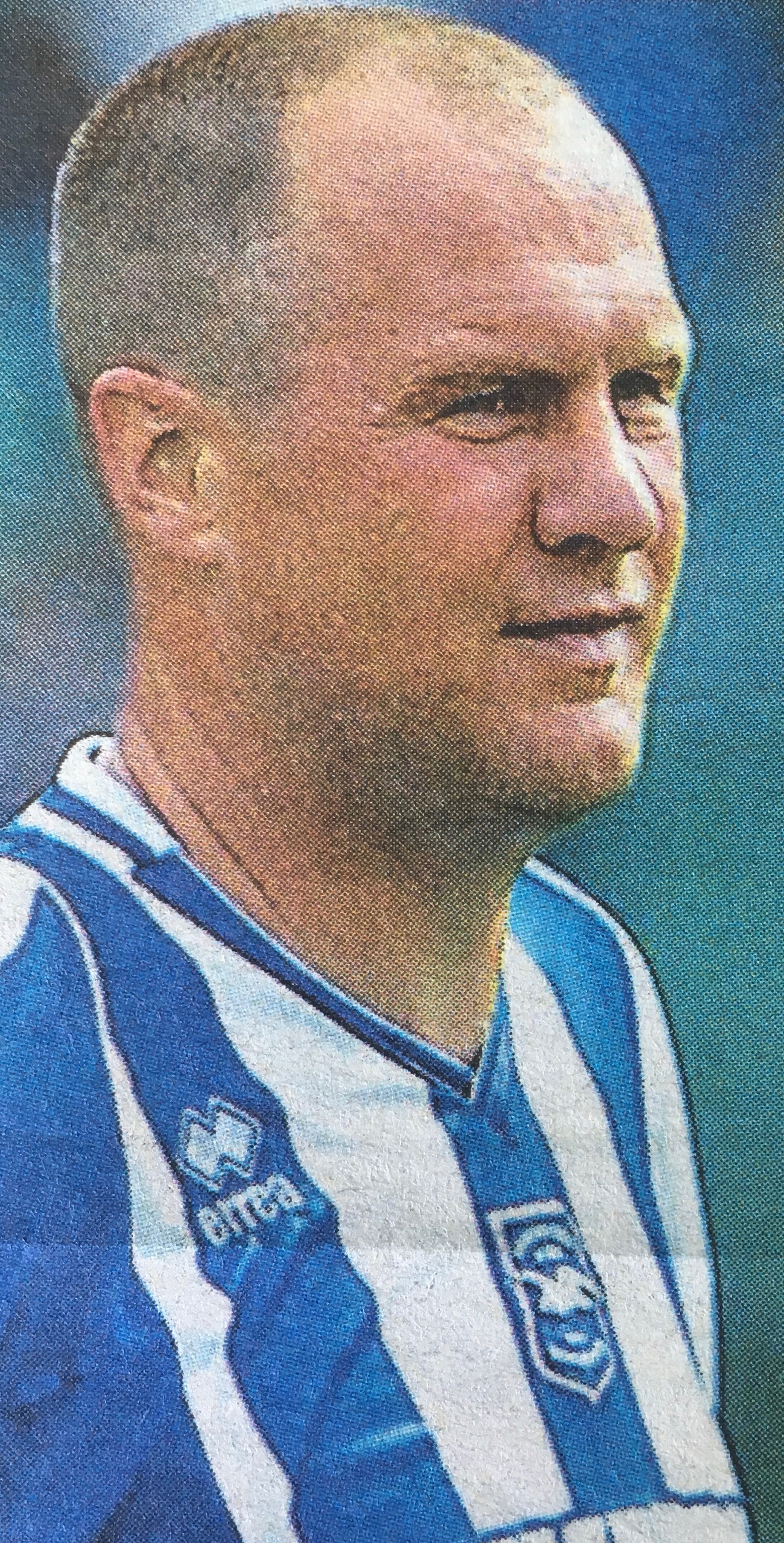
GUY BUTTERS saw plenty of highs and lows in a 20-year playing career that started with great promise at Tottenham Hotspur and included six years at Brighton, where he still works.

Butts coaches for Albion in the Community, he’s scouted players, hosted hospitality lounges and still turns out to play in charity matches, not to mention sharing a constant flow of corny jokes with his 3,700+ followers on Twitter!

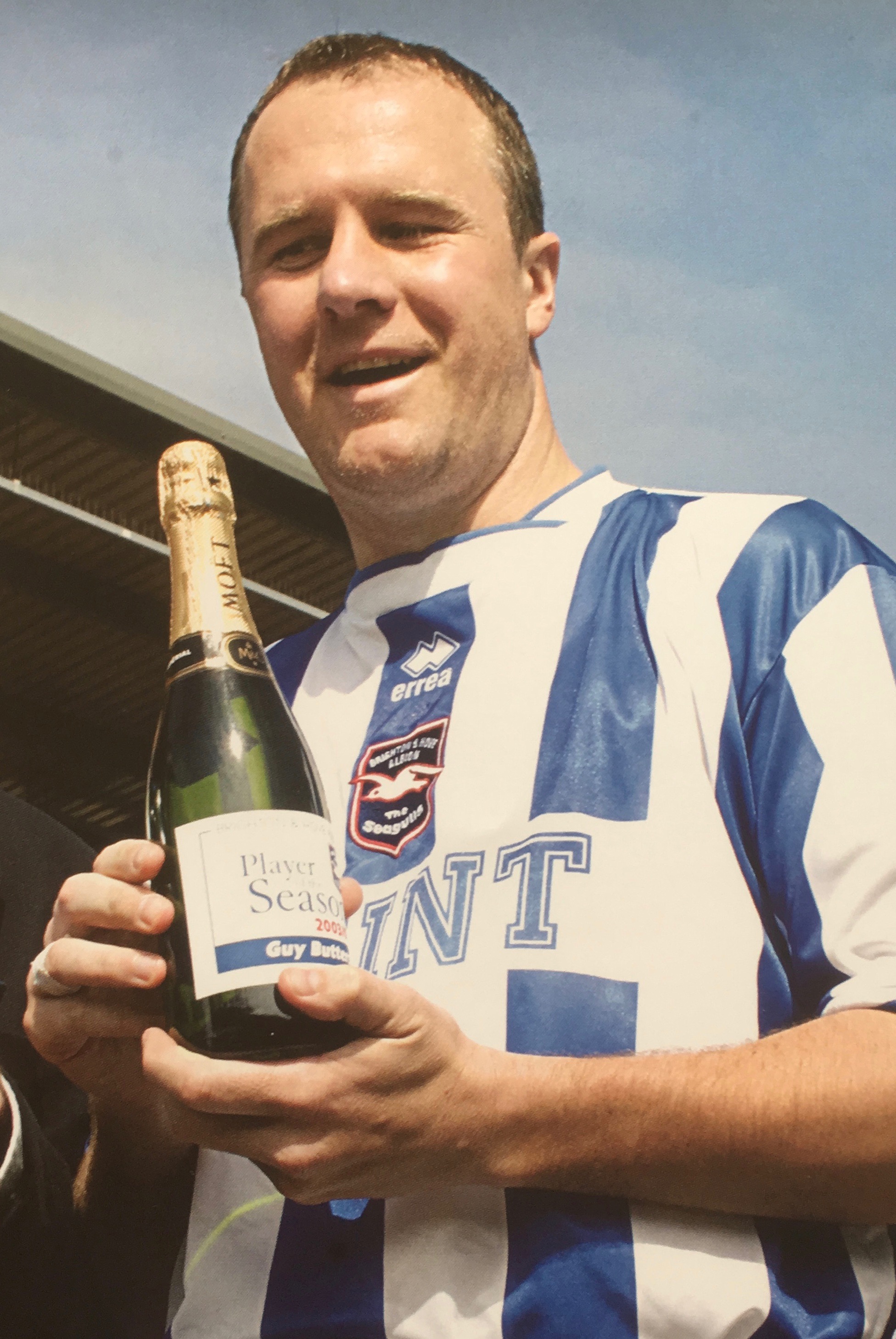
Promotion via the play-offs at Cardiff in 2004 and being chosen as player of the season would be up there in terms of highs with Brighton.

My personal favourite came on 13 November 2004, when Butters scored the only goal of the game as Albion committed daylight robbery in front of 29,514 packed into West Ham’s Boleyn Ground.

BZ GBBrighton were up against it going into the game and had taken veteran Steve Claridge on for a month to help them out of a striker crisis. Hammers threw everything at the Albion that afternoon but somehow the Seagulls kept the ball out and, on 68 minutes, Butts, up for a Richard Carpenter free kick, got his head on the end of it to send the ball into the back of the net in front of the Seagull faithful.

Even after versatile Adam Virgo and Hammers’ Haydn Mullins were sent off for a scrap on 74 minutes, and West Ham bought on substitute Bobby Zamora, the scoreline remained 1-0 to the Albion.

A couple of months later, it was obviously a special day for Butters when, on 8 January 2005, he was given the captain’s armband to lead the Albion in their third round FA Cup tie against Spurs at White Hart Lane.

  • A programme portrait and skipper for the day in the FA Cup at White Hart Lane.

The matchday programme recalled how Butters “was very much the discovery of the 1988-89 season when manager Terry Venables lifted the tough tackling former Spurs trainee from our reserves to the first team to play alongside Gary Mabbutt and Chris Fairclough in a back three.

“Guy was also in there alongside such names as Paul Gascoigne, Chris Hughton, Chris Waddle, Paul Walsh, Terry Fenwick, Paul Stewart, (former Brighton Cup Final hero) Gary Stevens and Paul Allen. And he kept his regular place the following season when Gary Lineker was added to the squad.”

Born on 30 October 1969 in Hillingdon, he made his debut shortly after his 19th birthday in a League Cup game against Blackburn, and suffered the agony of scoring an own goal. But on his full league debut as a sub against Wimbledon on 12 November 1988, he made amends with a goal in the right end.

“We won that one 3-2 but it’s probably better remembered by Spurs fans as the game in which Gary Stevens was injured following a tackle by Vinnie Jones,” Butters told the Spurs programme.

“I’ve got great memories of my time at Tottenham but, looking back, I recall spending much of my time trying to avoid Gazza who was always up to something! But it was the players around me that I will never forget – I was in there with men who had appeared in World Cups, and that’s my abiding memory.”

The year after his Spurs debut, Butters also earned international honours. In June 1989, he was involved in three England under 21 tournament matches in Espoirs de Toulon matches.

He started in the 3-2 defeat to Bulgaria on 5 June, and was replaced by substitute Neil Ruddock. Two days later, he came on as a sub for Dean Yates in England’s 6-1 thrashing of Senegal in Sainte Mazime. Two days after that, he came on as a sub for Ruddock, as the under 21s drew 0-0 with the Republic of Ireland in Six-Fours-les-Plages.

Of that side, Carlton Palmer, David Batty and David Hirst went on to gain full England caps, but those three games were Butters’ only representative appearances.

After limited game time at Spurs in the 1989-90 season, Butters went out on loan to Fourth Division Southend United, scoring three times in 16 games.

Steve Sedgley, Fenwick and Gudni Bergsson were all ahead of him as potential partners for Mabbutt so, on 28 September 1990, he was transferred to Portsmouth for a fee of £375,000, having made a total of 35 league appearances for Tottenham.

At Pompey, he played at the back alongside Kit Symons and colleagues included Mark Chamberlain on the wing and Warren Aspinall up front, together with his ex-Spurs teammate Paul Walsh, now better known as a Sky Sports pundit.

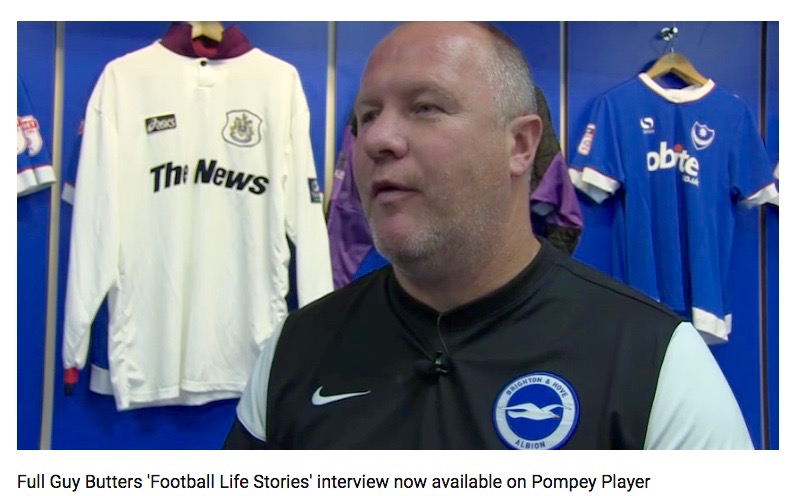
But there were mixed fortunes for Butters at Pompey, which he spoke about in a November 2016 interview for the Portsmouth website. He was there six years and enjoyed some good times when Jim Smith was manager.

guy butters YouTube

He had a brief spell on loan with Oxford United in 1994 and he eventually realised his time at Fratton Park was up when a regime change saw the arrival of Terry Venables, who was the Spurs boss when he was sold to Portsmouth.

Tony Pulis signed him for Gillingham for £225,000 on 18 October 1996 and, in six years at Priestfield, one game in particular stands out for the unfortunate pivotal moment Butters played in it.

It was 30 May 1999, the Football League Second Division play-off final to determine the third and final team to gain promotion and Gillingham were up against Manchester City, remarkably, at that time, struggling to get out of the third tier of English football.

Goals from Carl Asaba and Bob Taylor on 81 and 87 minutes looked to have given Pulis’ side victory. But Kevin Horlock had pulled one back for Joe Royle’s City and, as normal time expired, former Albion loanee Paul Dickov equalised for City in the fifth minute of added on time to level the scores at 2-2.

With no further scoring in extra time, it went to penalties. City scored three of their first four; Gills had scored only one of their three. So, the pressure was on Butters, the fourth penalty taker, to bury it to keep the Gills in it.

When Butters stepped up and hit it low to ‘keeper Nicky Weaver’s left…. it was within the 20-year-old’s reach, and he pushed it away. Cue wild celebrations as City won the shoot-out 3-1.

“Missing that penalty was one of the worst moments of my life but you have to move on and I am not afraid to have another go,” Butters told interviewer Alex Crook in an article for the 2004 Division Two play-off final match programme. “At the time, I just wanted the ground to swallow me up but nobody blamed me because it was just one of those things.”

Consolation for Butters came the following year when Gillingham returned to Wembley and on that occasion won 3-2 in extra-time against Wigan Athletic. As with Pompey, Butters had six years in total with the Kent club and played 159 league games before being released in the summer of 2002.

IMG_6010The 2002-03 season was already under way by the time Butters joined Albion on a free transfer and, in the September, he was doing his own personal pre-season workout programme in a bid to get fit.
“When I first came here I had to do a lot of extra work with Dean White,” Butters told Brian Owen, of the Argus. “It was a case of trying to cram a lot of stuff into a little space of time. I wasn’t really getting too much time to recover after it.”

The managerial change from Martin Hinshelwood to Steve Coppell didn’t do Butters any favours either. Virgo and Butters were the centre back pairing for Coppell’s first match – a 4-2 home defeat to Bristol City – and both were then discarded into the wilderness.  Virgo went on loan to Exeter and, after Coppell brought in Dean Blackwell to play alongside Danny Cullip, Butters was sent out on loan to Barnet.

But when injury meant Blackwell’s career was over, the door opened again for Butters and he seized the opportunity to such an extent that as Albion won promotion back to the second tier via the play-offs, he was voted player of the season.

GB potseas by Bennett Dean• 2004 Player of the Season pictured by Bennett Dean.

In fact, it was the arrival of Mark McGhee to succeed Coppell that was very much a turning point in Butters’ career because he had previously been considering hanging up his boots.

In Match of My Life (www.knowthescorebooks.com), he said: “Mark was a real breath of fresh air as manager. Straight away he helped me with a special diet and fitness programme aimed at improving my general match fitness, but, more importantly, helping me work towards prolonging my professional football career.

“He was the first manager to do that and under his guidance I began to thrive and really enjoy my football again.”

As the Argus previewed the 2004-05 season with a special publication, they declared: “Buoyed by a great run of form in last season’s run-in and looking in good shape in training, Butters is ready for another stab at the second tier of English football.”

And Butters said: “This year I did a bit in the summer when I was on holiday and the gaffer put us through our paces so I’m sure that when the season starts I’ll be pretty match fit.

“It’s a big step up but, if we can get a few results away from home, not too many of those big teams are going to fancy coming to Withdean.”

  • The Argus spots a lighter refreshing moment!
  • Butters and Cullip were opponents when the Seagulls won at Sheffield United, another moment captured by the Argus.

Three years later, at the age of 37, Butters was still with the Seagulls and looking forward to what would ultimately turn out to be his last in the stripes.

“I thoroughly enjoyed it last year,” Butters told Andy Naylor. “It is probably one of the most enjoyable seasons I’ve had.

IMG_6014“I missed out on pre-season last year through injury. The gaffer was amazed I played as many games as I did.

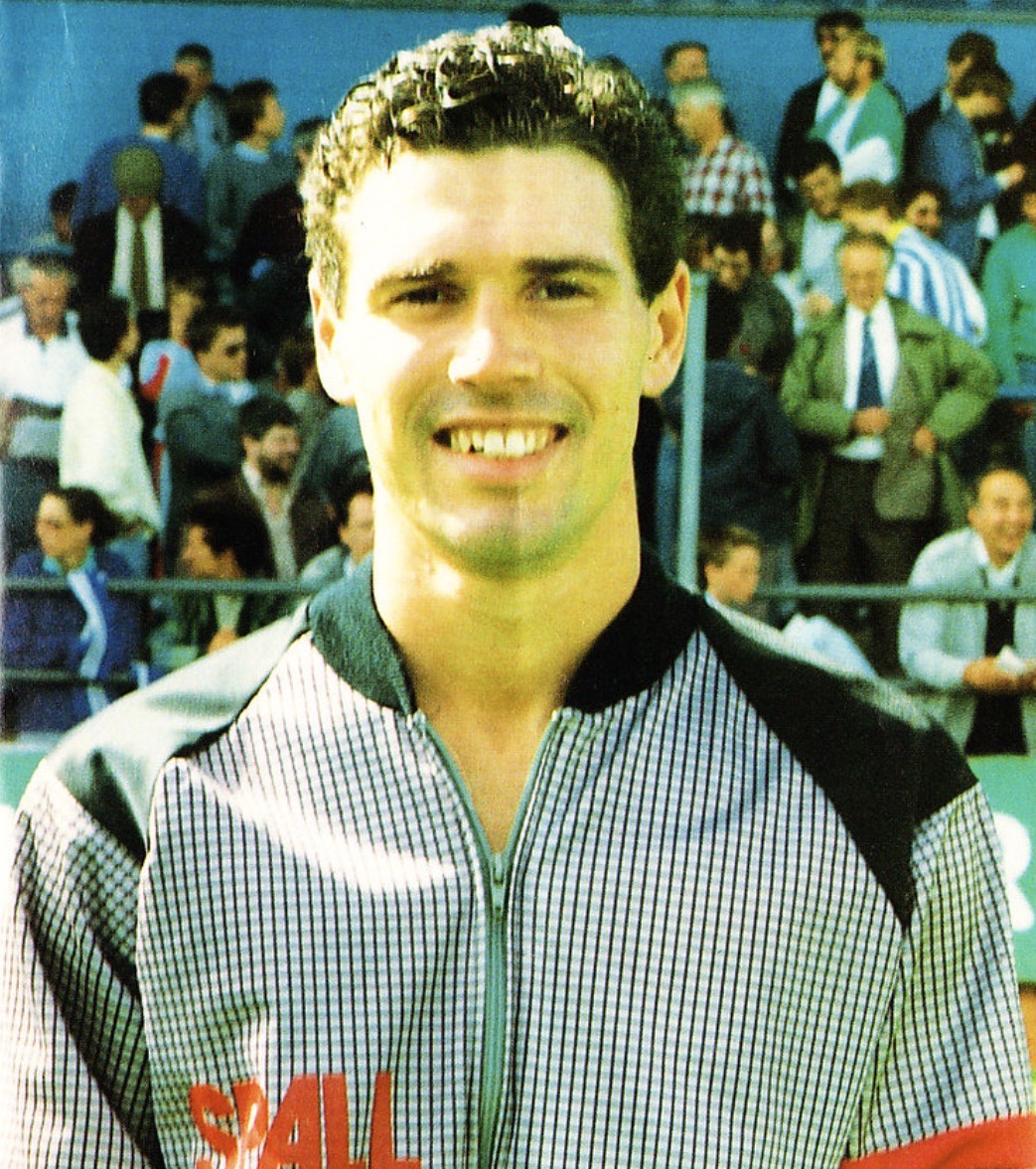
“I cannot see why, with a decent pre-season under my belt and, as long as I look after myself, that I cannot do the same again.

“I just want to go on playing as long as I can and along the way enhance my CV with coaching badges.”

Manager Dean Wilkins finally released Butters at the end of the 2007-08 season, during which he had been sent off for the first time in his career.

He’d played a total of 187 games for the Seagulls and carried on playing with Havant & Waterlooville briefly plus a seven-game spell on loan at Lewes before trying his hand at management with Winchester City and Eastleigh.

Guy + Nick

  • I got the chance to meet Guy when he kindly presented an award at an event I was involved in organising: what a great bloke!

South Coast suited utility man Paul Wood at Brighton, Bournemouth and Pompey

paul wood (red)

THE quote at the top of an Albion matchday programme feature about Paul Wood sums up his Brighton career perfectly.

“I’ve played so many positions at the Albion. I’m not sure that I consider myself a centre-forward any more.

“Actually, playing on the right as I am now takes my career virtually full circle – I always used to be a winger before I joined Portsmouth.”

Manager Barry Lloyd bought Wood from Portsmouth for £40,000 in the summer of 1987 to play up front alongside Kevin Bremner, with Garry Nelson wide on the left.

Nelson, of course, thought otherwise – and 32 goals in a promotion season playing down the middle rather proved him right.

Thus Wood found himself deployed in that rather dubious-sounding role of ‘utility player’.

“A couple of goals would have done me great guns when I got a chance up front,” Wood admitted. “I don’t think I let anybody down when Nelson and Bremner were injured but I wasn’t putting them away.

“It didn’t really bother me too much. I was most happy just to be getting first team football, especially as I had spent the previous year at Portsmouth, while they got promoted to Division One, watching from the stands.”

A pelvis ligament problem had sidelined Wood at Fratton Park so the new lease of life as part of a promotion-winning squad was a welcome break.

After making his Albion debut in a 2-0 home win over Fulham on 29 August 1987, Wood admitted: “I found it very tiring after playing only one hour of reserve football in the last nine months. But I enjoyed the experience and I’m looking forward to creating and taking more chances.”

PW colBorn in Saltburn-by-the-Sea in the north east on 1 November 1964, at one point it was thought Wood’s football career was over almost before it had begun.

As a talented schoolboy footballer, he was spotted playing for Middlesbrough Boys as the side won the English Schools’ Trophy. His school headteacher had connections at Elland Road so he went for a trial but only 15 minutes into the game broke a leg.

It seems he had broken a knuckle at the back of his knee and the Leeds physio, Bob English, took a look at the injury and said: “Sorry son, you’ve broken your leg, ripped all the ligaments, and I think you’re finished.”

Thankfully for the budding young footballer, the dire diagnosis was wrong, but it put him off trying to make it at Leeds and instead he got picked up by Portsmouth whose scout in the north had seen him playing for Guisborough under-16s.

It was a long way from home, but he appreciated the club’s more caring nature and when a homesick Wood mentioned how he was feeling, manager Frank Burrows took £30 from his own pocket to send the youngster home for a break.

Wood’s Pompey debut eventually came, ironically at Middlesbrough, after Bobby Campbell had taken over in the manager’s chair.

Originally, he had only travelled with the squad so that he could visit friends and relatives but a couple of players fell ill and Wood got his big chance.

“Before I knew it, I was in the team,” he said. “I think that’s the best game I’ve ever played, although it flew past so fast.”

Another favourite moment came when he scored two in a 4-0 win over Shrewsbury. England World Cup winner Alan Ball had succeeded Campbell as manager and said after the 21-year-old’s performance ‘a star is born’. Wood told portsmouth.co.uk: “That will stay with me for the rest of my life. For somebody who has achieved what he has in football and the respect he commands to come out and give me that compliment was a great feeling.

“It was a game where everything seemed to go right. I scored a couple and was in confident form.”

A run in the team followed for Wood, who made 25 league appearances as Pompey fell just short of promotion.

The following season, he only played seven games at the start of the season before sustaining the pelvic injury he put down to playing three times on plastic pitches in the space of three weeks.

paul wood portrait

By the time Wood had made his recovery, Pompey were playing in the top flight and he had fallen down the pecking order. The move to Brighton came about after Wood scored a hat-trick for Portsmouth’s reserves.

He told portsmouth.co.uk: “I was disappointed to go because I never really wanted to leave but I had a mortgage to pay and no bonuses on appearance money was forthcoming.”

Ironically it was the long-term injury problems to crowd favourite Steve Penney that presented Wood with a lot of his games at Brighton and when Penney got back into the side in 1989, Wood put in a transfer request because he felt he was doing well enough to merit a place.

Penney was to move on before Wood but eventually, after two and a half seasons with the Seagulls in which he played 88 games + 17 as sub, and scored just eight goals, he was sold.

That canny transfer market operator Lloyd had acquired the services of one-time England international wideman Mark Barham, who had been written off elsewhere because of injury issues, so he dispensed with Wood’s services by selling him to promotion-chasing Sheffield United.

On 5 May 1990, Wood was on the scoresheet as Dave Bassett’s United beat Leicester City 5-2 to earn promotion to the top division. Playing alongside him were future Blades manager Chris Wilder, former Albion assistant manager Bob Booker and Mark Morris, who went on to play for Bournemouth and Brighton.

In 1991, Wood played 21 games for Bournemouth on loan from United, before making the move permanent, and in three years with the Cherries he scored 18 times in 78 appearances.

Then, in a deal that saw the Cherries acquire out-of-favour Portsmouth striker Warren Aspinall (known to BBC Radio Sussex listeners as a matchday summariser) Wood returned to Fratton Park.

He said: “It was fantastic for me to get the opportunity to return to the club.”

Pompey used him as more of a utility player than ever before, Jim Smith playing him in midfield and his successor Terry Fenwick even trying him at wing-back. Sadly, though, he suffered a bad knee injury that curtailed his professional career, causing him to retire in 1996.

He managed to play 20 games and score 15 goals for a Hong Kong side, Happy Valley, in 1997-98 and back in the UK linked up with National League South side Havant & Waterlooville.

He spent five years there, retiring at the end of the 2002-03 season after playing 137 games and scoring 48 goals.

Wood now runs his own Bournemouth-based decorating business.

Read more at: http://www.portsmouth.co.uk/sport/football/pompey/big-interview-paul-wood-1-7109817