
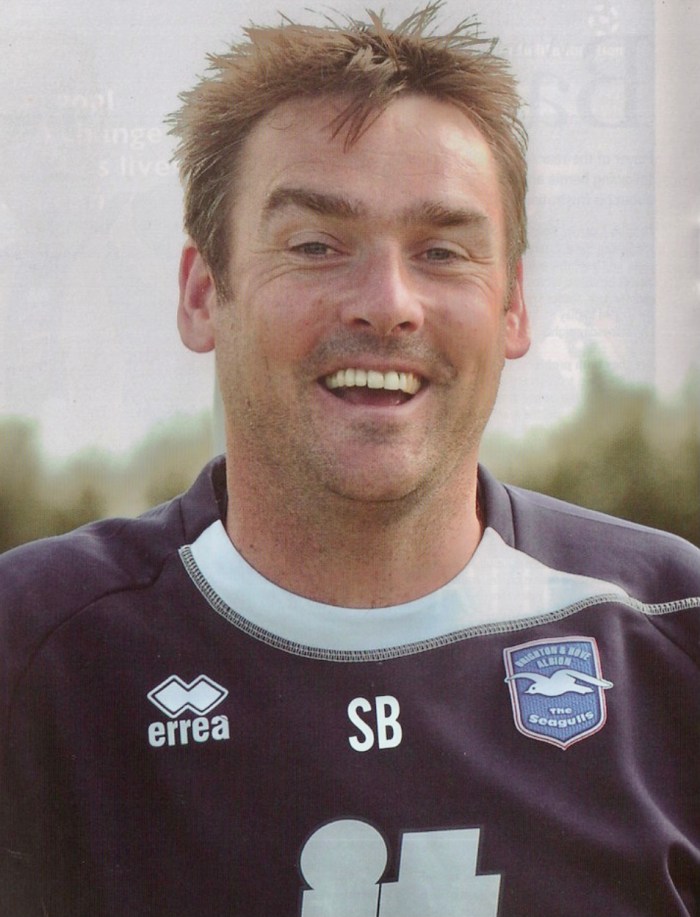
BRIGHTON-BORN Steve Brown walked out on the Albion as a schoolboy but later returned as an influential coach of the club’s emerging talent, including a young Lewis Dunk.
Previously, as reserve team coach at West Ham, Brown brought through the likes of Jack Collison, James Tomkins and Junior Stanislas.
Indeed, the former Charlton Athletic defender applied his aptitude for teaching budding young footballers to various settings, including Charlton and at Sussex independent schools Ardingly College and Lancing College (2017-19).

In his two-year spell as Albion youth team coach, between 2008 and 2010, 11 youth players signed professional contracts, and five made first-team appearances, including Dunk, Grant Hall and Jake Forster-Caskey.
In an end of season summary, Brown reported: “We have out-passed and out-played teams but not finished them off, and that is something the players need to learn to do, but the foundations are there.
“We have taken things on board from Gus (Poyet) and the first team, and we’ve tried to adapt that to the players in the youth team.”
He added: “The way the first team manager plays here, everyone has got to know what they are doing and be a very good forward-thinking football player – but at youth level you are going to get inconsistency because they are not at that level yet.”
Brown took on the Albion youth team job when Russell Slade was in charge, shortly after obtaining his UEFA A coaching licence, which he had been working towards at Charlton and West Ham, through the different stages of the badge process.

In an interview with the matchday programme, he admitted: “In some respects I’ve come home. In my playing career I had a couple of opportunities to come here and came very close when Steve Coppell was manager.
“I also had talks when Martin (Hinshelwood) was in charge and the two of us have stayed in contact ever since. So, when he phoned up to offer me the job, I grabbed it with both hands.”
Although at the time he dropped down a couple of levels, he said: “Your coaching philosophies don’t change whether you’re with a West Ham international or a Brighton youth team player. The message that you are trying to get across is the same – you want them to improve.
“It’s also my job here to make the players understand it’s not a cakewalk. They see the professionals and think it’s going to be a natural progression for them but it’s not.”
Born in Brighton on 13 May 1972, Brown went to Coldean Primary School and Patcham Fawcett High School.
His dad, Gary, had been a professional footballer in South Africa before returning to play non-league in Sussex, so it was little surprise his son developed a love for the game.
“You can definitely say that football was in the family genes,” Brown told doverathletic.com.
His performances for the Patcham Fawcett school team led him to be selected for East Sussex and Brighton Schoolboys, and the Albion signed him up on schoolboy forms for two years.
However, when 14, he admitted: “I just fell out of love with football for a time. When you’ve got a squad of 25 boys and only 11 can play, you spend a lot of time just training. I missed the competitive edge of matches and as a result I began to enjoy my football less and less.”
So, he walked away from the Albion and returned to playing for East Sussex and Brighton Schoolboys, as well as Whitehawk, where his dad was first team coach.

When he was 16, he was spotted by a Charlton scout, and was taken on as an apprentice. Reflecting on how hard he had to work to get a regular spot in the reserve side, before eventually signing as a professional, he said: “It’s really about how resilient you are.
“Lots of players get rejected once, twice, even three times before someone takes a chance on them. You just have to refuse to give up and learn not to take one person’s rejection as final.”
However, Brown’s career nearly ended before it had begun when he suffered a serious knee injury at 18, forcing him to completely reshape his game and the way he played.
“From that point, decision-making had to become his strength because his body would be permanently affected,” wrote Benjy Nurick in a blog about the defender. “I had a cruciate, the operation went wrong,” he said. “I’ve got nothing left in the right knee now.”
He told Benjy: “I don’t think people appreciated how bad the injury was. I’d say from about 26-27 years of age…from that point onwards, I was icing front and back after training and after games. I wasn’t a pill taker on a regular basis, but I did get put on some quite strong anti-inflammatories.
“I’d finish a match and for anybody that ever sort of said ‘where’s Browny?’ I had an ice pack on the front of my knee and I had an ice pack on the back of my knee and I was laying on the floor of the dressing room!”

Having made his first team debut alongside the likes of Garth Crooks and Tommy Caton, Brown established himself in the Addicks defence and played a crucial role in the club’s 1998 promotion via a memorable play-off against Sunderland at Wembley.
Brown put in a crucial tackle in extra time to ensure the score stayed 4-4 and then scored in the decisive penalty shoot-out, although he admitted: “It was an absolutely horrific experience.
“The pressure was unbelievable and once the ball went in, I didn’t care if anyone else in our side missed. I know that sounds selfish, but I was just so overwhelmed with relief at scoring.”
Brown earned a bit of a reputation as a stand-in goalkeeper too, as witnessed in May 1999, in a game against Aston Villa. After Addicks goalkeeper Andy Petterson had been sent off, Brown donned the gloves and made a number of crucial saves as his side ran out 4-3 winners.
Brown told Laura Burkin for whufc.com: “It was not the first time for me in goal, actually. I had gone in a couple of other matches over the years, against Manchester City and Southampton if I remember rightly.
“But the one with Aston Villa was the one that stands out. As soon as Andy had been sent off, the gaffer asked me and I said yes, no problem. I was quite pleased with myself, there was a dangerous cross and I got my hands to that well and a few corners as well, and I enjoyed it!”
Unfortunately, those heroics were unable to prevent Athletic returning to the second tier. But Brown was skipper when they won promotion as champions in 2000. “We broke a host of records on our way to the title. It was my best year in football,” he declared.
It’s widely felt by Addicks fans that Brown played some of the best football of his career alongside Richard Rufus at the heart of the defence under Alan Curbishley’s managership.
But what did Brown make of the former Albion midfielder as a boss? “He didn’t give out a lot of praise, you had to earn it, but he left no stone unturned in terms of our preparation for games.
“He could throw the odd teacup but was generally a level-headed guy who would work out ways for you to improve if he felt you needed it.”
Brown’s 12-year playing career at Charlton came to an end in 2002 and he joined former teammate Alan Pardew at Reading, making 40 appearances before retiring in 2005.
He told the Reading Chronicle: “I went from one very family-orientated, stable club which had seen some very good times straight into another one that was very much in a similar state.
Reading had come out of League One, was in the ascendancy, had a new stadium, the owner made the club financially responsible, they had Alan Pardew as manager who was doing well. You can leave one football club and walk into a bit of a nightmare…and I didn’t. It was a brilliant move for me.
“We got to the play-offs my first year at Reading. When I turned up, they’d just gotten rid of Matthew Upson who had been outstanding for them, so I had extremely big shoes to fill. And I slotted into his shoes and filled them quite nicely and we got to the play-offs.”
Unfortunately, although Reading had James Harper and Steve Sidwell pulling the strings in midfield, they lost Nicky Forster to injury in their semi-final first leg against Wolves, and went down 3-1 on aggregate.
“If it hadn’t been for the injury to Nicky, I think momentum would have carried us through,” said Brown. “But losing Nicky…he was our number one striker by some distance and losing him left us very short up top.”
A recurrence of that anterior cruciate ligament injury eventually forced Brown to stop playing and after a spell coaching in Charlton’s academy, he linked up with Pardew again after he’d taken over as West Ham manager before the management team changed in July 2007.
As well as working as head of football at Ardingly College, Brown also scouted for Charlton Athletic and covered first team matches as a radio co-commentator for BBC London. That radio work gradually expanded into coverage of Premier League and EFL matches.
On leaving Brighton in 2011, Brown joined his former teammate Forster at Conference South Dover Athletic, becoming his assistant manager. In the summer of 2013, he moved on to become manager of Ebbsfleet United, a role he held for 18 months.
Next stop was a brief stint in charge of Lewes before he moved on to become joint manager and director of football at Margate.
While working at Lancing College, Brown was also a regional scout for Stoke City, searching out potential players for the club’s development squad.


 In parallel lines