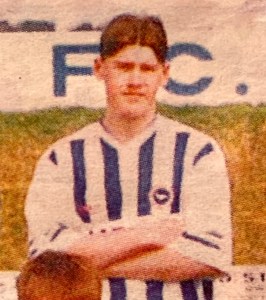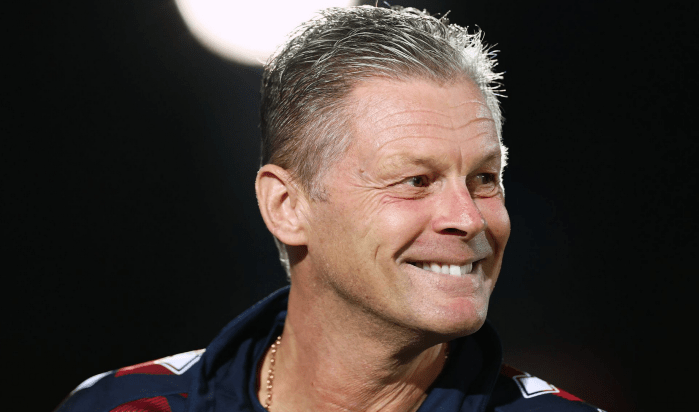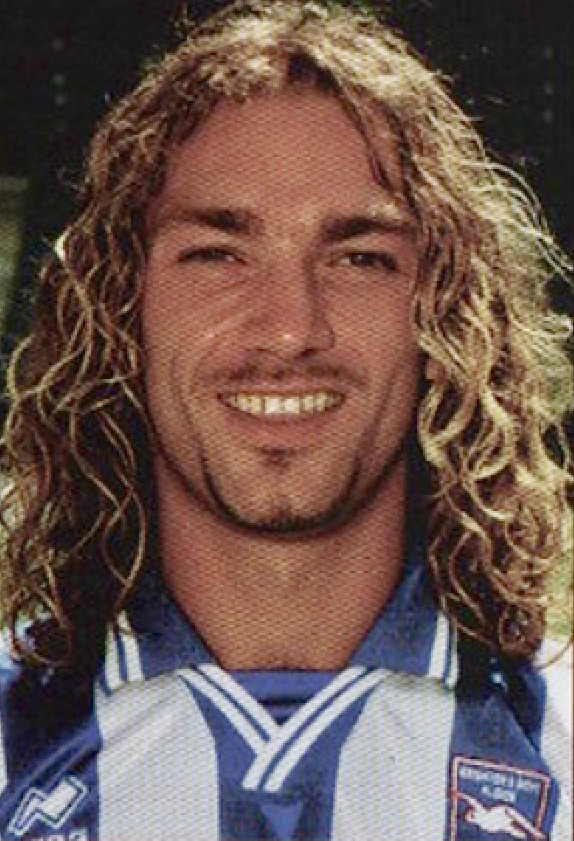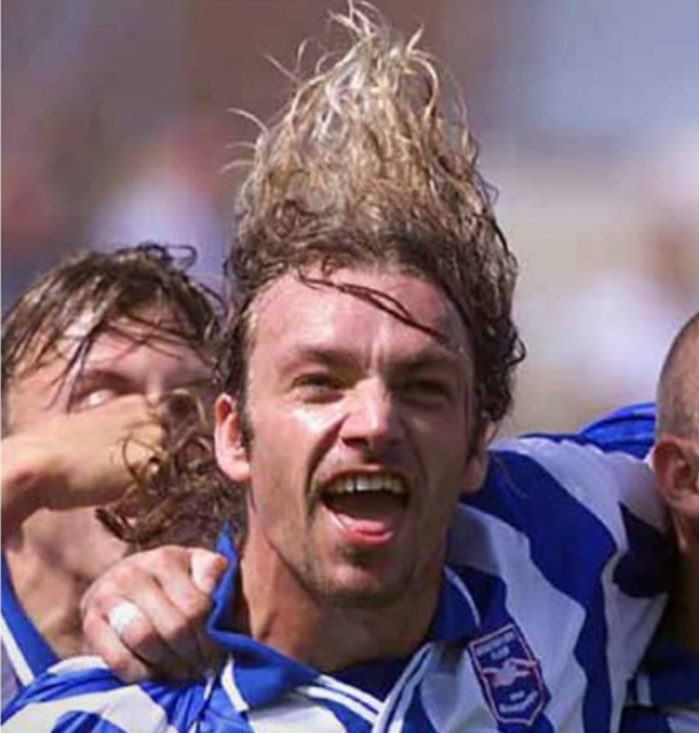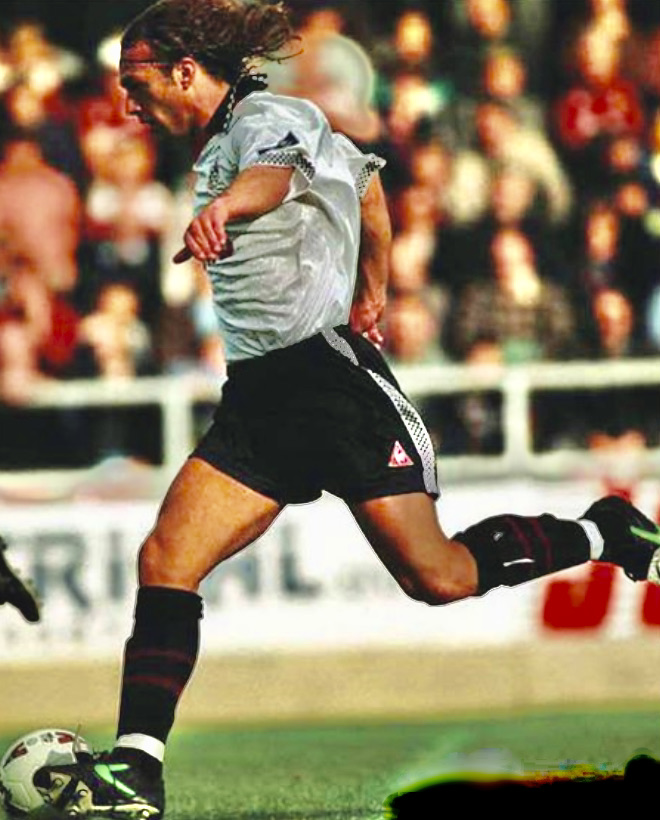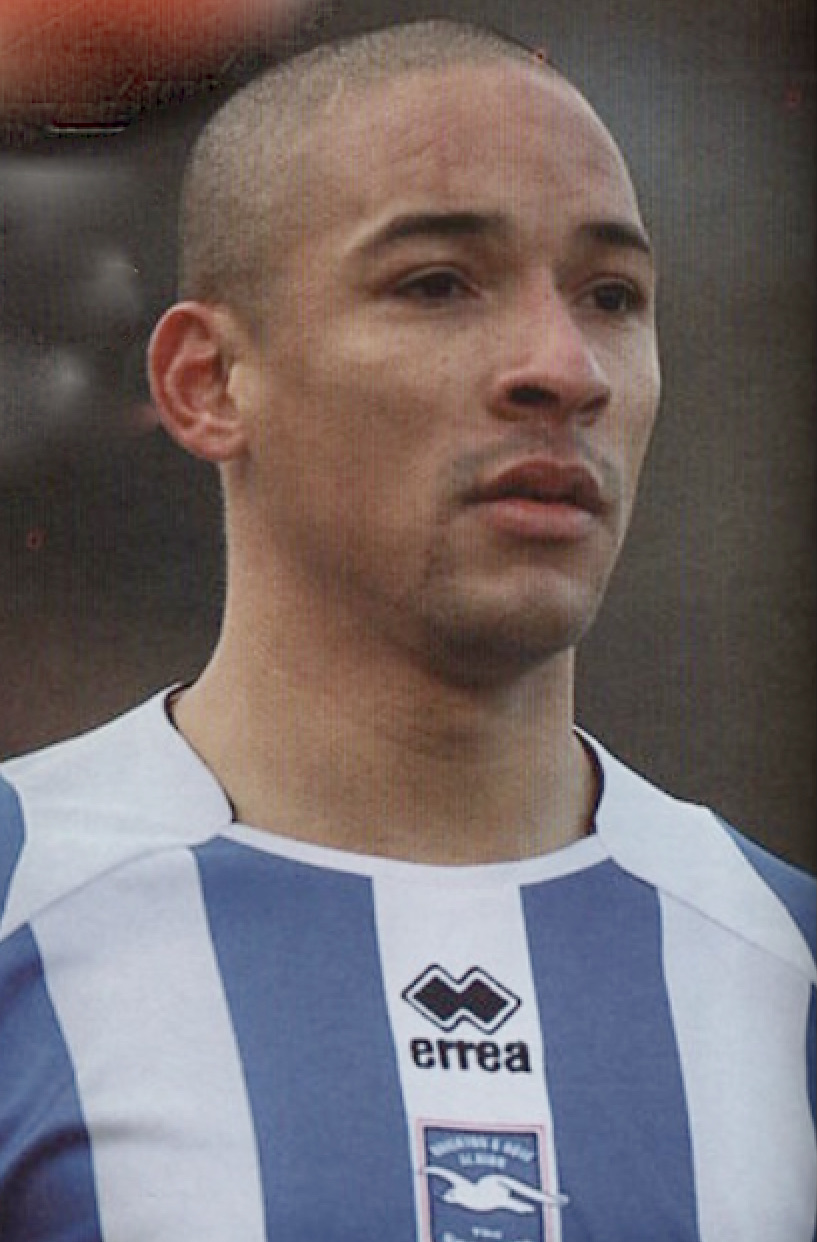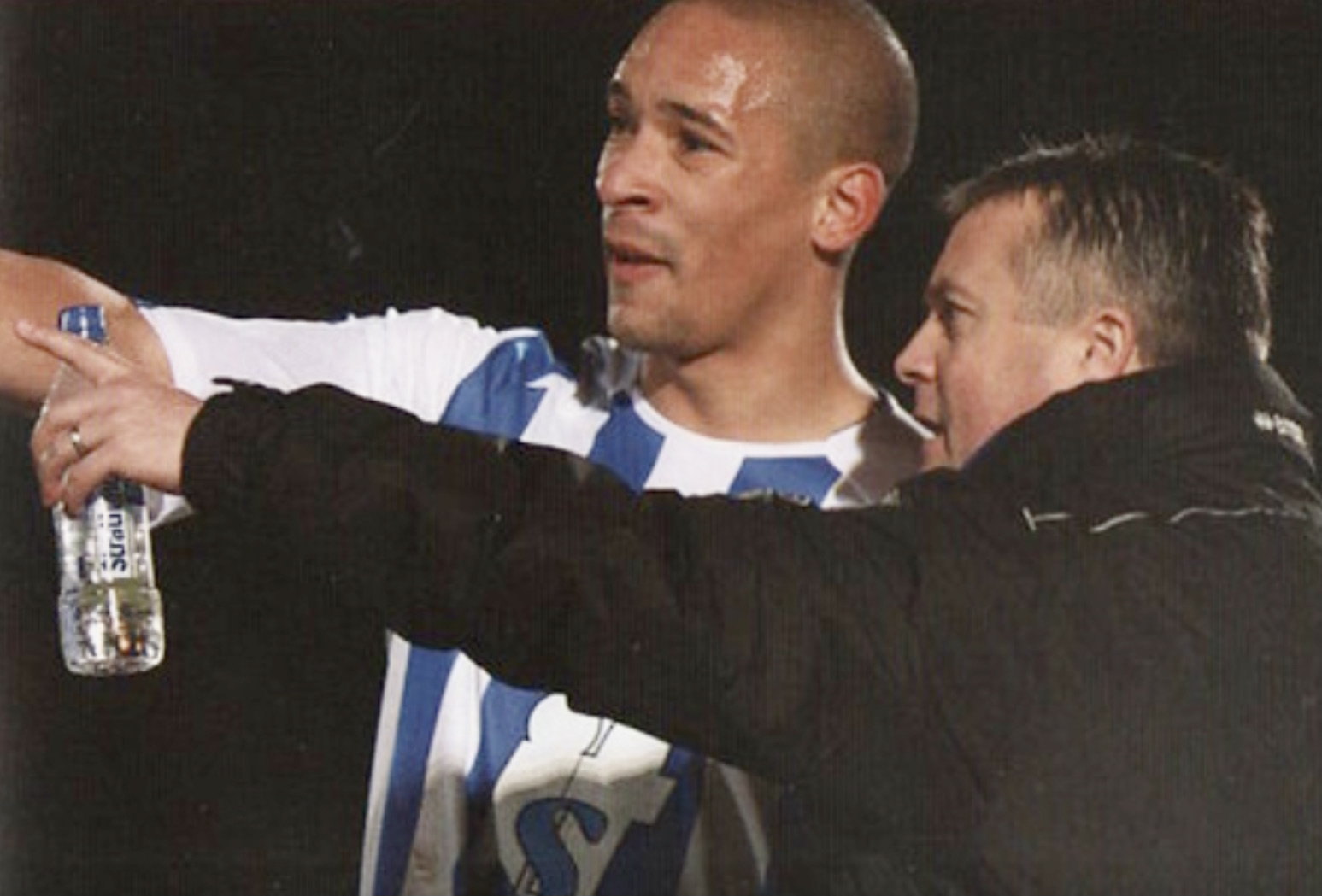
Season-opening hat-trick a dream come true for Freeman

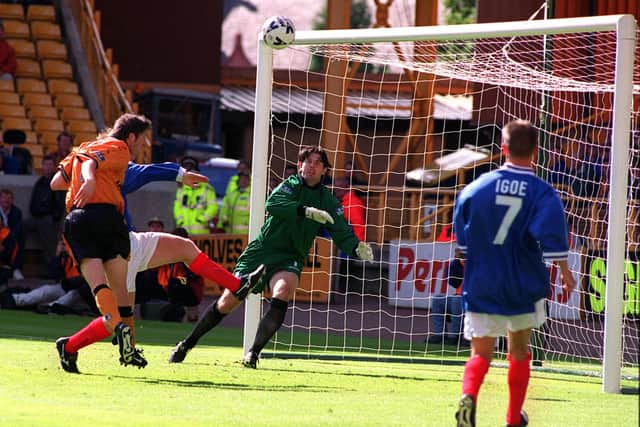
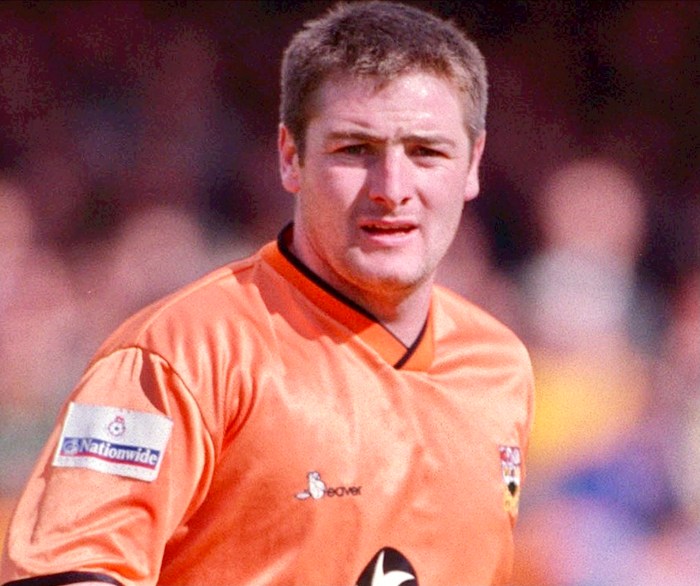
THE NEW season opening game 26 years ago saw Darren Freeman score a hat-trick as the back-in-Brighton Seagulls hammered Mansfield Town 6-0.

For Freeman, who’d previously played under Micky Adams at Fulham and Brentford, it really couldn’t have been a better debut for his hometown club as the 1999-2000 season got under way at the Withdean Stadium.

Freeman hit the headlines again when he scored the first league goal of the millennium, crashing home a volley after only two minutes in a noon kick-off 4-2 Withdean win over Exeter City on 3 January 2000. It also earned him a magnum of champagne from league sponsor Nationwide.

Headline-maker

“It was a dream come true to play for my hometown club,” Freeman later admitted. After he’d scored that hat-trick at Withdean, he managed to pick out his dad’s face in the 5,582 crowd and fondly recalled his ‘That’s my boy!’ look of pride.

If the start of the season was spectacular, trouble was lurking round the corner with Freeman ending up suspended for seven matches – all in the first half of the season. He incurred a three-game ban after being dismissed for a stamping incident at Cheltenham and worse was to follow after he spat in Plymouth defender Jon Beswetherick’s face.

Beswetherick said: “He caught me in the face with his fist just inside the 18-yard box. I ran after him to have a word in his ear and on the way back up the pitch he just spat in my face.

“He had to go. Footballers all say that is the lowest thing you can do. It was probably in the heat of the moment, but I am sure he regrets it now.”

Not only did he receive a four-game suspension, manager Adams fined him a week’s wages and said: “He let himself down, the club down, his family down and everybody connected with Brighton. He knows that and he is full of remorse. He has been left in no doubt at all that it’s not good enough.”

Freeman was top scorer with 13 goals by the end of the season but a new goalscoring hero had begun to emerge in the shape of raw teenager Bobby Zamora!

That’s not to say Freeman’s days in the stripes were over, but his second season was dogged by injuries. Two hernia operations ruled him out from the start of September to the middle of December, then, after he had worked his way back into the starting line-up, in February 2001 he put in a transfer request after being left out of the side for a home game against Blackpool, sparking an angry reaction from Adams.

“I picked a side against Blackpool which I thought would win us the game and he wasn’t in it,” he said. “He is entitled not to agree, but there is a wrong way and a right way of knocking on my door and he chose the wrong way.

“I’ve never had one player ask to leave a club where I have been a manager. This is somebody as well who I had the utmost time and respect for, having taken him to two of my previous clubs.”

Freeman had a change of heart the following month after Adams restored him to the bench.

“I want to be a part of things,” he explained. “Obviously I’ve had a bad season with injuries and a lot of it was frustration.

“When me and Micky had a chat and I asked for a transfer we both said a few things. We didn’t have a massive fall-out. We are both adults and we have got to get on with it.”

The Argus revealed Freeman’s mentor, and former Albion forward and Northern Ireland international Gerry Armstrong played a part in the decision.

“I speak to Gerry a couple of times a week,” Freeman said. “A man of his experience can only give you good advice. I’ve had a number of conversations with him. It was my own choice to come off the transfer list, but Gerry has talked some great sense into me.”

Albion finished the season as division champions but by then Freeman was having a third hernia operation having made just six starts plus 12 appearances off the bench.

“I admit that as much as I was pleased for the lads, I felt gutted I wasn’t really part of it,” Freeman admitted. He went to Lilleshall and worked through the summer in an effort to regain fitness and earn a new contract.

But it was an uphill battle and although he struggled through pre-season and played in Albion’s opening friendly at his old club Worthing, he told the Argus: “I could hardly walk after the game. I was up all night in absolute agony.”

He was sent to see Harley Street specialist Jerry Gilmore who delivered devastating news: “There is no way you can carry on playing professional football. You are in a right mess, but hopefully we can do something to give you a better quality of life.”

A fourth hernia operation followed but not being able to resume his career hit him hard.

“The club have played an absolutely massive part in helping me through and all of my family and friends, because it has really been a rough time,” he told the Argus.

“It has been great working with him (Adams). He gave me the opportunity to experience promotions, the freedom to express my way of playing and the opportunity to fulfil my ambition.”

In a matchday programme interview several years later, Freeman told Spencer Vignes: “On reflection, I was lucky. Some people play their entire career and don’t win anything, and yet every club I played for got promoted.”

Born in Brighton on 22 August 1973, Freeman went to Varndean School, started playing football with Hollingbury Hawks and then joined Whitehawk as a teenager before playing at Isthmian League level for Worthing and Horsham.

“I came through the non-league system and was given the opportunity to fulfil my dreams,” he told Vignes. “I wasn’t the greatest player but what I can say is I gave everything for every club I played for.”

Freeman turned professional with Gillingham under Tony Pulis in August 1994, where he played alongside future Fulham and Albion teammates Richard Carpenter and Paul Watson. He recalled how it was while he was playing for the Gills against Fulham that Adams’ no.2 Alan Cork got in his ear and told him not to sign a new contract at Priestfield because Fulham wanted to sign him.

Sure enough, as Freeman admitted to Vignes: “Once I knew Fulham were interested, then I was interested. They were, and are, a massive club and it was nice that a team like that wanted me.”

Impressed by Adams’ man-management skills, he said: “He made me feel wanted and that I was a big part of his plans for the 1996-97 season. He sold Fulham to me, saying we were going to do well. And we did, because we won promotion.”

In full flow for Fulham

Fulham fans website HammyEnd.com recalled: “The £15,000 Micky Adams paid to Gillingham for the services of shaggy-haired Darren Freeman proved to be a bargain.

“The popular forward quickly became a firm favourite with the Fulham faithful on account of his ability to terrorise defenders, either out wide or through the middle as a conventional centre forward.

“Injuries robbed Freeman of the chance to make good on his undoubted talented, but he still scored nine goals as the Whites went up from Division Three in 1997.”

In an interview with fulhamfc.com, Freeman said: “Micky brought in a great bunch of lads and the togetherness was fantastic. The team morale was really, really good.

“He was quite a young manager, I think he’d actually played that season, but he’d got a great bunch of lads together and we really kicked on.

“When you consider that it was Micky’s first full season as a manager, it’s incredible what he achieved. He went about his business and did his job fantastically.”

He added: “Micky had a lot of faith in me and I feel very privileged to have achieved my goals and my ambitions from when I was a kid, and to be a part of Fulham was the icing on the cake.

“We were paid to do a job but, when I look back at it, it was a dream come true and I don’t think you realise until later on in life how important it was. Fulham, to me, the fans and the whole club, it was just a special time for me.”

As with many others at Craven Cottage, Freeman’s fortunes changed when Kevin Keegan and Ray Wilkins were installed as managers by Mohamed Al Fayed and he joined something of an exodus across London to Brentford.

Coincidentally, Freeman scored on his league debut for Brentford in a 3-0 win over Mansfield (the Stags must have loved him!) and his teammates in that 1998-99 season included Watson, Lloyd Uwusu, Warren Aspinall and Charlie Oatway. Owusu ended the season as top scorer with 25 goals (Freeman scored nine) as the Bees won the Third Division championship.

After his playing days were brought to a premature end, Freeman spent five years as manager of his first club, Whitehawk, leading them to three promotions (from the Sussex County League to the Conference South) and in 2012 to winning the Sussex Senior Cup.

He briefly managed Peacehaven and Telscombe before occupying the manager’s chair at Lewes for nearly three years.

He subsequently became a football agent, initially spending 18 months with Sports Total, one of Europe’s leading football agencies, before joining forces with his former Brentford team at Dirk Hebel Sports Consulting (Hebel named one of his sons Darren after his teammate!).

Freeman told Vignes he relishes the opportunity to pass on his knowledge of the game to current players. “They say nothing compares to playing, but I find it very rewarding. It’s the next best thing to being out there, definitely.”

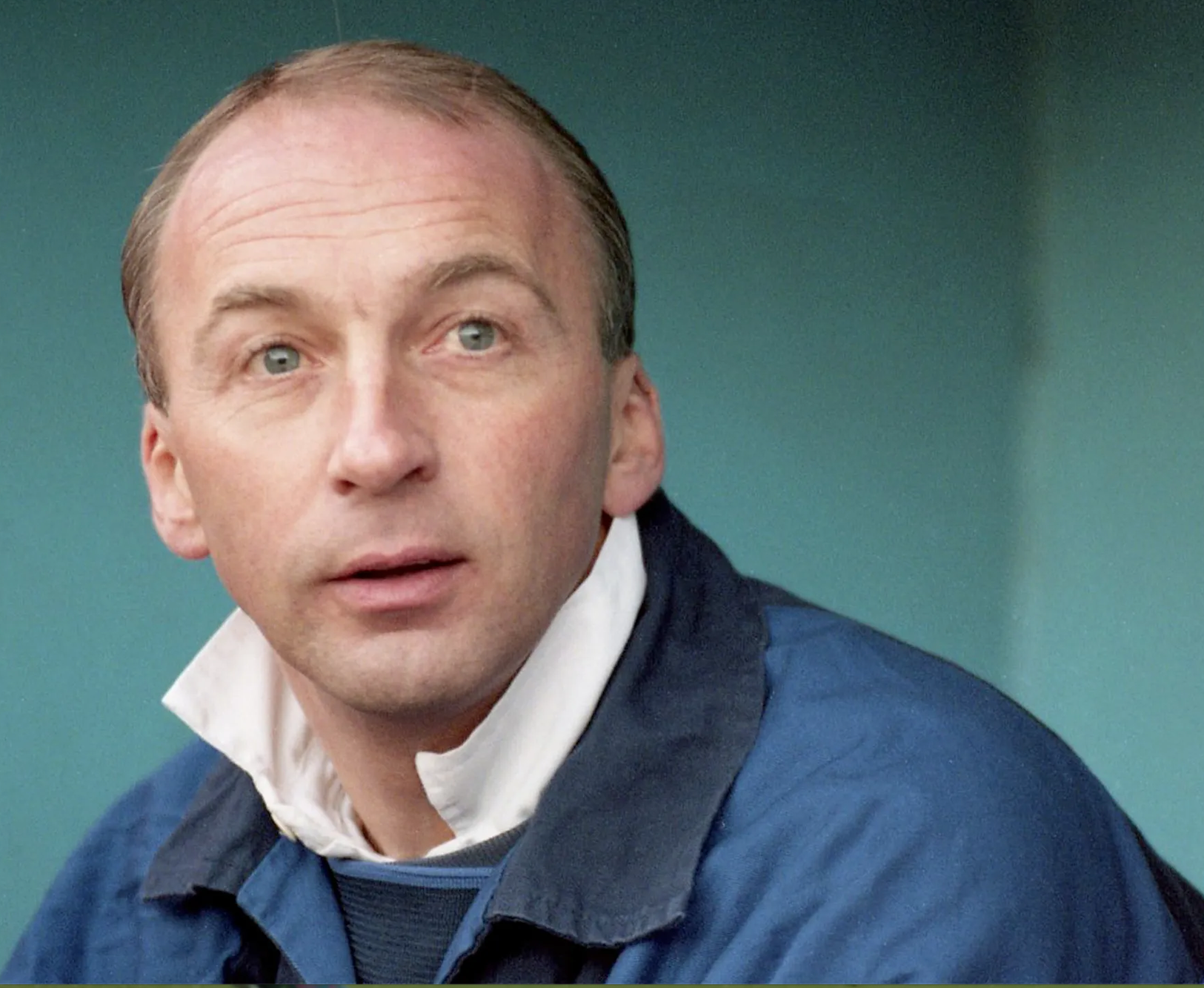
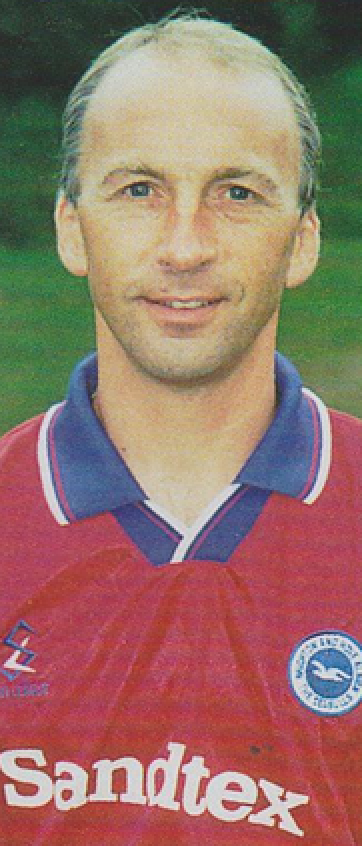
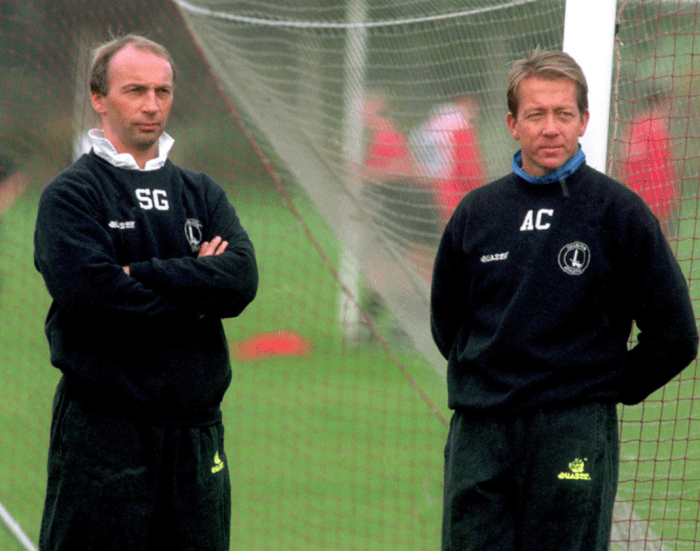
When Steve Gritt took on the ‘worst job in football’

BOURNEMOUTH-BORN Steve Gritt is synonymous with Brighton & Hove Albion’s darkest hour because he was in the almost scalding managerial hotseat at the time the club nearly went out of the league.

The mastermind behind Albion’s ‘Great Escape’ in 1997 grew up in the Dorset coastal resort and began his footballing career with his local club in the 1970s. He later worked as the Cherries chief scout, although, apart from etching his part in Brighton’s footballing folklore, most of his more memorable days in the game came at Charlton Athletic.

Somehow, against all the odds, he managed to keep the Seagulls up when most doomsters could only see the club losing its status – and possibly going out of business as a result.

Gritt, who had been out of work for 18 months having been cast adrift by a new chairman at Charlton, took over from the beleaguered Jimmy Case in December 1996 with Albion 12 points adrift at the bottom of the fourth tier.

“I was delighted when Brighton offered me the chance to return,” he wrote in his matchday programme notes. “I know a lot of people were calling it the ‘worst job in football’ but when you love football as I do then you don’t always see things that way.”

Gritt was certainly an old hand when it came to football’s vicissitudes: rejected by AFC Bournemouth as a teenager, he went on to enjoy the elation of promotion as well as enduring the despair of relegation during his time with the Addicks.

Quite what would have become of Albion if they’d lost their place in the league is now only speculation – thankfully it wasn’t a bridge Gritt had to cross.

“I’d spent 18 years at Charlton as player and joint-manager, with just six months away from it, at Walsall. Then a new chairman, Richard Murray, came in and he didn’t like the joint-manager situation, so he put Alan Curbishley in sole charge, and I left,” Gritt explained.

Without a full-time job in the game, he stayed in touch by doing some scouting work for Tony Pulis at Gillingham, Brian Flynn at Wrexham and a couple of stints for West Brom. He even pulled his boots back on to play for Welling and Tooting & Mitcham.

Eager not to continue to have to queue at the benefit office for dole money, he applied for the vacant Albion manager’s job and got it after an interview in Crewe with the despised chairman Bill Archer and his ‘henchman’ chief executive David Bellotti.

“I knew very little about what was going on at the club,” Gritt told Roy Chuter in a retrospective programme piece. “I’d read bits in the papers, but my only interest was in the football. I wasn’t going to get involved.

“The place was very low. Some of the senior players filled me in on what was happening. In my first few days, there was graffiti on the walls saying I was a stooge, a whistle protest, a fan chained himself to the goal at half-time at my first match – that bothered me as we were winning at the time and went on to beat Hull 3-0.

“Then the next week I had to go onto the pitch with a megaphone at Leyton Orient to get the supporters to leave after the match – and they already hated me! I thought ‘What is going on?’ but my job was to get some sunshine back into the fans’ Saturday afternoons.”

After familiarising himself with the issues at a fans’ forum – “It helped me understand that the fans had to do what they had to do” – he devoted himself to improving the football and although the budget was tight, brought in the experienced defender John Humphrey and Robbie Reinelt, who would go on to score one of the most crucial goals in Albion’s history.

Puzzled by the plight of a side that contained good players in the likes of Craig Maskell, Ian Baird and Paul McDonald, Gritt maintained: “I never thought we’d go down.”

He recalled: “There was such a lot of experience. If I could organise them, we’d have a chance.”

Looking back years later

Ultimately, the club’s fate was decided in the final two games of the season – at home to Doncaster Rovers and away to Hereford United.

“We knew we could beat Doncaster,” he said. “There was a big crowd and a tremendous atmosphere – very tense. Maybe that got to the players – we didn’t play as well as we had done, but once we were 1-0 up, we weren’t going to get beat. We had a great defence.”

Gritt recalled: “I was beginning to think that there wasn’t going to be any goals in the game as there hadn’t been too many chances during the game that I can remember.

“Suddenly we had a corner from which Mark Morris eventually hit the bar, confirming my thoughts. But suddenly the ball fell to Stuart (Storer) who struck it into the net to spark off unbelievable celebrations on the pitch, off the pitch and in the dugout.

“Could we now keep our composure and see the game out to a memorable 1 nil win? We did! What a day and what a memory.”

And so to Hereford, who needed to win to avoid dropping out of the league. Albion only needed a draw to stay up. Everyone knows the story. A goal down at half-time when Kerry Mayo put through his own net, Gritt reminded the players at half-time that their jobs were on the line.

Relief at Hereford

He sent on Reinelt as a sub and in the 62nd minute he slotted a second half equaliser to send the Albion faithful into ecstasy and condemn the Bulls to their fate.

“I think if it had been Brighton, we could have faded into obscurity,” he said. “Most of the players would have left, and I don’t think we could have coped.”

As things subsequently transpired, it was Gritt who would soon be on his way.

It’s perhaps a bit of a cliché to say there is no sentiment in football but when Gritt’s side had managed only four league wins up to February in the 1997-98 season, and were second bottom of the table, chairman Dick Knight wielded the axe.

“No one who cares about the Albion will forget Steve’s tremendous contribution to our survival last season,” said Knight. “This season, given our difficult circumstances, feasibly we were only seeking to preserve our league status by a safe margin, but to date that comfort zone has eluded us.”

Thankfully you can’t keep a good man down for long, though, and within two weeks of getting the Brighton bullet, Gritt was back in the saddle as assistant manager to Billy Bonds at Millwall.

Although Bonds was sacked by the Lions only six weeks after Gritt’s arrival, successors Keith Stevens and Alan McLeary kept him on, working with the reserve team. Then Mark McGhee took charge and got Gritt back involved with the first team to take on organisational work such as set plays.

After McGhee took charge at Brighton, Gritt switched across south London back to Charlton, where he ran their academy for the next six years.

He returned to his hometown club in 2011 to become chief scout, initially under Lee Bradbury and then his successor, Paul Groves.

But he was disappointed to be let go in September 2012, telling theEcho: “They have changed the way they are doing their recruitment so there wasn’t really any need for me to be there.”

Bournemouth chairman Eddie Mitchell explained: “We have got analysts on board now and all games are available on DVD. We are trying to build a database from these clips.

“We felt it was impractical to send somebody all over the country to watch games every day when we can get DVDs of games and players.

“It was a role which diminished for us. Whether it is the right way to go remains to be seen but we have got to look at effectiveness and costs.”

Gritt said: “It was a big thing last year for me to come back to the club where I grew up. I am disappointed it has come to an end like this, but life goes on.

“I have lost jobs in the past and, hopefully, I will bounce back. I am looking forward to the next chapter in my career and will just have to wait and see what comes up.”

Born in Bournemouth on 31 October 1957, Gritt’s early footballing ability was first seen in the Kings Park First School football team of 1969, as the Echo discovered when readers were asked to send in their old sports photos.

A rare sight: young Gritt with hair!

Gritt, a forward, was taken on as an apprentice by the Cherries and played a handful of games for the first team under John Benson before being released at the age of 18.

Colin Masters remembered on the Where Are They Now? website (in an October 2020 post) how Gritt linked up with non-league Dorchester who paired him up front with Ron Davies, the former Welsh international centre-forward who’d played for Southampton, Man Utd and Portsmouth.

“They were an exciting pair to watch at that level,” said Masters. “After three matches I was so impressed with Steve that I went and found the Dorchester club secretary and asked if he had signed Steve Gritt on a contract.

“The reply was ‘No’. Within two weeks, Charlton Athletic came in and took him (presumably for nothing) and he went on to have a very successful career for many years. Dorchester’s loss was Charlton’s gain!”

Between 1977 and 1993, Gritt played a total of 435 matches for the Addicks, including a relegation to the old Third Division in 1980 and two promotions – to the Second Division in 1981 under Mike Bailey and the First Division under Lennie Lawrence in 1986. He had a six-month spell with Walsall in 1989 before returning and experiencing another relegation in 1990.

Gritt became joint player-manager with Curbishley in 1991 and, under their stewardship for the next four years, the likes of Lee Bowyer, John Robinson, Richard Rufus and Shaun Newton established themselves as mainstays of the side.

When Charlton decided in 2021 to re-name their East Stand in Curbishley’s honour, a generous Gritt told londonnewsonline.co.uk it was a fitting tribute to his former colleague.

“We had our trials and tribulations but I’ve always judged that we did what was required to keep the club going. We had to steady the ship.

Joint Charlton manager with Alan Curbishley

“We would have loved to have kept Rob Lee, for example, but we had to do things for the well-being of the club so we could keep it going and give the fans something to shout about.

“It was a great time when we got back to The Valley (they’d spent several years sharing Selhurst Park with Crystal Palace).

“Then the club made a decision which I was never going to agree with. But when I look back to see what Alan did – he went on to do a significant job – I cannot complain. Ultimately what he achieved he thoroughly deserved.”
Gritt said: “When I was there we had to make sure we weren’t seen to be having disagreements although I cannot recall us having too many anyway.

“When we were on the training ground, we each knew what the other one would be doing during the sessions. We both had jobs to do on the day.

“I was more of a player than he was at that time – so the management side was more in his hands. It was fairly straightforward, until the club decided that they wanted one man in charge. That was obviously disappointing for me at the time but I have thoroughly enjoyed my career.

“Alan gave the club a massive block to build on – but no one could have envisaged how the club went after he left. It was a massive disappointment.”

After he left Bournemouth in 2012, Gritt dropped out of league football and spent five years as assistant manager at Ebbsfleet United, working with his former Charlton teammate (and ex-Albion youth team manager) Steve Brown and then Daryl McMahon, who he subsequently followed to League Two Macclesfield Town, Conference side Dagenham & Redbridge and Isthmian League Hornchurch.

Hailed as a hero at the Amex

‘Rooster’ became pivotal to developing young players

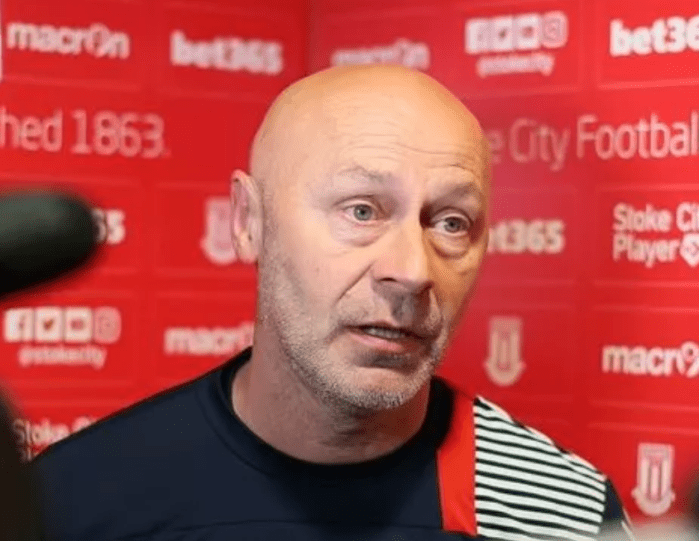
FORMER BRIGHTON apprentice Kevin Russell enjoyed a 20-year playing career in which he scored 105 goals in 552 games but he had forgettable spells at three South Coast clubs.

As we learned in my previous blog post, England Youth international Russell scored goals for Albion’s youth team and reserves but moved on before making the first team after a falling out with manager Chris Cattlin.

He got on better with Alan Ball at Portsmouth but only played eight games in three years at Pompey.

In March 1994, he was back in the south after a £125,000 move from Burnley to AFC Bournemouth. Unfortunately, his time at Dean Court coincided with dismal form on the pitch and financial pressures off it.

Russell was signed by Tony Pulis, who, it turned out, was in the final throes of his first spell as a manager, having succeeded Harry Redknapp at Dean Court.

The side had a dreadful run of form the month after Russell joined, suffering five defeats and three draws in eight matches. It was in the last of these that Russell finally got on the scoresheet for the Cherries as they picked up a point in a 1-1 draw at Hull City (his only goal in 17 matches).

While Mark McGhee won the Division Two title with Reading and Russell’s former club Burnley won promotion via a play-off final win over Stockport County, the Cherries finished a disappointing 17th in the table.

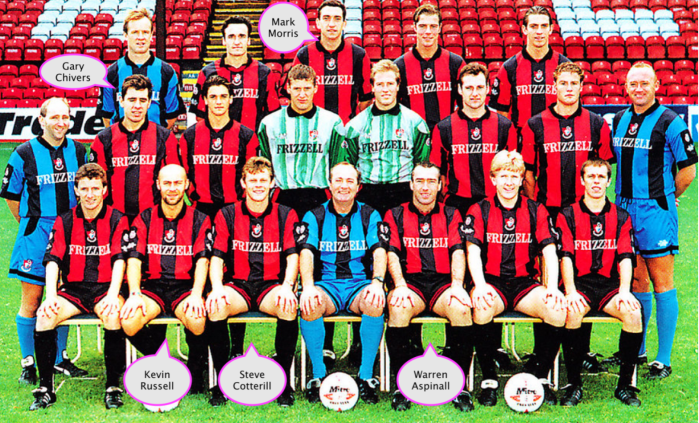
Portsmouth-born Russell had joined a squad (above) that included a number of players with past or future Brighton connections: Gary Chivers, Mark Morris, Paul Wood, Steve Cotterill and Warren Aspinall.

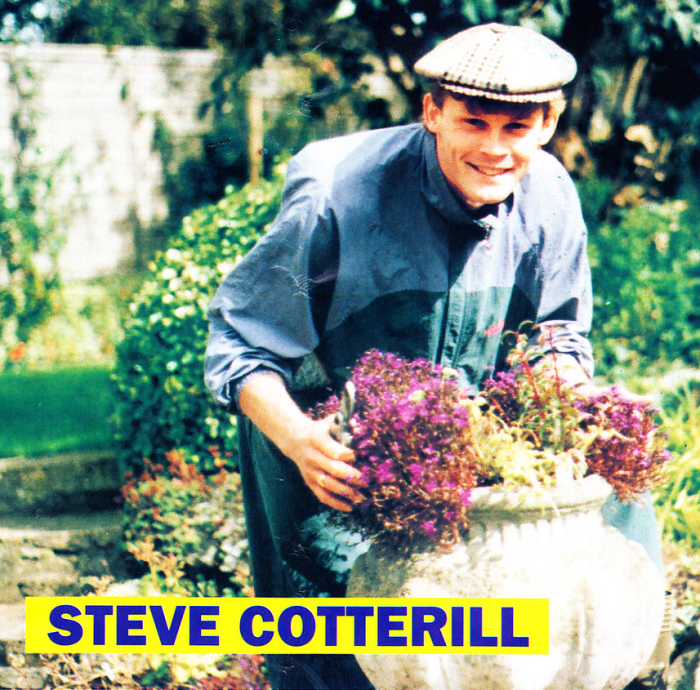
Cotterill recalled in a 2023 interview with gloucestershirelive.co.uk: “I know Rooster very well. I played with him at Bournemouth and he’s a great guy and a good coach.

“I liked him when I played with him because he used to stick crosses on a sixpence for me. I remember scoring a few goals from his crosses.”
Back in 1994, Pulis was sacked early on in the new season and former player Mel Machin took over, but the Cherries had managed only one win and a draw in their first 14 matches by the time they met the Albion at the Goldstone on 2 November 1994.

The game ended in a 0-0 draw and, although they won their next game, by Christmas they’d only got nine points from 21 games. Staring down the barrel of relegation, a last ditch revival in fortunes saw the season go down in memory as ‘The Great Escape’ because Bournemouth managed to avoided the drop by two points.

Russell, who had scored twice in 18 matches, had moved on by then and according to Aspinall, in a September 2011 interview with the Bournemouth Daily Echo: “Mel wanted rid of myself and Kevin Russell.”

Russell, who later had a habit of scoring against the Cherries – he hit four in 10 games against them – said after a 2001 encounter between Wrexham and Bournemouth: “The club was in a bad state when I was there, but Mel Machin and Sean O’Driscoll have turned things round and you know you’re always going to have a hard game against them.

“I don’t try any harder than normal when I play against them, but because I am playing up front and not in midfield or out wide, I get more chances to score.”

Aspinall had a couple of trial matches for the Albion before being packed off to Carlisle, while in February 1995 Russell joined First Division strugglers Notts County where he was reunited with former Leicester teammates Gary Mills and Phil Turner.

Howard Kendall was in charge at the time but County, who got through four managers that season (including Russell Slade for four months), finished bottom of the table having won only nine matches all season.

Russell then returned to his spiritual home in north Wales and, over the next seven years, played a further 240 matches for Wrexham, scoring 23 goals along the way.

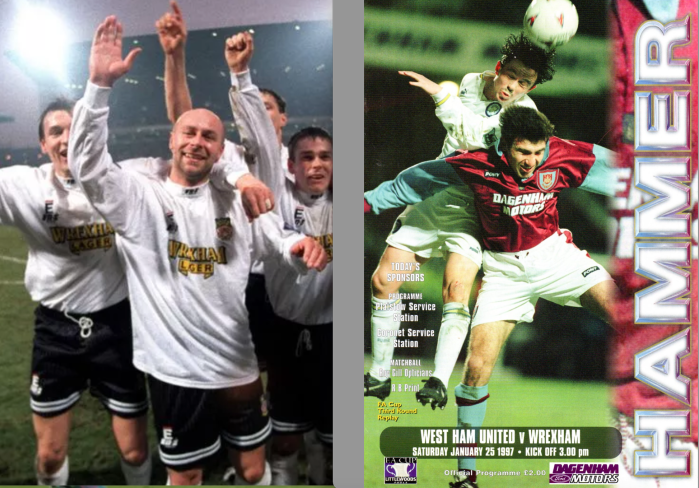
One of the most memorable was a last-minute winner at the Boleyn Ground in January 1997 as Wrexham pulled off a FA Cup giant-killing against West Ham. Having held the Hammers to a 1-1 draw at the Racecourse Ground, Russell went on as a 75th minute sub in the replay and scored a screamer in the dying seconds against a side that included Rio Ferdinand and Frank Lampard.

While the Dragons fans were elated, protesting home supporters spilled onto the pitch in anger at Harry Redknapp’s side’s performance and lowly Premier League position.

Slaven Bilic, later West Ham’s manager, was playing alongside Ferdinand and remembered the game thus: “We were struggling. We weren’t conceding a lot of goals but we couldn’t score and then Wrexham came and they scored at the end of the game, a great goal from 25 yards. After that we signed Johnny Hartson and Paul Kitson and we stayed up.”

When Russell’s playing days were over, he stayed on as a coach and worked as assistant manager under Denis Smith, taking Wrexham to promotion from the Third Division in 2002-03 and winning the LDV (English Football League) trophy in 2005.

That same year his loyalty and service to the club were rewarded with a pre-season testimonial against Manchester United – managed by his former teammate and captain Darren Ferguson’s dad!

Russell played the first 14 minutes of the match against a largely youthful United before being replaced by Ferguson. United won the game 3-1 with goals from Giuseppe Rossi, Liam Miller and Frazier Campbell and one of their subs that day was Paul McShane.

“I can’t speak highly enough of Alex for bringing his side here for me,” said Russell. “I’ve been treated to a special team with a lot of quality. I know there were a lot of young players out there, but you could see the potential they’ve got is immense.”

A crowd of nearly 6,000 watched the match and Wrexham secretary Geraint Parry said: “It just shows how well respected Kevin Russell is after his many years in the game.”

Smith and Russell were sacked in January 2007 but he went straight to Peterborough with Ferguson, who had been appointed Posh player-manager.

“We had an unbelievable time at Peterborough,” Russell told John Hutchinson. “We took them from the bottom league to the Championship in successive seasons in 2008 and 2009.”

There was a brief and unsuccessful spell for the managerial duo at Preston North End in 2010 – they were sacked four days after Christmas with Preston bottom of the Championship – but they weren’t out of work for long because they were re-appointed at Peterborough the following month.

They lost their first game back in charge though – to Brighton. Albion, on course to be league one champions under Gus Poyet that season, beat Posh 3-1: Chris Wood two and Elliott Bennett the scorers while Craig Noone made his home debut for the Seagulls.

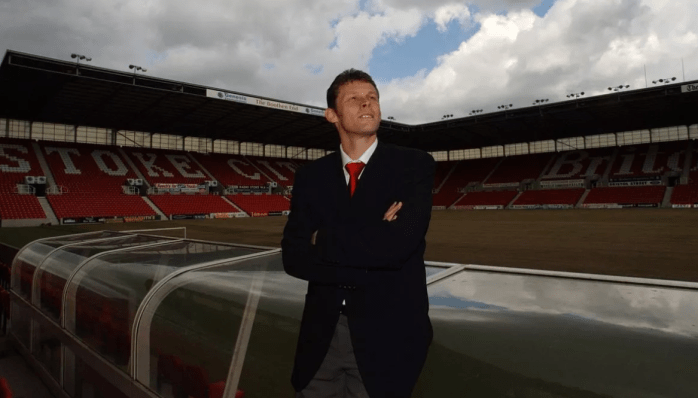
After three years at Peterborough, Russell moved back to the Potteries to join the coaching staff at Stoke (below) and stayed for nine years! He mainly worked with the under 18s and under 21s but also helped with the first team in between managerial changes in 2018 and 2019.

In May 2023, Russell joined Cheltenham Town as assistant manager to Wade Elliott. He was in caretaker charge for two matches when Elliott was sacked four months later but didn’t want the job on a permanent basis and left the club in October 2023 when Darrell Clarke was appointed.

Robins chairman David Bloxham said: “I am extremely grateful to Kevin for all his hard work and dedication and for his willingness to step in to manage the side in an extremely difficult period between Wade leaving and Darrell’s appointment.”

Once again, Russell wasn’t out of work for long. In January 2024, he was reunited with former Stoke technical director Mark Cartwright, a former goalkeeper who played 15 matches in Brighton’s 2000-01 promotion winning side, at Huddersfield Town.

Back in the game at Huddersfield Town

He was appointed as B team manager with a glowing endorsement from Cartwright, now Town’s sporting director, who said: “Not only is Kevin a great coach, but he also has a brilliant ability to develop relationships with young players.

“He’s a lively character and he knows how to relate to individuals to get the best out of them. Whilst at Stoke City, he played the pivotal role in developing players such as Nathan Collins, Harry Souttar, Tyrese Campbell, and Josh Tymon, alongside many others.

“He’s been so successful in doing that because he has a great understanding of the qualities that senior coaching staff want to see in young players.”

The Uruguayan who saw red on Lewis Dunk’s debut

URUGUAYAN international Diego Arismendi shook his Staffordshire neighbourhood but left football followers somewhat unmoved.

Noisy late-night parties hosted by the defensive midfielder at his Newcastle-under-Lyme home hit the headlines for the wrong reasons but on the pitch he made little impact, in spite of high expectations. He ended his first season in England on loan at Brighton – and got sent off in his last game for the Seagulls.

Stoke City, then in the Premier League, paid £2.6m for the 20-year-old after he had already won medals at one of his home country’s top teams – Nacional – and two caps for his country.

He made his first appearance for Stoke on his first day at the club, setting up the only goal of the game in a reserve team win over Wolves.

Peter Reid, assistant manager at the time, said: “Diego was excellent. He broke up the play and the beauty with him is, for a defensive midfielder, he can pass, which he did extremely well.

“It will take him a little bit of time to get used to the pace but first impressions on him, I’m very pleased. He has had a smile on his face since being with us and he really enjoys his football. He has the attributes to be a very good player for us.”

Arismendi made his first team debut in a League Cup match against Blackpool but was forced off with an injury on 47 minutes of the 4-3 win.

Having struggled with the language barrier and not being able to force his way into Tony Pulis’s starting line-up, he was loaned to third tier Albion…where there was a Uruguayan in charge.

Gus Poyet was excited by signing his fellow countryman and saw it as quite a sign of the Albion’s intentions under Tony Bloom. He told The Argus: “We are showing where we want to go as a club, starting from the chairman and going through the whole of the staff.

“We are trying to achieve things that are not very easy but, because of the knowledge of the game and the contacts we’ve got, sometimes they work.

“When you know people and people know you personally and they are happy to let you have a player like Diego, you have to take advantage of that.

“I know him and his agent very well from before he came to England. He was a player growing up in one of the two biggest teams in Uruguay (Nacional) and playing for them regularly.

“I was surprised when he came because, I don’t know why, but Uruguayans have got a little bit of fear about England. I suppose it’s because of the language and the weather. They prefer Italy or Spain.

“I was very pleased by his decision to come and join Stoke. Of course, I have been following him a bit to see if he was making the first team.

“Unfortunately, Stoke are doing very well and there is no place for him right now there. He wants to play football, so he is very welcome.”

One place he wasn’t so welcome was Newcastle-under-Lyme. The month before he joined Brighton he had upset his neighbours by holding a number of noisy, late night parties, playing loud music and apparently having indoor kickabouts with his friends.

One neighbour at the prestigious No 1 London Road apartment complex, plastic surgeon Dr Muhammad Khan, told the Daily Mail: “I can’t sleep and I can’t concentrate doing my work. I am at my wits’ end. My flat vibrates from the volume of the music and it is like elephants stomping across the floor.

“Sometimes it sounds like he is playing football in the flat. It makes my lights flicker. It is every single night and then gets worse at weekends. I have spoken to Mr Arismendi twice, but all he said was that it was his friend’s birthday.”

In Sussex, Poyet hoped Arismendi would find the surroundings more to his liking. “I think he will love the city, a young boy with his girlfriend. He is going to adapt to Brighton very nicely. He wants to enjoy playing football so, slowly, I think he is going to get into the team.”

Poyet thought Arismendi would adjust to life in League One and the English game in general, but things didn’t work out that way and he only made three starts and three appearances off the bench for the Seagulls.

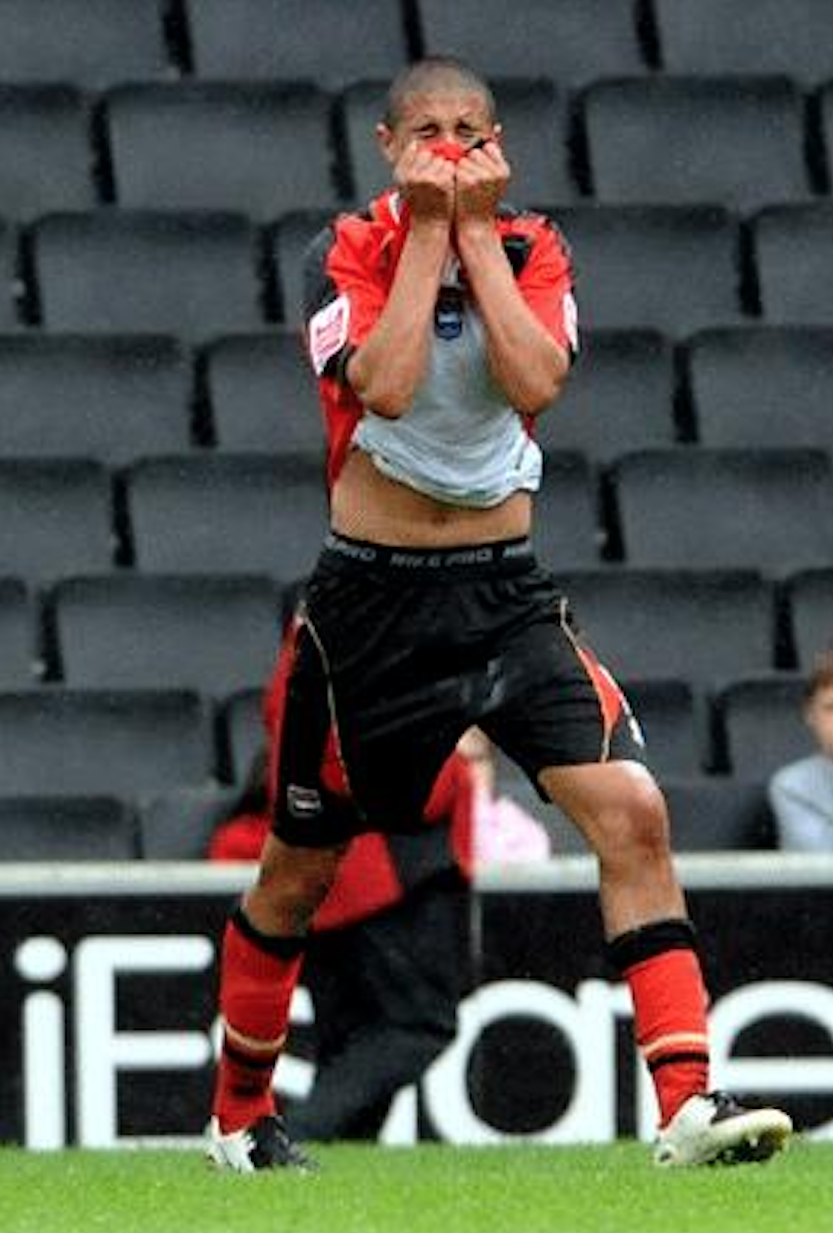
To make matters worse, in his final game he saw red (above) after scuffling with MK Dons’ Alex Rae. It was the same match that saw Lewis Dunk make his debut.

Poyet considered bringing Arismendi back to the Albion the following season on a season-long loan but they couldn’t afford to buy him and instead he ended up joining Barnsley, newly promoted to the Championship, on a similar arrangement.

He scored once (against Yorkshire rivals Leeds United in a 5-2 win) and featured in 32 games for Mark Robins’ Tykes, together with fellow loanees Kieran Trippier (from Man City), Chris Wood (from West Brom) and Paul McShane (from Hull) before returning to Stoke at the end of the season.

Because previous season’s FA Cup winners Man City had qualified for the Champions League in third place, cup runners up Stoke got to play in the Europa League (their first venture into Europe since 1975) and Arismendi started two matches and was sub in another two.

As an aside, in August 2011 I was on holiday in Split, Croatia, when City and their fans arrived to play local side Hadjuk (the visitors won 1-0). Our swimming pool sunbeds were taken over by red and white striped towels!!

Back in England, Arismendi remained firmly rooted to the bench as an unused sub for league matches and in March 2012 he was sent out on loan again, this time to Huddersfield Town until the end of the season.

Newly appointed manager Simon Grayson gave him seven starts and two appearances off the bench but he was not involved as the fourth-placed Terriers won promotion via an 8-7 penalty shoot-out win over Sheffield United at Wembley.

When Stoke excluded him from their 25-man squad at the start of the 2012-13 season, the writing was on the wall and his unhappy three-year spell in England came to an end when his contract was terminated in November 2012. He rejoined Nacional back in Uruguay.

Born in Montevideo on 25 January 1988, Arismendi said: “I had a tough upbringing. Everybody in Uruguay has a hard life, that is just the way it is there. But I come from a working class family and my childhood was not really any harder than anyone else.

“The aim, though, for me was always to play football and I have managed to realise that dream.”

He was only 20 when he won his first international cap in a friendly match against Norway in May 2008 and his second came in a World Cup qualifier against Bolivia. Both games finished 2–2.

After he returned to Montevideo and helped Nacional continue their domestic dominance by winning the Torneo Apertura (round robin South American tournament) and Uruguayan championship, he won two more caps in 2014.

He spent the 2015-16 season in Saudi Arabia playing for Al-Shabab but returned to Nacional for a third spell between 2016 and 2018. He then moved to Argentina, and at Rosario Central he once again didn’t leave a lasting impression.

A Copa Argentina win for Rosario in 2018 – but Arismendi was a non-playing sub

In a rather scathing assessment elciudadano.com reported: “Arismendi had the confidence of the coach when he signed earlier this year but did not meet expectations at all.

“(Coach) Paton Bauza thought he would fit in quickly but that was very far from reality. He never adapted to the team. When he had chances to show himself, he wasted them; he suffered injuries and he always showed more errors than virtues when he got on the pitch.”

Arismendi once again returned to the Uruguayan capital, this time to play for Racing Montevideo, where he spent one season, before switching to one of the city’s other clubs, Montevideo City Torque.

The moment Lee Hendrie felt ten feet tall at Brighton

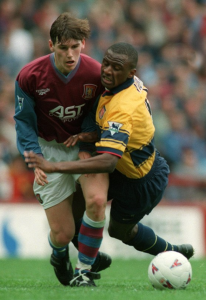
SKY SPORTS pundit Lee Hendrie has reached heights and plumbed depths in a life that saw him stop off at third-tier Brighton in 2010 after 17 years with Aston Villa.

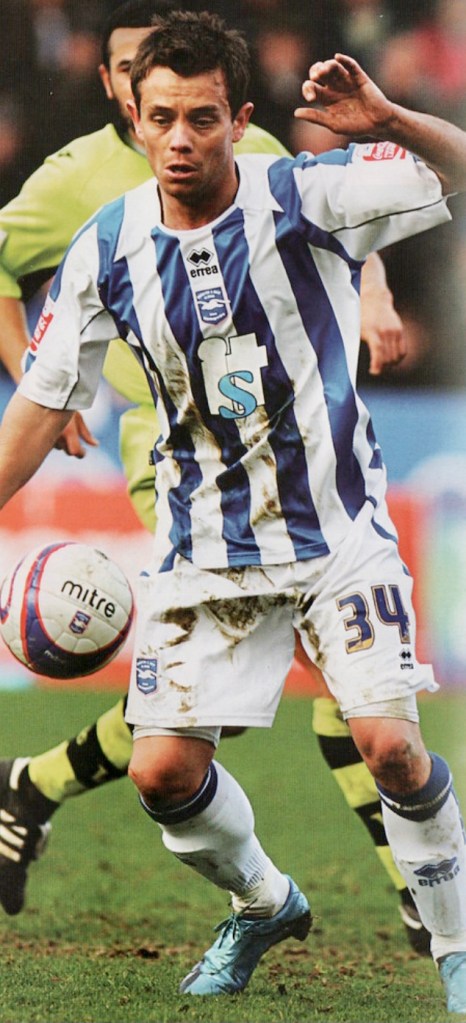
Hendrie was something of a forgotten man of football when Gus Poyet snapped him up for the Seagulls on loan from Derby County in March 2010.

Hendrie featured in eight Albion games in the last six weeks of the season: four wins, two draws and two defeats.

Turning out in League One was quite a fall for a player Glenn Hoddle selected for England, but he told the matchday programme: “The main thing is to play football. If you’re not playing then you tend to get forgotten but hopefully I can get some game time between now and the end of the season.”

And he later said to football.co.uk: “I went to Brighton to get my face back out there. Gus Poyet was brilliant. He got the lads together in a circle and said, ‘******* hell, we’ve got Lee Hendrie here’. Let me tell you, after feeling so unwanted I suddenly felt 10 feet tall.”
Hendrie made his debut as a 75th minute substitute for Sebastien Carole in a 3-0 home win over Tranmere Rovers, and he told the matchday programme: “We could have had more than three goals and I should have scored.”

But Hendrie was bubbling after his involvement and said: “Listening to the gaffer in the changing room, you can see why the lads are playing with a lot of confidence and have improved so much.

“I’ve played under a few managers, but not many, can I say, are like Gus, who is so enthusiastic and tells the players to go and enjoy themselves. There is nothing a player wants more than a gaffer telling you to enjoy your game.”

Of Albion’s midfield triumvirate of Gary Dicker, Alan Navarro and Andrew Crofts, it tended to be Dicker who was edged out by Hendrie’s arrival.

However it was in Crofts’ place that the loanee got his first start, in a 2-0 Easter Monday defeat at Hartlepool in which former Albion loanee ‘keeper Scott Flinders prevented the visitors from leaving with a point. Hendrie was subbed off on 58 minutes when Kazenga LuaLua took over.

Hendrie went on as a sub for Dicker in the following home game against Carlisle United and it was his cross that set up what looked like a late equaliser by Tommy Elphick, only for Gary Madine to nick all three points with a second for United two minutes from the end.

Hendrie started in place of Dicker away to Gillingham but gave way to the Irishman in the 79th minute and the game ended 1-1. Hendrie started once again in the 1-0 win away to Southend, but Dicker replaced him on 65 minutes.

Hendrie’s third successive start in place of Dicker came at home to Bristol Rovers, when Albion won 2-1, but once again he didn’t last the 90 minutes as Dicker took over on 74 minutes.

In the penultimate game of the season, away to MK Dons, the game finished goalless although Alex Rae and Diego Arismendi were red carded for brawling. Hendrie started and Dicker replaced him on 58 minutes.

The on-loan midfielder’s only full 90-minute appearance came in the last game of the season when Yeovil were beaten 1-0 at the Withdean Stadium; Elliott Bennett scoring the only goal of the game a minute before half-time.

The chances of a permanent deal for Hendrie looked unlikely with Poyet admitting: “We were very pleased with him and he was pleased to be here. We will wait to see if, when we start putting the squad together, there is a possibility of it happening. It’s not an easy one, because of the wages.”

Born in Solihull on 18 May 1977, football was in Hendrie’s blood: Scottish dad Paul had played for Villa’s arch rivals Birmingham City and he was playing professionally for Portland Timbers at the time his son was born. He later played for Bristol Rovers, Halifax Town and Stockport County.

For someone who became Villa through and through, Hendrie admitted to the Birmingham Mail that he had actually been at city rivals Birmingham’s school of excellence before ‘Big’ Ron Atkinson snapped him up as a teenager.

As well as his dad having played for them, his nan was a City season ticket holder and his uncle also supported them. “Villa didn’t come and scout me at the time and Blues were the first club that did. It was an opportunity for me to get myself into the pro ranks and see what it was all about. Dad said it would be good to go and have a feel for it, which I did.”

But ever since he’d scored two goals in a schools’ cup final victory for his school, Washwood Heath, against Hodge Heath at Villa Park, he had dreamed of playing for Villa.

The dream came closer when Hendrie signed on the dotted line as a 14-year-old at Villa’s Bodymoor Heath training ground, although he remembers his dad tempering his excitement.

“When we came out after I’d signed, I’d got given a load of training clobber and I thought this was it, I’d made it,” he said. “My dad said: ‘Take a step back, you, you ain’t got anywhere yet, this is the start of a long road. Just because you’ve got all the kit it doesn’t mean you’re a professional footballer and an Aston Villa player – relax yourself’.”

Hendrie and his best mate Darren Byfield, who had been strike partners in Erdington Star and Erdington & Saltley district team as kids, developed a reputation as a dynamic duo on and off the pitch, and soon became Atkinson’s ‘teacher’s pets’.

Atkinson converted Hendrie from a centre forward to left winger (even predicting he’s one day play for England in that position) and the duo continued to do well for the Villa youth team.

As it turned out, it was Atkinson’s successor, Brian Little, who ended up giving Hendrie his first team debut – although it was memorable for all the wrong reasons!

It came two days before Christmas in 1995 when he went on as a 33rd minute substitute for Mark Draper away to Queens Park Rangers. He collected a yellow card for kicking the ball away and was red carded in stoppage time; a second booking for an innocuous foul on Rufus Brevett. Into the bargain, Villa lost 1-0.

A devastated Hendrie revealed it was the opposition player-manager, Ray Wilkins, rather than Little, who put a comforting arm round him. “Someone who I’ve seen play football, a legend of the game, to come and console me and say: ‘This is football, welcome to football, these are the ups and downs you’re going to have in your career’.

“He said there’s lot of people who are talking highly of you, you’ve got a big future in the game, kid. As he got up, he tapped my shoulder and said: ‘Keep that up’.”

Few subsequent chances were given to him under Little but, when John Gregory took over, he became more established.

He would go on to make a total of 308 appearances for Villa (243 league and cup starts), scoring 32 goals, with his best performances coming in Gregory’s tenure. He wasn’t quite the same player under Graham Taylor or David O’Leary.

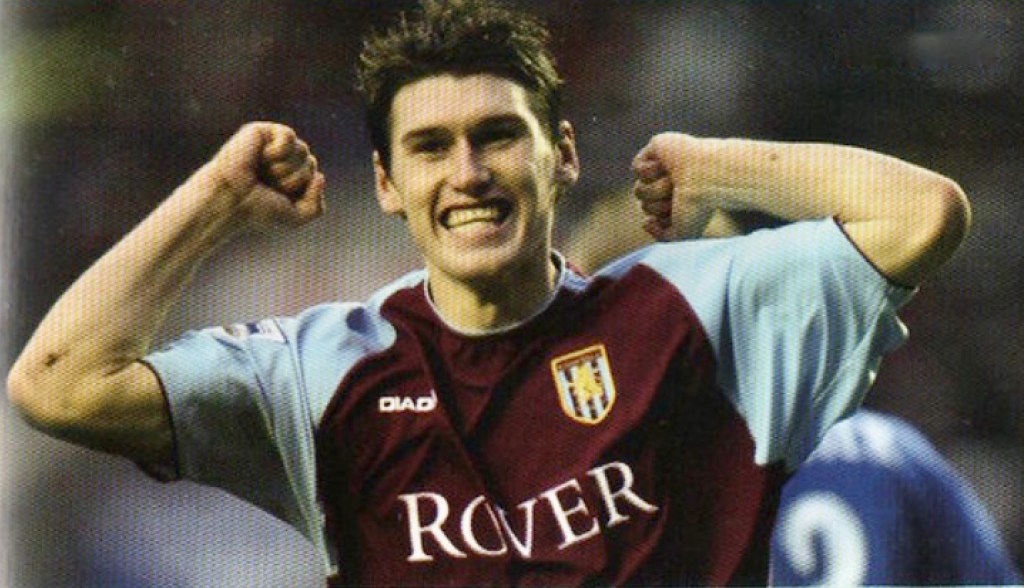
It was on November 18 1998 that he won his one and only England cap, sent on by Glenn Hoddle as a 77th minute substitute for Villa team-mate Paul Merson in a 2-0 win over the Czech Republic at Wembley. Two other Villa teammates, Dion Dublin and Gareth Southgate, were also part of Hoddle’s squad.

Unfortunately for Hendrie, Hoddle was sacked two months later and no subsequent England bosses called on him. “It’s a regret that I didn’t go on and make more of my England career,” he said. “It’s great that I’ve got a cap and it’s something you can’t take away from me, but I hate being classed as a one-cap wonder.”

Hendrie’s days at Villa came to an end in August 2006, his last involvement being from the bench in Martin O’Neill’s first match in charge, a 1-1 Premier League draw at Arsenal on the opening day of the 2006-07 campaign.

While Hendrie, by then 30, was excited about playing for O’Neill, the new boss had other plans and told him he was not part of them.

Initially he joined Stoke City under Tony Pulis on a season-long loan but Bryan Robson at Sheffield United outbid the Potters for his services on a permanent basis, and he signed a three-year deal at Bramall Lane at the start of the 2007-08 season.

Unfortunately, when Robson swiftly parted company with the Blades, Hendrie didn’t see eye to eye with his successor, Kevin Blackwell, who accused the player of being a money-grabber.

“Sheffield United was just the worst thing I could have done,” he told the Claret & Blue podcast.

“Kevin Blackwell was one of the worst managers I have ever, ever been under. He put the nail in the coffin for (my career).”

Blackwell sent him on loan to Leicester City, where he played nine games, and he later went to Blackpool too. United moved him on to Derby County but when he struggled for games there, he joined Brighton.

If the spell at Brighton was a temporary relief from his mounting problems, he revealed in a Guardian interview with Donald McRae that 2010 turned out to be one of the worst years of his life, and he attempted suicide on several occasions.

A property empire he had built up amassed insurmountable debts which even saw his mother’s home repossessed. He lost his own house as well, and it sent him into depression. Divorce and bankruptcy made the situation even worse.

“The football was almost over and my head was gone. I’d been trying to sell property, but the housing market crashed,” he said. “I got to the stage where I just wanted to end it all. I’d hit rock bottom.”

The ups and downs of Hendrie’s colourful life have featured in various media interviews.

The rise and fall tale was charted by the sporting.blog and Hendrie’s spoken about his troubles on Sky Sports, where he later became a pundit.

He was in tears on Harry’s Heroes: Euro Having A Laugh discussing his depression struggles with Vinnie Jones. The BBC radio programme You and Yours highlighted his plight in a March 2013 episode.

On the footballing front, a brief spell at Bradford City was followed by a host of short stopovers at Bandung (2011), Daventry Town (2011), Kidderminster Harriers (2011-12), Chasetown (2012), Redditch United (2012) and Tamworth (2012-13) before he retired as a professional.

He then played for Corby Town (2013), Highgate United (2013), Basford United (2013 – 2015), Montpellier (2016-17), Redditch United (2016), Nuneaton Griff (2019) and Highgate United (2019) on a non-professional basis.

As he tried to find a new purpose in life, alongside his media work, Hendrie set up FootieBugs, a football academy for kids aged from three to 12.

Hendrie chats on TV with Dion Dublin, a former Villa teammate

Petterson the fall guy during disastrous winless run

ANDY PETTERSON conceded two goals in the first seven minutes of his Albion debut but still picked up the man of the match award when managing to deny visitors Walsall any further goals in a 2-0 defeat.

He pulled off a brilliant point-blank save on the stroke of half-time to deny goalscorer Jorge Leitao a second goal and later blocked the same player’s angled drive. Steve Corica had opened the scoring for the Saddlers.

The game on August Bank Holiday Monday in 2002 was part of a disastrous run under new manager Martin Hinshelwood. In only eight games as a stand-in for injured Michel Kuipers, Petterson conceded eighteen goals, including four against his old club, Portsmouth, in only his second game.

He shipped another four in a game at home to Gillingham, one of which the matchday programme described as “the most embarrassing moment of Petterson’s long career”.

With the score 3-2, and Albion committing everyone forward, including the goalkeeper, in search of an equaliser, when 10-man Gillingham broke on a counter attack, backpedalling Petterson fell over giving Gills striker Kevin James an open goal to notch a fourth for the visitors.

Petterson only appeared once under Hinshelwood’s successor, Steve Coppell, when Kuipers had been sent off in the 89th minute of a home game against Bradford City. Paul Brooker was withdrawn and the sub goalie went between the sticks, although his first involvement was to pick the ball out of the net, Andy Gray having scored from the penalty kick awarded for the infringement that saw Kuipers dismissed.

In pouring rain, Albion – and Petterson – clung on throughout five added minutes for a 3-2 win, bringing to an end a 14-game winless league run. Bobby Zamora scored two penalties for the Seagulls and new arrival Simon Rodger, a loyal Coppell lieutenant, curled in a beauty from outside the area.

Although he was a non-playing sub on two further occasions, Petterson was let go. In a recent interview, he said he had been nursing a recurring calf injury during his time with the Albion.

Albion were the 12th of a remarkable 21 clubs the Aussie ‘keeper joined on loan or permanently.

Wolverhampton Wanderers were another stopping off point for the perennial back-up ‘keeper from Fremantle and it was one of his regrets that he only had a four-month loan spell at Molineux, having previously spurned a two-year deal with the Black Country side to make what turned out to be a career-damaging move to Pompey.

Instead of building on a career that had shown signs of promise at Charlton Athletic, Petterson flitted from club to club without ever putting down roots.

Born in Fremantle, Western Australia, on 26 September 1969, he was still only a teenager when he arrived in the UK and signed for Luton Town, where he spent four seasons.

The Hatters Heritage website recalls: “Andy was so desperate to make a name for himself in the English professional game that he paid his own passage to take up a trial at Luton. Fortunately, his gamble paid off as he was offered a contract at Kenilworth Road in 1988 although he had to wait until the start of the 1992-93 season before making his League debut.

“Impressing in pre-season with his shot stopping ability and quick reflexes, Andy was ever present for the first 14 games but a calamitous performance during a 3-3 draw at Cambridge effectively put paid to his Luton career.”

Petterson joined Alan Curbishley’s Addicks for £85,000 in July 1994, was their player of the season in 1996-97 in the First Division and played for them in the Premier League.

But he was generally no. 2 to Sasa Ilic, and subsequently dropped down to third choice behind Simon Royce, another goalkeeper who spent time with the Seagulls. The situation prompted Petterson to join struggling Portsmouth on loan in November 1998.

“Portsmouth were in financial trouble and down at the bottom of the table,” he recalled in an interview with the Argus. “I went there for three months and everything went very well. Then in the summer I was out of contract at Charlton.

“Portsmouth were one of three clubs in for me and they offered me quite a good deal, so I decided to sign for them. Everything went well under Alan Ball for the first six months, but he got the sack and it was downhill for me from there.

“We had another four managers (Tony Pulis, Steve Claridge, Graham Rix and Harry Redknapp) in the three years I was there and my face never fitted really. It was just unfortunate I went there. I was happy with the way it started, and it was a good club to be at, but it just wasn’t meant to be for me.”

In an extended interview with Neil Allen of The News, Portsmouth, in June 2020, Petterson reflected on his missed opportunity to join Wolves instead of Pompey, when he had been released by Charlton.

“Wolves’ boss Colin Lee was interested,” he said. “I was in Australia and flew back to England ahead of signing at Molineux on a two-year deal on the Monday afternoon.

“Then, late Sunday, my agent called. Milan Mandaric had taken over Pompey and they wanted to talk on Monday morning.

“That was the club I wanted to join, I had familiarity there. I signed a three-year deal. If the club had been taken over 24 hours later, the move would never have happened and I would have ended up at Wolves.”

Petterson told The News: “It was the beginning of the end when I went back to Pompey. My career never really recovered. I was kind of a journeyman before that, but at least was signed to a parent club and sent on loan to places.

“After moving to Pompey permanently it was six months here, three months there. It was the beginning of the end for my career. I guess everything happens for a reason – and for some reason it happened to me.”

Ipswich (three times), Swindon, Bradford, Plymouth, Colchester, Wolves, Torquay and West Brom were all temporary moves for the Australian stopper. After his short stint in Sussex, he also went to Bournemouth, Rushden and Diamonds, Southend, Walsall and Notts County.

“I always had belief in my ability and always wanted to play,” he said. “I think I was a good goalkeeper, although maybe mentally didn’t have the belief in myself enough.

“I’m a bit of a laid-back, casual sort of guy. Sometimes you have to be that pushy arrogant sort of person for the coach to take notice of you a bit more. I tried to do it, as a footballer you have to be a bit of an actor, but it just wasn’t in my nature.”

Referring to the fact he had 16 years as a professional footballer in the UK, he added: “That’s what gives me the belief that I was a decent goalkeeper. But something wasn’t quite there for me to go to the next level, I guess.”

He eventually only got a run of regular games when he returned to Australia and played for Newcastle Jets and then ECU Joondalup.

After his playing days were over, he became a goalkeeper coach for several clubs, including Bali United in Indonesia for a while. In August 2022, he was appointed goalkeeper coach at East Bengal FC.

“I have experienced the highs, the lows, all that kind of stuff, so can relate to goalkeepers,” he told Allen. “I’ve been through plenty.”

Talent spotter John Doolan now eyeing forwards for Brighton

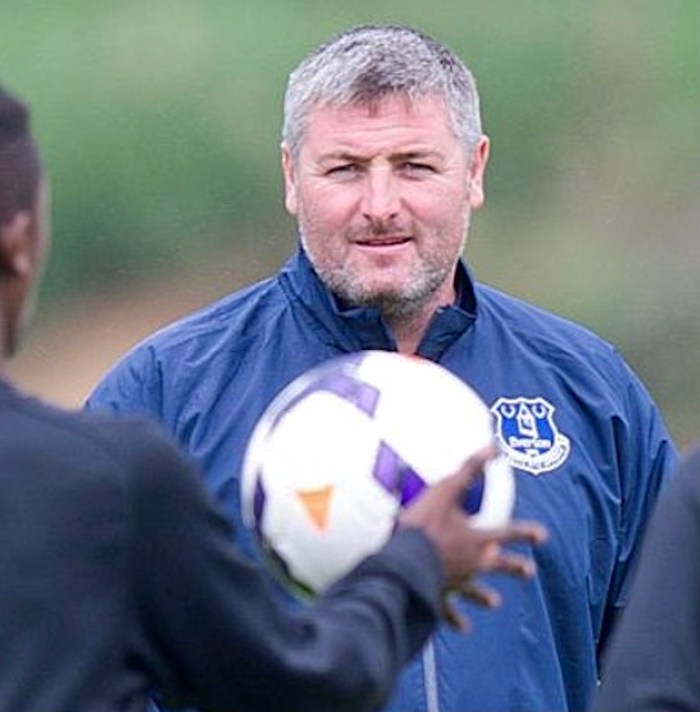
THE SCOUSER searching for Brighton’s next Evan Ferguson had Everton blue coursing through his veins from an early age.

But John Doolan’s long association with the Merseyside club came to an end in February 2023 when he swapped places with another backroom man, Lee Sargeson, who joined Everton as their head of scouting operations. Sargeson spent more than five years working in Albion’s much-admired scouting set up.

Now Doolan, a former Everton academy player, has been tasked by another well-known Evertonian, Albion technical director David Weir, and head of recruitment, Sam Jewell, with scouting forwards for the Seagulls.

Although not making it into Everton’s first team himself, Doolan helped to develop the likes of Shane Duffy, Tom Davies and Ross Barkley at Finch Farm.

During more than a decade working behind the scenes, he coached youth teams, worked on player and team development and rose through the scouting and recruitment departments.

After being released by the Toffees on a free transfer, Doolan’s own playing career spanned 550 matches for six clubs in the lower leagues, starting at Mansfield Town. His former Everton coach, Colin Harvey, took him to Field Mill where he’d become assistant manager to another ex-Evertonian, Andy King.

Simon Ireland (Albion’s under 21s coach for 21 months between June 2013 and February 2015) was a teammate at Mansfield. In a matchday programme pen picture of Doolan, when the Third Division Stags visited the Goldstone, it said: ‘Big things are expected of this stylish midfield player.’

He played 151 games for Town in a four-year spell before moving on to Barnet for a £60,000 fee in 1998. In five years with John Still’s Barnet, Doolan made one short of 200 appearances and was a teammate of skilful wideman Darren Currie, who later proved a popular signing for Mark McGhee’s Albion side in the Championship.

He was also at the club when they lost their Football League status in 2001 and became regarded as one of the best midfielders in the Football Conference.

Doolan switched to fellow Conference side Doncaster Rovers for a small fee in March 2003 and helped them gain promotion back to the League via the play-offs.

Described on Donny’s website as “a combative but skilled midfielder” he was a key member of the side that won the Third Division championship in 2003-04 and, in total, made 92 senior appearances for Rovers, scoring three goals.

In a Bred a Blue podcast interview reflecting on his career, he said: “Donny was the best. We won the league twice. The lads were great. It was like Kelly’s Heroes; a bunch of misfits put together and we went on a double promotion. There were some very good players in there.”

The only period of his playing career he regretted was when he was drawn to League One Blackpool by money. By then he was 31, and the move only lasted six months. “I had to play 25 games to get a new deal and I played 24,” he said.

He went on loan to League Two Rochdale in January 2006 and made the move permanent within 10 days. Doolan had already begun to think ahead and had taken some coaching badges while still playing. In just short of two and a half years with Rochdale he clocked up 90 appearances before, aged 34, taking his next steps in the game.

When he left Dale in May 2008 to take up a player-coach role at Blue Square North side Southport,  

Dale boss Keith Hill said: “John is a fantastic character and will be missed. He always gave 100 per cent and provided a fantastic example to the young players in the dressing room.”

He added: “I cannot speak highly enough of him and I am sure he will make a real success of coaching because he is a natural.”

Neil Dewsnip, who worked at Everton’s academy for 17 years, had already taken Doolan back to Everton as a part-time youth coach after they’d met on a coaching course. It was at the time Everton’s youth development centre was moving from Netherton to Finch Farm, and Doolan started coaching a couple of days a week while also fulfilling his duties at Southport before returning full time.

In the years that followed, he worked with all the different age groups and, under Kevin Reeves (the chief scout during the reign of Roberto Martinez) he moved into talent identification, watching promising young players across the region.

Born in Liverpool on 7 May 1974, Doolan joined Everton as a 14-year-old schoolboy, having been picked up after playing for Liverpool Schoolboys.

He started training two days a week – David Unsworth and Billy Kenny were contemporaries – before signing as a youth trainee. “My YTS days were the best days of my footballing career,” he told the podcast. “I loved every single minute of it.”

Doolan described to Bred a Blue the enjoyment he got when getting involved with the first team in training but, as a right-back, he had stiff competition and when Everton signed Paul Holmes he saw the writing was on the wall.

“I realised I wasn’t good enough,” he said. “They brought in Paul Holmes and that was like a kick in the teeth. They paid a fee for him (£100,000 from Birmingham City) and they were always going to prefer him.”

There was a momentary glimmer of a chance under Howard Kendall, but he broke an ankle in a youth cup game and the opportunity was gone.

He was sent to Bournemouth for a brief loan spell under Tony Pulis and on his return to Merseyside was told he wasn’t going to feature. “I still had a year on my contract but I decided to leave,” he said. “When I left Everton and went to Mansfield I changed position and went into midfield. I never played at the back again.”

Bred a Blue says of Doolan: “His is a story of how the adversity of being released can be overcome by resolve, hard work and confidence in your own ability.”

Doolan was one of a trio of senior scouts (Pete Bulmer and Charlie Hutton were the others) who were made redundant by the Albion in November 2024 as part of a shake-up of the recruitment department.

Managerial change had habit of foxing Jason Jarrett’s progress

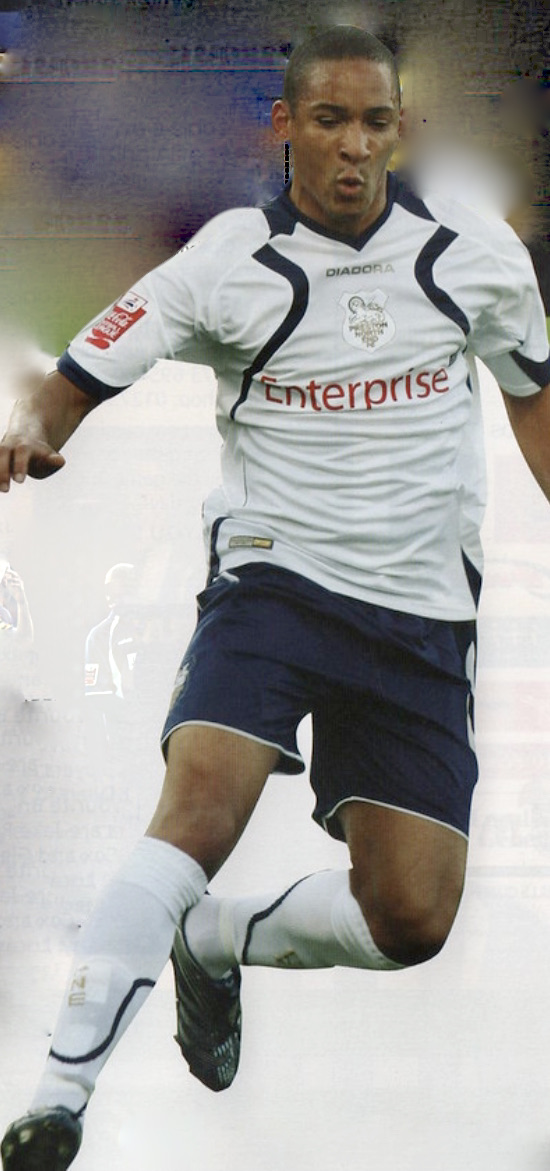
JASON JARRETT was one of multiple additions to Micky Adams’ struggling League One Brighton side in January 2009, advised to head to the Withdean by former Preston playing colleague Joe Anyinsah.

Anyinsah, who had been on loan at the Albion and declined the opportunity to stay in favour of moving to Carlisle United, nonetheless recommended the Seagulls to Jarrett.

The alliteratively named midfielder was 29 when he arrived on a free transfer hoping to reignite his career after a frustrating two-and-a-half years at Deepdale during which time he made just nine appearances.

“I was told by Alan Irvine I had a future at Preston North End, but there is only so long that you can sit on the bench,” he said. “I wanted to leave so that I can play some games and I have heard good things about Brighton so in the end it was a straightforward decision.”

He pointed out: “This is a chance to resurrect my career and I’m grateful to Micky Adams for bringing me down here.”

Jarrett was one of six new arrivals that month: Jim McNulty, Craig Davies, Calvin Andrew, Seb Carole and Chris Birchall were the others.

“We needed a bit more physical strength in midfield, which is why Jason is there,” Adams explained.

His debut for the Seagulls saw him in opposition to a club he’d very nearly signed for – Leicester City – after playing 13 games for them on loan in 2007.

And, in an even more bizarre twist, he ended up wearing the Foxes’ second kit of all yellow in the game on 27 January 2009 because the match referee deemed Albion’s would have clashed.

“Rob Kelly took me to Leicester and I was close to signing for them but it fell through when he was sacked,” Jarrett told the Argus ahead of the game.

“They are a big club and obviously the best team in the League. Everyone can see that, so it is going to be very difficult. They are a club that should definitely be in the Championship at the very least.”

Nevertheless, the Albion caused something of an upset by holding the high-flyers to a goalless draw, and the new man came close to netting the Albion a win.

Brighton were the 13th club of Jarrett’s career, most of which had been spent at Championship level. Anyone of a superstitious nature would say luck was not on his side.

Although he made 12 starts + two as a sub for the Albion, it was only a matter of weeks after he signed that Adams parted company with the Seagulls.

New boss Russell Slade stuck with Jarrett initially but then brought in his own man in Gary Dicker from Stockport County.

Having been given a contract only until the end of the season, Jarrett was not kept on, and it wasn’t long before he was reunited with Adams, this time at Port Vale.

Born in Bury on 14 September 1979, Jarrett started his career as a 16-year-old apprentice with Blackpool, and made his first team debut in November 1998. He moved on to Wrexham for the 1999-2000 season but only made one appearance for the Welsh side. Next up was hometown club Bury in the Second Division where he got a foothold in the team and featured in 69 matches. However, when they went into administration in 2002, they were forced to sell Jarrett to Wigan Athletic for £75,000.

Jarrett was a key part of the Latics midfield as they rose from the fourth tier through to the Championship, making 107 appearances under Paul Jewell.

A broken leg suffered in pre-season ahead of the 2004-05 season sidelined him and after he’d recovered he spent a month on loan at Stoke City under Tony Pulis.

Jarrett moved on before getting the chance to play in the Premier League for Wigan, instead joining Norwich City in the summer of 2005. He had previously played for Canaries boss Nigel Worthington at his first club, Blackpool, but, in common with a few other signings, his chances at Carrow Road were few and far between. He went on loan to Plymouth Argyle in the first part of the season, returning in January 2006, and two months later joined Preston on a temporary basis before making the switch to Deepdale permanent in May that year.

Once again, though, he found a manager in Paul Simpson reluctant to give him a regular starting berth so he went on loans to Hull City (where he played alongside Nicky Forster and David Livermore), Leicester (as mentioned above), QPR (for three months) and Oldham (where Craig Davies was a teammate).

He was picked out in the Albion matchday programme as Oldham’s star man ahead of their visit to the Withdean in February 2008, described as “a mobile, pacy central operator who can get forward but is also prepared to do the grimy tracking back and box-to-box work that are a good midfielder’s staple diet”.

He later returned to Oldham after his short term contract with Port Vale had expired. He’d been without a club in the latter half of the 2009-10 season but, in the summer of 2010, Oldham boss Paul Dickov took him on after a successful trial period. He told the club website: “We have a very young team and Jason’s experience helps us.”

However, he only made eight appearances and in January 2011 he dropped out of the league, initially playing for Conference North FC Halifax Town, then Airbus UK in Wales, before, in May 2013, signing for Conference side Chester. When they were relegated from the Conference in April 2014, Jarrett moved to Salford City.

After his playing days were over, Jarrett set up his own business: ProBall Sport. On his LinkedIn profile, he describes its aims thus: “At ProBall Sport we provide fun, educational sport activities for primary and secondary schools plus nutrition and well-being workshops.

“The power of school sports changed my life,” Jarrett writes. “I know first-hand how much of a positive impact it can have on young children, whether that be in pushing them on towards becoming a professional sports person or keeping them fit, active and healthy.

“I believe that first class sports coaching from a young age had a profound effect on my life and achievements so I developed Proball Sport to directly support and inspire today’s pupils to give them the chance to experience something similar, hopefully, even more special.”

Confrontation was seldom far away in Micky Adams’ career

THE FIRST player ever to be sent off in a Premier League game managed Brighton twice.

Fiery Micky Adams saw red playing for Southampton when he decked England international midfielder Ray Wilkins.

“People asked me why I did it. I said I didn’t like him, but I didn’t really know him,” Adams recalls in his autobiography, My Life in Football (Biteback Publishing, 2017).

It was only the second game of the 1992-93 season and Adams was dismissed as Saints lost 3-1 at Queens Park Rangers.

Adams blamed the fact boss Ian Branfoot had played him in midfield that day, where he was never comfortable.

“He (Wilkins) was probably running rings around me. I turned around and thumped him. I was fined two weeks’ wages and hit with a three-match ban.”

It wasn’t the only time he would have cause not to like Wilkins either. The former Chelsea, Manchester United and England midfielder replaced Adams as boss of Fulham when Mohammed Al-Fayed took over.

His previously harmonious relationship with Ray’s younger brother, Dean, turned frosty too. When Adams first took charge at the Albion, he considered youth team boss Dean “one of my best mates”. But the two fell out when Seagulls chairman Dick Knight decided to bring Adams back to the club in 2008 to replace Wilkins, who’d taken over from Mark McGhee as manager.

“He thought I had stitched him up,” said Adams. “I told him that I wanted him to stay. We talked it through and, at the end of the meeting, we seemed to have agreed on the way forward.

“I thought I’d reassured him enough for him to believe he should stay on. But he declined the invitation. He obviously wasn’t happy and attacked me verbally. I did have to remind him about the hypocrisy of a member of the Wilkins family having a dig at me, particularly when his older brother had taken my first job at Fulham.

“We don’t speak now which is a regret because he was a good mate and one of the few people I felt I could talk to and confide in.”

With the benefit of hindsight, Adams also regretted returning to manage the Seagulls a second time considering his stock among Brighton supporters had been high having led them to promotion from the fourth tier in 2001. The side that won promotion to the second tier in 2002 was also regarded as Adams’ team, even though he had left for Leicester City by the time the Albion went up under Peter Taylor.

Adams first took charge of the Seagulls when home games were still being played at Gillingham’s Priestfield Stadium.  Jeff Wood’s short reign was brought to an end after he’d failed to galvanise the side following Brian Horton’s decision to quit to return to the north. Horton took over at Port Vale, where Adams himself would subsequently become manager for two separate stints.

Back in 1999, though, Adams had been at Nottingham Forest before accepting Knight’s offer to take charge of the Albion. He’d originally gone to Nottingham to work as no.2 to Dave Bassett but Ron Atkinson had been brought in to replace Bassett and Adams was switched to reserve team manager.

The Albion job gave him the opportunity to return to front line management, a role he had enjoyed at Fulham and Brentford before regime changes had brought about his departure from both clubs.

On taking the Albion reins, Adams said: “For too long now this club has, for one reason and another, had major problems. The one thing that has remained positive is the faith the supporters have shown in their club.

“The club has to turn around eventually and I want to be the man that helps to turn it around.”

The man who appointed him, Knight, said: “Micky is a formidable character with a proven track record. He knows what it takes to get a club promoted from this division. But, more than that, Micky shares our vision of the future and wants to be part of it. That is why I have offered him a four-year contract and he has agreed to that commitment.”

Not long after taking over the Albion hotseat, he was happy to say goodbye to the stadium he’d previously known as home when a Gillingham player in the ‘80s and it was a revamped squad he assembled for the Albion’s return to Brighton, albeit within the confines of the restricted capacity Withdean Stadium.

Darren Freeman and Aidan Newhouse, two players who’d played for Adams at Fulham, scored five of the six goals that buried Mansfield Town in the new season opener at the ‘Theatre of Trees’.

Considering he was only too happy to be photographed supporting the campaign to build the new stadium at Falmer, it’s disappointing to read in his autobiography what he really thought about it.

“My mates and I nicknamed it ‘Falmer – my arse’ although I never said this to Dick’s face,” he said. “There was always so much talk and we never felt like it was going to get done.”

The turning point in his first full season in charge was the arrival of Bobby Zamora on loan from Bristol Rovers. “The first time I saw him he came onto the training ground; he looked like a kid. But he was tall and gangly with a useful left foot; there was potential there.”

Interestingly, considering Adams makes a point of saying he usually ignored directors who tried to get involved on the playing side, he took up Knight’s suggestion that the side should switch to a 4-4-2 formation – and the Albion promptly won 7-1 at Chester with Zamora scoring a hat-trick!

After a so-so first season back in Brighton, not long into the next season Adams was forced to replace his no.2, Alan Cork, with Bob Booker because Cork was offered the manager’s job at Cardiff City, at the time owned by his former Wimbledon chairman, Sam Hammam. Adams reckoned Booker’s appointment was one of the best decisions he ever made.

Surrounded by players who had served him well at Fulham and Brentford, together with the additions of Zamora, Michel Kuipers and Paul Rogers, Adams and Booker steered Albion to promotion as champions. Zamora was player of the season and he and Danny Cullip were named in the PFA divisional XI.

Not long into the new season, the lure of taking over as manager at a Premier League club saw Adams quit Brighton, initially to become Bassett’s no.2 at Leicester City, but with the promise of succeeding him.

“While I thought I had a shot at another promotion, it wasn’t a certainty,” Adams explained. “I knew I had put together a team of winners, and I knew I had a goalscorer in Bobby Zamora, but football’s fickle finger of fate could have disrupted that at any time.”

He admitted in the autobiography: “Had I been in charge at the age of 55, rather than 40, then I perhaps would have taken a different decision.”

While Albion enjoyed promotion under Taylor, what followed at Leicester for Adams was a lot more than he’d bargained for and, to his dismay, he is still associated with the ugly shenanigans surrounding the club’s mid-season trip to La Manga, to which he devotes a whole chapter of his book, aiming to set the record straight.

On the pitch, he experienced relegation and promotion with the Foxes and he doesn’t hold back from lashing out about ‘moaner’ Martin Keown, “one of the worst signings of my career”. Eventually, he’d had enough, and walked away from the club with 18 months left on his contract.

After a break in the Dordogne area of France, staying with at his sister-in-law and her husband’s vineyard, he looked for a way back into the game. He was interviewed for the job of managing MK Dons but was put off by a Brighton-style new-ground-in-the-future scenario. Then Peter Reid, a former Southampton teammate, was sacked by Coventry City. He put his name forward and took charge of a Championship side full of experienced players like Steve Staunton and Tim Sherwood.

The side’s fortunes were further boosted by the arrival of Dennis Wise, but, in an all-too-familiar scenario Adams had encountered elsewhere, the chairman who appointed him (Mike McGinnity) was replaced by Geoffrey Robinson. It wasn’t long before it was obvious the relationship was only going to end one way. As Adams tells it, Robinson was influenced by lifelong Sky Blues fan Richard Keys, the TV presenter, and it was pretty much on his say-so that Adams became an ex-City manager after two years in the job.

With an ex-wife and three children to support as well as his partner Claire, Adams couldn’t afford to be out of work for long and fortunately his next opportunity came courtesy of Geraint Williams, boss of newly promoted Colchester United, who took him on as his no.2.

However, it only got to the turn of the year before he was out of work once again, although, from what he describes, he wasn’t enjoying his time with the U’s anyway because Williams kept him at arm’s length when it came to tactics and team selection.

He was amongst the ranks of the unemployed once again when Albion chairman Knight gave him a call, but, with the benefit of hindsight, he said: “Going back turned out to be one of the biggest mistakes of my life.”

Adams blamed the backdrop of “the power struggle” between Knight and Tony Bloom on the lack of success during his second stint in the hotseat, and he reckons it was Bloom who “demanded my head on a platter”. The fateful meeting with Knight, when a parting of the ways was agreed, famously took place in the Little Chef on the A23 near Hickstead.

Looking back, Adams conceded he bowed to pressure from Knight to make certain signings – namely Jim McNulty, Jason Jarrett and Craig Davies in January 2009 – who didn’t work out. He reflected: “I shouldn’t have taken the job in the first place. I’d let my heart rule my head but, in fairness, I didn’t have any other offers coming through and it seemed like a good idea at the time.

“I wouldn’t ever say he (Knight) let me down, but he had his idea about players. I did listen to him, and maybe that’s where I went wrong.”

He added: “Going back to a club where success had been achieved before felt good, yet, the second time around, the same spark wasn’t there no matter how hard I tried.”

Born in Sheffield on 8 November 1961, Micky was the second son of four children. It might be argued his penchant for lashing out could have stemmed from seeing his father hitting his mother, which he chose to spoke about at his father’s funeral. Adams is obviously not sure if he did the right thing but he felt the record should be straight.

The Adams family were always Blades rather than Wednesdayites and, at 15, young Micky was in the youth set-up at Bramall Lane having made progress with Sunday league side Hackenthorpe Throstles.

While he thought he had done well under youth coach John Short during (former Brighton player) Jimmy Sirrel’s reign as first team manager, Sirrel’s successor, Harry Haslam, replaced Short and, not long afterwards, Adams was released.

However, Short moved to Gillingham and invited the young left winger to join the Gills. Adams linked up with a group of promising youngsters that included Steve Bruce.

In September 1979, he had a call-up to John Cartwright’s England Youth side, going on as a sub in a 1-1 draw with West Germany, and starting on the left wing away to Poland (0-1), Hungary (0-2) and Czechoslovakia (1-2) alongside the likes of Colin Pates, Paul Allen, Gary Mabbutt, Paul Walsh and Terry Gibson.

Adams honed his craft under the tutelage of a tough Northern Irishman Bill ‘Buster’ Collins and began to catch the attention of first team manager Gerry Summers and his assistant Alan Hodgkinson, who had played 675 games in goal for Sheffield United.

He made his debut aged just 17 against Rotherham United but didn’t properly break through until Summers and Hodgkinson were replaced by Keith Peacock (remember him, he was the first ever substitute in English football, in 1965, when he went on for Charlton Athletic against John Napier’s Bolton Wanderers) and Paul Taylor.

“Keith saw me as a full-back and that was probably the turning point of my career,” Adams recalled.

Once Adams and Bruce became regulars for the Gills, scouts from bigger clubs began to circle and at one point it looked like Spurs were about to sign Adams. That was until he came up against the aforementioned Peter Taylor, who was playing on the wing for Orient at the time (having previously played for Crystal Palace, Spurs and England).

“He nutmegged me three times in front of the main stand and, to cut a long story short, that was the end of that. Gillingham never heard from Spurs again,” Adams remembered.

Even so, Adams did get a move to play in the top division when Bobby Gould signed him for Coventry City. Managerial upheaval didn’t help his cause at Highfield Road and when John Sillett preferred Greg Downs at left-back, Adams dropped down a division to sign for Billy Bremner’s Leeds United (pictured below right with the legendary Scot).

“He had such a big influence on my career and life that I wouldn’t have swapped it for the world,” said Adams. But life at Elland Road changed with the arrival of Howard Wilkinson, and Adams found himself carpeted by the new boss after admitting punching physio Alan Sutton for making what an injured Adams considered an unreasonable demand to perform an exercise routine even though he was in plaster at the time.

Nevertheless, Adams admits he learned a great deal in terms of coaching from Wilkinson, especially when an improvement in results came about through repetitive fine-tuning on the training pitch.

“It is the one aspect of coaching that is extremely effective, if delivered properly,” said Adams. “I learnt this from Howard and took this lesson with me throughout my coaching and managerial career.”

However, Adams didn’t fit into Wilkinson’s plans for Leeds and he was transferred to Southampton, managed by former Aston Villa, Saints and Northern Ireland international Chris Nicholl. Adams joined Saints in the same week as Neil ‘Razor’ Ruddock and the pair were quickly summoned by Nicholl to explain the large size of the hotel bills they racked up.

Adams moved his family from Wakefield to Warsash and he went on to enjoy what he reflected on as “the best few years of my playing career”. He was at the club when a young Alan Shearer marked his debut by scoring a hat-trick and the “biggest fish in the pond at the Dell” was Jimmy Case.

Adams described the appointment of Branfoot in place of the sacked Nicholl as a watershed moment in his own career. “Overall he was decent to me and I found his methods good,” he said. And he pointed out: “I was getting older, I’d started my coaching badges and I already had one eye on my future.”

Adams recalled an incident during a two-week residential course at Lilleshall, after he had just completed his coaching badge, when he dislocated his shoulder trying to kick Neil Smillie.

“I was left-back and he was right-wing, and he took the piss out of me for 15 minutes. The fuse came out and I decided to boot him up in the air,” Adams recounted. “The only problem was that I missed. I fell over and managed to dislocate my shoulder hitting the ground. It was the worst pain I’ve ever had.”

If life was sweet at Southampton under Branfoot, that all changed when he was replaced by Alan Ball and the returning Lawrie McMenemy. Adams and other older players were left out of the side. Simon Charlton and Francis Benali were preferred at left-back. Eventually Adams went on a month’s loan to Stoke City, at the time managed by former Saints striker Joe Jordan, assisted by Asa Hartford.

On his return to Southampton, and by then 33, Adams was given a free transfer.

Former boss Branfoot came to his rescue, inviting him to move to League Two Fulham as a player-coach in charge of the reserve team. Branfoot also signed Alan Cork and he and Adams began a longstanding friendship that manifested itself in becoming a management pair at various clubs.

On the pitch, Branfoot struggled to galvanise Fulham and, with the team second from bottom of the league, he was sacked – and Adams replaced him. He kept Fulham up by improving fitness levels and introducing more of a passing game.

But he knew big changes were needed if they were going to improve and he gave free transfers to 17 players, despite clashing with Jimmy Hill, who had different ideas.

An admirer of what Tony Pulis was doing at Gillingham, Adams signed three of their players: Paul Watson, Richard Carpenter and Darren Freeman. He also got in goalkeeper Mark Walton and centre back Danny Cullip. Simon Morgan was one of the few who wasn’t let go, and Paul Brooker emerged as a skilful winger. All would later play under him at Brighton.

Promotion was secured and Adams was named divisional Manager of the Year but after all the celebrations had died down Mohamed Al-Fayed bought the club and things changed dramatically.

“The club was in a state of flux as it tried desperately to come to terms with its new status as a billionaire’s plaything,” Adams acerbically observed. “From having nothing, we had everything.”

Before too long, in spite of being given a new five-year contract, Adams was out of the Craven Cottage door, replaced by Wilkins and Kevin Keegan.

But he wasn’t out of work for long because Branfoot’s former deputy, Len Walker, introduced him to the chairman of Swansea City, who were on the brink of relieving Jan Molby of his duties as manager.

Various promises were made regarding funds that would be made available to him but when they were not forthcoming he realised something was not right and he quit, leaving Cork, the deputy he’d taken with him, to take over.

By his own admission, if he hadn’t been sitting on the £140,000 pay-off he’d received from Fulham, he probably would have stayed. As it was, he was out of work once again…..until he had a ‘phone call from David Webb, the former Chelsea and Southampton defender who was the owner of Brentford, but in the process of trying to sell the club.

His brief was to keep the side in the league and to make it attractive to potential purchasers. It was at Griffin Park that he first met up with the aforementioned Bob Booker, who was managing the under 18s at the time. “He is one of the most loyal and trustworthy friends I have ever known,” said Adams. “He would do anything for you.”

However, although he signed the likes of Cullip and Watson from Fulham, he wasn’t able to stop the Bees from being relegated. During the close season, former Palace chairman Ron Noades bought the club and announced he was also taking over as manager.

Once again, Adams was out of a job but his next step saw him appointed as no.2 to Dave Bassett at Nottingham Forest.

Which brings us almost full circle in the Adams career story, but not quite.

After the debacle of his second stint in charge of Brighton, he was twice manager at Port Vale, each spell straddling what turned out to be a disastrous period in charge of his family’s favourite club, Sheffield United.

It was Adams who gave a league debut to Harry Maguire during his time at Bramall Lane, but the side were relegated from the Championship on his watch, and he was sacked.

Adams took charge of 249 games as Vale boss but quit after a run of six defeats saying he’d fallen out of love with the game.

It didn’t prevent him having another go at it, though. He went to bottom of the league Tranmere Rovers and admitted in his book: “It was arrogance to think I could turn round a club that had been relegated twice in two seasons.”

In short, he couldn’t and he ended up leaving two games before the end of what was their third successive relegation.

“It was a really poor end to a career that had started so promisingly at Fulham,” he said.

The strange tale of Lorenzo Pinamonte, a gentleman of Verona

IF CASH-STRAPPED Brighton hadn’t been outbid by Brentford for a little-known Italian striker in the opening months of the 21st century, a teenage forward who went on to earn a place in the club’s history might never have appeared in an Albion shirt.

‘If only’, ‘but’ and ‘maybe’ preface many a football fan’s dashed hopes but in the case of Lorenzo Pinamonte, it seems the Gods were smiling on the Seagulls.

The imposing Italian scored only three goals in 26 appearances for the Bees after their £75,000 gazumped Albion’s bid to take him permanently from Bristol City.

Thankfully Brighton’s fortunes were vastly improved by the chap they signed instead: a raw reserve at City’s neighbours Rovers called Bobby Zamora!

Let’s go back to the last month of the 20th century. After a spectacular start to life back in Brighton following the two-year exile playing home games at Gillingham – including an opening day 6-0 crushing of Mansfield Town – mid-table Albion were struggling to find the back of the net with any consistency.

Twice-red-carded striker Darren Freeman missed multiple games through suspension, former soldier David Cameron struggled to cut it at leading the line, and former England Youth international Aidan Newhouse didn’t live up to Micky Adams’ expectations either.

That’s when Adams turned to the first Italian to represent the Albion, 22-year-old 6’3” Pinamonte, who was struggling to get a game under Tony Pulis, then boss of the relegated Robins (they’d dropped down to the third tier the season before).

He made his debut for ‘flu-hit Albion away to Swansea City on a rainy night at the Vetch Field, only meeting his teammates for the first time when being picked up en route to Wales for the game.

“Pinamonte led the line as a lone striker,” recalled wearebrighton.com. “A thankless task was made even harder when the Albion were reduced to 10 men following a red card for Jamie Campbell with only 25 minutes played.”

While makeshift Albion lost 2-0 to the Swans, their run of defeats was halted courtesy of a 1-1 Boxing Day draw at home to Barnet and a last game of the century 3-1 win at Rotherham. The 3 January match at home to Exeter City not only famously saw Freeman score the first football league goal of the 21st century, it also featured a brace from the lanky loan signing as Albion won 4-2.

It seems Adams had seen enough to want to make Pinamonte’s move permanent, but matters became complicated when Pulis decided to quit the Robins and take over at Portsmouth.

Because the departing manager’s successor may have had a different view of the striker, he signed on loan for a second month, rather than permanently, Adams telling the Argus: “We are pleased to keep Lorenzo for another month. The situation at Bristol won’t be resolved for a few weeks, so a permanent deal is up in the air.”

The same article declared that Pinamonte wanted to join Albion permanently but the bid put in by chairman Dick Knight was below the asking price, and Brentford, a division above Albion at the time, had also made an offer.

Pinamonte unsurprisingly felt in limbo and confessed to being distracted when he played in a 1-0 defeat against Leyton Orient.

“In your mind you wonder what is happening, whether you are going to stay or go, so there was a little bit of confusion.

“That probably affected me. I was thinking about it, and perhaps not concentrating,” he said. “I think I have done well so far, but not in that game.”

Cover boy Lorenzo

The turn round in form took the Seagulls to within five points of a play-off place but Pinamonte’s head was turned by the chance to play at a higher level and Brentford eventually got their man.

Offered a lucrative three-and-a-half-year contract at Griffin Park, Pinamonte admitted to the Argus: “I am a little bit upset to be leaving and I would love to come back in the future. I wanted to stay but for my future it is better to leave. Money talks and I will be playing in a higher division.”

A disappointed Adams admitted he would have to look elsewhere for a big, hold-up striker. “We thought Dave Cameron would come in and be that big centre forward and Aidan Newhouse also. Unfortunately Dave prefers the ball into his body and feet so he can jink and turn.

“Big Lorenzo came in and gave us that other option. Gary Hart and Darren Freeman gambled off him. Now that he has gone, to get the best out of them and the other forwards at the club, we may need to bring another big man in.”

Adams later told Greville Waterman, one of the voices of authority on all things Brentford: “We were going through an indifferent spell and struggling for a big centre forward. David Cameron wasn’t up to it and we had been outbid by Brentford for Lorenzo Pinamonte, so I called Ian Holloway at Bristol Rovers who told me: ‘I have got a young lad who’s been on loan at Bath City. He’s only 19 and as raw as anything, but he has scored a few goals for them.’

“I was not totally convinced but we were desperate and the clincher was when Ian told me he was only earning £140 per week, so I said ‘send him down,’ and the rest is history!”

For his part, Pinamonte reflected some years later that his time at Brighton probably just came too early in his life. “Maybe if I had gone when I was 25 or 26 it would have been different for me,” he told Brian Owen of the Argus in 2016. “I enjoyed England but it probably came too early for me. I was there alone and I was very young.”

Pinamonte’s time at Brentford certainly divided opinion. ‘Smilely’ on griffinpark.org described him as “Lorenzo Pinthetailonthedonkey” but ‘Saffrey’ on the same platform said: “I think he’s been unlucky with (Ron) Noades as he was never really given a chance, as Uncle Ron brought in that donkey Steve ‘Murray’ Jones, when he should have given Pinamonte, who had recently joined the club, a decent run out.”

The Bees lured Pinamonte from Albion’s grasp – thankfully

‘Chalfont Bees’ reckoned: “All I’ve seen of Lorenzo is him getting booked or worse. He just doesn’t seem to be good enough at the moment and I can’t see him improving. I say cut our losses and get rid of him so as to give other strikers a chance.”

And ‘Holysmith’ opined: “Although Pinamonte hasn’t done much, he has a good strike rate for the amount of time he has played for Brentford. The problem is he doesn’t move about much.”

In the 2000-01 season, Pinamonte went out on a mid-season loan to Leyton Orient and at the season’s end he was released by Steve Coppell.

As he explained in that 2016 interview with Brian Owen, he then returned to Italy and spent eight years playing in the Italian third division until retiring as a pro at the age of 31.

Born on 9 May 1978, a gentleman of Verona (Caprino Veronese to be precise), the young Pinamonte was with southern Italy side Foggia before trying his luck in England. He joined Bristol City on a free transfer in the 1997-98 season.

In City’s disastrous 1998-99 season, when they were relegated from Division One (now the Championship) in bottom place, Pinamonte celebrated his 21st birthday by scoring the only goal of the game on his debut as Norwich City were beaten at Ashton Gate in the last fixture of the campaign.

With their fate already sealed and with an eye to the following season, Swedish manager Benny Lennartsson, who had won only five of the 30 games he’d taken charge of, chose to blood a few youngsters and handed Pinamonte his debut up front alongside £1.2m signing Ade Akinbiyi.

Five minutes before half time, the City faithful finally had a moment to cheer, as Bristol Evening Post reporter Richard Latham recorded. “Akinbiyi, made captain for the day against the club who launched his career, headed down a Micky Bell corner and Pinamonte stuck out a long right leg to find the top corner of the net from close range.”

Lennartsson was relieved of his duties at the end of the season and two months later he was replaced by former Gillingham boss Pulis, who sent the young Italian striker on a fruitless loan at Carlisle United (he didn’t play a game) before answering Brighton’s call for reinforcements.

Off the field, Albion’s matchday programme informed us how Pinamonte was staying at the Courtlands Hotel in Hove during his temporary stay where the manager was Italian Jo Guiseppe-Messina, and he had also enjoyed the hospitality of Angelo Cavalli, the owner of Topolino Duo restaurant in Hove.

Apart from scrapbook memories of his time with the Albion, Pinamonte continued his friendship with Cavalli; the restaurateur had been to visit him at the hotel at Lake Garda that he ran after his professional playing days were over.