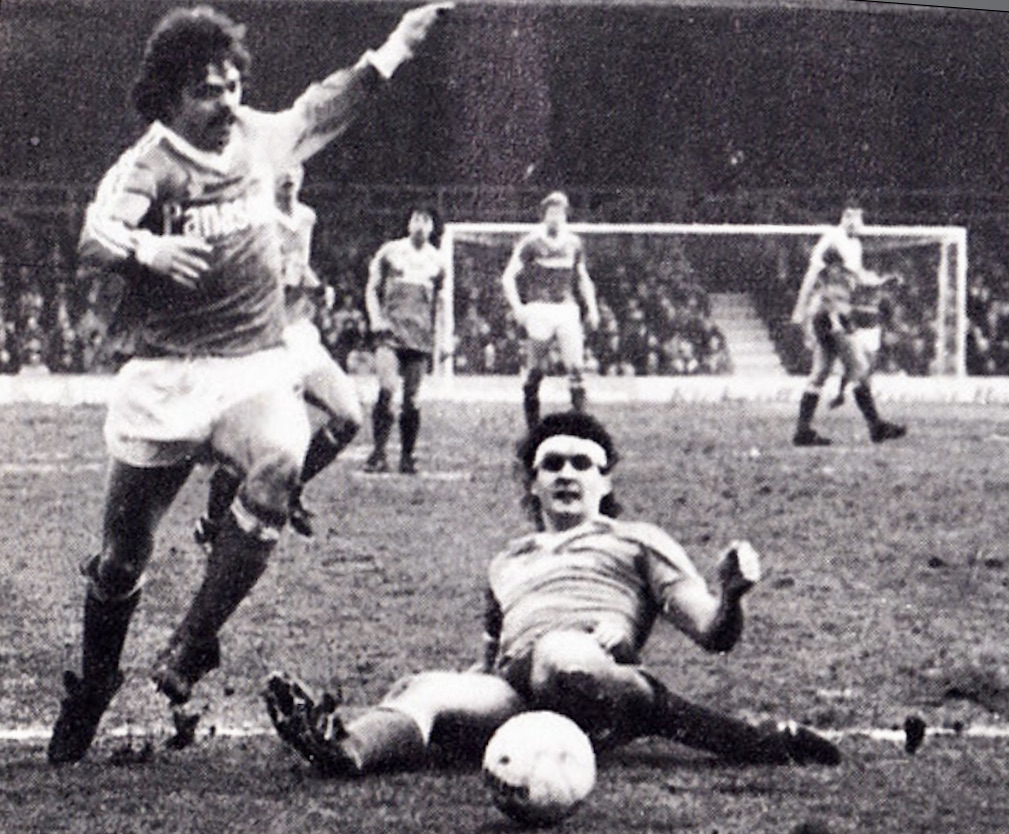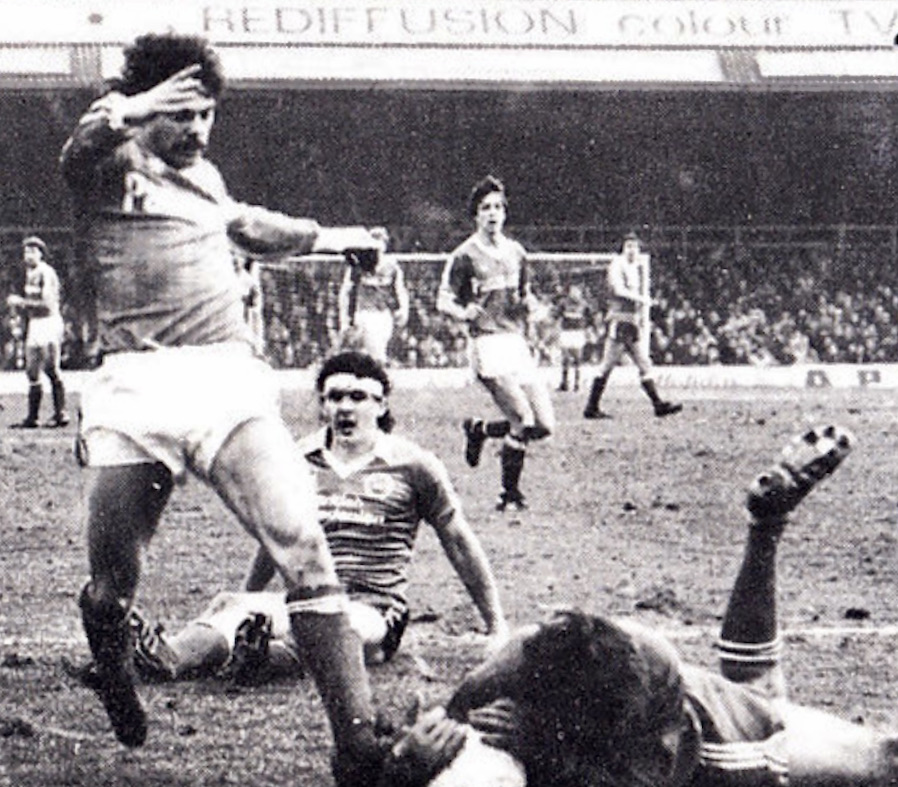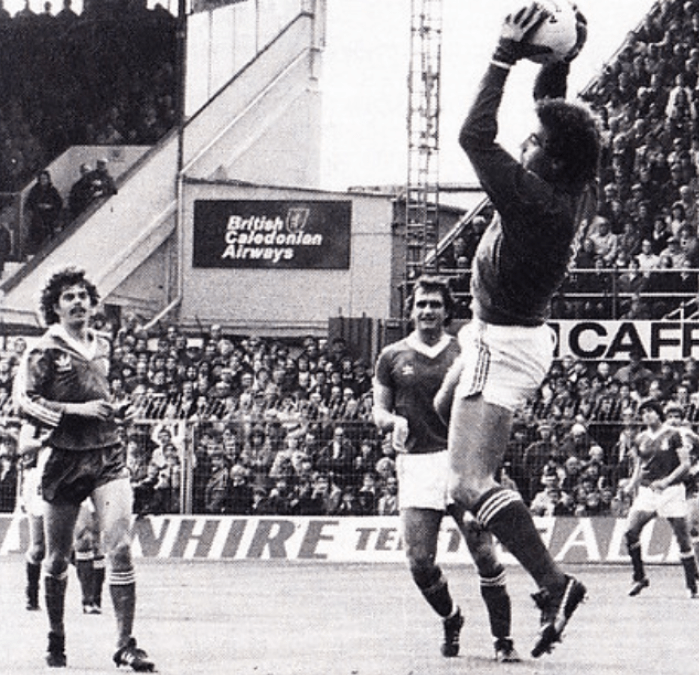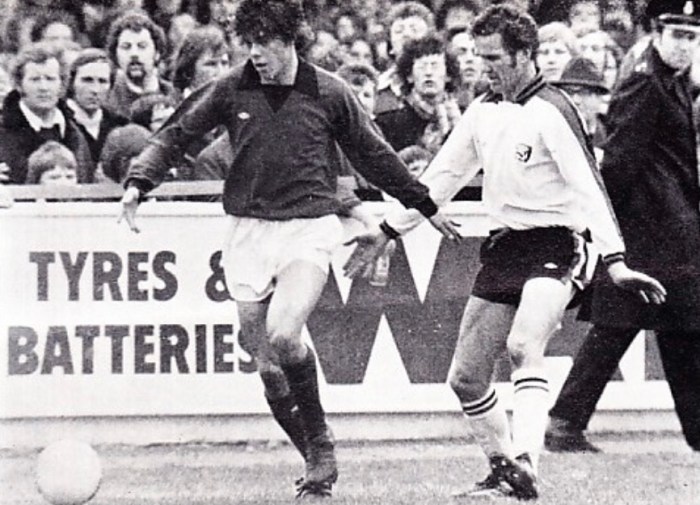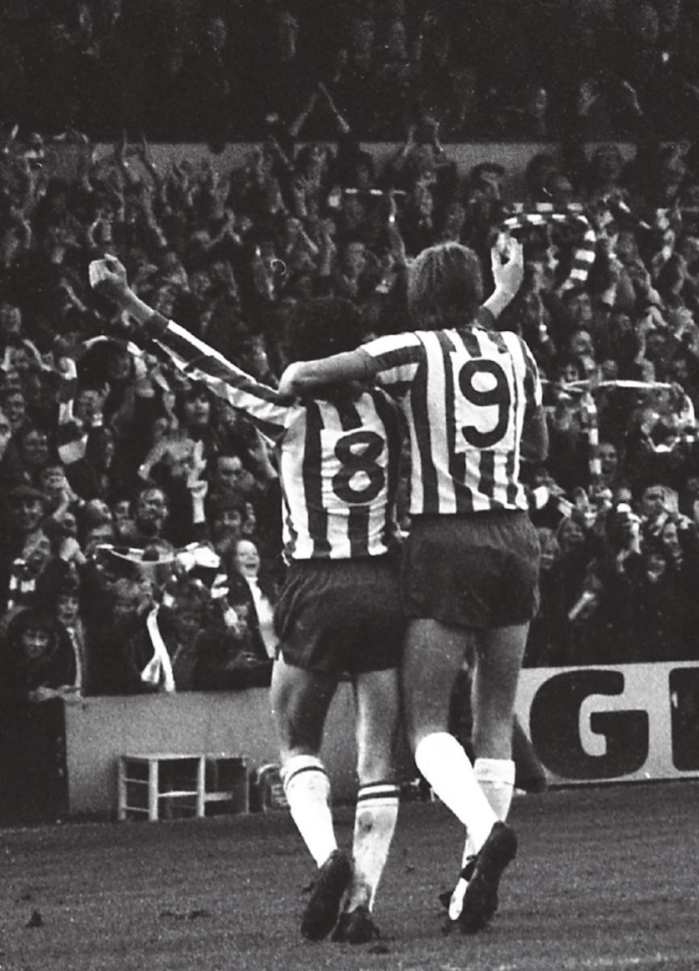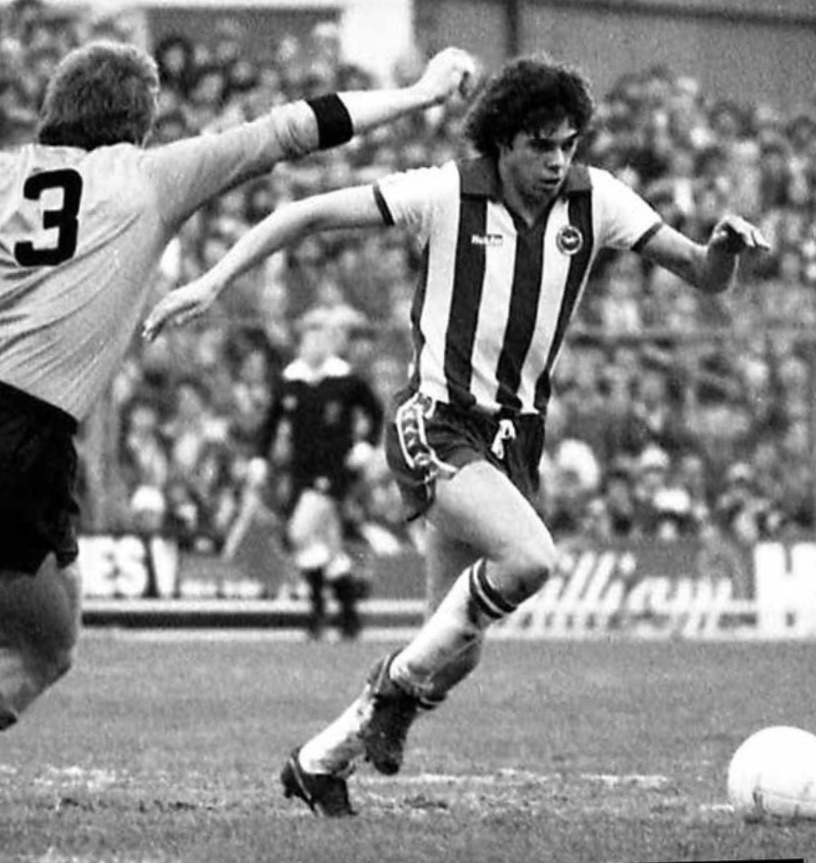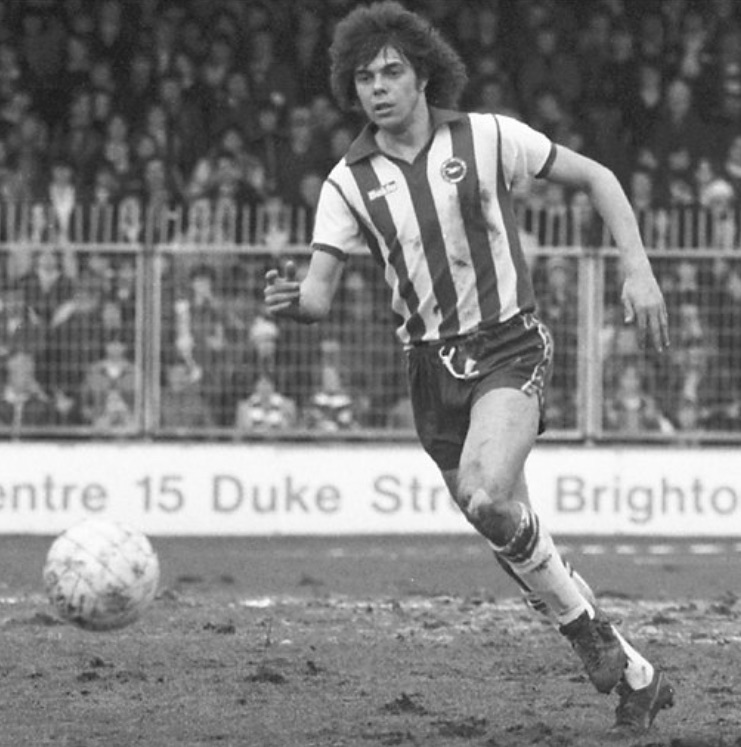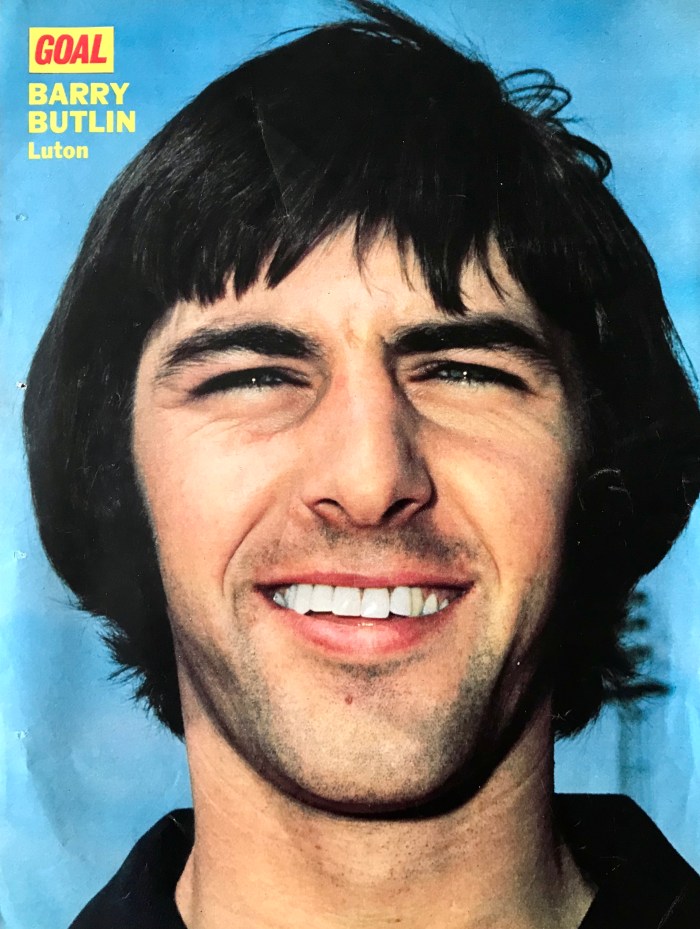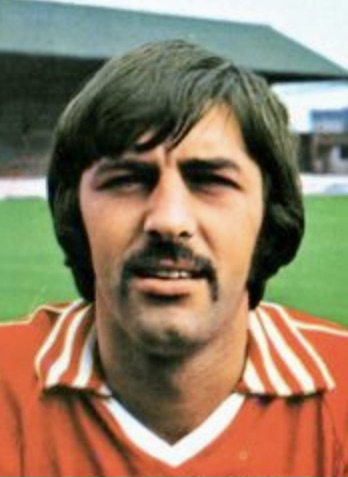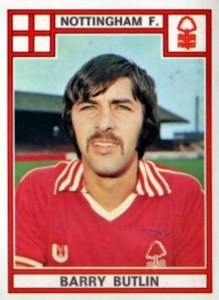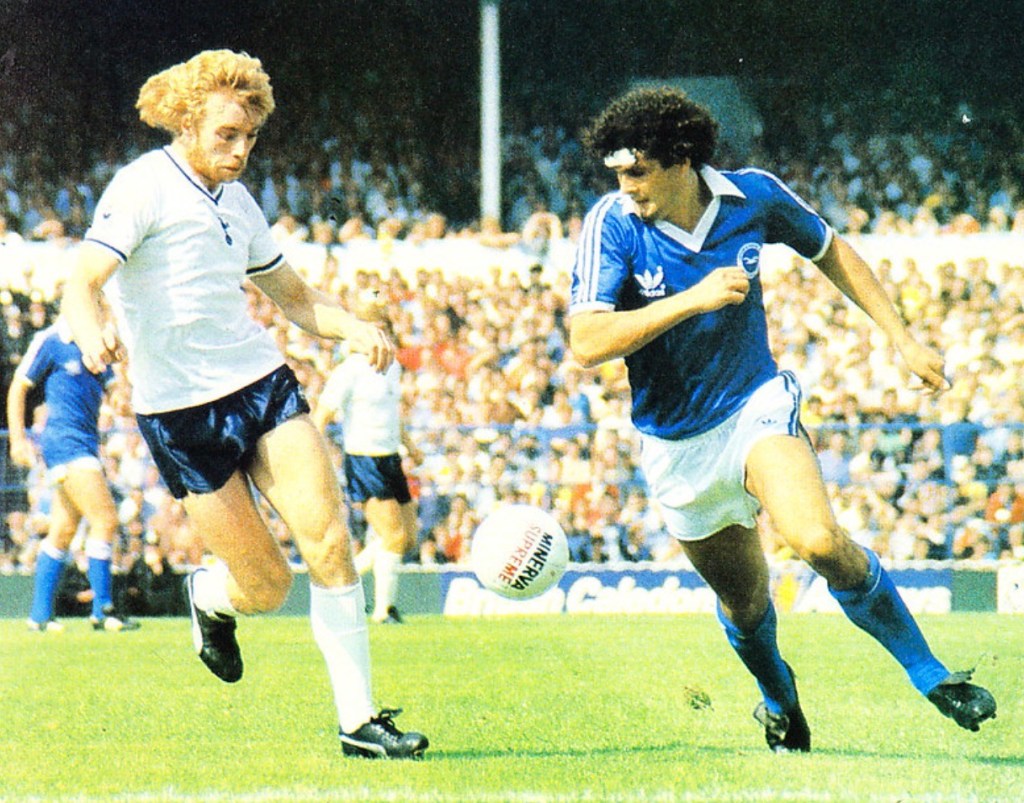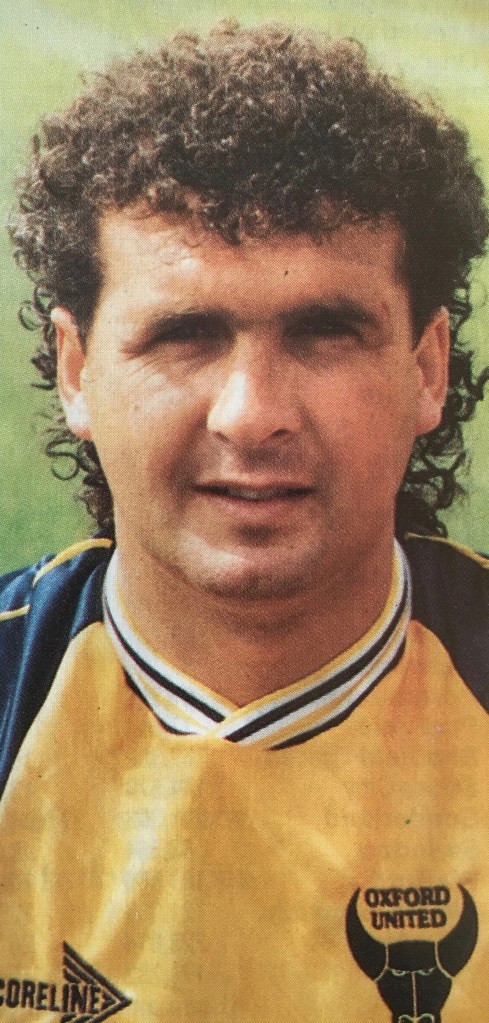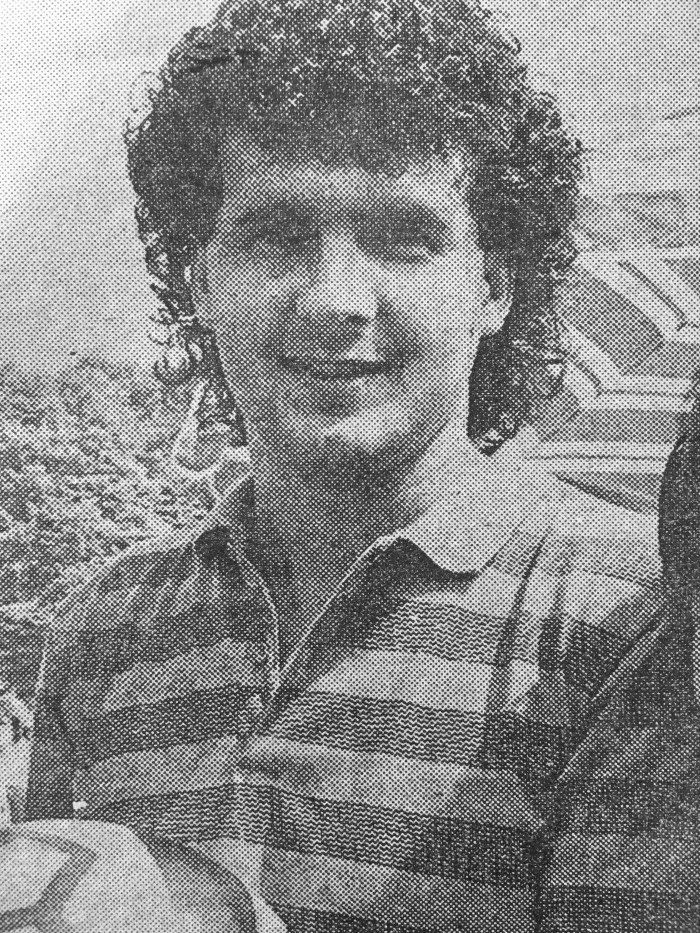
BARRY BUTLIN is one of that pantheon of players who’ve scored winning goals for the Albion against Crystal Palace.
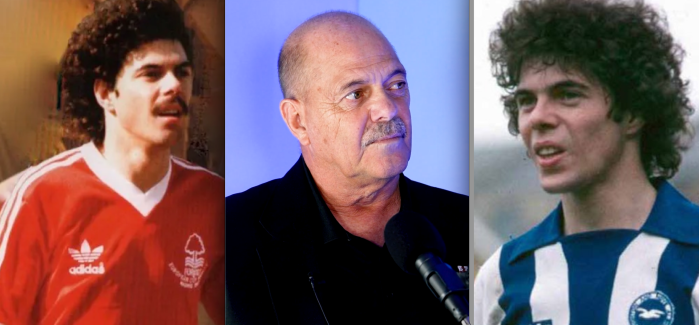
He may sound like the alliterative title of a south Wales holiday camp, but this was a moustachioed striker who’d joined Third Division Brighton on loan from Second Division Nottingham Forest.
When former Albion boss Brian Clough couldn’t find a place for him in his Forest line-up in September 1975, previous managerial partner, Peter Taylor, going it alone at the Albion, was more than happy to add Butlin to his forward line options.
Butlin had started his career at Derby County on the periphery of Clough and Taylor’s squad at the Baseball Ground.
During his five years as a Rams player, he’d twice been out on loan to Notts County, scoring eight in 20 games in 1968-69 and another five in 10 appearances in the 1969-70 season.
While Derby won the First Division title in 1972, Butlin was sold for £50,000 to Luton Town, where he made his mark with an impressive 24 goals in 57 matches.
One of them came in a 1-1 draw at Elland Road during Clough’s ill-fated 44-day spell as Leeds manager, and, in a typically odd Clough way, in the post-match press conference he put his arm around Butlin and told the journalists: “This is who you want to write about after that wonderful goal. He deserves it.”
The following month, Butlin’s goalscoring exploits for the Hatters saw Forest boss Allan Brown take him to the City Ground for a fee of £120,000.
Imagine how he must have felt when his old Derby boss Clough arrived to take over at Forest in January 1975!
Nevertheless, the striker said all the right things publicly ahead of the manager’s first game, a third round FA Cup replay against Spurs, as recorded in Jonathan Wilson’s excellent book Brian Clough: Nobody Ever Says Thank YouThe Biography (Orion Books 2011).
“The lads all know that everybody is starting from scratch with everything to prove,” said Butlin. “Brian Clough has the ability to make an average player good and a good player great.”
Such a show of loyalty might have been understandable in the circumstances but Wilson also recalls Clough’s eccentric attitude towards players when they were injured. Butlin fractured his cheek in a training ground incident when at Derby.
“As he lay on the ground, Clough screamed at him to get up, insisting there was nothing wrong with him,” wrote Wilson. “Even after he’d been taken to hospital, Clough refused to believe anything was the matter.
“When Butlin’s wife turned up looking for her husband and mentioned an ‘accident’ to Clough, he snapped: ‘I’ll tell you when there’s been an accident’.”
Although Butlin feared the worst when Clough arrived at Forest, he wasn’t instantly discarded, finishing that season with seven goals in 33 games (plus one as a sub), while fellow forward Neil Martin netted 12 in 30 matches (plus two as a sub).
Butlin had a front row seat in this Forest line-up
But Clough clearly had other ideas about who he wanted in attack and brought in John O’Hare, who had done well for him at Derby, but less well during the ill-fated spell at Leeds, and introduced a young Tony Woodcock.
Intriguingly, that summer Martin was reunited with Taylor at Brighton and, within a matter of weeks, Butlin was also heading to the Albion, although his move was only temporary.
As it happened, Martin got off to a decent start alongside Fred Binney up front, scoring three times in the opening matches. But Taylor obviously considered Butlin offered a more potent threat; and it wasn’t long before fans saw why.
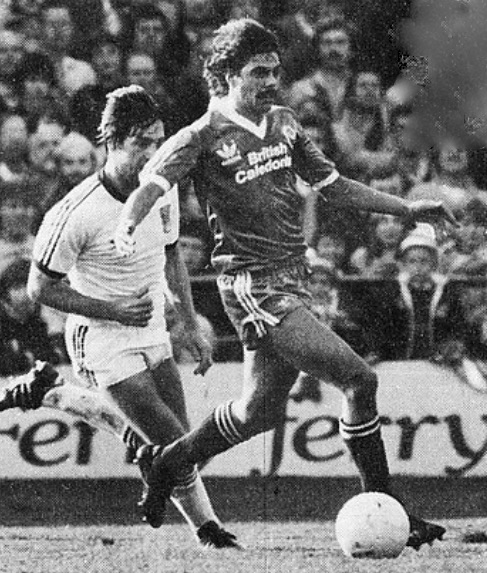
Butlin lets fly and scores the winner at Selhurst Park in 1975
In only his second game, in the third minute of Albion’s clash with Palace at Selhurst Park on 23 September 1975, Butlin got on the end of a Gerry Fell cross and hit an unstoppable shot that turned out to be the only goal of a pulsating game played in front of a crowd of 25,606 – a quite remarkable number for a third tier fixture.
“It still sticks with me, that one,” Butlin told Spencer Vignes, in his book Bloody Southerners (Biteback Publishing), which details the Clough-Taylor period at the Goldstone.
“It was the start of a cracking time down at Brighton,” said Butlin. “I only wish I could have gone on a little longer.”
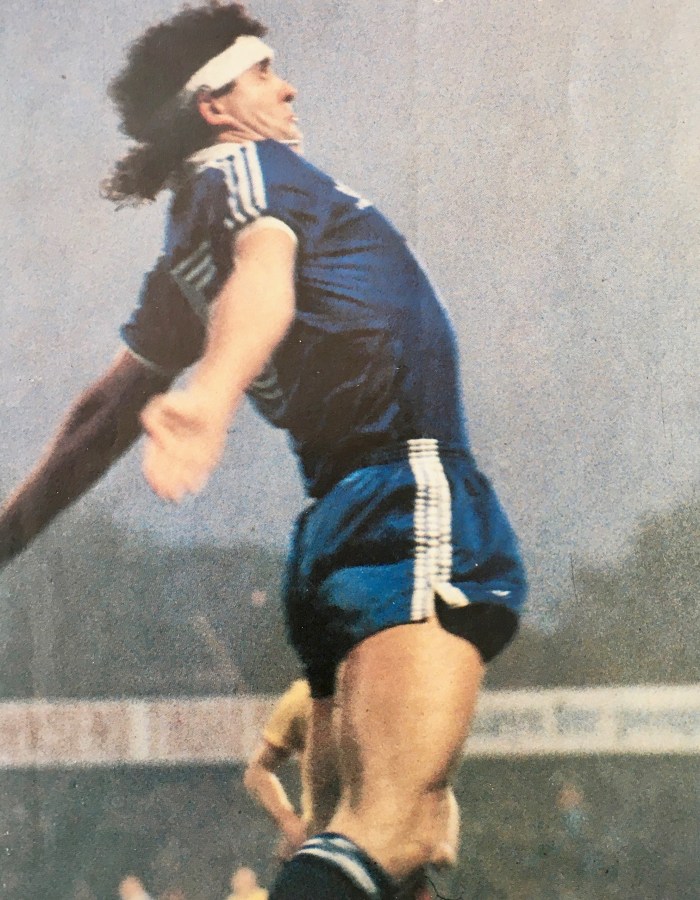
Butlin soars to connect with this header
Butlin followed up that midweek winner at Palace with another goal on his home debut four days later when Chesterfield were beaten 3-0 (Peter O’Sullivan and Binney the other scorers).
Although not on the scoresheet, he also featured in two more wins (2-1 at Shrewsbury Town and 1-0 at home to Preston). However, in his absence Forest had gone through a mini slump, losing four out of five matches.
Butlin had taken his wife and children to Sussex with him, staying in the Courtlands Hotel in Hove. They all really liked the area, and the player had hopes of making the move a permanent one. Clough had other ideas.
“Brighton made me so welcome, but Forest weren’t doing very well at all,” Butlin told Vignes. “When I came to the end of my loan period, Brian got me straight back up to Forest and I had a real purple patch during which I played really well.”
In fact, he finished the season with eight goals from 38 games played as Forest finished eighth in the old Second Division.
Collector’s item
“We had this team meeting before one game and Brian said: ‘If sending you down to Brighton gives you that impetus, then I’d better start sending some more players down there!’
“I’d seen the seafront and the wonderful countryside and thought it was the prelude to us staying there as a family, but it wasn’t to be. I was disappointed to say the least.”
Born in the south Derbyshire village of Rosliston, on 9 November 1949, Butlin attended Granville County Secondary School in Woodville from 1961 to 1966, and proudly records on his LinkedIn profile that he obtained six GCEs. He was also the school football captain.
He signed on for Derby in July 1967 but the likes of Richie Barker and Frank Wignall initially, then O’Hare and Kevin Hector, were ahead of him as the Rams progressed from the old Second Division into the First, before winning the title in 1972.
Chances for Butlin were few and far between. He made just four first team appearances in five years but those loan spells at Notts County at least demonstrated there was a player in the making, able to find the back of the net.
A knee injury prevented him making an immediate impact at Luton, after Harry Haslam had signed him, but he was the top scorer as Town gained promotion to the elite in second place in 1973-74.
The Hatters assured promotion by securing a 1-1 draw at West Brom in the penultimate game of the season, and midfield player Alan West relived the moment in an interview with theleaguepaper.com.
“I remember Barry Butlin, who was magnificent in the old centre forward’s role that season, got the vital goal,” he said. “I played in midfield with Peter Anderson and Jimmy Ryan. Peter was a great player and finished that season as our second highest scorer behind Barry.”
Just before Christmas in 2014, Butlin and West were among several former players who got together for a 40th anniversary celebration dinner. Also there were John Faulkner, Gordon Hindson, Alan Garner, Jimmy Husband, John Ryan, Jimmy Ryan, Don Shanks and Ken Goodeve.
Luton history website hattersheritage.co.uk remembers Butlin as “brilliant in the air and no slouch on the ground” and mentions the shock fans felt when he was sold to Forest, particularly as Town were desperate for goals at the time.
In the 1976-77 season, Butlin once more went out on loan, this time to Reading, and the heave-ho from Forest he had long expected finally came when Peter Withe was brought in.
Butlin was sold to Peterborough United and in two seasons with the Posh he scored 14 goals in 77 matches. His teammates at London Road included former Forest colleagues Jim Barron and Peter Hindley as well as former Albion midfielder Billy McEwan.
United just missed out on promotion from the Third Division, finishing fourth in 1977-78. It was a disastrously different second season, by which time another former Albion player, Lammie Robertson had joined them – when Posh were relegated to Division Four.
Butlin’s final club was Sheffield United, as they faced their first season outside the top two divisions. Signed by his former Luton boss Harry Haslam, Butlin scored 12 times in 53 matches for the Blades, but by the end of 1980-81 season, after Martin Peters had taken over, United were relegated to the fourth tier for the first time in their history.
Butlin retired and spent three decades working as a financial adviser and mortgage manager in Sherwood, Nottingham.
He lived in Derby and between July 2000 and October 2010 was secretary and treasurer of the Derby County Former Players’ Association.
Steve Foster challenges Spurs’ Steve Archibald at White Hart Lane
LEGEND is overused far too much in football circles but, in some circumstances, it is justified. That applies to Steve Foster.
He played 800 games in a 21-year career which included nine years with Brighton in two separate spells.
His performances in the top-flight for Brighton led him to play for England at the 1982 World Cup and he lifted the League Cup in 1988 as the captain of Luton Town.
He might have enjoyed a longer spell at Aston Villa if the European Cup-winning manager who signed him hadn’t been unceremoniously dumped by ‘Deadly’ Doug Ellis.
Foster became – and, to older fans, still is – synonymous with Brighton & Hove Albion, and football followers the world over could readily identify the captain with the white headband.
In several interviews over the years, he has explained how the distinctive headpiece was actually a piece of padded white towel designed to protect a forehead split open in collisions with centre forwards Andy Gray and Justin Fashanu.
I wonder if physio Mike Yaxley’s wife Sharon, who made up the dressing before every game, realised at the time the key role she played in helping to make Foster one of the most identifiable characters in football.
Foster’s illustrious career is warmly documented in Spencer Vignes’ excellent 2007 book A Few Good Men (Breedon Books Publishing), featuring an interview with the player himself and those who played with him.
For example, Gerry Ryan told Vignes: “Fozzie was a huge player with a huge personality, a real leader and deceptively quick for a big man.
“When he played against the best, like Ian Rush and Kenny Dalglish, he was the best. People talk about giving 100 per cent, but Fozzie gave 150 per cent in everything he did, and I mean off the field as well.”
Gordon Smith added: “He was a fantastic person, great fun and a terrific centre half.”
Vignes himself observed: “Steve’s willingness to put his neck on the line for the cause earned him hero status among the fans, together with the complete respect of the dressing room.”
Unsurprisingly, Foster pulls no punches in describing the various characters and events surrounding his colourful career, for instance describing Chris Cattlin as “definitely the wrong man. I told him the truth and what I thought of him.” And, of predecessor Jimmy Melia: “When Jimmy took over it was more like a circus than a football club.”
Foster said the two biggest influences on his career were Frank Burrows, the manager of his first club, Portsmouth, who taught him about balance as the key to strength on the pitch, and Brian Horton, the dynamic midfield driving force he succeeded as Albion captain.
“He shouted and screamed for 90 minutes to help us get results, and to keep everyone on their toes,” said Foster. “If he made a mistake, 10 other people would shout and scream at him, and he would take it. When I was captain at Brighton, and my other clubs, that’s how I tried to be.”
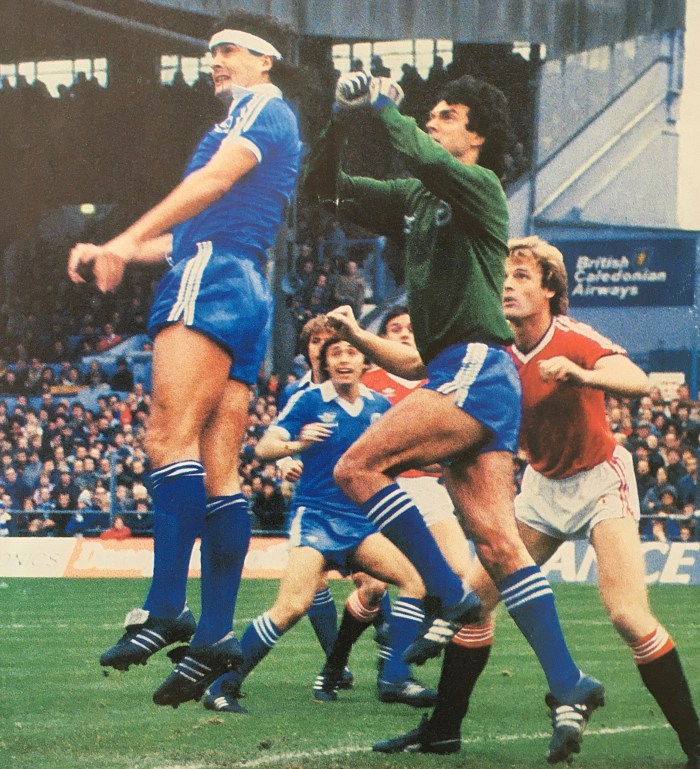
Such a recognisable figure as Albion’s centre-half
Fortunately, sufficient archive film footage remains for fans of different generations to see what a dominant force Foster was at the heart of Brighton’s defence, while I retain plenty of now-yellowing cuttings from the numerous columns of newsprint he filled during his pomp.
Born on 24 September 1957 in Portsmouth, Foster went to St Swithin’s Junior School before moving on to St John’s College. A centre-forward in the early days, he played for the Portsmouth Schools under-12s side but it was Southampton who took him on as an associate schoolboy.
He played in the same youth team as Steve Williams and Nick Holmes, who both went on to have long careers.
But Saints boss Lawrie McMenemy let Foster go at 16, urging him to go elsewhere and prove him wrong. After Foster won his first England cap, McMenemy sent him a congratulatory telegram. “That was class, nothing but class,” Foster told Vignes.
Southampton’s loss was Portsmouth’s gain, courtesy of a tip off from local schoolteacher Harry Bourne to Pompey youth team coach Ray Crawford (who’d previously held a similar role under Pat Saward at Brighton). Bourne ran the Portsmouth and Hampshire schools teams.
Crawford describes in his excellent autobiography Curse of the Jungle Boy (PB Publishing 2007) how he called at the family’s house in Gladys Avenue, Portsmouth, but Foster’s mother was at a works disco at the local Allders store. Wasting no time, he immediately went in pursuit and, against a backdrop of deafening music and flashing lights, shouted above the din that they were interested in signing her son.
Foster called the club the following day and he was invited to play in a youth team game for Portsmouth – against Southampton! “I scored twice because I was playing as a centre-forward then, and they ended up offering me an apprenticeship on £5 per week which was my entry into the professional game,” said Foster.
Reg Tyrell, a respected former chief scout from Crawford’s time at Ipswich, watched the young striker in a youth team training game and declared: “That no.9, he’s no centre-forward but he’d make a good number 5.” A few weeks’ later, manager Ron Tindall’s successor, Ian St John (later Saint and Greavsie TV show partner of Jimmy Greaves), gave Foster his debut as a centre half!
Foster played more than 100 games during Pompey’s slide down through the divisions, and, at 21, had developed something of a fiery reputation. But Brighton boss Alan Mullery saw him as “big and brave, strong in the tackle and good in the air” providing “much-needed stability at the back” as the Seagulls began their first adventure into the top-flight of English football in 1979. He was signed for £150,000.
A couple of disciplinary issues in the early days of the new season looked like proving the doubters right to have warned Mullery off signing him, but an injury to first choice centre back Andy Rollings forced the manager to backtrack on a temporary ban he’d handed out. Foster made the most of his reprieve and never looked back.
By the end of a season in which the side grew collectively Foster was named Player of the Year and he earned international recognition, gaining an England under 21 cap as a substitute for Terry Butcher in a 1-0 defeat against East Germany in Jena on 23 April 1980 (Peter Ward was playing up front).
While the 1980-81 season saw Albion struggle and flirt with relegation, Foster’s tussles with some of the top strikers in the game saw his reputation grow, and he even chipped in with a vital goal in the final home game of the season against Leeds.
When Horton and Mullery departed at the end of that season, Foster took over the captaincy under new boss Mike Bailey, and, even though fans didn’t much like the way Bailey set up his side, Foster thrived with the emphasis on defence first.
England boss Ron Greenwood, who lived in Hove, was in the process of shaping his squad for the 1992 World Cup in Spain and, with injuries affecting some of the other centre backs in contention, Foster was given a chance to prove himself.
I can remember travelling to Wembley on 23 February 1982 to watch him make his debut against Northern Ireland, a game England won 4-0 courtesy of goals from Ray Wilkins, Kevin Keegan, Bryan Robson and Glenn Hoddle.
I had been to the stadium 10 years before to watch another Albion player – Willie Irvine – make his international comeback in a 1-0 win for the Irish, but it was something special – and rare – to see a Brighton player line up for England.
To break through to the senior team in a World Cup year was a notable achievement, although, by his own admission, he accepted his good fortune directly correlated to injuries ruling out other players.
Although the record books show Foster earned three caps, in fact he represented the country four times that year.
A month after his debut against Northern Ireland, on 23 March, Foster played for an England XI in Bilbao against Athletic Bilbao. The game finished 1-1 with Keegan scoring for England. It didn’t qualify for a cap because it was a testimonial match for retiring Bilbao player Txetxu Rojo, but Greenwood used the fixture to familiarise the players with what was the venue for England’s opening round matches at the World Cup.
Foster also featured in a 2-0 friendly win over the Netherlands (goals by Tony Woodcock and Graham Rix) on 25 May as Greenwood continued to assess his options.
Foster (circled) in Ron Greenwood’s 1982 World Cup squad
When it was clear neither Alvin Martin nor Dave Watson would be fit for the tournament in Spain, Foster was selected as back-up to first choice centre back pairing Terry Butcher and Phil Thompson. Ahead of the third group match, Greenwood didn’t want to risk a ban for the already-booked Butcher, so Foster played alongside Thompson and England won 1-0 against Kuwait; Trevor Francis getting the England goal.
When England didn’t progress past the second phase, Greenwood’s spell as boss came to an end and he was replaced by Bobby Robson who, for his first game in charge, partnered Russell Osman with Butcher – both having played under him at Ipswich Town.
Foster didn’t play for England again.
Much has been written already about the 1982-83 season and Albion’s path to the FA Cup Final. Foster demonstrated real heroism in the semi-final at Highbury, playing through the pain of a septic elbow, and, memorably, towards the end of the game, launched into an overhead kick to clear a goal-bound shot to safety (pictured above).
History records Foster being suspended for the Cup Final – a well-documented appeal to the High Court against a two-game ban for accumulated bookings couldn’t get the decision reversed – but, as is often the case in football, his misfortune presented a golden opportunity for stand-in Gary Stevens who capped a man-of-the-match performance with the equalising goal. What he did that day persuaded Spurs to sign him.
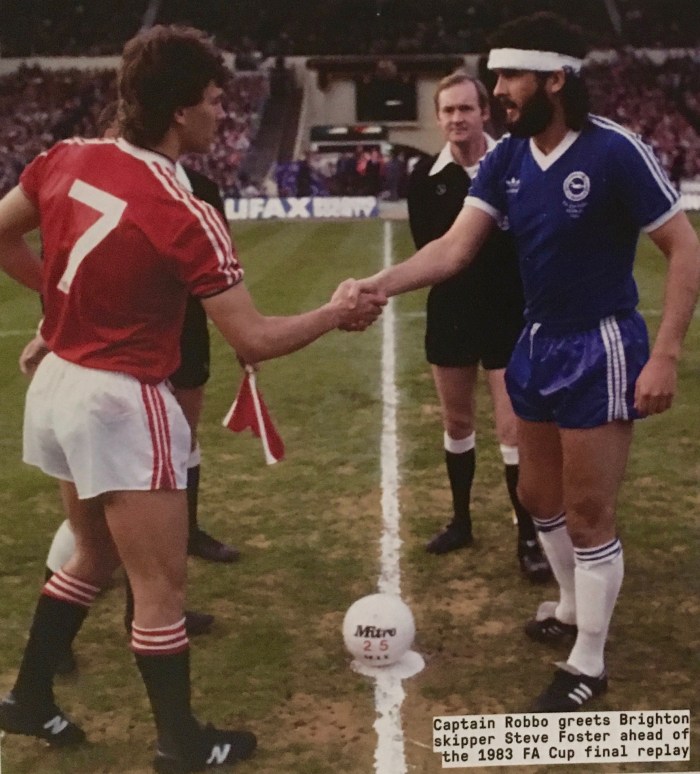
Foster, of course, eventually got his Wembley chance in the replay but with a rampant Manchester United running out easy 4-0 winners, their fans also rather cruelly derided the Albion skipper with the chant I can still hear ringing around Wembley that evening: “Stevie Foster, Stevie Foster, what a difference you have made!”
In truth the whole defence lacked balance in the replay because manager Melia had elected to fill the right-back berth vacated by injury to Chris Ramsey with the left-footed Steve Gatting. He figured Stevens couldn’t be moved from the centre where he had performed so well on the Saturday, but it was a mistake, especially as Stevens had often played right back previously.
The relegation that went in tandem with Albion’s Wembley loss sparked the beginning of a big clear-out of the best players. First to go was Stevens, closely followed by Michael Robinson.
It wasn’t until the following March that Foster followed them through the exit, although, according to Foster, he might have gone sooner – even though he didn’t want to leave; a point he made clear in an interview with Match Weekly shortly after he signed for Villa for £150,000.
“I never wanted to move,” he said. “I had nearly seven years of my contract to run at Brighton and would have quite happily played out my career there. It’s a great little club.
“But economies dictated otherwise and, although manager Chris Cattlin wanted to keep me, he was under pressure to sell me and help ease the club’s financial problems.
“It was a wrench to leave Brighton because the club has treated me tremendously well and I’ve had some great times there – not least the FA Cup run last season.”
Cattlin had a slightly different take about the transaction in his matchday programme notes. “I feel that Steve Foster has been a fine player during his four-and-a-half years at the Goldstone, but I felt that the time was right and the offer good enough to let him go,” he said.
“I hope the move will benefit both Steve and the club. I hope it rejuvenates his career because he has been unlucky with injuries this season. It gives me breathing space for Eric Young to develop and it will also allow me to strengthen other positions if necessary.”
In a rather oblique reference to the need to get rid of high-earning players, Cattlin added in another matchday programme article: “Certain players have left Brighton in moves which I feel are important for our future. Salaries and bonuses of individual players are confidential and obviously I cannot disclose details, but the moves I have made I am certain are right.”
He added: “I can’t explain all the matters that have been considered but I will once again emphasise that we are building for the future and every move I make in the transfer market is being made with this in mind.”
Foster revealed that Villa boss Tony Barton, a former coach at Foster’s first club, Portsmouth, had tried to sign him twice before, but the clubs hadn’t been able to agree on a fee. Eventually, the transfer saw defender Mark Jones (who’d made seven top-flight appearances for Villa that season) move in the opposite direction, in addition to a £150,000 fee.
Barton wanted Foster to tighten up a leaky defence, to fill the position previously occupied by former European Cup winning centre-half Ken McNaught, who had moved to West Brom.
The relatively inexperienced Brendan Ormsby had been playing alongside McNaught’s former partner, Allan Evans, and the signing of Foster put his nose well and truly out of joint. “It’s obvious that I’m just going to be used as cover for Steve Foster or Allan Evans now and so it’s probably in my best interests to try and find another club,” he told Match Weekly.
As it turned out, it was Barton who was ousted; Ormsby stayed, and new manager Graham Turner decreed it would be Foster who was the odd one out. But I jump ahead too soon.
Foster’s arrival at Villa Park as featured on a matchday programme cover
A picture of Foster being introduced to the Villa faithful appeared on the front cover of the programme for the 17 March home game against Nottingham Forest although he didn’t make his Villa debut until 14 April 1984, away to Leicester City, which ended in a 2-0 defeat.
Foster made seven appearances by the end of the season and he got on the scoresheet in only his third game, netting together with future Albion player Dennis Mortimer, in a 2-1 win over Watford on 21 April.
Villa finished the season in 10th place but it wasn’t good enough for the erratic chairman Ellis. Suddenly Foster found the man who signed him had been sacked, and the side Barton had led to European Cup success was gradually dismantled.
To the astonishment of the Villa faithful, Barton was succeeded by former Shrewsbury Town boss Turner.
Foster played 10 games under the new boss, and scored twice, once in a 4-2 win over Chelsea on 15 September and then again the following Saturday in a 3-3 draw away to Watford.
He’d started the season alongside Evans but Turner then offered a way back to Ormsby. While Foster played a couple of games alongside Ormsby, Turner preferred Evans and Ormsby together, making the new man surplus to requirements.
His last game for Villa was away to Everton on 13 October and the following month he was sold to Luton for £70,000 – less than half the fee Villa had paid for him eight months earlier. Foster simply put it down to his face not fitting with the new man.
It was a completely different story with Luton boss David Pleat and Foster’s time at Kenilworth Road coincided with the club’s most successful period in their history, even though Pleat left to manage Spurs.
Alongside representing his country, Foster said the best moment of his career was captaining the Hatters as they won the League Cup (then sponsored by Littlewoods) at Wembley in 1988 with a 3-2 win over Arsenal, his former Brighton teammate Danny Wilson scoring one of their goals (Brian Stein got the other two).
They reached the final of the same competition the following year too, but on that occasion lost 3-1 to Nottingham Forest. By then Foster was assistant manager to Ray Harford, and it looked like he was on a path to become a boss in his own right.
But that summer, when his old Albion captain, Horton, who had taken over from Mark Lawrenson as the manager of Oxford United, asked him to join him as a player at the Manor Ground, he was unable to resist and a new chapter in his career began.
It meant a drop down a division but Foster accepted the challenge and went on to play more than 100 games for United, many being quite a struggle as the side fought for survival at the foot of the second tier.
In the autumn of 1991, injury sidelined Foster from the U’s team and he believed it could have been the end of his career.
However, when the following summer he was contemplating whether or not to retire, he gave Brighton boss Barry Lloyd a call and asked if he could keep his fitness going by joining in pre-season training with the Seagulls.
Lloyd could see that the former skipper was still able to perform and, although the club was in a downward spiral, Foster seized the opportunity to extend his career and help out his old side.
Another veteran of that side, Clive Walker, told Vignes for A Few Good Men: “Fozzie might not have been so mobile then but his positional sense was absolutely brilliant, as was his ability in the air.”
Foster said: “Funnily enough during that second period I played probably some of my best football. I had to because of the position the club was in. There was no money so you had to pull out all the stops.”
Foster continued to play after Lloyd had departed, and he vented his anger publicly about the off-field shenanigans new boss Liam Brady was having to operate under.
Foster eventually called it a day at the end of the 1995-96 season, saddened at the club’s plight. He was granted a testimonial match against Sheffield Wednesday, played as a pre-season friendly in July 1996. Throughout Foster’s career he had continued to live in Hove and he retains his affection for the Albion to this day.
During his second spell at the club, Foster was the PFA rep and he had to deal with the heartbreak of telling the parents of a young player (Billly Logan) that an ankle injury was going to end his career. The youngster got just £1,500 compensation.
As a result, after his own playing days were over, Foster set up an insurance business (Pro-Secure) which continues to this day, making sure players are properly covered and get suitably recompensed if things don’t turn out as they’d hoped.
Although Foster hasn’t always been popular with the Albion’s hierarchy (courtesy of suggested involvement in potential takeovers), his association with the club hasn’t dimmed and Seagulls fans of two generations took him to their hearts for his on-field performances and leadership spanning a total of 332 games.
• Pictures from my scrapbook, the Albion matchday programme over several seasons, and some online sources.
MARK McGHEE saw highs and lows as Brighton & Hove Albion manager after a medal-laden playing career that took him from his native Scotland to England and also to Germany.
McGhee was in charge when the Seagulls memorably won the 2004 play-off final to gain promotion from the third tier, beating Bristol City at the Millennium Stadium, Cardiff.
Play off final boss
Keeping the Seagulls up the following season was arguably an even greater achievement considering at the time playing home games at the crowd-restricted Withdean Stadium meant the club was at a huge disadvantage compared to most clubs in the division.
With the Amex still a distant dream, relegation came at the end of the 2005-06 season, and it wasn’t long into the following season that Dick Knight wielded the axe on the Glaswegian’s time in charge.
“It was hard to sack Mark, but we had to have a change,” Knight wrote in his autobiography, Mad Man: From the Gutter to the Stars. “Everyone recognised what he had done in taking up and keeping up a team that was not that great, to be honest. Hats off to him, he had done a terrific job. And he is a very intelligent, personable guy.”
Knight took decisive action when part of the crowd became vociferous in wanting McGhee out, and the chairman also felt some of the young players drafted into the team weren’t responding to him.
He was finally toppled over lunch at Topolino’s, and Knight admitted: “It was a difficult decision. There was strong vocal opposition to McGhee, but also a large, less noisy element who were behind him.”
McGhee liked Brighton so much he made it his home despite subsequently taking on a series of other roles the length and breadth of the country.
It’s probably fair to say the Scot has never been afraid to speak his mind, which his former Newcastle boss Bill McGarry mentioned to him. McGhee recounted in an interview with theleaguepaper.com: “I was managing Wolves at the time. He said ‘Mark, you talk too much. Tone it down a bit’. I tried to take his advice, give nothing away in media briefings. Then, somebody would say something interesting and I wasn’t able to stop myself.”
It’s probably what helped him gain a place on the Sky Sports Soccer Saturday panel when he was in between management jobs.
McGhee would most likely look back on some jobs he’d perhaps have been wiser to stay away from, for example taking temporary charge of Eastbourne Borough in 2018, although his enthusiasm was undimmed as he revealed in an interview with thenonleaguefootballpaper.com.
Born in Glasgow on 20 May 1957, his father was an electrical engineer and his mother a fertility consultant at Glasgow Royal Infirmary. McGhee was on the books of Bristol City at the start of his long career but he returned to Scotland and became a part-timer with Greenock Morton while also training to be an architect.
Aforementioned manager McGarry signed him for Newcastle for a £150,000 fee on 30 December 1977 and he made his debut on 2 January 1978.
His face didn’t fit after Arthur Cox took over as boss, but Alex Ferguson took a punt on him in March 1979 and signed him for Aberdeen, and it proved to be one of many shrewd decisions the esteemed Scot would make in his career.
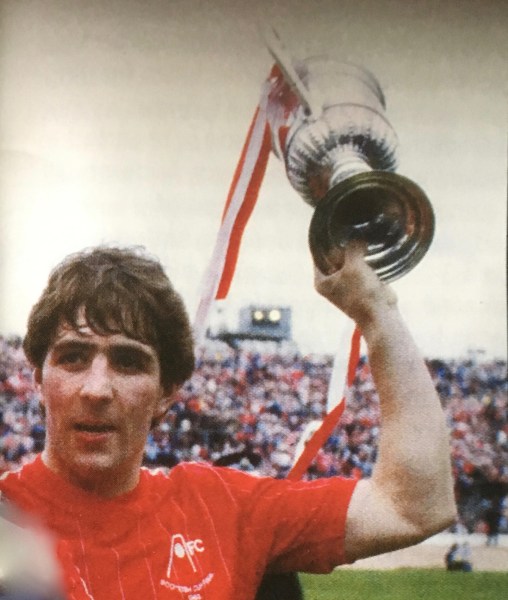
McGhee was named Scottish PFA Players’ Player of the Year in 1982, and the following year was part of the Aberdeen side who beat Real Madrid 2–1 to lift the 1983 European Cup Winners’ Cup in Gothenburg.
He also scored the second goal as Aberdeen defeated Hamburg 2-0 to win the UEFA Super Cup in the same year.
Asked about the best goal he scored, he said: “Probably the winning goal in my last game for Aberdeen.”
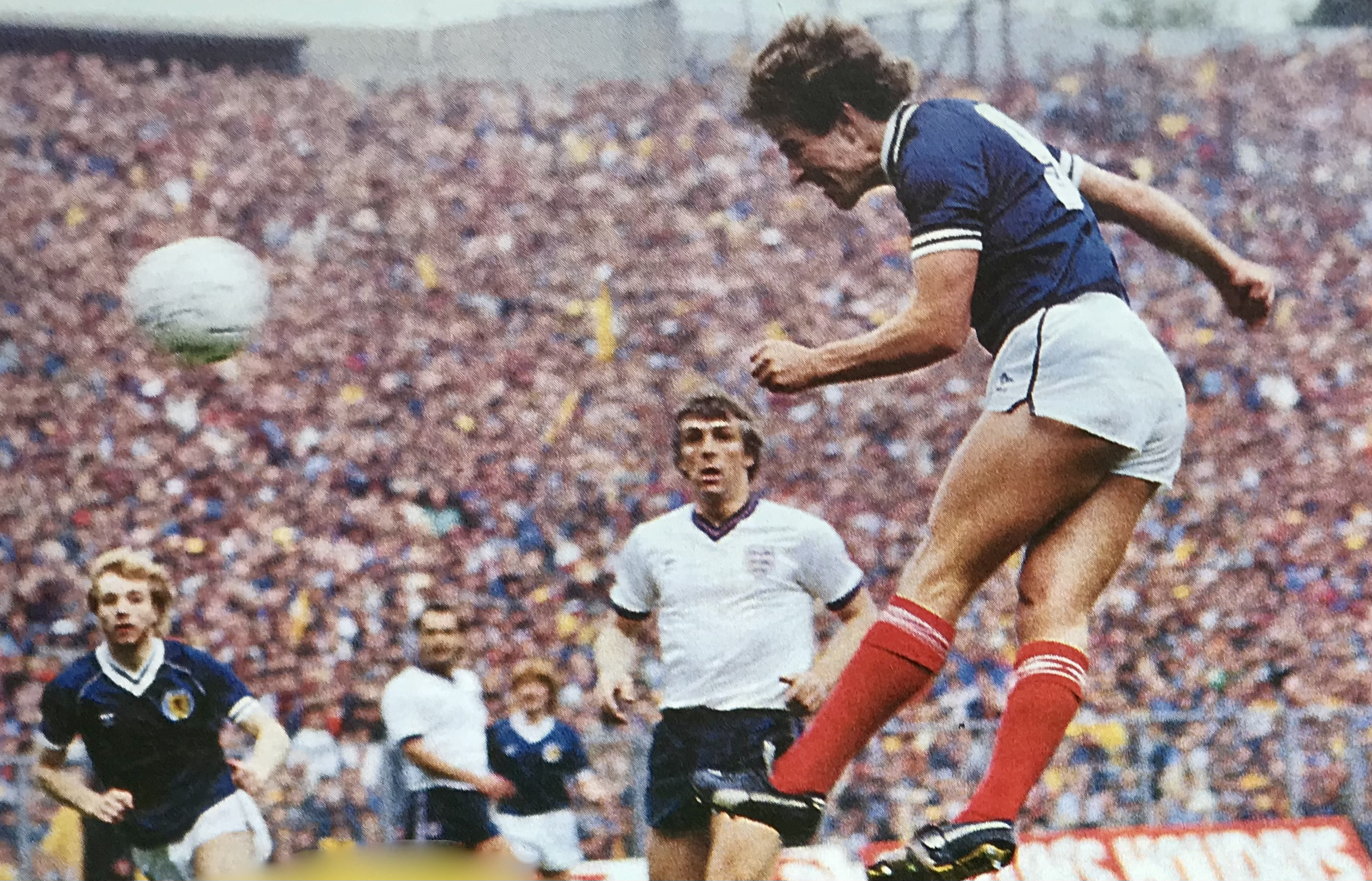
McGhee reckoned his best moment in football came on 26 May 1984 when he scored against England at Hampden Park. He headed in a cross (as pictured) from his great pal Gordon Strachan past Peter Shilton.
“It put us 1-0 up but Tony Woodcock equalised to make the final score 1-1.”
It was one of four caps he won for his country. Nearly two decades later, in January 2013, Strachan appointed him as his no.2 with the Scottish national side.
But back to those playing days, and with two Scottish league titles and three Cup wins behind him, McGhee tried his hand at European football and spent 16 months at Hamburg. The spell was probably more of an education than a success, with injuries limiting his game time.
A £170,000 fee took him back to Scotland, to Celtic, where he had mixed fortunes during four years with the Glasgow giants. He was, though, part of the squad that won a League and Cup double in their centenary season.
After winning another Scottish Cup winners’ medal in 1989, he was on the move again, back to Newcastle.
Now with Jim Smith in charge, Newcastle paid £200,000 to take McGhee back to St James’ Park, where he formed an impressive strike partnership with the legendary Micky Quinn as Toon finished third in the old Division Two.
“We were good friends, but we didn’t blend on the pitch like Toshack and Keegan, Quinn told theleaguepaper.com. “Mark was a free spirit. He’d get the ball and drift left or right and drop deep.
“He’d turn defenders and drag them out of position. He would hold the ball up well for me to get into the box and score goals. He went where he wanted, but it worked.”
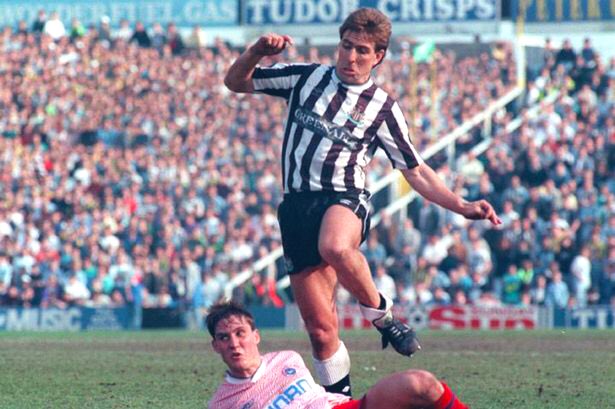
This Football Back Then picture shows McGhee in action for Newcastle against Albion’s Nicky Bissett.
His farewell performance came on 6 April 1991, not long after Ossie Ardiles had taken over as manager, and McGhee departed having scored a total of 36 goals in 115 appearances for the Magpies.
Next stop was Sweden, where he played briefly for IK Brage, but he seized the opportunity to try his hand at management by taking up the role of player-manager at Reading in the summer of 1991.
He’d been recommended for the role by his old boss Ferguson, and, after quitting playing through injury in 1993, he led the Royals to promotion from the third tier the following year.
A struggling Leicester City gave him a chance to manage in the Premier League but he was unable to keep them up and, less than a year after joining, decided to switch to Wolverhampton Wanderers, to succeed Graham Taylor.
Wolves just failed to gain promotion in 1996-97 (they lost in the play-off semi-finals) and were ninth the following campaign. Four months into the 1998-99 season, following a string of poor results, McGhee was fired.
It would be 20 months before he gained his next opportunity, this time at Millwall where he enjoyed initial success, leading them to promotion from the third tier, and then narrowly missing out on another promotion when they lost in the play-off semi-finals to Birmingham City.
When he parted company from Millwall in October 2003, he wasn’t out of work long because Brighton needed a replacement for Steve Coppell, who’d been wooed to take over at Reading (pictured above, with chairman Dick Knight, at his unveiling as Albion manager).
Those Albion fans who stuck by the team in the humble surroundings of the Withdean Stadium enjoyed some good moments during McGhee’s time as manager, in particular promotion via the play-off final in 2004.
He certainly found a formula to get the best out of certain players, as Adam Virgo, converted from defender to goalscorer, observed in that theleaguepaper.com article. “Mark is a very good communicator and very experienced,” he said. “He can make you feel ten feet tall. He’s very good at being honest, at analysing your game and telling you what you’re good at.”
After his departure from the Albion, McGhee was out of the game for nine months but got back in at Motherwell, turning them from near relegation candidates to qualifiers for European competition.
The lure of his old club, Aberdeen, proved too strong in the summer of 2009, but his tenure proved to be disastrous – and brief.
He spent the majority of 2012 as manager of Bristol Rovers, where one of the squad he inherited was former Brighton defender-turned-striker, Virgo. The following year, his old pal, Strachan, appointed him as assistant coach to the Scottish national side.
Motherwell manager Mark McGhee before the Ladbrokes Scottish Premiership match at Fir Park, Motherwell.
He later combined the role part-time when he returned to Motherwell but there were mixed fortunes second time round, and he left them again in early 2017. Towards the end of that year, he popped up at League Two Barnet, but the arrangement lasted only two months before he was moved to a ‘head of technical’ role, and then dismissed in March 2018.
McGhee was ‘slaughtered’ on Twitter when he took over as interim manager of National South side Eastbourne Borough in the spring of 2019, after being beaten 3-0 by Wealdstone in his first match in charge, his new side reduced to nine men after two players were sent off. Borough won just once in 11 matches.
When Albion under 23s coach Simon Rusk was appointed manager of Vanarama National League side Stockport County in January 2021, McGhee was appointed as one of his assistants.
His final managerial post was at Dundee in February 2022 when he took temporary charge of the Scottish Premiership side until the end of the season (with Rusk as his assistant), but they couldn’t avoid them being relegated, overseeing just one win in 13 matches.
McGhee finally announced his retirement from the game in September 2022 at the age of 65, telling the Sunday Post: “I won’t be pursuing any other managerial vacancies, and nor would I want to be a director of football or a head of recruitment. That’s not what I am – I’m a manager.
“I feel that players now deserve a young manager who can give them the energy I was able to when I started out. They don’t need a 65-year-old with a dodgy ankle.”
ISLINGTON-born Raphael Meade joined Arsenal as a schoolboy and made it through the ranks to play more than 50 times for the Gunners.
A rather eclectic career saw him play in Portugal, Spain, Scotland, Denmark, Hong Kong and back in England.
Brighton boss Barry Lloyd had something of a penchant for picking up players from these shores who’d rather lost their way playing abroad and, while forwards Mike Small and John Byrne would count as great successes of that genre, Meade was largely a disappointment.
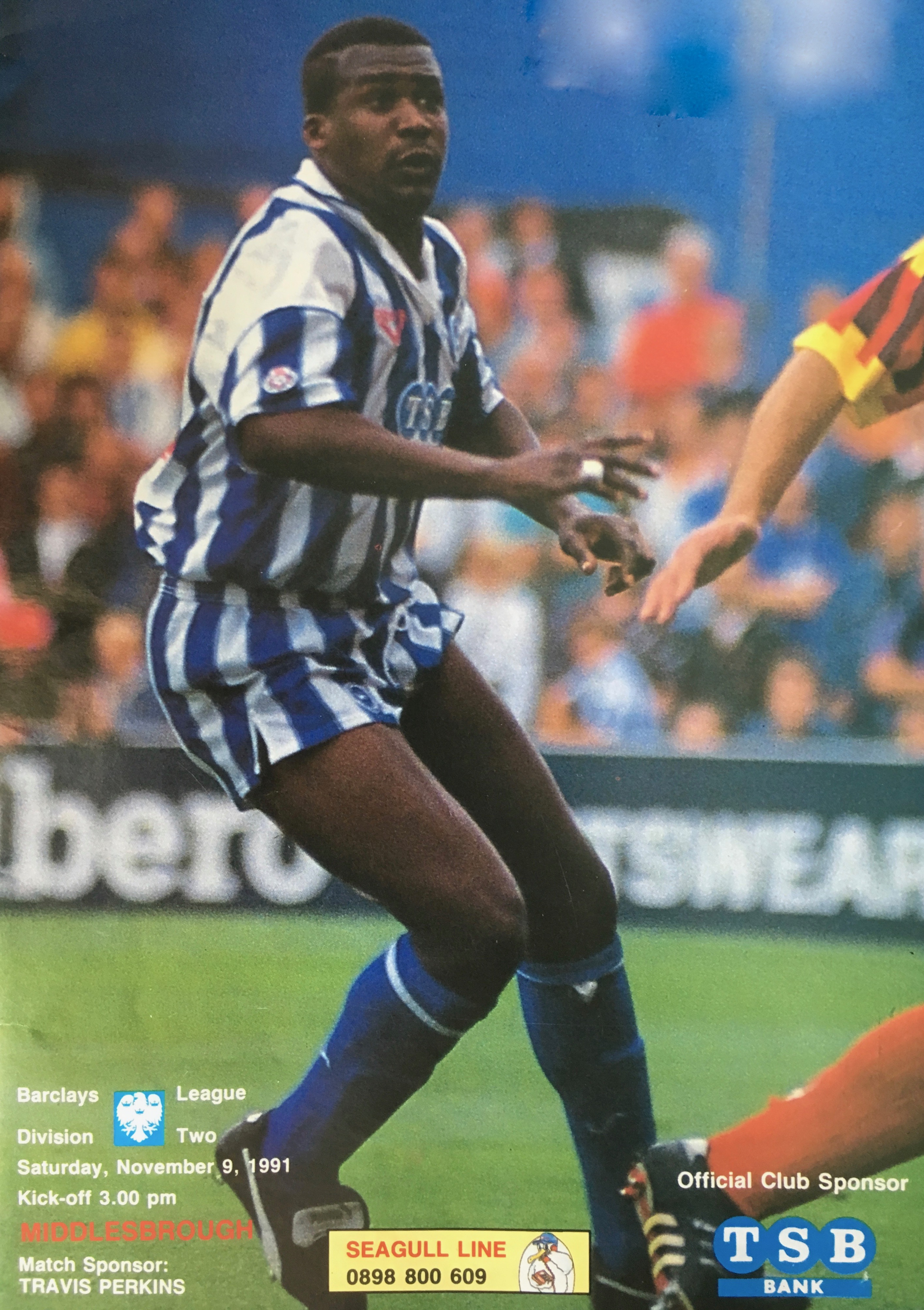
He played 40 times and scored 12 goals in the 1991-92 season, but the Albion were relegated to the third tier, so it was memorable for all the wrong reasons.
Born on 22 November 1962, Meade was on the Gunners’ books from June 1977 to the summer of 1985.
The superb thegoldstonewrap.com unearthed the Arsenal annual for 1981 in its research; it said of the young Meade: “He’s got a hell of a lot of pace and is fantastically brave in the box. He’s got all the makings of a top player. However, he’s another one who has got to work on his control like Brian McDermott with tighter controls and lay-offs. But with his type of pace he will always be a threat.”
The reality was that with the likes of initially Alan Sunderland and John Hawley ahead of him in the pecking order, then Tony Woodcock and Lee Chapman, followed by the arrival of Charlie Nicholas and former Ipswich striker Paul Mariner, his first team chances at Highbury were restricted.
While he was prolific in the Reserves (24 goals in 27 league games in 1983-84), his first team appearances over four years were somewhat sporadic.
Manager Terry Neill handed him his debut in a 3-0 UEFA Cup away win against Panathinaikos on 16 September 1981 and he scored a spectacular goal with his very first kick! His league debut came a month later – and he scored again, netting the only goal in a 1-0 win at home to Manchester City. The 1981-82 season saw the majority of his first team involvement: he played a total of 22 games, scoring five times.
A cartilage injury sidelined him for a large part of the 1982-83 season but when he did return in February 1983 he scored twice against Brighton in a 3-1 win.
The following season, Meade scored a hat-trick in the 3-1 win over Watford, which began Don Howe’s tenure as Arsenal manager, and he also earned a special place in Gunners’ fans hearts when scoring twice (pictured celebrating above with Charlie Nicholas, who also got two) in Arsenal’s 4-2 victory over arch-rivals Spurs on Boxing Day 1983.
Unfortunately, they were sporadic highlights and, in the summer of 1985, he was sold to Sporting Lisbon.
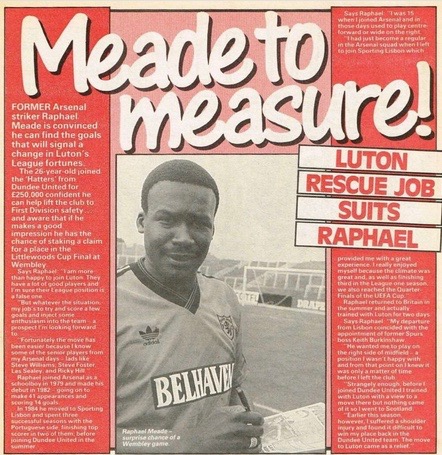
“Sporting Lisbon provided me with a great experience. I really enjoyed myself because the climate was great and, as well as finishing third in the league one season, we also reached the quarter finals of the UEFA Cup,” Meade said in a Shoot/Goal article.
He said it was the arrival of former Spurs boss Keith Burkinshaw that precipitated the end of his time in Portugal because he wanted him to play in an unfamiliar right midfield role.
Thus he was loaned to Spanish side Real Betis towards the end of his three-year contract, and, on his return, was transferred to Dundee United where he made 16 starts, plus six substitute appearances, scoring seven goals.
However, United boss Jim McLean made public his dissatisfaction with the striker and questioned his fitness. Meade hit back saying he was fit but being played out of position on the wing.
Subsequently a shoulder injury saw him sidelined and unable to regain his place and he joined a struggling Luton Town side for a £250,000 fee.
But after only four games for the Hatters he was on his way again, this time to Odense BK in Denmark.
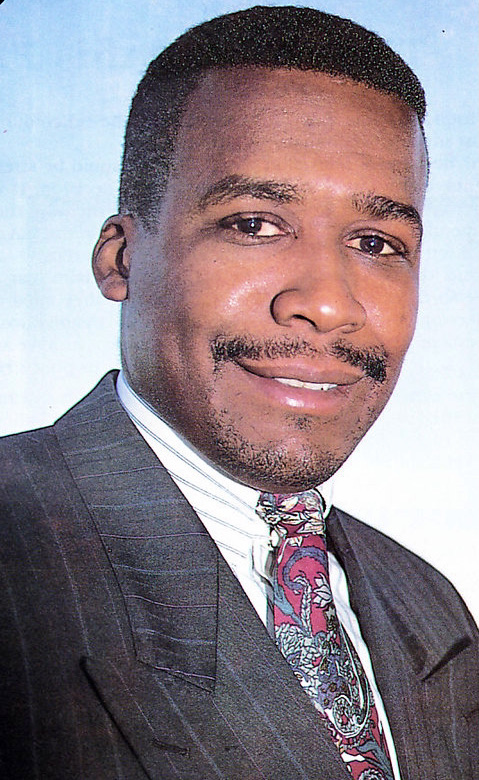
During two years on their books, he had loan spells back in the UK, playing once for Ipswich Town and five times for Plymouth Argyle.
As the 1991-92 season got under way, cash-strapped Brighton were forced to sell the previous season’s successful strike duo of Small (to West Ham) and Byrne (to Sunderland).
Byrne’s departure didn’t happen until October, and it was while playing alongside the popular Republic of Ireland international that Meade scored his first goal for the Seagulls, in a 3-1 home win over Port Vale.
He had found himself in the right place at the right time in only the fourth game of the season when an injury sidelined Bryan Wade, who had started the first three games alongside Byrne.
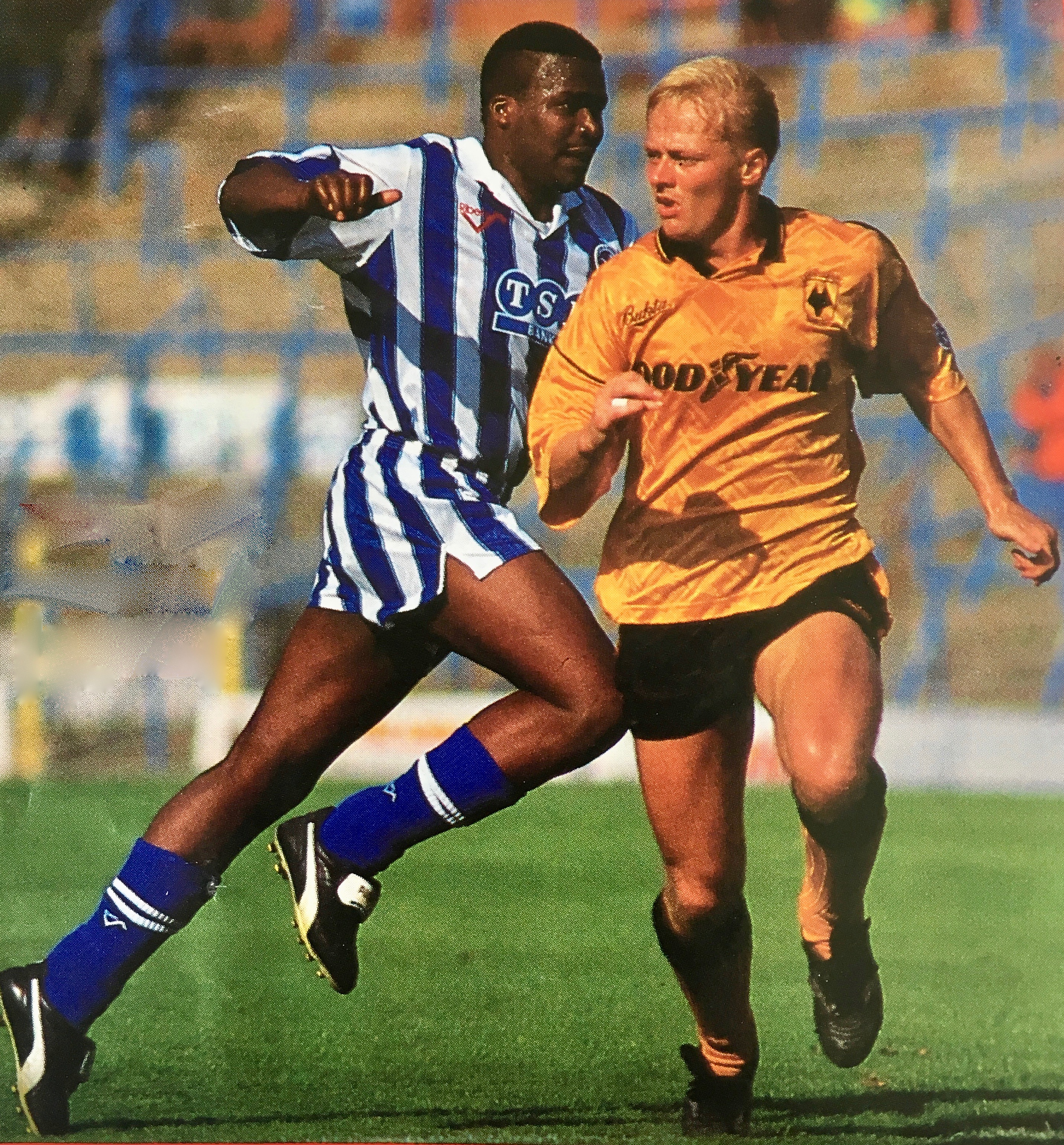
Lloyd had watched the former Arsenal striker score in a 2-0 win for the reserves against Fulham and pitched him in against Wolves – a 3-3 thriller in which Mark Barham, Gary O’Reilly and John Robinson netted for the Albion.
“Ideally, I needed one or two games to get match fit but it was great to get the chance in the first team and I wasn’t going to waste it,” said Meade.
Meade in action with another former Gunner, and ex-Albion defender, Steve Gatting (in Charlton’s colours), and a man of the match award for a brace against Grimsby Town.
After Byrne’s departure to the north east, there was seldom a regular strike partner for Meade. The busy and bustling Mark Gall, signed from non-league Maidstone United for £45,000, managed 14 goals but was some way short of Byrne or Small’s quality. And another of Lloyd’s overseas ‘finds’- Mark Farrington from Feyenoord – was an almighty flop.
Meade popped up with the occasional goal and one of those rare glimmers of light in an otherwise dark season came in a game I went to see at Vicarage Road on 31 March 1992.
Although Albion were ultimately headed back to Division 3, a brief respite from that tumble came against the Hornets courtesy of a howler by David ‘Calamity’ James in their goal. James came to the edge of his area to collect a routine-looking through ball, spilled it rather than gathering it cleanly and Meade was on hand to pick up the loose ball, round the stranded ‘keeper and slot what turned out to be the only goal of the game.
Meade scored twice more before the season’s end but Albion lost four of the final six games and were relegated along with Port Vale and Plymouth. Meade elected to leave the club and head for Hong Kong.
After a season with Sea Bee, he returned to England and rejoined Brighton but only featured in three games. He moved on to Crawley Town in 1995-96, where he ended his playing days.
Pictures from various sources including the matchday programme, Shoot/Goal, and online.