Zamora’s wait for England while dad’s Trinidad came knocking

TEN DAYS after Barry Fry’s prediction about Bobby Zamora playing for England, he made his debut for the country’s under 21 side.

It was 16 April 2002 and the Brighton striker went on as a sub for Leeds’ Alan Smith in a 1-0 friendly defeat v Portugal at Stoke’s Britannia Stadium. Paul Konchesky, a fellow graduate of the East London boys’ team Senrab, was left-back that day.

While plenty of observers expected Zamora eventually to step up to the full England side, he had to wait until he was 30 to make his first (and only) start at that level, and not before being wooed to switch allegiance and play for Trinidad and Tobago.

That happened in 2005, when the Caribbean country’s Dutch coach, Leo Beenhakker, wanted him to play in a World Cup qualifier against Guatemala. Zamora told the News of the World: “Trinidad is my dad’s country and to play in the finals would be a dream but West Ham are more important.

“I am only thinking about the club at the moment and do not want to be distracted from that. The club mean everything to me and if I can help us have a good season that is all that matters.”

After an injury-hit 2007-08 season, though, West Ham sold him to Fulham in the summer of 2008. The following year it was reported Zamora and his old Senrab teammate Jloyd Samuel had both obtained Trinidad & Tobago passports in time to play in a 2010 World Cup qualifier.

Injury prevented Zamora from getting involved but Samuel did play twice for the Soca Warriors even though he had won seven England under 21 caps. (Samuel tragically died in a road accident aged 37 in 2018).

Zamora top-scored with 19 goals in Fulham’s memorable 2009-10 season under Roy Hodgson. The south London side finished 12th in the Premier League and made it through to the final of the Europa League (the first season of the revamped competition previously known as the UEFA Cup).

Zamora had been a fitness doubt before the game against Athletico Madrid in the People’s Park Stadium in Hamburg and he had to give way to Clint Dempsey 10 minutes into the second half.

The game went into extra time with the score 1-1 after 90 minutes and agonisingly Fulham succumbed to an extra time winner scored by Diego Forlan. Sergio Aguero, later of Man City fame, beat defender Aaron Hughes and crossed for Forlan to flick the ball home four minutes from the end.

Nevertheless, Zamora’s goalscoring form had caught the attention of England manager Fabio Capello and his deputy Franco Baldini who were keen to call him up for the 2010 World Cup.

Sadly, those hopes were dashed by an achilles injury, and Zamora conceded: “I told Fabio that I was struggling and I knew that, had I gone, I wouldn’t have done myself or England justice.”

The player told The Independent: “It’s been an up and down season because it’s been so good on the pitch and I’ve scored some important goals. To now pick up this injury has kicked me in the teeth.

“It’s come during the last couple of weeks and when there was the possibility of going to the World Cup with England. That’s football, it’s a cruel game.”

He added: “The World Cup’s a massive tournament. It’s not about myself, it’s about England.

“Capello wished me all the best, hoped that I get fit and would be available next season.”

True to his word, Zamora was one of five uncapped players included in Capello’s squad immediately after the disappointment in South Africa.

One of the first people to contact him was former West Ham teammate, Teddy Sheringham, who he said he learnt so much from. “I got a long text message from Teddy. He said I might be nervous beforehand but that I deserved this opportunity, and he said once I’d taken part in my first training session, I would realise that I deserved to be there. He was spot on; after that I did not look out of place and I embraced being part of the squad.”

The call up came in something of a crazy week for Zamora because only days earlier his wife gave birth to twin girls, Gisele and Siena.

“The twins were born last Monday, they came out (of hospital) on Friday, then I had a match on Saturday, was back home for one day and then I was away with England, so I have not seen them as much as I wanted to, but I am sure I will find some time when I get back home,” he said.

“The twins are a massive part of my life now, and with getting the call-up to play for your country is a massive honour. I am lost for words. I am extremely proud to be called up to play for my country.”

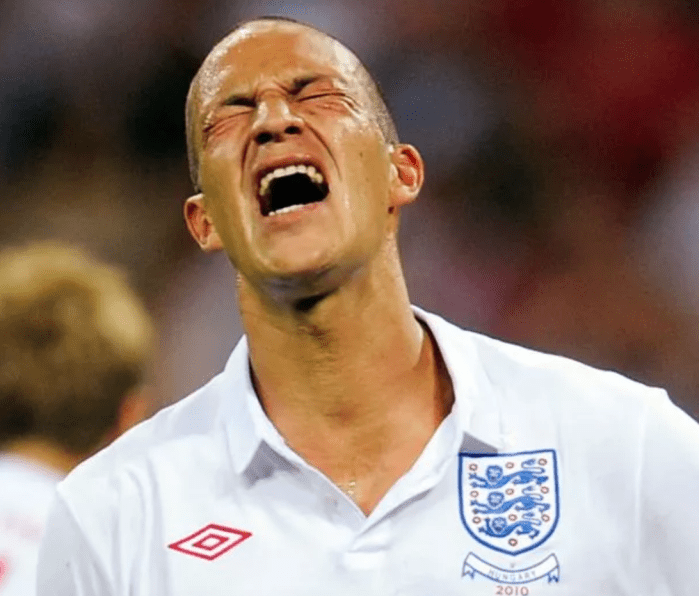
Capello sent him on as a second half substitute for Frank Lampard to play up front alongside Wayne Rooney in England’s 2-1 friendly win over Hungary at Wembley on 11 August 2010.
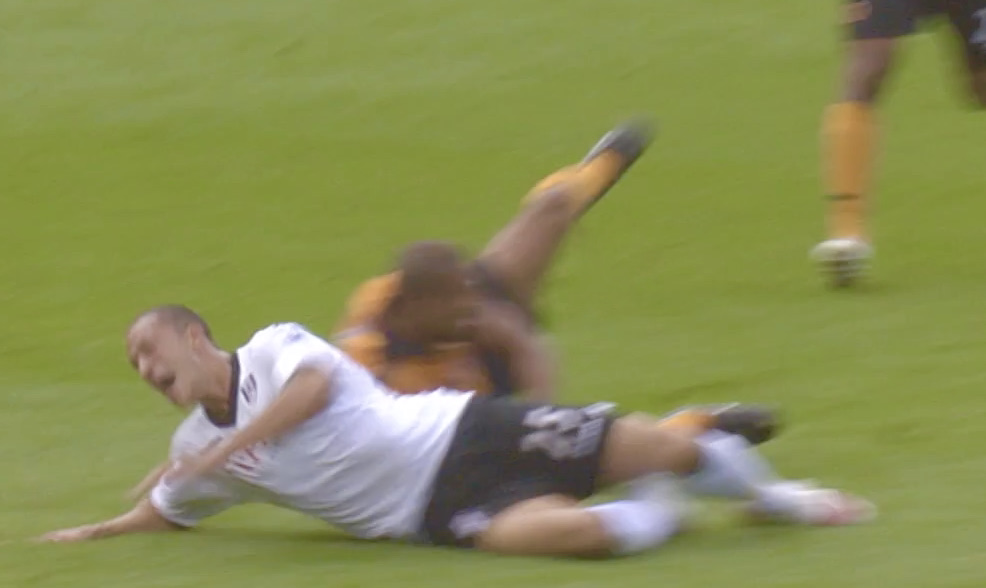
Having made that breakthrough, the day after he signed a new four-year contract with Fulham he agonisingly suffered another setback when he broke a leg (above) and sustained ankle ligament damage during a 2-1 win over Wolves. He was sidelined for five months.

Capello didn’t consign him to history, though, and called him up again in May 2011 (his teammate David Stockdale was in the same squad) to face Switzerland in a Euro 2012 qualifier. But neither were involved in the disappointing 2-2 Wembley draw.

His first start for England finally came six months later in a 1-0 home win over Sweden, the first time in 43 years that England had beaten the Scandinavian country. Zamora’s close friend (and another former Senrab graduate) John Terry was England captain and joining the striker in making first starts were right-back Kyle Walker and Everton’s Jack Rodwell.

Richard Williams in The Guardian clearly felt sorry for the debutant centre forward, though, writing: “Poor Bobby Zamora. Offered the opportunity to score England’s 2,000th goal on Tuesday night, a perennially unfortunate footballer was forced instead to stand and watch as Stewart Downing’s cross glanced off the side of Gareth Barry’s head and then off Daniel Majstorovic’s forehead before evading Andreas Isaksson’s dive as it looped inside the post for the most anticlimactic of own goals.”

Reporting on the narrow victory over the Swedes, Williams added: “Whichever side the ball went, Zamora made sure he was available. A double exchange of passes with Walcott in the 17th minute put Zamora in on goal, but after Isaksson blocked his first effort the follow-up was poked past the post from five yards.

“Any centre forward will ultimately be judged by the goals he scores rather than his total of assists, and Zamora spurned a wonderful chance in the 65th minute when Downing scampered down the left once more before pulling the ball back at precisely the right pace and angle for the striker to meet it with a first‑time connection. Jonas Olsson, however, flew in to deflect the shot for a corner.”

Zamora was subbed off in the 70th minute to be replaced by Darren Bent and the Guardian sports writer concluded: “England – and Zamora in particular – really should have inflicted greater punishment on such humdrum opposition.”

Bent had also replaced Zamora in his first start for England under 21s. That came in February 2003 in a 1-0 defeat to Italy in Carrara.

A month before his move to Spurs, he also started England’s 3-2 friendly win over Serbia and Montenegro at Hull’s Kingston Communications Stadium, on that occasion being replaced by Darren Ambrose. (His future Fulham and Albion teammate Steve Sidwell was in midfield that day).

Eight days later, in a UEFA under 21 championship preliminary match, he went on as a sub for Shola Ameobi as England beat Slovakia at the Stadium of Light, Sunderland.

Zamora showed England quality at an early age

After that under 21s debut against Portugal, he was selected in the squad for the UEFA under 21 championship finals in Switzerland. On 20 May 2002, David Platt sent him on as a sub for Gareth Barry in a 2-1 defeat to Italy in Basle.

Two days later, in the third group match, again a sub, he replaced Jermain Defoe as England lost 3-1 to Portugal and were eliminated from the competition.

On two other occasions Zamora was an unused sub but he didn’t add to his six caps. And, after

Capello quit the England job in February 2012, Zamora didn’t play for the full England side again.

• Ahead of Albion’s new year clash with West Ham, find out why Zamora’s move to the Boleyn Ground was so ideal in the next instalment.

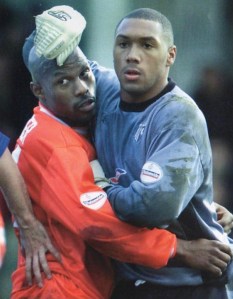
Tony Rougier couldn’t have wished for a better Albion start

A GOAL by Tony Rougier three minutes into his debut as a substitute gave Brighton a glimmer of hope in their battle to avoid relegation.

His strike against Mark McGhee’s mid-table Millwall side at Withdean Stadium on 22 February 2003 was the only goal of the game and lifted Albion out of the bottom three of the Championship.

When Bobby Zamora dummied Kerry Mayo’s pass to allow Arsenal loanee Graham Barrett to turn and move the ball goalwards, Rougier nipped in to complete a neat finish past Tony Warner in the Millwall goal.

Manager Steve Coppell had sent on the Reading loanee as a 61st minute substitute for winger Paul Brooker although he admitted to Stuart Barnes of The Guardian: “I honestly didn’t know if Tony would make a difference, but I felt he would pep up everybody else because we were starting to lose our grip.

“Getting out of the bottom three will give the players a lot of self-esteem. For a long time this season they have questioned whether they belonged at this level.”

Trinidad and Tobago international Rougier joined the Seagulls having been sidelined by Alan Pardew at Reading who paid £325,000 when signing him from Brian Horton’s Port Vale.

Horton gave the Argus an insight of what Albion fans might expect when he said in an interview: “Tony has a great build and he is a threat with his pace and strength.

“We had to sell him because we needed the money and he was one of our major earners.”

He had been Vale’s leading goalscorer with eight goals in 38 games when they were relegated from the First Division in 2000 before moving to Reading that August.

Rougier made a total of 84 appearances for Reading, scoring six goals, and in his first season helped them to the Division Two play-off final where they lost 3-2 to Walsall (and Rougier scored an own goal after going on as a substitute). But a year later, he made 20 starts and 13 appearances off the bench as Reading were promoted in second place – behind the Albion!

He had scored twice in 12 outings for Pardew’s high-flying Royals in 2002-03, including in a 1-0 win against Albion at Withdean. But competition for places was fierce, with the likes of Nicky Forster, Darius Henderson, John Salako and Nathan Tyson.

Coppell told the Argus: “I speak with Alan fairly regularly but this came totally out of the blue when I phoned him up.

“Tony is a big, strong lad and he gives us options. He can play as a wide man or down the middle and the move suits Reading, the player and me.”

Getting to grips with Jason Brown of Gillingham

Coppell needed forward cover because Gary Hart was about to start a four-match suspension, Zamora was banned for the next away game at Gillingham, Paul Kitson was still injured and Barrett was struggling for form and goals.

The following matchday programme observed Rougier had not been signed for his goalscoring prowess, but rather for his “power, direct running, and causing havoc that others can exploit”.

But the goal was very welcome in a season that might well not have ended in relegation if Coppell had started the season in charge rather than joining after so many games had already been lost under Martin Hinshelwood.

Rougier made his first start in a 3-0 defeat away to Gillingham playing up front with Barrett when Zamora and Hart were suspended.

He featured in home wins over Rotherham United (2-0) and Nottingham Forest (1-0) as well as an away defeat at Stoke City (0-1), but he missed the 2-1 defeat at Sheffield United after twisting his right ankle against Forest.

He bowed out in style in his final appearance, making one goal and scoring a second in a memorable 2-2 draw away to Ipswich Town.

I took my then 14-year-old son Rhys to the clash at Portman Road and the lively midfielder-cum-striker in the no.34 shirt, who had been taken to the hearts of the Albion faithful, was suitably serenaded with the chant ‘Ra-ra-ra Rougier’ to the tune of the popular vaudeville and music hall song Tarara Boom-de-ay.

His first significant involvement saw him go up for a header from Hart’s cross and Town goalkeeper Andy Marshall diverted the ball into his own net to gift Albion an equaliser.

Future Albion loanee striker Darren Bent missed a penalty that would have put Ipswich back in front, and then, with 10 minutes to go, Albion fans were buoyant with expectation when Rougier slammed the ball into the roof of the net after Ipswich had failed to clear their lines.

Unfortunately for Brighton, a 30-yard thunderbolt from Martin Reuser flew past Dave Beasant to put the home side level and Albion had to be content with a point, which ultimately wasn’t enough to avoid making an immediate return to the division they’d left the previous season.

While the player was keen to extend his stay, Pardew wanted him back to help with Reading’s promotion run-in, although thankfully he wasn’t involved in Brighton’s shock 2-1 win at the Madejski Stadium on 4 April (and Steve Sidwell, who had been on loan at the Albion earlier that season was an unused sub). Goals from Brooker and sub Kitson took the spoils for the Albion, Cureton netting for the home side.

The Royals finished fourth in the league before losing 3-1 on aggregate to Wolves in the play-off semi-finals, and Rougier was released on a free transfer having scored three times in 13 starts and nine appearances off the bench.

Rougier told the Argus he would be interested in returning to the Albion, but nothing came of it and he joined Brentford instead. Manager Wally Downes believed the player had “real quality” although Brentford fans seemed to have divided opinions on what he brought to the side.

‘Snappy’ on The Griffin Park Grapevine reckoned: “The guy is a huge asset, especially in the last 10 minutes of a game when he can hold the ball up and dance his way around players like they were statues and relieve the pressure on the defence.”

‘West Ealing Bee’ agreed: “He is an asset to the club and a very important part of the team.” But ‘Boston Bee’ had a totally different take on the player:Even when he actually tried (15min/match) he looked like he wasn’t trying. His lack of interest in the game going on around him drove me crazy.”

Rougier made 34 appearances for the Bees, scoring five goals but when Martin Allen took over as manager in March 2004, Rougier was one of five players he allowed to leave Griffin Park as part of a squad overhaul that ultimately helped them to a last-day escape from relegation.

Meanwhile, Rougier linked up with another ex-Albion captain, Danny Wilson, at Bristol City on a free transfer. Indeed, Rougier appeared for the Robins when they lost 1-0 to McGhee’s Albion in the divisional play-off final in Cardiff on 30 May.

But when Wilson lost his job that summer, Rougier followed him out of the exit and he returned to Trinidad, where he won the last of 67 international caps for Trinidad and Tobago.

Rougier stepped into coaching

He has since turned to coaching, becoming a UEFA A licensed coach, and attained a degree in sports development. On his LinkedIn profile, he describes himself as the founder, president and technical director of FC South End, and, in 2014, among his past coaching experiences was a spell working with his nation’s under 20 squad.

Four years later, he had moved to the United States to coach the New England Revolution academy team.

Born on 17 July 1971 in Sobo, a village in south west Trinidad, his footballing career was initially confined to his home country.

Tom Lunn, writing for Reading fan website thetilehurstend.sbnation.com in 2019, profiled Rougier describing how the player began his senior footballing career in his home country with La Brea Angels. His Wikipedia page says he also played for Trintoc, United Petrotrin, and Trinity Pros.

An Albion matchday programme article said Rougier then moved to New York where he spent a year working in the baggage department at John F Kennedy airport before heading to the UK.

After overcoming work permit issues, he was taken on by Raith Rovers where, over the course of two years, he became something of a cult hero. In 2018, he returned to Fife to be inducted into the club’s Hall of Fame.

“This is where it all started,” he said in an interview with the club’s TV channel. “It never felt the same whichever club I went to afterwards. The Fife people gave me respect and it’s something I’ll never forget.”

Rougier welcomed back in Fife

During the interview, Rougier remembered fondly an occasion when he man-marked Paul Gascoigne, playing central midfield against Rangers.

His stand-out moment was a UEFA Cup second round tie in Munich’s Olympic Stadium on 30 October 1985 when Raith only narrowly lost 2-1 to Bayern Munich who boasted the likes of Oliver Kahn in goal and Jurgen Klinsmann up front.

His performances for Raith earned him a £250,000 move to Hibernian. He scored four times in 45 matches for Alex McLeish’s Edinburgh outfit but in January 1999 joined Port Vale, signed by Horton’s predecessor John Rudge for £175,000.

By then, he had established himself in the Trinidad and Tobago national side, a teammate of Dwight Yorke, and often being chosen as captain.

In his own words, he describes himself as: “A highly experienced football coach and former professional player with a career in the game spanning more than 25 years, I has successfully made the transition into coaching, management and club operations through a consistent focus on long term player and team development.

“A former national team captain with Trinidad & Tobago and a promotion winner in both England and Scotland, I have been able to effectively apply my on-field experience to guide team success and coaching strategy at professional, grassroots and school level.

“I am a positive, dynamic and passionate professional who is committed to my continued progression as a coach. I am always open to opportunities in which I can develop while positively impacting a football club or organisation, and would relish the opportunity to work with elite players within an ambitious environment.”

Rami’s route from Rome’s Olympic arena to Albion’s ‘Theatre of Trees’ – and then the World Cup!

IN ALBION’S 2004-05 Championship season, both regular goalkeepers, Michel Kuipers and Ben Roberts, were injured.

A rookie American ‘keeper, David Yeldell, was signed on loan from Blackburn Rovers but didn’t inspire confidence and was discarded after just three games.

Instead, Albion manager Mark McGhee turned to Rami Shaaban, a Swedish-born goalkeeper with a Finnish mother and Egyptian father who hadn’t played a competitive match for two years!

However, that game had been for Arsenal in the Champions League in the 70,000-capacity Olympic Stadium in Rome!

Now, here he was on 19 February 2005 lining up for Albion in front of 6,647 at Withdean – The Theatre of Trees – against eventual champions Sunderland.

It proved to be an eventful debut, which I watched with my 10-year-old daughter, Holly (during her brief flirtation with wondering why her Dad was obsessed with this football lark). Albion played more than an hour of the game with only 10 men, Adam Virgo being sent off by referee Dermot Gallagher for two yellow cards.

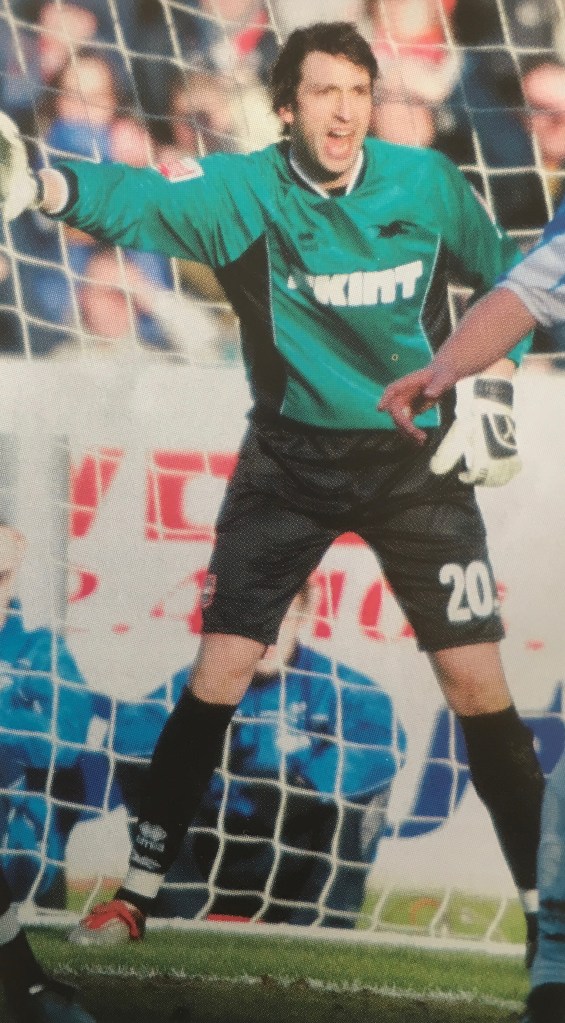
Shaaban, Albion’s fourth different goalkeeper in the space of five games, did not have that much to do but he made an instinctive stop to keep out a cross from Dean Whitehead, fisted away a Sean Thornton effort and did well to hold Julio Arca’s shot from 15 yards.

He told The Argus afterwards: “It’s a great start. I’ve always been lucky with my first games at new clubs.

“At Arsenal, I had a clean sheet. That was in the Champions League, so it was a bit different, but you have to start somewhere and I’m very pleased to get 90 minutes of competitive football.

“I was more nervous playing here than for Arsenal, because before I went to Arsenal I was match fit. Here I had not played competitive football for two years, so this was a big milestone for me.”

albion action

Against all the odds, Albion won the game 2-1 with Albion’s goals coming from a deflected Richard Carpenter shot and a rare Mark McCammon header from a corner.

Born on 30 June 1975 in Solna, Stockholm, Shaaban’s professional football career began with the local Saltsjöbadens IF who he played for 39 times in 1994-95. Then, while studying at university in Cairo, he played for Zamalek and Ittihad Osman.

After university, he spent four years in Chile, between 1997 and 2001, playing initially for Coquimbo Unido and then Deportes Temuco.

Good performances there alerted his hometown club Djurgårdens, of Sweden’s first division, and it was while he was playing there that Arsenal snapped him up.

But his good fortune was to run out quite quickly. Originally drafted in by Arsenal as a possible successor to David Seaman, he suffered a freak training ground accident on Christmas Eve 2002 that left him with a broken leg.

It took him a year to recover and during that time the Gunners signed Jens Lehmann who went on to establish himself as Arsenal’s no.1.

Shaaban did play five games for Arsenal – three Premier League games and two in the Champions League – but he never did make it back to play for Arsenal competitively again after his injury.

However, he did warm the bench in the latter part of the famous Arsenal ‘Invincibles’ season (2003-04), because regular back-up ‘keeper Stuart Taylor had picked up an injury.

In January 2004, Shabaan was loaned to West Ham for a month, but didn’t play for the first team, and then at the season’s end he was released.

Immediately before joining Brighton, he had been training back in Sweden with Djurgårdens, but he was recommended to McGhee by former Wolves goalkeeper coach Hans Segers who had moved to Spurs where Shaaban had recently had a trial.

After spending two weeks training with the Albion, the ‘keeper impressed McGhee, who told the matchday programme: “He’s done well. There’s no doubt about it, he’s a good goalkeeper. We have to now consider what we do with him. We’re going to need two goalkeepers that can play in the team between now and the end of the season.”

Shaaban kept goal for the Albion for six games one of which, on 12 March 2005, saw him harshly penalised in a 5-1 defeat away to Plymouth Argyle, which I attended with my son, Rhys.

Of course, as fans, we would say it, wouldn’t we, but it was never a 5-1 game, and that was largely down to an unbelievable performance by referee Phil Crossley.

Albion, wearing yellow, started brightly enough and soon had the ball in the net. Admittedly the action was at the far end from us, but we couldn’t see anything wrong with the goal (I think the ref ruled out Guy Butters’ header because he claimed the ball from Carpenter’s free kick curled out over the line before the cross came into him).

It was the first of several injustices meted out to the Albion that afternoon by Crossley. Plymouth took a lead as early as the ninth minute when Nick Chadwick finished off a neat one-two with Dexter Blackstock, who, ironically, manager McGhee had tried to sign on loan from Southampton earlier that season.

Our hopes were raised, though, when Charlie Oatway, on his 200th League appearance for the Seagulls, scored with a deflected header from another Carpenter free-kick.

Unfortunately, it wasn’t long before Plymouth were back in front when Crossley failed to spot Adam Hinshelwood being pushed as he went to head the ball. Instead he saw the ball hit the young centre half’s hand and awarded a penalty which Paul Wotton converted.

Then, though, came an almost unbelievable bit of nitpicking by a linesman which led to Plymouth scoring again!

Goalkeepers often go right to the edge of their penalty area before drop-kicking a clearance up field and, just as Shaaban did so, the lino flagged to claim he had taken it out of the area.

Crossley was obliged to award a free kick right on the edge of the penalty area and Wotton duly dispatched a thunderbolt into the net. It was as good as a penalty.

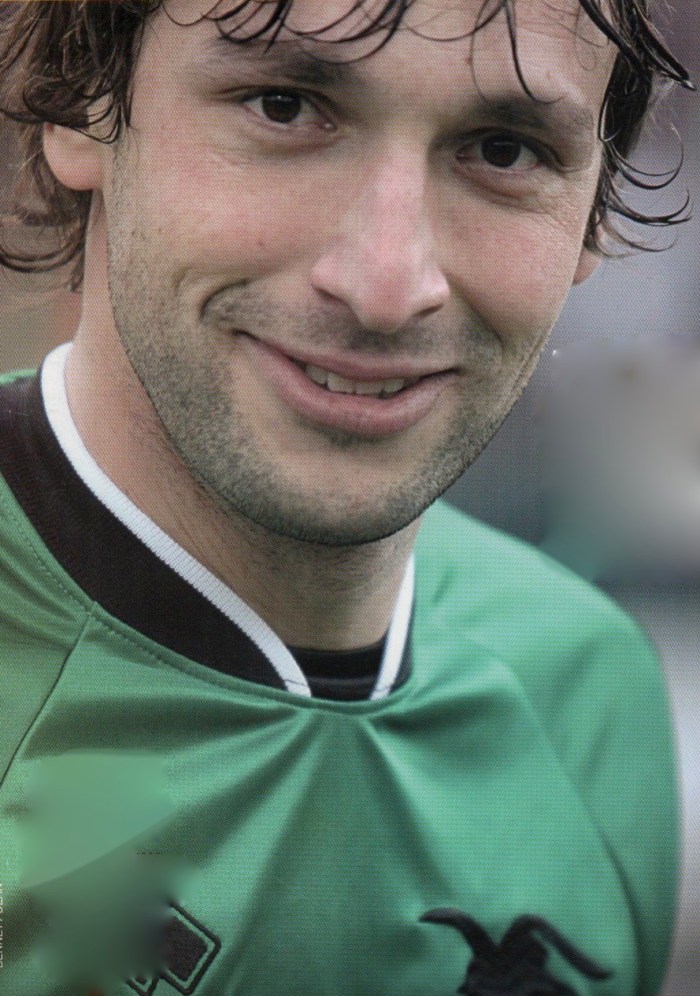
close-up shout

Although 3-1 down, it still looked like Albion were in with a chance, but Plymouth got a fourth on 36 minutes when David Norris evaded several despairing tackles before slotting past Shaaban.

To make matters worse, shortly into the restart Carpenter was consumed by red mist when Chadwick stopped him taking a quick free kick and, having pushed the guy in the chest, was sent off for the first time in his career.

So, 4-1 down and with only ten men, a difficult task just got harder: Plymouth continued to plug away and with just seconds remaining, substitute Scott Taylor rounded the hapless Shaaban to notch a fifth.

In the post-match interviews, McGhee described Chippy’s dismissal as “an absolute joke” and the refereeing as “shambolic”. And of the decision which led to Plymouth’s third, he said: “We see goalkeepers kicking at the edge of the box week in and week out and never in my career have I seen a linesman so sharp to put his flag up.”

Unfortunately for Shaaban, in his short time with the Albion he had conceded 13 goals, so McGhee turned to another loanee ‘keeper, Alan Blayney, from Southampton, who took over between the sticks for the remaining seven games of the season, when four draws and a win saw Albion do just enough to avoid the drop.

Shaaban remained on the bench and, at the end of the season, Albion decided not to take him on long-term. A year later he was called up to the Sweden squad for the 2006 World Cup!!

After his release from Brighton he had a trial with Dundee United but played only once, and also went on trial at Bristol City, but wasn’t taken on. Instead he went to Frederikstad in Norway, where he spent two years, and then joined Stockholm-based Hammarby, where he managed 26 appearances.

Those games led to him being selected for Sweden’s 2006 World Cup squad, although he had never previously been involved with the national side. In fact, in 2006 (and 2007) he was named Swedish goalkeeper of the year.

He made his debut as a half-time substitute in a warm up game with Finland and he played in his country’s 2006 World Cup opener, a 0-0 draw against Trinidad and Tobago, in place of injured first choice Andreas Isaksson.

He also played four Euro 2008 qualifying games for the Swedes, in which he kept a vital clean sheet in a 2-0 win over a Spain side which included the likes of Fernando Torres, Cesc Fabregas and David Villa and was also a member of their final stage squad.

Earlier in his career Shaaban could have chosen to play for Finland but decided to represent Sweden because, at that time Finland had two strong national team goalkeepers in Antii Niemi (later Albion’s goalkeeping coach) and Jussi Jääskeläinen, a Premier League ‘keeper for Bolton for many years.

After retiring from the game, Shabaan set up his own Swedish-based company, Rami Fresh, supplying Egypt-grown fruit and vegetables. The Sun did an article about him on 5 July 2023.


Photos from Albion matchday programme.