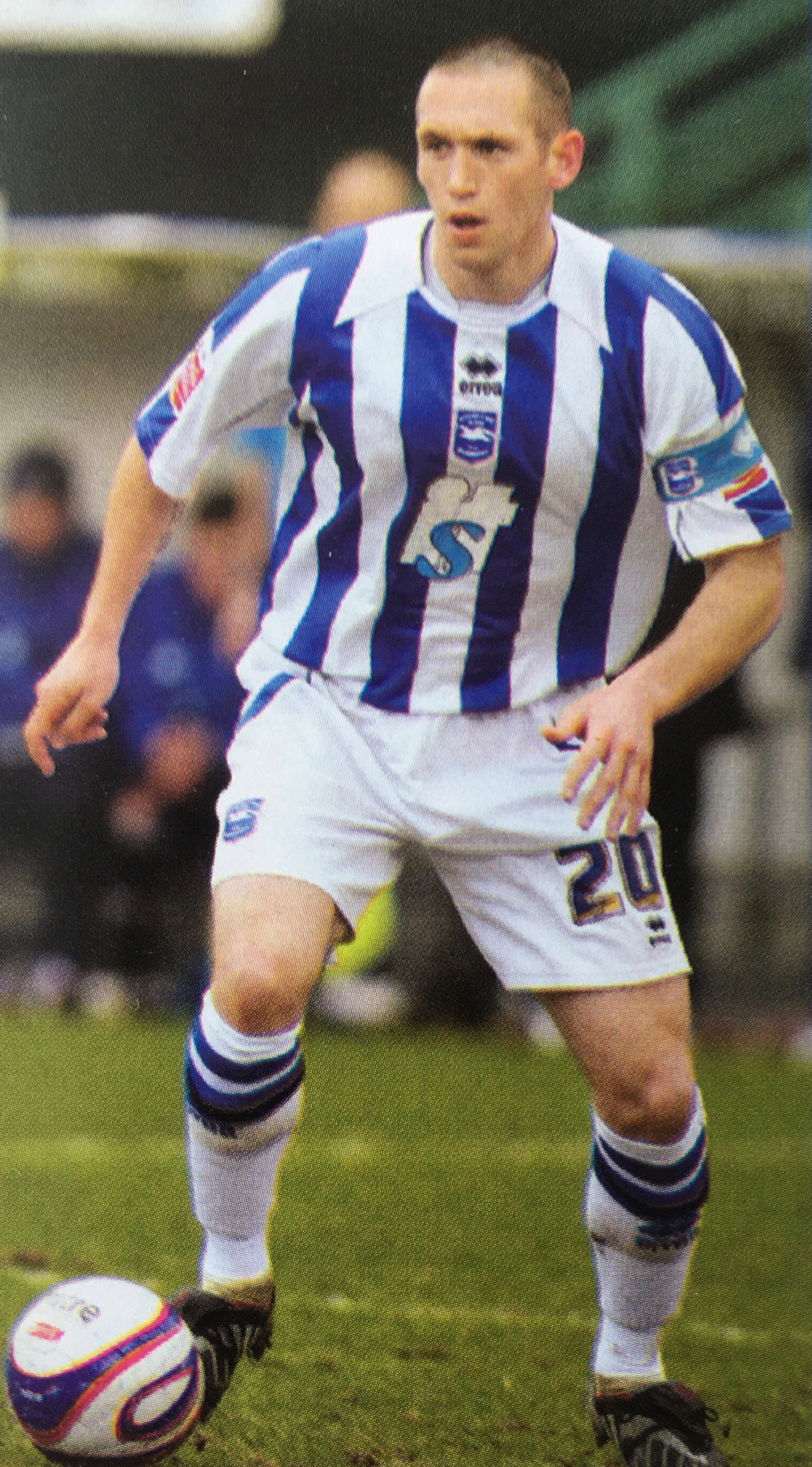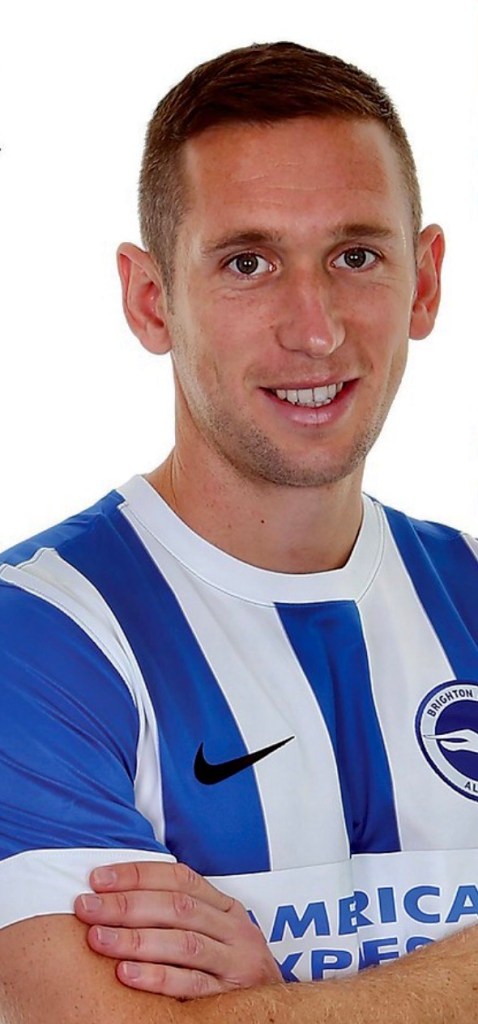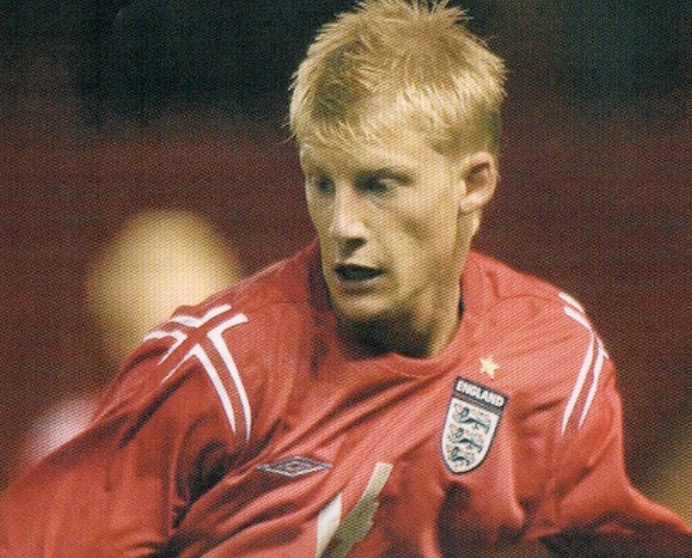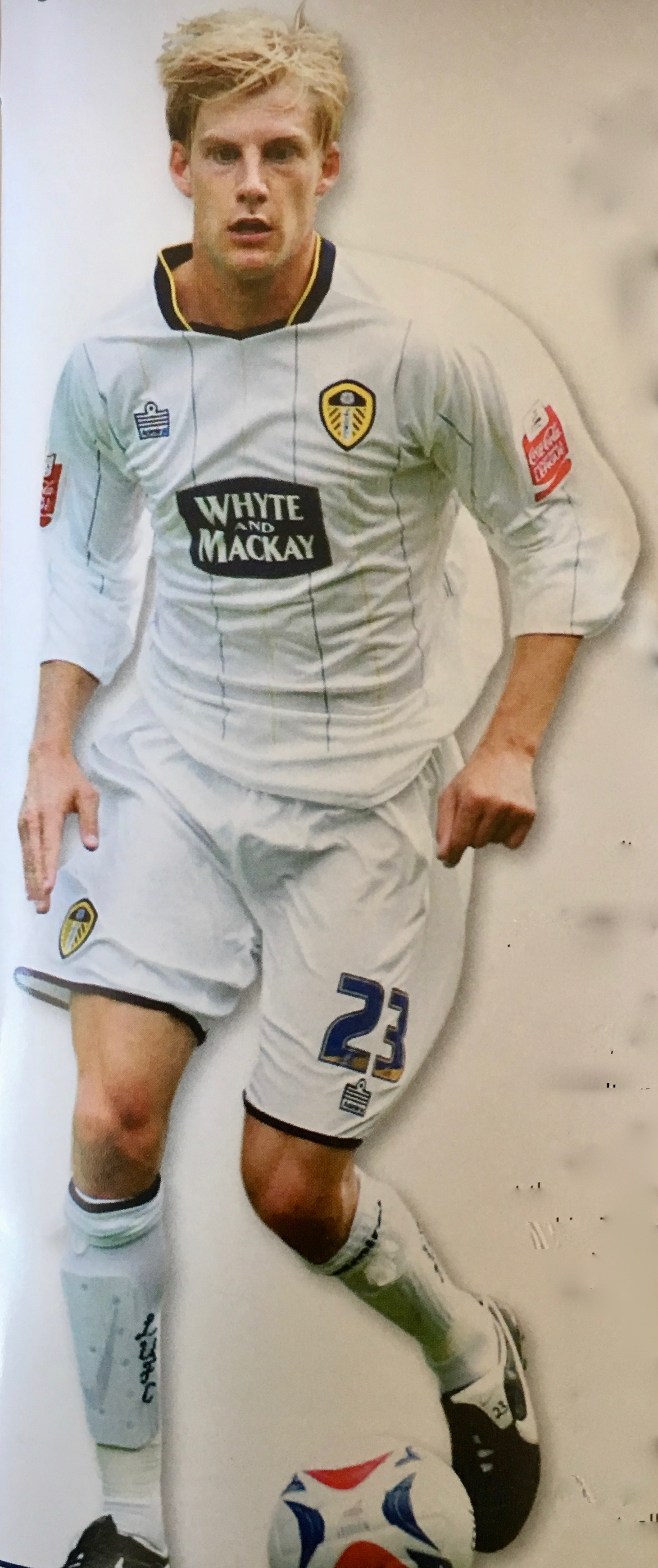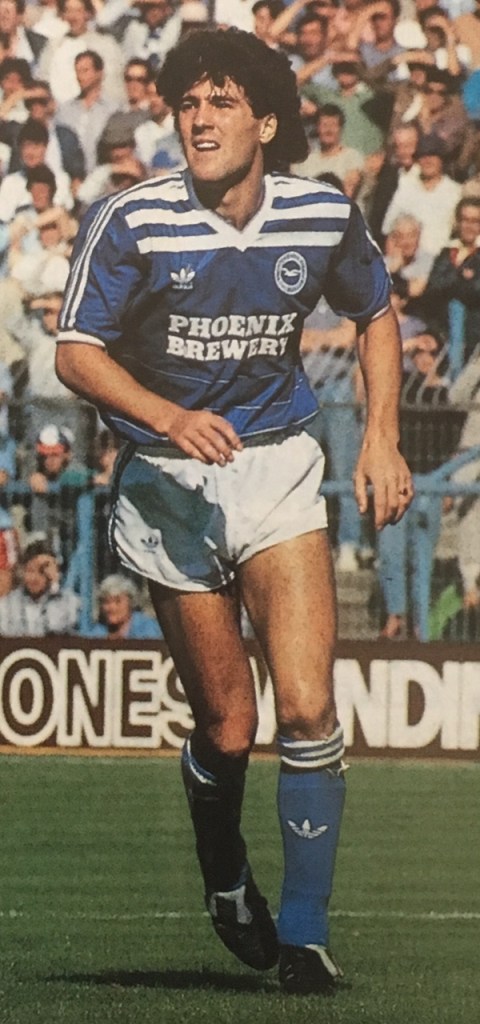
Dean Saunders raised cash for Brighton and Liverpool

IT’S NOT often Brighton and Liverpool have had something in common but, when it came to striker Dean Saunders, they both sold him to raise money. And they weren’t alone.

In the Albion’s case, it happened in 1987 when manager Barry Lloyd was forced to cash in on the free transfer signing to raise £60,000 to go towards players’ wages.

For their part, five years later, Liverpool let the Welsh international depart Anfield for £2.3m because boss Graeme Souness wanted the money to buy a central defender.

When Saunders was remarkably transferred for £1m from the Maxwell-owned Oxford United to the Maxwell-owned Derby County, it prompted former Brighton and Liverpool defender Mark Lawrenson to quit as boss at the Manor Ground after he’d been promised there would be no transfers likely to weaken his squad.

Saunders’ long and much-travelled career began in Swansea, the place where he was born on 21 June 1964, the son of former Swansea and Liverpool wing-half Roy Saunders.

He attended GwrossydJunior School and was soon appearing in the school football team on Saturday mornings and playing minor football in the afternoons. He went on to Penlan Comprehensive in Swansea and his career began to blossom, playing in the school team at all levels under sports master Lee Jones, a former British gymanstics champion. Saunders played for the Swansea Schools representative sides at under 11, 13 and 15 levels.

“I can remember enjoying watching the Swansea players train when I was a lad,” he told Tony Norman in an Albion matchday programme article. “I was lucky because my dad was the assistant manager, so I could go to pre-season training and things like that.

“I used to kick a ball around on the sidelines and dream of playing for Swansea.” That dream turned to reality after he joined the Swans in 1980 as an apprentice (when John Toshack was the manager), turned professional in 1982, and made his debut in the 1983-84 season. He scored 12 times in 49 appearances but in his final year had a goalless four-game loan at Cardiff City.

Manager John Bond released him on a free transfer after a turbulent season in which the Swans only narrowly avoided relegation to the basement division and Chris Cattlin, who’d been impressed when he saw Saunders playing for Swansea Reserves at the Goldstone Ground, snapped him up for Brighton.

“I was amazed when the Welsh club let him go for financial reasons,” Cattlin wrote in his matchday programme notes for the opening game of the season. “He is young, quick and, if he works hard, he has a great chance.”
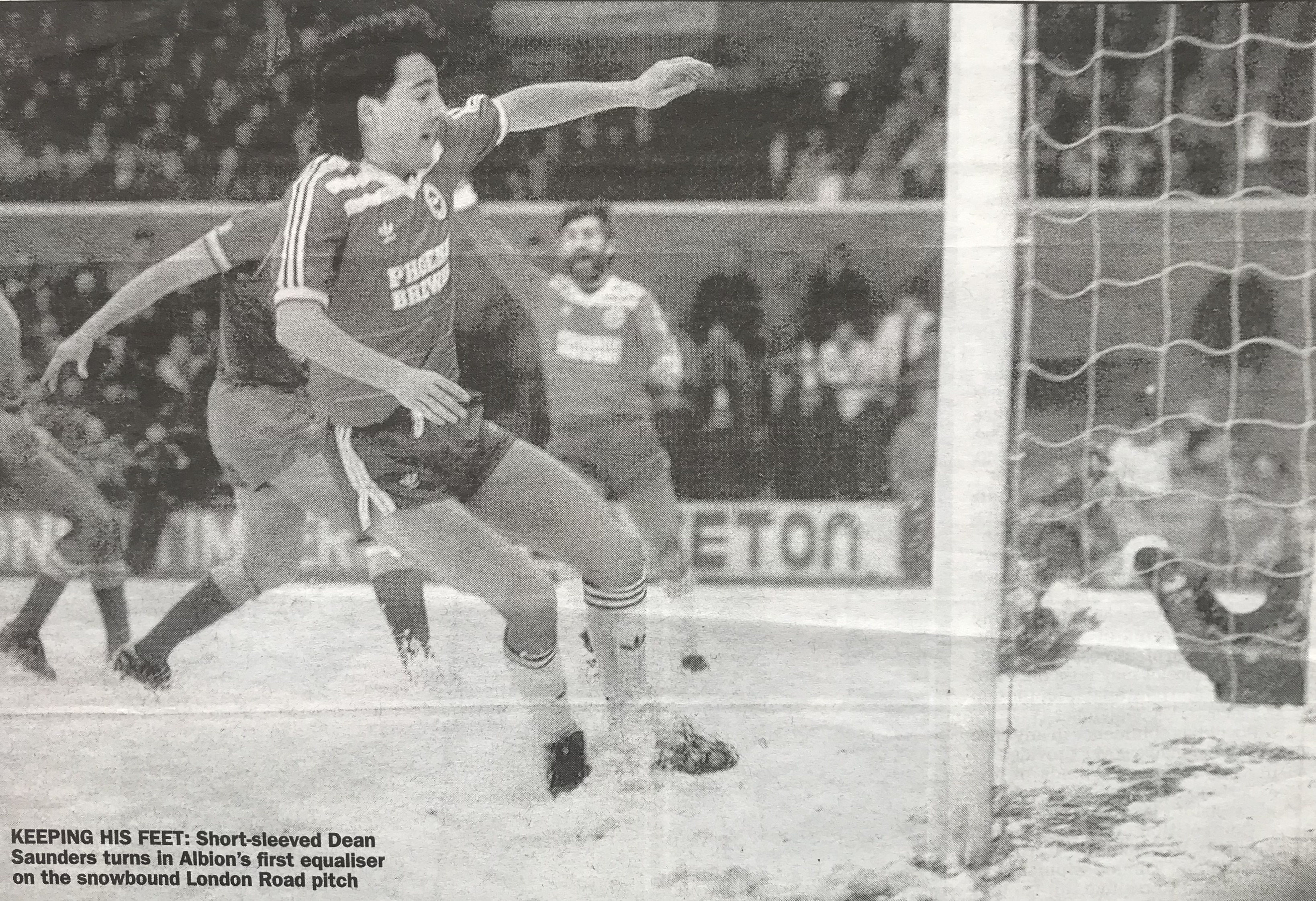
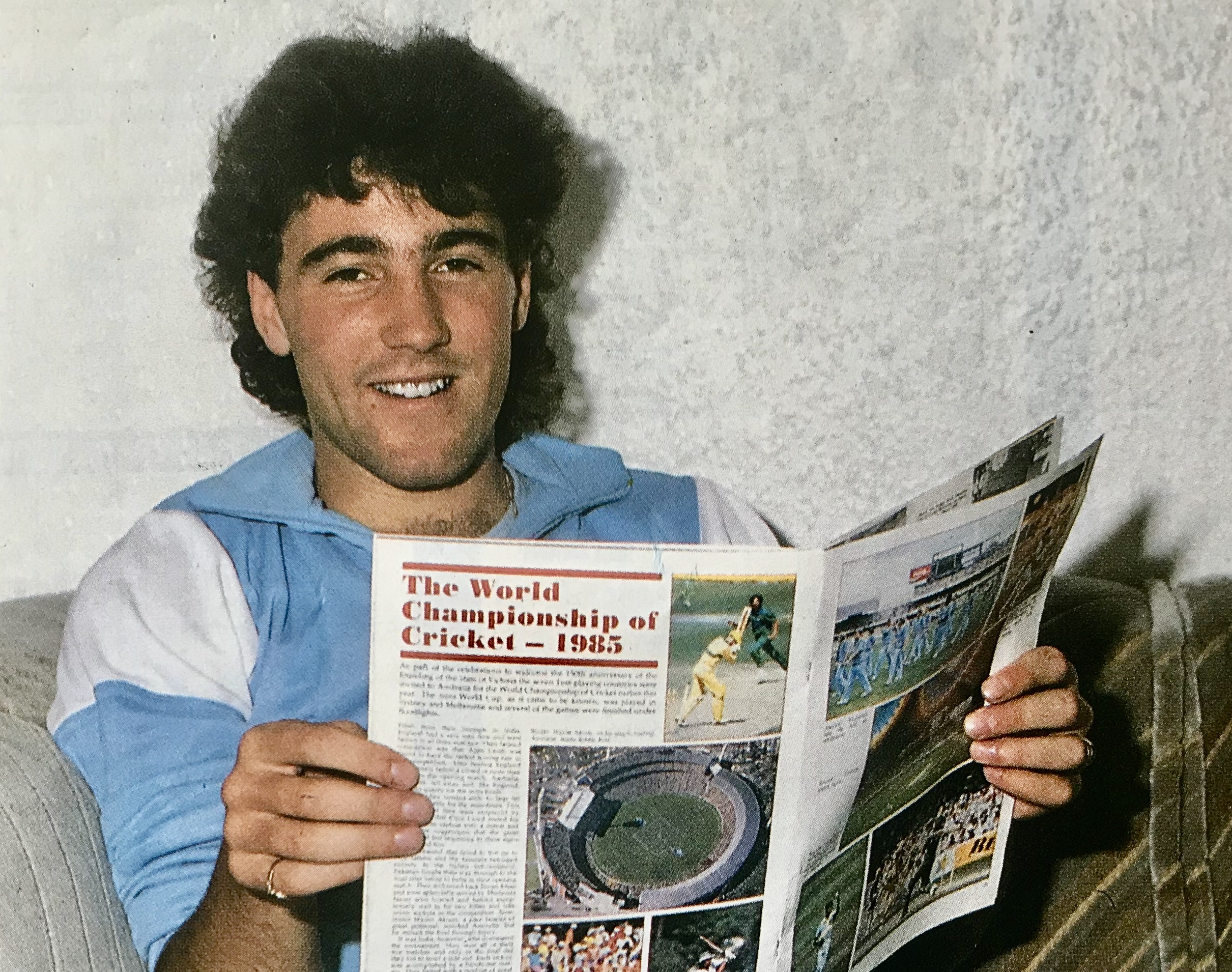
By the end of that season, Saunders had scored 19 goals in 48 league and cup games and was voted player of the season. His performances in the second tier for the Albion caught the eye of the Welsh national team manager, Mike England, and on 26 March 1986 Saunders made his full international debut for Wales as a substitute in a 1-0 win away to the Republic of Ireland. It was the first of 75 caps.
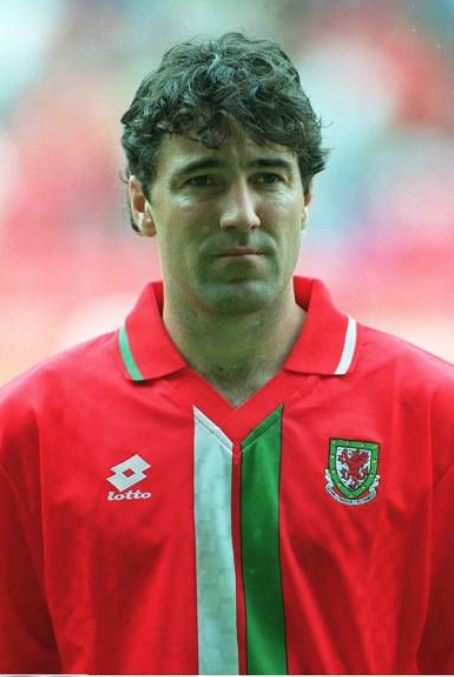
Saunders scored his first international goals when he netted twice in a 3-0 friendly win over Canada in Vancouver on 19 May 1986, after which England said: “He goes past defenders with his tremendous pace and his finishing against Canada was a revelation.

“The experience he gained at Brighton has done him the world of good. To finish top scorer in his first full season of Second Division football tells its own story.”

Saunders, who shared a house with Albion’s young Republic of Ireland international Kieran O’Regan, said being happy at home had helped him to settle down quickly.

“I liked Brighton from the day I arrived,” he said in a matchday programme article. “It reminds me of my home town of Swansea and I like living by the sea.”

A lover of all sports, Saunders revealed how he liked to play cricket in the summer, when he turned out for Haywards Heath, and he played snooker with O’Regan and Steve Penney.

That summer, Saunders told Shoot! magazine: “I had both cartilages out of my left knee at 18 and had both Swansea and Cardiff turn me down. I’ve had my share of the downs. From the moment I joined Brighton, my career has turned for the better.”

The young striker continued: “Swansea just gave me away – despite the fact that I was top scorer in a team coming apart. Cardiff City gave me a few games but always seemed to have reasons for not playing me consistently when I was on loan there.

“So, I had every incentive to make the break from Welsh football and I joined Brighton. Brighton can go places.

“I was disappointed that we didn’t make the First Division first time around. But all the lads are convinced that we will get there next season. I’ve been given a three-year contract so there are tremendous incentives to do better.”

It didn’t work out that way, though. After only a mid-table finish, Cattlin was sacked and there were rumblings of financial issues beginning to reverberate around the corridors of the Goldstone. Alan Mullery returned as manager but had limited funds to invest in the team, and, with echoes of the Pat Saward era back in the early ‘70s, the club turned to fans for financial help to bring in players.

After Mullery’s unseemly swift departure halfway through the season, former Worthing boss Lloyd took over and fans were completely mystified as to how he could leave out Saunders in favour of Richard Tiltman, who Lloyd had plucked from local football. Since then, it has been suggested his omission was more to do with money than football ability.

There was great consternation that Albion collected only £60,000 when Lloyd sold Saunders to Oxford in early March 1987, especially as the Seagulls were fast hurtling back to a level of football they’d manage to avoid for ten years.

That was no longer a concern for Saunders who recovered the goalscoring touch he’d shown during his first season at the Goldstone Ground, scoring 33 goals in 73 games for Oxford before being sold to Derby for £1m against Lawrenson’s wishes 19 months after arriving at the Manor Ground.
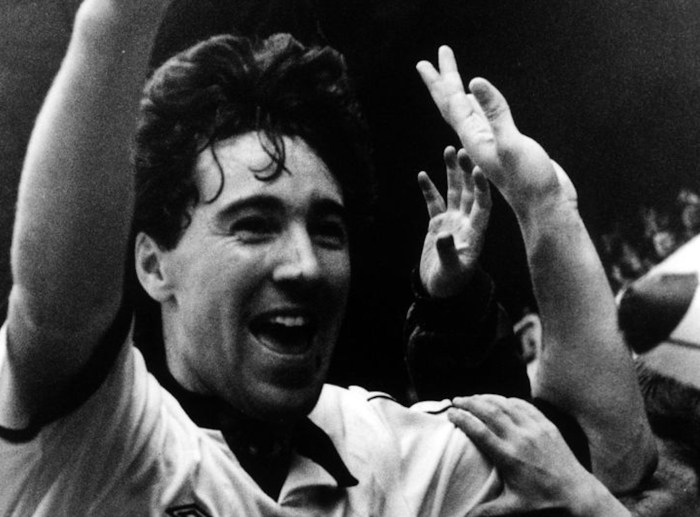
Meanwhile, the goals kept flowing for Saunders as he netted 57 in 131 games for Derby. The side finished fifth in the old First Division by the end of Saunders’ first season with the Rams, and he’d contributed 14 goals. The Derby Telegraph noted: “From the moment ‘Deano’ arrived, the players were inspired and the crowd enthused. The signing also suited the post-war tradition of 5ft 8in goalscoring heroes at the Baseball Ground – Raich Carter, Bill Curry, Kevin Hector and Bobby Davison.

“Derby fans were too wise to comment on height. What mattered was Saunders’ speed, eel-like turn and persistence. He scored six in his first five games, starting with two against Wimbledon when he captured supporters’ hearts with the immediacy of a Kevin Hector. A close-in header and long-range right-footer were beautiful appetisers.”

Despite Saunders scoring 24 goals for Derby in 1990-91, the side was relegated and Saunders and teammate Mark Wright were snapped up by Liverpool. Reds paid £2.9m to take Saunders to Anfield, boss Souness believing he’d be an ideal strike partner for their established Welsh international striker, Ian Rush.

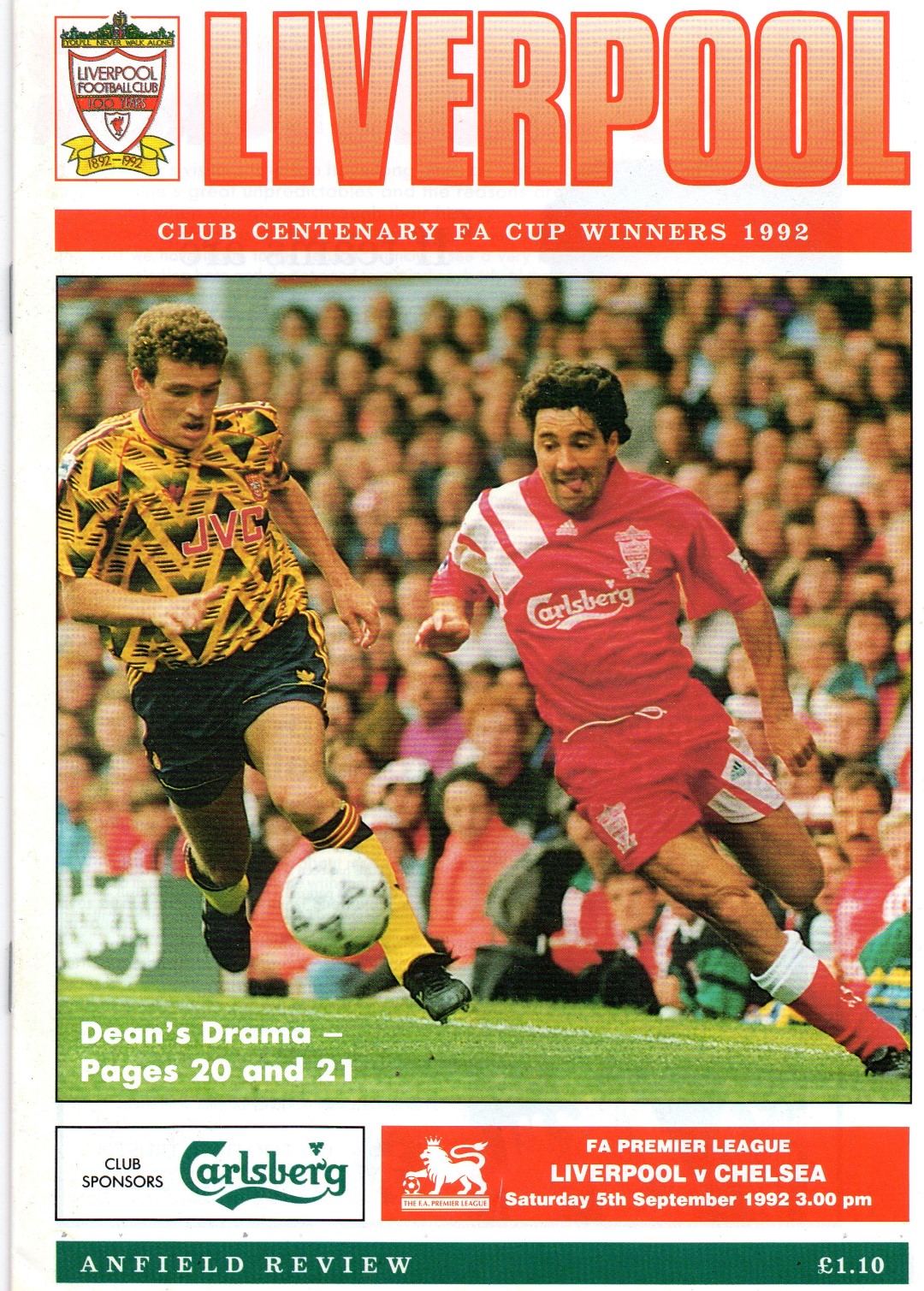
Saunders made his Liverpool debut on 17 August 1991 in a 2-1 win over Oldham Athletic (Mark Walters and defender Wright also played their first league games for Liverpool); Ray Houghton and John Barnes scored Liverpool’s goals.

Saunders scored his first goal for the Reds 10 days’ later in a 1-0 win over QPR at Anfield but a Liverpool history website reckons he struggled to adapt to Liverpool’s passing game. “He was used to Derby’s counter-attacking style, scoring many of his goals by using his exceptional pace,” it said. “Saunders wasn’t very prolific in the league with about one goal every four games but flourished in the UEFA Cup with nine goals in five matches that included a quadruple against Kuusysi Lahti.”

Saunders scored twice in Liverpool’s successful FA Cup campaign, which culminated in them lifting the trophy at Wembley after beating Sunderland.

Although he scored twice in seven games at the start of his second season at Anfield, a cashflow issue meant Souness was forced to sell him to raise funds to dip into the transfer market.

Saunders explained: “Graeme called me in one day and told me he needed a centre-half [Torben Piechnik], and that he could raise the money by selling me to Aston Villa.

“I couldn’t believe he was prepared to let me go, but he said he didn’t think my partnership with Ian Rush had worked out, and Rushy wouldn’t be the one going anywhere. That was it.” 

Saunders had scored 25 goals in 61 appearances for Liverpool, the last coming in a 2-1 home win over Chelsea (Jamie Redknapp scoring the other Liverpool goal) on 5 September 1992.

The Welshman had the last laugh, though, because only nine days after his departure from Liverpool he scored twice in Villa’s 4-2 victory over the Reds.

“Obviously I had a big incentive to do well today and I’m thrilled to have scored,” said Saunders. “Both my goals went through the goalkeeper’s legs.”

Signed by Ron Atkinson, Saunders spent three seasons at Villa, initially developing a formidable strike partnership with Dalian Atkinson, and then pairing up with Dwight Yorke. Saunders’ brace in the 1994 League Cup final helped beat Manchester United 3-1.

Villa history site lerwill-life.org.uk remembers him as “a spring-heeled attacker and very popular with the supporters” and adds: “Not big in size, he was very speedy and scored some spectacular goals including a 35-yard spectacular against Ipswich.”

His time at Villa Park came to an end when Brian Little took over as manager, and Saunders was reunited with his old Liverpool boss Souness in Turkey. A £2.35million fee took him to Galatasaray for the 1995-96 season and he netted 15 goals in 27 Turkish League matches.

Next stop for Saunders was back in the UK at Nottingham Forest, but the 1996-97 was an unhappy one as the manager who signed him, Frank Clark, was sacked in December after a bad run of defeats and Forest’s slide towards relegation continued under Stuart Pearce and Dave Bassett.

By the time Forest had bounced straight back up, Saunders had left the club, moving in December 1997 to second-tier Sheffield United for a year under Nigel Spackman and caretaker managers Russell Slade and Steve Thompson. United made the play-offs but lost out to Sunderland in the semi-finals. In December 1998, Saunders moved abroad again to link up with Souness a third time, at Benfica in Portugal.

The following summer, he returned to England and joined Bradford City, where his former Brighton teammate Chris Hutchings was assistant manager, then briefly manager. Saunders was a regular in his first season at Valley Parade, when the Bantams managed to narrowly avoid relegation from the Premier League, but he played only a handful of games in 2000-01, when they were relegated. Saunders retired as a player shortly before his 37th birthday and became a coach at Bradford before linking up with Souness again, this time as a coach.

He joined him at Blackburn Rovers and then Newcastle United, but when Newcastle sacked Souness early in 2006, Saunders lost his job as well.

In the following year he began taking the Certificate in Football Management course run by the University of Warwick; and this led to him being granted his UEFA Pro Licence coaching badge, a qualification that allowed him to be appointed as assistant to John Toshack with the Welsh national team. 

In October 2008, Saunders replaced Brian Little as manager of Wrexham, newly relegated to the Conference. He eventually managed to steer the north Wales outfit into the play-offs in the 2010-11 season, but they were knocked out by Luton Town and, in September 2011, Saunders was appointed manager of then Championship club Doncaster Rovers.

Unfortunately, he couldn’t save Rovers from relegation and they went back down to League One with only 36 points from their 46 League fixtures.

Having guided Rovers to second place in League One, Saunders was appointed manager of Wolverhampton Wanderers in January 2013, but he couldn’t prevent them being relegated from the Championship and he was sacked three days after relegation was confirmed courtesy of a 2-0 defeat at the hands of Gus Poyet’s Albion.

Saunders told the media after the game: “We have to get some players in who think like I’m thinking, who want to win, fresh minds, no damage done to them, no confidence issues, no ‘been here too long’ issues, no ‘I don’t know if the manager likes me’ issues. Once I get my own team on the pitch, imagine what the supporters will be like.”

Saunders, with only five wins from his 20 games in charge, didn’t get that chance and rather ruefully said of his opponents that day: “A few years ago they were bankrupt and without a stadium, but they’ve shown what is possible and, with the momentum, they have could well get into the Premier League.”

Just after Christmas 2014, Saunders was named as the interim manager of Crawley Town after the previous incumbent John Gregory stood down for health reasons.

Saunders then became manager of League One side Chesterfield on 13 May 2015 but his stay there lasted only five months.

In June 2016, Saunders was part of the BBC pundit team for their coverage of the Welsh national team’s games at Euro 2016 and made the headlines during the tournament when it was revealed that he had incurred parking charges of over £1,000 from Birmingham Airport’s short stay car park as he wasn’t expecting Wales to progress as far as they did. The charge was eventually waived by the airport who asked him to make a donation to charity instead.

His subsequent involvement in football has been as a pundit on BT Sport’s Saturday afternoon Score programme as well as on the radio with talkSPORT. He hit the headlines in 2019 when he was jailed for failing to comply with a roadside breath test but the initial punishment was quashed and changed to a suspended sentence. Via the League Managers’ Association, Saunders issued a statement in which he said: “I made a terrible error of judgment for which I have been rightly punished, and I wholeheartedly regret that it happened.”

Pictures from the Albion matchday programme and various online sources.
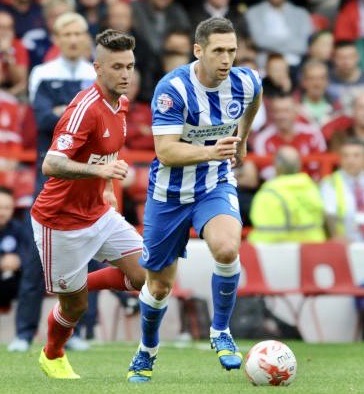
Andrew Crofts just couldn’t stay away from the Seagulls

ANDREW Crofts is one of that rare breed of player who had three separate spells at Brighton, although the latter time was only as player-coach with the under-23s.

The Welsh international midfielder returned to the Seagulls after only a month as player-coach at Yeovil Town when Liam Rosenior left the Albion to move to Derby County.

His signing as an over-age player as well as a coach was explained by technical director Dan Ashworth, who hailed the “innovative step” and told the club website: “The thinking behind the playing role is to have someone of his experience out there on the pitch alongside our younger players, and to impart that crucial knowledge he has gained from his time in the game.

“To have that experience out on the field, in the pressure situation of a game, will be of enormous benefit to our young players and have a positive impact on their collective and individual development.”

Crofts first joined the club in the summer of 2009 during Russell Slade’s managerial reign and, when Gus Poyet took over the managerial chair, he appointed Crofts as captain for his first game in charge.

The midfielder repaid the faith in that televised away game at St Mary’s on 15 November by scoring in Albion’s memorable 3-1 win. Crofts retained the armband through to the end of the season and his form had caught the attention of Championship side Norwich City.

Crofts made the switch to Carrow Road and played 44 games as Paul Lambert’s outfit won promotion to the Premier League in runners up spot.

In the top-flight, though, Crofts was no longer a mainstay of the midfield, starting just 15 matches in 2011-12, and coming off the bench on 10 occasions.

“Towards the end of the season I was in and out,” he told the Albion matchday programme in 2019. “Paul then went to Aston Villa and when the chance came up to return to the Albion I jumped at it.”

“It felt like coming home and I wanted to replicate what we had done with Norwich. It was a completely different club compared to the one I’d left, with the Amex Stadium and plans for the new training ground.”

Poyet wasted no time in seizing the chance to re-sign him, telling the club website: “When we knew about the possibility to bring him back we worked very hard to do that.

“I am delighted to have him back. He is going to be a very important player.

“He is coming back to a club that he knows and he was happy to come back – that shows his commitment,” said Poyet. “He leads by example and we want players like that on the pitch.”

Unfortunately, that season his playing time was limited by two long-term spells out injured, and the following season it got worse. After sustaining a serious cruciate knee ligament injury in January 2014, he was sidelined by an almost identical injury again in October 2014.

When the player suffered the first injury in an away game at Birmingham, Poyet’s successor, Oscar Garcia, said: “He will be a big loss and I feel sorry for Crofty. He has been excellent and has been a key player.”

Crofts battled over many months to regain fitness only to suffer a partial tear of his anterior cruciate ligament and a tear to the meniscus in a match against Watford in October 2014, putting paid to any involvement in the rest of the 2014-15 season.

Head coach Sami Hyypia told the club website: “We are all devastated for Crofty. He is an important member of our squad and worked incredibly hard to get back to full fitness after last season’s knee injury.

“Crofty is a very strong character and he will continue to receive the best possible care and treatment from our medical staff throughout his rehabilitation.”

Unfortunately for him, by the time he was fit again, another new manager was in place and Dale Stephens and Beram Kayal were firmly established as Chris Hughton’s preferred midfield pairing. So, in March 2016, Albion loaned him back to his first club, Gillingham, until the end of the season.

On leaving the Seagulls that summer, he moved to Charlton Athletic under his former Albion boss Slade, on a one-year contract, and made a total of 54 appearances for the Addicks.

Although born in Chatham, Kent, Crofts qualified to play for Wales because his grandfather hailed from the principality. He earned a total of 29 caps, spread over 13 seasons, initially under John Toshack, most coming under Gary Speed, before making his final appearance against Panama in November 2017, in Chris Coleman’s last game as Wales manager.

Crofts v Rooney in a Wales v England match
Welsh international

Crofts was on Chelsea’s books from the age of 10 to 15, going through the ranks with John Terry, with whom he shared digs. One of his coaches was ex-Albion and Chelsea defender Gary Chivers. After being released by Chelsea, he linked up with Gillingham as a trainee and worked his way through the youth and reserve sides, making a surprise first team debut against Watford in May 2001 when only 16.

It wasn’t until 2004 and 2005 that he became a first team regular. His first Gills goal was scored in the Championship clash at the Withdean Stadium on Boxing Day 2004 when the Seagulls won 2-1.

Crofts eventually took over the captaincy at Gillingham but, after the side were relegated to League One, manager Mark Stimson believed the role was too much of a burden on the player. After more than 200 appearances for the Gills, he was made available for transfer and, in 2008-09, went out on loan to Peterborough United and then Conference side Wrexham under former Albion striker Dean Saunders.

When he joined Albion on a free transfer in June 2009, boss Slade said: “He’s an international player so that’s not bad for a start. He’s got good pedigree and was an important player for a good Gillingham team at the time.

“He can sit in for you defensively or he can get forward. He has got a good work ethic and I’m pleased to get him.”

Towards the end of his league playing days, Crofts had spells at Scunthorpe United in 2017-18 then Newport County for the 2018-19 season, playing under his former Gillingham teammate Michael Flynn, who he played alongside at Priestfield between 2005 and 2007,

Flynn made his old pal captain and said: “He’s a gentleman and he’s somebody I trust a lot. So signing him was really a no-brainer.

“Andrew coming in is a massive signing for the club. He’s the ultimate professional and he’s in fantastic condition.”

Crofts himself said: “I played with Michael Flynn at Gillingham and he was a winner. I loved playing with him and I can’t wait to play for him now with him being my gaffer.”

Unfortunately, injury issues restricted Crofts to just 12 appearances for Newport and he was released at the end of the season.

On leaving County, Crofts moved to Yeovil Town as player-coach with manager Darren Sarll saying: “To bring a player of Andrew’s experience into the club at this time is a great coup.

“He still has a thirst and hunger for playing and winning promotions and it’s refreshing to be part of the very early stages of his coaching career.

“He’ll be a valuable asset to the squad both as a player and in terms of passing on his experience and knowledge to the younger members of the squad.”

But then the opening arose with the Albion and he didn’t hesitate to return. When Graham Potter left the Albion, Crofts temporarily took on the head coach position and was retained as a first team coach under Roberto De Zerbi and his successor, Fabian Hurzeler.

• In an interview with Andy Naylor of The Athletic in December 2020, Crofts talked at length about his career, his coaching ambitions and some of the big names he played alongside.

Why Saint Dan riled the Albion

DAN HARDING was promoted twice with Southampton and once with the Seagulls and later cut short his career because of family tragedy.

Personally, I’m not sure he really need to be cast as ‘public enemy no.1’ because of the way he left Brighton.

With the benefit of hindsight, it was really no surprise that he chose to turn his back on playing at Withdean in favour of Elland Road, Leeds.

OK, the stringing-out of the contract negotiations, and public slanging match that accompanied them, didn’t help matters.

But football careers are short and the Amex was a long way off becoming a reality when Harding decided to opt for pastures new.

“I really enjoyed my time at Brighton but you can’t compare the size of the two clubs or the facilities,” he told the Leeds matchday programme at the time. “It has been like going from one world to another.”

Ironically, it seems his success on the pitch with Brighton, which led to him gaining international recognition, might well have been the unsettling influence.

Former Albion boss Peter Taylor selected him for England under-21s as the 2004-05 season got underway. He made his England debut as a substitute for Micah Richards in a 3-1 win over Ukraine at the Riverside Stadium, Middlesbrough, on 17 August 2004. Future full internationals James Milner and Darren Bent were in the same squad.

He started the 8 October 2004 match against Wales at Ewood Park, Blackburn: a 2-0 win courtesy of goals from Milner and Bent. He also started the game four days later when the under 21s drew 0-0 away to Azerbaijan in Baku. His last cap came the following month in a 1-0 defeat away to Spain when he was replaced by Ben Watson. Future Albion loanee Liam Ridgewell was also a substitute in that game.

It was this platform that sowed the seeds of discord, according to former chairman Dick Knight’s take on the circumstances surrounding Harding’s acrimonious departure from the Albion.

In his autobiography Mad Man: From the Gutter to the Stars, Knight reckoned it was while on international duty that Harding was “egged on by his agent about his value after talking to players with bigger clubs, on bigger wages”.

Knight went on: “Early on, I offered him a sizeable contract renewal but he sat on it. He kept saying he wanted to stay, but I don’t think he had any intention of doing so.

“Because he was under 24, we were entitled to compensation. Shaun Harvey, the Leeds chief executive – who became CEO of the Football League in July 2013 – tested me with a couple of paltry sums before finally offering £250,000, which I rejected.”

DH Leeds action 2Via the Football League tribunal system, Knight managed to get the figure up to £850,000, part achievement-based, and with a 20 per cent sell-on clause.

All in all, not a bad return for a player who came through the Albion’s youth and reserve ranks after being spotted at 15 playing for Hove Park Colts.

Born in Gloucester on 23 December 1983, the young Harding loved kicking a football from the moment he could walk and enjoyed watching his dad, Kevan, turn out for the Army team.

The family was posted to Brighton, and Harding was taken to the Goldstone Ground by his mum, Linda. One of his earliest memories was on 23 September 1992 seeing a 17-year-old David Beckham make his Manchester United debut as a substitute for Andrei Kanchelskis in a League Cup tie that finished 1-1.

Harding joined the Albion initially on schoolboy terms for a year and was then taken on as a YTS trainee, progressing through the juniors and reserves before eventually making his first team debut on 17 August 2002, during Martin Hinshelwood’s brief reign, as a substitute for Shaun Wilkinson in a 2-0 home defeat to Norwich City.

After Hinshelwood was replaced by Steve Coppell, and Harding sustained a back injury, the youngster played no further part in the first team picture that season, but he was awarded a new contract in April 2003.

In the first part of the 2003-04 season, Harding was a regular on the bench, but, on 21 February 2004, Coppell’s successor, Mark McGhee, gave him his full debut in place of the suspended Kerry Mayo in a 3-0 win over Bournemouth.

Dan Harding

Harding kept his place through to the end of the season, making a total of 23 appearances, including being part of the side that lifted the divisional play-off trophy at the Millennium Stadium, Cardiff, as the Seagulls beat Bristol City 1-0.

“In hindsight, it was a very lucky time for me. I broke into a team that was winning games and was promoted,” he told the Daily Echo. “Looking back now, I don’t think I appreciated at the time what a big achievement it was.”

Sent off in only the second game of the following season for two bookable offences, it wasn’t long before his contract discussions were aired publicly, with McGhee telling the Argus in October: “It’s starting to really frustrate me.

“Dan keeps telling us and saying publicly he wants to sign but we cannot tie his agent down to have a meeting with us. He has to be honest with us.”

Harding in turn denied he was being difficult, telling the Argus that talks were ongoing.

The off-field issues certainly seemed to be troubling Harding and McGhee publicly blamed the defender for a 2-0 defeat at Millwall in December. He was also outmuscled by Stoke City’s Ade Akinbiyi in a game at Withdean, leading to a late winner for the visitors. Across the season, McGhee dropped him on four occasions because of such inconsistency.

When he won his place back in February, he told the Argus: “I had to prove not only to the gaffer but to the other players and the fans that I want that position back.

“That’s where I prefer to play. I like to call that my position. I don’t mind playing on the left hand side of midfield or centre midfield, but I do love playing at left-back.

“Hopefully I can reproduce the same sort of form and keep my confidence up. Everyone wants to be playing, so when you are left out it’s a bit of a kick in the teeth. It’s not nice, but you have to pick yourself up and try to get back into the team.”

DH leeds action 1However, the Brighton contract offer was declined and on 7 June that summer, Harding put pen to paper on a deal with Leeds, whose fans were no doubt delighted to read that he used to follow their fortunes when he was a youngster.
“When I lived in Germany, they showed quite a lot of Leeds games on telly and, in a strange way, I kind of ended up supporting them because it was the only football I really got to see out there,” he said.

His dad later took him to a Leeds FA Cup match v Wolves, and he added: “I have to admit I have been a closet Leeds fan. Obviously, I didn’t shout about it when I was playing for Brighton and it’s kind of strange now that this move has happened.”

If Harding doubted the size of the task at Elland Road, he’d only have had to read the comments of manager Kevin Blackwell, often Neil Warnock’s no.2, who was the Leeds manager at the time.

In an article about Harding in the club programme, Blackwell said: “It has been a big transition for him. No disrespect to Brighton, but coming from the scaffolding at Withdean to Elland Road was a big step-up for Dan. He was nervous in the first couple of games, but he has started to settle down.”

He talked about how he needed to cement his place at United, and added: “If he does succeed here, all the doors will be open to him. I have no doubt that once he develops certain aspects of his game and his self-confidence, he will go a long way because he is a real athlete with a great left foot.”

Brighton fans vented their displeasure at how things had turned out every time Harding touched the ball when Leeds entertained the Seagulls on 12 September 2005; a game which finished 3-3. The fact two of Albion’s goals came from crosses on Harding’s flank prompted Blackwell to drop him for the following match.

After only seven games, Harding picked up an injury and, over the course of the season, played just 21 matches for United. In August 2006, the Yorkshire club used the full-back as a makeweight in a deal which took future Albion loanee Ian Westlake from Ipswich to Leeds.

He was a regular at Portman Road for a couple of seasons but, in his third season, manager Jim Magilton deemed him surplus to requirements and sent him out on loan to Southend United. I recall going to a match at Roots Hall and seeing him have an outstanding game against Brighton.

Later the same season, with Ipswich bobbing along in mid-table, Harding seized the chance to join Steve Coppell’s promotion-chasing Reading, and he played in their play-offs defeat to Burnley.

When Roy Keane took over at Ipswich in 2009, Harding was sold to Southampton; manager Alan Pardew’s first signing for the Saints. Harding’s former Albion youth coach, Dean Wilkins, was part of Pardew’s coaching team.

Harding reflected in an interview with the Southern Daily Echo that what followed were the happiest three years of his career, in which he played 121 games and chipped in with five goals.

In 2010-11, he was named in the PFA League One team of the year along with teammates Kelvin Davies, Jose Fonte, Adam Lallana and Alex Oxlade-Chamberlain.

In the harsh and fickle world of football, Brighton fans relished Brighton’s 3-0 win over Southampton at the Amex on 2 January 2012 when Albion winger Will Buckley gave Harding such a torrid time that, to compound his humiliation, the former Brighton player was subbed off by boss Nigel Adkins with five minutes of the first half still to play.

Although part of the Saints side that won promotion back to the Premier League that May, Harding didn’t get the chance to play at the top level because Adkins moved him on to Nottingham Forest.

Harding talked in detail to the Echo’s Paul McNamara about life at Forest, which he found an unstable place, especially when Sean O’Driscoll, the manager who signed him, was sacked.

Although he played some games under that legendary left-back Stuart Pearce, when he took over, Harding eventually went on loan to Millwall, but wasn’t able to help them stave off relegation from the Championship.

He reveals in his interview with McNamara how disillusioned he became with the amount of dishonesty in football and, coupled with his pregnant wife losing two of the triplets she was expecting, he put family before football and, at the age of only 31, dropped down four divisions to play non-league with Eastleigh.

He talked about the tough decisions he’d had to make in an interview before a FA Cup tie Eastleigh played against Bolton Wanderers.

In 2016, Harding joined Whitehawk as a player, then became part of the coaching set-up, and was briefly caretaker manager before the appointment of Steve King.

Goalkeeper John Phillips – the ‘unenviable understudy’

JOHN PHILLIPS was a Welsh international goalkeeper who played for Chelsea and Aston Villa before becoming a back-up at Brighton under Alan Mullery.

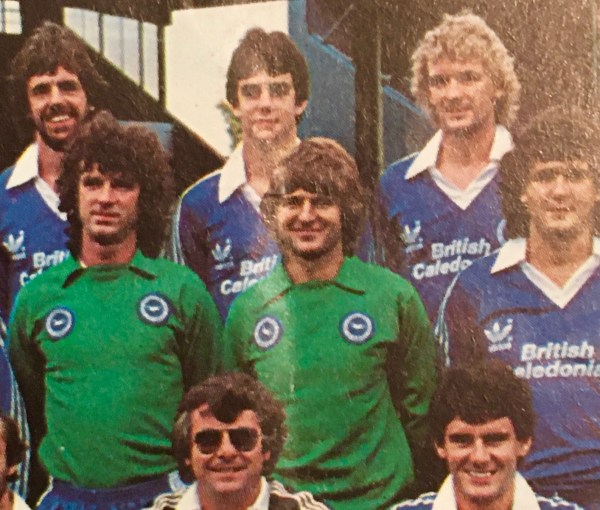
A £15,000 fee took him to the Goldstone Ground as no.2 to Graham Moseley in 1980 and, possibly the most interesting thing about his time at Brighton was his appearance in the centre of the pre-season team photo (see below) alongside Moseley in which both ‘keepers rather oddly wore green jerseys sporting two Seagulls badges!

JP 2 badge colourPreviously an understudy to the legendary Chelsea goalkeeper Peter Bonetti, Phillips did have occasional first team spells at Stamford Bridge, including playing in earlier rounds of the successful European Cup Winners’ Cup campaign of 1970-71.

When he died aged 65 on 31 March 2017, the Chelsea website paid a warm tribute to his contribution.

JP prog notes

At Brighton he featured 19 times for the reserves but only played one first team game. That came in front of a bumper festive season Goldstone crowd of 27,387 on 27 December 1980 (as seen above on my amended programme teamsheet) as the Seagulls beat traditional rivals Crystal Palace 3-2; a brace from Michael Robinson and Peter O’Sullivan with the Albion goals.

IMG_6433The following month, it looked like he might get a second game after Mullery publicly blamed first-choice Moseley for the side losing six points, and told the Argus Phillips would come in for the next match unless he could sign another ‘keeper.
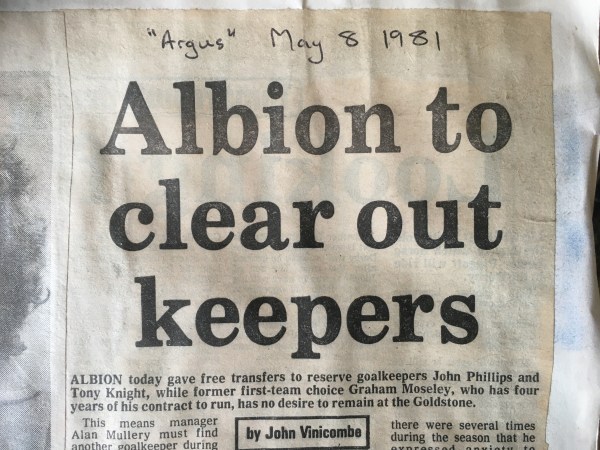
Mullery promptly went back to his old club, Fulham, and splashed out £150,000 on unknown youngster Perry Digweed – pushing Phillips further down the pecking order.

IMG_6431At the end of the season, Phillips and Tony Knight, a young ‘keeper who didn’t progress to the first team, were released on free transfers. It was also reported that Moseley was on his way, but Mullery’s shock departure that summer gave him a stay of execution.
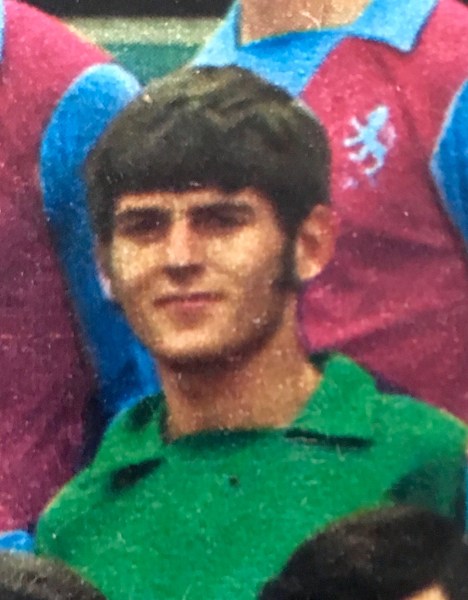
Disgruntled Mullery swapped managerial seats with Mike Bailey, who’d just led Charlton Athletic to promotion from the old Third Division,

Phillips was one of his first signings. However, he only played two games for Charlton, so he was to endure another frustrating spell of being the understudy.

Contributor Richard J on charltonlife.com remembered how Phillips replaced first choice Nicky Johns in the first away game of the 1981-82 season – a 3-0 defeat at Luton Town.

“Nicky returned for the next game and Phillips’s only other game was away at Leicester. Unfortunately, we lost that game as well, 3-1.”

But Richard continued: “I work with Tony Lange who took over from the Welsh international as Charlton’s number two keeper. He felt that John was a big influence on his career.

“Apparently, Phillips was exceptionally good at distribution and this was one of the reasons he had played so much for Chelsea and Tony credits him as a big influence on that part of his game.”

He moved from Charlton to Crystal Palace but he didn’t feature for their first team at all. He then tried his luck in Hong Kong, with See Bee.

Born in Shrewsbury on 7 July 1951, Phillips went to the Grange School in Shrewsbury and, because both his father and grandfather played league football for Shrewsbury Town, it was no surprise when he also signed for Town. He made his debut in 1968 at the age of 17.

A big influence on him was the former Manchester United and Northern Ireland goalkeeper, Harry Gregg, who was manager at Gay Meadow between 1968 and 1972.

In an early edition of Goal magazine, Gregg said: “He’s the finest goalkeeping prospect I have seen. He seems to have every asset in the book and his temperament really stands out.”

J Phil VillaPhillips played 51 times for the Shrews before being bought in 1969 by Tommy Docherty, the former Chelsea boss who’d taken over as Aston Villa manager.

After only 15 games for Villa, in August 1970, Chelsea paid a fee of £25,000 to take Phillips to Stamford Bridge.

The regular back-up ‘keeper, Tommy Hughes, who went on to have a loan spell at Brighton in the 1972-73 season, was out injured with a broken leg at the time and Chelsea needed someone to deputise for Bonetti, who only two months earlier had been criticised when having to take over in goal from ill Gordon Banks as England lost 3-2 to West Germany in the 1970 World Cup quarter final in Mexico.

Phillips stayed with Chelsea for 10 years and played a total of 149 games for the club. He managed 23 league and cup games during the 1972-73 season owing to Bonetti’s absence through injury and illness.

In October 1973, Goal ran a series called The Understudies and featured the rivalry between Phillips and Bonetti. Bonetti said of him: “John is a first-class ‘keeper and has pushed me more than anyone. It’s nice to know you have to play well to keep your place.”

Phillips told the magazine’s David Wright: “We are rivals, yes, but friends as well.”

It was only in the 1974-75 season that Phillips had an extended run of games as the no.1.

Although kind things were said of him when he died, not all recollections were favourable. The footballnetwork.net, for instance, said: “Phillips always conceded a lot of goals. Is this because he was awful or his defence and midfield were woeful? I suspect that it was a bit of both. Phillips did assist Chelsea in reaching the 1971 European Cup Winners Cup final, but he conceded seven at mediocre Wolverhampton as Chelsea sloped off into a long decline.

“Funnily enough, he shared goalkeeping duties for Wales with one Gary Sprake, a notoriously erratic Leeds goalie, as the late Peter Houseman could have testified!

“Obviously in the early seventies, while the Welsh rugby team had an embarrassment of riches, there was no such luxury in the goalkeeping department.”

Although English by birth, Phillips played for Wales at a time when qualification to play for countries beyond the one in which a player was born was extended to include the homeland of their parents or grandparents. He won four caps in 1973-74, making his debut in a 3-0 defeat to England in front of 38,000 at Wembley on 15 May 1973.

A none-too-flattering recollection can be found in a book charting the history of Welsh international football. Red Dragons – The Story of Welsh Football says: “Sadly a nervy performance by Chelsea goalkeeper John Phillips was responsible for a grim 0-2 defeat at home to England in May 1974.”

Bonetti saw off many pretenders to his throne, but Phillips went closer than anyone to taking his place, according to gameofthepeople.com, which described him as “the unenviable understudy” in an article charting his Blues career.

In the summer of 1975, Chelsea had been relegated and Bonetti given a free transfer, so Phillips was expected to start the new season as first choice ‘keeper.

But he fractured his right leg in training and badly damaged knee ligaments, opening the door for Steve Sherwood to take over between the sticks.

In the 1979-80 season, Phillips was loaned to Crewe Alexandra. Even there, he only played six times for the league side, having to be content with 23 games for their reserves.


  • Pictures mainly sourced from Goal magazine or Shoot! Also the Argus and matchday programme.

One-goal striker Craig Davies a Seagulls flop

THE PHRASE ‘journeyman striker’ sits perfectly with Welsh international Craig Davies who, despite success later in his career, fired blanks for Wolverhampton Wanderers and Brighton.

To use that rather amusing, though well-worn phrase, he couldn’t hit a cow’s arse with a banjo during his time with the Seagulls.

He arrived on the south coast in January 2009 during Micky Adams’ second, unsuccessful, spell in Albion’s managerial chair.

Oldham Athletic received a reported £150,000 for his signature and, in 23 games for Brighton, he managed just the one goal – on his debut!

That strike came at Withdean – the opening goal in what ended up a 4-2 defeat to Peterborough United (for whom a certain Craig Mackail-Smith equalised).

When a 4-0 home thrashing by Crewe Alexandra meant it had been six games on the trot without a win, Adams was fired by Dick Knight at a Little Chef on the A23. He’d managed just seven wins in 34 matches, and ‘fireman’ Russell Slade arrived just in time to rescue the Seagulls from the League One relegation trapdoor.

Many different striker permutations were tried that season, with main men Nicky Forster and Glenn Murray sidelined by injury, and Albion’s survival was largely due to the goals of loan arrival Lloyd Owusu. Davies huffed and puffed but simply couldn’t make a meaningful connection when the goal beckoned.

Typical of the fans’ eye view was this observation by wearebrighton.com: “That Adams actually paid money for Craig Davies remains one of the more startling moments of his reign of terror.

“Rarely has a Brighton player enraged the Seagulls support like Davies, a man who mixed incompetence – such as the ability to put the ball over the bar when faced with an open goal three yards away – with a complete lack of effort.”

There had been such promise on his arrival, with chairman Dick Knight telling the matchday programme: “Craig is an exciting player with loads of potential, he is lightning-quick and his direct approach can be a nightmare for defenders. This is a major career move for him and he has every chance to be a crucial part of our future.”

Davies himself clearly thought he’d finally found a place to further his career, saying: “I’ve had a few ups and downs through my career but hopefully now I can get settled at Brighton and start knocking in the goals here.

“The gaffer seems to have a bit of faith in me so hopefully I can repay that by putting in some performances and getting a few goals.”

Albion cut their losses on Davies and loaned him to Yeovil Town (he didn’t score in four games for them, either) and then Adams re-signed him, this time for League Two Port Vale, where he finally managed to find the back of the net again.

In the summer of 2010, Davies came to a mutual agreement to end his Brighton nightmare and he joined League Two Chesterfield, from where his career began an amazing upward trajectory.

Born in Burton-upon-Trent on 9 January 1986, Davies began his career as a schoolboy at Shrewsbury Town, but did his apprenticeship at Manchester City. In August 2004, he moved on to League Two Oxford United, where he made his league debut the same month in a 1-0 win at Notts County.

In two seasons with Oxford, managed by former Ipswich and Arsenal midfielder Brian Talbot, he scored eight times in 55 appearances. In the summer of 2005, he made his debut for Wales (qualifying because he had a Welsh grandfather) as a substitute in a 0-0 draw v Slovenia. Reports linked him with a move to Premier League Charlton Athletic, but nothing came of it and instead, in January 2006, he moved to Italy to join Hellas Verona for a £85,000 fee.

It proved to be too big a step for someone who was then only 20, and he referred to feelings of homesickness in an interview with the BBC.

Remarkably, Davies hit the headlines in May 2006, when in the sixth of seven games he played for the Wales under-21 side (which featured Gareth Bale, Andrew Crofts and Arron Davies) he scored a hat-trick in a 5-1 win over Estonia, and it earned him a recall to the full international side.

Wales under-21 manager Brian Flynn told the BBC: “Craig has sometimes been frustrating to watch, but he has skill and we will help him, and them all, to flourish.”

Davies hoped the international goals would attract a club to rescue him from Italy. “I have found it very hard to settle in Italy,” he told the BBC. “Verona want me to come back and have a year on loan somewhere and then they will look at the situation again when I have a bit more experience.”

It was Wolves, then in the Championship, who offered him a lifeline back in the UK and he moved to Molineux on loan, playing 23 games, mainly in the first half of the 2006-07 season.

The only goals he scored for Wolves both came in a FA Cup tie against Oldham Athletic who, ironically, turned out to be his next club. He joined them for an undisclosed fee from Hellas in June 2007.

Davies netted 13 times for a League One Latics side in 2007-08 but, after a 10-game barren spell the following season, he was sent on loan to Stockport County where he scored six times in 13 games, including bagging a hat-trick against Bristol Rovers, and scoring a penalty against Albion as County won 2-0.

When Adams rescued Davies from his Seagulls horror spell, he was rewarded with seven goals in 24 matches for League Two Port Vale between January 2010 and the end of the season.

Chesterfield stepped in to sign him on a one-year deal for the 2010-11 season – and he was promptly sent off in his first competitive game for the Spireites!

Things did get much better, though, and he ended the season with 25 goals to his name, Chesterfield were promoted, and Davies was chosen in the divisional PFA select team for the season.

Such success drew attention from other clubs and he opted to join Championship side Barnsley under Keith Hill. He struggled to find the net in the opening nine matches but eventually finished the season with 11 goals in 42 appearances.

In September 2012, Davies scored FOUR goals in the space of 19 minutes in a 5-0 demolition of Birmingham City at St Andrews and, with nine goals in 22 appearances to his name in the first half of the 2012-13 season, Bolton Wanderers came forward with a £300,000 bid to take him to the Reebok Stadium.

He scored four goals in 18 Championship games for Wanderers but another of his barren spells struck in the opening half of the following season. Wanderers loaned him to League One Preston and he got a goal on his debut as well as a hat-trick in a 6-1 thrashing of Carlisle United. North End reached the play-offs, and Davies made his way back to Bolton having scored five in 15 games.

Hamstring injury issues plagued him in 2014-15 and manager Neil Lennon released him at the end of the season.

He didn’t have far to travel for his next port of call when newly-relegated Wigan Athletic offered him a two-year contract. He only scored twice in 30 appearances, but Wigan won promotion as League One champions.

With just one goal in 14 Championship games in the first part of the 2016-17 season, Davies was on the move again, this time linking up with League One Scunthorpe United until the end of the season. Cue another barren spell: no goals in 21 games.

The 2017-18 season saw Davies return to his old club, Oldham Athletic, and despite scoring 14 goals in 44 appearances, could not prevent the club being relegated to League Two. Davies had strong views about the ownership of the club as he departed for Mansfield Town.

He signed a two-year deal with the Stags, but injury curtailed his involvement in 2018-19.

C Davies Wales

Brighton briefly on the trail of the ‘loansome’ Sam Vokes

‘LOANSOME’ Sam Vokes joined Brighton temporarily on the eve of transfer deadline day in January 2012.

He was 22 at the time and had already had five loan spells away from Molineux since joining Wolverhampton Wanderers in the summer of 2008. Vokes told BBC Sussex: “I need to settle down in my career and it’s a fantastic chance for me to come here and play some football.

“It’s a matter of playing games and, as a striker, scoring goals.”

Vokes had been troubled by injury and had found it difficult to establish himself in the Wolves side. The season before, he had been out on loan at Bristol City, Sheffield United and Norwich, and earlier in the 2011-12 season had scored two goals in nine appearances on loan at Burnley.

Eddie Howe, who’d managed Vokes during his first spell at Bournemouth, had taken him to Turf Moor to partner Jay Rodriguez. But when his deal with Burnley expired in mid-January, Albion boss Gus Poyet stepped in and persuaded him to join the Seagulls.

Vokes was invited to the Amex to watch the side’s FA Cup fourth round tie against Newcastle and, two days after the 1-0 win, put pen to the loan deal.

7188430“I don’t want to sit around – I love playing,” said Vokes. “Brighton have a great way of playing football that is different to a lot of teams in the Championship.”
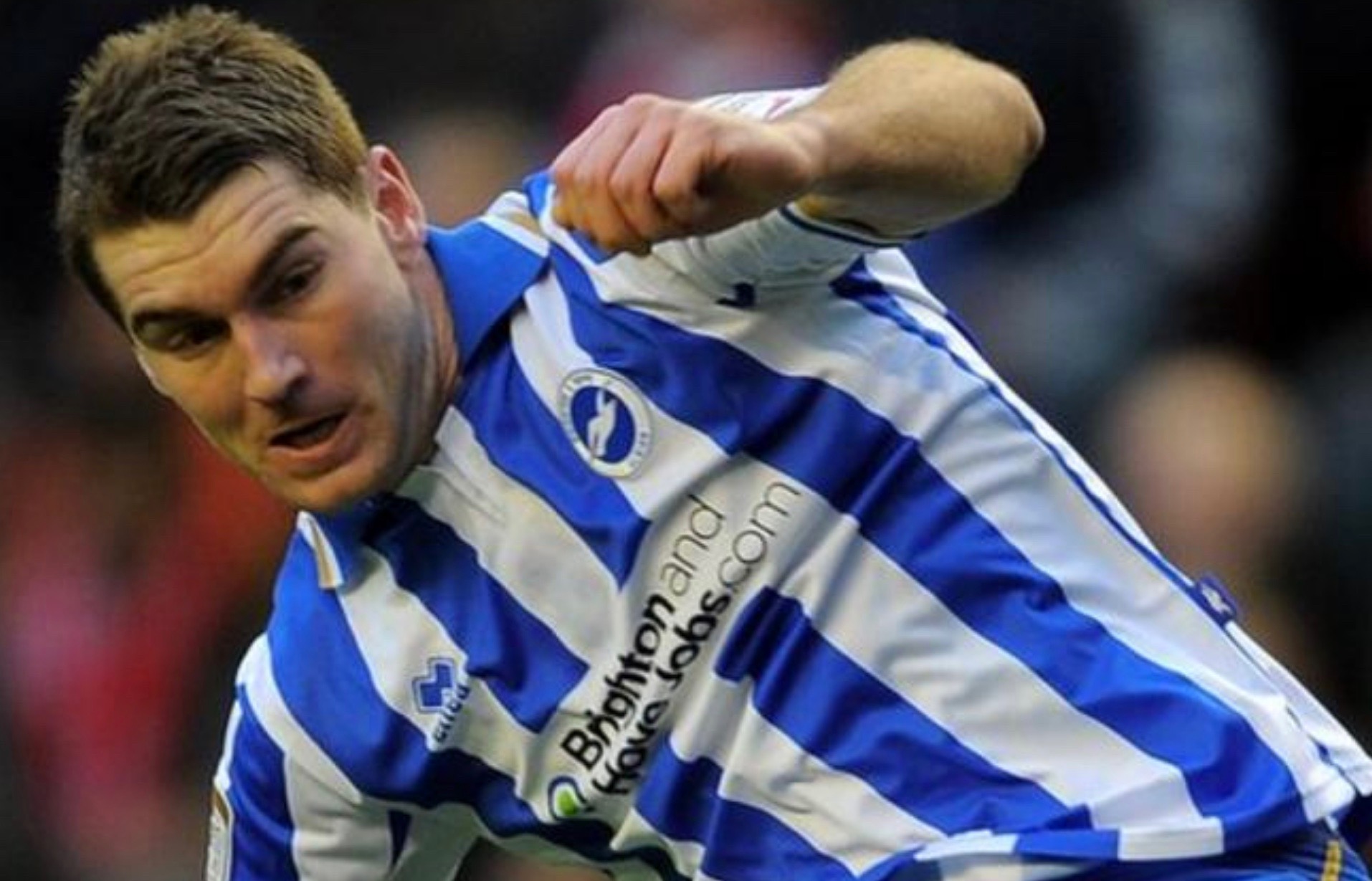
The young striker told the Albion matchday programme: “I’m a southern boy. I know the area well, and I know what football means to people down here.

“It’s been difficult for me to settle anywhere, moving from place to place on loan, but now I just want to play football. I love the game. I need to play, it’s all I want to do.

“I would like to stay and if all goes well we will see what happens in the summer, but my main aim at the moment is to start playing football again and scoring goals.”

Poyet told the media: “Sam was one of the players we’ve been following for a long time but it’s been difficult to get him.

“The idea was to bring someone who will give us that presence and strength in the air that we don’t have.

“We’ve got the time to explain how we play, and what he needs to do for us. The quicker he adapts, the easier for us. I’m delighted to have him and I hope it works for him.

“He’s been trying to find that place that he can stay for a few years.”

As it turned out, Vokes struggled to dislodge incumbent strikers Ashley Barnes and Craig Mackail-Smith, and he made just seven starts plus five substitute appearances.

SV- BHA stripes

Although he scored on his full home debut in a 2-2 draw v Millwall, he only got two more goals, a last-minute equaliser in another 2-2 draw, at home to Cardiff City, and Albion’s lone strike in a 1-1 draw away to Nottingham Forest.

In July 2012, it was reported Wolves were demanding £500,000 for the player’s signature on a permanent basis, and that Brighton and Burnley were both keen to sign him.

Vokes burnley

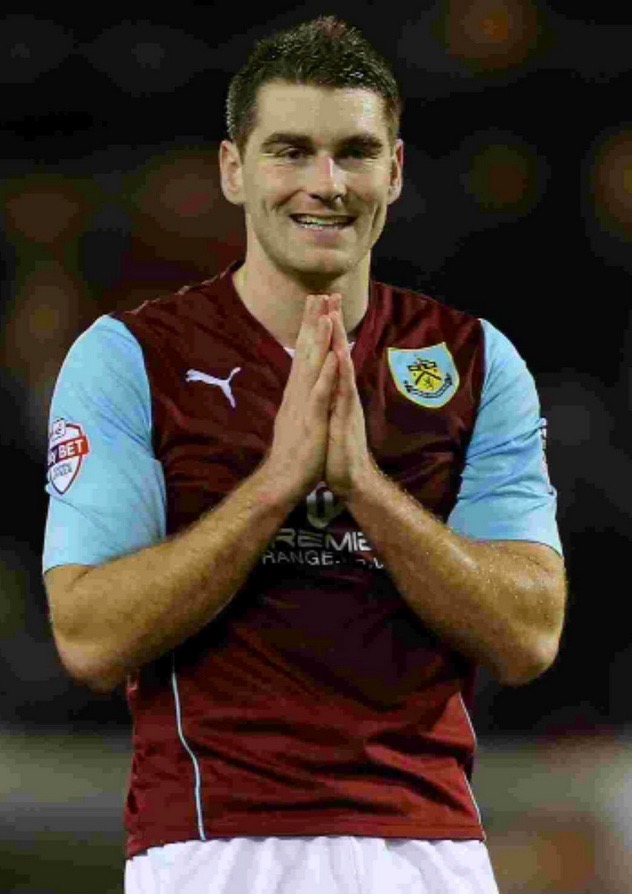
Howe had always been keen to get the player back to Burnley and, although officially undisclosed, it’s believed a £350,000 fee took him to Turf Moor where he finally settled down and, over the next seven years, scored 62 goals in 258 appearances.

Born in Southampton on 21 October 1989, Vokes was brought up in Lymington and was a Southampton fan at an early age. He even had a trial with them when he was just 10 but wasn’t taken on.

It was when he was playing football for local sides in the New Forest that he was spotted by Bournemouth and joined them in 2005. He was only 17 when he made his first team debut in December 2006 (in a 2-0 win over Nottingham Forest) and although he scored 12 goals in the 2007-08 season, the Cherries were relegated from League One.

Vokes WolvesWolves stepped in to sign him that May and he came off the bench in the opening game of the following season to score an equaliser in a 2-2 draw at Plymouth Argyle. However, Chris Iwelumo and Sylvan Ebanks-Blake were the main men scoring goals as Wolves won the Championship that year, and Vokes’ involvement was mainly off the bench.

With his parent club in the Premier League, Vokes was loaned out to League One Leeds United on a three-month deal, although he only scored once in eight games. One of those matches was against the Albion at Withdean and Vokes recalled picking up his first footballing scar when an Adam El-Abd elbow caught him in the face.

Once Vokes finally settled down at Burnley after his various loan moves, it can’t have helped his cause when the man who signed him quit Turf Moor to return to Bournemouth.

Indeed, when Sean Dyche replaced Howe, his go-to centre forward at first was Charlie Austin, but when Austin was sold Vokes got more of a chance to show his worth alongside Danny Ings.

The partnership that began to evolve surprised Burnley fans who’d wondered whether Vokes was only ever destined to be a bit-part player.

“Everyone was concerned to be honest,” said Tony Scholes on uptheclarets.com. “We’d seen some potential in Ings but there wasn’t much confidence that Vokes could become a regular, goalscoring striker at Championship level.

Burnley Football Club_1st Team head Shots_30/7/15He went on: “Our shortage of strikers was highlighted by the fact that he played the full 90 minutes in all of the first 26 league games that season, but he wasn’t just filling in. He was turning in some outstanding performances, linking up really well with Ings and both were scoring goals aplenty.”
Unfortunately, a cruciate knee injury sidelined him for a lengthy spell and Burnley bought Ashley Barnes from Brighton as they sought to bolster their forward options.

A fit Vokes eventually reclaimed his place and formed a useful partnership with big money signing Andre Gray when Barnes himself was also hit by a cruciate injury.

In the early part of last season, Vokes often found himself on the bench, with Barnes and Chris Wood starting ahead of him, and, in January, he decided to drop back down to the Championship, joining Nathan Jones’ new regime at Stoke City, with former England international Peter Crouch going in the opposite direction.

As is often the way these days, the fee was ‘undisclosed’ but was rumoured to be in the order of £7m, and Stoke offered Vokes a three-and-a-half-year contract.

His popularity at Burnley was reflected in a thoughtful parting message thanking the club and the Clarets fans, in which he said: “You made the club a ‘home’ for myself and all my family and for that I’m eternally grateful.”

He added: “It’s been an incredible journey that we’ve been on over the past seven years, with promotions, relegation, survival and even European football through the Europa League.

“There have been so many highlights and every step along the way has been a joy, but now I am looking forward to a new challenge.”

Dyche, meanwhile, told the Stoke Sentinel: “Sam has been an absolutely fantastic servant, not just as a player but as a person.

“There was a bit of frustration that he hasn’t played as much as he’d like and this presents a fresh challenge, so, with all that factored in, it became a win-win deal.

“We feel we’ve got a good deal financially for the business and Sam has got a fresh chance somewhere different.”

Since July 2021, Vokes has been leading the line for League One Wycombe Wanderers.

Vokes Wales

Vokes may have been born and brought up in England but, thanks to having a grandfather born in Colwyn Bay, he became eligible to play for Wales and has earned more than 60 caps since making his debut in 2008, including their most recent game against Belarus.

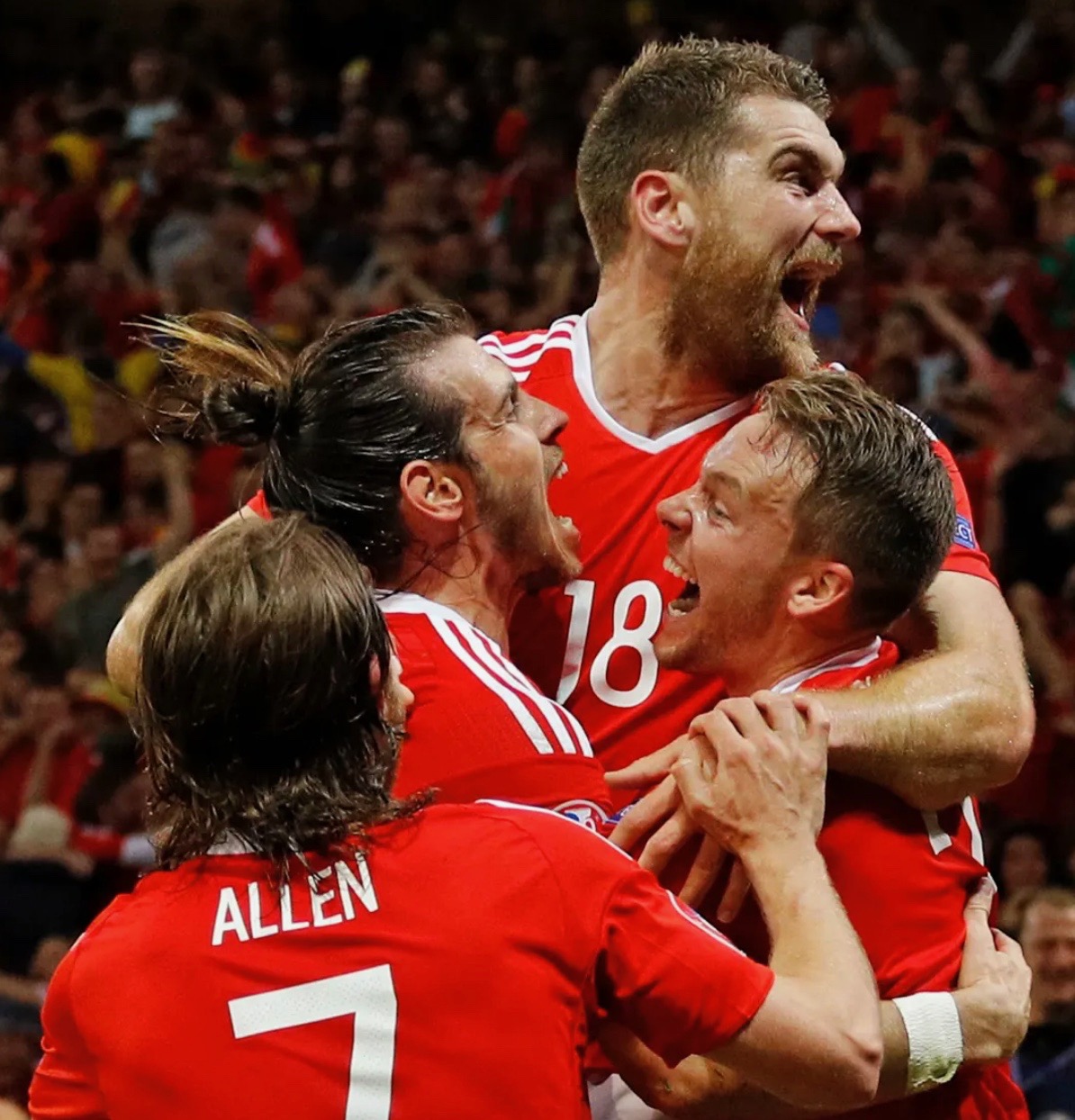
A stand-out moment for his adopted country came during the Euro 2016 tournament when he came on as a substitute and (pictured above) sealed Wales’ 3-1 win over Belgium with an 85th-minute goal to reach the semi-finals.

  • Pictures from various online sources.

History-maker Joel Lynch went to Town after Brighton breakthrough

SUSSEX lad Joel Lynch made Brighton & Hove Albion history when he was made first team captain aged just 19 and 186 days.

The ‘youngest-ever Albion captain’ honour was a measure of the maturity the defender had displayed in Dean Wilkins’ young line-up in April 2007, even if it was a temporary appointment in the absence of the rested Guy Butters and the injured Dean Hammond.

“I wasn’t even captain of my school team,” Lynch told Argus reporter Andy Naylor. “I am 19 years old and it is a great honour. I am grateful to the gaffer for having so much faith in me and it will be good for my confidence.”

Unfortunately, the experience against Doncaster Rovers at Withdean was marred when Lynch missed a clearance, the player he was supposed to be marking, Graeme Lee, scored and Rovers went on to win 2-0.

It was a minor blip at the beginning of a career which saw Lynch become a consistent Championship defender for more than a decade after emerging from Brighton’s youth ranks in the ‘noughties’.

Born on 3 October 1987 in Eastbourne, Lynch made his way through the age group sides with the Albion, often alongside another local youngster who went on to have a good career, Tommy Elphick.

“We played all the way through the youth teams together since the age of about ten,” Lynch told Naylor of the Argus. “Both of our games really changed and we really grew up when we went to Bognor on loan. We did really well there for Bognor and ourselves.”

 Lynch pictured in the Argus alongside Tommy Elphick when they were together as under 14s in 2001, and still together a couple of years later.

As well as being part of the Brighton team which reached the quarter finals of the FA Youth Cup in 2006, the year couldn’t have begun better for Lynch when Wilkins’ predecessor, Mark McGhee, handed him his first team debut in a narrow 2-1 defeat away to Southampton on 2 January 2006.

He went on to play 16 times that season, and also registered his first goal for the club, which is a fond memory for me and my son, Rhys. It came on Easter Saturday 2006, and we made a last-minute decision on the day to travel up to Ipswich to watch the game.

Although Albion were destined to relinquish their Championship status, they had a new-found confidence in their play thanks to the belated arrival of much-needed hold-up centre forward, Gifton Noel-Williams (on loan from Burnley).

He’d scored on his debut in a home draw against Luton and got an assist by laying on a goal for Paul Reid in a 2-0 win at Millwall two weeks before.

At Portman Road, always a favourite away ground, Albion, wearing the stylish all-burgundy away strip, opened the scoring when Noel-Williams buried a cross from Colin Kazim-Richards.

To add to the unexpected delight, teenage defender Lynch made sure our trip was a memorable one. Ipswich failed to clear a corner properly and when Reid returned the ball to the penalty area, Kazim-Richards jumped simultaneously with ‘keeper Shane Supple and the ball broke for Lynch (above left) to prod it in.

Albion, never wanting to make life too easy for themselves or their fans, allowed Ipswich to pull a goal back when Alan Lee flicked on from former Seagull Darren Currie’s cross for substitute Nicky Forster – a future £75,000 signing for Albion – to score. But thankfully it was too late for Ipswich to salvage anything from the game.

It was all to turn pear-shaped on the Easter Monday at home to Sheffield Wednesday, but for a couple of days at least the Great Escape still seemed a possibility.

In December 2006, the matchday programme devoted a two-page article to Lynch’s progress in the first team, pointing out how he had begun at left-back, stepped in as a left-sided centre-back – his more natural position – and even played right-back in the 8-0 thrashing of Northwich Victoria in the FA Cup.

Lynch spoke of the experience he had gained playing alongside the veteran defender Guy Butters, telling the programme: “I learned a lot from him, Guy’s had a great career and he is still playing great football. Hopefully I will just slot in there when the time comes and, in the meantime, I will play wherever the manager wants me to play and hopefully stay in the team. I’ve still got a lot of years ahead of me to make the centre-half slot my own.”

Lynch confessed being handed the no.5 shirt at the start of the season had given him a massive boost. “So far, I have really enjoyed this season. I have had my ups and downs and missed a few games due to my performances,” he said. “There have been things that I have had to sort out within my game, but I think I have resolved them now and I am slowly regaining my confidence and my performances have been improving week by week since I regained my place in the team.

“I feel more confident and my self-belief has improved a lot. I want to keep improving and I think that I can help the team in a big way.”

Lynch said a lot of the younger players had been inspired by Bobby Zamora’s elevation to Premiership football and added: “Hopefully a few years down the line we all will be playing at a higher level with Brighton in a new stadium.”

Interviewed by the Argus on the eve of the 2006-07 season, Lynch said: “Last season was a season to just keep on progressing and doing well.

“This season is one where I really want to push on. I want to play a major part in getting the club promoted and express myself more so maybe more clubs are interested in me or I get called up for England.”

Pretty bold stuff from a 19-year-old player still aiming to establish himself, but, having been awarded a three-year contract, he certainly wasn’t short of confidence. “I’ve got to do something really big or something big should happen,” he continued.

“We’ll take it one game at a time but you’ve got to aim for promotion. You can’t aim for anything else.”

Lynch certainly made his mark across the League One season, playing in a total of 44 league and cup games.

The following season was only a matter of a few weeks old when Lynch was sidelined by a hairline fracture in his left leg and ligament damage when twisting to clear in a game against Millwall. Then when he returned sooner than expected, he suffered a hamstring problem.

Perhaps if Albion’s move to the Amex had come sooner, Lynch might have stuck around, but he clearly felt he needed to be playing at a higher level than the Seagulls could attain at the time and, in September 2008, having made 88 first-team appearances, forced through a loan move to Nottingham Forest, with various extensions taking the loan through to the end of the season.

In July 2009, the deal eventually became permanent, with Forest paying a £200,000 fee and offering Lynch a three-year contract. Albion obtained midfielder Matt Thornhill on a six-month loan from Forest as part of the arrangement.

The young defender initially found it difficult to break through as a regular at Forest, with most of his appearances coming as a stand-in left-back.

It was in the 2011-12 season that he began to get games in his preferred position, at first playing alongside Wes Morgan and then, after Morgan’s transfer to Leicester, pairing with Luke Chambers.

In November 2011, writer Peter Blackburn waxed lyrical about Lynch’s form at Forest via the seatpitch.co.uk platform, describing him as “a tough-tackling, committed, classy and agile defender”.

Blackburn added: “Capable of reading the game, nipping in front of the attacker to steal the ball and hold his own in the air, Lynch also seems to possess the sort of driven cross-field ball out of defence not seen on the fair shores of the Trent since prodigal son, Michael Dawson so entertained the crowd.”

No doubt it would have delighted Lynch that he scored a last-gasp equaliser for Forest at the Amex in March 2012.

Four months later, he rejected a new deal at Forest to become a fifth new signing made by Simon Grayson at Huddersfield Town, and in August the same year he got onto the international stage – not for England, though, but Wales. He qualified for Wales because his father came from Barry in South Wales, and he made his debut as a substitute in a friendly against Bosnia and Herzogovina.

HuddExam LynchLynch made 22 appearances in his first season with the Terriers; nine more the following season, and 35 in 2014-15. In January 2015, Lynch was winner of the Examiner Huddersfield Town Player of the Month award, with writer Doug Thomson saying: “He scored a stunning goal to help clinch a welcome 3-1 win over Watford. But Lynch, who stung the Hornets with an overhead kick, also excelled in the centre of defence.

“And the former Brighton and Hove Albion and Nottingham Forest man played a key role when Town finally ended their long wait for an away win, and kept a clean sheet to boot, at Wigan Athletic.

“Calm and composed both on the ground and in the air, the 27-year-old brings plenty of experience to the backline. Lynch also works well alongside skipper Mark Hudson.”

lynch qprAfter making 40 appearances for Town in 2015-16, he departed Yorkshire for London and signed a three-year deal with Championship side Queens Park Rangers.
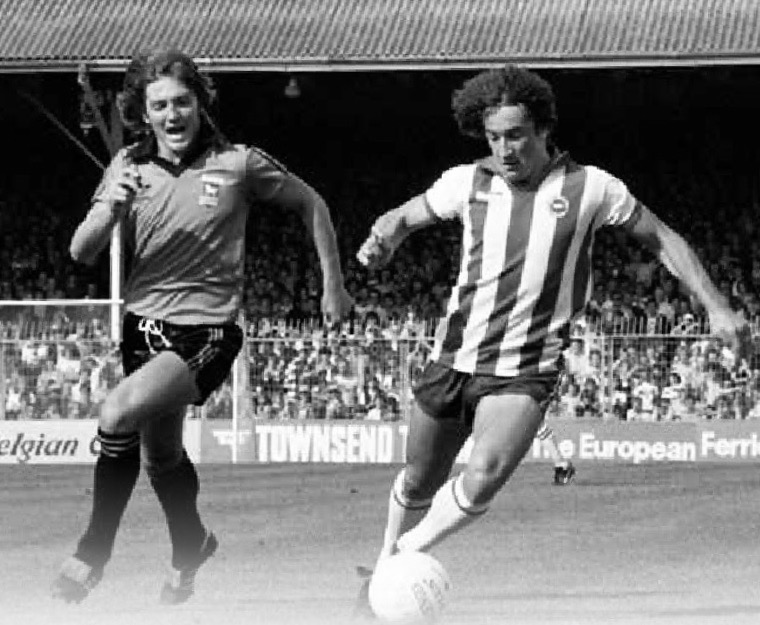
The fee was undisclosed but was believed to be something of the order of £1.2 million and the QPR manager at the time, Jimmy Floyd Hasselbaink told bbc.co.uk: “He offers us something a little bit different. He’s left-sided, which will give us better balance, and has that ability to bring the ball out from the back.”

Hamstring and foot injuries hampered opportunities to show his worth to the Loftus Road faithful, a frustrating situation he talked about in January 2018, but he has since become a regular at the heart of the Rs’ defence.

Perhaps with an eye to the future, Lynch has a profile on the professional networking site LinkedIn.

Pictures sourced from The Argus (Simon Dack / Liz Finlayson), matchday programmes, Huddersfield Examiner and QPR websites.


Welsh international Peter Sayer added artistry to Brighton’s rise to the elite

NIMBLE-footed Peter Sayer was certainly a player for the big occasion: a Cardiff City legend and briefly a Welsh national team star.

At Brighton & Hove Albion, he was part of the team that memorably won promotion to the top division for the first time in its history.

He signed for the Seagulls for £100,000 just nine months after playing for his country in what was the only Wales victory over England at Wembley (on 31 May 1977).

Sayer was part of a Welsh team captained by Terry Yorath (father of TV presenter Gabby Logan) but with far fewer household names than their illustrious opponents.

Wales were managed by Mike Smith, the former Hove Grammar School teacher, while Don Revie’s England were captained by Kevin Keegan, playing up front alongside Stuart Pearson and Mick Channon.

The BBC highlights of the match show the diminutive Sayer getting on the end of a Leighton James cross but steering his header wide before James scored the only goal of the game from the penalty spot after he’d been upended by Peter Shilton.

Neil Moxley, for dailymail.co.uk in September 2011 discovered what had happened to that Welsh team since, which included jobs ranging from Wales boss to toilet roll business managers. Sayer, he reported, had become steward at a golf club in Preston, where he moved to after Brighton, and then run a pub in the area.

In Back Pass magazine in August 2013, Sayer was quoted as saying: It was an excellent time at Brighton. There were some very good players at the club and I was playing well.

“I especially remember when we won promotion to the old First Division at Newcastle in 1978-79.

sayer bwhs“We had our own train which we used to travel on to away games. It was great for team morale.”

He added: “I ended up in the reserves even though I was playing well. I got asked to go to Newcastle but failed the medical.

“The club then had an opportunity to sell me to Preston and they perhaps felt they needed to offload some players. Maybe I should have dug my heels in and fought.”

Sayer wasn’t a prolific goalscorer but he did get on the scoresheet in a memorable 3-3 draw at Orient that I went to in April 1979, when Martin Chivers scored his only goal for the Albion and another former Spurs star, Ralph Coates, was among the scorers for the Os.Jackson concedes Sayer

The game was covered by ITV’s The Big Match and broadcast to the nation the day after the game. Sayer scored after ‘keeper John Jackson, who later became a goalkeeping coach at Brighton, parried a Paul Clark thunderbolt and the Welshman cracked in the rebound.

There’s a very detailed look back at Sayer’s career on pneformerplayers.co.uk by Ian Rigby. His report says: “Occasionally he quietly attends Deepdale to watch North End, but on his return to Cardiff City, as a guest, he is treated as a former star player, which he was.”

A televised third round FA Cup tie between Cardiff and Spurs in January 1977 thrust Sayer into the limelight when his winning goal was seen by millions and can still be seen on YouTube today.

Rigby recounts: “He controlled the ball with his head and, with four defenders converging upon him, he smashed the ball past Pat Jennings. A sponsored car was just one of the perks that came Peter’s way after that goal.”

Born in Cardiff on 2 May 1955, Sayer grew up in the city and went to Trelai Primary School then Cantonian Comprehensive School. He played for his school at all levels and at each successive age group for the Cardiff Schools representative side. That led to him winning Welsh international caps at schoolboy level and later at youth, under-21 and full levels too.

He was awarded a professional contract with Cardiff in July 1973 by then manager Jimmy Scoular but he had to wait until February 1974, by which time Scoular had been replaced by former Leicester and Man Utd boss Frank O’Farrell, to make his league debut as a substitute against Blackpool.

By 1975, just as he was beginning to establish himself, he suffered a broken leg and dislocated ankle in a game at Southampton. Eighteen months later, though, he had recovered sufficiently well to earn his first international honour, playing for Wales Under-21s against England, at Molineux.

Sayer ultimately earned seven full international caps including that Home International win against England and two World Cup qualifying games, one being the controversial game against Scotland at Anfield when a diabolical refereeing decision robbed the Welsh.

Nicknamed ‘Leo’ because he sported the same-style perm as the 70s Shoreham-born pop singer who shared the same surname, Sayer was a regular in the Albion’s 1978-79 promotion-winning side.

He initially retained his place as Brighton strove to come to terms with the top division but when Alan Mullery decided to switch the mercurial Mark Lawrenson from defence to midfield, it was at Sayer’s expense.

In August 1980, Preston manager Nobby Stiles, the England World Cup winner, paid £85,000 to take Sayer to Deepdale, but his career there was beset by injuries and he was released at the end of the 1983-84 season and signed for Chester City for one season.

He subsequently played non-league for Morecambe, Northwich Victoria, Chorley and Southport.

Pictures from my scrapbook show the Albion matchday programme photograph of Sayer scoring in that game against Orient and, from the BBC coverage of England v Wales at Wembley in 1977, the winger looking exasperated after his header has gone wide. Sayer was quite a dab hand at snooker, too.

Welsh wizard Peter O’Sullivan an all-time Albion great

IMG_5086

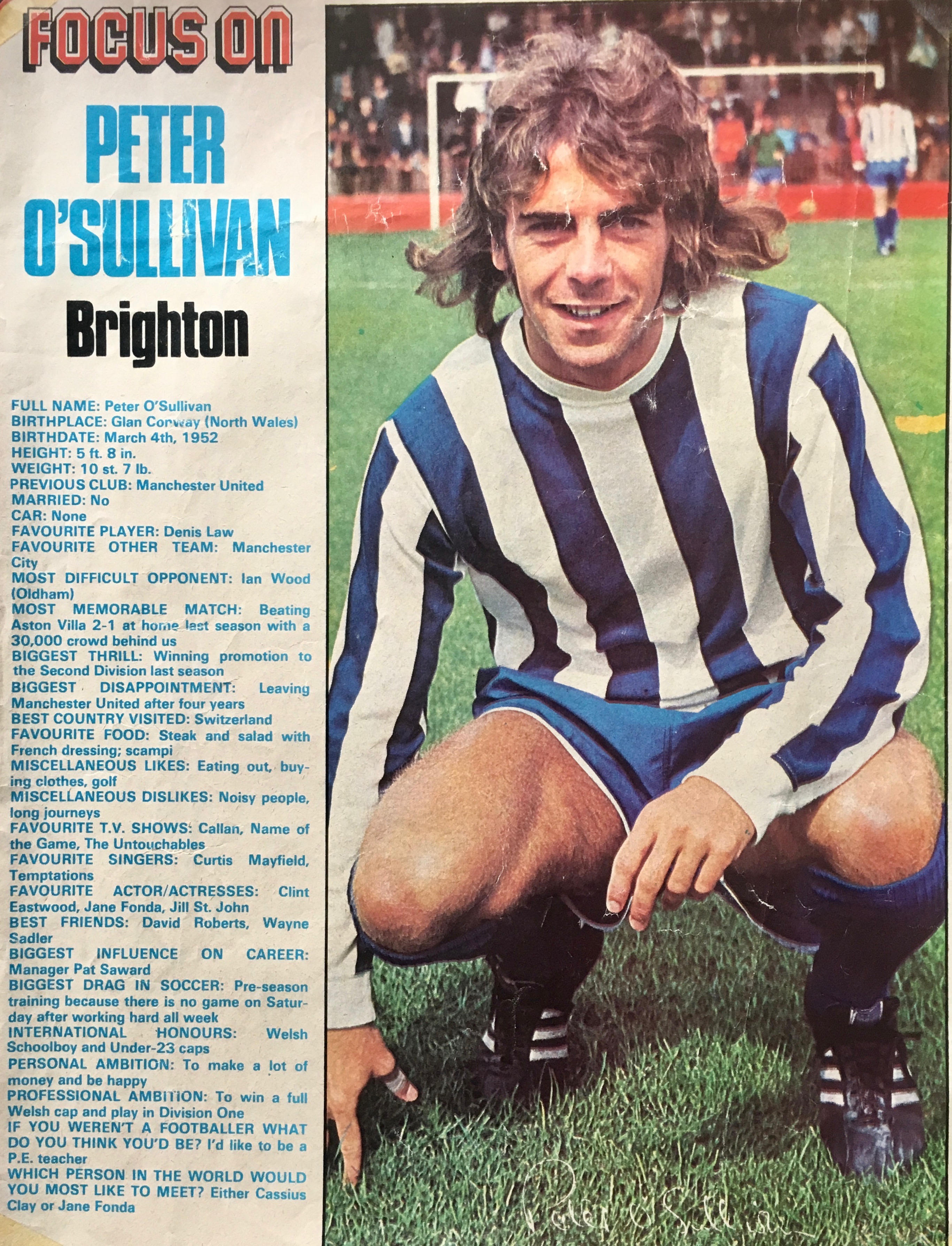
WHILE Peter Ward rightly attracted much of the attention during Albion’s rise to the top in the late ‘70s, few would deny that midfield maestro PETER O’SULLIVAN also deserves a place amongst the club’s all-time greats.

Sully had a long career with the Seagulls before a short stint with Fulham towards the end of his playing days.

The statisticians of the modern football era would have needed their calculators to record the ‘assists’ racked up by Sully, who, from the left wing or left midfield, found goalscoring teammates with unerring accuracy throughout a remarkable 11 years with the Albion.

Managers came and went, a huge swathe of teammates were discarded, but Sully stayed put, showed his worth to whoever sat in the manager’s chair, and entertained the watching faithful.

He played in the same position as the Brazilian genius Rivelino and even sported the same style of moustache in homage to him.

As Brighton rose through the footballing pyramid, Sully was a constant, displaying the talent to make an impact in the third, second and top tiers. One of his former teammates, Andy Rollings, maintained: “He should have played at the top level all the time, he was that good a player.

“He had natural ability and great fitness,” Rollings told freelance journalist Spencer Vignes. “What he did at this club was incredible, and as an individual player he was one of the best I ever played with. He’s a lovely, smashing guy.”

In the excellent Vignes’ book A Few Good Men (Breedon Books Publishing),  Sully admitted there had been occasions when he couldn’t wait to get away from Brighton, and he had some serious arguments with all of the managers he played under.

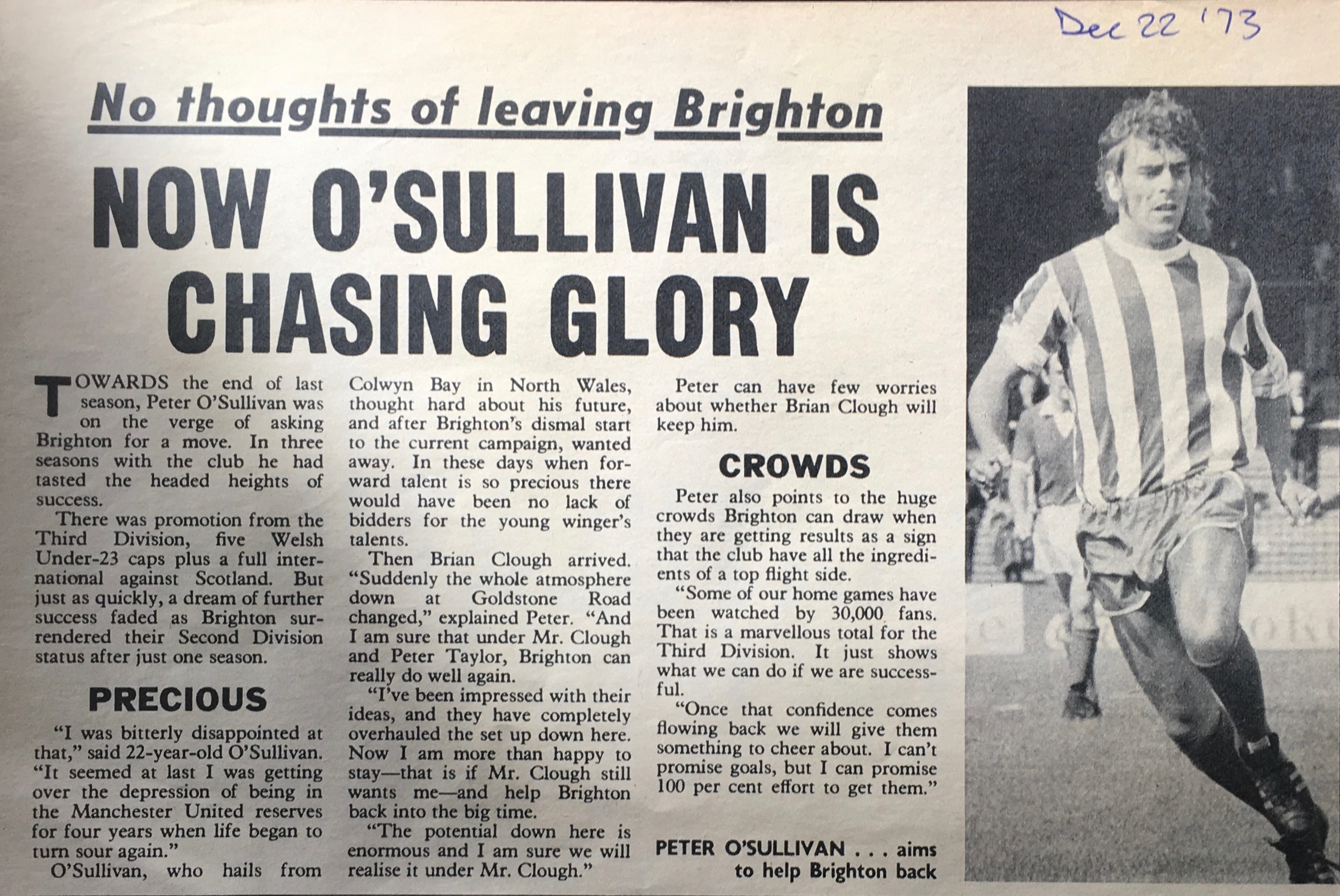
Sully shared his thoughts in a Goal magazine article of 22 December 1973, a couple of months after the arrival of Brian Clough and Peter Taylor. Having won promotion from the Third Division, won five Wales under 23 caps and made his full international debut against Scotland, he was disillusioned after relegation from Division 2.

“I was bitterly disappointed at that,” he said. “It seemed at last I was getting over the depression of being in the Manchester United reserves for four years when life began to turn sour again.”

However, with the arrival of Clough and Taylor, O’Sullivan changed his outlook and told the magazine: “I’ve been impressed with their ideas and they have completely overhauled the set up down here. Now I am more than happy to stay – that is if Mr Clough still wants me – and help Brighton back into the big time.

“The potential down here is enormous and I am sure we will realise it under Mr Clough.”

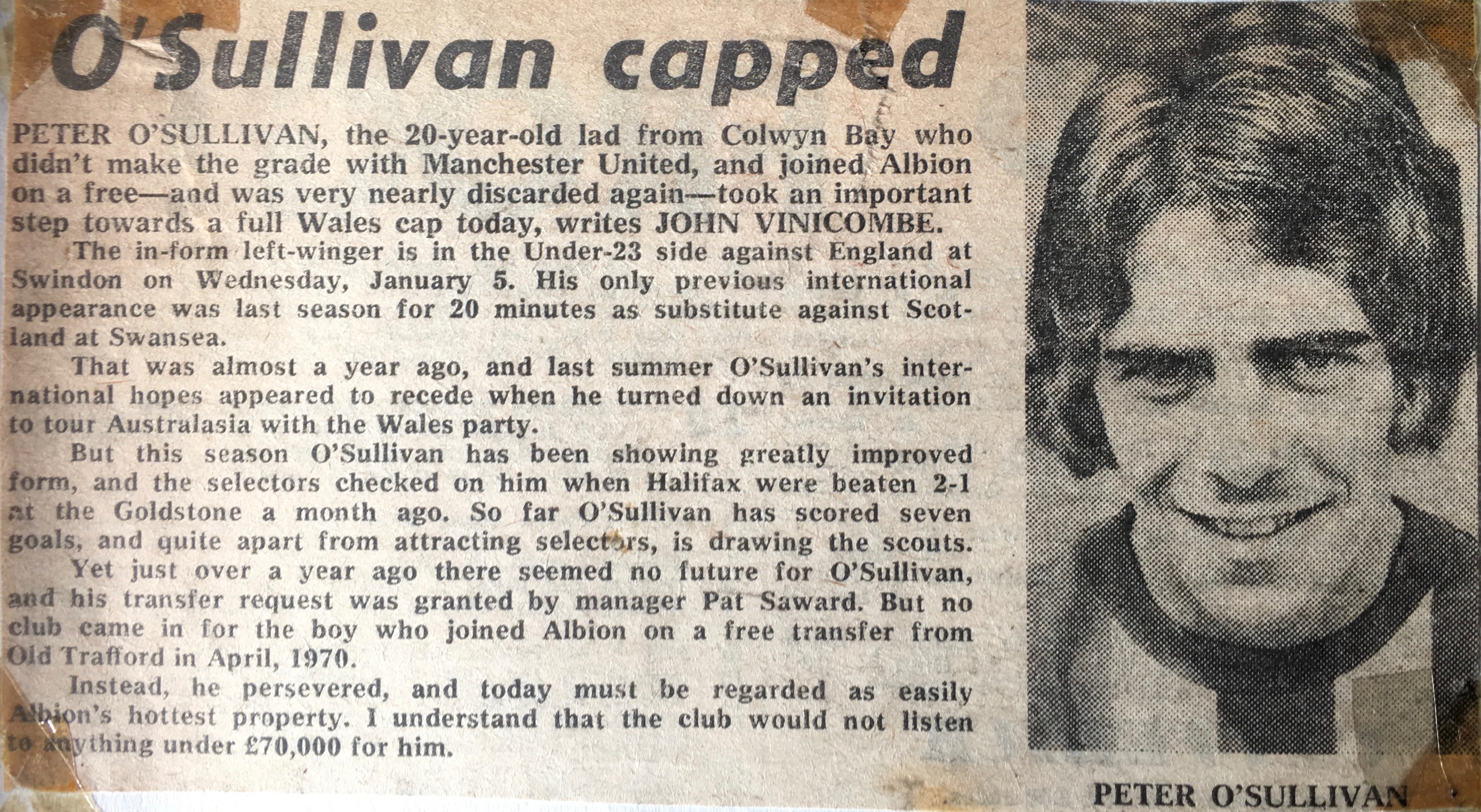
Vignes’ 2007 interview with Sully explained exactly how he ended up at Brighton having been given a free transfer from Manchester United. None other than the great Bobby Charlton was responsible.

sully man u

Young Peter crouches alongside George Best in a Manchester United team photo

Born in Colwyn Bay, north Wales, on 4 March 1951, Sully had trained alongside the United legend while at Old Trafford as a youngster and, on being released on a free transfer in 1970, was considering offers from several different clubs.

He’d gone to Bristol to have a trial with Bristol City when, on a neighbouring pitch, Charlton was taking part in an England training session prior to the 1970 Mexico World Cup.

The kindly maestro exchanged the time of day with his recently departed colleague and asked which clubs were in for him. On hearing that one of them was Brighton, managed by his former Busby Babe teammate, Freddie Goodwin, Charlton advised him to link up with his old pal……and the rest, as they say, is history.

What Charlton and Sully didn’t know, however, was that no sooner had he arrived on the south coast than Goodwin was heading for the exit, en route to Birmingham City. Sully hadn’t even kicked a ball in anger for him.

“I was a little apprehensive about joining Brighton and it was unsettling when Freddie Goodwin left the club before I had even played for Albion,” he said. “I wondered what was going on and how it would affect me.

“But then Pat Saward arrived and I was overjoyed when he put me in the team. My hopes were quickly dashed again, though, when he dropped me after about six games.”

A homesick Sully struggled to settle at first but he stuck at it and went on to cement his place in the side. He ultimately featured under four different managers, Saward, Clough, Taylor and Alan Mullery.

IMG_5087

He was part of the promotion-winning teams in 1972, 1976 and 1979, and was player of the season in 1978. He won promotion with Fulham too, going up to the old Division 2 in 1982 when the former Newcastle, Arsenal and England centre forward Malcolm MacDonald was in charge.

Sully had one amazing period with the Albion in which he made 194 consecutive appearances, an Albion record for an outfield player.

IMG_5091The performances of the lad from Colwyn Bay also saw him earn three international caps for Wales, two against Scotland and one in a rout against Malta when he also got on the scoresheet. Unfortunately for him, during the same period, a superb left-sided player called Leighton James was the first choice for the national side.
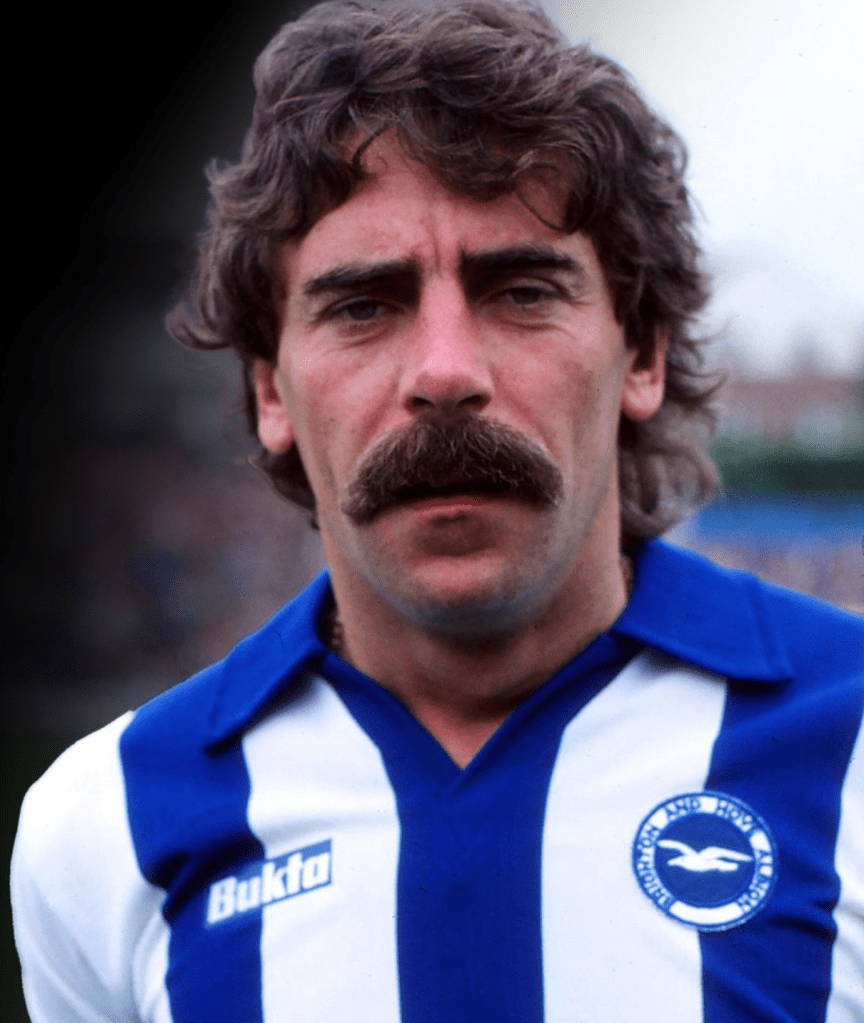
“When I joined Manchester United from school it was always one of my ambitions to play for Wales,” he told the Albion matchday programme. “But I thought those hopes had been dashed when Manchester United released me.”PO Wales

Sully’s 491 appearances for Brighton made him the club’s longest-serving post-war player. He actually left the club in 1980 to play in America for San Diego Sockers but a £50,000 transfer fee saw him return just five months later.

Eventually Sully moved on to Fulham in 1981 and notched up 46 appearances. There were short loan spells with Reading and Charlton in 1982-83 and his Football League career came to an end when he made 14 appearances for Aldershot in the following season.