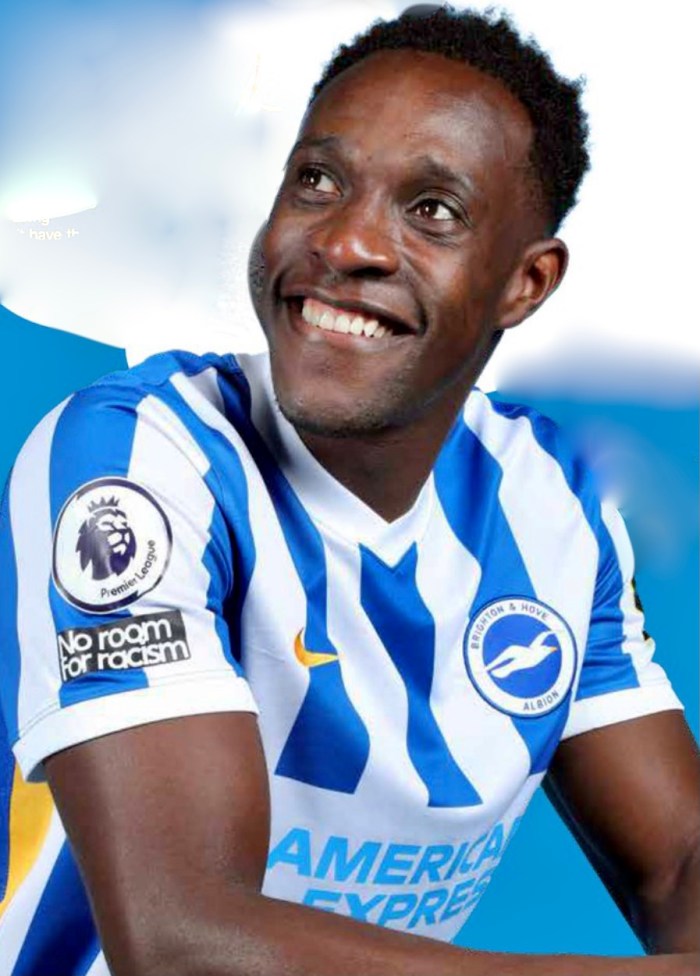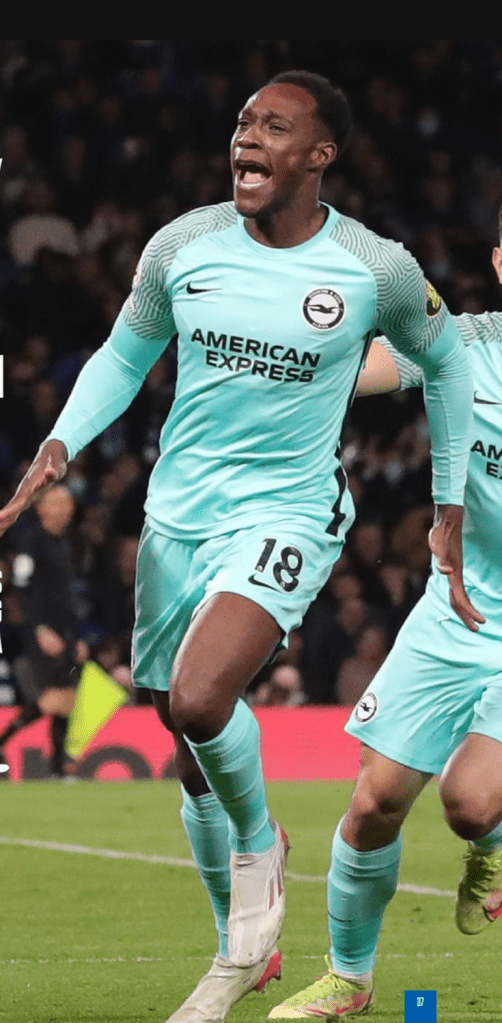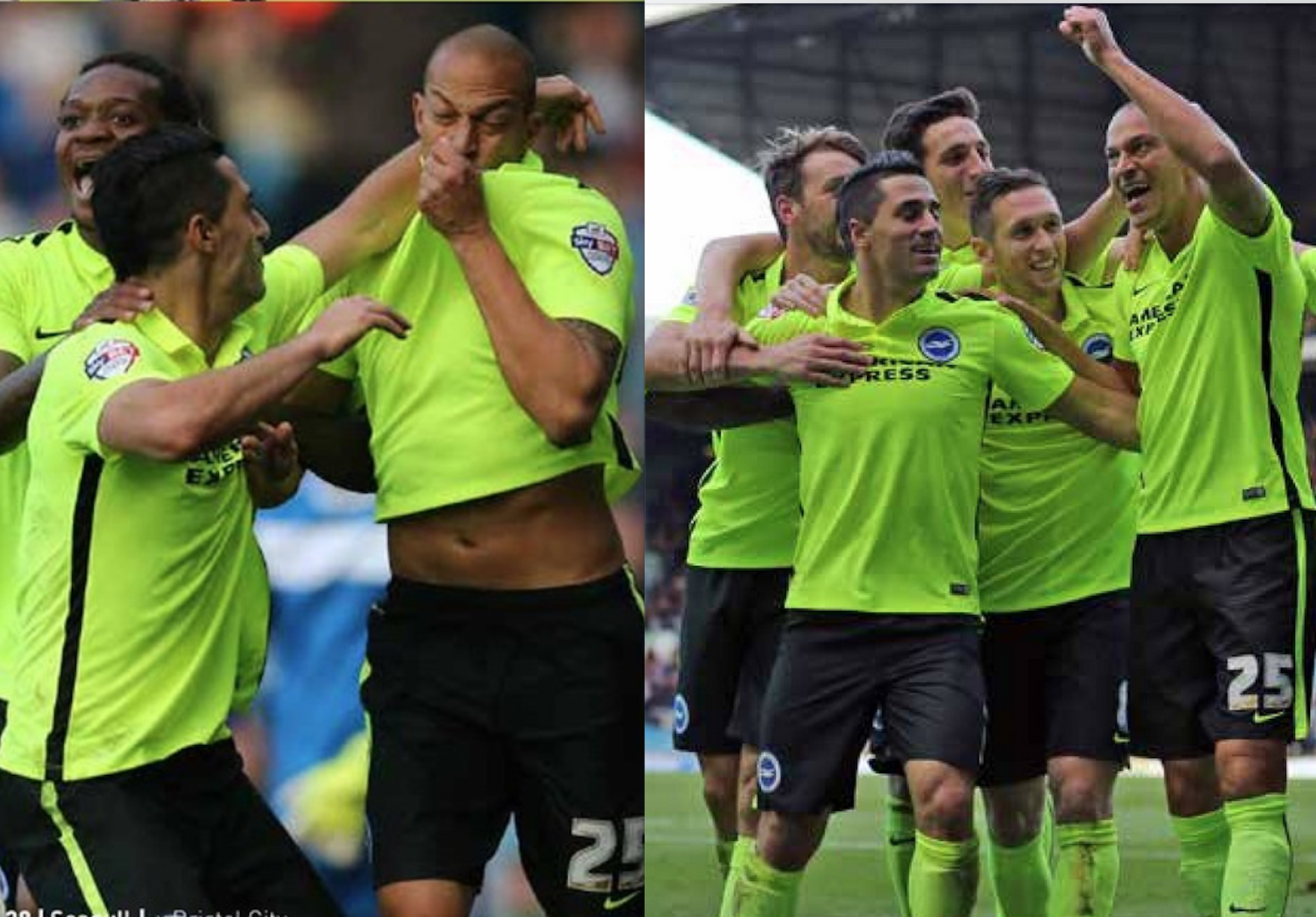
Dat guy Danny Welbeck “a top player and a top person”

INJURY has undoubtedly caused Danny Welbeck to miss more games of football than he would have wished but the game is full of admirers for the longevity of his career.

As Gabby Logan said on Match of the Day, like a good wine, Welbeck seems to be getting better with age. He has scored more Premier League goals per game in his thirties than he did in his twenties or teens.

His 10 Premier League goals for Brighton last season was his best goalscoring campaign in the top flight and in the autumn of 2025 he has already scored two goals apiece against Newcastle and Chelsea, opponents competing in the Champions League.

“I have the passion and love for football,” he told Match of the Day after scoring the pair against Newcastle. “It’s what I want to do. I feel good. I feel strong and fit so I won’t be stopping soon.”

And as BBC Sport reporter Ciaran Kelly pointed out, Welbeck has the knack of scoring crucial goals for the Seagulls: 11 of his last 12 Premier League goals for Brighton have either put the side ahead (eight) or drawn the game level (three).

Welbeck has now played more matches for Brighton than Manchester United, the club he joined aged eight and where he spent 15 years, rising from the club’s academy, making his way through the junior sides and going on to play 142 first team games (90 starts + 52 as sub) between 2008 and 2014.

The 29 goals he scored along the way played a big part in him earning selection for the England national team for whom he collected 42 caps between 2011 and 2018 having also won 42 caps across the various junior England levels. Welbeck netted 16 times for the full England side.

That there have been calls in certain spheres for United to try to take him back to Old Trafford as he approaches his 35th birthday are a mark of the man and the quality he still exudes.

Striker-turned-pundit Tony Cascarino even urged Thomas Tuchel to recall him for England as back-up for Harry Kane. He told talkSPORT: “Welbeck contributes in various ways beyond scoring. His goal tally isn’t huge, but it’s a decent level and, above all, he is an excellent team player.

“I’ve never seen anyone speak ill of his attitude or professionalism. He is truly an exemplary veteran,”

Cascarino added: “Poland still uses superstars like Robert Lewandowski. If a team needs a veteran, I think there’s absolutely no problem calling Welbeck back,”

Graham Potter was in charge when Welbeck arrived at the Albion in October 2020 on a free transfer, signing a one-year contract.

Welbeck scores for Albion at Old Trafford

Potter moved on but in October 2024 he couldn’t speak highly enough of what the player had brought to the Seagulls, in particular as an influence on others.

“Somebody like Danny is a role model. He can teach you how to act, how to be, how to condition yourself and how to interact with your team-mates at the highest level,” said Potter, speaking on BBC Sounds’ Planet Premier League podcast.

“He is a top player and a top person. Credit to the club – they didn’t just recognise that it is about signing young players, it is also about understanding what older players can do for the environment and for the collective.

“To have someone [in your squad] that has been there and done it, and can just handle it well, I think is priceless as a coach.

“If you see what Danny has had to go through, I think he is also a resilient character. He is a good human being, so he doesn’t get carried away too much with the nonsense of football.”

Potter’s successor Roberto De Zerbi was equally effusive. “Great player, great guy,” said the Italian. Speaking in April 2024, when his own Albion future was in doubt, he said of Welbeck: “We have to keep him for a lot of years. He is playing very well and he is important for the young players, for the dressing room.”

A couple of months earlier in the season, De Zerbi’s assistant, Andrea Maldera, told Andy Naylor of The Athletic: “Danny is one of the best teachers on the pitch.

“He is always positive and he is not only a teacher on the pitch. He can speak with a young player when he is eating with them or when he is on the bus.

“He always gives a lot of advice to everybody. He is a big teacher, he has the soul of a teacher. I don’t know what he wants to do in the future in his life, but he is always very clear-minded. On the pitch, it is the same. He doesn’t speak a lot, but he’ll go close to the players, sometimes work a little with them on the training ground.”

Welbeck himself appreciated the influences of more experienced players in his own early days and told BBC Sport’s Simon Stone: “At Manchester United there were lots of players to guide me and give me advice. It meant a lot back then hearing that sort of stuff, listening to people who had been through certain situations and different experiences, who have a lot of knowledge in the game.

“I am always happy to help with the other players. It is pretty easy for them to come and talk to me. It’s nice to pass on a bit of knowledge and experience.”

Born in the Longsight suburb of Manchester on 26 November 1990, Welbeck’s first games of football were played with his older brothers Wayne and Chris when he was just four or five.

Wes Brown, who was already on United’s books, and his brothers lived nearby and the young Welbeck was inspired to follow in Brown’s footsteps.

He actually had a trial for City when he was eight but they didn’t have an age group side for him. It was while he was playing for local side Fletcher Moss Rangers that United seized the opportunity to offer him a two-week trial, and he didn’t look back.

After progressing though the academy schoolboy squads, he made his debut for the youth team in December 2006, debuted for the reserves the following October and was United Young Player of the Year for the 2007-08 season, going on to sign as a professional in July 2008.

On the ball for United

Three months later, Sir Alex Ferguson gave him his first team debut, starting up front alongside Cristiano Ronaldo at home to Middlesbrough in the third round of the League Cup, when United won 3-1.

In November, he went on as a substitute to make his Premier League debut and scored United’s fourth goal in a 5-0 thumping of Stoke City, unleashing a swerving shot from 30 yards.

Welbeck was winning his first significant medal before that season was over after he had started for United in the League Cup final, when they beat Tottenham on penalties at Wembley (although Welbeck had been subbed off 10 minutes into the second half, the BBC match report noting “youngster Welbeck was having a tough time making an impact in the face of the physical presence of Dawson and King”).

He scored twice in eight matches on loan to Preston North End in 2010 and then spent the 2010-11 season on loan to Sunderland, scoring six in 28 matches (23 starts plus five as sub) for ex-United skipper Steve Bruce’s Premier League side.

“He has always had ability but made slow progress because he had a bit of a knee growth problem, so we knew we had to wait for him,” said Ferguson in August 2011. “We put him on loan to Sunderland last season and that is when he became a man. He has grown up.”

Dat Guy (Mancunian slang for The Man), the nickname given to him by former United teammate Ravel Morrison, was part of the 2012-13 Premier League title-winning squad (23 starts plus 17 as sub) which turned out to be Ferguson’s last in the hotseat.

He scored 10 in 24 starts plus 12 as sub under David Moyes, but Dutchman Louis van Gaal preferred to bring in Colombian striker Radamel Falcao and, after only three games at the start of the 2014-15 season, Welbeck was sold to Arsenal for £16m (Ferguson putting in a good word with Gunners boss Arsene Wenger).

Plenty of iconic United names, such as Rio Ferdinand, Paul Scholes and Bryan Robson, voiced their disapproval of the decision and former coach Rene Meulensteen was adamant Ferguson wouldn’t have sold him if he’d still been in charge.

Meulensteen told talkSPORT: “We were always keen on bringing young players through and giving them a chance. I had him from when he was 8, 9 years of age and I think the best of Danny is yet to come.

“He is a very versatile player and I’m 100 per cent sure he will do very, very well for Arsenal. Danny is a perfect match for Arsenal. He is such a versatile player.

“He is very good in short, creative, combination play, showing for the ball, passing and moving, picking up different positions. At the same time, he has the pace and power to break away if they break from their own half.”

Robson said: “He came through the ranks, he has a great attitude, he’s a great lad.” And Wayne Rooney told The Mirror: “Danny’s great to play alongside. If I’m completely honest, I’d probably like to still see him here, playing for Manchester United.”

Saying United let him go too quickly, Gary Neville added: “He’s actually perfect for how Manchester United should play. Threatening space in behind, playing off front players. This idea that he’s not good enough for Manchester United is absolutely rubbish.”

In a January 2025 interview with the Manchester Evening News, Welbeck remembered: “At the time I was playing on the left-wing a lot and in a 4-4-2, which is very difficult for me because I can’t make an impact on the game.

“I can play it to the best of my ability but that’s not best for the team, and I could make a bigger impact playing in my preferred position.

Welbeck and Ashley Young at United

“You start to have thoughts but at that time you’re still going to training and I was still giving 100 per cent and giving my all in every single game – that’s just me, I’m not going to change that. But you do start to think about what’s best for you.”

Apart from anything else, Welbeck was an established member of the England set-up by then.

He had been on loan at Sunderland when he was first called up to the England senior squad (following the withdrawal of Aaron Lennon) only days after scoring for England Under-21s in a win over Denmark.

Ironically, the opponents at Wembley on 29 March 2011 were Ghana – the country his parents came from – and Fabio Capello sent him on in the 81st minute as a sub for Ashley Young. The game ended 1-1.

He ultimately featured under four different England managers (albeit Stuart Pearce only managed one game) with the majority (29) under Roy Hodgson. His final England game was as a sub for Trent Alexander-Arnold at the 2018 World Cup in a 1-0 defeat to Belgium.

When Welbeck suffered a badly broken night ankle in a Europa League match for Arsenal in November 2018, and was forced to withdraw from the England squad, Gareth Southgate revealed how the squad showed their strong bond with him by placing his photo on a TV they were watching ahead of a Nations League match.

And after he’d left Arsenal in the summer of 2019, but was still recovering from the ankle injury, the FA helped his comeback by allowing him to use all of the facilities he needed at the St George’s Park national centre.

Welbeck nets in the FA Cup against Newcastle

Another illustration of the enduring relationships Welbeck has built during his career came after he’d scored an extra-time winner for Brighton at St James’ Park in March 2025 to book an FA Cup quarter-final against Nottingham Forest.

Ferguson phoned the player after the game, and Welbeck told BBC Football Focus: “He talked about the goal and the performance. He was buzzing and to have that sort of connection, he is a manager who is always looking out for his players, always wants the best for them, and still to this day is in contact.”

At Arsenal, Welbeck played under another great manager and he told the programme: “Sir Alex Ferguson got success in his own way, Arsene Wenger had success in his way. There’s different ways to reach success. Those two managers played a huge part in my life, not just my career.”

• More about Welbeck’s time at Arsenal in my next blog post.

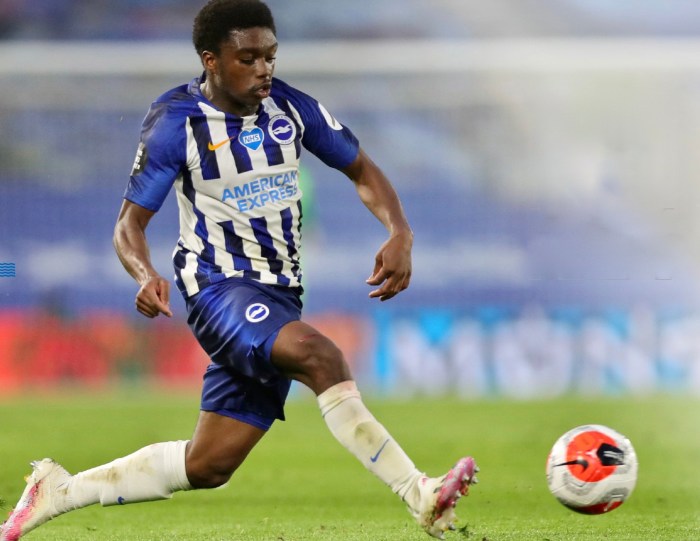
Pacy Tariq Lamptey smiled on through, despite injury woes

SPEEDY Tariq Lamptey missed too many games through injury in five and a half years at Brighton.

Like many quick players, Lamptey would excite fans when he sped past opponents with ease to create chances for others or score himself. Sadly, that electric pace came at a price.

Shortly after the pint-sized, fleet-footed full-back first broke through at Chelsea under Frank Lampard, he joined Brighton for £3m on January transfer deadline day in 2020.

Brighton were able to offer him more first team chances but lengthy spells on the treatment table meant he only made 122 appearances for the club and 49 of those were as a sub.

The 2024-25 season was another when his involvement was limited to only 14 starts plus six as a sub, although he scored two Premier League goals, netting the opener in a 2-2 draw at Leicester and burying an impressive late equaliser to salvage a point in another 2-2 draw, at Aston Villa. He also scored in the 3-2 League Cup defeat at home to Liverpool.

Throughout the season, there was speculation linking him to moves elsewhere so it came as something of a surprise in the summer of 2025 when it was announced that he had signed a new one-year deal.

However, it transpired that was just a device to secure a fee because he moved on anyway, joining Fiorentina in Italy on August transfer deadline day. Officially the sum involved was undisclosed although media reports put it at £6m.

There was no acrimony surrounding his departure; indeed, head coach Fabian Hurzeler said: “He’s been a valued player throughout his time, but more than that he is a brilliant professional and person.

“This is a good opportunity for him to play both Serie A and European football. On behalf of everyone at the club I’d like to wish him all the very best for the future.”

Sadly, after only a handful of weeks into life at his new club, Lamptey was struck by another devastating injury blow in the 22nd minute of Fiorentina’s 2-1 Serie A defeat at home to Como on 21 September.

He tore the anterior cruciate ligament in his left knee and faced a long period of recovery after successful reconstruction surgery.

Lamptey had been at Chelsea for 12 years and had just broken into their first team when he joined the Seagulls in the Covid-hit season. It meant he didn’t make his first start for the Seagulls until June 2020, in a behind-closed-doors 0-0 draw at Leicester.

By the autumn, Lamptey’s form for Brighton was catching the eye of various suitors and earned him a call-up to the England under 21 squad.

He was an unused sub for young England’s 6-0 win over Kosovo on 4 September that year but four days later started in their 2-1 win over Austria; Aaron Ramsdale, Mark Guehi and Jude Bellingham were in the same line-up.

Injury ruled him out of two matches the following month but he returned to the starting XI for England’s 3-1 win over Andorra at Molineux. He was again an unused sub four days later when England beat Albania 5-0 at the same stadium.

Wayne Rooney was reported as saying Lamptey was a player Man United should sign while Bayern Munich, Seville and Atletico Madrid were also said to be watching him.

Amidst it all, head coach Graham Potter said: “We have been delighted with Tariq. It is great to see a young player like him come in and grasp the opportunity. He fits in really well with our club and our team.”

Sadly, Lamptey then suffered a hamstring injury at Fulham in December 2020. It sidelined him until October the following year.

Unsurprisingly, on his return, he said: “I’m grateful to be back on the pitch, playing football and playing well. I’d like to be involved in every game, but it’s up to what the gaffer decides, so I just have to keep training well. Whenever the team call upon me, I’m ready to help.”

Grounded, polite and popular with teammates, Lamptey said in a matchday programme interview: “I love football and have a smile on my face because I enjoy playing. Of course, there are things that you sacrifice for it, but you know why you’re doing it.

“When you’re on the pitch and you have great moments, you remember the times there was sacrifice and you enjoy the moment – that’s what you play for.

“You’re going to go through battles and tough times in football, but that’s all part of it. You know what you’re getting yourself into, so you just have to make sure you believe in yourself, keep working hard and things will turn out right.”

Born in Hillingdon to Ghanaian parents on 30 September 2000, he played locally for Larkspur Rovers before joining the Chelsea academy aged just seven. Lamptey’s progress through the age groups reached a peak when he was part of the Chelsea youth team that won the FA Youth Cup in 2018 (beating Arsenal 7-1 over two legs), alongside the likes of Guehi, Reece James, Conor Gallagher, Billy Gilmour and Callum Hudson-Odoi.

That development at Chelsea also led to him earning selection for England age group sides. He made a total of 18 appearances for the under 18, 19 and 20 sides.

Lampard and Lamptey

His progression to the Chelsea first team saw Frank Lampard give him his Chelsea debut as sub for Fikayo Tomori in a Premier League game away to Arsenal, when he helped Chelsea turn round a goal deficit to win 2-1 on 29 December 2019.

He made two more sub appearances in FA Cup wins the following month: a home debut when he went on in the 76th minute of the 2-0 win over Nottingham Forest and he played most of the second half of the 2-1 win at Hull City. But at the end of that month, he joined Brighton.

If it seemed like a surprise move at the time, Albion’s then technical director, Dan Ashworth, pointed out: “We’ve been tracking Tariq for a while and I knew him from my England days, coming through the youth systems, where they spoke very, very highly of him.

“It’s an opportunity for us to bring in a young, exciting and talented player. He has terrific pace and is technically good. He can play as a full-back, a wing-back and has also played some of his time as an advanced midfield player. He brings some real energy and hunger to the squad and I hope he’ll be here for a number of years.”

For his part, Lamptey told the matchday programme: “It was a really tough decision to leave. I’d been with the club since the age of seven and had seen it all the way through to the under 23s and this season with the first team.

“It was a proud moment for me to make my debut but I felt like it was the right time to start a new chapter and come to this brilliant club.”

After welcoming Lamptey back after his first long injury absence, Potter said: “He’s just an amazing person, an amazing young lad. If you speak to anybody here (at Brighton), they just say the same, which is everyone loves him.

“When you have that feeling for someone, of course you want everything to go well for him and he’s had a really tough time. He’s a human being, so you’re going to be frustrated and you’re going to be disappointed and you’re going to be sad and you’re going to be angry — all of those things.

“But how he’s conducted himself, how he’s acted, how he’s got on with his work is just inspirational to everybody. His resilience, his mental strength, his capacity to deal with adversity is incredible, and I think that’s credit to him and his family.

“He’s been fantastic around the place and I think he will use it as a way to strengthen and a way to grow and a way to improve — that’s how Tariq is.”

In a subsequent interview, Potter added: “Tariq needs to be threatening the opposition defenders as much as he can. Some games you can do that from right-back, some games from left-back, sometimes from right wing-back, and sometimes you can be a little bit higher.

“The fact that he’s so open-minded and so ready to help the team makes it easy for me. It’s just finding the right solution for him.”

Albion’s European season of 2023-24 once again saw injury deprive Lamptey of greater involvement (14 starts and 10 as a sub) although coach Roberto De Zerbi was grateful to exploit his versatility when called upon, using him as right-back, left-back and winger.

Lamptey played a key part in the 2-2 comeback draw away to Marseille in the October Europa League group match when filling in for injured Pervis Estupinan at left-back. He capped an influential second-half performance by winning the late penalty from which Joao Pedro equalised.

De Zerbi told The Athletic: “He is a unique player. His attitude and behaviour are incredible. It is to Tariq’s credit that we achieved first place in the Europa League. The penalty in Marseille was for his attitude and passion to create the penalty, to find the one-on-one.

“I would like to improve him in pass control and I would like him cleaner in technique. His characteristic is speed, his energy. When Tariq starts (to run) and is attacking, you have to follow him or you will be left 40 metres behind.”

The admiration was certainly mutual, with Lamptey telling 3 Sports: “He’s an amazing coach; tactically, he makes you look at football from a different point of view.

“You try to add as much to your game as possible, and the way he saw the game was different. We played some fantastic football, so I really enjoyed my time with him. I just try to use the experiences he gave me to add to my game and make me a better player.”

Having collecting those two England under 21 caps after the move to Brighton, and with several contenders ahead of him in the pecking order for the full international side, Lamptey opted to play for his parents’ country at full international level.

It was perhaps not a surprise because through his own charitable foundation he supports youth in Ghana, donating football kit and other sports equipment to the country’s schools and other organisations.

It was the warmth of the people he met while in the country doing his charity work that helped him to decide to play for Ghana, although he said his upbringing in a Ghanaian household was also a factor.

He finally decided to play for the Black Stars after visiting the Cape Coast Stadium to watch Ghana beat Madagascar 3-0. He made his debut for Ghana in September 2022, going on as a sub in a friendly 3-0 defeat against Brazil, and went on to play twice for the country at the Qatar World Cup.

Football’s Ansah to making the game look dramatic

FICTIONAL football gained an unlikely champion in Andy Ansah.

The journeyman striker eventually mixed it with the game’s elite players as he built a new career in the world of football make-believe for TV and film.

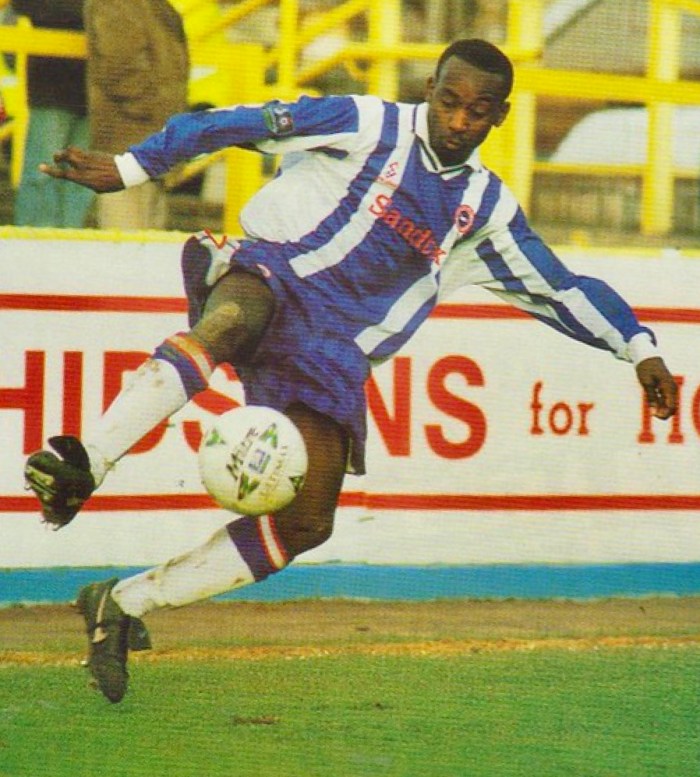
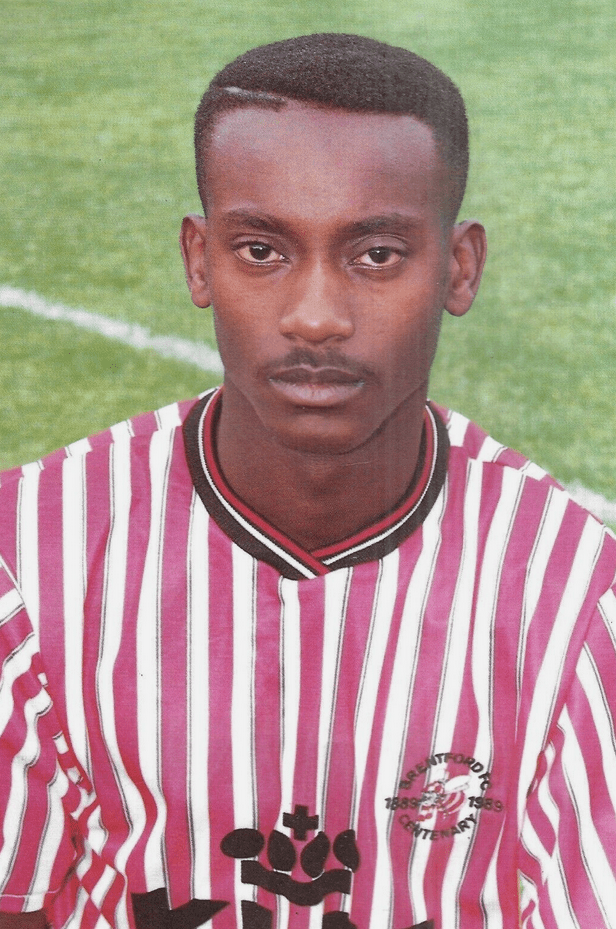
His own exploits on the field were in less esteemed company, including stints playing in the lower leagues for Brighton, Brentford and Southend United.

Not too many Brighton fans will remember him, though, because his 25 appearances in the blue and white stripes coincided with the two seasons when home matches were played 90 miles from home in Gillingham.

With crowd numbers low and finances tight as a consequence, Albion were in no position to splash the cash in the autumn of 1997; indeed John Humphrey, Craig Maskell, Paul McDonald, Denny Mundee and Ian Baird, five of the squad who had kept the Seagulls in the league by the skin of their teeth only six months earlier, were let go in an effort to trim the wage bill.

It was in that climate that Ansah, who had dropped out of league football at the time, was picked up by Steve Gritt.

It only transpired in an interview Ansah gave to the Express in December 2011 that he came clean to the Albion about a kidney condition (nephrotic syndrome) he had suffered from since teenage years but had kept hidden at previous clubs.

It could at times make his body swell so much he could hardly walk and he would need hospital treatment to bring it under control.

He told the newspaper he had gone to extraordinary lengths to hide the illness from managers, coaches and fellow players for fear that it would mean the end of his career. When he felt poorly, he would wear tracksuit bottoms on the training ground to hide the swelling, and then feign illness.

At Brighton, however, the condition did not stop him being involved, although the majority of his appearances were as a substitute.

Apart from a start in a 5-0 mauling at the hands of Walsall in the Auto Windscreens Shield on 6 January 1998, he had made three Third Division appearances going on as a sub and was unused on seven occasions before his fortunes changed.

Although he missed a decent chance after going on as a sub in a 2-0 defeat at Rochdale, he made amends when Gritt gave him his first League start away to Exeter City, curving the ball beyond Ashley Bayes from Stuart Storer’s flick-on.

Sadly, a rogue refereeing decision helped the home side to a 2-1 win, and, with Albion floundering in second-to-bottom spot in the division, Gritt was sacked the following day.

Andy Ansah on the ball for the Albion

Ansah retained his place for new manager Brian Horton’s first match – and he was on the scoresheet again. This time, his goal and a brace from Kerry Mayo gave the Seagulls a 3-2 win over Chester – the side’s first taste of victory in 10 matches!

“The emergency partnership of Stuart Storer and Andy Ansah has provided fresh movement and impetus up front, while wingers John Westcott and Steve Barnes saw far more of the ball on Saturday than they have been accustomed to,” reported The Argus.

Albion finished the season 23rd of 24 teams but thankfully 15 points ahead of Doncaster Rovers in last place.

Ansah scored again in the last ‘home’ game of the season – a 2-2 draw with Horton’s old side Hull City (who finished 22nd) – but, like a lot of players, he was out of contract at the end of the season.

Horton wanted to bring in his own players but, as it turned out, Ansah was offered a new one-year deal, with The Argus saying “Horton hasn’t been able to find a better replacement at the right price, so Ansah has been given a second chance”.

The manager explained: “He did well, but I was bringing new faces in. I’ve had a good look around and Andy is as good as what we could get. He can score goals and he can play in different positions.”

Ansah lines up for the Seagulls in exile

For his part, Ansah told the newspaper:Technically I was given a free, but I knew I would be speaking to the gaffer again before pre-season.

“There was still a chance that I was going to get a contract and I’m very pleased that I have. I think Brighton are going to do things this season.”

Although Albion avoided flirting with relegation for the first time in three seasons, their 17th finishing spot was hardly cause to put the flags out, and Ansah made only two starts. He went on as a sub on nine occasions and was an unused sub on nine others.

Horton left mid-season to return to the north, assistant Jeff Wood struggled in a brief spell as no.1, and Micky Adams only arrived to take charge towards the very end. Ansah was one of nine players out of contract and released at the end of the season (the others were Derek Allan, Michael Bennett, Tony Browne, Lee Doherty, Danny Mills, Darragh Ryan, Peter Smith, Storer, Terry Streeter and Paul Sturgess).

While the Albion prepared to return to Brighton to play at the Withdean athletics stadium, Ansah embarked on a career that attracted a hell of a lot more viewers than had seen him perform at the Priestfield Stadium.

Brentford fan Nick Bruzon has told Andy’s remarkable story on a few occasions and his ‘last word’ blog goes into plenty of detail about it.

In summary, though, after leaving Brighton, Ansah worked as an actor for six seasons on the Sky TV football soap Dream Team, appearing for fictional Harchester United.

He recruited two other former Albion players for Harchester: Peter Smith and Junior McDougald. As one of the older players, early on he was asked the best way to shoot certain scenes and within a year he was the producer.

His ability to choreograph football scenes then led him to Hollywood as a consultant on Goal!, a US film trilogy about a Mexican immigrant who gets to play in the English Premiership.

He even got to spend a day working with his all-time hero Pele in Brazil. “He was an unbelievable guy, a real gentleman,” Ansah told the Southend Echo in a 2008 interview with John Geoghegan.

“Because of my footballing background, I can talk to the players and the crew and translate between the two.

“It’s my job to make sure the footballers feel relaxed and do what they do normally in front of a camera.

“Film has always been a big love of mine, ever since school. And with football, to a degree, you are on stage entertaining. So, there are a lot of similarities between the two.”

He choreographed the whole of the Mike Bassett: England Manager film (starring Ricky Tomlinson) and worked on three series of Wayne Rooney’s Street Striker.

As co-presenter of the Sky 1 programme, Ansah scouted the UK for talent, and took to Rooney 100 talented young footballers who he had to whittle down to win the Street Striker crown.

It was with encouragement from contacts in Hollywood that he put his work on a more commercial footing. He set up his own consultancy, Soccer on Screen, and among many football-based advertisements helped Guy Ritchie direct a Nike commercial for the 2010 World Cup. He has also advised EA Sports, makers of the Fifa video games.

Born in Lewisham, south east London, on 19 March 1969, Ansah was a promising winger during his school days and was playing at county level when he started to attract the attention of clubs.

Way before the days of organised academies, he was picked up by Charlton Athletic aged 11 and stayed with them until he was 16. When he turned 17, he signed as a professional at Crystal Palace.

Ansah told Bruzon: “Because I had been in the system from such a young age, I kind of got a bit complacent and a little bit fed up of football.

“When I left Palace, Steve Coppell said to me: ‘I’m not sure if you really want to play football so I’m going to release you.’

After a six-month break from the game, he joined non-league Dorking stayed out of the game for about six months and then joined Dorking, where Dave Goodwin, who had originally scouted him for Charlton, was working.

When he scored 14 goals in three months for Dorking, Brentford, Fulham and Reading all offered him a contract but he chose the Bees because assistant manager Phil Holder promised to pick him up and take him to play for the reserve team, which he was managing.

Ansah scored twice on his first start for Brentford in a 3-2 defeat at Bolton but only made eight appearances after falling out with manager Steve Perryman.

In a reserves match between Brentford and Southend, Ansah scored and caught the attention of Shrimpers boss David Webb, who eventually took him to Roots Hall.

Over the course of six years, he scored 38 goals in 180 appearances for Southend and, as well as Holder, reckoned Webb had been the biggest influence on his career.

“David gave me a licence to express myself,” Ansah told Bruzon. “He would say, ‘I don’t care what the outcome is, just go out there and express yourself.’ It really did work!”

Ansah was part of the United side that earned promotion to Division One (now the Championship) and was later named Southend’s 13th most popular player of all time.

“That in itself is a massive achievement,” he said. “It’s good to know that the fans enjoyed what I was doing when I was there. It’s always nice, to get that sort of feedback.”

Perhaps unsurprisingly, when Webb took charge at Brentford, Ansah ended up following him, albeit on loan, scoring just the once (ironically against Brighton in a 2-1 Bees win on 26 November 1994) in four games and again the following season, when he scored once in six appearances.

But Ansah told Bruzon that he didn’t do himself justice because he wasn’t properly fit at that time and, if he had taken medical advice, he probably should have retired because of a knee injury.

“I was fighting to get myself back fit again,” he said. “My first game back I got a cut on my head within 15 minutes and then got it stitched up. I got man of the match but never could regain full fitness. At that stage, the surgeon told me I’d never be fully fit again with my knee.”

He played a couple of games at each of Peterborough, Gillingham and Leyton Orient before dropping out of the league with Hayes, Bromley and Heybridge Swifts.

Ansah’s son Zac spent 10 years with Arsenal’s academy. He moved on to Charlton Athletic when they were in the Championship but didn’t break through and had loan spells with League Two sides Plymouth Argyle and Newport County (playing a total of 26 matches) before moving into non-league football.

Milner: ‘a player Toon should have built the club around’

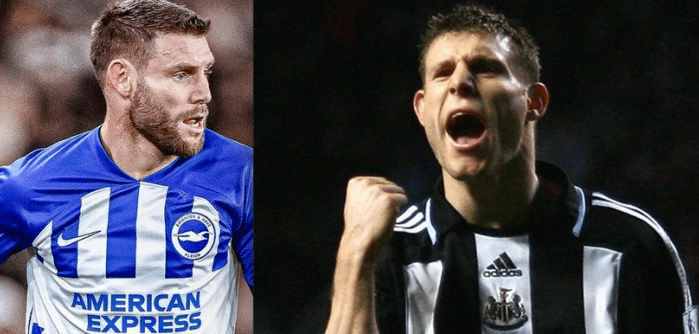
FROM being given his Premier League debut at 16 by one former England manager to being signed by another when only 18, James Milner’s career was on an upwards trajectory from an early age.

Terry Venables, when manager of Leeds, was happy to make Milner the youngest player to feature in the league (shortly after Wayne Rooney had become that at Everton and until the Toffees also gave that honour to James Vaughan).

Then, when Leeds were relegated from the top flight, Sir Bobby Robson took the teenager from his boyhood club to join Newcastle United for a fee of £3.6m. Leeds needed the money even though Milner was reluctant to leave.

The young winger made an instant impression on Robson in pre-season friendlies on the club’s tour of the Far East, expressing his delight with his workrate and desire to run at defenders and support the attack.

Even when Milner missed a crucial penalty against Thailand in a penalty shoot-out, he was confident enough to take another and score in the next game.

“We’re very pleased with him in the two games we’ve seen him in so far,” said Robson. “He’s shown a willingness to go forward and attack his full back, which I like very much. 

“He’s got confidence and on this display he is a young talent who is going to be very good for us. I was desperate to get him and we have done. He has a big future, I’m certain of that. He’s comfortable with both feet and he’s versatile because of that.”

Having mainly played on the left for Leeds, Newcastle initially put him on the right wing, but Milner was unfazed. “I really enjoyed myself,” he said. “I can play on the left as well but I would play anywhere as long as I am in the team. It doesn’t bother me.

“At my age, getting experience in The Premiership is all that matters. I have to use that experience to try and become a better player.”

The early positivity didn’t last long, though, when Robson was sacked at the end of August 2004 after five years in charge. His successor, Graeme Souness, didn’t share the previous manager’s view of young Milner and although he made 16 starts for Toon he was a sub on no fewer than  23 occasions.

“It’s very frustrating not playing every week but that’s the same if you are 39 or 19,” said Milner when interviewed ahead of an important England under 21 match against Azerbaijan at Middlesbrough’s Riverside Stadium. “I am hopeful that between now and the end of the season I can show my best form and hold down a regular spot in the side.

“It is an important match for the Under-21s as it is a qualifying game but it is also important for me on a personal basis as it will keep me match fit and ready for Newcastle.

“I hope the manager will be watching and I am determined to show him what I can do in a competitive situation.

“I have got to be patient because there are a lot of high-class players at Newcastle and I have got to wait to get my chance.

“I have got to prove myself to the manager and show that I should be involved in every game.”

Former Brighton manager Peter Taylor, who managed Milner for many of his record 46 appearances for England under 21s, said of him: “You couldn’t meet a nicer, more professional boy. He works his socks off for the team.

“If he is playing wide right and you are the right-back, then you are over the moon because he will put his shift in defensively and always be available when you have got the ball. He has an incredible work ethic.

“He is great to have in your team and he just keeps working and working to improve.

“The beautiful thing about him is when I first got involved with him at under 21 level, I wasn’t sure if he was right footed or left footed!

“He can use both feet and I think he can play in midfield as well as out wide and up front.”

When Newcastle were in somewhat of a slump under Souness, the Scot preferred experience over youth and was happy to let Milner go to Aston Villa on a season-long loan.

Many years later, in a column for the Daily Mail, Souness said: “At Newcastle, I knew him as a young boy. He has matured into a professional you can bet is a ten out of ten around the dressing room. He was upset with me many years ago at Newcastle when I said ‘You won’t win the league with James Milners’ and he took that as me saying he wasn’t good enough.

“I was trying to say that you needed men. He was only 19 at the time. I apologised to him for that and I hope he’s forgiven me. You can never have enough James Milners in the dressing room. He makes other players turn up.”

Milner certainly didn’t bear a grudge, as he described in an interview with FourFourTwo in 2018. “Newcastle was tough – the manager who’d signed me, Bobby Robson, got sacked three games into the season, so a new manager arrived and I ended up going on loan again, to Aston Villa,” he said.

“The first time I finished a season with the same manager who started it was Martin O’Neill at Villa, probably five seasons into my career. When someone has an opinion, even if it ends up misquoted, people jump on it.

“But as a player you love the chance to shut people up. Any time that you’re criticised, it drives you on and you try to prove people wrong. That’s what I did in that part of my career.

“But I get on with Graeme – there’s no beef. When I won the Premier League title at Manchester City, he was covering the game and he came over to congratulate me.”

As covered in my previous blog post, Newcastle had a change of heart about making the player’s move to Villa permanent in the summer of 2005 and he returned to St James’ Park to become a regular under Glenn Roeder, supplying crosses to the likes of Obafemi Martins, Michael Owen and Mark Viduka.

He made 46 league and cup appearances plus seven as a sub and, in half of the 2007-08 season under Sam Allardyce and the other half under Kevin Keegan, he played 28 games plus four as a sub.

It was during the brief England managership of Allardyce in 2016 that Milner decided to step away from his international career after winning 61 caps. Allardyce told the media:“James has had the chance to reflect on his international career in recent months and consider his next steps, particularly with a young family at home and having allowed himself little free time away from the professional game in the past 15 years. James can be proud of his seven-year career as a senior England player.”

How Milner left Newcastle was a lot less convivial. He said their transfer valuation of him wasn’t reflected in what he was paid at the club, and he was further angered by what he thought was a private negotiation being made public by the powers that be at St James’.

It forced the PFA (Professional Footballers’ Association), who were representing Milner, to speak out in his defence. Expressing disappointment that the club had not respected the privacy the player expected, PFA chief executive Mick McGuire said: “All James wanted was a deal that reflected his development and that was in line with Newcastle’s transfer valuation of him.

“Whilst James does have three years left on his current agreement, it is common practice that when a young player signs a long-term contract, this is reviewed and improved on a regular basis with a player’s development, but equally it protects the club’s position in regard to their transfer value.”

As it turned out, Milner got a permanent transfer to Villa that August (2008) and Keegan toldthe media: “He’s a player, in an ideal world, you would not want to lose, but I just want to make it absolutely clear that at the end of the day, it was my decision to sell him.

“We got an offer that I feel was his value. We are all aware James has had a difficult time – he almost signed for them once before and was dragged back.

“But he has always behaved impeccably. He’s a fantastic professional, and there’s no doubt about it, they’ve got an outstanding player and we have got to move on.”

However, in a 2016 Interview with the Birmingham Mail, Keegan’s former deputy Terry McDermott said they only agreed to the sale because the Newcastle hierarchy promised they’d sign Bastien Schweinsteiger – at the time one of the world’s most in-demand players – as a replacement.

But after the Milner sale had been agreed, Bayern Munich wanted £50m for the German midfielder and there was no chance United would spend that kind of money.

“So, we had no one to replace him,” said McDermott. “But he was irreplaceable anyway because he could play anywhere.”

The saga was symptomatic of the strained relationship Keegan discovered working under new owner Mike Ashley and the football operations triumvirate of Dennis Wise, Tony Jimenez and Derek Llambias. Within a few days he walked out of the club.

Injury has restricted Milner’s outings for the Albion

Meanwhile, on completing his move, Milner spoke out about the way Newcastle had handled things insisting their asking price was not reflected in his salary at St James’ Park, saying there was “never” any indication the club were willing to discuss a new contract.

“I enjoyed every minute at Newcastle and working with the manager,” said Milner. “But the way things were going, I knew offers had come in over the summer and the club had turned them down.

“Their valuation of me wasn’t reflected in the deal I was on. Speaking to Newcastle I thought it was the right thing to do to put in a transfer request to show how I felt, seeing they weren’t on the same wavelength as me. They then made the decision to sell me.”

Newcastle fans were certainly disappointed to see Milner leave the club, for example independent online newsletter The Mag said: “His dedication, workrate and energy could never be questioned and the Toon Army loved his wholehearted commitment to the cause.

“His crossing and goal threat needed work but everyone was in agreement that this was a player that the club should be building its future around.”

Reflecting on the numerous trophies the player won with City and Liverpool, the title concluded: “Undoubtedly one of the most successful players that we allowed to slip through our grasp.”

The Withdean visitors’ teenage winger went on to great things

MY FIRST memory of watching James Milner play was at Withdean Stadium when he was on loan to Swindon Town from Leeds United.

Even then, as a seventeen-year-old, he had something about him – but I certainly didn’t imagine I would be watching him playing in the Premier League and Europe for Brighton 20 years later!

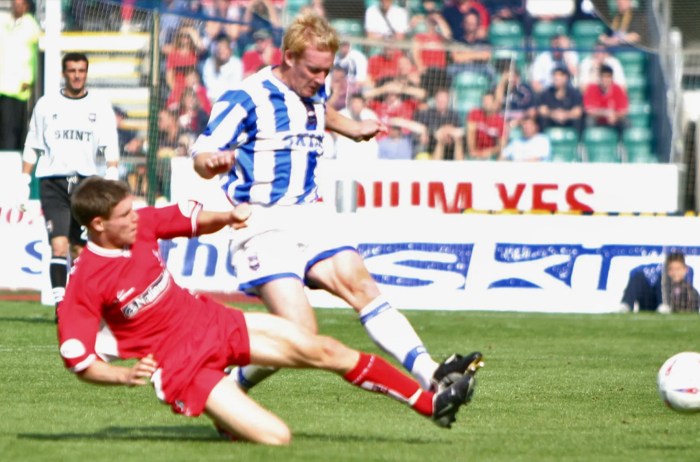
Young Milner tackles Brighton’s Kerry Mayo

That League One game on 6 September 2003 finished 2-2. Sam Parkin scored twice for Town and Albion’s goals came from Gary Hart and a penalty from on-loan Darius Henderson.

The Albion matchday programme subsequently recorded: “Kerry Mayo had a fine match, mainly subduing the impressive teenager James Milner.” (although, as the picture suggests, he wasn’t afraid to launch himself into a tackle).

Swindon’s manager Andy King had persuaded his old Everton teammate, Peter Reid (in charge of Leeds at the time) to loan Milner to the Robins for a month. In just six matches, the young winger scored twice.

“The boy is a terrific talent and everyone has been able to see the skills he has and I have no doubt he will go on to perform in the Premiership,” King told Sky Sports.

Milner already had two goals to his name for his parent club having scored twice in the Premier League in 2002-03 while still only 16.

On Boxing Day 2002, ten days short of his 17th birthday, he became the youngest player to score in the elite division, with a goal in a 2–1 win at Sunderland (the record had been set a couple of months earlier by Wayne Rooney for Everton and was subsequently taken by James Vaughan, also for the Toffees).

Milner had gone on as a 36th-minute sub for Alan Smith, a player he had admired when a boy growing up in Leeds. Terry Venables, Leeds manager at the time, said: “It’s not just a case of him simply coming through and helping out because every day he is getting better and better.”

Milner scored again three days later after going on as a 31st minute sub for Harry Kewell as Leeds beat Chelsea 2-0 at Elland Road.

“Picking up Mark Viduka’s pass in first-half injury time, Milner beat his man before thumping a right-foot shot low into the net with Blues keeper Ed de Goey powerless to stop him,” said the BBC report of the match.

“I am very pleased with him,” said Venables. “He is growing in this group and he has taken advantage of every day’s training to show what he can do.

“He has two good feet, he is courageous and everyone likes him a lot. He also is not only a nice, solid, good, well-mannered boy, he is a very talented player.

“It’s early days for the boy. At the moment he has not achieved anything and he is the first to admit that.

“But I think a lot of people are confident about his development. We have just got to take it easy.”

Wind on the clock more than two decades and Albion are now enjoying the benefit of Milner’s vast experience gained winning trophies galore for two of the country’s top clubs and playing for his country.

Born in Wortley, Leeds, on 4 January 1986, Milner broke through with Leeds United before joining Newcastle United at 18 and having loan and permanent spells at Aston Villa.

Milner went on to make more than 200 league and cup appearances for Manchester City and more than 300 for Liverpool as well as earning 61 full England caps and a record 46 at under 21 level.

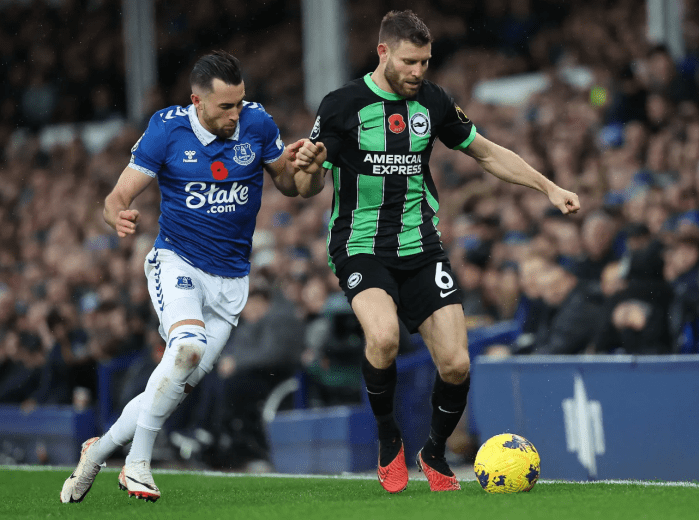
Against Wolves on 22 January 2024, 38-year-old Milner overtook Ryan Giggs to go second outright on the Premier League’s all-time appearance list when he played in his 633rd top-flight match, 20 short of record holder Gareth Barry.

“I’ve had some luck,” Milner told TNT Sports. “I’ve worked hard and you have to enjoy it to put the work in every day. I’ve hopefully got a few more games in me.”

Milner’s free transfer move to Liverpool from Manchester City in the summer of 2015 proved an inspiration that brought him even more medals than he had won with the Sky Blues.

Over eight seasons, he made 332 appearances, scored 26 goals and lifted seven trophies along the way.  

“He’s a role model,” said manager Jürgen Klopp. “Nothing we have achieved in the last few years would have happened without James Milner, it’s as easy as that.

“Whether he was on the pitch or not, he’s set standards in a way not a lot of people can set standards, and it educated all of us.”

In a heartfelt tribute to the player, Klopp added: “From the first moment for me, he was a super-important player reference point.

“When you have a meeting and you look at Millie’s eyes and he’s not shaking his head, you know you’re on the right way. Nothing would have happened here without Millie because he kept it always going.

“From the player who was super-angry when he didn’t play, to the player when he did play, the way he pushed the whole dressing room before a game is absolutely second to none.”

For his part, Milner enjoyed a good relationship with Klopp, apart from once during a half-time flashpoint when the manager lost it, as Milner revealed to The High Performance Podcast.

“We had one moment where he was sharing his thoughts and I was sharing mine and I remember him smashing his hands on down the table and shouting, ‘Will you shut the f**k up!’ But Jurgen was brilliant, we had a great relationship and we were great off the pitch.”

It was Klopp’s predecessor, Brendan Rodgers, who persuaded Milner to make the journey along the M62, and he said at the time he signed him: “He had won the Premier League, he had won cups. His whole ambition was to win the Champions League and he felt that he would have a better opportunity to win it at Liverpool.”

Rodgers revealed that when Liverpool were trying to persuade him to sign, his wife Charlotte spent time chatting to Mrs Milner while he spent time with her husband!

“His actual football talent has probably gone under the radar because he’s played around some outstanding talents, but this is a guy who works tirelessly at his game,” said Rodgers.

“He’s in here at 7.45am making sure he’s prepared for his training, getting all of his food supplements and getting everything correct before training – he’s in two-and-a-half hours before he trains and then does his work, gives his maximum.

“He prepares himself like an elite player should. He’s also got big character and a big mentality.”

Rodgers was effusive in his praise of the new signing even before a ball had been kicked in anger after he scored the winner in a 2-1 pre-season victory over Brisbane Roar. Playing in the central role he preferred, he also provided a pass for Adam Lallana’s 27th-minute equaliser.

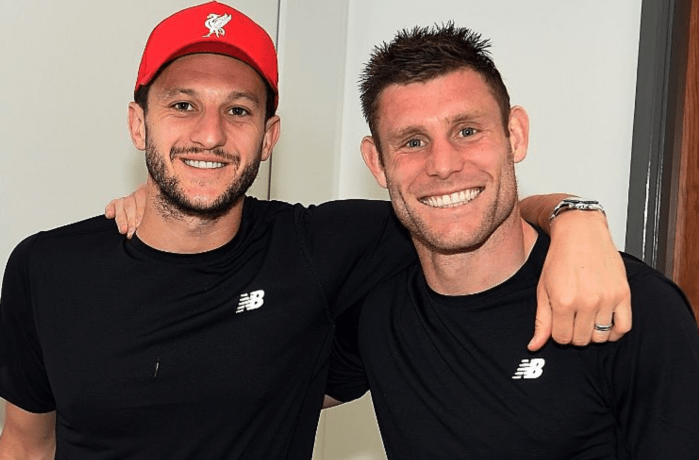
Former Liverpool teammates Adam Lallana and James Milner reunited at Brighton

“James Milner is a class act,” he told reporters. “We had to work very hard to get him in but I think we’ll see over the course of the season how important he is for us.

“He’s a wonderful personality and a top class footballer. When you see him play in his favourite position, you see all these qualities come out.”

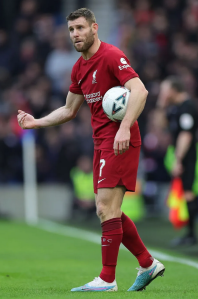
Milner in action for Liverpool against Brighton during a lockdown match

Rodgers departed Anfield not long after Milner’s arrival but the player grew in stature under Klopp and, although it wasn’t his favourite position, he spent much of 2016-17, filling in at left-back.

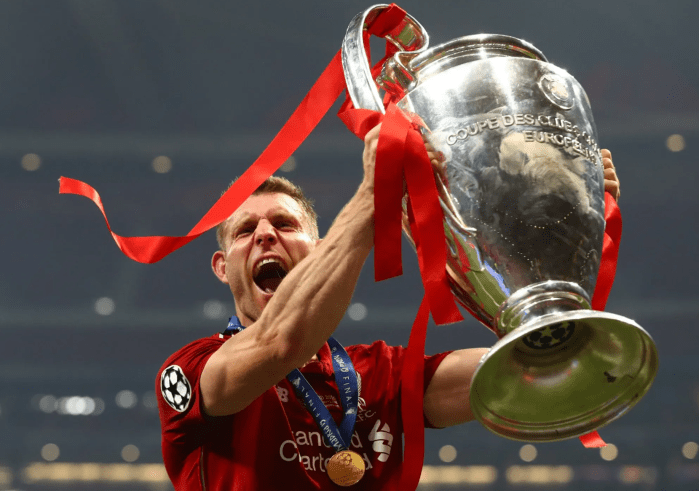
That season he made 40 appearances – 36 in the Premier League – as Liverpool qualified for the Champions League. They made it all the way to the final, only to lose to Real Madrid in Kyiv. But they made amends the following season and returned from Madrid with Liverpool’s sixth European Cup.

Milner went on as a second-half substitute in the Estadio Metropolitano in the 2-0 win over Tottenham Hotspur. “It will be nice going to Melwood seeing No.6 there,” he said. “Liverpool has a great history and when I signed for the club, I was desperate to add trophies as this club expects to win trophies and it has an amazing history – but we want to create our own history.”

Not only did they add the UEFA Super Cup and FIFA Club World Cup, Milner made 22 appearances as Liverpool clinched the Premier League title in 2019-20 with 99 points.

In 2021-22, Milner scored the first in Liverpool’s 11-10 penalty shoot-out win in Liverpool’s Carabao Cup defeat of Chelsea at Wembley, having gone on as an 80th minute sub, and he repeated the feat (as a 74th-minute sub) when the teams were also goalless at the end of the Emirates FA Cup final three months later. Liverpool won that 6-5 on penalties.

In his final season at Anfield, Milner featured 43 times and moved up to third spot on the Premier League’s all-time appearances list.

“I’m Leeds through and through and always have been and always will be – but I never probably thought that another club would get into me as much as Liverpool has,” said Milner.

The player he followed from Anfield to the Amex, Lallana, told the BBC exactly what Milner brings to a squad, especially in setting an example to younger players.

“He helps the management team in so many ways with the experience he’s built up,” said Lallana. “He knows what it takes to win. He knows what sacrifices need to be made.

“I’m not sure how he got the boring James Milner label, but he couldn’t be further away from that. He’s one of the loudest in the dressing room for sure. Full of life. Full of banter. But he’s definitely old school.”

Lallana added: “Those basics are always there and they’ll never change. I think that’s what’s made him who he is and given him his success. Those values that he’ll always live by. He taught me how to be a better professional and a better role model.”

It all began at Westbrook Lane Primary School in Horsforth and the secondary Horsforth School. He played local amateur football with Rawdon whose coach Graeme Coulson had first noticed Milner as a nine-year-old.

“I first came across him when I was refereeing a junior match involving Westbrook under nines at Horsforth,” Coulson told the Craven Herald and Pioneer. “He was so outstanding then that I asked some of the Horsforth parents who he was.

“I noted his name and it was one not to be forgotten. He was an outstanding talent scoring lots of goals but he was also very strong.”

Horsforth School spokeswoman Fran Morris said: “He was a first class student and he did really well at his GCSEs (he got eleven).

“He was very sporty at school and he won the PE prize which was handed out just before we broke up.

“He was the most wonderful young man and he was very popular, so we wish him all the best in his career. I am very sure he will do well and we are all proud of him at the school.”

Let alone his football ability, the young Milner also played cricket for Yorkshire Schools and excelled as an athlete: he was Leeds Schools’ cross-country champion for three successive years and district 100 metres champion for successive years.

Milner was a season ticket holder at Elland Road along with his parents Peter and Lesley before becoming a ball boy. He joined the Leeds United Academy after being spotted playing for Westbrook in Horsforth.

The sporty youngster was forced to decide between cricket and football, explaining in one interview: “I played for Yorkshire at the ages of 10 and 11 as a wicketkeeper-batsman. It was something I enjoyed but you get to a stage where you have to make a choice.

“I stopped playing cricket at 16 when I moved full time to the Leeds United Academy. They couldn’t take the risk of me getting injured, having my foot broken by a yorker or something like that.

“A couple of months later I made my Leeds debut. I still can’t take the risk for the same reason, but as soon as I retire from football, I’ll look forward to taking up cricket again.”

He completed his formal education at sports college Boston Spa School, which works in partnership with Leeds United, and, as soon as he left school, he was taken on as a trainee.

As he worked his way through United’s youth ranks, he also played for England at under-15 and under-17 levels.

Milner in action for the Albion against Everton at Goodison Park

Zamora’s wait for England while dad’s Trinidad came knocking

TEN DAYS after Barry Fry’s prediction about Bobby Zamora playing for England, he made his debut for the country’s under 21 side.

It was 16 April 2002 and the Brighton striker went on as a sub for Leeds’ Alan Smith in a 1-0 friendly defeat v Portugal at Stoke’s Britannia Stadium. Paul Konchesky, a fellow graduate of the East London boys’ team Senrab, was left-back that day.

While plenty of observers expected Zamora eventually to step up to the full England side, he had to wait until he was 30 to make his first (and only) start at that level, and not before being wooed to switch allegiance and play for Trinidad and Tobago.

That happened in 2005, when the Caribbean country’s Dutch coach, Leo Beenhakker, wanted him to play in a World Cup qualifier against Guatemala. Zamora told the News of the World: “Trinidad is my dad’s country and to play in the finals would be a dream but West Ham are more important.

“I am only thinking about the club at the moment and do not want to be distracted from that. The club mean everything to me and if I can help us have a good season that is all that matters.”

After an injury-hit 2007-08 season, though, West Ham sold him to Fulham in the summer of 2008. The following year it was reported Zamora and his old Senrab teammate Jloyd Samuel had both obtained Trinidad & Tobago passports in time to play in a 2010 World Cup qualifier.

Injury prevented Zamora from getting involved but Samuel did play twice for the Soca Warriors even though he had won seven England under 21 caps. (Samuel tragically died in a road accident aged 37 in 2018).

Zamora top-scored with 19 goals in Fulham’s memorable 2009-10 season under Roy Hodgson. The south London side finished 12th in the Premier League and made it through to the final of the Europa League (the first season of the revamped competition previously known as the UEFA Cup).

Zamora had been a fitness doubt before the game against Athletico Madrid in the People’s Park Stadium in Hamburg and he had to give way to Clint Dempsey 10 minutes into the second half.

The game went into extra time with the score 1-1 after 90 minutes and agonisingly Fulham succumbed to an extra time winner scored by Diego Forlan. Sergio Aguero, later of Man City fame, beat defender Aaron Hughes and crossed for Forlan to flick the ball home four minutes from the end.

Nevertheless, Zamora’s goalscoring form had caught the attention of England manager Fabio Capello and his deputy Franco Baldini who were keen to call him up for the 2010 World Cup.

Sadly, those hopes were dashed by an achilles injury, and Zamora conceded: “I told Fabio that I was struggling and I knew that, had I gone, I wouldn’t have done myself or England justice.”

The player told The Independent: “It’s been an up and down season because it’s been so good on the pitch and I’ve scored some important goals. To now pick up this injury has kicked me in the teeth.

“It’s come during the last couple of weeks and when there was the possibility of going to the World Cup with England. That’s football, it’s a cruel game.”

He added: “The World Cup’s a massive tournament. It’s not about myself, it’s about England.

“Capello wished me all the best, hoped that I get fit and would be available next season.”

True to his word, Zamora was one of five uncapped players included in Capello’s squad immediately after the disappointment in South Africa.

One of the first people to contact him was former West Ham teammate, Teddy Sheringham, who he said he learnt so much from. “I got a long text message from Teddy. He said I might be nervous beforehand but that I deserved this opportunity, and he said once I’d taken part in my first training session, I would realise that I deserved to be there. He was spot on; after that I did not look out of place and I embraced being part of the squad.”

The call up came in something of a crazy week for Zamora because only days earlier his wife gave birth to twin girls, Gisele and Siena.

“The twins were born last Monday, they came out (of hospital) on Friday, then I had a match on Saturday, was back home for one day and then I was away with England, so I have not seen them as much as I wanted to, but I am sure I will find some time when I get back home,” he said.

“The twins are a massive part of my life now, and with getting the call-up to play for your country is a massive honour. I am lost for words. I am extremely proud to be called up to play for my country.”

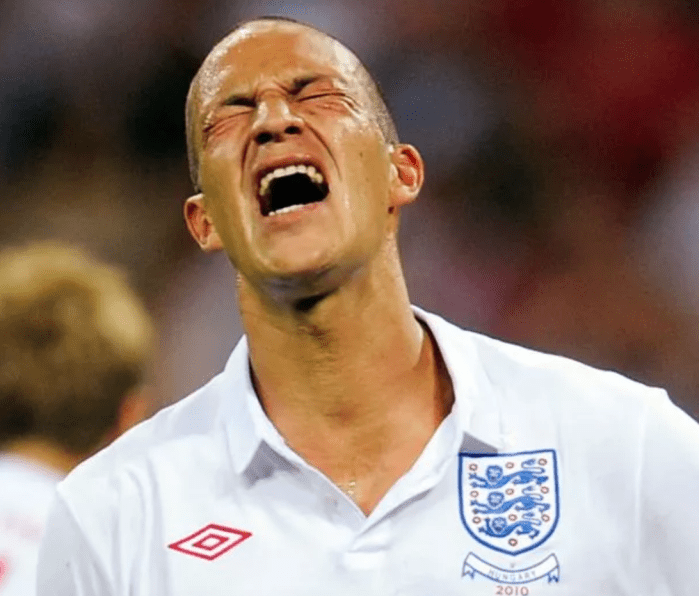
Capello sent him on as a second half substitute for Frank Lampard to play up front alongside Wayne Rooney in England’s 2-1 friendly win over Hungary at Wembley on 11 August 2010.

Having made that breakthrough, the day after he signed a new four-year contract with Fulham he agonisingly suffered another setback when he broke a leg (above) and sustained ankle ligament damage during a 2-1 win over Wolves. He was sidelined for five months.

Capello didn’t consign him to history, though, and called him up again in May 2011 (his teammate David Stockdale was in the same squad) to face Switzerland in a Euro 2012 qualifier. But neither were involved in the disappointing 2-2 Wembley draw.

His first start for England finally came six months later in a 1-0 home win over Sweden, the first time in 43 years that England had beaten the Scandinavian country. Zamora’s close friend (and another former Senrab graduate) John Terry was England captain and joining the striker in making first starts were right-back Kyle Walker and Everton’s Jack Rodwell.

Richard Williams in The Guardian clearly felt sorry for the debutant centre forward, though, writing: “Poor Bobby Zamora. Offered the opportunity to score England’s 2,000th goal on Tuesday night, a perennially unfortunate footballer was forced instead to stand and watch as Stewart Downing’s cross glanced off the side of Gareth Barry’s head and then off Daniel Majstorovic’s forehead before evading Andreas Isaksson’s dive as it looped inside the post for the most anticlimactic of own goals.”

Reporting on the narrow victory over the Swedes, Williams added: “Whichever side the ball went, Zamora made sure he was available. A double exchange of passes with Walcott in the 17th minute put Zamora in on goal, but after Isaksson blocked his first effort the follow-up was poked past the post from five yards.

“Any centre forward will ultimately be judged by the goals he scores rather than his total of assists, and Zamora spurned a wonderful chance in the 65th minute when Downing scampered down the left once more before pulling the ball back at precisely the right pace and angle for the striker to meet it with a first‑time connection. Jonas Olsson, however, flew in to deflect the shot for a corner.”

Zamora was subbed off in the 70th minute to be replaced by Darren Bent and the Guardian sports writer concluded: “England – and Zamora in particular – really should have inflicted greater punishment on such humdrum opposition.”

Bent had also replaced Zamora in his first start for England under 21s. That came in February 2003 in a 1-0 defeat to Italy in Carrara.

A month before his move to Spurs, he also started England’s 3-2 friendly win over Serbia and Montenegro at Hull’s Kingston Communications Stadium, on that occasion being replaced by Darren Ambrose. (His future Fulham and Albion teammate Steve Sidwell was in midfield that day).

Eight days later, in a UEFA under 21 championship preliminary match, he went on as a sub for Shola Ameobi as England beat Slovakia at the Stadium of Light, Sunderland.

Zamora showed England quality at an early age

After that under 21s debut against Portugal, he was selected in the squad for the UEFA under 21 championship finals in Switzerland. On 20 May 2002, David Platt sent him on as a sub for Gareth Barry in a 2-1 defeat to Italy in Basle.

Two days later, in the third group match, again a sub, he replaced Jermain Defoe as England lost 3-1 to Portugal and were eliminated from the competition.

On two other occasions Zamora was an unused sub but he didn’t add to his six caps. And, after

Capello quit the England job in February 2012, Zamora didn’t play for the full England side again.

• Ahead of Albion’s new year clash with West Ham, find out why Zamora’s move to the Boleyn Ground was so ideal in the next instalment.

When the ball hits the goal it’s not Shearer or Cole it’s Zamora!

EVERY NOW AND AGAIN as a football supporter a truly special player stands out well above the rest you’ve watched. Bobby Zamora was most definitely in that category.

As the new year dawns on what will be my 55th year supporting Brighton & Hove Albion, it is perhaps fitting to spend a little time remembering just how good Zamora was for the Seagulls before his outstanding ability to score goals was taken to higher levels: Tottenham Hotspur, West Ham, Fulham and ultimately, and, quite deservedly, England.

That he came back to the Albion from QPR as his career began to ebb was nothing short of a bonus­ – and, while I’m not a big gambler, I was delighted to get a modest return from the bookies when my punt on him being the last goalscorer came good after he had gone on as a sub at Elland Road on 15 October 2015 and chipped the winner (below) to register his first goal since rejoining!

“That goal was definitely the highlight of my season,” Zamora told interviewer Adam Virgo in a Seagulls World interview. “It was my first goal since coming back and to score the winner so late in the game was unbelievable. It was a special moment for me, and it settled the nerves knowing that we’d got the three points.”

Just four days later, Zamora repeated the feat going on as a 76th-minute substitute for Tomer Hemed at home to Bristol City and beating goalkeeper Frank Fielding with a low shot from 15 yards out. Albion won 2-1; Sam Baldock having levelled things up against his former club after Derrick Williams opened the scoring for City.

Unfortunately, Zamora managed just five more in that second spell. He made 10 starts plus 16 as a sub in Chris Hughton’s side but he was struggling with a hip injury.

It eventually caught up with him and prevented him from contributing further to Albion’s aim of promotion back to the elite; his last game being as a sub in a 0-0 draw at home to Sheffield Wednesday on 8 March 2016. “If I was fit, I would have scored some goals and we’d have been promoted automatically,” he told the UndrThe Cosh podcast (pictured above).

Thankfully another returning striker in the shape of Glenn Murray completed that task the following season and went on to cement his own place in Albion’s history: his 111 goals in 287 appearances putting him second in the list of Brighton’s all-time top goalscorers.

Golden goalscorers: Zamora + Murray

Each of the different eras I’ve watched the Albion has thrown up truly memorable players who have generated their own air of excitement and anticipation because of the goals they scored.

The first one for me was Alex Dawson, who netted seven in the first five games I watched in 1969. Then along came Willie Irvine whose goalscoring in third tier Albion’s promotion-winning season of 1972 earned him an unexpected recall to the Northern Ireland side – and an appearance (that I went to watch) in a 1-0 win against England at Wembley.

Next, of course, was the truly outstanding Peter Ward, who jinked his way past defenders with apparent ease and scored goals for fun, his 36 goals in 1976-77 smashing a decades-old record. Like Zamora, he came back to the scene of past glories (albeit only on loan) and scored a magnificent winner against the team he supported as a boy, Manchester United.

Garry Nelson, with 32 goals, and Kevin Bremner were a superb front pair in another third tier promotion-winning line-up in 1988 while, in 1990-91, Mike Small and John Byrne combined brilliantly to take the Seagulls within a hair’s breadth of a return to the big time.

The arrival of a beanpole of a kid with an eye for goal in Zamora completely transformed Albion’s fortunes under Micky Adams and he was the talisman in back-to-back promotions following years in the doldrums.

Zamora’s Albion story is pretty well known but let’s remind ourselves of how it all began.

Depending on whose account you believe more, it was either Dick Knight or Adams who had the foresight to bring Zamora to the Withdean.

Adams said: “The first time I saw him he came onto the training ground; he looked like a kid. But he was tall and gangly with a useful left foot; there was potential there.”

In fact, Zamora might never have arrived in Sussex if Albion had been successful in securing a permanent deal for on-loan Lorenzo Pinamonte. When Brentford outbid Brighton for the services of the Bristol City loanee, Albion turned their attention to Zamora (left), a Bristol Rovers player who was only getting sub appearances under Ian Holloway but had scored eight goals in six games on loan at nearby non-league Bath City.

“He was six foot one and we knew he had a very good first touch and could hold the ball up well, the type of player we wanted,” Knight recounted in his autobiography Mad Man: From The Gutter to the Stars (Vision Sports Publishing, 2013).

Zamora duly arrived on loan and scored six in six matches (including a hat-trick in a 7-1 away win at Chester). He scored an equaliser and was named Man of the Match on his debut v Plymouth and by the end of February was Player of the Month.

Hat-trick ball at Chester

While Knight and Adams wanted him to stay, he insisted on returning to Rovers where he thought he might force his way into Holloway’s starting line-up. But it was back only to the bench as Nathan Ellington, Jason Roberts and Jamie Cureton were ahead of him in the pecking order.

As preparations began for the new season, Albion offered £60,000 for Zamora but Rovers chairman Geoff Dunford wanted £250,000. An incredulous Knight said he wouldn’t go higher than £100,000 and couldn’t believe they could demand such a figure for someone who hadn’t actually started a first team game.

Zamora had Rovers’ youth team coach Phil Bater to thank for forcing through the move. He accompanied the shy youngster into a meeting with Holloway, who tried to say he’d get some games if he stayed. Bater reckoned the youngster was being strung along and argued Zamora’s cause saying he stood more chance of playing if Rovers let him join the Albion.

After some brinkmanship from each club’s respective chairmen, with Knight threatening to walk away from the deal, it finally went through two days before the start of the season, although Albion’s chairman reluctantly agreed to a 30 per cent sell-on clause for the player.

Zamora instantly became one of the top earners on £2,000 a week with a goal bonus built in.

“It was an absolute coup that we had finally secured this player,” said Knight. “I could only see good things in him, could only see that he would be a huge asset to us.

“Football is all a matter of opinions. There is little science to it. For me, Zamora was the best signing I ever made.”

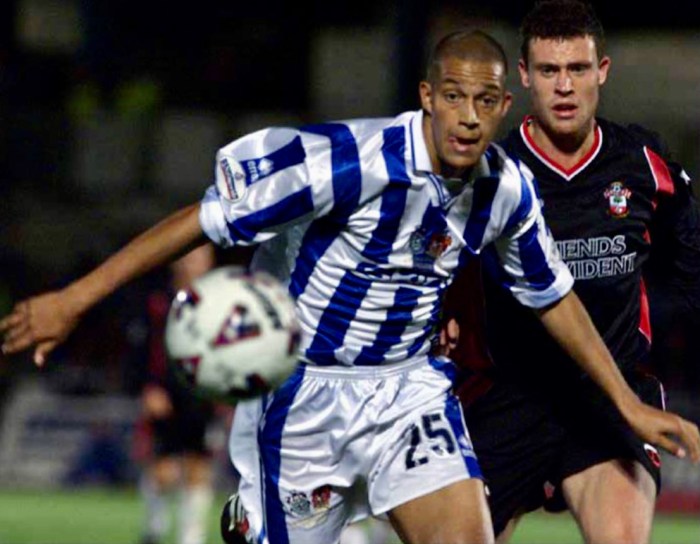
Zamora has eyes on the ball closely watched by a young Wayne Bridge for Southampton

Not only did Zamora manage to score 31 goals as Albion won promotion from the basement division, he went one better when they went straight to the top of the third tier the following season, netting 32 times in 46 matches.

A significant number of those goals came courtesy of Zamora’s excellent understanding with left-footed right-back Paul Watson, of whom he said: “He created a lot of goals for me with those quick free kicks. He didn’t put a foot wrong too often and was very underrated. He never got the credit his hard work deserved.”

Expanding on it in another interview, he said: “Whenever Watto got the ball I knew precisely where I needed to run to and he knew where to deliver it. It was such a great connection: Watto has an absolutely wonderful left foot and it made my job as a striker so much easier when you get deliveries like that.”

Declaring that even in the Premiership he hadn’t come across anybody with a better left foot, he added: “I was very lucky to have played in the same team as him; he created numerous goals for me; not only with his deliveries but with his intelligent play as well.”

Watson had arrived at the club with Charlie Oatway and was part of a cluster of players who had served under Adams at Brentford and Fulham. When Adams and assistant Bob Booker steered Albion to promotion as fourth tier champions, Zamora was player of the season and he and Danny Cullip were named in the PFA divisional XI.

Not long into the following season, the lure of taking over as manager at a Premier League club saw Adams quit Brighton, initially to become Dave Bassett’s no.2 at Leicester City, but with the promise of succeeding him.

“While I thought I had a shot at another promotion, it wasn’t a certainty,” Adams explained. “I knew I had put together a team of winners, and I knew I had a goalscorer in Bobby Zamora, but football’s fickle finger of fate could have disrupted that at any time.”

His successor, Peter Taylor, knew how fortunate he was to inherit an experienced squad, and said: “Of course the greatest asset we had was Bobby Zamora. Having him meant that we could play a front two at home and away from home we could play him on his own and he would still get us a goal out of nothing. He was an incredible player and miles too good for that level.”

And Zamora wasn’t only a star on the pitch, as Knight spoke about in his autobiography. “When he was at his zenith at Brighton, the requests we got for him to visit schools, hospitals and go to prize-givings far outweighed all the other players together, but he was always amenable. He was never starry, never refused. I couldn’t speak more highly of Bobby Zamora as a person.”

Knight recounted in his book how, after a 1-0 win at Peterborough, when Zamora missed a penalty but also scored the only goal of the game, Albion’s promotion to the second tier was confirmed and in his own inimitable way Posh boss Barry Fry said to Brighton’s star striker: “You’re a fucking great player and you’ll play for England one day, I’m fucking sure of it.”

Zamora was still only 21 when Tottenham signed him from relegated Brighton in July 2003. He left the south coast having scored a total of 83 goals in 136 appearances but in his last season in the stripes he netted just 14 as the Seagulls battled unsuccessfully to retain their tier two status.

Unfortunately, he missed eleven matches with a dislocated shoulder and, had former Premier League striker Paul Kitson been fit to play alongside him (he managed only seven starts plus three off the bench), the season may well have had a different outcome.

Everton’s Bill Kenwright had offered £3m for Zamora during the season but their manager Walter Smith seemed less convinced and, with Kevin Campbell and Wayne Rooney likely to be ahead of him, Zamora stayed in Sussex.

But chairman Dick Knight promised not to stand in his way if an opportunity was presented at the end of the season and that came from Tottenham. Manager Glenn Hoddle and assistant Chris Hughton had been to see Zamora in action at the Withdean on a number of occasions.

Spurs chairman Daniel Levy played hardball over the deal. Eventually, Knight settled on a £1.5m fee but, because of the original sell-on clause, £450,000 was due to Bristol Rovers.

Hoddle told The Guardian: “He has got good pace and great movement on and off the ball. No disrespect to Brighton, they have got a good team down there, but we have got players here who can make the most of his movement.”

The player’s agent Phil Smith told the newspaper: “The fee for Bobby is £1.5m which is a decent price in today’s market for a Second Division striker.

“It has been a long time coming for Bobby but he is delighted to be going into the Premiership. It has always been an ambition.”

Disappointed Albion manager Steve Coppell observed: “It is a big move for Bobby and nobody really expected we could hang onto him for much longer. But it has blown a big hole in any plans I had. I don’t have a better option than playing with Bobby Zamora up front.”

When he arrived at Spurs, one of the senior pros who took him under his wing was none other than Gus Poyet.

“As a young guy coming into the team, he was one of the senior pros who would always talk to me and encourage me,” Zamora told the matchday programme. “He didn’t have to do that, but he went out of his way to do so and you could see he had coaching qualities. He would often point things out on the pitch that you’d pick up on, and when he spoke, you’d listen.

“He wasn’t starting every game either, so in training I did more things with him than maybe the rest. I really got on well with him.”

As it turned out, Zamora made only 18 appearances for Spurs (11 as a substitute) and only scored once – ironically a single goal that knocked West Ham out of the Carling Cup in October 2003.

In January 2004, Spurs chose to use him as a makeweight in taking Jermain Defoe from the Boleyn Ground to White Hart Lane.

Phlegmatic Zamora didn’t look on it as a failure but embraced the “learning curve” of training alongside the likes of Poyet, Robbie Keane, Darren Anderton and Jamie Redknapp.

“I came away a better player and with more experience,” he said. “Glenn Hoddle had signed me and then he got sacked not long afterwards. David Pleat took charge and we didn’t really see eye-to-eye, but the lads and the club were brilliant and I learned so much from my time there.

“I took a chance by stepping back down to the Championship with West Ham – but it was the opportunity of playing regular football again that was the pull for me.”

‘Glove-wearing gazelle’ played only 16 Albion games

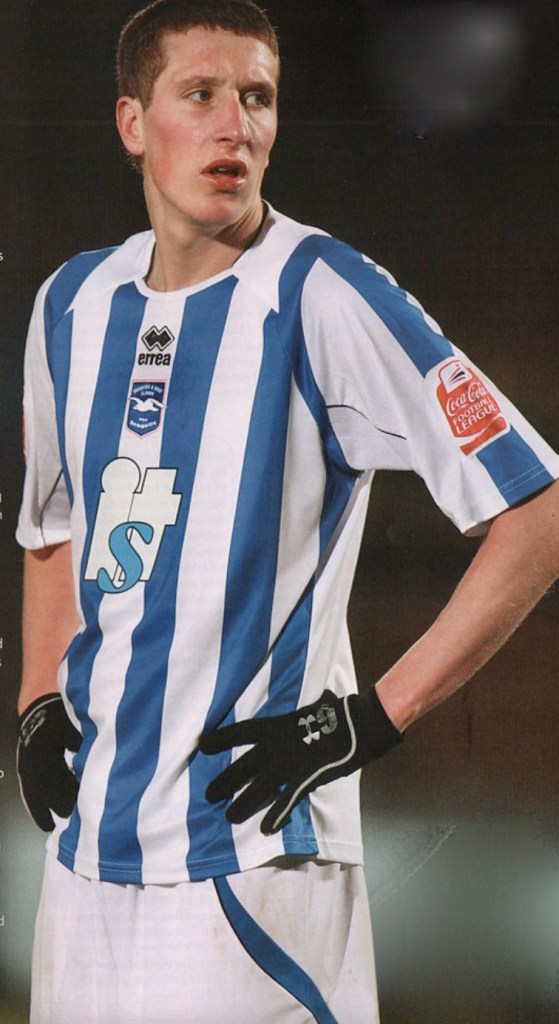
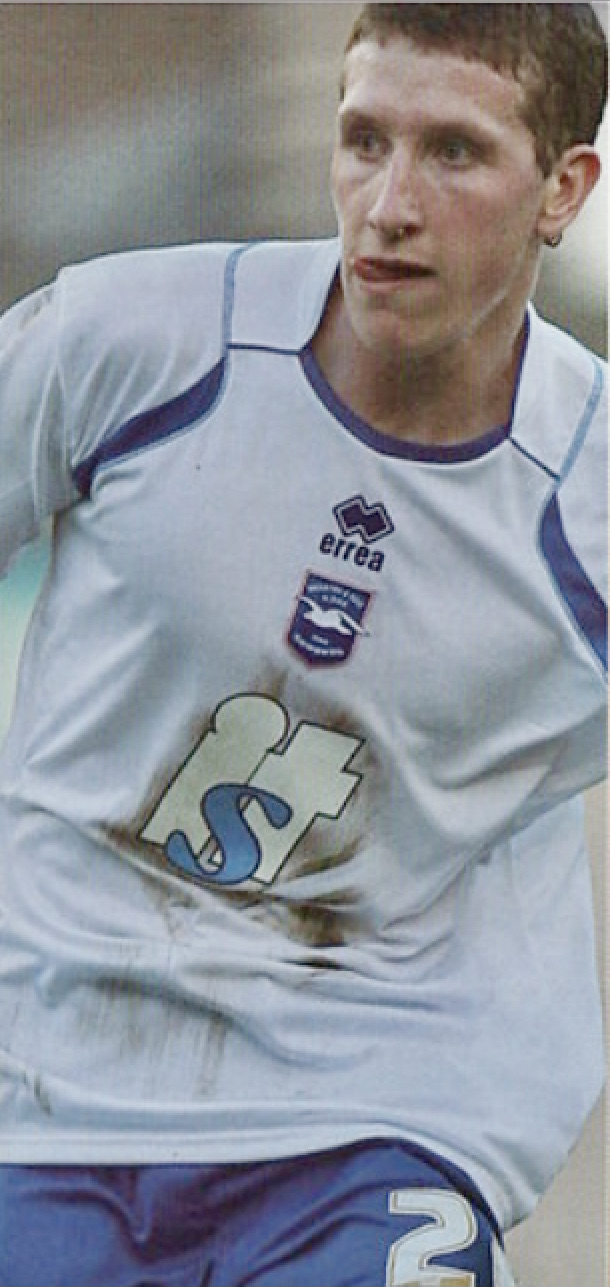
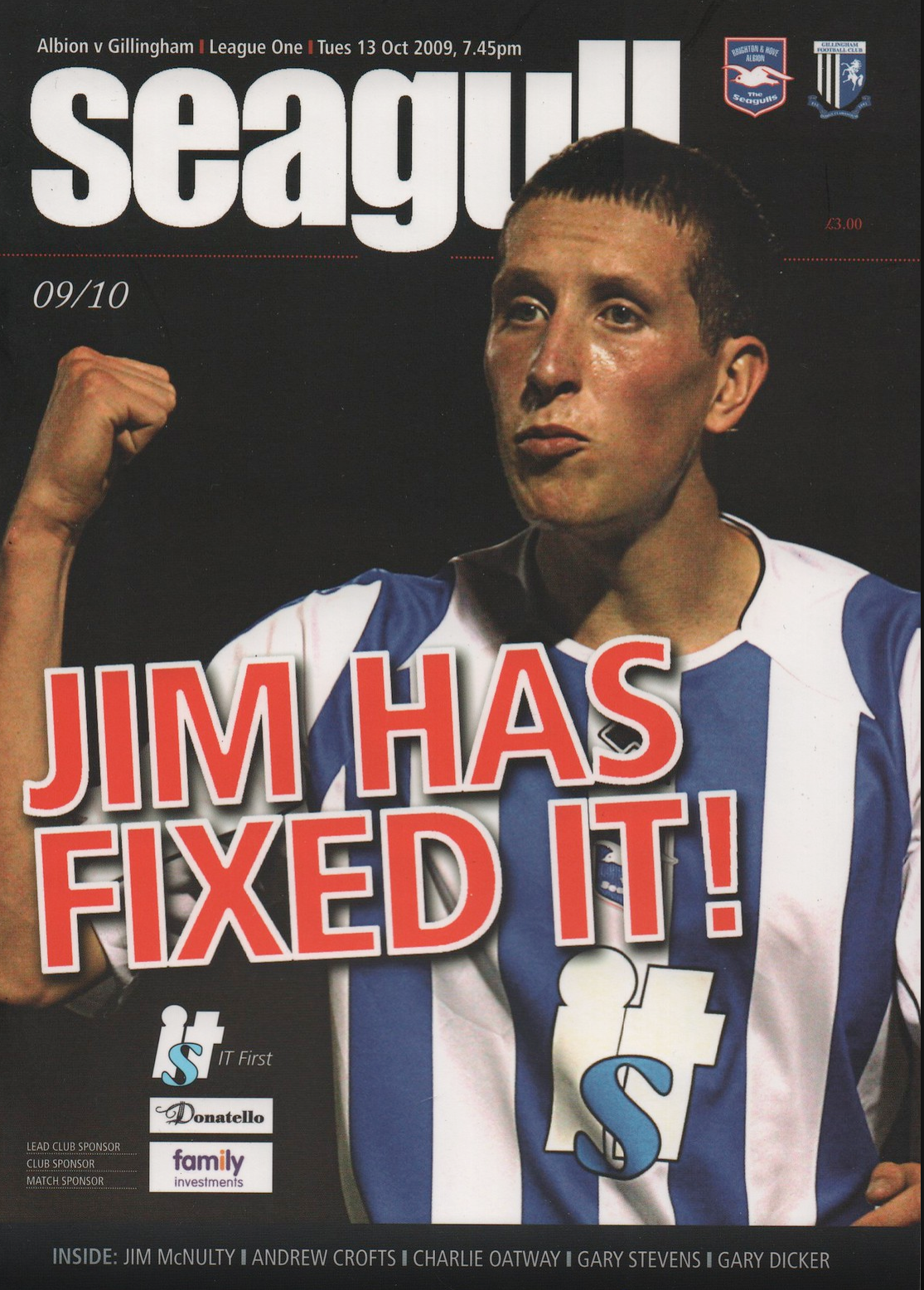
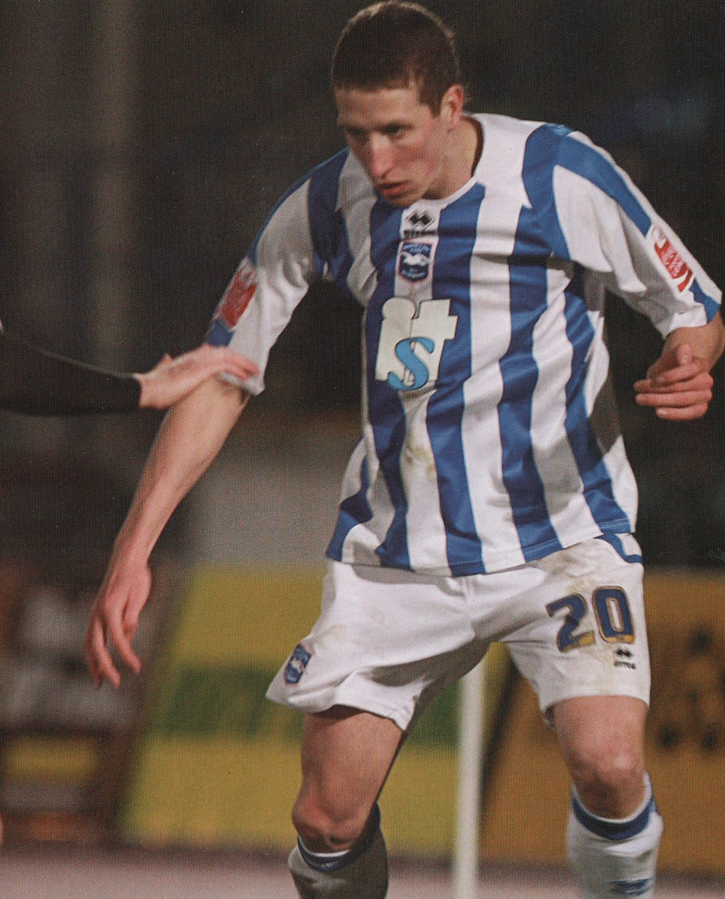
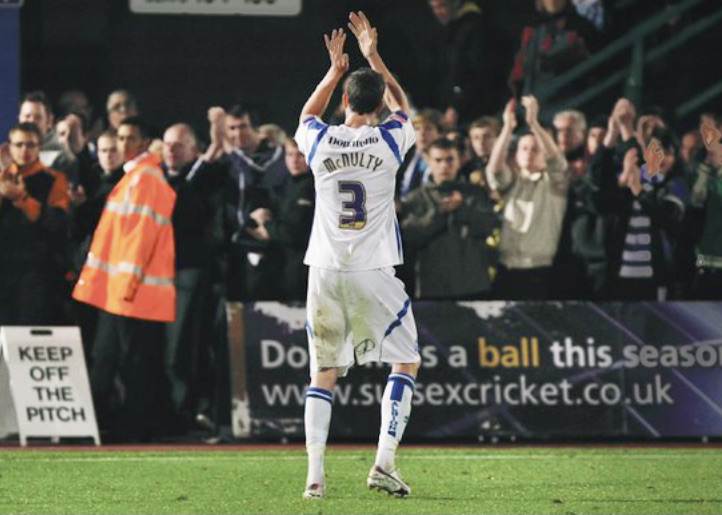
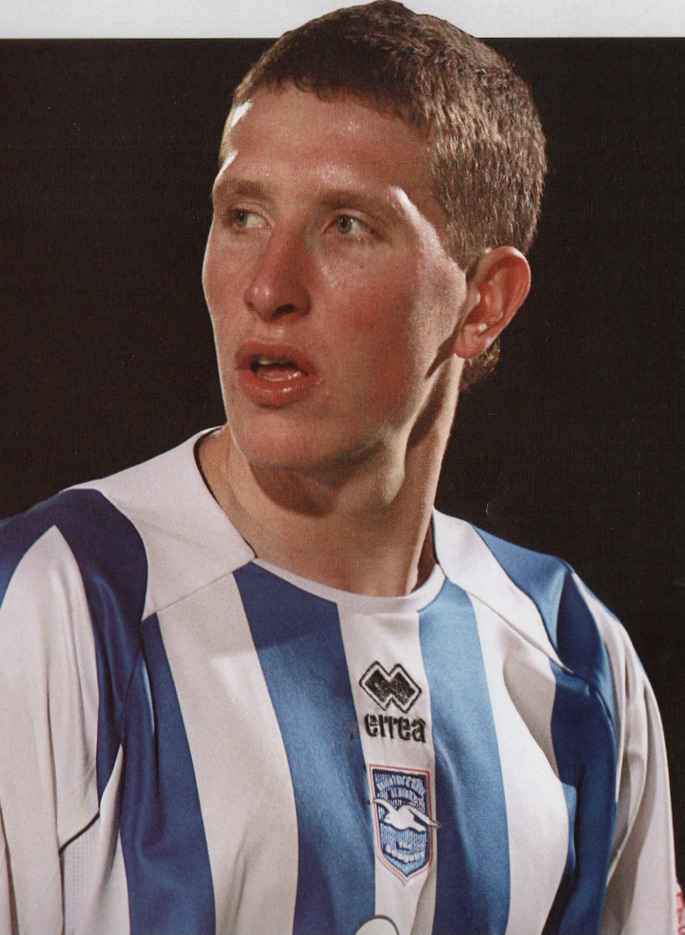
SCOUSE defender Jim McNulty, who played alongside Wayne Rooney at Everton as a schoolboy, will probably always be remembered by Brighton fans for a horror injury he suffered in a match at Withdean.

After an on-off transfer saga in which McNulty initially rejected Albion’s desire to sign him, the £150,000 signing from Stockport County scored on his debut and less than three weeks later was involved in an accidental collision that threatened to end his career at 23.

In only his fifth game after under-pressure boss Micky Adams finally landed the left back, a seemingly innocuous challenge as a Crewe defender caught him with his knee in his side quickly became much more serious when he started passing blood.

“Having walked back to the changing room I remember having the sensation of needing to go to the toilet and it was then that blood started spurting out,” he recounted. “I was also throwing up and the real scary part was the look of concern on the medical team’s faces.

“I was rushed to the Royal Sussex County Hospital for an MRI scan and had a catheter inserted as my belly was swelling up. It was then that I discovered one of my kidneys had capitulated.

“I was on the bed in the hospital after the scan when the surgeon said 90 per cent of the kidney is mush and I don’t believe you can play again,” McNulty told the club’s official website.

Nine years later, ahead of facing Harry Kane for Rochdale against Spurs in the FA Cup, McNulty told Ivan Speck of the Express: “It was instant tears. I was there with my father and fiancée, at the time. I remember crying into my dad’s chest.

“It was probably a bit of everyday information for him but, for me, football was my life and he should have stayed quiet until he was better informed. It still winds me up now.

“The FA actually got wind of the news and their doctor spoke with our club doctor. They had spoken to some rugby guys in the southern hemisphere because it’s a more common injury in rugby than it is in football.

“It was nonsense to suggest it would end my career.”

Initially, because he was a professional sportsman, the medics tried two operations to save the kidney but, when he was still passing blood three weeks later, the decision was taken to remove it.

McNulty described incredible pain he had to endure but realised once he had gone through with the operation that he would be able to play football again.

Amazingly, he was able to return to training within three months although he had a lot of work to do to rebuild his fitness. Within four weeks he was even able to play in a couple of pre-season friendlies.

However, McNulty went on to suffer a number of knock-on injuries because his posture was affected by having an empty space on the right side of his body.

“I had multiple ankle injuries because my pelvic alignment was a nightmare from that point on,” he said.

The first came just when it looked like he would make a return to league action in September 2009. He damaged his ankle ligaments on a local park pitch while training ahead of the 7-1 defeat at Huddersfield and was ruled out for a further four weeks.

His long-awaited return to first team action came in a Johnstone’s Paint Trophy tie away to Leyton Orient on 6 October, which Albion lost 1-0.

“Just to get out on the pitch and on the ball was fantastic,” he said. “I cramped up after about 70 minutes but the reaction from our fans was tremendous.”

McNulty told the matchday programme: “I have no intention of just sitting around, hoping to break into the side. I want to be playing every week now. I’m fit, raring to go and I want to help us get up the table.”

The unlucky McNulty then missed the following Saturday’s match at MK Dons, enduring yet more pain when he had to have two wisdom teeth extracted.

Nevertheless, McNulty’s eventual return to league action followed on 13 October in a 2-0 Withdean win over a Gillingham side which featured former Albion loanee Simon Royce in goal.

Astonishingly, the following Saturday, he lasted only 27 minutes before injury struck again in a 2-1 defeat away to Tranmere. He limped off with an ankle injury and Jake Wright was sent on to replace him. Glenn Murray scored a penalty consolation for the Albion and was then sent off for a second yellow card.

By the time McNulty was fit enough to return, the second manager of his brief time at the Albion, Russell Slade, had been replaced by Gus Poyet. His first involvement under the new boss saw him go on as a sub against: Charlton at home on 1 December.

He then went on as an 87th minute substitute for his good friend Gary Dicker at Exeter and provided the all-important cross from which Andrew Crofts headed the only goal of the game in the 92nd minute.

He had what one observer described as a man of the match involvement as a sub in the next match, a 2-1 home defeat v Colchester United. Saying the left back was “the epitome of Poyet’s ‘bravery on the ball’ mantra”, Richie Morris wrote: “Jimmy McNulty, like a rampaging glove-wearing gazelle, mercilessly attacked the left flank. Time and again he delivered teasing crosses, and time and again the ball simply would not nestle in the net.”

McNulty celebrates with goalscorer Tommy Elphick

That performance was rewarded with four starts on the trot – but then Poyet brought in the cultured Marcos Painter as his preferred left-back. McNulty was in the Albion side that put on a decent show in a 3-2 fourth round FA Cup defeat at Aston Villa, because Painter was ineligible, but he didn’t make another start that season. And, as it turned out, he didn’t play for the club again. He’d actually only played 16 times for the Albion.

Before the end of the season, to get some games, McNulty actually stepped up a level, going on loan to Scunthorpe United in the Championship, where he made two starts and a sub appearance under Nigel Adkins.

He rejoined The Iron in July 2010 on a six-month loan arrangement and played six games. But he suffered a recurrence of his ankle issues, so returned to Brighton in December.

When Albion kicked off a new era playing Championship football at the Amex, McNulty had stayed at the same level but with Barnsley, where he was voted players’ player of the year in his first season, and was made captain in his second season at Oakwell.

McNulty certainly wasn’t bitter about the way things turned out for him in Sussex. He said: “I couldn’t speak more highly of my time with Brighton. It is an unbelievable club, an unbelievable fan base, and it was an incredible place to live.

“My daughter was born there and we had a brilliant time, despite the fact that I was horrendously injured for pretty much all of that time.

“I’ve always been a 40-game-a-season man wherever I’ve been, but at Brighton I hardly played at all. Saying that, it was the club I had the best time at.”

Born in Runcorn on 13 February 1985, Liverpool and Everton were both interested in him when he was young, but it was Everton who put a contract offer in front of him.

“At the time I actually played for Everton against Liverpool in a game at Melwood,” he explained. “This would have been in the under-9s and we absolutely destroyed them.

“Ourselves and Arsenal dominated in that particular age group, right up to the under-16s – every week, every game, every season. Everton were a very dominant team and it gave me a great grounding, so I chose the right team.”

Initially a central midfield player, McNulty was switched to left-back during his time at Everton. Although Rooney was in the year below him, from under-10s, he was put up an age level. “I played with him for about four years until he jumped up again,” said McNulty. “He was playing two or three years up during the teenage years. I was just always playing at my own age.

“He was incredible, incredible. It was like watching a man play with boys in terms of his strength and aggression. He was pinging balls 70 yards as a 10- or 11-year-old boy.

“We couldn’t really lift it off the floor yet. His technique and the power that he had as a young boy, he was devastating at that age. He’d score eight goals every week. He’s one of the reasons we were so rampant as a team. Probably the main reason.”

McNulty moved on to Wrexham to make his breakthrough at senior level, ironically going on as a sub against Stockport in a Northern Section Football League Trophy game which the Welsh side lost 5-4 after extra time.

Because he had a Scottish mother, Englishman McNulty was selected for Scotland at under-17 and under-19 level, although one of his worst footballing memories came while playing for Scotland against France when they were beaten 5-0 in the European Under-19s Championship.

“I always remember being particularly mentally scarred by one player,” he said. “He was a winger and I was at left-back – and he scored four, so obviously that was mentally scarring. His name was Jimmy Briand.”

Briand went on to have a 20-year playing career in France and Germany and played five times for the senior French national team, but McNulty didn’t make it to the Scots full international side.

“There was a time when I had some genuine belief that it might happen,” he told The Sunday Post. “I had a good season in my first year at Barnsley in the Championship, in 2011, and ended up being named player of the year and made captain of the club.

“At the time, Scotland were having a bit of a defender crisis, and there was an opportunity there. I actually thought, ‘My name might come out of the hat here.’ But they ended up choosing a couple of guys who were playing in League One at the time ahead of me. That was a bit of a disappointment.”

But back to those early days, and when he didn’t make further progress at Wrexham he dropped down to League of Wales level to play for Bangor City and Caernarfon Town, but in June 2006, former Albion skipper and manager Brian Horton signed him for Macclesfield Town.

“I appreciate what Brian did for me, bringing me back into league football,” he said. “I was playing non-league football in Wales and he gave me a chance to come back and prove myself.”

He spent 18 months at Macclesfield, where he also played under Paul Ince, before moving to Stockport on a free transfer in January 2007. He became part of the County side that won promotion via the League Two play-off final at Wembley, when they beat another of his future employers, Rochdale, 3-2 in front of a crowd of 35,000.

McNulty was reluctant to give up a League One promotion tilt at County to join struggling Albion but chairman Dick Knight and manager Adams spoke of the club’s ambition and he was finally persuaded.

Albion needed a left back after loan signing Matt Richards had returned to Ipswich and

Adams said: “He fits the profile of what we are looking for. He likes getting forward and, without being disrespectful to anyone who has played there before, he is a natural defender, and he is six-foot two. At one stage it looked like we had lost out, so I am delighted to get him.”

Knight and Adams finally persuade their man to sign for the Albion

McNulty was not alone as Knight sanctioned quite a spending spree on new signings – Craig Davies, Calvin Andrew, Seb Carole, Jason Jarrett and Chris Birchall also arrived in that window, all financed by Tony Bloom, a low-profile investor at that time.

“I am very satisfied,” said Adams. “Finding a left back was a major priority. We haven’t been scoring the amount of goals we should, so we needed to look at avenues to open up teams. We have got Carole and Birchall for that.

“We also needed two strikers (Davies and Andrew) to increase the striking options and we needed a bit more physical strength in midfield, which is why Jason (Jarrett) is there, so I can’t complain.

“I had to be patient to make sure the right type of player was available and at the right price. Two of them were money buys and I am delighted that the board have backed me.”

Both Davies and McNulty were on the scoresheet when Peterborough visited the Withdean on 10 February but Barry Fry’s side took away the three points courtesy of a 4-2 win; Craig Mackail-Smith scoring for Posh along with strike partner Aaron McLean (two) and Dean Keates.

With only one League One win in six and a hoped-for tilt at silverware – the Johnstone’s Paint Trophy – gone in a penalty shoot-out defeat to Luton Town, the second coming of Adams was over. That horrendous injury to McNulty came while Dean White was caretaker manager and, when new boss Russell Slade arrived, one of his first tasks was to bring in Gary Borrowdale on loan from QPR to cover McNulty’s absence.

A change in manager often spells bad news for certain players and, after those successful first two seasons at Barnsley, McNulty found his face didn’t fit when David Flitcroft succeeded Keith Hill as manager. He’d only had one first team outing in a Capital One Cup tie against Southampton.

He grabbed the chance to join Tranmere Rovers on loan in November 2013, although he told the Liverpool Echo: “I have not even had a chance there.  I think I should still be playing for Barnsley.

“They are struggling defensively this season and had been conceding a lot of goals. But now I’m thinking about helping Tranmere.”

Rovers boss Ronnie Moore said: “Jim is a knowledgeable player and a good talker. He settled in quickly here. He is a footballing centre-back, rather than the Terry Butcher type. I don’t think you will see too many cuts and bandages around Jim’s head. He is clever. He drops off and picks the ball up.”

In January 2014, McNulty reached a mutual agreement with Barnsley to terminate his contract and he switched to Bury under old boss Flitcroft. He played 51 times for the League Two Shakers before beginning a long association with Rochdale in 2015.

McNulty in control with the Shakers

Over eight seasons, McNulty played a total of 237 matches for Dale, eventually combining coaching with playing. In August 2022, he found himself in interim charge for three matches after the club sacked Robbie Stockdale.

Former Morecambe boss Jim Bentley was appointed manager but when his services were dispensed with in March 2023, with Rochdale at the foot of League Two, 2023, McNulty once again stepped in as boss.

He was unable to prevent the club’s 102-year reign as a league club coming to an end but, in May 2023, he was appointed manager on a two-year deal.

“The opportunity to lead our team and represent our club, which the fans cherish, has always been a dream of mine,” he said.

“To be given the opportunity at a club so close to mine and my family’s hearts, is really special to me.

“As a boy, first and foremost, I dreamt of becoming a footballer, then when I did, I very quickly knew I wanted to become a manager thereafter.

“Within a couple of years of being a Dale player, I knew that this would be the club where I hoped to fulfil that ambition.”

Boo boys saw off international ‘keeper Wayne Henderson

DISGRUNTLED former Albion goalkeeper Wayne Henderson helped Grimsby Town keep their place in the Football League.

The Republic of Ireland international stopper, forced away from Brighton by a section of voluble supporters, was on loan to the Mariners in 2009 as they desperately tried to avoid the drop.

Although there were Grimsby grumbles on his debut, Henderson’s mission was a success, Town avoiding the drop by four points. But it was only a stay of execution because they finally fell out of the league for the first time in 100 years in 2010.

By then, Henderson was back at parent club Preston North End, who had bought him from the Seagulls for £150,000 on deadline day in January 2007.

He managed only 10 appearances for the Lancashire club – his last game coming in the final match of the 2009-10 season – and in March 2011, when only 27, he was forced to quit the game after two years plagued with spinal injuries.

Much had been expected of the young Irishman at Brighton after an initial loan spell from Aston Villa, where he had been coached by former Seagulls ‘keeper Eric Steele. He made his Albion debut away to Derby County, together with fellow countryman Paul McShane (on loan from Manchester United), in the opening game of the 2004-05 season.

Manager Mark McGhee said the youngster hadn’t put a foot wrong. “His kicking really took the pressure off us,” he said. “He was composed and took a couple of crosses towards the end which also helped relieve the pressure.”

McGhee had first hoped to sign Henderson in January 2005 to help solve a goalkeeping crisis created by a serious shoulder muscle injury to Michel Kuipers in a home match against Nottingham Forest.

Youngster Chris May, son of former Albion defender Larry May, had come off the bench to replace Kuipers in the match but McGhee didn’t see him as experienced enough in the battle to stay in the Championship. The previous season’s first choice ‘keeper, Ben Roberts, was a long-term absentee with a back injury, so McGhee had few options.

The Seagulls hoped a contractual hitch relating to Henderson’s previous loan spell at Notts County could be resolved in time to enable him to make his debut for the Albion at Elland Road. But it couldn’t and Brighton turned to Blackburn’s David Yelldell instead. That was the game where the loan goalkeeper famously wore a bright pink goalkeeper jersey and predictably suffered abuse from the Leeds crowd.

Although Clarke Carlisle put Leeds ahead just before half time, Yelldell had the last laugh when defender Guy Butters prodded home an equaliser in the 81st minute.

When McGhee didn’t see Yelldell as a long-term option, he turned to one-time Arsenal ‘keeper Rami Shabaan, who hadn’t played a competitive game for two years, but he let in 13 goals in six games. The manager brought in Southampton’s Alan Blayney, and he was between the posts for the last seven games of the season when Albion just managed to cling on to their tier two status.

McGhee finally managed to bring in Henderson ahead of the new season and, perhaps mindful of the goalkeeping headache he’d had the previous season, found he suddenly had an embarrassment of riches in that department.

Promising youngster Richard Martin appeared as a back-up on the bench, as did season-long French loanee Florent Chaigneau. In September, Southampton’s Blayney also returned for another loan spell and eventually took over the gloves when Henderson’s three-month loan from Villa came to an end.

Intriguingly, Henderson’s penultimate game on loan was a 1-1 draw with Ipswich at the Withdean when another Villa loanee, Stefan Postma was in goal for the visitors.

It had been Henderson’s understanding that a permanent move would follow soon after he’d featured in a 1-1 draw at home to Wolves on 1 November. But a two-month on-off saga began which, according to McGhee and chairman Dick Knight, was largely down to demands made by Henderson’s agent.

Albion agreed a fee with Villa of £20,000, plus £15,000 if he helped avoid relegation from the Championship. He didn’t.

The Argus sought the opinion of former Albion no. 1 Steele who felt Henderson had a chance to make a name for himself with the Seagulls.

“With Thomas Sorensen as the no. 1 and Stuart Taylor bought in from Arsenal, Wayne’s route in terms of playing first team football was always going to be limited,” Steele told the paper. “Our problem is that we only need one goalkeeper to play in one position and it’s just been a question of what level he would make his mark.

“He’s 22 now and he really had to be looking to move on and I wish him all the best. I’ve worked with him now for four and a half years and always thought he would make a good living from the game.

“I think that’s summed up by the fact that Brighton are going to pay a small fee and we’ll also get sell-ons. He’s the same height, he’s got the same build and he has got the same attributes as Shay Given (Newcastle and Republic of Ireland). And he just needs the chance to go and play.

“He’s been away at Wycombe and been away at Notts County, who would have signed him had they had the money. He’s done it in the Second Division and the First, now he’s got the chance to do it in the Championship.”

Even if supporters of the club he’d just joined had doubts about his merits, the Republic of Ireland selectors were confident enough to give him a first senior call up in February 2006, and he made his full international debut on 1 March 2006, as a second half substitute in a 3–0 win over Sweden.

After the Albion had forfeited their tier two status that season, and the omitted Kuipers had been transfer-listed after falling out with McGhee, Henderson opened his heart to the Argus.

“Michel is liked by the fans and hopefully one day I will get the respect of the fans I feel I deserve,” he told Andy Naylor. “Michel has that because he has been at the club for a long time. I have mixed feelings about him being on the transfer list because it’s good to have someone with his reputation at the club pushing me, but sadly he fell out with the manager.

“Hopefully, I can prove the fans who are criticising me wrong but if they are set in their ways there is nothing I can do about that. It’s a shame if that is the way they feel but I couldn’t care less. I am not going to worry about it.

“I know myself how well I have done, and I am an international player because of that.”

Although he started the new season as first choice ‘keeper, three defeats on the spin saw McGhee sacked and Kuipers back in the starting line-up.

New boss Dean Wilkins restored the Irishman to the team in October which was enough to convince Eire manager Steve Staunton, a former Aston Villa colleague, to put him into a Euro 2008 qualifier against the Czech Republic, when first choice Shay Given and back-up Paddy Kenny were unavailable.

“I knew Stan from Villa, yes, but I like to think I’m being picked on merit not just because he knows what I’m capable of,” said Henderson. “I’ve got a long way to go in all aspects but being at Brighton and playing first-team football means I’m developing under pressure and getting a chance to show Stan (Staunton) what I can do.”

The Irish drew 1-1 and, having been to Dublin to watch the match, Albion goalkeeping coach John Keeley believed Henderson could be Albion’s ‘keeper for 10 years.

“I’m so pleased for Wayne. It proves what a good goalkeeper he is,” said Keeley. “He has taken some stick but people should appreciate him.”

The coach praised his handling at Lansdowne Road, the way he had made himself available for back-passes from his full-backs, and his composure. Highlighting a fine one-handed save he made to deny Milan Baros, Keeley said: “The save that he made just before half-time was world class.”

He added:“I honestly believe that Wayne is a better ‘keeper than Paddy Kenny. His all-round game is more suited to international football.”

Henderson makes his Eire debut, replacing Shay Given

Keeley reckoned: “He’s 22 and we’ve got a world-class player. With Wayne being so young we’ve got a goalkeeper now for the next ten years. That’s the way I look at it.”

The following month, Henderson even made the headlines when he wasn’t playing! Injury ruled him out of Albion’s side to face Bradford City at Valley Parade on 4 November and he decided to watch from the seats behind the goal.

When Dean Bowditch scored an 89th-minute winner for the Seagulls, the exuberant ‘keeper jumped over the hoardings – and was promptly escorted out of the ground by a steward!

“It was over-zealous stewarding,” he said afterwards. “Alex Revell made the goal and he was celebrating right in front of where I was sitting in the front row of the stand.

“The natural thing was to go and celebrate within him but one of the Bradford stewards – who knew I was one of the non-playing squad members – took exception to my celebration.

“I think he was a Bradford supporter and perhaps he thought I was trying to rub his nose in it – but I wasn’t. I was just pumped up to see the lads score a last-minute winner.

“The next thing I was being grabbed by a steward and then I was marched out of the ground where the police took my name and address, but I think they saw the funny side of it.”

Henderson wasn’t laughing a few weeks later. He’d returned from injury but the side was on a losing streak in December. Away to Bournemouth on New Year’s Day, it looked like Albion might come away with a point but in stoppage time the ‘keeper lost his footing and gifted the Cherries a win, and a section of Brighton supporters booed him off the pitch.

After a 3-0 defeat to West Ham in the FA Cup third round, the Seagulls entertained Millwall at Withdean and a mix-up between Henderson and Joel Lynch led to the visitors winning by the only goal of the game.

Manager Dean Wilkins dropped him and it was the last time he played for the club. The barracking had got to him to the extent he had submitted a second transfer request of the season and, referring to the fans who’d got on his back, he told the Argus: “They love their football as much as anyone else but the way they reacted was pathetic really.”

After securing a deadline day move to Preston, he said: “It was disappointing the way it finished. I was devastated at being left out of the team. The mistake I made against Bournemouth could have happened to anybody and the Millwall game was a mistake by someone else that caught me out.”

Now free to air his feelings about the series of events, he said: “A lot of fans have certain opinions of players. For me the whole experience at Brighton was more like the X Factor.

“It just seemed to be a personality contest and I couldn’t enjoy my football.”

He continued: “I’ve never felt welcome at the club, except by the coaching staff and the players. The coaching staff have been magnificent, and I wish them all the best, because, if anyone is going to get anything out of the kids, it is Dean (Wilkins) and Dean (White), so I hope they are given a fair crack of the whip.

“Outside of them and the lads, a handful of fans have backed me lately and I really respect that but there were an awful lot of fans who didn’t and other people at the club who, for some reason, made it more difficult than it should have been.”

Within the tight confines of the small capacity Withdean Stadium, perhaps it was always going to be a tall order for Henderson to supplant crowd favourite Kuipers.

The ‘former Dutch marine – chef’ Kuipers, as he was serenaded by the singing section, had endeared himself to the Albion crowd after Micky Adams brought the previously unknown shot-stopper to the club in 2000. Subsequent managers brought in their own alternatives but Kuipers, always a reliable shot-stopper, had a habit of bouncing back.

If Henderson was perturbed by unfavourable crowd opinion at Brighton, it seems there was similar mood music when he made his debut for Grimsby.

Manager Mike Newell brought him in along with three other loan players (Joe Widdowson, Peter Sweeney and Barry Conlon) and, in 14 games he played through to the end of the season, five wins and three draws were enough to give them a finish four points above the relegation trapdoor (Chester City and Luton Town went out of the league).

The excellent Cod Almighty fans website observed some fans booed and jeered Henderson on his home debut because the gale force wind kept blowing his goal kicks into touch.

Pete Green, on the same website, later wrote: “These temporary Mariners have played an enormous part in preserving the club’s status in the Football League – even as repeated mistakes by experienced, longer-term Town players such as Phil Barnes and Tom Newey continued to jeopardise it. Henderson has already gone back to Preston, and we stand no chance of signing him permanently.”

While the other three loan players did sign permanently, Newell brought in another Irish international goalkeeper in Nick Colgan the following season.

Born in Dublin on 16 September 1983, Henderson followed in the goalkeeping footsteps of his father and brothers. Dad Paddy played for Shamrock Rovers; brothers Dave and Stephen played in the League of Ireland. Even his nephew, Stephen, was a goalkeeper – most notably for Portsmouth, Charlton and Nottingham Forest after also going through the youth ranks at Villa.

Wayne played for the same Cherry Orchard club in his home city that also spawned the likes of Mark Yeates, Dave Langan, Andy Reid and Stephen Quinn.

John Gregory was in charge at Villa Park when Henderson joined Aston Villa in July 2001. A year later, he was in goal when Villa won the FA Youth Cup (below), beating Everton – with Wayne Rooney playing up front – 4-2 on aggregate over two legs. Also in the Villa side that day was Liam Ridgewell, who later had a brief loan spell at Brighton, and Peter Whittingham, who went on to play more than 500 professional games and died in tragic circumstances aged just 35.

Joy for Henderson as Aston Villa win the 2002 FA Youth Cup

Although Henderson was chosen on Villa’s first team bench occasionally, he didn’t play any competitive fixtures for the first team. Those opportunities came via loans.

After a month at non-league Tamworth in the spring of 2004, he spent a month on loan at Second Division Wycombe Wanderers under Tony Adams towards the end of the 2003-04 season, when their last place finish meant they were relegated to the newly formed League Two.

The following season he joined Notts County, another of the clubs who’d been relegated with Wycombe, and had two loan spells, three months under Gary Mills and then a month under his successor, caretaker boss Ian Richardson.

Paul Simpson signed Henderson for Preston but when injuries forced him to retire at just 27, he told skysports.com: “I’ve decided to actually step out of football and give my body time to heal for once.

“It is exciting for me though because I’m looking to go into a completely different environment from playing but stay within football at the same time.

“I’ve been trying to get back fit for a few years now with injections and operations, but I’ve decided that rest is the way forward for it now.

“I’ve not signed anything yet, but there are a good few options for me to choose from, which I am really excited about.”

Henderson, who married 2010 Apprentice winner Liz Locke, now works as a licensed intermediary for agency YMU, who, among plenty of other elite footballers, represent Albion’s Evan Ferguson and Andrew Moran.

‘Weirdo’ makes meteoric rise to Albion’s top football role

DAVID WEIR had something of a meteoric rise to the top football role at Brighton.

Weir, a former Rangers, Everton and Scotland international, became the club’s new technical director in May 2022 having only been appointed assistant technical director in January. He stepped up to the top job in an interim capacity only a month later after Dan Ashworth quit (and was put on ‘gardening leave’ before joining Newcastle).

Previously Weir had been pathway development manager, keeping tabs on players sent out on loan. When Weir’s appointment to the top role was confirmed, chairman Tony Bloom told the club website: “During his recent role as acting technical director he has used his experience, knowledge and ability in supporting  both Graham Potter and the men’s first-team, as we secured a record top-flight finish, and to Hope Powell and the women’s first-team. 

“In that time he has already further enhanced an already excellent working relationship with both Paul Barber and me, as well as our executive team responsible for the running of the club. David will oversee all football operations; including recruitment, analysis, medical and player welfare, across both the men’s and women’s set-up.”

Weir didn’t have long in the role before he was having to help Bloom and deputy chairman and chief executive Paul Barber find a new head coach following Potter’s defection to Chelsea. Weir found himself facing the media when Roberto De Zerbi was unveiled as Potter’s replacement.

However, as Barber said at the time of Weir’s appointment: “It is well known by Everton, Rangers and Scotland fans that David was a leader on the pitch. He has continued to show those qualities off the pitch and has quickly settled into the role.”

When the pathway development manager job was created, who better to entrust the care and progress of promising youngsters than a father of four who played more than 600 matches at the highest level in both the English and Scottish leagues, not to mention 69 games for his country.

Weir had a 20-year playing career, and was still playing for Scotland aged 40, after starting out with his hometown club Falkirk. He was at the heart of Everton’s defence for seven years, including several as captain.

“David has an excellent playing and coaching CV, has excellent contacts throughout the football world and is hugely respected within the industry,” Albion’s head of recruitment, Paul Winstanley, said at the time of his appointment.

“With an increasing number of our younger players going out on loan, this is a particular area in which we feel it is important for us to develop.

“David will be responsible for working with those players individually and collectively, during pre-season and throughout their loan spells to help their footballing development, with the aim of assisting with their graduation to long term first-team football.”

Weir told the matchday programme: “As a former manager and coach, I know the pitfalls that come with loan moves and so I put procedures in place to make sure our players gain the most from their time away from the club.

“It’s also important that we send our players to work with coaches who will enhance their experience – I think a loan move is more about sending them to the right coach rather than any particular club.”

One of the many aspects Weir keeps an eye on is how a player adapts outside the cosseted Brighton bubble.

“The loan process, to a lower league club for instance, should make them appreciate how good they’ve got it here and provide the motivation for them to want to succeed at our club.

“They will have to adapt to new surroundings, maybe bringing their own food, washing their kit or finding a gym to work out in. They have to grow up quickly but I’m available to support and help.”

Weir knows himself what it is like being far from home while trying to get your career started. He went to the United States on a scholarship deal, at Indiana’s University of Evansville, between 1988 and 1991.

Born in Falkirk on 10 May 1970, when the centre back returned to the UK he linked up with his hometown team, playing 134 matches over four seasons, before being transferred to Edinburgh side Hearts.

He was in the 1998 Scottish Cup-winning Hearts side (they beat Rangers 2-1) and featured in a total of 116 games before Everton took him to England in February 1999 for a £250,000 fee.

He was signed by Walter Smith and spent seven seasons with the club as a player, during which time he was club captain under both Smith and his successor, David Moyes.

“I spent ten years in total at Everton, so they will always be a club that means a lot to me,” said Weir. “It’s just a special club for me and one that provided me with many happy memories.”

Everton fan website toffeeweb.com summed him up thus: “Weir brought all the essentials of a great defender: big, strong, good in the air and a hard tackler, he had also shown that he was good at attacking, scoring important goals and taking set pieces.”

Weir cited the 2004-05 season when Everton finished fourth and qualified for the Champions League as one of his highlights.

“It was a team that worked hard for each other, and we had that never-say-die attitude that came from the manager (David Moyes),” he pointed out.

Weir played alongside the likes of Wayne Rooney, Duncan Ferguson, Mikel Arteta and Paul Gascoigne during his time at Goodison Park, and he went back after his playing days were over to coach the academy and reserve teams.

Weir had returned to Scotland in 2007 and, while silverware eluded him on Merseyside, he made up for it in Glasgow, where he won the Scottish Premier League title three times, the Scottish Cup twice and the League Cup on three occasions. A personal high came in 2010 when he was the SFWA Footballer of the Year and the Scottish Premier League Player of the Year.

The previous year he had taken over the Rangers captaincy from Barry Ferguson and in 2011 he became the first player to be inducted into the club’s Hall of Fame while still playing.

Weir was first selected for Scotland in 1997 and was in Craig Brown’s squad for the 1998 World Cup in France. He only scored once – in a World Cup qualifier versus Latvia at Hampden Park in 2001. He retired from international football in 2002, when Berti Vogts was the coach, but had a change of heart and returned when his old club boss Walter Smith took charge two years later.

It was in a Euro 2012 qualifying game in 2010 that Weir became the oldest player to play for his country. His 69 caps make him the nation’s seventh-most capped player.

He finally hung up his boots in May 2012 at the age of 42 and returned to Everton as an academy coach. A year later, he took over as manager of third tier Sheffield United but his tenure lasted only 13 games after a disastrous start in which only the opening game was won.

Undeterred, he became Mark Warburton’s assistant manager at Brentford and, after winning promotion to the Championship in their first season and securing a fifth-placed finish in their second season, the pair left the club after a management restructure.

In the summer of 2015, Warburton took charge of Rangers with Weir as his assistant, and after their departure from Ibrox in early 2017, they joined forces at Nottingham Forest in the Championship. 

Warburton, Weir and director of football Frank McParland were all appointed towards the end of Fawaz Al Hasawi’s ownership of the club – two months before a takeover by Greek shipping magnate Evangelos Marinakis – and lasted only nine months at the City Ground.

It was in July 2018 that Brighton took on Weir to guide the club’s loanees.

Amongst his cohort were his own son, Jensen, who went on loan to League One Cambridge United in 2021-22. The England under 20 international then joined Morecambe for the 2022-23 season.

On 20 December 2021, according to Mail Online, Everton held talks with Weir senior about him rejoining the club in a player development role at Goodison Park, but nothing came of it.

A month later, Albion announced Weir had been promoted to become the club’s assistant technical director, supporting Dan Ashworth.