BRIGHTON travel to Newcastle in the fifth round of the FA Cup with the backdrop of having won there twice in the competition in the 1980s – not to mention a 1-0 win in the Premier League this season.
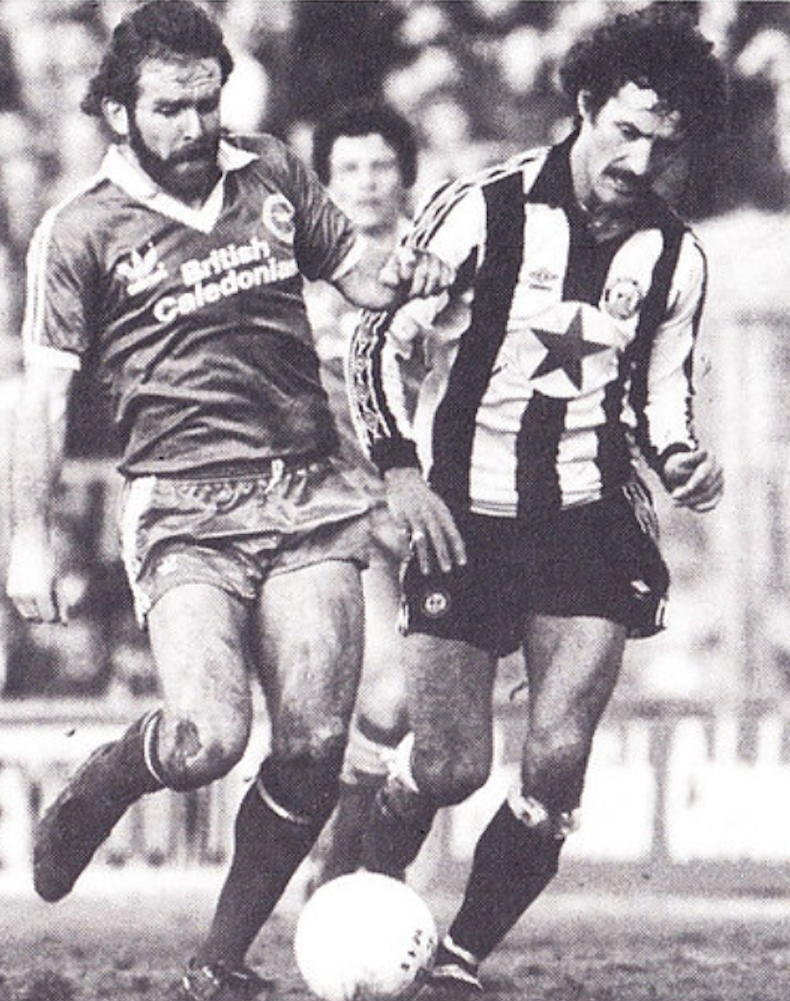
The 1-0 third round win at St. James’ Park in January 1983 set Albion en route to that season’s FA Cup final – but Toon supporters of that era blamed the game’s unusually-named referee, Trelford Mills, from Barnsley, for their exit.
Think I’m exaggerating? Newcastle fans’ website themag.co.uk had this to say ahead of another FA Cup game between the two sides in 2013: “It is doubtful that anything could match the anger and frustration that many of us felt nearly thirty years ago.
“Wednesday 12 January 1983 will always be synonymous with the name Trelford Mills, etched into the consciousness of an entire generation of Newcastle fans, convinced he cheated us out of the FA Cup. Well, a chance of the fourth round anyway!”
Neil Smillie, goalscorer Peter Ward, Steve Gatting, Chris Ramsey and Andy Ritchie celebrate after the 1983 win.
Mills disallowed two Newcastle ‘goals’ while Albion nicked it courtesy of a penalty area pounce by Peter Ward, back at the club on loan from Nottingham Forest, on 62 minutes. They did it without captain Steve Foster who was suspended (as, of course, he would be for the final too).
The game was a third round replay four days after the sides drew 1-1 at the Goldstone Ground when Andy Ritchie’s mis-hit shot in the 56th minute put Albion ahead and Terry McDermott (below right, with Tony Grealish) equalised on 77 minutes.
Even though the Magpies were in the old Division Two at the time, they had Kevin Keegan and Chris Waddle in their line-up, and they fully expected to win because Brighton hadn’t previously won away that season.
Albion, competing in the top division for the fourth season in a row, with joint caretaker managers Jimmy Melia and George Aitken in charge, had goalkeeper Graham Moseley to thank for some heroic stops to keep them in the first game.
The replay at St. James’s Park was in front of a typically noisy crowd of 32,687 and Newcastle did everything but score: they had shots cleared off the line and hit the woodwork and, when they thought they’d scored, Mr Mills disallowed them – twice!
In the meantime, Ward made the most of a counter attack to put the Seagulls ahead. It turned out to be the last goal he scored for the Albion, although he was in the side that pulled off a shock 2-1 win at Anfield to knock out Liverpool in the fifth round.
“I remember Brighton went one up, then Imre Varadi went through on goal, but quite clearly controlled the ball with his wrist,” said Mills.
“I think the Brighton keeper realised this, just as most of the players did, and let the ball go into the goal just to waste a bit of time. I just restarted with a free kick. I have spoken to Imre since. I think he accepts my version now.”
Mills continued: “Jeff Clarke managed to win a ball in the penalty area, but only because he had his arm around the defender’s neck. Keegan bundled the ball into the goal, but I had blown up a few seconds before it went in.
“Keegan did his Mick Channon cartwheel arm in front of the Gallowgate end, but I just jogged across to where I wanted the free kick taken from and indicated as to why I had disallowed the goal.”
Mills also recalled how he and his fellow officials needed a police escort away from the ground after the match. “When we sat in the dressing room after the match, I remember chatting to one of my linesmen, John Morley, when this police officer turns up,” he said. The copper said to him: “You’d better hang on here a while, Trelford. There are 2,000 Geordies outside and they all want your autograph!”
Three years later, the status of the teams had been reversed with Newcastle promoted back to the top division in 1984 and Albion back in the second tier, relegated the same year as the cup final appearance.
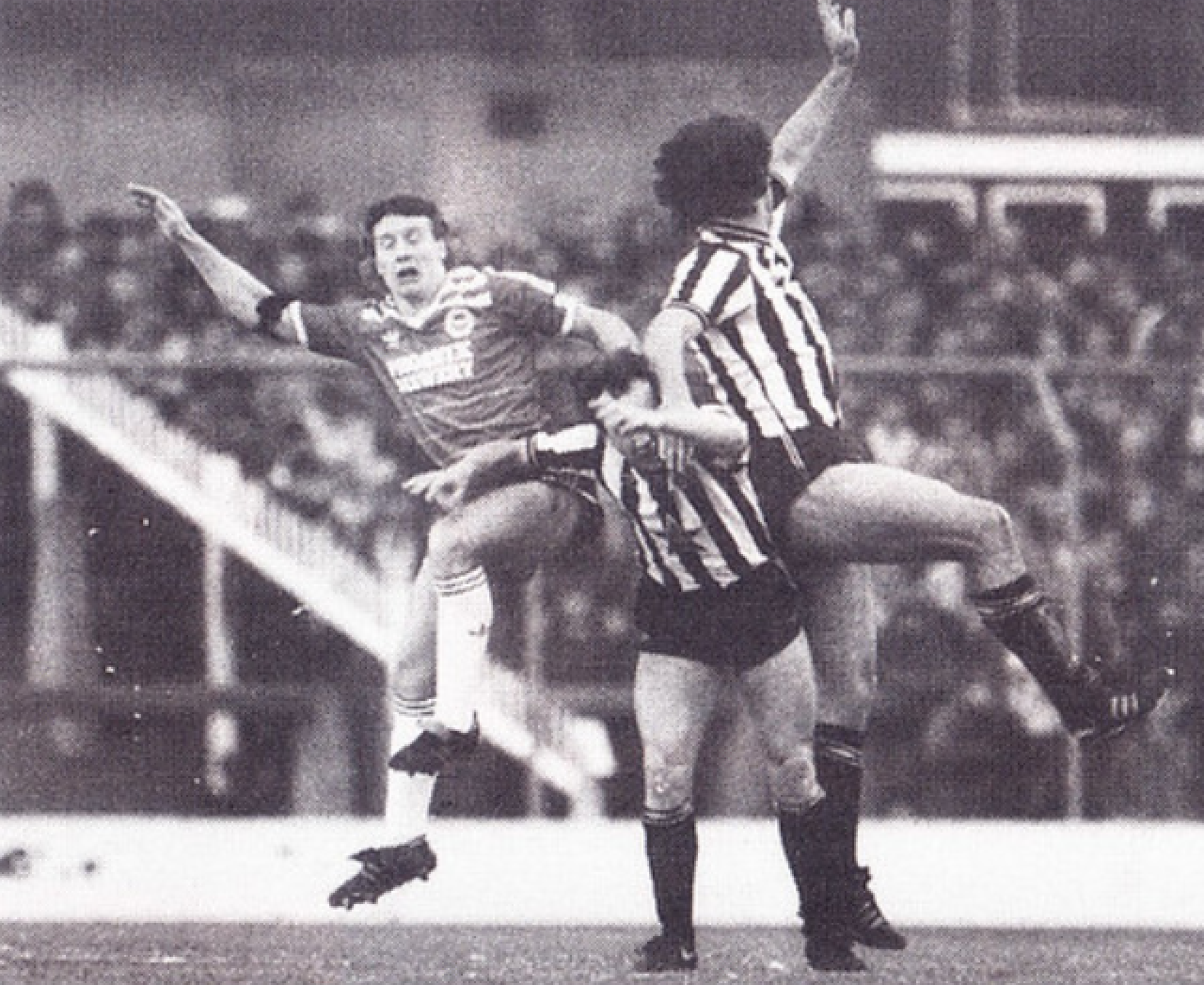
While Keegan had retired, Willie McFaul’s side had a young Paul Gascoigne in midfield and Peter Beardsley in the forward line. Clarke, who’d played four games on loan at Brighton two years earlier, was still in the centre of United’s defence and it was his foul on Terry Connor in the first minute of the game that saw Albion take a shock early lead.
Danny Wilson floated in a free kick from 30 yards out on the right which found centre back Eric Young on the far edge of the penalty box. He hooked the ball into the Newcastle net with only 50 seconds on the clock!
Albion, wearing their change strip of red, had to endure a relentless series of attacks (Toon had 23 corners to Albion’s one!) and Perry Digweed in Brighton’s goal put in a man of the match performance between the sticks, notable saves keeping out shots from John Bailey, Beardsley and Billy Whitehurst.
With five minutes left of the game, against the run of play, a quick throw-in by Graham Pearce found Dean Saunders and he rifled home an unstoppable shot past Martin Thomas for his 10th goal of the season.
Manager Chris Cattlin summed up afterwards: “It was really tough and we had a little luck on our side, but to go away to a club who have won the cup no fewer than six times and come away winners was quite an achievement.
“With the Geordie fervour up there the noise their supporters created was something special, but our efforts speak volumes for everyone connected with our club.”
There would be no fairytale ending that season, though, with Albion being dumped out of the cup 2-0 by Southampton in a quarter-final tie at the Goldstone Ground.
John Barnes and Steve Harper were on pundit duty for ESPN for the 2012 match
Younger fans will doubtless recall two more recent FA Cup meetings between Brighton and Newcastle, in consecutive seasons during Gus Poyet’s reign, at the Amex in 2012 and 2013.
The Championship Seagulls beat the Premier League Magpies on both occasions – 1-0 in the fourth round in 2012 and 2-0 in the third round the following year.
Getting to grips with Will Buckley
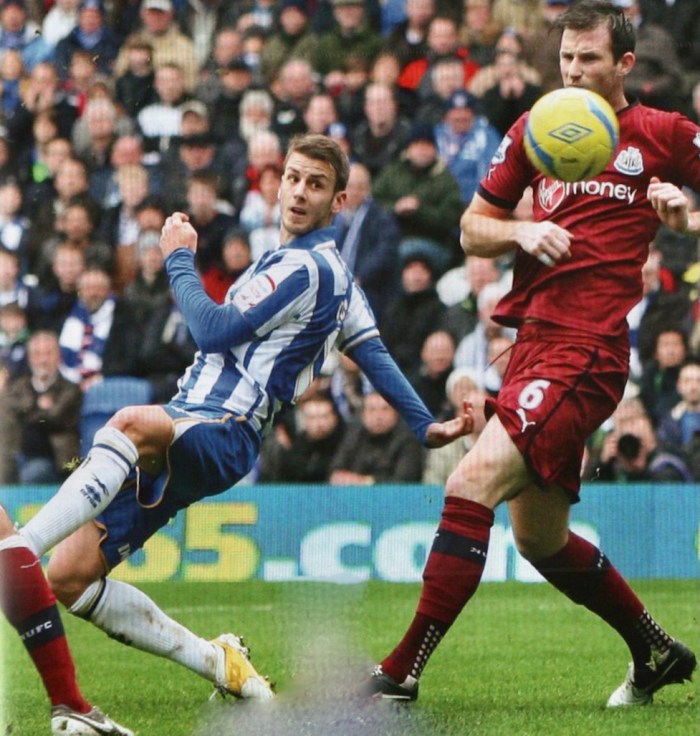
A Mike Williamson own goal was enough to give Albion the edge over Alan Pardew’s side in the first of those games; Will Buckley’s 76th minute shot deflecting off the defender and looping over Tim Krul for the only goal of the game. Leon Best, who would later have a torrid time at Brighton, missed two good chances for the visitors.
The 2013 fixture was a more convincing win for Brighton against a weakened Newcastle side who had Shola Ameobi sent off. Andrea Orlandi gave Albion the lead on the half-hour mark and substitute Will Hoskins added a second late on.
Andrea Orlandi hooks in Albion’s first goal
Praise for Liam Bridcutt
“This was an impressive victory for Brighton, a result that will add to the optimism that surrounds this upwardly mobile club and strengthen their resolve to host Newcastle in next season’s Premier League,” wrote Ben Smith, for BBC Sport. “The cool passing game of Liam Bridcutt at the heart of their midfield was tremendous.”
The reporter added: “Sharper to the ball, and swifter to make use of it, the Seagulls toyed with their more celebrated opponents for much of the opening 45 minutes, producing some stylish attacking moves while tackling, battling and dominating territory in their uncomplicated and effective way.”
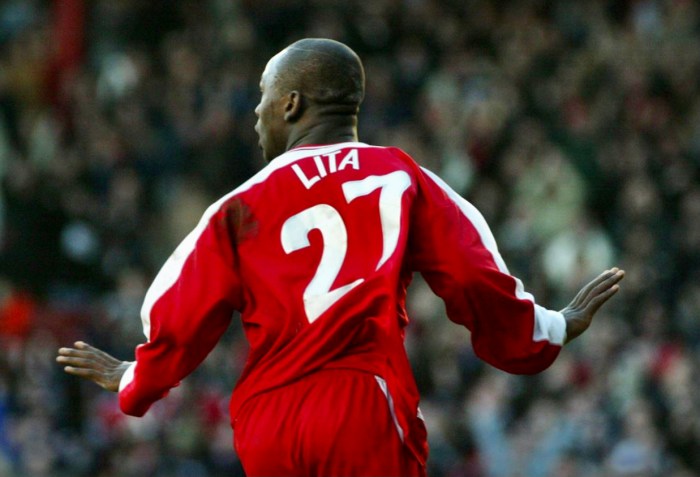
PROLIFIC second tier goalscorer Leroy Lita was a Gareth Southgate free transfer signing for Middlesbrough where he scored 20 in 82 games.
Two years after Boro cashed in and sold him for £1.75m to newly promoted Premier League side Swansea City, Lita joined an injury-hit Brighton side three months into Oscar Garcia’s reign.
Goals had been harder to come by for Lita after Brendan Rodgers had signed him for the Swans and he was sent out on loan, spending time back in the Championship with Birmingham City and Sheffield Wednesday.
It was a familiar story for Lita who had been Reading’s first £1m player when Steve Coppell signed him from Bristol City in 2005.
He netted a goal every three games for the Royals, but towards the end of his four years at the Madejski Stadium, he’d gone on loan to Charlton Athletic and Norwich City.
By the autumn of 2013, Lita had become something of a footballing nomad, fed up with a lack of first team action under Michael Laudrup.
With Albion’s leading striker Leo Ulloa out for two months with a broken foot, and Craig Mackail-Smith and Will Hoskins also sidelined, Garcia brought the diminutive striker to Brighton on a three-month loan arrangement.
“He is strong, fast and direct, and he has shown he can score goals in the Championship,” Garcia told the club website. “He offers us something different going forward.”
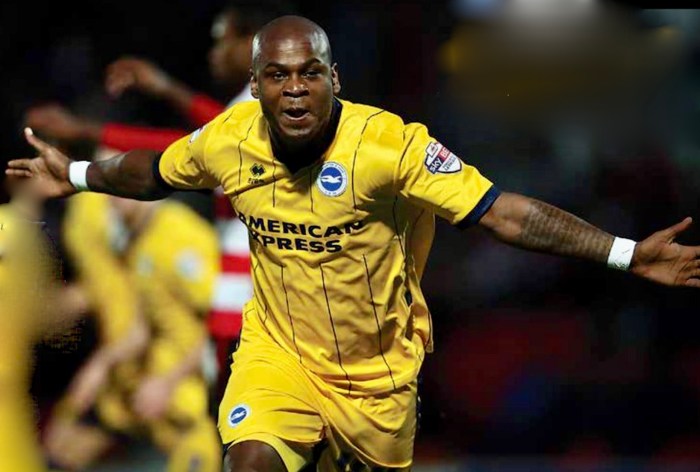
I can remember being at the Keepmoat Stadium, Doncaster, when he scored his only goal for the club two minutes after going on as a substitute for Jake Forster-Caskey (he’d played with his stepdad Nicky Forster at Reading).
Forster-Caskey had scored a wonder goal with his left foot from 35 yards before Rovers equalised but visiting Albion went on to collect three points in a 3-1 win (David Lopez scored the other with a long range free kick).
Lita had made his debut in a 0-0 draw at Yeovil on 11 October, going on as a sub for Ashley Barnes and his home debut saw him replacing another loanee, Craig Conway, in a 1-1 draw with Watford.
The eager striker made a public plea via the Argus to be given a start but Garcia only ever used Lita off the bench for the Seagulls (he went on as a sub on five occasions and was an unused sub for three games).
“The staff have a bit of doubt but I feel fine,” Lita said. “When I am on the pitch my mind just takes over anyway. “I don’t ever feel tired or not match fit. I know you still need your match fitness, but you have to get that at some point, so hopefully this week.”
Having got off the mark for the fifth Championship club he had served on loan, he added: “Once you get that first goal you are thinking about the next one and the next one. I am just looking forward to scoring plenty of goals.
“I know I can score goals wherever I go so I’ve never had that doubt. Whoever has doubted me it’s up to them. My belief in myself is not going to end until I am 50 years old and can’t move!”
But with Ulloa’s fitness restored, Lita’s final appearance in an Albion shirt was on 3 December when he went on for Barnes at the Amex as the Seagulls succumbed 2-1 to Barnsley.
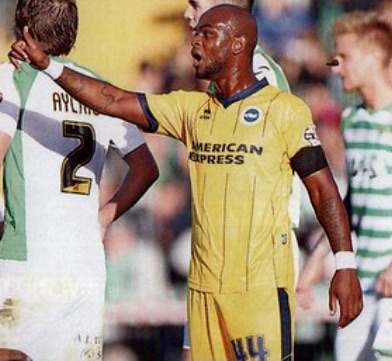
Maybe Lita’s Albion spell was cursed from the start when he was handed squad number 44 (all the fours, droopy drawers)?
He was still only 28 when he arrived at the Amex with an impressive record of 101 goals in 330 league and cup games, 14 of which had been in Reading’s 2006-07 Premier League season.
“I know the Championship well,” Lita said in the matchday programme. “Consistency is the main thing at this level because everyone beats everyone; some teams start well and drop off, while others start badly then pick up a run of results. So, it’s all about putting a good run together then you never know what might happen.”
Lita followed in the footsteps of former Swansea teammates Kemy Agustien and Andrea Orlandi to the Amex, but he also knew Liam Bridcutt and Andrew Crofts from his time as a youngster at Chelsea.
He recalled summer training camps at Horsham with Bridcutt and he played in the same Chelsea junior side as Crofts. “They have both gone on to become really good players,” he said.
“It helps when you go to a club and know a few people but I think the style of play here will also suit me.
“It is similar to Swansea and the club only signs players here who know the system.
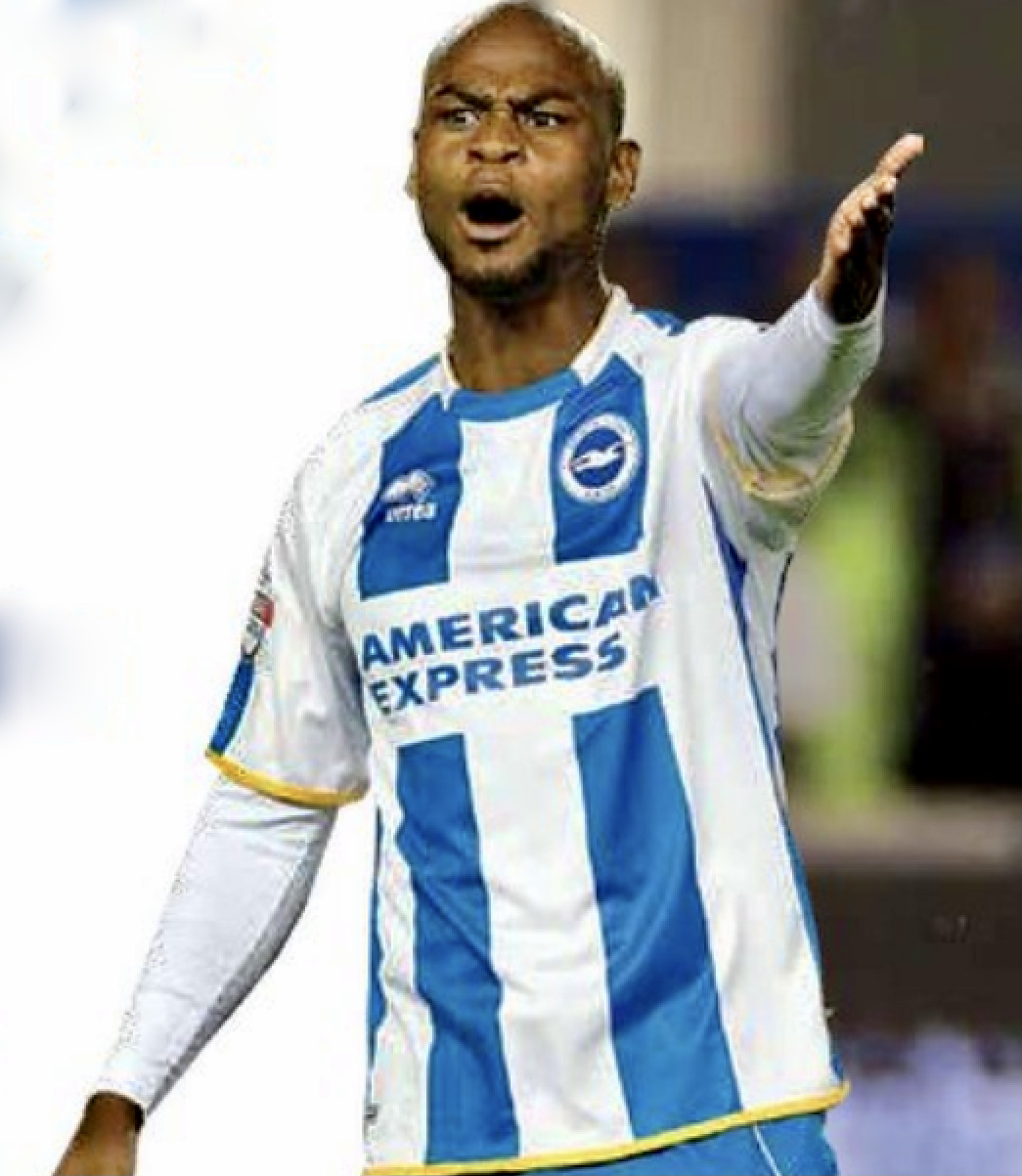
“I played against Brighton last season, scoring on my home debut for Sheffield Wednesday, and although we won that day, I was still impressed by the way the team played.” He had also played at the Amex before when he was on loan at Birmingham and (below right) was the subject of a page feature in the matchday programme.
Born in Kinshasa in the Democratic Republic of Congo on 28 December 1984, it was as a teenager on Chelsea’s books that he couldn’t believe his luck to be sharing a training pitch with Jimmy Floyd Hasselbaink and Eidur Gudjohnsen.
“I would go home and see them on TV and the next day I would be training with them,” he told The Guardian. “It was unbelievable.”
Reporter Jon Brodkin wrote: “Chelsea broke his heart by releasing him but his three years at the club he supports were hardly wasted. The thrill of being a ballboy was surpassed by training with the first team’s front two.”
Lita told him: “I was 15 and the academy director said he had spoken to my school and I could have a couple of days off a week to train with the first team and the ressies [reserves]. It was a great opportunity and I learned a lot from it.
“Hasselbaink’s finishing was unbelievable, he didn’t mess about. He could place it and smash it. I mainly did finishing with them, not much else, but I could see as well how professional they were and how they looked after themselves.”
After Lita’s release, he contacted a few clubs – Fulham were interested but didn’t offer a contract – and he was aware that after leaving Arsenal Andy Cole had made a new start to his successful career at Bristol City.
It was the Robins who gave Lita an opportunity and former Albion skipper Danny Wilson handed him his first team debut at the beginning of the 2002-03 season when he was still only 17.
His first league goal was a late winner on 28 September 2002 to secure a 3-2 victory after going on as a substitute at Port Vale (for whom an 18-year-old Billy Paynter had scored).
“The striker hit a glorious goal to end Vale’s hopes of a point after they had fought back to level matters just a minute earlier,” said the BBC report of the game.
It wasn’t until the following season that he was given a professional contract and it was only after Brian Tinnion succeeded Wilson as manager in 2004-05 that Lita established himself in the City side. He scored 29 goals in all competitions and that form earned him a call-up to the England under-21s, Lita having decided not to play for his birth country.
He scored on his debut on 8 February 2005 when he went on as a sub for Justin Hoyte in a 2-1 defeat against the Netherlands at Derby’s Pride Park.
Those goals also earned him a £1m move to Reading, even though Tinnion advised him against the move, believing a Premiership club would come in for him.
“Once I got down here, I knew it was right,” Lita told The Guardian. “I want to go a step at a time. Reading are a good club, they’re looking to get into the Premiership and that’s where I want to be.”
He went on to score 15 goals in 25 league and cup games (+ seven as a sub) as Reading topped the Championship, and he returned to the England under-21 fold in February 2006.
He was on home turf at the Madejski Stadium when he earned his second cap, again as a sub, replacing David Nugent in a 3-1 win over Norway (future Albion loanee Liam Ridgewell was among his teammates).
A year later, after finding the net in the Premier League with Reading, Lita got a third cap as a substitute (for James Milner) and scored again in a 2-2 draw against Spain at Pride Park. Liam Rosenior was also a substitute that day.
Lita’s first start for the under 21s came the following month, on 24 March, in a 3-3 draw with Italy in the first game played at the new Wembley Stadium, in front of 55,700. On 5 June the same year, Lita scored England’s fifth goal in a 5-0 win over Slovakia at Carrow Road after he’d gone on as a sub for Nigel Reo-Coker.
Lita was an overage player in the 2007 UEFA European Under 21 Championship: he missed an 88th minute penalty after going on as a sub in a 0-0 draw with the Czech Republic but scored in each of the three games he started: 2-2 v Italy, 2-0 v Serbia and 1-1 v the Netherlands (who won the tie 13-12 on penalties). But a full cap eluded him.
Lita was a regular throughout Reading’s first top-flight campaign. In a side that include Ivar Ingimarsson and Steve Sidwell, Lita scored 14 times in 26 league and cup starts plus 12 appearances off the bench.
But with Kevin Doyle and Dave Kitson the preferred strike duo in 2007-08, Lita’s game time was much reduced and he went on loan to Charlton in March 2008.
It was a similar story the following season when he scored seven times in 16 games during a three-month loan at Norwich City – the haul included a hat-trick against eventual champions Wolves.
The excellent Flown From The Nest website, that profiles former Norwich players, recalled how that treble attracted the interest of plenty of other clubs, but City boss Glenn Roeder said: “It’s a better problem to have than him not scoring and playing rubbish – then none of us want him. What can you do?
“He was brought here to score goals. He was a little bit rusty in his first game which was understandable. He did better in the second game against Bristol City when he had a couple of chances which unfortunately never went in, and then in the third game on Tuesday night, we saw the real Leroy Lita and what he is all about.”
Lita returned to Reading and played in a FA Cup third round defeat at Cardiff and although Sheffield United made a bid for him, he preferred to stay with the Royals.
Nevertheless, at the end of the season, he finally left the Madejski and headed to Teesside on a three-year deal.
On signing for Boro, Lita said: “The manager has been after me for about a year, it’s great to feel wanted. I have a lot of respect for the gaffer and I want to do well for him and the club.
“I aim to repay him for his faith in me with goals. That’s the main strength to my game and I’m looking forward to scoring goals for Middlesbrough.”
He told the Northern Echo: “I’m raring to go. I haven’t enjoyed the last two seasons one bit, but this is a fresh start and I’m excited about the challenge.
“Other clubs were interested in signing me, but there was only once place I wanted to go and that was Middlesbrough.”
Southgate added: “Leroy has a hunger to score goals and his goalscoring record in the Championship in particular is very strong.
“His record says he gets one in two at this level so that will be important for us. I think he has a point to prove and, when he’s fully fit, he will relish the challenge.”
It wasn’t long before Southgate was succeeded by Gordon Strachan but Lita made the second highest number of appearances (41) in that season’s squad and scored nine goals as Boro finished mid-table.
There was yet another managerial change the following season, with the return of former player Tony Mowbray, but Boro once again finished mid-table with a side that featured Joe Bennett at left back and Jason Steele in goal.
Lita scored 11 times in 40 matches, which was enough to attract newly-promoted Swansea. “I’ve had a good chat with Leroy,” said Mowbray. “He has a chance to play in the Premier League and good on him. His talent has earned him that chance.”
But he only scored twice in six starts (+ 12 appearances off the bench) all season and in September 2012, Lee Clark signed him on a three-month loan for Birmingham.
“I know Leroy very well having worked with him at Norwich during a loan spell in which he scored seven goals in 16 games,” said Clark. “He’s a proven goalscorer who has power and pace and there’s no doubt that he’ll add quality to my squad.”
Lita scored three goals in 10 games for Birmingham before being recalled early, but in late January 2013, he joined Sheffield Wednesday on loan until the end of the season.
Wednesday manager Dave Jones told BBC Radio Sheffield: “Leroy has a lot of experience at this level and the one above. It could be with a view to a permanent deal. This lets us have a look at him and he can have a look at us.” But he only scored twice in nine appearances for the Owls.
Released by Swansea at the end of the 2013-14 season, Lita was then reunited with Danny Wilson, manager at newly relegated League One Barnsley.
“He was my first manager and I like the way he works,” said Lita. “He’s got a lot of trust in me and I’ve got a lot of trust in him.
“I enjoyed my time under him as a youngster. He helped me a lot and helped me progress in my career so far. I just want to get back to playing football regularly again and I’m going to get that opportunity here.”
He scored in his first two league games but didn’t register again for 21 games. When Wilson was replaced by Lee Johnson in February 2015, within a matter of weeks Lita joined lowly Notts County on loan until the end of the season but was unable to prevent their relegation.
On expiry of his Barnsley contract, Lita moved to Crete side AO Chania in August 2015 but was back in England the following March, signing a short term deal with League Two Yeovil Town, where he scored once in eight games. That was his last league club in England.
He scored five goals in 21 games for Thai Premier League side Sisaket in 2017 and on his return to the UK turned out for a number of non-league clubs: Margate, Haverhill Rovers, Salisbury and Chelmsford City.
In May 2020, the Coventry Evening Telegraph hailed his signing for Nuneaton Borough, whose manager Jimmy Ginnelly told the newspaper: “His partner is from Nuneaton and they’ve recently moved into a house on The Longshoot, which is just five minutes from the ground, so this is a win-win situation for both parties.
“These sorts of players don’t come onto Nuneaton’s radar very often so we moved quickly and obviously all of us here at the Boro are very excited.”
He scored eight goals in 33 appearances for Nuneaton, went on to play for Southern League Premier Division Central rivals Stratford Town before moving on to Hednesford Town, where he’s still playing.
In March 2022, the Express and Star reported: “Lita lit up Keys Park last night as he smashed a debut hat-trick to help Hednesford to a 3-1 victory over Stourbridge.”
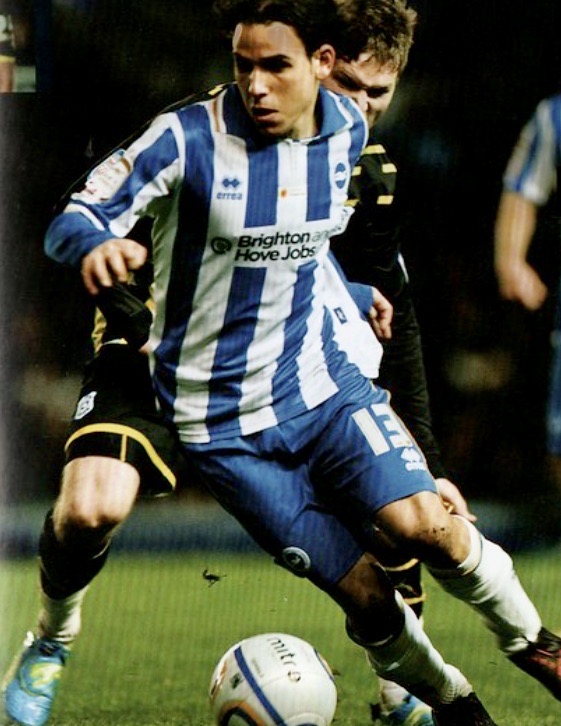
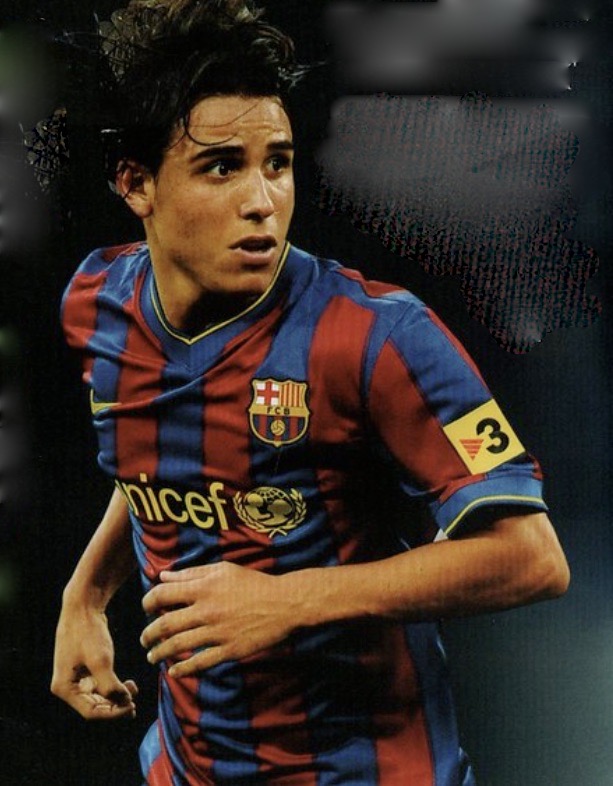
GAI ASSULIN played for his country aged just 16, was hailed as ‘the new Lionel Messi’ and appeared in Pep Guardiola’s Barcelona first team at 18.
Two years later he had two starts and five substitute appearances for Brighton in the Championship, on loan from Manchester City, but couldn’t agree terms for a permanent move.
He subsequently flitted from club to club, country to country, and in the autumn of 2021 was playing local five-a-side football in Cheshire.
Where did it all go wrong? Was it a case of too much too soon?
Assulin was only 12 when he uprooted from his Israel home to pursue the chance of a career with Barca. He spent seven years there, playing for the youth side before reaching the renowned B team in 2007 where he was coached by Guardiola.
“I learnt a lot from him,” he said. “He helped me develop as a player but then so did all the coaches I played for at the club. From the age of 12 to 17 you learn the philosophy of the first team; how to play, what to do, and that never changed.
“Whatever age group you are in, the system you play is the same as the senior side so, if you do get called into the first team, it is not a big, big difference to what you are used to.”
When Guardiola stepped up to first team coach, Assulin was among the youngsters he blooded involving the winger in the Copa del Rey game against Cultural Leonesa in October 2009 and then some pre-season friendlies, including against Tottenham at Wembley.
“Playing in those games was a good experience,” he told the Albion matchday programme. “As the manager likes his younger players, he gave me an opportunity but the competition for places was really, really tough so it was hard to break into the team.
“I also had a few problems with my knee which didn’t help either and my time with the club eventually came to an end.”
Ahead of Guardiola eventually making the same move, Assulin signed for Manchester City under Roberto Mancini in December 2010, explaining: “I wanted to continue my football education at another top club and Manchester City has many top, top players.”
He has since publicly castigated Mancini for not giving him the opportunity to break through at City, telling ITV in 2016: “He didn’t give anyone a chance, he didn’t care about any young players, especially me.
“I didn’t even do the pre-season, when it was a good time to give someone a chance and see if they do well (or) if they are not doing well. But I didn’t get a chance, which was frustrating. It was a shame as I always felt good when I trained with the first team, but sometimes he chose his own sons over other players and I don’t think it was fair.
“It is very important for me to tell people as a lot of City (fans) don’t know what happened with me at City. People always ask me why I didn’t get a chance, and it’s obvious that the manager was the problem.
“I loved playing there, I loved the city and I wish I had a chance there. (City execs) Brian Marwood and Garry Cook loved me and really wanted me to stay, but Mancini didn’t and that was the problem.”
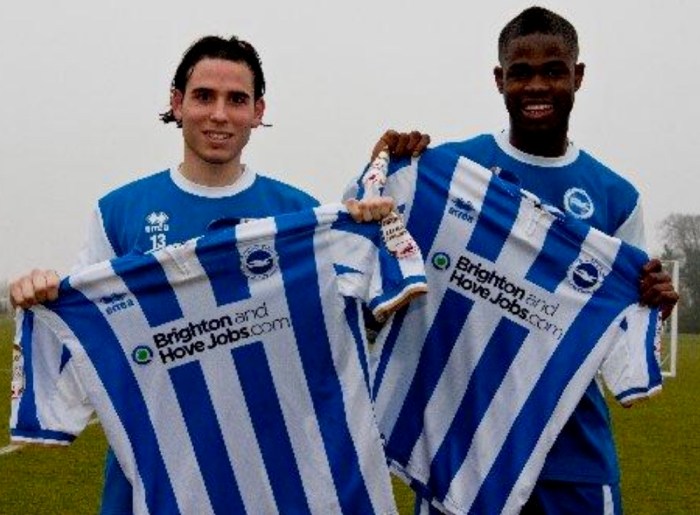
When Assulin joined Brighton in February 2012, Gus Poyet admitted he hadn’t been planning to take him on because at the time he was only interested in getting City midfielder Abdul Razak on loan.
A window opened up when forward Will Hoskins went to Sheffield United on loan, and Poyet told the Argus: “We were not looking to bring in another player after Razak. This was something that came along that I thought was very interesting. When there is something unique and unexpected like this I think it’s a no brainer.
“Gai was one of the top young talents in the world four or five years ago and he was very unlucky with an injury.
“He is still very young. He has got an incredible amount of quality and he can really make a difference but for any young player he needs to be playing and right now at Man City that is very difficult.
“He is an offensive player without any doubt, not a midfielder. He can play up front, wide or behind the striker.”
Assulin made his Brighton debut on 22 February against Hull City, going on as a substitute for Razak in the 77th minute of a 0–0 draw. He made his first start against Cardiff City at the Amex on 7 March but was substituted after 59 minutes of a 2–2 draw.
Although Razak returned to City after falling out with Poyet, Assulin’s loan was extended to the end of the season. However, he only made one more start – in the 6-0 drubbing dished out by West Ham at the Boleyn Ground, again being subbed off when Kazenga LuaLua replaced him on 53 minutes.
His last action in an Albion shirt was as a 61st-minute substitute for Will Buckley in a 0-0 draw at Barnsley’s Oakwell ground. As an aside, Barnsley had future Albion back-up ‘keeper David Button in goal, and ex-Seagulls Jim McNulty in defence and Craig Davies up front.
Rather like the situation at City, there was plenty of competition for places at Brighton with Buckley, Craig Noone and LuaLua the wide choices and the incomparable Vicente playing just off the strikers.
Supporters commenting online recognised Assulin’s talent but felt he was too slight for the robust sort of treatment meted out by Championship defenders.
There was some speculation at the end of the season that a permanent move from City might materialise but terms couldn’t be agreed and Assulin moved instead to Racing Santander back in Spain.
He also had spells with Granada, Hercules and Mallorca and Israeli side Hapoel Tel Aviv. He returned to Barcelona to join third-tier side Sabadell in August 2016 but in January 2018 his contract was cancelled by mutual consent after an 18-month spell hampered by injury.
Next stop was Kazakhstan Premier League team Kairat but he played only once and mutually agreed to tear up the two-year contract he’d signed. He also went to Romanian outfit FC Politehnica Iași and, until the end of the 2020-21 season, he was playing for Crema in Italy’s Serie D.
Without a club, Assulin returned to his home in Cheshire with his partner and eight-year-old daughter, and, while searching for his next move, was doing the school run, coaching, playing five-a-side and helping with his partner’s children’s clothes shop, he told football reporter Will Unwin in a November 2021 interview.
“On an indoor pitch at an industrial estate in nearby Cheadle Hulme, it is not hard to spot the man with La Masia education among those from Moston and Moss Side,” Unwin observed.
“I grew up as a kid in Israel, in a small town and my dream was to play first-team football for a professional club,” Assulin told the reporter.
Born in Nahariya, Israel, on 9 April 1991, Assulin’s family supported Maccabi Haifa, and young Gai went to watch them from an early age.
How did he end up at Barcelona? “My dad (Eli) took me to a club in Israel called Natanya and they had a manager who had contacts with Barcelona,” he explained. “I was invited to Andorra for a ten-day trial with other players from many different countries and I did really well. A scout from the club then invited me to Barcelona and I did really well at a trial there too. They then offered me a contract.”
Only 12 at the time, he said: “It was a big change obviously at that age, as you are not used to being in a different country and a different culture, but I did the right thing. I love football, it is my life and my family were with me when I needed them.
“My dad came over with me to live in Barcelona and then the rest of my family – my mum, one brother and two sisters – came over for a year before returning to Israel. They used to come and visit every couple of months. The experience has made me a more mature person.”
Unwin noted that Liverpool’s Thiago Alcântara once described Assulin as “the most talented player I’ve ever seen in La Masia”, the two players having progressed alongside each other.
“We grew up together at the club and played in the same team for seven years,” said Assulin. “I would see him every day, and we went to school together.”
In a 2018 interview with Unwin for Planet Football, Assulin said: “Training with Barcelona’s first team was the best experience I’ve had in my career.
“I learned so much. I’m proud to say I was training with such big players. I’ve learned from Messi, Henry, Zlatan. They’re all different types of players, so it was great to see how they operate and pick up little things from them.”
Likewise at Man City, especially from David Silva. “He’s such a good player and different from anything you will see,” said Assulin. “He’s just so intelligent on the pitch and a great guy too.
“I had a good relationship with almost everyone. I was talking more to the Spanish guys – Silva; Carlos Tevez was there at the time; Yaya Toure I knew from Barcelona; Kolo Toure was a really nice guy.
“I had a great relationship with everyone, but especially those guys. Every time I went to train with the first team, they helped me, and they liked me.”
That one full international appearance for Israel happened in a friendly match against Chile in 2008, his appearance as a 78th minute substitute coming 14 days before his 17th birthday. He subsequently made 22 appearances for Israel’s under 21 side over the next five years, but didn’t win another full cap.
Unwin observed: “The early pressure of being synonymous with Lionel Messi was not a tag Assulin particularly enjoyed as he looked to come out of the Argentinian’s shadow.”
The player himself explained: ‘They like to compare in football; it is something they do all the time and for me it is a big compliment, but Messi is the greatest footballer in history. ‘Sometimes it is not good if you take it in the wrong way, as the expectation is for you to go on to the pitch and do the same as Messi all the time. Whichever club I went to, they saw I was compared with Messi, so they thought I was going to be Messi and score 50 goals a year, so that comparison at the time was not as positive.
‘Right now, after being at so many clubs, I see it as something positive and I take it as something that hasn’t been said about so many players. Messi is the best in history, so it’s nice to be compared to him for something that I did right at the time.’
MULTIPLE loans away from parent club Tottenham Hotspur didn’t succeed in laying a path to a top level football career for striker Jonathan Obika.
One of the last such arrangements saw the young forward spend three months with the Seagulls in the 2013-14 season.
Nathan Jones, no.2 to Brighton head coach Oscar Garcia, had seen what Obika could do when the young striker had been under him as a coach on loan at Yeovil and Charlton Athletic.
Unfortunately, his impact with the Seagulls was underwhelming even though he scored on his first (and, ultimately, only) full start in a 3-1 win away to Port Vale in the fourth round of the FA Cup.
Obika salutes his one and only goal for Brighton
Albion’s other goals that day, from Rohan Ince and Solly March, were also their first for the club – generating the statistic that it was the first Albion game in 110 years in which three players had scored their first goal in the same league or cup match.
It had been an amazing goalscoring performance for Spurs reserves that prompted Albion to make a move for Obika as cover for first choice Leonardo Ulloa, especially with Craig Mackail-Smith and Will Hoskins sidelined by injury and Ashley Barnes on the brink of a move to Burnley.
The Argus reported that Obika had previously been a target but a move had been put on ice because he’d been injured. His return to fitness saw him net a double hat-trick in a friendly for Tottenham against Charlton’s under-21s, watched by Jones.
“The report coming back on him after the game was one word – lethal!” former Seagulls goalkeeper Ben Roberts, then on the coaching staff at Charlton, told the Argus.
“Like Nathan, I worked with Jon at Yeovil and then at Charlton and he’s a really good pro,” said Roberts. “He is guaranteed to score goals. He is a real predator around the box.
Obika in action for Yeovil
“I’ve been waiting for his career to really kick off. When he came to us at Charlton it took him a couple of weeks to get up to speed. But he was brilliant for us. The end of the season came too soon for us.
“He is a great signing for Brighton and he will suit the way they play.”
However, Garcia also brought in Spaniard David Rodriguez at the same time and Obika found himself down the pecking order, especially when Manchester United loanee Jesse Lingard was added to the forward options.
The Vale cup game aside, Obika made just seven appearances as a substitute but didn’t add to the lone goal and was eventually recalled by Spurs and sent out on loan to Charlton again until the end of the season.
Nevertheless, Garcia said: “He came in to give us forward cover and, while he may not have played as much as he would have liked, he has been a great professional and a pleasure to work with.”
Obika’s long association with Tottenham finally came to an end in September that year when he headed west to League One Swindon Town, where he played for three years, scoring 28 times in 108 games for the Robins.
In 2017, he switched to Town’s rivals Oxford United on a two-year deal before then trying his luck in Scotland, playing in the Scottish Premier League for St Mirren.
On the expiry of that contract, Obika moved to League One Morecambe and, in January 2022, found himself back in the news ahead of this year’s FA Cup third round when Morecambe travelled to North London to take on the club who nurtured his early career for 13 years.
Although Morecambe took a shock first half lead against Spurs through defender Antony O’Connor, it wasn’t a fairytale ending as the Premier League side eventually won the tie 3-1 with three goals in the last 16 minutes of the game.
Obika had to watch from the bench until the 58th minute when he replaced Jonah Ayunga – a Brighton reserve player between 2016 and 2018 – with Morecambe still clinging on to their slim lead.
Born in Enfield on 12 September 1990, of Nigerian parents, Obika grew up in Edmonton and it was while playing football for his primary school, St Paul’s & All Hallows, that he was scouted by Tottenham.
“I lived five minutes from the stadium, so I used to walk to training as a 10, 11-year-old,” he said. “That was my only focus back then.” He later attended Bishop Stopford School in Enfield and left with seven GCSEs.
Originally a left winger, Spurs’ under 18s coach Alex Inglethorpe was responsible for moving him to play as a central striker and in the 2007-08 season he was top scorer for the Spurs academy side.
Those goals caught the attention of first team boss Harry Redknapp and he signed his first professional contract at 18, while a second-year trainee in the academy, and earned a call-up to the first team squad.
Wearing the number 80, he made his debut off the bench in a UEFA Cup game in Holland against NEC Nijmegen on 28 November 2008. A few weeks later, he made his first senior start in front of the White Hart Lane faithful, playing against Shakhtar Donetsk in the same competition.
“I didn’t know I was starting at the beginning of the game, there were a few injuries so a lot of the youth team players trained that week and we were in the squad,” Obika remembered.
When announcing the team, Redknapp actually read out his name as John Utaka, his former player at Portsmouth, amid much hilarity. “That broke the ice,” said Obika. “I was less nervous after that. I was more relaxed and actually ended up having a good game. To play at the Lane, having grown up down the road, was a great feeling and I had all my family and friends there that night.”
Along with Inglethorpe, the coaches who most influenced his development at Spurs were John McDermott and, when he progressed to the reserves, Tim Sherwood, Les Ferdinand and former Albion full-back Chris Ramsey.
Obika and fellow Spurs youngster Andros Townsend were sent out on loan to Yeovil – it was the first of four loan spells there for Obika – as recalled by Jones in an interview with coachesvoice.com: “A host of other clubs wanted them, but I think Harry saw two young kids who wanted to play, and he saw something in us as a coaching team.
“Townsend clearly had huge drive and ambition, and Obika scored the goals that kept us in League One that season – so we will always be thankful to Harry for that.”
Obika recalled: “While I was at Yeovil, Nathan Jones was my coach and I built up a good relationship with him. He would stay behind with me while I did extra shooting: he didn’t need to, I could have done it with other teammates, but he wanted to be there and help me progress and I really appreciated that. He is a good man. He also took me to Charlton for a loan spell and, of course, to Brighton.”
Obika also had loan stints at Millwall, Crystal Palace, Peterborough and Swindon although in the 2012-13 season he did manage to get two more games for the Spurs first team, featuring in the League Cup and the FA Cup.
He went on as a 75th minute substitute for Clint Dempsey when André Villas-Boas’ Spurs side beat Carlisle United 3-0 in the League Cup in September 2012, and was a 59th-minute substitute for Gylfi Sigurdsson when Leeds dumped Spurs out of the FA Cup 2-1 in a fourth round tie at Elland Road in January 2013.
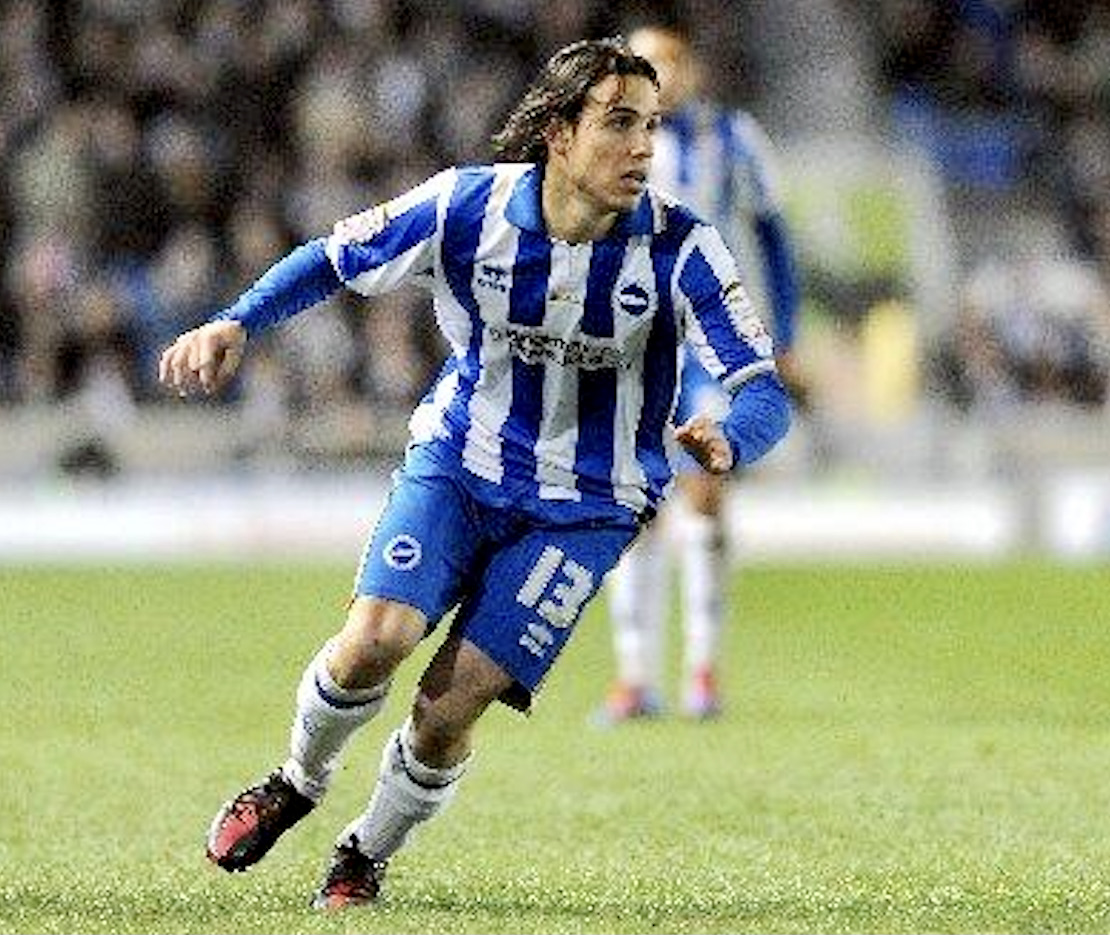
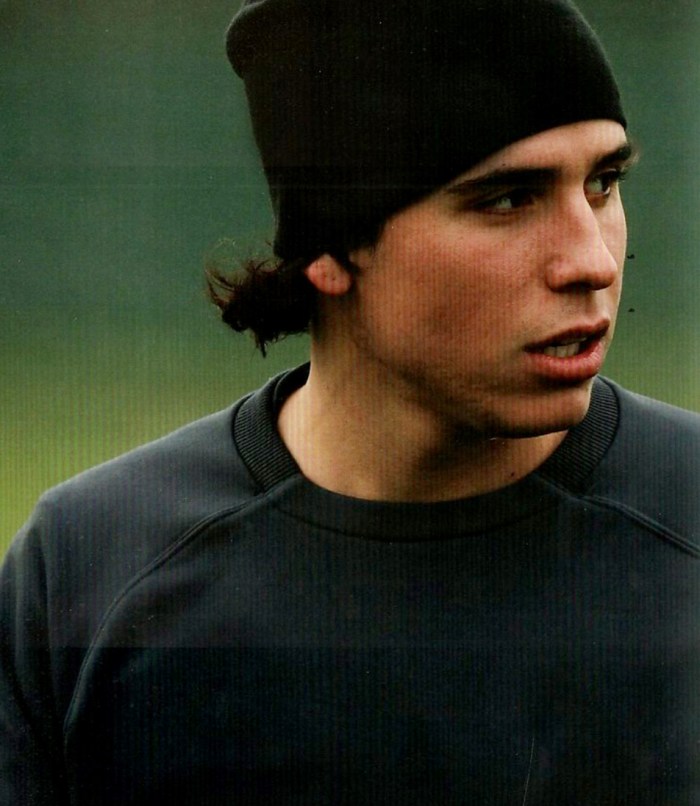
DEFENDER Gary Borrowdale couldn’t have been more aptly named for a loanee which is just as well because he found himself in that situation half a dozen times over five years.
He made a temporary switch to Brighton from QPR in March 2009 to fill the spot vacated when Albion’s regular left-back Jim McNulty suffered a shocking injury in a 4-0 home defeat to Crewe Alexandra.
While McNulty needed an operation to remove a kidney, former England under 20 international Borrowdale had the chance to resurrect his flagging career with the Seagulls.
For a player who’d clocked up 100 appearances for Crystal Palace by the time he was 21, there was the inevitable ‘noise’ about helping out the arch rivals, but Borrowdale just wanted some game time, and he was one of five debutants who pulled on Albion’s sky blue second kit for the game at Brisbane Road on 7 March 2009.
Brighton lost that match 2-1 but, under Russell Slade’s astute stewardship, Borrowdale acquitted himself well during 12 matches through to the end of the season and the Albion just managed to retain their third-tier status.
“I made my debut for Palace at 17 and played my first game in the Premiership at 18, so it was a great start and Palace will always be dear to me as a result,” Borrowdale told Spencer Vignes for a matchday programme article.
“The highlight of my career would be the promotion I had with Palace when we went from the Championship to the Premiership,” he said, referring to the play-off win over West Ham, the day before Albion beat Bristol City in their own divisional play-off.
Borrowdale returned to west London after his spell on the south coast but in March 2010 he went on loan to Charlton Athletic and the following year had temporary spells at Carlisle United and Barnet.
His league career seemed to be over when QPR released him in June 2012 and he went over to Northern Ireland to join second tier outfit Carrick Rangers.
In January 2014, he looked to have got a foothold back in the English professional game when loaned by Margate to Gillingham, but he didn’t play any first-team games and was released at the end of the season.
Former Albion boss Peter Taylor told the club’s official website: “He’s done very well, lost weight every week and looked fitter every week.
“I just don’t think he’s ready for League One football, especially considering if we have to play Saturday and Tuesday. As a result, I have decided to let him go.”
Borrowdale then linked up with Greenwich Borough, initially as a player, before becoming a coach.
Born in Worcester Park, south London, on 16 July 1985, Borrowdale came through the youth ranks at Selhurst Park and Trevor Francis handed him his debut for Crystal Palace in December 2002.
When Iain Dowie took over as manager, Borrowdale quickly became a regular in the first team. He also represented England at each of the age groups from 16 to 20, playing alongside the likes of Gary Cahill in defence.
In a 2-2 draw with the Netherlands, played at Turf Moor, Borrowdale’s teammates included fellow Palace youngster Scott Flinders in goal and future Albion player Will Hoskins.
Borrowdale won Palace’s Young Player of the Year award in 2006-07, but, when Dowie moved on to manage Coventry City, Borrowdale joined him there, a tribunal fixing the transfer fee at £650,000.
The move didn’t work out, though, and, with Dowie gone, Borrowdale was sidelined, eventually being sent out on loan to Colchester United and then QPR.
Paulo Sousa took him on loan in November 2008 and, although he didn’t feature, made the move permanent in January 2009 on a three-and-a-half-year deal. He made just 22 appearances for QPR during that time.
• Pictures as featured in the Albion matchday programme.
AN UNDERSTUDY to eccentric Crystal Palace goalkeeper Gabor Kiraly played a dozen games in goal for Brighton in the spring of 2007.
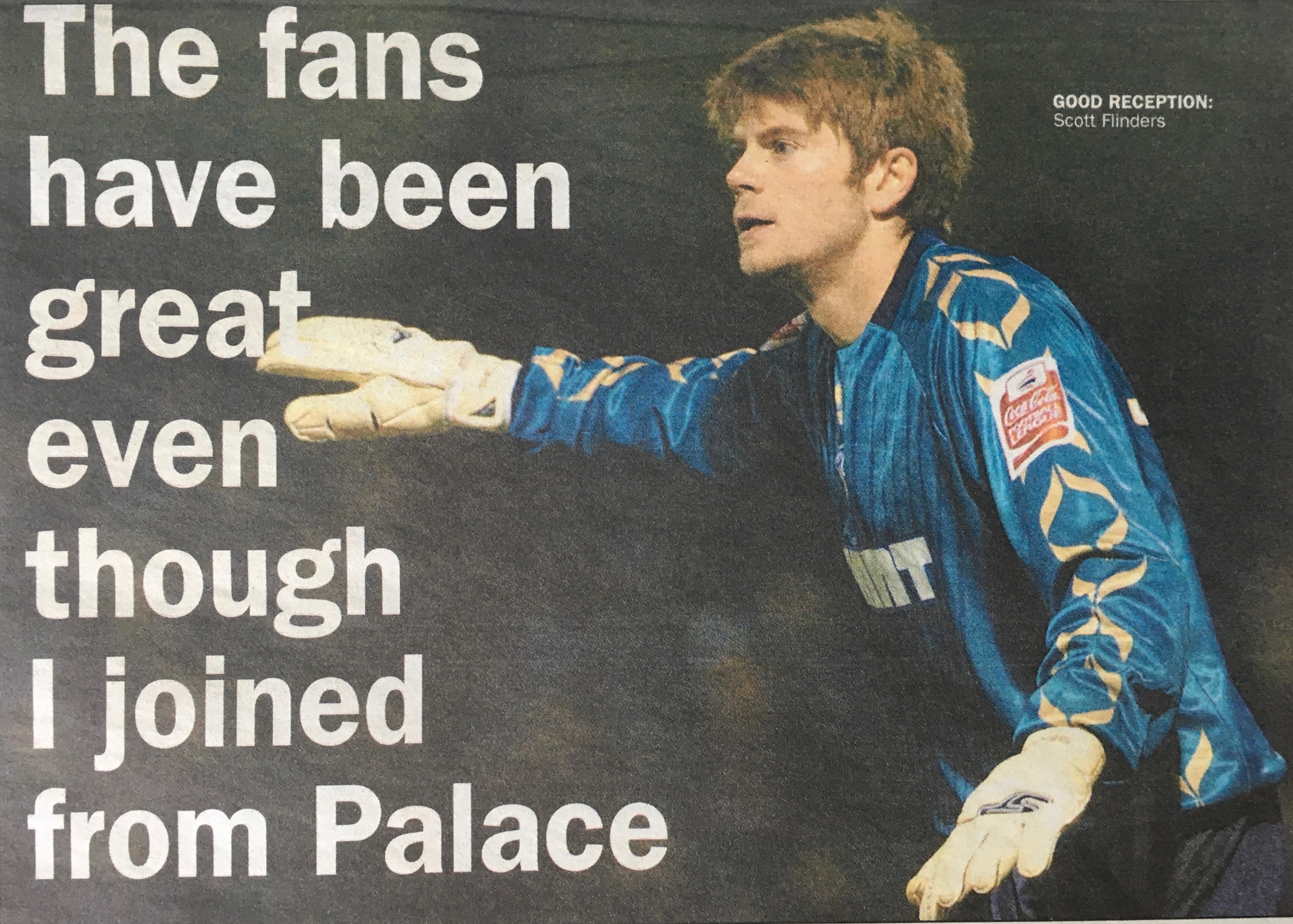
Scott Flinders was just 20, and suffering from the effects of a bout of ‘flu, when he answered a call from fledgling manager Dean Wilkins to help solve a goalkeeper crisis.
With first choice Michel Kuipers injured, Wilkins considered it too early to risk rookie ‘keepers Richard Martin and John Sullivan, so he turned to Albion’s arch rivals to borrow 6’ 4” Flinders.
“I always thought Millwall were Palace’s biggest rivals but then I got told, I think it was by Dougie Freedman or Clinton Morrison, that it is Brighton,” Flinders told The Argus. “It didn’t put me off signing. It is just about playing games.”
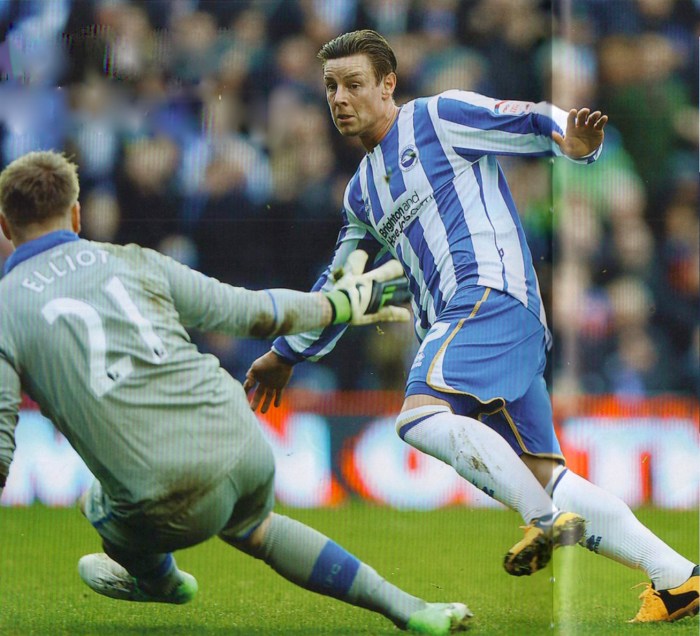
Flinders made a slightly shaky start in a win away to Gillingham, and in a defeat to Bristol City on his first appearance at Withdean, but he made some important stops to help earn points in consecutive away draws at Crewe and Blackpool.
Manager Wilkins told The Argus: “We knew we were bringing in somebody who was not 100 per cent for the first couple of matches. Scott has recovered from that and he has done very well for us.
“We are still in a position where we need another ‘keeper with a bit more experience than the young lads we’ve got.”
Flinders seemed happy to extend his loan from one month to two and said: “The fans have been absolutely excellent towards me, even though I am coming from a rival club.
“John Keeley, the goalkeeping coach, has been different class and I am delighted to be here.”
Unfortunately, Albion lost all five of their matches in April and finished 18th, six points clear of relegation.
Born in Rotherham on 12 June 1986, Flinders joined nearby Barnsley as a youth trainee in 2003 and made it through to the first team in 2005 when former Albion striker Andy Ritchie was the manager.
He took over from Ross Turnbull and featured in 11 games over three months before losing his place and subsequently having to settle for being understudy to Republic of Ireland international Nick Colgan.
However, Flinders earned his own international recognition in the shape of five caps for the England under 20 side, three of them in the 2005 Toulon tournament. He made his debut in a 3-0 win against the Korean Republic in a side which also featured Liam Ridgewell, Liam Rosenior and Greg Halford.
He kept his place three days later in a 0-0 draw with France, then came on as a sub three days later in a 1-1 draw with Mexico.
In August the same year, he started against Russia but was substituted as the side went down 4-0. A teammate in that one was Will Hoskins. His final match was at Turf Moor when England drew 2-2 with Holland, although he was subbed off again. In that England team was future England centre-back Gary Cahill while the left-back was Gary Borrowdale, who played on loan at Brighton under Russell Slade in 2009.
Frustrated playing second fiddle at Barnsley, Flinders had trials at Chelsea and Wigan Athletic but he ended up at Crystal Palace in 2006 as part of an exchange deal involving midfield player Sam Togwell.
It’s believed Palace paid an initial fee of £250,000 with additional instalments to be paid according to appearances.
However, Flinders only made one league cup appearance before being sent on loan to Gillingham. It was the first of five loans away from Selhurst Park, the lengthiest being his time at Brighton.
Other loan spells saw him spend time with Yeovil Town, Blackpool and Falkirk and he was released by Palace in May 2009 after playing just 13 games for them in three years.
His years of understudying finally came to an end when he headed to the north east in the summer of 2009 and joined Hartlepool United, where he established himself as first-choice ‘keeper.
Flinders even got on the scoresheet while at Hartlepool, scoring with a 94th minute header against Bournemouth on 30 April 2011 to earn his side a point in the last home game of the season.
The 2012-13 season was a particular triumph for him when he earned the accolades of Player’s Player, Supporter’s Player, Away Player of the Year and Hartlepool Mail SportsMail Player of the Year.
In six years at Hartlepool, he made more appearances – 276 – than any other ‘keeper in the club’s history, eventually moving on in June 2015 to League Two York City.
It was alleged Dons striker Lyle Taylor grabbed Flinders by the testicles and, as he retaliated, the goalkeeper was alleged to have used racist abuse.
Flinders denied the charge but was found guilty by the FA following an independent regulatory commission. Fined £1,250, Flinders was also warned about his future conduct and ordered to complete an education course.
York initially suspended Flinders but then loaned him out to National League rivals Macclesfield Town, who he subsequently joined on a contract from January to June 2017.
On deadline day in August 2017, he joined League Two Cheltenham Town, with boss Gary Johnson telling the club’s website: “Scott has played over 400 league and cup games in his career and there is no substitute for experience.”
In January 2020, Flinders suffered a broken leg in a game against Oldham which put him out of the game for nine months.
GARY LINEKER’S former strike partner at Leicester City had a good goals to appearances ratio for Brighton & Hove Albion.
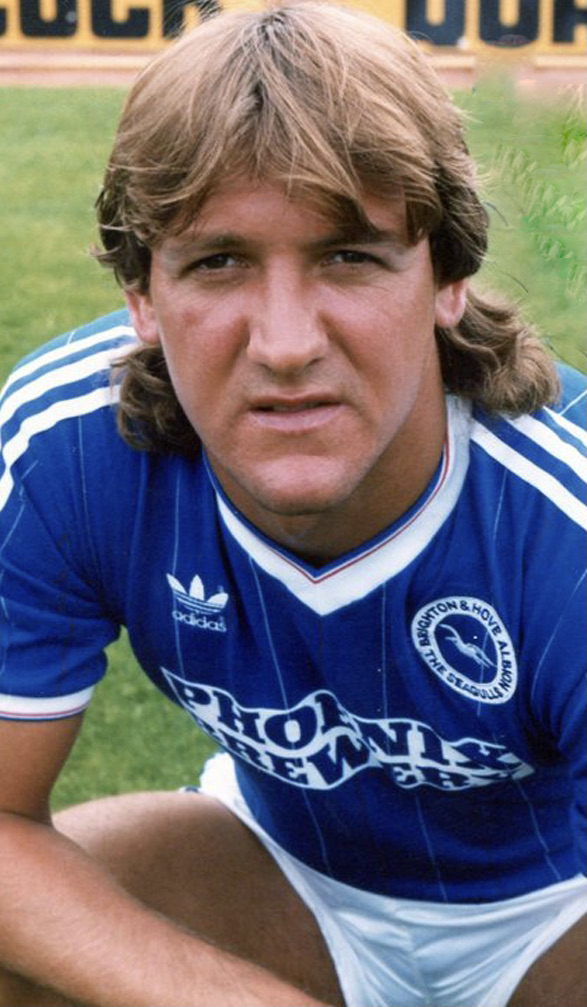
Sadly, Scotsman Alan Young only managed 26 appearances in his one season (1983-84) with the Albion, although his 12 goals meant he finished second top goalscorer behind Terry Connor.
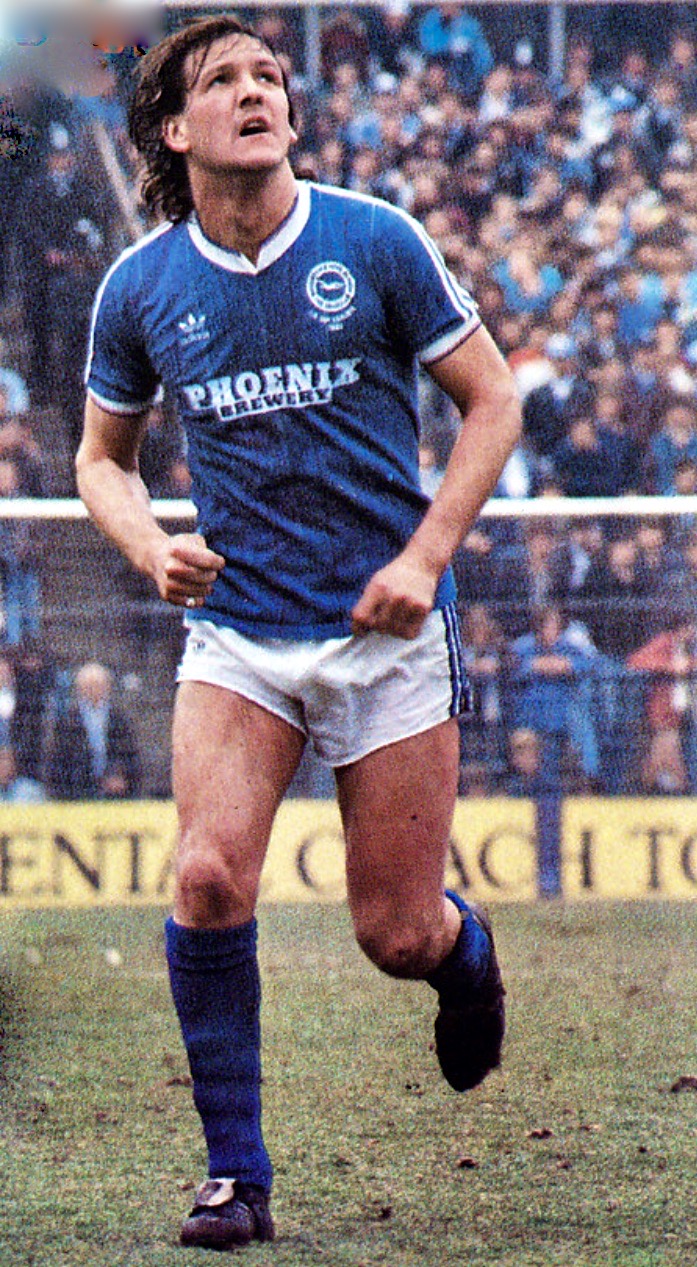
His brief Brighton career got off to a great start with a memorable debut goal, an overhead kick to net against Chelsea at the Goldstone. Young twice scored braces for the Seagulls but his season was injury-hit and, with manager Chris Cattlin bringing in his old pal Frank Worthington for the 1984-85 season, Young was sold to Notts County.
In more recent times, Young courted controversy as a radio pundit sharing his opinions about Leicester, and in 2014 BBC Radio Leicester dropped him from his role supporting commentator Ian Stringer.
Back in September 2013, Young was berated online for his criticism of winger Anthony Knockaert. Foxello, on ja606.co.uk, wrote: “If there’s one thing that annoys me more than just about anything else at this football club, it is that grumpy, nasty egotist Alan Young and his never-ending agenda against certain members of the football club.”
The correspondent bemoaned: “Knocky is now the butt of every joke, and the object of every jibe Young throws out…. It’s almost as if he doesn’t want us to have skilful players who occasionally misplace a pass due to their advanced vision, and just have hoofers and cloggers like in his day.”
So let’s take a look back at ‘his day’. Born in Kirkcaldy on 26 October 1955, Young was football-daft and showed sufficient promise to earn Scottish schoolboy international honours.
His boyhood favourite team was Raith Rovers, whose star player at the time was Ian Porterfield, who famously scored the winning goal when Second Division Sunderland beat Leeds in the 1973 FA Cup Final.
Surprisingly overlooked by Scottish professional clubs, Young also experienced early disappointment in England when Nottingham Forest rejected him. “Nottingham Forert didn’t want me and I left there thinking I was no good,” he told Shoot! magazine.
Nonetheless, when he was playing as an unattached player for Scotland Schoolboys against England at Old Trafford, Oldham Athletic scout Colin McDonald, a former Burnley and England international goalkeeper, noted his promise and persuaded the young forward to head south of the border to begin his professional career.
In five years at Boundary Park he scored 30 goals in 122 games, and, to a large extent, learned his trade from old pro Andy Lochhead, a prolific goalscorer in his day for Burnley, Leicester and Aston Villa.
In the 1978-79 season, Young netted a hat-trick against Leicester which caught the eye of fellow Scot and former Rangers boss, Jock Wallace, who had taken over at Filbert Street and was building a team with his fellow countrymen at its core.
When Young joined Leicester, and played alongside his boyhood pal Martin Henderson, it began a love affair with Leicester that endures to this day.
In three years at Leicester, Young scored 26 times in 104 games, eventually forming a partnership with the emerging Lineker. TV’s favourite football frontman was generous enough to pen the foreword to Young’s 2013 autobiography, Youn9y (written in conjunction with Simon Kimber and published by the historypress.co.uk) and said of him: “He was an old-fashioned, aggressive centre forward. He possessed, though, a delicate touch and finesse that belied his big target man status – the perfect partner for a nippy little goalhanger trying to make a name for himself.”
Leicester strike partner for Gary Lineker
Young scored on his full debut for City in a league cup game v Rotherham and followed it up with two on his league debut at home to Watford.
The only time Young was sent off while playing for Leicester was, ironically, at the Goldstone Ground in 1981, at Easter, which was the second of four games at the end of the season that Albion won to stay in the top division.
Young was dismissed for two bookable offences, the first for clattering into goalkeeper Graham Moseley and the other a clash with Steve Foster, although, in his autobiography, he says Foster play-acted a knee injury, which the referee bought. Foster even teased him about it when he joined the Seagulls two years later. In that Easter 1981 fixture, Young’s teammate Kevin McDonald was also sent off, Brighton won 2-1 – and Leicester ended up being relegated together with Norwich and bottom-placed Crystal Palace.
Back in the old Second Division, Young did his cartilage in a game on QPR’s plastic pitch which he says was the beginning of the end of his career, because his knee was never the same afterwards (years later he had a knee replacement).
He also had the disappointment of losing to Spurs in the 1982 FA Cup semi final, although he maintains if a certain Chris Hughton had been sent off for two fouls on Lineker, it might all have been a different story.
Before the next season kicked off, Jock Wallace, the manager he idolised, decided to move back to Scotland to manage Motherwell and his successor at Filbert Street, Gordon Milne, swiftly chose to pair the emerging Alan Smith up front with Lineker, signalling the exit for Young.
Managerial upheaval was to become a familiar cause of Young’s departures in the years that followed, too. But I am getting ahead of myself.
Ian Porterfield, his footballing hero from yesteryear, had taken over as manager at Fourth Division Sheffield United and, although he didn’t really want to drop down the leagues, the Blades were a big club so Young moved to Bramall Lane.
A year later, though, after Brighton’s relegation from the elite in 1983, striker Michael Robinson was sold to Liverpool so there was a centre forward vacancy – and manager Jimmy Melia chose Young to fill it.
The fee was either £140,000 or £150,000 depending on which account you believe, but Young was happy because he pocketed a £20,000 signing on fee (four times what he had received only a year earlier when moving to Sheffield).
While Young had a lot of time for Melia, when Cattlin took over it was a different story and, in his book, there are plenty of colourful expletives used to describe exactly what he thought! He also castigates physio Mike Yaxley – “the most useless physio I have ever worked with” – although he says the team spirit was very good…seemingly fuelled by long post-training ‘sessions’ in Woody’s wine bar.
He said: “The football was very enjoyable there and never more so than when Jimmy Case and I were playing together; I loved playing with Jimmy.”
For a short time in that 1983-84 season, Albion had three Youngs in their squad, none of whom were related. Along with Young the forward, there were centre backs Eric Young and on-loan Willie Young.
When Cattlin decided to bring in his old Huddersfield teammate Worthington the following season, Young was on his way, this time to Notts County. The manager who signed him was the former Liverpool and Nottingham Forest defender Larry Lloyd, but his tenure in the managerial chair was very short so, once again, Young found himself playing for a manager who hadn’t chosen him.
In two years at Meadow Lane, Young scored 12 in 43 games for County. He moved on to Rochdale where the Leeds legend Eddie Gray was in charge, but injury took its toll and he only scored twice in 28 games in the 1986-87 season before retiring at 31. He had scored a career total of 89 goals in 349 appearances.
While there were a few non-league appearances, he eventually landed a job back at Notts County in the early days of community football schemes. He made a success of the job, obtained his coaching qualifications and eventually they combined the community scheme with the centre of excellence.
Brighton fans will be interested to know that among the young lads who emerged during Young’s time there were Will Hoskins and Leon Best. The star player, though, was Jermaine Pennant.
Young has fond memories of Neil Warnock’s time as County manager, because of his interest in the work being done at grassroots level. However, the mood changed when Sam Allardyce took over.
Allardyce initially cut Young’s salary and then showed him the door. “I can’t and I never will forgive Sam Allardyce,” he said.
Away from football, Young has had a tempestuous love life – read the book to gather the detail – and has three sons and a daughter. While he also had spells working for Chesterfield and Leeds, he dropped out of the game and then had a very dark period dominated by heavy drinking in isolation, including a time living alone in a caravan on the banks of Loch Lomond.
Eventually a return to England and his break into radio punditry brought him back from the brink.
In 2013, his autobiography Youn9y was published, the sleeve notes describing the story of “a talented, brave striker who played at the highest level of the domestic game but also experienced human misery at its lowest once his playing career was over”.
The notes add: “Youngy doesn’t just recount the good times of his playing career; he also offers valuable insight and moments of perception and understanding of some of the darkest days of his life.”
After four years as match summariser, in 2014 BBC Radio Leicester dispensed with his services and replaced him with another former Fox, Gerry Taggart.
However, Young still gives his opinions about Leicester on the community radio station Hermitage FM.
Pictures show a shot of Alan on Brighton seafront from an Albion matchday programme; the front cover of his autobiography; other matchday programme action shots, and in the Hermitage FM radio studio from Twitter.
















 “I made my debut for Palace at 17 and played my first game in the Premiership at 18, so it was a great start and Palace will always be dear to me as a result,” Borrowdale told Spencer Vignes for a matchday programme article.

 Flinders made a slightly shaky start in a win away to Gillingham, and in a defeat to Bristol City on his first appearance at Withdean, but he made some important stops to help earn points in consecutive away draws at Crewe and Blackpool.



 He said: “The football was very enjoyable there and never more so than when
  In parallel lines