

VERSATILE ICELAND international Ivar Ingimarsson was one of the first players Steve Coppell turned to when manager at three different clubs.
The combative defender or midfield player originally played for Coppell at Brentford and, after the former Palace boss took charge of the Seagulls, Ingimarsson was brought in on loan from Wolverhampton Wanderers.
Later, when he managed Reading, Ingimarsson joined Coppell’s new regime at the Madejeski Stadium, and went on to become a legendary part of their rise to the elite.
Ingimarsson arrived at the Withdean Stadium in February 2003 making his Albion debut in a 1-0 away win at Bradford City on 15 February. He took over from Robbie Pethick and kept the no.20 shirt through to the end of the season.

In an interview with Brian Owen of The Argus in 2016, he said it was one of his best times in English football, and described how Coppell set up teams in a way players could understand.
“That is what Steve Coppell did there – and with Reading,” he said. “Brighton was up there as one of the best times. I loved the city and the atmosphere and the buildings and culture.
“I think if we had played like that for the whole season, we would have been well up the table. That had a lot to do with Steve Coppell.”
Born in the Icelandic capital Reykjavik on 20 August 1977, Ingimarsson was raised in the tiny village of Stöðvarfjörður in the east of the country and after taking up football locally he went on to play for Valur between 1995 and 1997, then moved on to IBV, a side which won the double of Icelandic Premier League and Icelandic Cup in 1998.
He played for Iceland’s under 17 international side 16 times in the 1993-94 season, represented the under 19s 11 times in 1995-96, move up to the under 21s and played 14 times between 1996 and 1999 and then over nine years played for the full international side 30 times.
Eyeing a move to England in 1999, Ingimarsson initially went on loan to Torquay United in October that year but after only four appearances his parent club did a permanent deal with Brentford which saw him sign for £150,000.
Ingimarsson spent nearly three years with the Bees, making 113 appearances, and was player of the year in the 2001-02 season which culminated in the side losing the Second Division play-off final to Stoke City.
It seems financial pressure forced Brentford to release the player on a free transfer and Wolves boss Dave Jones snapped him up and took him to Molineux.
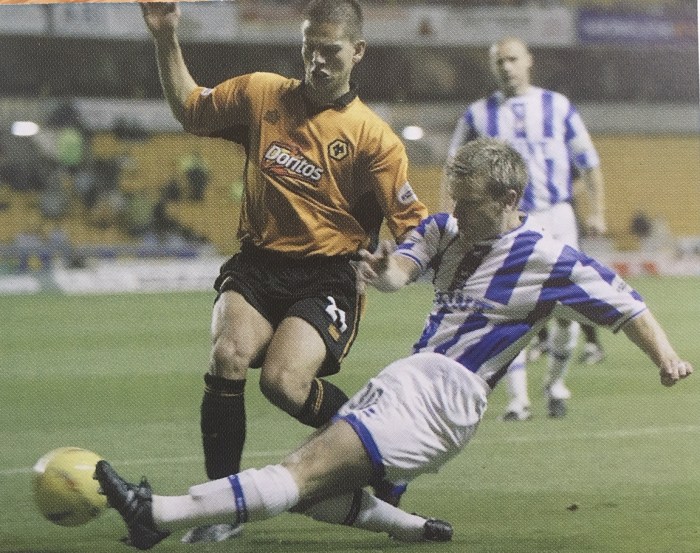 “I’m really looking forward to playing for Wolves,” Ingimarsson (pictured above being tackled by Albion’s Simon Rodger) told the club’s official website. “I was impressed with what Dave Jones had to say to me and although I knew other clubs were interested in me I knew this was the place to be.
“It’s a big club with big ambitions and I want to be a part of it. People say that Wolves should be in the Premier League and everyone seems determined to put that right this year.”
However, his opportunities at Wolves were limited and he made just 13 appearances for them, one of which included a 1-1 draw at home to Brighton which was Coppell’s fourth game in charge. Three months later, Coppell took the opportunity to take Ingimarsson to Brighton to try to bolster the club’s efforts to stay in the second tier after a disastrous start under Martin Hinshelwood.
Ingimarsson initially joined for a month but ended up staying to the end of the season, making 15 appearances as Coppell’s side fought a valiant but ultimately unsuccessful fight to stay in the division.
 On signing him, Coppell told bbc.co.uk: “He’s a terrific athlete. He will fit in with the players we have and that’s an important ingredient in anyone coming to this club.
“It’s an extra body. We’ve got seven games coming in March and I wouldn’t be doing my job properly if we lost matches because of lack of numbers and personnel.”
Once Coppell had been poached by Reading to succeed Alan Pardew as manager of Reading, Ingimarsson was one of the first signings he made, for a £175,000 fee. There he linked up once again with Steve Sidwell, who Coppell had also managed at Brentford and Brighton.
It was at the Madejeski that Ingimarsson enjoyed the most successful period of his career, forming a defensive partnership with Ibrahima Sonko, which he talked about in an interview with Stuart Fagg.
Over eight years at the club, the popular Icelander amassed a total of 282 appearances for the Royals. He was part of the side that won promotion to the Premier League in 2006, he was voted player of the year in 2006-07 and, in 2009, took over as club captain.
After his time at Reading came to an end in 2011, he was offered a one-year deal by Paul Jewell at Ipswich Town but, with his appearances restricted to six starts and two off the bench, he mutually agreed to leave Portman Road in January 2012.
On retirement from the game aged 34, he returned to his home in the east of Iceland where he runs two guest houses and a farm, which he spoke about in that extended interview with Brian Owen of The Argus.
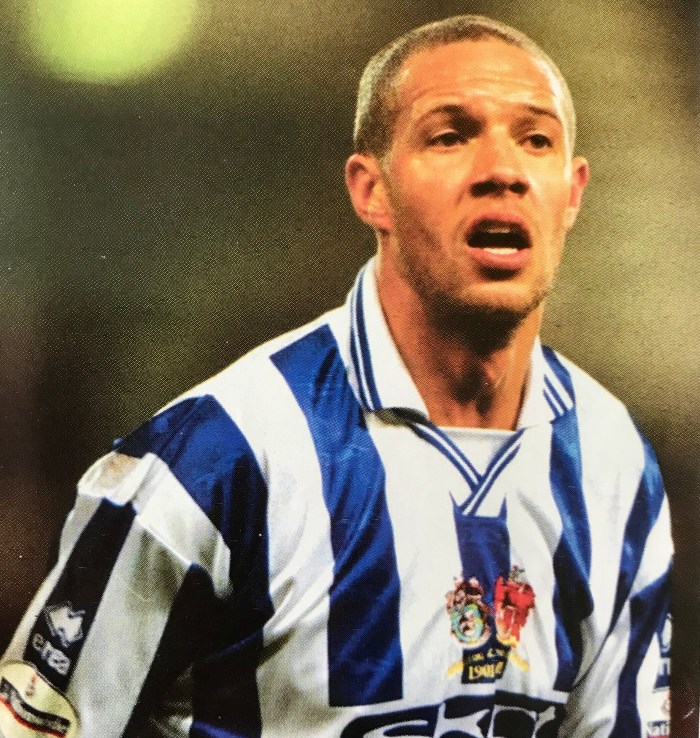 JUNIOR LEWIS was a loyal disciple of Peter Taylor, linking up with him as a player or a coach at EIGHT different clubs.
 Born in Wembley on 9 October 1973, Lewis was on Fulham’s books as a youngster and made it through to the first team, his debut coming as a substitute in a league game against Burnley in October 1992.

 THE REVENGE exacted by Frenchman Georges Santos against an opponent who had inflicted serious injuries to him sparked one of the most notorious football incidents of the modern era.


 In parallel lines