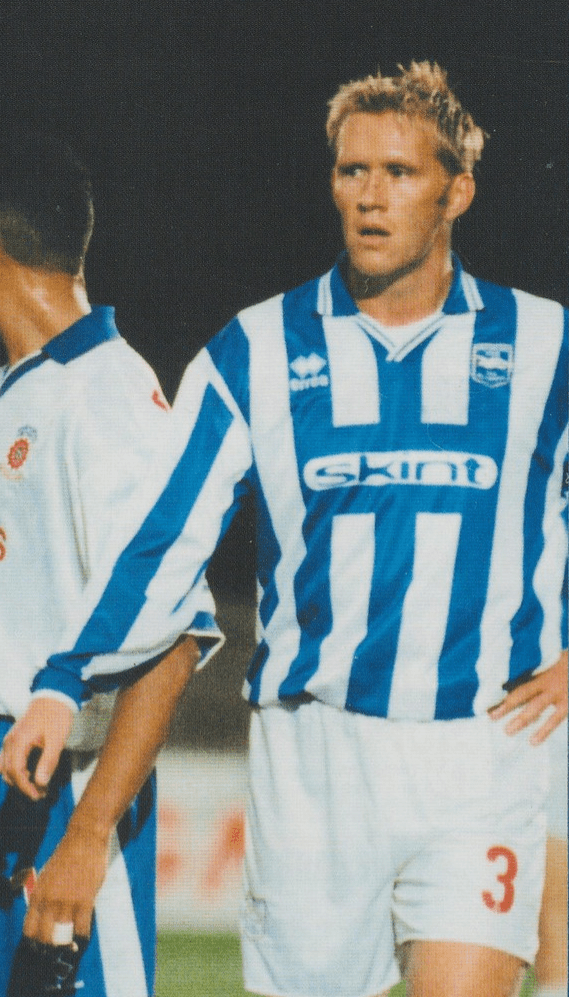
JAMIE CAMPBELL played in the top flight for Luton Town and later filled the left-back berth in the opening months of the season when Albion returned to Brighton after two years in exile at Gillingham.
However, by the time Albion won promotion from the fourth tier in May 2000, Campbell was on the outside looking in, Kerry Mayo having taken his place, and he was given a free transfer halfway through his two-year contract.
Campbell had been one of numerous new arrivals brought in by Micky Adams ahead of the 1999-2000 season having been given a free transfer by newly promoted Cambridge United where he had only missed one match in two years.
Although Albion famously beat Mansfield Town 6-0 in the season opener at the Withdean Stadium, subsequent form had some pondering whether it had been a flash in the pan.
Campbell, the only ever-present defender after eight games (three wins, two draws, three defeats), reassured supporters when he told the Argus: “At Cambridge we had some terrible hiccups at the start of the season. It was a new team, the same as Micky has put together here, and it does take time to gel.
“It’s early days yet. There are a lot of points to be played for and it’s a long old season. It’s far too early to start panicking. Let’s give it until Christmas, see where we are, and take it from there.”
In truth, there were few highlights for Campbell to enjoy in his time with the Seagulls. He put through his own net in only his fourth league outing, heading past the recalled Mark Walton at Darlington when filling in at centre back, although Gary Hart subsequently levelled it up.
He did score (left) in the right end to bag the only goal of the game in a Withdean win over Hartlepool on 6 November 1999, but the following month, when Albion were up against it with several players injured, ill or suspended, Campbell got himself sent off after only 25 minutes in a 2-0 defeat at Swansea City prompting Adams to drop him and relegate him to the reserves.
Campbell was shown the red card by Premiership referee Dermot Gallagher after twice sliding in recklessly on Jason Price in the space of just over a minute. He was Albion’s sixth player to be suspended that season.
“Campbell’s stupidity couldn’t have come at a worse time as a flu-ravaged squad had a hard enough task against the eventual Division Three champions without having to play for over an hour with 10 men,” recalled wearebrighton.com.
Campbell clears from Orient’s Martin Ling
Boss Adams, who had already fined Darren Freeman for a red card at Plymouth, told the Argus: “The boy will be disciplined. They’ve got to learn. In wet conditions like that, good defenders stay on their feet, it’s as simple as that.
“Obviously it’s a worry because with small squads in the third division you can’t afford too many sendings-off.”
Having lost his place, things then got worse for Campbell in February of the new century when he had to undergo a hernia operation, dashing any hopes he might have had of winning back a starting place. With Mayo and new arrival Nathan Jones vying for the left back spot, Campbell became surplus to requirements.
He moved on to Exeter City where he was almost ever-present in the 2000-01 season under Noel Blake and was named the Grecians’ player of the year.
Not long into his first season at St James’s Park, he was interviewed by the local paper and compared the situation at City to his experience with Brighton, because Blake, like his former Leeds teammate Adams, had assembled a new squad of players.
“You’ve got to quickly get to know everyone’s strengths and weaknesses so you can gel as a team,” he said. “He (Blake) has got standards and he wants people to believe in them.
“The boss runs things very professionally, he thrives on running the club like a First Division or even a Premiership club.
“And the good thing with the boss is that he admits he is still learning and his door is always free for us to knock on.”
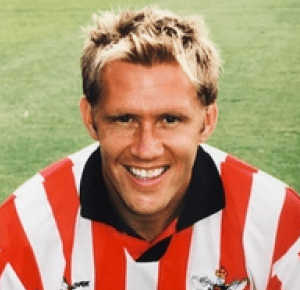
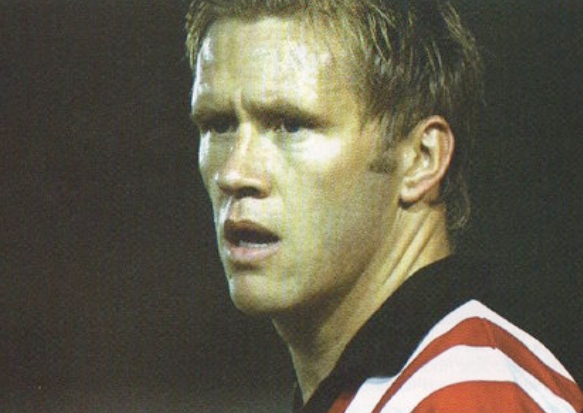
On his return to the Withdean in the red and white stripes of Exeter three days before Christmas 2000 (above), Campbell’s penchant for own goals once again came to the fore when he deflected a Gary Hart effort that was going wide past the City ‘keeper to contribute to a 2-0 win for the Seagulls.
Not long into the 2001-02 season, Blake was replaced by former City player John Cornforth and, although Campbell played 20 games for the Grecians that season, he switched to Conference side Stevenage Borough in March 2002, where he linked up with former Albion players Simon Wormull and Andy Arnott.
The website boroguide.co.uk seems to be singularly underwhelmed by the Wayne Turner signing declaring: “It was perhaps indicative of the poor form that we found ourselves in that Campbell was often a beacon of mediocrity.
“In defence or midfield, the utility player often had little impact; frustration becoming a buzz word when describing JC’s performances.
“So, it was only natural therefore, that he ended up at Woking. Like many other former Boro’ players who didn’t live up to expectations, all roads lead to Kingfield.”
That move took place in February 2003, and he moved on again a year later, to Havant & Waterlooville where he stayed until July 2005, when he retired from playing.
Born in Birmingham on 21 October 1972, he was a trainee at Luton before signing professional in July 1991. He broke through under David Pleat in the 1991-92 season when Town were relegated from the top flight after 10 seasons at that level.
Young Hatter Campbell
Campbell made four starts plus nine appearances off the bench as the Hatters lost their place amongst the elite. Pleat’s squad also included a young Kurt Nogan and combative midfielder Chris Kamara.
On other occasions Campbell was part of Town line-ups that included one-game Albion loanee goalkeeper Juergen Sommer and Arsenal loanee striker Paul Dickov. The excellent Hatters Heritage website said of him: “Jamie was regarded as a utility man at Kenilworth Road with his versatility meaning that he was used mainly as a substitute, which sadly ensured that he could never claim a permanent position in the Hatters side.” Somewhat ignominiously, the fans podcast We Are Luton Town named the defender in their worst-ever Hatters XI.
When he found first team opportunities were limited at Kenilworth Road, Campbell went on loan to Mansfield Town and Cambridge United and left Luton in July 1995 to sign for Barnet.
During two seasons at Underhill, Campbell featured in 67 league matches (and scored five goals) before moving back to Cambridge on a permanent basis in August 1997.
While playing for the Us, Campbell put the ball in the wrong net but ended up on the winning side in a memorable second round second leg League Cup match in 1998.
Roy McFarland’s basement league United side knocked out Premier League Sheffield Wednesday 2-1 on aggregate, having nicked a 1-0 win at Hillsborough in the first leg.
Campbell for Cambridge tries to block a cross by Albion’s Paul Armstrong
Fan Matt Ramsay recalled: “Jamie Campbell’s freak headed 20-yard own goal summarised the cruel nature the sport can possess as it handed the big guns the initiative.
“Yet just as supporters began to embrace the familiar underdog emotion of consoling each other with the knowledge that at least it was a valiant effort, the magic moment arrived.
“Just as football is cruel when it goes against you, the success brings delirium. As Trevor Benjamin thumped home a right wing freekick to put United back into the lead, and as the final whistle fifteen minutes later heralded a major cup upset, there was proof that there is reward for the eternal hope that all fans of all clubs require.”
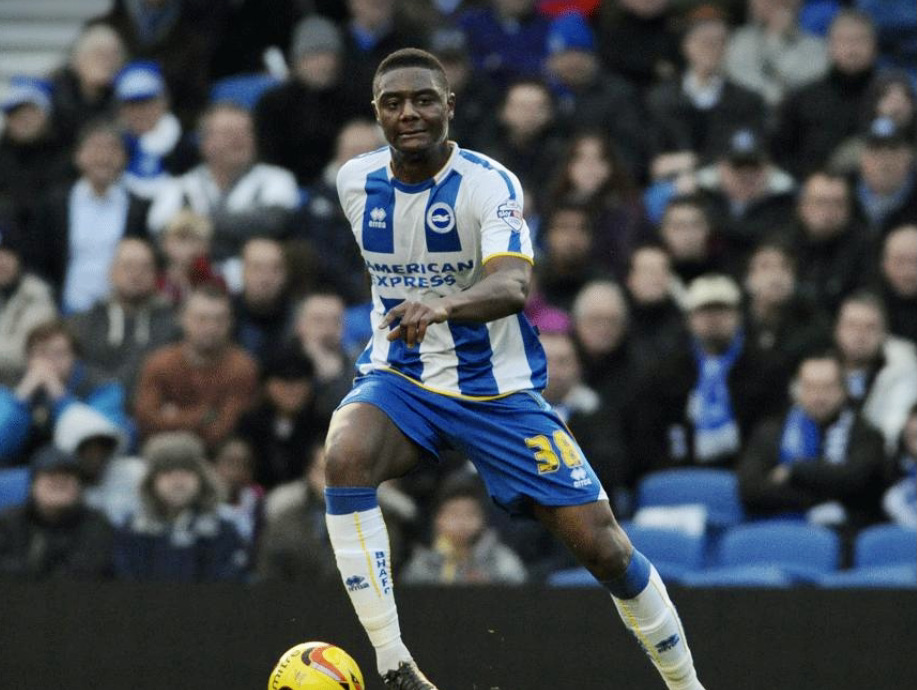
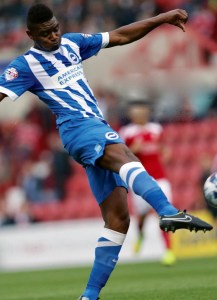
THERE WAS a time it looked like Brighton had rescued a gem of a player in Rohan Ince.
After 13 years on Chelsea’s books, he was picked up at 20 by the Seagulls and quickly earned a place in the first team.
He progressed from a development squad triallist to first-team midfielder in little over six months, getting his chance because of an injury to Liam Bridcutt, another former Chelsea youngster who had been an inspiration for his move to the Albion.
“Liam is older than me but I knew he was a good lad who was always having a laugh,” Ince told the matchday programme. “It was only later when we were training with the reserves that I played with him.
“He is doing well at Brighton and I have great respect for him because it is not easy to find that success after leaving a club like Chelsea.
“He is a great example for young Chelsea boys that have been released, and to all young footballers who don’t get offered contracts.
“Liam has shown it is not the end of the world and if you keep fighting you can get there.”
Ince knew about Brighton from his uncle, Eric Young, a centre-half who played for Brighton in the 1980s.
“When I told him I was signing for the club, he was really happy for me,” he said. “He told me it was a good club and good area to live in. He’s an accountant these days, doing really well for himself.”
Ince arrived at the club towards the end of Gus Poyet’s reign but it was under successor Oscar Garcia’s direction that he thrived. Garcia switched him from a central defender into a defensive midfield player.
“For me he is a player who will have a better professional career as a midfielder than as a defender,” said the head coach. “He positions himself well, he is very alert to second balls, he doesn’t lose possession, he can move the ball quickly.
“I think these are all physical and technical characteristics that are better suited to the midfield role.”
And Garcia demonstrated that it wasn’t always a case of either/or between Bridcutt and Ince when the pair combined successfully in a 3-1 home win over Leicester City at the Amex in early December 2013.
He told The Argus: “All good players can play together. It’s up to the manager to try to find the best position for them.
“Rohan is young but when we are watching him he seems an experienced player. He has to improve a lot of things but he wants to do it and this for me is the most important thing.”
Such was Ince’s progress that in January 2014, a year after he joined the club, he was offered a new two-and-a-half-year contract and was being touted as the natural successor to Bridcutt, who, at the end of that month, made a much-predicted move to follow Poyet to Sunderland.
“He has earned this contract with the way he has trained and played ever since I came to the club,” said Garcia. “He has an excellent attitude every day, he looks after himself and works hard in training; and we are all seeing the benefit of that with his performances on the pitch.
“It is nice for the club to reward that hard work and professionalism with this new contract and I am very pleased for him.”
Ince topped off the first of his two seasons playing in the Championship by being crowned Brighton’s Young Player of the Year. He was probably sadder than most to see Garcia depart immediately after the play-off semi-final defeat to Derby County.
He told The Argus: “I started off as a midfielder at Chelsea up until I was 16, then I was changed to a centre-back because of my height and physical attributes.
“I went back and forwards between midfield and defence in my Chelsea career but I came here as a centre-back because that’s where I thought my career would be best.
“Oscar didn’t believe that and I am happy he didn’t believe it either, because midfield is my preferred position.
“He has given me the opportunity to play first team football, in my preferred role as well, so I couldn’t be more grateful.”
After winning the Young Player of the Year award, Ince said: “The gaffer is a really calm character who doesn’t go about shouting, so is my type of person. The senior pros have also been a massive help, talking to me on the pitch and in training. I couldn’t have won this award without them all.”
Sadly, Ince’s progress seemed to peter away after Garcia left. He made only 11 starts in 26 games for Sami Hyypia, and the player told The Argus: “It was quite hard for me, quite a setback, coming off the back of a good season I had previously.
“I had to keep my head up, keep training well, not get too down or depressed about it. I felt I did that and when the opportunity came I felt I did well.”
It looked like his fortunes had changed after Chris Hughton had taken charge. He was a frequent starter under Hughton initially and the player himself felt bold enough to tell The Argus: “I feel I’ve been playing quite well recently, bringing good competition for the gaffer in the midfield area. I’m giving him quite a tough decision to drop me, in my opinion.”
Hughton clearly felt differently, though. He had already signed Beram Kayal and, in the summer of 2015, added Dale Stephens. They became Hughton’s go-to central midfield pairing.
Another promising young midfielder, Jake Forster-Caskey, found himself sent on loan to MK Dons and, on the last day of the transfer window in early 2016, after Hughton acquired the services of the experienced Steve Sidwell, Ince joined Fulham on loan until the end of the season.
At least it was still Championship level, although Ince didn’t get into Slavisa Jokanovic’s struggling side straight away. It wasn’t until 19 March he was handed a start away to Birmingham City when he obliged with a goal in a 1-1 draw.
“It was a frustrating and a confusing period,” admitted Ince in Fulham’s official matchday programme. “I could have easily given up, but I continued to train hard and kept knocking on the gaffer’s door to make sure he didn’t forget about me. It’s starting to pay off.
“He just said it was tactical why I wasn’t playing but then he decided he wanted to try something different at Birmingham. I think he wanted a more solid midfield with me and Scott Parker in there and I’ve been back in ever since. Long may it continue.”
Ince made eight starts and two sub appearances as Fulham narrowly avoided the drop.
Back at the Albion, Ince only got three first-team starts in the League Cup and was an unused sub for a handful of league games. It was no surprise, therefore, that in January 2017 he was once again sent out on loan, this time to Swindon Town, whose head coach was Luke Williams, who had been in charge of Albion’s development squad when Ince first joined the Seagulls.
Robins fans would have remembered Ince for a wonder strike for Brighton at the County Ground during a Capital One Cup tie in August 2014. It opened the scoring in a 4-2 Albion win, that went to extra-time.
Ince scored twice in 14 games in a squad with some familiar faces: Bradley Barry, Yaser Kasim, Anton Rodgers and Jonathan Obika.
As Albion began life in the Premier League, Ince once again found his only outlet for first-team football was in the League Cup and his display in a 1-0 win over Barnet proved to be a shop window.
Within days, League One Bury signed him on a season-long loan, their manager Lee Clark, saying: “Rohan is a player that has been on the radar for a while. The chairman, Alan Thompson and I went down to Brighton on Tuesday to watch him play for Brighton and he was very impressive for them.
“He will bring a presence to the team and is a very good footballer. He plays it simple and plays it effectively and I believe he will be a big player for us in every sense of the word, both in his physicality and in his play.
“He is an established Championship player and unfortunately for him, Brighton have gone to the next level. Once we found out he was available, we went for him. I am more than delighted to get him in.”
Ince made 22 appearances for Bury in what turned out to be a disastrous season for them because they finished bottom of the table and were relegated. Clark only lasted as manager until the end of October, Chris Lucketti was in charge for two months and caretaker Ryan Lowe was in the hotseat for the remainder of the season.
The loanee played his last match for Bury in April 2018 and was released by the Albion in June that year.
Let’s rewind for a moment, though. Born in Whitechapel, London, on 8 November 1992, Ince was picked up by Chelsea as a promising young player when he was only eight years old.
Football was clearly in the Ince family genes; as well as Uncle Eric, a less close relation is former England international Paul Ince, his dad’s second cousin.
Rohan progressed through Chelsea’s academy and joined the club after completing his formal education at Thamesmead School in Shepperton.
In a detailed pen picture on cfcnet.co.uk in July 2009, Philip Rolfe said: “Look at Rohan from a distance and you could mistake him for a younger John Obi Mikel. His tall, gangly stature and his head of spiky black hair brings about the comparison, and although he’s a centre-back by trade, his laid-back and composed style is very much in the mould of the Nigerian international.
“Ince has most often played in the heart of the under 16s defence alongside Danny Mills, especially in 2007-08. Previously he could also have been found in defensive midfield when Jack Saville was a regular in the under 16s team, and it’s in that position where he might be at his best.
“Much taller and stronger than most opponents his age, he can bring the ball out in the style of the much sought after footballing centre-back. At centre back his somewhat lethargic style can result in a loss of possession, and he is often found to hit a long pass rather than pick out a shorter option.
“In midfield he has more options and more freedom, but as a regular in the under-18s already, he’s honing his craft.”
In 2010, Ince was a member of Dermot Drummy’s FA Youth Cup-winning side that beat Aston Villa 3-2 on aggregate (Ben Sampayo and Anton Rodgers, who also later joined Brighton, were Chelsea subs). Ince signed professional for Chelsea in July 2010 and went on to play regularly for the reserves but didn’t make it to the first-team.
In July 2012, he signed a six-month deal to go on loan to Yeovil. But he made only one start and three substitute appearances for Gary Johnson’s side before returning to Stamford Bridge with a recurring ankle injury.
After finally leaving Chelsea in January 2013, he said: “Chelsea said they couldn’t see me breaking into the first team, which is probably true.
“It is very difficult to get into their first team because they can go out and buy the best players in the world.
“When I was told I wouldn’t get a new deal, I decided to go on a series of trials and Brighton was the club I identified as the best place to go to.
“I travelled to Bournemouth for a friendly on the second day of my trial and felt I had performed well, but then the weather had a dramatic impact on my hopes. There was loads of snow so I was limited to what I could show as we were training indoors, but from what I did show, Luke Williams liked it and extended my trial.”
On being released by Brighton, Ince played a couple of pre-season friendly matches for Charlton Athletic but he didn’t get taken on because of a knee injury. Caretaker boss Lee Bowyer told londonnewsonline: “He’s got something wrong with his knee. He came with it. How he’s been training and playing in the games I don’t know, because he’s injured.”
It led to Ince spending the whole of 2018-19 without a club trying to heal and recover his fitness. Eventually, he was taken on by League Two Cheltenham Town in July 2019, with manager Michael Duff telling the club website: “He’s had a good schooling where he’s come from at Chelsea and had 80 or 90 games for Brighton in the Championship. “When I played against him, he was the next big thing coming through. He’s been a bit unfortunate with his injury last year. We’ve done all the due diligence with regards to testing, seeing specialists, scanning — we think we’ve found a very good player.
Michael Duff greets Rohan Ince
“He’s 6’4”, powerful, but he can play as well. We’re hoping he can add physicality and quality into our midfield.”
Unfortunately, it wasn’t a great start for Ince, when the Robins travelled to east London to take on Leyton Orient on the opening day of the season. In a mad five minutes midway through the second half, Josh Wright scored past Scott Flinders to put Orient ahead, Town striker Luke Varney saw a second yellow for alleged simulation in what the visitors contended was a clear penalty shout.
Frustrated by the decision, Ince, who’d taken a drink of water during the halt in proceedings, threw the empty plastic bottle to the sidelines, but it hit the fourth official. Referee Michael Salisbury deemed it to be violent conduct and showed him a straight red card.
“He seems to think he did it intentionally,” manager Duff explained to gloucestershirelive.co.uk afterwards. “I am not sure Rohan’s aim is that good that he can hit someone five or six yards away, walking the other way. There is not a lot I can do about that one, but I think it’s very soft, particularly after what’s gone on in the 60 minutes before that.”
To make matters worse, the FA charged Ince with breaching an FA rule and, instead of the statutory three-match ban, he was banned for five matches.
Then, just when it looked like he would return to the side in a game at Crawley, he injured his hamstring in a pre-match warm-up and had to pull-out of Cheltenham’s starting line-up.
He ended up making only nine League Two appearances and was released at the end of his one-year deal.
It was only when he linked up with fifth-tier Maidenhead United for the 2020-21 season that he finally got a decent run of games, featuring 31 times for the National League side, and helping the club finish 13th, the second-best finish in the club’s history.
In 2021 he was called up for the first time to play for the national football team of Montserrat, which is coached by Willie Donachie, the former Manchester City, Oldham and Scotland defender, who had been Joe Royle’s managerial no.2 at various clubs.
The tiny Caribbean nation, a British overseas territory of less than 5,000 inhabitants, is trying to rebuild after half the island was destroyed by a volcanic eruption in 1995, forcing thousands to flee to Britain. Most of the British-born semi-professionals who play for Montserrat are related to those island residents who came to the UK.
Ince featured in qualifying matches for the 2022 FIFA World Cup and scored his first goal in a 4-0 win over the U.S. Virgin Islands.
Although they did not advance from their World Cup qualifying preliminary group, the ‘Emerald Boys’ finished unbeaten with eight points and earned draws against El Salvador and Antigua and Barbuda.
On his return, for the 2021-22 season, Ince switched to another National League side, Woking, and is described on the club website as “an integral player at the base of the Woking midfield”.
Adding that he had “quickly became a firm fan favourite”, it says of him: “A tough-tackling defensive midfielder also capable of pushing further forward, he made 37 appearances during his debut season with the Cards, whilst chipping in with two goals and four assists.”
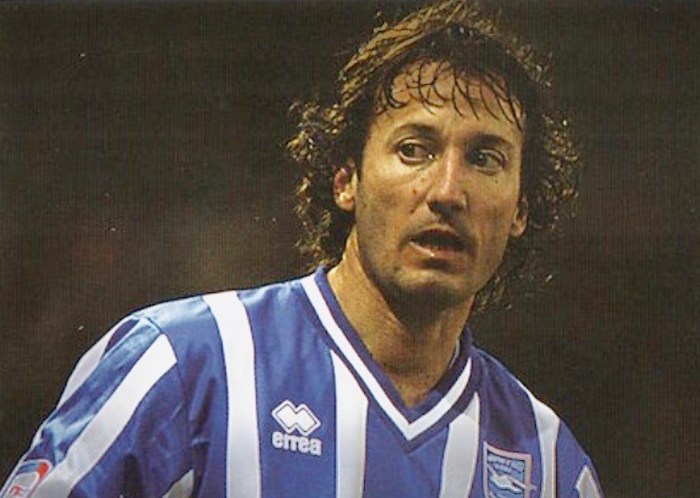
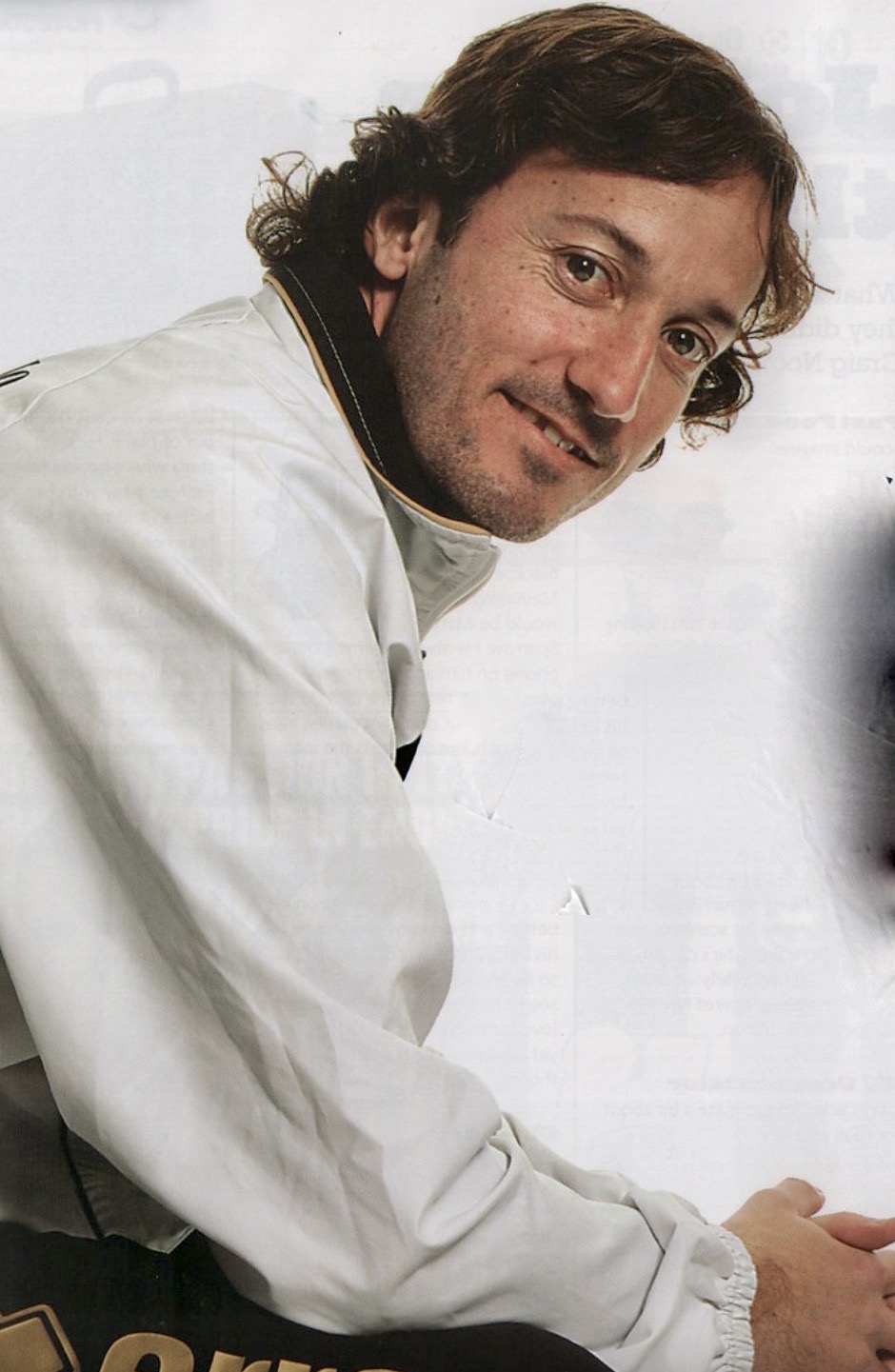
GUS POYET’s loyal deputy, Mauricio Taricco, once labelled ‘The Premiership’s most hated footballer’, had a late and unexpected swansong to his playing career with Brighton.
It came six years after the Argentinian full-back thought his playing days were over when he sustained a bad injury on his debut for West Ham, having switched across London from Tottenham Hotspur, where he played alongside Poyet.
Taricco was no stranger to a red card during his days playing at the top level and he was also sent for an early bath in his comeback game when the Seagulls beat Woking on penalties in the FA Cup.
Some of Taricco’s actions drew fierce cricitism when he was at White Hart Lane, for instance the BBC’s chief football writer, Phil McNulty, wrote an excoriating piece which he began: “Taricco may have a modicum of limited talent, but he hides it brilliantly behind a selection of all that is sneaky and cynical in football.”
Spitting, diving and feigning injury were among the accusations levelled at Taricco, and he left Everton’s Thomas Gravesen nursing a shin wound that required 30 stitches.
After two sendings off in three games in 2002, McNulty said the Argentine was “swiftly becoming the Premiership’s most hated footballer” and concluded: “Taricco is a scar on the Premiership and on a club with a name for a certain style – and (Glenn) Hoddle must operate to remove it.”
Strong stuff but the BBC man was not alone in his scathing criticism; Leicester boss Dave Bassett was incensed when Taricco feigned injury to try to get Foxes’ Andy Impey sent off at White Hart Lane. “That man should be done away with,” said Bassett. “He is a disgrace to the game.”
After Taricco had been sent off at Old Trafford, and then again following “a wild lunge” on Graeme Le Saux in a match against Chelsea at Stamford Bridge, Hoddle stood up for the Argentine defender, saying he’d been harshly criticised and that the reaction was disproportionate.
“I’m not saying that there haven’t been times this season that he’s done some silly things, and he admits that, but the two sendings off, in my eyes, have not been warranted,” said Hoddle. “The press have gone OTT on it.”
Not everyone viewed him harshly. Jonas Ahrell, of sports internet company Sportal, said: “A string of assured performances, along with great control, touch and distribution, has shown him to be a shrewd purchase by Spurs boss George Graham, who knows a thing or two about defenders.”
He explained how his nickname Tano is Argentine for Italian – his father was from Sardinia – and he described the defender as “articulate, impeccably-mannered and an all-round lovely bloke”.
Born in Buenos Aires on 10 March 1973, Taricco grew up playing football in the capital’s streets and he would eventually follow in the footsteps of Argentina’s famous World Cup stars Ossie Ardiles and Ricky Villa to White Hart Lane.
It was John Lyall who was instrumental in his arrival on European soil. Taricco had been playing for home city club Argentinos Juniors for only a year when Ipswich Town boss Lyall and experienced scout Charlie Woods were in South America on the hunt for new talent. Their main target was Uruguayan midfielder Adrián Paz, but they took a chance on 21-year-old Taricco too for whom a £175,000 fee was paid.
“You often see two players coming over together to help each other with a new culture and a new way of life but it proved to be me who stayed,” Taricco recalled in an Albion matchday programme article. “Although I was playing in the top league in my homeland, it was always an ambition to play in Europe.
“I think that Adrian leaving after a few months helped me. I was now more isolated, but it helped me to stand on my own two feet. I had to understand the language and mix with people.”
While Taricco quickly made his debut in the League Cup against Bolton Wanderers, he mainly had to be content with reserve team football initially until a change of management – from Lyall to George Burley – and relegation from the Premier League eventually worked in his favour.
Taricco made 167 starts for Town and although defending was his priority, he also scored half a dozen goals – memorably in a 2-0 League Cup win over Manchester United in 1997 and a 3-0 league win against Crystal Palace in 1998 which followed a solo run from inside his own half.
In a March 2020 interview with the East Anglian Daily Times, Taricco looked back fondly on his days at Portman Road, telling Richard Woodall: “I have great memories of being an Ipswich player – in particular the derby games against Norwich. I always knew what that game meant for the fans and for everybody involved with the club. Winning the derby, oh my god, it was a nice feeling.”
Woodall said fans remembered him as a big game player; for example, following a pre-match presentation of his Supporters’ Player of the Year award in 1997, he went on to score in that evening’s 2-0 win against Norwich. The Argentinian described the award at the time as the “greatest honour of my career”.
His cult status among Tractor Boys fans was best described by Csaba Abrahall in a piece for When Saturday Comes and, when he was sold to Spurs for £1.75m in November 1998, there was widespread outcry amongst the faithful.
Taricco became the first signing of Graham’s reign as manager at White Hart Lane, although he was injured at the time, causing a delay before he could make his debut.
“It was always my ambition to move to the Premier League, although I still left Ipswich with a heavy heart,” he said. “I was George Graham’s first signing, but I didn’t see that as an extra pressure – I knew Spurs had been watching me for a while, so I just got on with my football and I coped with the step up – I was a regular for much of my time at the club.
“At Ipswich, we lost in the play-offs and I was absolutely devastated because my dream had gone, that’s why I was so determined to make the most of the opportunity to play at the top level.”
Taricco maintained: “I think the fans at Ipswich and Tottenham liked me because they could relate to me. I’m like a fan when I’m playing. I want to win. When fans get a penalty, even if their player has dived, they jump for joy. I was the same and I’m on the pitch! I didn’t care about other players, fans, clubs. I was playing for my team and nothing else mattered.
“I always got stuck in. You don’t have to be big but you have to have the will to do it. Sometimes you give it, sometimes you take it, that’s football.
“Saying that, there were things I only learnt when I came here. For instance, when you see a 50-50 tackle here and someone gets hurt you just say ‘both players were committed’ and you carry on. In Argentina, there would be a red card and a fight breaking out. So, I learnt that I could get away with things here. If a bad tackle’s coming in and I knew a player was not going to get booked, I had to ‘manage’ things.”
Off the field, there were several managerial changes during his time at the Lane but Taricco learned most from Hoddle. “He was a very technical type of manager, as he was a player, and it was of prime importance to him to have his teams playing a particular type of football,” he said.
“I really appreciated this as someone who always wanted to play the ball on the ground, think forward and create lots of goal-scoring opportunities. He was a really positive manager and I can take a lot from my days working under him.”
The other important take from his time there was getting to know Poyet well (after the midfielder’s move from Chelsea in 2001) and developing a strong bond of friendship that would last through appointments at Albion and several other clubs.
Taricco’s time at Spurs came to an end in 2004 after 149 games (plus seven as a sub) when French manager Jacques Santini told him he was not part of his plans. He missed the start of the season through injury and then suspension and was allowed to join West Ham on a free transfer. It’s now quite well known that he sustained a bad injury on his Hammers debut against Millwall and voluntarily tore up his contract.
He moved to Sardinia with his wife and children, managed a property portfolio by day and kept himself fit turning out for his local team.
The idyll lasted five years before his old friend Poyet asked if he’d be interested in becoming his no.2 at Brighton. “Gus is a person I respect both as a man and for his football brain,” he said. “When he asked if I wanted to join him, I said ‘yes’ straight away – I was willing to swap everything I had for Brighton and it’s been a great decision.”
While the plan was always for him to use his knowledge and experience on the training ground and in the dugout, on 18 August 2010 there was a hint of a comeback when he suddenly played 45 minutes for Albion reserves in a 0-0 draw with Gillingham at Culver Road, Lancing. By then he was 37.
The matchday programme observed how he “turned in a cultured display, likewise one feisty challenge that has become a hallmark of an illustrious career”.
The assistant manager himself said: “It was a normal match and nothing more – there was not a lot of thinking behind my decision to play.
“West Ham v Millwall was my last professional game, although I played amateur league (for Castiadas) and regional league football (for Villasimius) in Sardinia right up until last November when I arrived at Brighton.
“But I’m not thinking about coming back to play, I’m just thinking about getting myself as fit as I can.”
However, he added: “If something happens with the team regarding an injury crisis or suspension and I can get fit enough and powerful enough to cope with League One, then who knows?
“I will now try to push myself more and try to get involved in training more often, when I can. If I can mix it up and do my own specific programme to get my sharpness and explosive power back, then I’m sure I will.”
Sure enough, three months later, Taricco stepped into first team action in the FA Cup, playing against Woking on 16 November 2010, although his involvement ended prematurely when he was sent off for two yellow cards – the second one for dissent.
He also played in the next round when it took two games to see off FC United and he finally made his 350th senior appearance after a six-year absence from playing professionally.
“I love playing football, so it’s nice to play, although I feel like I need a bit more power in my legs,” he said. “If I can get that bit more power for the first four or five yards I’ll be happier, but I am 37 years old.
“Any game could be your last, so you have got to make the most of every opportunity. Every player needs to give his all because that’s what you need to make it to the top. That goes for training as well as matches and it’s the way I’ve always approached the game of football.”
He didn’t expect to play regularly, though, and said: “I still see myself as part of the coaching staff rather than the playing staff. I’m there if we need to rest players or if somebody is recovering from an injury, because it is a very long and intense season.
“It is nice to play, don’t get me wrong, and I have enjoyed training with the team, but there are players with better legs than me in the squad.”
By the end of the season in which Albion won promotion to the Championship, he’d started five games and been sub twice, but he was still not done with playing.
The following season, Poyet called on his assistant’s playing experience on nine occasions (plus three as a sub) although Taricco was never far from the headlines for the wrong reasons.
Taricco looks back in anger after seeing red at St Mary’s
I can remember watching at St Mary’s as Taricco so hotly disputed a controversial penalty award by Peter Walton when Lewis Dunk downed Jose Fonte, quite clearly outside the box, that his protests gained him a straight red card.
Taricco also didn’t cover himself in glory at the Madejski Stadium on Boxing Day when lively wideman Jobi McAnuff gave him a torrid time and got two goals in a 3-0 win.
He featured in a six-game spell spanning December and early January but the surprise New Year 3-0 home win over Saints, when young Grant Hall replaced him in the 54th minute, turned out to be his last appearance as a player.
After his departure from the Seagulls with Poyet following the defeat to Palace in the 2013 Championship play-offs, Taricco followed his friend to Sunderland, AEK Athens, Real Betis, Shanghai Shenhua and FC Bordeaux.
He told the East Anglian Daily Times: “When I choose who to work with, I want to know that they are a decent human being, and Gus Poyet is certainly that. This quality is not always easy to find in football.
“Both of us come from similar cultures and we think about football the same way. As well as wanting to win, we both want to put our players in situations where they will flourish. Both of us feel that sometimes as players, our managers didn’t necessarily give us that chance.”
In October 2020, Taricco told the EADT: “Not being a coach now means I’ve had the time to think a lot, and I’m currently learning about world finance, how the world’s monetary system works, and why poverty still exists, so quite big topics!”
But he added: “When the phone goes and the right opportunity comes along, I’ll be ready to be assistant manager again!”
• Pictures from online sources and matchday programmes.
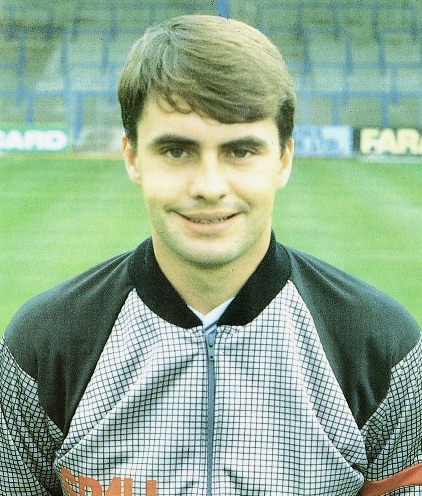
FULL-BACK Kevan Brown made more than 120 appearances for Southampton reserves during three years as a young professional but it took a move east along the coast to Brighton to play league football.
Brown arrived at the Goldstone Ground for a fee of £7,500 shortly after Barry Lloyd had taken over from Alan Mullery early in 1987.
Lloyd preferred the youngster from Andover as right-back to the ageing Les Berry, who’d joined on a free transfer the previous summer.
The club put Brown into digs in Hove (run by Val and Dave Tillson) with another young player who had moved away from home, former Everton youngster Darren Hughes.
In a programme profile feature, Brown said Hughes had been a big help in him settling into his new surroundings. “He has been showing me around the area and we’ve become good friends,” he said. “I’m glad I wasn’t put in a hotel on my own.”
Unfortunately, Brown was only on the winning side twice in the 15 matches he played that season and Albion were relegated from the second tier in rock bottom place.
Brown was a permanent fixture in the no.2 shirt for 46 league and cup matches in the 1987-88 season until the arrival of experienced defender Gary Chivers from Watford.
With promotion in sight, while Lloyd dropped the experienced captain Doug Rougvie in favour of the relatively untried Robert Isaac in the centre of defence, he saw Chivers rather than Brown as the better option at right-back.
Chivers went straight into the side for the promotion run-in and the 2-1 home win against Walsall on 12 March 1988 was the last time Brown appeared that season.
He played in the opening two games of the following season but Chivers on the right and Keith Dublin on the left were Lloyd’s preferred full-back pairing, and Brown found himself on the outside looking in.
Born on 2 January 1966, Brown was an associate schoolboy with Southampton at the age of 13, following in the footsteps of his father Peter, who had played for Saints in the late 1950s.
Brown said in an Albion profile feature that his father and Saints youth development officer Bob Higgins had been the biggest influences on his career, although Higgins later drew opprobrium.
Lawrie McMenemy awarded Brown a professional contract but neither he nor his successor Chris Nicholl elevated the young full-back to the first team, although he did get to play against Manchester United in Trinidad and Tobago while on tour with Southampton.
Having had his fill of reserve team football at Saints, rather than repeat the experience at Brighton, he moved on to Aldershot in the autumn of 1988.
He spent four years there and made quite a few more appearances than the 175 that the record books show: the 1991-92 season records having been expunged after the club went out of business.
Aldershot found themselves in a worse financial situation than the Albion were to suffer later that decade and the club was finally wound up owing £1.2m on 25 March 1992.
Five days earlier, Brown played in a match – alongside future Albion hero Robbie Reinelt – that was the last game Aldershot would play.
Although his next career move saw him drop out of the league, he enjoyed huge success in terms of silverware and recognition.
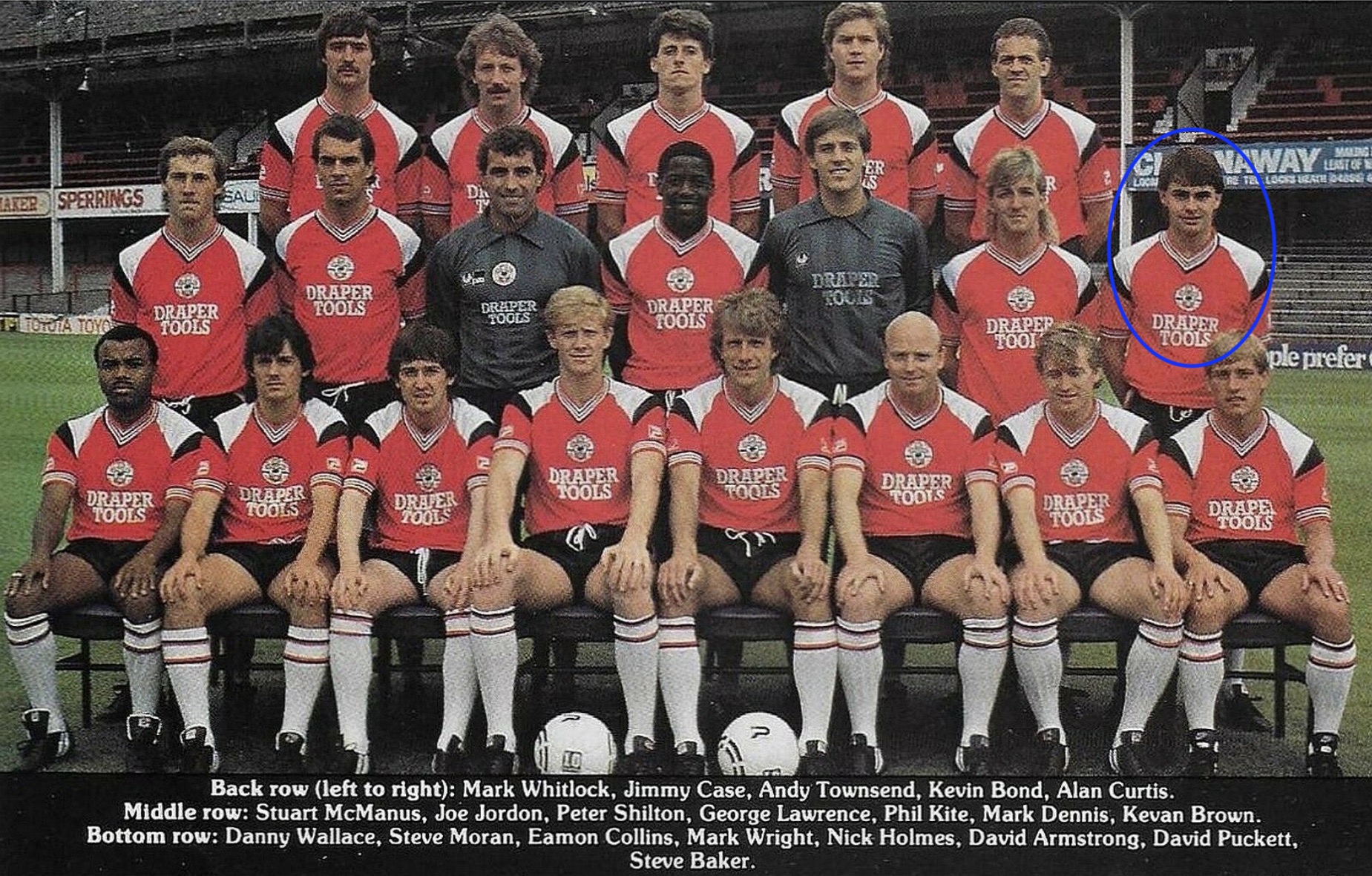
He joined Geoff Chapple’s Woking in the Football Conference and captained The Cards to three FA Trophy wins – in 1994, 1995 and 1997 – with veteran former Albion winger Clive Walker the side’s talisman.
In addition to leading his team up the steps at Wembley to lift the silverware, Brown’s performances with Woking earned him international recognition with the England semi-professional ‘C’ side.
He made his debut in a 1-0 win over Wales at Huish Park, Yeovil, on 28 February 1995. He made three more appearances that year: away to Netherlands (0-0) on 11 April, home on 19 May (played in St Albans) against the Highland League (3-4), then away to Gibraltar (3-2) on 31 May.
His fifth and final appearance was on 2 April the following year as England beat the Netherlands 3-1 at the Nene Park home of Rushden & Diamonds.
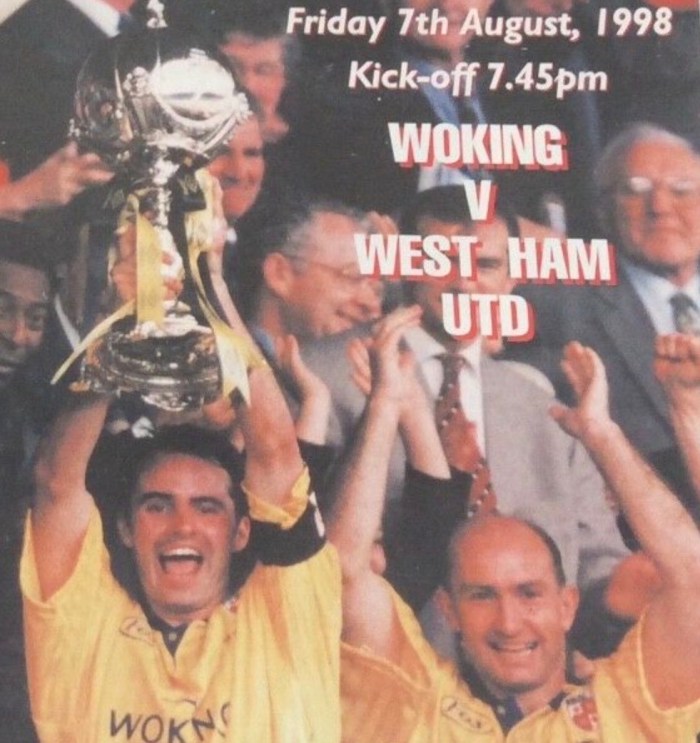
Brown’s loyalty to Woking – he made more than 350 appearances across six years – was rewarded with a testimonial game at home to West Ham United in August 1998.
More than 5,500 turned out at the Kingfield Stadium to see the Hammers edge it 2-1 with goals from Frank Lampard and Steve Lomas. Rio Ferdinand limped off early in the match and Ian Wright played up front for West Ham.
The game took place five months after Brown had moved on from Woking to Yeovil Town.
Chapple’s former assistant, Colin Lippiatt, had taken charge at Huish Park in January that year, having joined three months earlier as a coach under Graham Roberts.
One of his first moves was to sign Brown and teammate Steve Thompson (who ended up staying with The Glovers for ten years). Brown stayed for two years, making a total of 88 appearances, latterly playing under Thompson when he took over as caretaker manager following Lippiatt’s departure.
The arrival of former Chelsea defender David Webb as manager in March 2000 spelled the end of Brown’s time at Yeovil and he returned to Woking to play a further 25 games as they battled against relegation from the Conference in the 2000-2001 season.
Playing part-time had enabled Brown to pursue a teaching career and in April 2007 he was appointed director of sport at independent co-educational St Francis School in Pewsey, Wiltshire.
Brown’s devotion to the club who set him on the road remains undimmed and on his Twitter account @KevanBrown05 he declares himself a Saints season ticket holder.
IN MY OPINION, one of the best wingers ever to pull on the famous blue and white stripes was Clive Walker, an evergreen player who remarkably played more than 1,000 games for eight clubs.
Although well into his 30s when he arrived at the Goldstone Ground, the balding former Chelsea and Fulham wideman was an effervescent talent with the ball at his feet.
Asked by the Argus to preview the squad ahead of the 1991 Division Two play-off final at Wembley, Brighton coach Martin Hinshelwood said of him: “Alias Phil Collins. A great character. The dressing room buzzes when he is around. He is good on the ball, a great crosser and has scored some great goals this season.”
Both Albion’s wingers for that game had Wembley experience behind them having been on opposing sides in in the 1985 League Cup Final.
Walker had missed a penalty for Sunderland as Mark Barham’s Norwich City won 1-0 and six years later, against Neil Warnock’s Notts County, Walker’s bad luck continued when a Wembley post denied him as Brighton’s dream of promotion ended in a 3-1 defeat.
Both had played big parts in Albion reaching Wembley, though: Barham levelled for the Seagulls in the first leg of the semi-final at home to Millwall and Walker got the third when the Seagulls upturned the form book and beat Bruce Rioch’s side 4-1.
Born on 26 May 1957 in Oxford, Walker joined Chelsea in 1973, made his league debut in a 1-0 defeat away to Burnley on 23 April 1977 and was a first team squad regular between December 1977 and the summer of 1984, although, in 1979, Chelsea loaned Walker to Fort Lauderdale Strikers (as pictured below) where he scored nine goals in 22 appearances.
“Those were exciting, lively times and we loved our football. We were a bunch of young lads growing up together and, in my last couple of years there, I played with the likes of Kerry Dixon for the side who brought good times back on the pitch,” Walker told Mike Walters of the Mirror. “We were a close-knit bunch with a great sense of camaraderie, and a lot of teams these days would probably envy us in that regard.”
A fast winger with the knack of scoring stunning goals, Walker netted 17 in 1981-1982 and the next season, with Chelsea looking set to be relegated to Division Three, fans still remember how he scored the winner at Bolton Wanderers to maintain their status.
And a Chelsea fans’ blog, GameofthePeople emphasised the impact he had at Stamford Bridge, pointing out: “He was left-footed, as quick as a sprinter and awkward to knock off the ball. And he could shoot! Those that liked wingers were excited by his willingness to run between players and take a pot shot at goal. Put simply, he was exciting to watch.”
In what is an otherwise interesting and informative piece about Walker in 2014, they unfortunately failed to mention his successful stint with the Seagulls.
Although he began the 1983-84 season well, he sustained a broken jaw which put him out for several weeks and, during his absence, another nippy winger – Pat Nevin – seized the opportunity to claim a first-team spot and Walker’s Stamford Bridge days were numbered.
Come the end of the season, he was allowed to join Sunderland (above in action v Newcastle) for a fee of £70,000. “He returned to torment Chelsea in the Football League Cup semi-final second leg, scoring twice in what was a dreadful night for the club,” GameofthePeople observed. “Walker was abused from the stands, too, which was especially heartbreaking for those that appreciated his efforts at the Bridge.”
After two years in the north-east, Walker returned to London in September 1985, initially via a £75,000 move to Jim Smith’s First Division (Premier League equivalent) QPR, where he played 28 games in the 1986-87 season, alongside the likes of David Seaman, Michael Robinson and John Byrne. Just 20 months later, he left on a free transfer to Third Division Fulham for whom he made 127 appearances in three years, scoring 32 goals.
His debut was certainly memorable as he scored twice in a 3-1 home win over York City. Writer Ian McCulloch remembered the occasion in an article on fulhamfc.com.
“Fulham were in the doldrums, on the brink of extinction, owned by property developers, and going nowhere fast. And then, in the midst of all the doom and gloom, appeared one of football’s all-time, genuine crowd-pleasing entertainers. Walker ran the show that night, scored twice, and generally lifted both the fans and the team.”
Walker recalled: “That game really does stand out. And in the pouring rain as well! To score two goals on your debut is very special, and I just look back at it as a fabulous memory. Very, very enjoyable.”
Walker explained that it was Ray Lewington who took him to Craven Cottage, adding: “I had a great rapport with him – of course we were both apprentices at Chelsea – and we’re still good friends today. But then other managers came in, and you couldn’t escape the feeling that the club was going backwards and that was very, very sad because I had a lovely time at Fulham and I’ve got some very fond memories of those years. I loved playing at the Cottage and on the Cottage pitch.”
Walker picked up Fulham’s 1989-90 Player of the Year award before former Fulham captain Barry Lloyd went back to his old club to secure Walker’s services for the Seagulls in the summer of 1990. Even though he was the wrong side of 30, he pulled on the no.11 shirt on his debut away to Barnsley (in a side containing his old Chelsea teammate Gary Chivers in defence) and missed only one game all season as Albion nearly made it back to the elite level.
After that Wembley disappointment and only three games into the new season, Walker suffered another blow when he sustained a serious knee ligament injury away to Barnsley which sidelined him for several weeks.
With the previous season’s goalscoring duo Mike Small and John Byrne having been sold for big money, the side struggled, and eventually ended up being relegated.
Emerging young winger John Robinson had slotted into Walker’s place in the side during his absence although it was Barham who was the odd man out when Walker was fit to return to the line-up.
Back in the third tier the following season, although the return of Steve Foster in defence was a plus point, off the field the rumblings of financial meltdown grew louder and louder. Young Robinson was sold to Charlton Athletic and only the proceeds of the sale of goalkeeper Mark Beeney to Leeds United kept the taxman at bay when there was a winding-up order threat hanging over the club.
Three cup games against Manchester United were rare highlights in that precarious season and one of my favourite Walker moments came at Old Trafford in a League Cup replay on 7 October 1992.
Having managed a 1-1 draw against United in the first game, Albion gave United quite a scare in the replay, largely through Walker giving England full-back Paul Parker a torrid time. I watched the game sat amongst United supporters and they were full of praise for the veteran winger, albeit that United edged it 1-0.
Walker’s final appearance in an Albion shirt came on 24 April 1993 when he came on as a substitute for Matthew Edwards in a 2-1 home defeat to Rotherham United. Alas, as he recounted in an interview with Spencer Vignes for the matchday programme, his time with the Albion came to a sour end.
Together with Chivers and Perry Digweed he was let go by Lloyd apparently because he said as the highest earners the club could no longer afford them. He was unceremoniously ushered out of the door with his boots in a bin bag. “That was the thank-you we got from Brighton,” he said.
When most players would be considering hanging up their boots, at the age of 36, Walker left Brighton and moved into non-league with Woking where he scored 91 goals in 210 games.
A poster called NewAdventuresinWiFi, on Sunderland’s readytogo.net fans website, recalled watching Walker play for Woking, and said: “Walker was an absolute class act when he fancied it. He was instrumental in the cup run of 96-97 when Millwall and Cambridge were dispatched and Premiership Coventry given an almighty fright.
“Also remember a Conference game against Altrincham when we put seven past them and Walker was unplayable that day…to the point the opposition full back ended up getting a straight red for a frustrated desperate two footed ‘challenge’ he attempted on Clive after yet another glorious attacking run.”
Another poster, JumpingAnaconda, remembered: “I saw him playing for Woking in a minor cup final at Vicarage Road, in the season where he won a few big games for them in their FA Cup run. He was 40 years old and he was absolutely quality, up and down the line all night. That season there was some talk of Premiership sides looking at him to come in to do a job for them. His level of fitness was incredible. He ran around like a 20-year-old. He was probably the closest we would get to another Stanley Matthews in the Premiership era in terms of a winger that kept his pace, creativity, ability to beat a man and make crosses into his 40s.”
From Woking, he had a spell as the assistant manager at Brentford under Eddie May but then went back to playing, at Cheltenham Town. Finally, after winning the FA Trophy and the League, he retired at the grand old age of 43, although he continued to turn out for Chelsea Veterans teams.
He had a brief excursion into management with Molesey but a career in the media took off and he became a regular and well-known voice with BBC London, and for Sky TV’s coverage of Conference football.
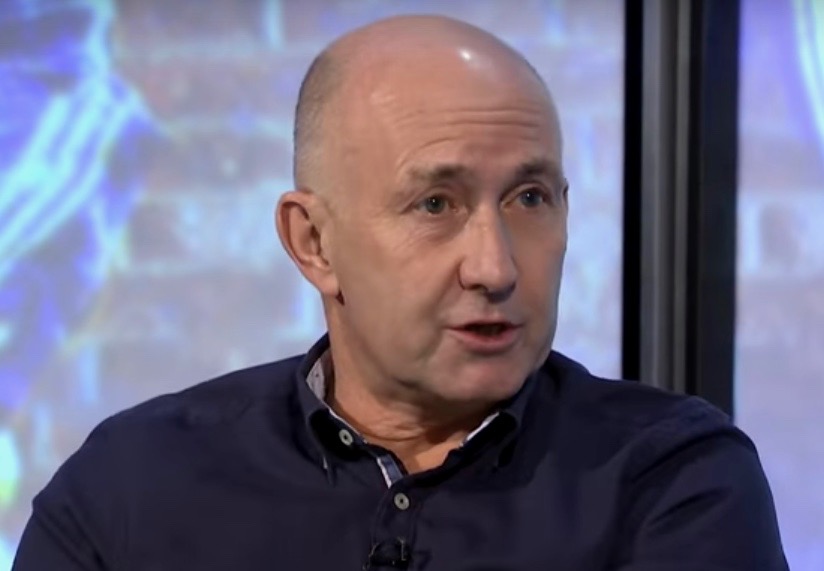
Walker has also worked for Talksport and appears regularly with former Chelsea and Spurs player Jason Cundy on Chelsea TV and radio (as above).
Pictures from a variety of sources but mainly the Albion matchday programme.
DEPENDABLE full-back Paul Watson will best be remembered by Brighton fans for a sweet left foot that invariably created goalscoring chances for Bobby Zamora
.Previously, Watson made 57 appearances in a season-and-a-half with Fulham, and was a mainstay in their famous 1996-97 side that earned promotion from Division Three under Micky Adams.
.Born in Hastings on 4 January 1975, Watson began his playing career with Gillingham, where he spent five years before following Adams to Fulham in July 1996.
He teamed up with Adams once more, at Brentford, where he played for 20 months before signing for the Albion in a joint deal with Bees teammate Charlie Oatway.
Watson was a key member of the side that won back-to-back championships, helping the Seagulls from the fourth to the second tier.
The left-footed right back was particularly accurate from dead ball situations and his pinpoint passing proved ideal for Zamora to thrive on.
In Paul Camillin’s Match of My Life book (knowthescorebooks.com, 2009), Zamora said: “Whenever Watto got the ball I knew precisely where I needed to run to and he knew where to deliver it to.
“It was just such a great connection: Watto has an absolutely wonderful left foot and it made my job as a striker so much easier when you get deliveries like that.”
At the time of the interview, Zamora had moved on to Premiership Fulham and had played several seasons at the highest level. He said: “I don’t think I have come across anybody with a better left foot than Watto’s.
“I was very lucky to have played in the same team as him: he created numerous goals for me; not only with his deliveries but with his intelligent play as well.”
When the Seagulls finished top of the third tier under Adams’ successor Peter Taylor, Watson was one of four former Fulham players in the side: Danny Cullip, Simon Morgan and Paul Brooker the others.
The disastrous run of 12 defeats under Martin Hinshelwood, after such a promising start in the second tier, took the players by surprise, as Watson revealed in an extended interview with Jon Culley for the Wolverhampton Wanderers matchday programme on 11 November 2002.
“Obviously we were aware it was a step up but we thought we would at least do okay,” he said. “Nobody was suggesting we would win promotion for a third season in a row, but, with a couple of new signings and the quality that was already in the side, we didn’t think we would struggle as we have.
“Everything started off all right. We had a good win at Burnley and then a 0-0 draw against Coventry and the way we were playing seemed to be working but after that nothing would go right.
“Every bit of luck, even the referees’ decisions, seemed to go against us and we could not get a point for love nor money.”
Watson conceded that the squad Peter Taylor had led to the Second Division title before his resignation faced a steeper learning curve than anticipated.
“You have to appreciate that 80 per cent of the squad had never played in the First Division before and it is a big jump in terms of the technical quality of some of the people you are up against,” he said.
Watson admitted the loss of Taylor had come as a big blow, and said: “Peter Taylor had been the England coach, even if it was only for one game, and to attract a manager of that quality to a club such as ourselves was very exciting. Lots of players were gutted when he left.”
The arrival of Steve Coppell as manager gave the team renewed hope, although at the time Watson also spoke about the return to fitness and form of Zamora.
“Bobby was out for a while at the beginning of the season and you are always going to miss a player of his quality,” he said. “Now that he is beginning to get his fitness back, hopefully he will be able to make a difference to our fortunes.
“Nobody here is talking about relegation despite the start we have made. The arrival of players like Dean Blackwell and Simon Rodger have given a bit more know-how to the squad. We think we have what it takes to stay up.”
Obviously, it didn’t quite turn out that way, although they came mighty close to avoiding the drop. Watson stayed with the club the following season when Mark McGhee came in and steered the Seagulls to play-off victory in Cardiff against Bristol City, but his regular right-back slot was taken over by Adam Virgo.
After six years with the Seagulls, Watson left in July 2005, once again following ex-boss Adams, this time to Coventry City.
“I’ve got a lot of respect for him,” Watson told fulhamfc.com. “He’s made my career, basically! I’ll always have good things to say about him. Wherever he’s been he’s always been able to get the best out of his players, and he got the best out of me as well.”
However, Watson only played three games in a six-month spell with the Sky Blues, before going non-league with Woking, playing 15 games and, in the 2006-07 season, appearing in 44 games for Rushden & Diamonds.
He then had a season with Crawley and finally finished playing with Bognor. After hanging up his boots, Watson undertook a physiotherapy degree and was subsequently taken on by the Albion.
“It kind of started when I was at Brighton,” Watson told fulhamfc.com. “I had a couple of injuries towards the end of my time there and the physio at the time, Malcolm Stuart, helped me along and pointed me in the right direction.
“I did a couple of courses while I was still playing which helped me get onto my degree when I retired.”
Watson spent just short of nine years with the Albion’s physio team, initially with the development squad and then with the first team, during which time he earned a first class honours degree in physiotherapy at Brunel University, graduating in 2012.
Since June 2017 he has been head physio at Sheffield United and is currently studying for a Master’s degree in Sports Physiotherapy with Bath University.






















 IN MY OPINION, one of the best wingers ever to pull on the famous blue and white stripes was Clive Walker, an evergreen player who remarkably played more than 1,000 games for eight clubs.


 Walker has also worked for Talksport and appears regularly with former Chelsea and Spurs player Jason Cundy on Chelsea TV and radio (as above).


 In parallel lines