

FOLLOWING Archie Macaulay’s decision to stand down as Albion manager two months into the 1968-69 season, former Busby Babe Freddie Goodwin, still only 35, was brought in as his successor.
Goodwin had already managed Scunthorpe United and had recently been in the United States at the helm of New York Generals. The then Third Division Brighton side responded positively to his arrival, going 15 games unbeaten at home.
Utility player John Templeman, who was at the Albion throughout Goodwin’s reign, told the Argus: “When I heard he was taking over I thought the news was brilliant. His youth was a really big plus for the players.
“For many of us, we were working with someone from the same age group. We talked about the same things after training or on away trips.”
Goodwin was Albion’ manager when I first started watching them and it hadn’t been long into his reign when he populated his side with players whose attributes he had witnessed first hand in other settings.
Two former Manchester United teammates were already at the Albion before he arrived: Nobby Lawton, who was captain, and former United reserve Bobby Smith who’d played for him at Scunthorpe United.
Centre forward Alex Dawson, a teammate in United’s losing 1958 FA Cup final side, was one of his first signings at the Goldstone, and Brighton were the third club for who he signed former Wolves and Villa goalkeeper Geoff Sidebottom.
At the start of the 1969-70 season, he brought in his former Leeds teammate Willie Bell as player-coach from 1969 FA Cup finalists, Leicester City.
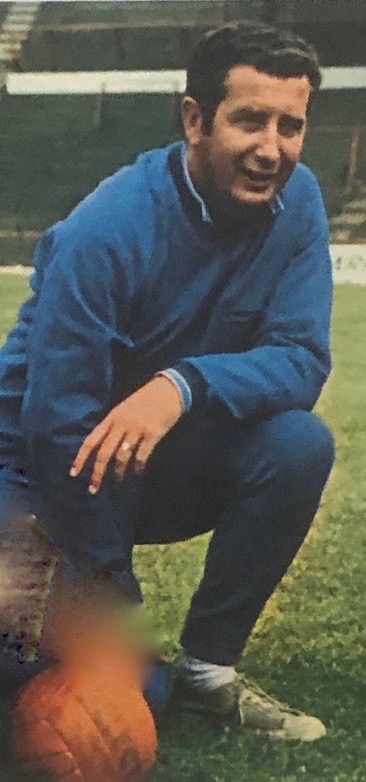 If Goodwin appeared to be relying on experienced pros on the way down the football pyramid, he wasn’t afraid to blend them with talented younger players, signing utility player Eddie Spearritt from Ipswich Town and bustling striker Alan Duffy from Newcastle United, both of whom went straight into the side and kept their places.
Before he arrived at the Goldstone, Goodwin had already given a league debut to goalkeeper Ray Clemence, who went on to play for Liverpool and Tottenham Hotspur and won 61 caps for England. And, after he left Brighton, Goodwin gave a Birmingham City debut to 16-year-old Trevor Francis who was England’s first £1 million player when transferred to Nottingham Forest in 1979, and he played 52 times for England.
As young lads, we always got to the Goldstone as the gates opened at 1.30pm and as we claimed our places at the front of the perimeter wall near the players’ tunnel, Goodwin would have a few words with us as he came out to inspect the pitch, one time in particular I recall him commenting how heavy going it would be after an almighty downpour.
In his only full season in charge, 1969-70, Brighton were looking good bets for promotion to Division Two. They were top after a cracking 2-1 Good Friday win over Reading but lost 1-0 the following day at Halifax and 4-1 at Fulham on Easter Monday.
With three games to go, they lost two of them, away to Rochdale and home to Mansfield (only managing to beat Rotherham 2-1 at the Goldstone) and ended up fifth, seven points behind champions Orient.
Goodwin’s last signing for the Albion saw him return to his old club, Manchester United, to bring exciting young Welshman Peter O’Sullivan to Hove. Although he didn’t stay to see the youngster flourish, O’Sullivan ended up staying for 10 years.
In the summer after narrowly missing out on promotion, Goodwin still had 18 months left on his contract but Birmingham came in an offered him a three-year deal to succeed Stan Cullis.
“Albion’s board were stunned,” wrote Evening Argus Albion reporter John Vinicombe. “They felt Goodwin was the man to take them up, and initially tried to prevent his release.
“The atmosphere was strained for a day or two. When the Albion board realised it was unrealistic in attempting to hold Goodwin, they came to a financial arrangement with City.”
When Birmingham played Albion in a First Division match at The Goldstone on 7 November 1981, Vinicombe wrote about his memories of Goodwin’s time at the helm.
“I recall him telling me that during his time at New York Generals he occupied his spare time by studying Spanish, book-keeping and accountancy,” wrote Vinicombe. And when he arrived at the Albion he told the players: “Results are nothing to do with you. They are my problem. Forget them and just give me 90 minutes effort, whatever the score.”
Templeman told the Argus: “He was a success for Brighton because he represented a fresh start. Who knows what would have happened if he had stayed at the club? He won promotion with Birmingham and I think he would probably have done the same at Brighton.”
Albion’s stuation with Birmingham was further soured because Goodwin decided he wanted to take Bell and youth coach George Dalton with him. So eager was he to hire them that he made an illegal approach while they were still under contract at Brighton and Birmingham were later fined £5,000 for a breach of regulations.
Born in Heywood, Lancashire, on 28 June 1933, Goodwin came to the attention of Manchester United when playing for Chorlton County Secondary School and became a professional under Matt Busby in October 1953. He made his senior debut for the club on 20 November 1954 against Arsenal in a 2-1 home win.
However, he wasn’t able to hold down a regular spot until the Munich air disaster in February 1958 decimated the United first team. Alongside Dawson, Goodwin was given a chance to establish himself and he played in the side which lost 2-0 in that year’s FA Cup Final to Bolton Wanderers (pre-match line-up at Wembley, below).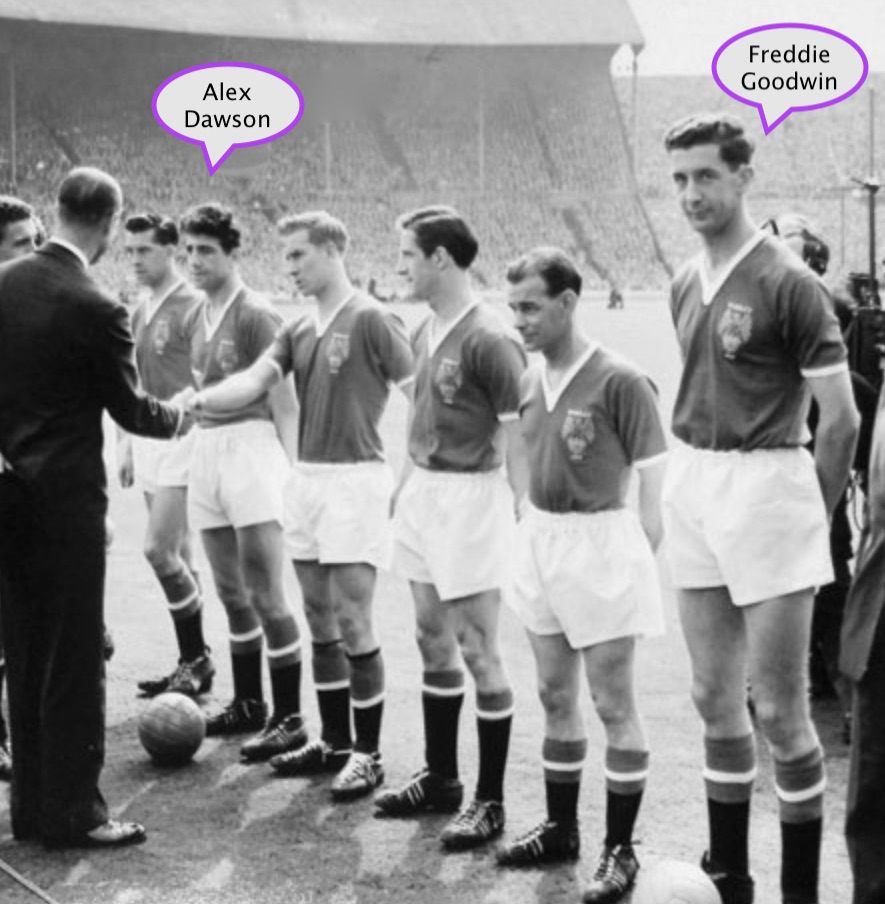
By the time United decided to sell him for £10,000 to Leeds United in March 1960, he’d played 107 games over five seasons.
From being a teammate of Bobby Charlton, Goodwin partnered Bobby’s brother Jack in the Leeds defence and captained the side until the arrival of Bobby Collins in 1962.
After 120 games for Leeds, his playing career was virtually ended when a tackle, ironically by former Leeds legend John Charles, playing for Cardiff, on 4 January 1964, fractured a leg in three places.
Goodwin went on to become player-manager at Division Three Scunthorpe (his injury restricted him to just six appearances) where he first signed Sidebottom whose place was eventually taken by the emerging Clemence.
When Goodwin tried his luck in America in 1967-68, Sidebottom was one of his first signings at New York Generals, and the ‘keeper played 44 games over there.
Birmingham fans will always remember how Goodwin launched the career of teenager Francis. In 1972, Francis, Bob Latchford and Bob Hatton spearheaded promotion for the Blues and a place in the FA Cup semi finals.
The 1973-74 season saw Birmingham escape relegation from the elite by a single point. They were marginally safer the following season, and reached the semi-final of the FA Cup again (losing in a replay to Fulham).
With Blues struggling at the foot of the table at the start of the 1975-76 season, Goodwin was sacked in September and Bell took over.
In 1976 Goodwin returned to America to become the first coach and president of the Minnesota Kicks where he remained until the early 1980s before retiring.
He settled in the US and lived there until his death from cancer aged 82 in Gig Harbour, Washington, on 19 February 2016.
In paying tribute to the man who gave him his big break, Francis told the Birmingham Mail: “I will forever be indebted to him for having the courage to put me into the team at such a young age – that tends to be overlooked.
“I had only had a season of youth football and not even a handful of reserve team games but he still gave me my opportunity.
“I held him in very high regard and had enormous respect for him. I was most saddened the day he was sacked.
“He looked after me and took care of me. He was like a father figure to me. He knew when to play me and when to take me out and give me a little bit of a rest – not that I understood that at 16 years old.
“Just before I went to Detroit, Freddie was already in the States coaching the Minnesota Kicks and he put a very lucrative offer in front of me to go out there and play.
“That alerted a lot of other NASL clubs and in the end I went to Detroit, who were managed by Jimmy Hill. I owe much of that to Freddie’s foresight.”
Read more here:
http://www.ozwhitelufc.net.au/players_profiles/G/GoodwinF.php


Pictures from the Albion matchday programme and online sources; Goodwin in a Leeds team line-up from 1962-63 alongside Billy Bremner and Jack Charlton.
 In parallel lines
. . . thank for this engaging piece, nicely written – you and I coincided at the splendid Goldstone Ground as supporters – and, indeed I had the honour of playing on the hallowed turf as a 16/17 year old trial ist under the gaze of Freddie G.; he spoke kindly of me as a player/ potential but offered no hint of further interest – to read of his illustrious career has been a delight and I, the more so, remember him well – thank you for your talent as a writer and your spirit as a fellow Albion fan ?
do you remember these lyrics circa 67 as resounding from we jolly young gentlemen of the North Stand ? we spirited songsters . . . “if Archie says we’re gonna win today, it’s gonna happen just that way . . . ba, ba, baba ba ba ba Brighton (credit The Troggs) – he’ll take us to division two . . . we won’t stop there cos we’ll go straight through . . . and when everything is said and done, we’ll end up in division one . . . ba ba ba etc..
LikeLike
Glad you enjoyed the piece. I have to say I don’t recall the particular song you mention; perhaps shortly before I became a regular.
LikeLike