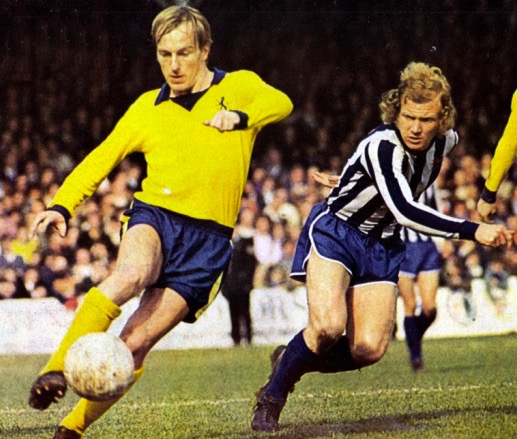
Saint Dean a sinner in some Albion fans’ eyes

HASTINGS-born Dean Hammond enjoyed two spells with the Albion having joined the club aged 11 and progressed from the school of excellence though the youth team and reserves to become a first team regular and captain of the side.

He also went on to captain Southampton as they rose from League One to the Premiership.

However, it’s a pretty surefire bet to say fans would be divided if asked to judge his contribution.

An over-the-top celebration in front of the Albion faithful after scoring for Southampton at Withdean made him public enemy number one in many people’s eyes.

The way he left the club under a cloud, suggesting they lacked ambition, was another catalyst for rancour.

Personally, I struggled with his penchant for missing some unbelievable, gilt-edged chances to score. There was one away at Leicester (one of his future employers) – a proverbial ‘easier to score than miss’ – that was particularly galling in a game that finished 0-0.

Putting all these things to one side, there is no denying that he ultimately enjoyed a decent career and, while his most successful years were spent in the second tier of English football, he also got to play at the highest level.

Albion have struggled for a good many years to bring through promising local talent from schoolboy level but Hammond was one of the few who made it.

Born a couple of months before Brighton’s 1983 FA Cup Final appearance, he made his Albion bow in December 2000 when former Saints full-back Micky Adams put him on as a substitute in a 2-0 Football League Trophy win over Cardiff, but it was only when former youth coach Martin Hinshelwood briefly held the first team manager’s role that he got his next chance.

That came as an 85th minute substitute for Nathan Jones in a 4-2 defeat at Gillingham in September 2002 and 10 days later he made his first start and scored his first Albion goal (celebrating below right) after only eight minutes in a 3-1 League Cup defeat to Ipswich.

When Hinshelwood was sacked, new boss Steve Coppell opted for experience over youth and Hammond’s next competitive action came during two spells out on loan in 2003 – at Aldershot (seven games) and Orient (eight games).

In an Argus interview in November 2006, Hammond said: “It’s been up and down for me at Brighton. I loved it when I came through the youth team and then broke into the first team at quite a young age.”

Hammond watched from the sidelines at the Millennium Stadium in May 2004 as the Albion won promotion to the Championship via play-off victory over Bristol City. A couple of months later, the Argus was reporting how he had been given three months to prove he had a future with the club.

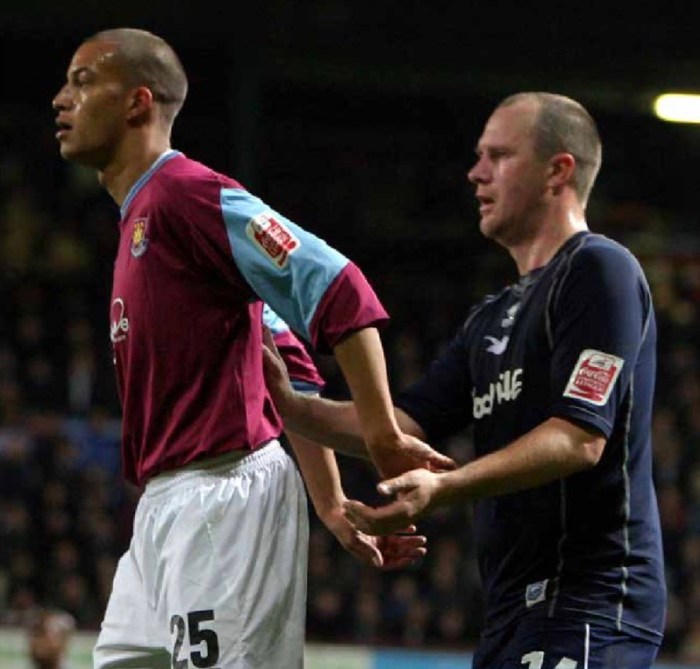
He did enough in a handful of games to be offered a contract until the end of the season and, although he was mainly used from the bench between October and March, by the season’s end he was playing a pivotal role in helping to steer Albion clear of the drop zone, scoring the equaliser in a 1-1 draw away to Burnley and getting both goals in a vital 2-2 draw at home to West Ham.

Before the 2006-07 season got under way, manager Mark McGhee obviously felt players like Hammond needed toughening up and sent him and a few others to some boxing sessions with former world heavyweight title contender Scott Welch, from Shoreham, at his Hove gym.

Hammond told Andy Naylor of the Argus: “When the gaffer mentioned it, I think the boys were thinking ‘Boxing? How is that going to help us’. But he worked on the mental side, as well as the power and strength stuff.

“If we felt tired or felt we couldn’t go on, he was pushing us and he said it would help us in a game. I think he’s right. When we went back for pre-season training you tended to push yourself that bit more, so I think it will help in the long run.”

Unfortunately, it didn’t help enough because the season saw Albion relegated back to the third tier. It wasn’t long before former youth coach Dean Wilkins was installed as manager and youngsters were given a chance to flourish in the first team, with Hammond appointed captain.

“I would say it is the best time of my career and I am really enjoying it,” he told Naylor. “It’s brilliant at the moment.”

In the same interview, however, there were perhaps the first rumblings of his discontent with the progress of the club.

“I’ve been here since the age of 11. I’m like every other player. I’m ambitious and I want to do the best I can in my career and play as high as I can. Hopefully that will be with Brighton.”

A career-ending injury to Charlie Oatway and Richard Carpenter’s departure from the club in January 2007 led to Hammond taking over the captain’s armband and 2006-07 was undoubtedly his best Albion season. He finished with 11 goals from 39 appearances and the award of Player of the Season.

D Ham v W HamIt was in the 2007-08 season that it turned sour between player and club, even though before a ball had been kicked he told the Argus he thought Brighton had it in them to make the play-offs.

“We can beat anyone in the division. It’s just about being consistent. Realistically we can push for the play-offs,” he told Brian Owen.

Considering he had been at the club from such an early age, what happened next clearly rankled with chairman Dick Knight, who talked about it in his autobiography, Mad Man: From the Gutter to the Stars, the Ad Man who saved Brighton.

Knight accused Hammond’s agent, Tim Webb, of touting his client around Championship clubs while there was an offer on the table from the Albion that would have made him the highest paid player at the club.

“Hammond kept telling the local media that he wanted to stay and sign a contract, but I think he was being told to hold out for more money,” said Knight.

Because Hammond could have walked away from the club for nothing at the end of the season, the pressure was on to resolve the situation one way or another by the close of the January transfer window.
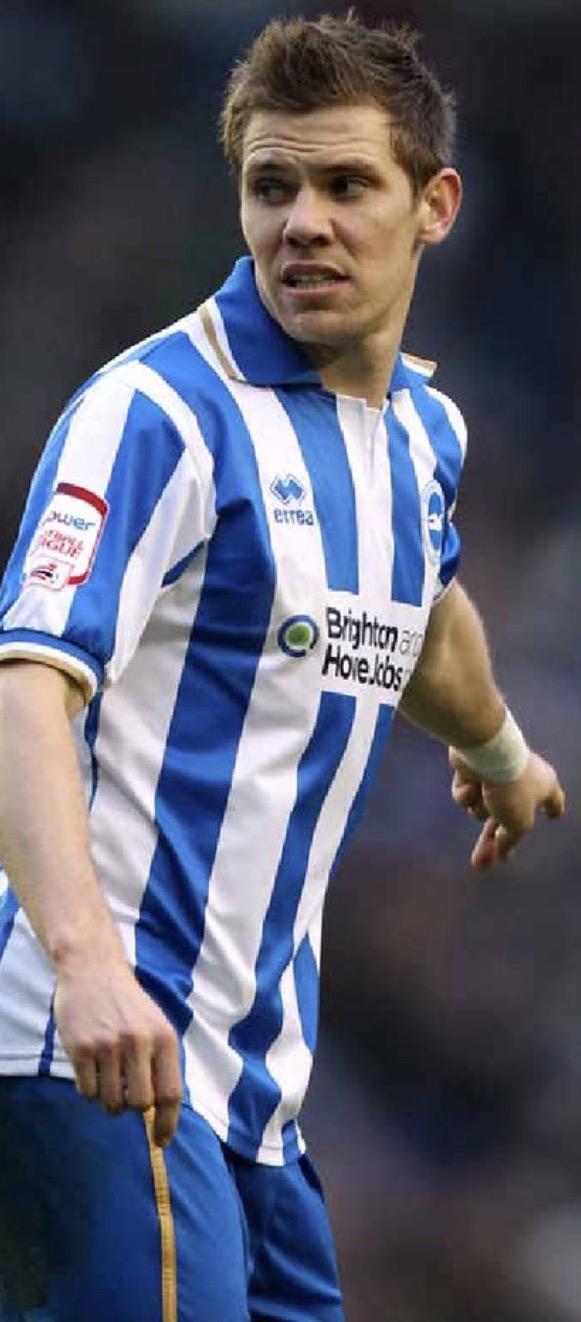
All the off-field stuff was clearly affecting Hammond’s head and I can remember a game at Oldham in the second week of January when he lunged into a reckless challenge after only nine minutes which certainly appeared to be a deliberate attempt to get himself sent off. That early dismissal was his last action for the Seagulls until his return to the club in 2012.

“I didn’t want to sell Dean but I was forced to,” said Knight, who persuaded Colchester United to buy him for £250,000, with a clause added in that Brighton would earn 20 per cent of any subsequent transfer involving the player. “In normal circumstances, I might have got more, but time was running out,” Knight added.

The move to Colchester wasn’t an unbridled success because his arrival couldn’t prevent them being relegated from the Championship, but, with Paul Lambert as manager, Hammond took over the captaincy in December 2008 and by the season’s end was voted Player of the Season.

Throughout the season there had been speculation that Southampton wanted to sign him and a deal duly went through in August 2009. At the time, Alan Pardew was the Saints manager and Hammond’s former Albion youth team coach and first team manager, Dean Wilkins, was Southampton first team coach, and played a part in him deciding to make the move. “His knowledge of the game and his passion for football is second to none and he was really good for Southampton – he had a good partnership there with Alan,” said Hammond.

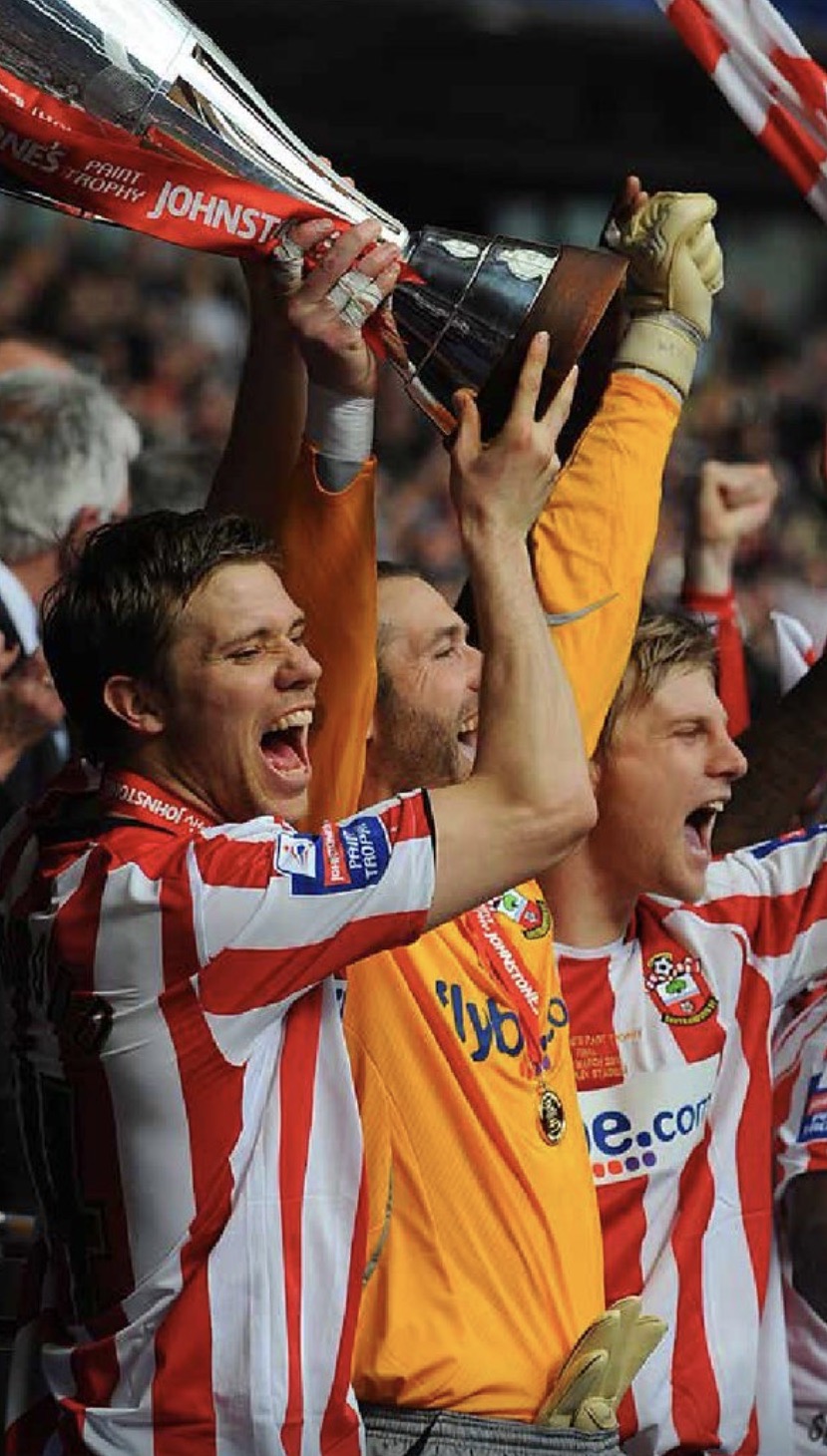
D hammo trophyAs had happened at his previous two clubs, it wasn’t long before Hammond was taking on the captaincy and he got to lift the Johnstone’s Paint Trophy at Wembley on 28 March 2010 (above) when Pardew’s team beat Carlisle United 4-1 – the first piece of silverware Saints had won since the 1976 FA Cup.
“I was really enjoying my football and it was like a new beginning for everyone connected with the club,” he said in an Albion matchday programme article. “Nicola Cortese came in off the field and a raft of new signings had been made, the likes of Rickie Lambert, Jason Puncheon, Lee Barnard, Radhi Jaidi, Dan Harding, Michail Antonio and Jose Fonte. When you add the likes of Morgan Schneiderlin and Adam Lallana, we had the makings of a really good team. It took us a little time to gel, but once we clicked we had a really good season.”

When Albion travelled to St Mary’s on 23 November 2010, the matchday programme inevitably featured their captain and former Seagull. It said: “Hammond was barely out of nappies when he first started supporting the Seagulls. He can even recall the days they played in front of 20,000 crowds at the old Goldstone Ground.

“The new Brighton stadium will hold just over 22,000 and the Saints midfielder said: ‘There’s no doubt they’ll fill it, certainly for their early games. That’s just about the size of their fan base and, if anyone deserved a bigger ground, it’s them’.”

Reflecting that he had certainly made the right career move, Hammond said: “I’ve developed as a player. I have a slightly deeper midfield role which means I pass the ball more and get involved in the game more.”

After two seasons in the third tier, Southampton famously finished runners up to Brighton in 2010-11 to regain their place in the Championship. Hammond was a regular throughout the 2011-12 season, although at times contributing from the bench, as Saints won promotion back to the Premier League, runners up behind Reading.

However, manager Nigel Adkins obviously didn’t see Hammond as top tier material and on transfer deadline day (31 August 2012) the midfielder agreed a season-long loan deal back at Brighton.

D Hammo 2By then 29, Hammond told the Argus: “It’s a different club now. The stadium is amazing and I can’t wait to get going.

“I saw the plans when I was 15 and it’s amazing to see it come to life. It will be a dream to play at this stadium as a Brighton player and I have been dreaming of that since a boy.”

Hammond made 33 appearances plus five as a sub during that season, alongside fellow loanees Wayne Bridge and Matt Upson, and said: “I loved my year back at the club. It was brilliant.

“I’d been sold the dream of the new stadium since I was 15 coming through the ranks, so to walk out of that tunnel for the first time as an Albion player was a fantastic feeling and one I’ll always cherish.”

Hammond reflected that the side did well to reach the play-offs but drew too many games. “We were only four points off automatic promotion and just didn’t do ourselves justice in that play-off game against Crystal Palace.

“Having drawn 0-0 at Selhurst Park, we really fancied finishing off the job at the Amex, but it just didn’t happen for us on the night. That has to rate as one of the biggest disappointments of my career.”

When manager Gus Poyet departed the Albion in the wake of the play-offs loss, Hammond returned to parent club Southampton, but, three months later he signed a two-year contract with Championship side Leicester City. Manager Nigel Pearson told the club’s website: “We’re really pleased to be able to add a player of Dean’s quality and experience to the squad.

“As well as having played a considerable number of games in his career, he also arrives with promotion credentials and will be a very positive influence on the squad both on and off the pitch.”

DHLCFC

Hammond added: “Once I knew of Leicester’s interest I wanted to come. My mind was made up. There was some interest from other clubs, but once Leicester was mentioned, and I spoke to the manager, I wanted to come here.

“It’s a massive football club. They came close last year in the play-offs and they’ve got a good history. It’s a club that’s going places and wants to push to the Premier League. It’s very exciting to be here.”

While facing midfield competition from Danny Drinkwater and Matty James, Hammond nevertheless played 29 games as Leicester were promoted and he finally got to play in the Premiership, albeit competition and injury restricted his number of appearances to 12.

Not all Saints fans felt it right that he had been abandoned as soon as the club reached the Premiership and, on the eve of his return to St Mary’s as a Leicester player, Saints’ fansnetwork.co.uk considered supporters might like to “thank him for his contribution to our resurgence in the game …. without Dean Hammond perhaps none of what they are enjoying in the Premier League would have been possible”.

Although Hammond earned a one-year extension to his contract in July 2015, he was not involved in the side that surprised the nation by winning the Premier League.

He had gone on loan to Sheffield United, then managed by his old Saints boss Adkins, and made 34 appearances for the Blades by the season’s end. However, he didn’t figure in new boss Chris Wilder’s plans and left the club in the summer of 2016.

Russell Slade gave him a trial at Coventry City in January 2017 but he didn’t get taken on and eventually he returned to Leicester to work with their under 23s. He later became loans manager for the Leicester City Academy.

Hammond opened up about his career, and some of the difficulties he’s faced since stopping playing, in an interview with James Rowe for The Secret Footballer.

  • Most photos from Argus cuttings; plus Southampton programme, Albion programme and Leicester City website.

Winger Neil Smillie was a Wembley winner eventually

NS v MU Wemb

AN UNSUNG hero of Brighton’s 1983 FA Cup Final side, winger Neil Smillie, had the distinction of being the first ever apprentice the legendary Malcolm Allison signed for Crystal Palace.

Big Mal had enjoyed league and FA Cup success at Manchester City as Joe Mercer’s sidekick but he swept into Palace in the early 70s as a boss in his own right, courting publicity with his flamboyant fedora hat and giant cigar.

Smillie admitted: “I was going to West Ham but Allison persuaded me to take a look at Palace.

“The place was so alive and vibrant under him that I went there instead.”

Born in Barnsley on 19 July 1958, Neil followed in the footsteps of his dad, Ron, a former professional who played for Barnsley and Lincoln.

After joining Palace in 1974, Smillie turned professional a year later and was on Palace’s books for seven years, although he had three loan spells away from Selhurst.

In 1977, he went briefly to Brentford, who he ultimately would have a long association with later in his career.

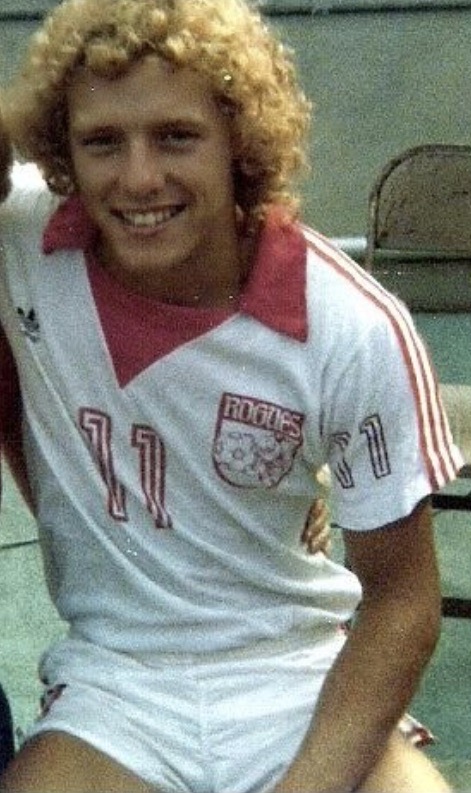
Smillie MemphisThe following two years, he went to play in America for Memphis Rogues (pictured left) where his teammates were players from the English game winding down their careers: the likes of former Albion players Tony Burns and Phil Beal, ex-Chelsea, Leicester and Palace striker Alan Birchenall and former Chelsea winger Charlie Cooke; the side being managed by former Chelsea defender Eddie McCreadie.

At the end of the 1981-82 season, Smillie was denied a pay rise by Palace so he decided to quit and wrote letters to clubs in the top two divisions in England asking for a job!

Brighton had managed to offload the troublesome Mickey Thomas to Stoke City so had a need for a left winger. They were the first to come up with an offer, and with full back Gary Williams surplus to requirements since the arrival of experienced defender Sammy Nelson, Brighton offered him in exchange for Smillie.

The bubble-haired winger gratefully accepted the switch to the Seagulls. While he made the starting line-up for the opening game of the new season, a heavy (5-0) defeat away at West Brom in the next game then saw him dropped and sidelined for months.

It was only once ultra-cautious manager Mike Bailey had left that Smillie got back in contention, and only then – in January 1983 – through someone else’s misfortune.

He said: “I was out in the cold and only got my break when Giles Stille was injured during the Cup game against Newcastle United.”

Smillie seized his opportunity and remained in the side for the rest of the season, culminating in the two Wembley FA Cup Final matches against Manchester United.

Back in the second tier following Brighton’s relegation, Smillie played 28 games plus once as a sub but following new manager Chris Cattlin’s signing of Northern Irish winger Steve Penney, there was competition in the wide areas.

Throughout the 1984-85 campaign, Smillie was more often than not a substitute rather than a starter. He did manage a seven-game run of appearances in the late autumn and began the final three games of the season, but the last game, a 1-0 home win over Sheffield United, proved to be his farewell.

Smillie revealed in a 2003 interview with Spencer Vignes that he’d discovered Manchester City had been keen to take him on loan but Cattlin hadn’t sanctioned it, even though he wasn’t selecting him.

“Chris had turned them down, saying I was a good player and he needed me. Yet he wasn’t even playing me! I just couldn’t believe he’d done it,” he said. Although he and his family were settled in Sussex, he realised he had to move.

Several eyebrows were raised when Cattlin managed to secure a £100,000 fee from Watford for Smillie’s services in the summer of 1985. The winger joined Graham Taylor’s beaten FA Cup finalists but he failed to establish himself in the side and made just 16 first team appearances in a season with the Hornets.

In the summer of 1986, he moved on to Reading for two years and, in 1988, after his disappointment with Brighton, Smillie was finally a winner at Wembley, scoring and setting up two goals as Reading beat Luton 4-1 in the Simod Cup Final.

The Hatters were led by former Albion captain Steve Foster and another of Smillie’s former teammates, Danny Wilson, was in their midfield. Mick Harford scored the opening goal for Luton, but Smillie’s pass allowed Michael Gilkes to bundle home an equaliser.

Smillie then won a spot kick converted by Stuart Beavon, and, in the second half, Mick Tait swept home another Smillie assist. Smillie then rounded off a great afternoon by scoring himself. It was hailed as one of the best days in Reading’s history, witnessed by over 45,000 loyal Royals fans.

Nevertheless, Smillie didn’t hang around and instead joined Brentford, where his former Palace teammate Phil Holder was assisting the manager at the time, Steve Perryman.NS Bees

Nick Bruzon interviewed Smillie in depth for a Where are they now? feature on the Brentford FC website in July 2010.

“Representing Brentford over three different decades, initially on loan in 1977 and then for five years from 1988 to 1993, Neil Smillie combined raw pace with ceaseless energy to make him one of the most popular players to patrol the New Road touchline,” said Bruzon. “Whilst with Brentford he experienced promotion, relegation and play off heartbreak, scoring 18 goals in 185 games.”

Smillie said: “I’ve got to say, the five years I spent at Brentford (and I was 30 when I signed) I thoroughly enjoyed.

“I’d reached a point in my career where I felt comfortable in terms of what I could give on the pitch. I’d always been a hard worker and I got the feeling that the supporters appreciated someone who worked hard.”

In the 1992-93 season, he played alongside Chris Hughton, who, like Smillie, was winding down his playing career.

“I loved taking people on and I loved getting crosses in for people to score so that just seemed to fit in nicely at the time with the team that we had,” he said. “I played my part as well as others who played theirs in getting the ball to me. We all did our bit and for me it was a great part of my career.”

On leaving Brentford, Smillie became a player-coach at Gillingham when his old Palace teammate Mike Flanagan was the manager. When Flanagan was sacked, Smillie took over the managerial reigns on a caretaker basis while the club tried to stabilise during financial troubles.

Smillie told Bruzon: “We were in a fairly precarious position and ended up in a decent position. So there was some enjoyment to it but the situation at a club without any money and struggling was difficult.”

Some names familiar to Brighton fans were at Gillingham at the time. Smillie played up front with Nicky Forster. Paul Watson was in defence and Richard Carpenter in midfield.

His three-month reign came to an end when Gillingham appointed Tony Pulis as the new manager and former Palace manager Alan Smith took Smillie to Wycombe Wanderers to look after their youth team.

When Smith left, Smillie was caretaker manager until former Albion full back John Gregory got the managerial post. Smillie then became Gregory’s successor in the hot seat for a year.

When the inevitable sack came, Smillie stepped outside of day to day running of football to become sports marketing manager for Nike in the UK. His role was to identify emerging talent for Nike to associate themselves with, and, as a result he stayed in touch with the game.

Among the players he signed to Nike were Theo Walcott, Darren Bent, Gabby Agbonlahor, James Milner, Tom Huddlestone, Danny Welbeck and Johnny Evans.

Pictures show (top) Smillie in action on the cover of the Albion programme; walking his dog; in Match magazine, on the cover of Shoot! being tackled by Liverpool’s Sammy Lee; a Simod Cup winner with Reading.

Steady Eddie Spearritt ‘Mr Versatility’ and a long throw specialist

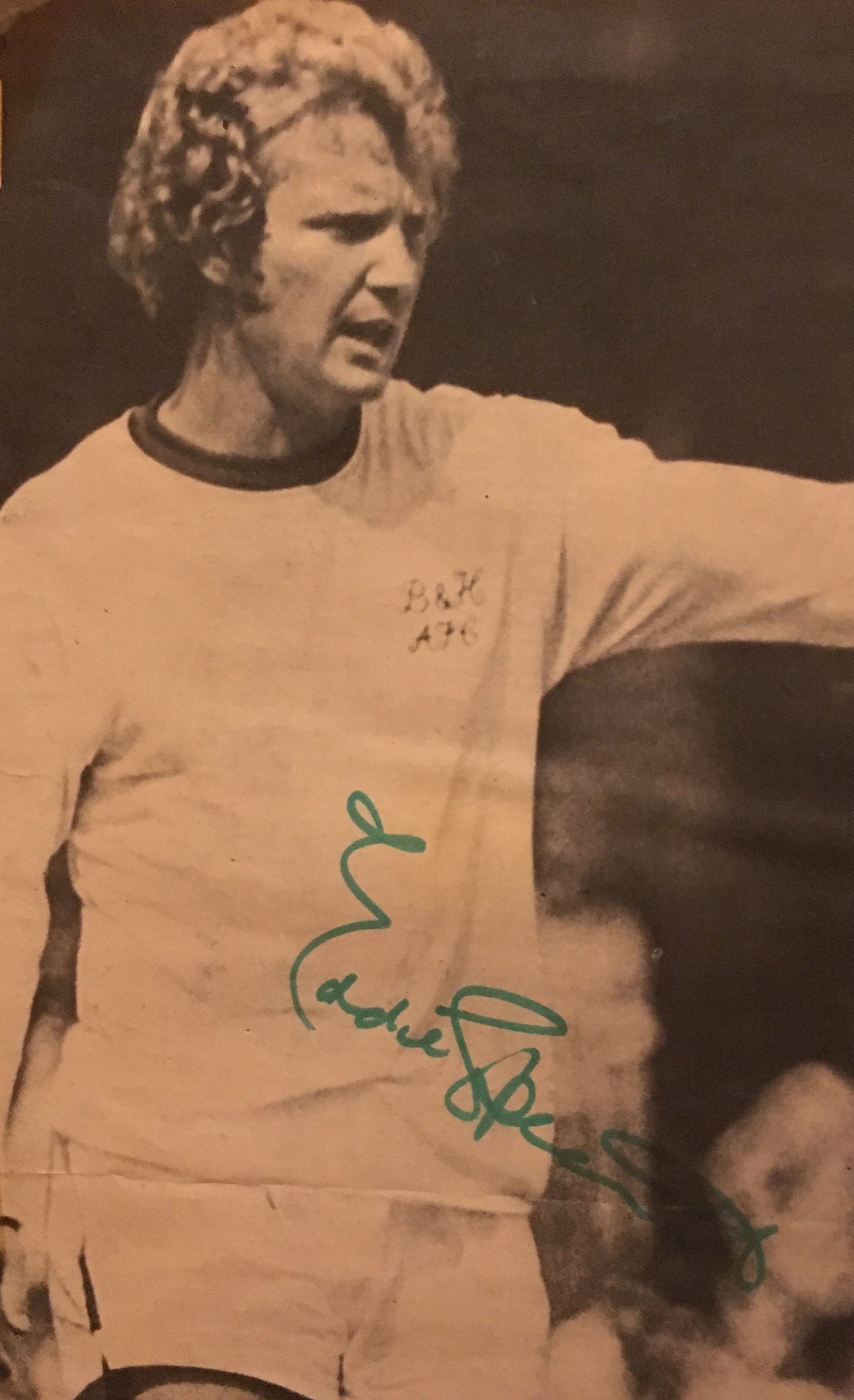
2-signed-eddie-spearrittIN THE days before managers had a bench of substitutes, players who could slot into virtually any position were a major asset. One of my favourites was Eddie Spearritt.

A wholehearted, tough character, Spearritt was equally comfortable playing in midfield, at full back or sweeper, would occasionally get on the scoresheet, and even turned his hand to goalkeeping when necessary.

Long before anyone had heard of Rory Delap, Spearritt was a top exponent of the long throw which could sometimes be as effective as a free kick or corner. It was a skill which earned him a place in a Longest Throw competition staged by BBC’s sport show Grandstand in 1970-71, although he didn’t win it.

Born in Lowestoft on 31 January 1947, Spearritt started out at Arsenal but on failing to make the grade there, switched to Ipswich Town as an apprentice in August 1963.


On prideofanglia.com, Tim Hodge details Eddie’s Ipswich career. He made his league debut in the 1965-66 season in a 1-0 win away to Preston in the old Division Two.

Over the next two years, he made a total of 69 appearances (plus 10 as sub) for Bill McGarry’s side, scoring 14 goals along the way (Spearritt is pictured in Ipswich squad photos above, including the side who were Second Division winners).

A 1-0 home defeat to Spurs in October 1968 was his last for the Suffolk club and three months later, surplus to new manager Bobby Robson’s requirements, was one of Freddie Goodwin’s first signings, for £20,000, just a few weeks before my first ever Albion game.ES debut Crewe

He made his debut in a 3-1 home win over Crewe Alexandra (above with the superb backdrop of a packed EastTerrace at the Goldstone Ground) and kept the number 10 shirt to the end of the season, by which time he had scored five times, including both Albion’s goals in the 2-2 draw at home to Tranmere Rovers.

1-spearritt-v-wolves-69-copyIn the 1969-70 season, not only was he part of the Third Division Albion side who pushed his old manager McGarry’s First Division Wolverhampton Wanderers side all the way in a memorable third round League Cup tie, it was his header from Kit Napier’s free kick that put the Albion 2-1 ahead just before half-time (aftermath pictured above).

Scottish international Hugh Curran scored twice in eight second half minutes to clinch the win for Wolves but a bumper Goldstone Ground crowd of 32,539 witnessed a terrific effort by their side.

ES Shoot action

A few weeks’ later, in a marathon FA Cup second round tie with Walsall that required three replays before the Saddlers finally prevailed 2-1, Spearritt took over in goal during the second replay when a concussed Geoff Sidebottom was stretchered off on 65 minutes. Albion hung on for a 1-1 draw.


Spearritt was a midfield regular in his first two seasons but Goodwin’s successor, Pat Saward, switched him to left back halfway through the 1970-71 season and that’s where he stayed throughout the 1971-72 promotion campaign. Player-of-the-season Bert Murray generously declared the award could have gone to Eddie for his consistency that season.

In the close season after promotion, Spearritt tied the knot with Penelope Biddulph, “an accomplished professional dancer,” the matchday programme told us, and they moved into a new home in Kingston-by-Sea.

Spearritt started out at left back in Division Two but after ten games was ousted by the arrival of George Ley from Portsmouth. He then switched back into midfield, but by the end of that relegation season was playing sweeper alongside Norman Gall (for nine games) and Steve Piper (for two).

He scored, along with Barry Bridges, in a 2-0 win at Huddersfield on 14 October but the team went on a disastrous run of 16 games without a win, although Spearritt did get on the scoresheet three times, including notching two penalties.

When Albion went to that footballing outpost Carlisle on 16 December, they had lost five in a row without managing a single goal. Carlisle were 5-0 up, goalkeeper Brian Powney was carried off with a broken nose, replaced between the sticks by Bert Murray, then Albion won a penalty.

Spearritt took up the story in a subsequent matchday programme.

“I used to be the club’s penalty taker but, after I had missed an important one at Mansfield in 1970, I lost the job. Penalty-taking is really all about confidence,” he said. “After I had missed that one at Mansfield, which cost us a point, the players lost confidence in me and the job went first to John Napier and was then taken over by Bert Murray.

“Bert would have taken the penalty at Carlisle. He has already scored two this season. But he had gone in goal and it was decided it was too risky to fetch Bert out of goal to take the penalty.

“Nobody else seemed to want to take it so I just picked the ball up and put it on the spot. We were 5-0 down by then but I thought from a morale point of view that it was extremely important that I scored. You can understand my relief when I saw the ball hit the back of the net.

“Everybody was beginning to wonder when we would score again. I suppose with the run of bad luck we have been having it was almost inevitable that we should break our goal famine from the penalty spot.”

Albion finally returned to winning ways with a 2-0 win over Luton on 10 February, and then beat Huddersfield, Carlisle and Swindon, prompting Saward to refer to “some outstanding individual performances” and adding: “I have been particularly pleased with the way Eddie Spearritt has been playing in recent weeks.

“He has maintained a high level of consistency this season and his work in defence and in midfield has been invaluable as the side has plugged away trying to turn the tide of results.”

Spearritt was Saward’s captain at the start of the 1973-74 season back in Division Three and with the return of central defender Ian Goodwin and then the emergence of Steve Piper in the sweeping role, he was soon back in midfield.

When Saward was sensationally replaced by Brian Clough and Peter Taylor in October, Spearritt was part of the side who capitulated 4-0, 8-2 and 4-1 in successive games against Walton & Hersham, Bristol Rovers and Tranmere Rovers. He was dropped for six games, along with Ley (who never played for Albion again) as Clough went into the transfer market and brought in midfielder Ronnie Welch and left back Harry Wilson from Burnley.

Spearritt was restored to the team in mid January and had a run of seven games — including his 200th league game for Albion — but when he was subbed off in a home win over Hereford United on 10 March 1974, it was to be his last appearance in an Albion shirt.

In five years he’d played 225 games (plus seven as sub) and scored 25 goals.

In common with lots of players from the Saward era, Spearritt was a victim of the great Clough clear-out. Perhaps surprisingly, though, his next step was UP two divisions to play in the First Division with then newly-promoted Carlisle United.

One of his teammates there was defender Graham Winstanley, who later joined the Albion. The side was captained by Chris Balderstone, who was also a top cricketer. Journeyman striker Hugh McIlmoyle played up front while John Gorman, who later played for Spurs and became Glenn Hoddle’s managerial sidekick, was also in the team.

They memorably topped the division after three games….but predictably finished bottom of the pile by the end. In his two-year stay with the Cumbrians, Spearritt played 29 times, was sub twice and scored a single goal.

He moved back south in August 1976, signed by Gerry Summers at Gillingham, and made his debut against Reading, going on to make 22 appearances in his one season at the club, scoring once, from the spot, against Rotherham United at Priestfield.

One of those games was against the Albion on December 29 1976, when the home side won 2-0 on a slippery, snow-covered pitch.

Eddie emigrated to Australia the following summer and settled in Brisbane where he played for and managed the Brisbane Lions before retiring. He subsequently became estates manager for L’Oréal.

3-spearritt-graydon4-spear-pen-v-black5-gill-eddie-v-mellor-dec-76

  • Pictures from my scrapbook show him celebrating after scoring in the League Cup against Wolves; an autographed Goal action shot in the white with blue cuffs kit when I was an autograph hunter around the players’ tunnel before a game, Eddie was always happy to oblige; a Shoot colour shot of him in action against winger Ray Graydon in the famous 1972 televised win over Aston Villa; from a matchday programme, Eddie’s successful penalty kick in a 2-1- home defeat to Blackpool in December 1972 nestles in the back of the net, with ‘keeper John Burridge beaten, and, from the Argus, challenging Ian Mellor playing for Gillingham against the Albion in December 1976.