
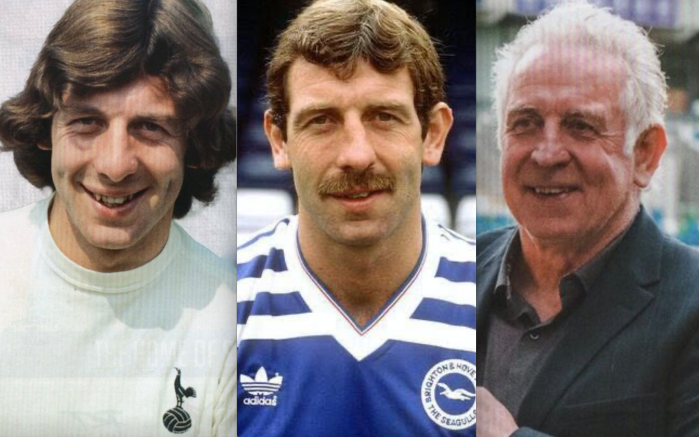
GERRY ARMSTRONG was a raw youngster not long over from Ireland when he was part of a Spurs team relegated from the top division.
“We were playing poorly. People kept telling us we were too good to go down but what a load of rubbish that was. You don’t want to believe that sort of nonsense,” Armstrong told Neale Harvey in a tottenhamhotspur.com interview.
“We started thinking they were right but you had to earn the right to stay up and we lost too many games, simple as that.”
It was 49 years ago when Armstrong suffered that fate, and Spurs bounced straight back courtesy of a mightily convenient last day 0-0 draw at second-placed Southampton (Brighton finished on the same number of points but were edged into fourth spot on goal difference).
Eight years later, Armstrong, fresh from playing for Northern Ireland at the 1986 World Cup in Mexico, joined Brighton during Alan Mullery’s unhappy second spell in charge, and endured a turbulent season.
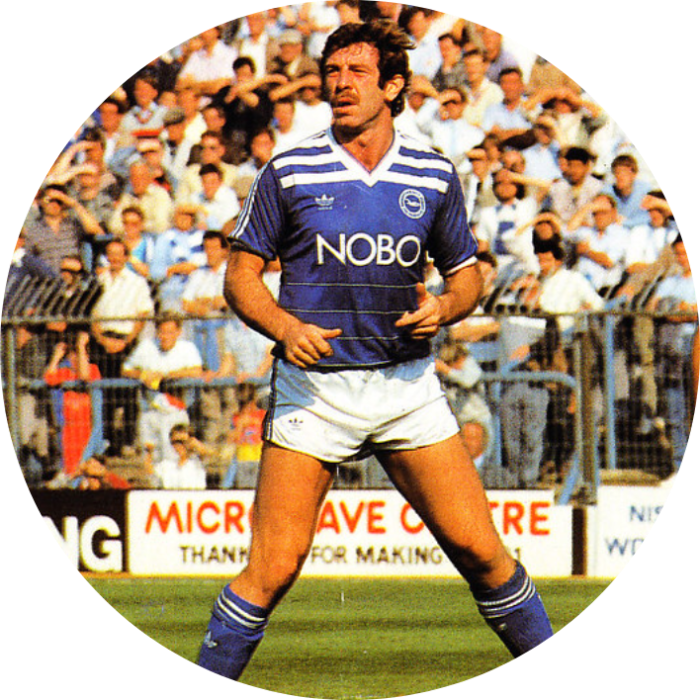
He went 17 games before scoring, joined Millwall on loan when Mullery was unceremoniously shown the door in January 1987, and was then recalled by new manager Barry Lloyd for the final eight games of the season. He only managed one goal (in a home 1-1 draw with Plymouth) to add to the three he scored earlier in the season, and he experienced relegation again, this time from second to third tier, as Albion finished bottom of the league.
Like Spurs, Albion bounced straight back up but by then Armstrong’s involvement was as a perennial substitute (in the days of two subs). In 1987-88, with Kevin Bremner and Garry Nelson on fire up front, he started one League Cup game early in the season and was a sub on no fewer than 25 occasions, only getting off the bench 11 times.
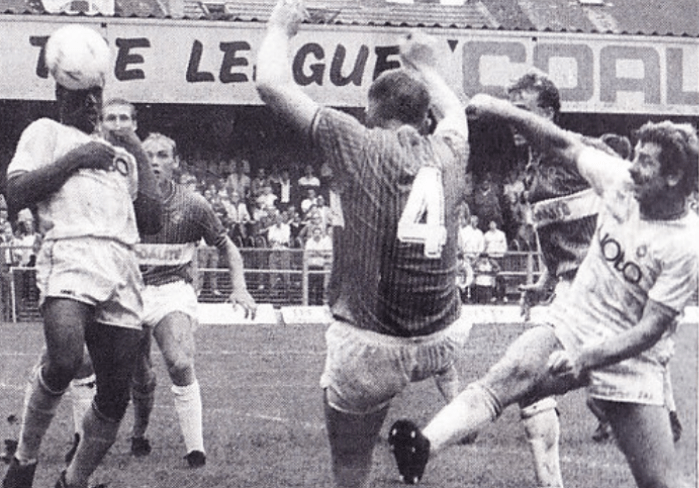
He scored twice, once on the last day of August, when he scored away at Northampton after going on as a sub for John Crumplin and, six months later, he went on for the injured Kevan Brown and netted the only goal of the game in extra time as Albion beat Hereford United in an away Sherpa Van Trophy tie.
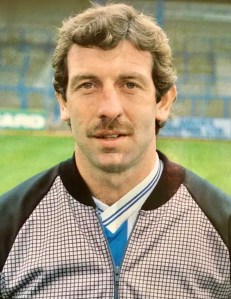
Chances of a starting berth in the 1988-89 season were limited because Bremner, Nelson and Paul Wood were regulars, but Armstrong managed four starts and went on three of the seven times he was a sub.
He was eventually appointed reserve team player-coach but his time with the club ended ignominiously. Playing for the reserves in a Sussex Senior Cup tie at Southwick in January 1989, he was shown a red card and, as he walked off, he took exception to a comment from a supporter, jumped into the crowd and headbutted the person concerned.
Armstrong left the club a fortnight after the altercation but the matter ended up in court and the footballer received a conditional discharge.
It wasn’t the first time the red mist had descended, though, as Armstrong explained in an interview with Lionel Birnie for watfordlegends.com. He originally played Gaelic football for St John’s GAC and the Antrim senior team.
“I only started playing soccer at 17. I’d played Gaelic football and hurling. I got suspended for an altercation in Gaelic,” he said. “It’s an amazing game but fights used to break out all over the pitch. It was fun, I loved it but it was a very confrontational game.
“There was an incident where I broke a guy’s jaw in several places and got suspended. I didn’t mean to break it but I caught him one.”
It was while he was suspended from playing Gaelic football that he was picked up by Bangor and in no time at all he found trouble in football too.
“I made my debut for Bangor, came on as a sub with 20 minutes to go, got sent off with 10 minutes to go for whacking the centre- half,” Armstrong told Birnie. “I went past him and put the ball in the net to make it 2-1 and he said, ‘Next time you do that I’m going to do you.’
“When he said he was going to do me, I decided to do him first and I whacked him. The manager, Bertie Neill, gave me a bollocking. He chewed a couple of strips off me and I learned that soccer wasn’t a fighting game.”
It was another three years before he signed for Spurs and, by his own admission, “a load of clubs came to watch me but no one took me on because I was very inconsistent, still learning about the game, really didn’t get to grips with the offside”.
The Gaelic game helped him build stamina and strength and soccer made him sharper. After Bangor won some trophies, Spurs invited him for a week’s trial and he told Harvey: “I thought I did okay but I heard nothing for weeks.
“Arsenal were trying to sign me but, out of the blue, Terry (Neill) came over (in November 1975) and signed me on a one-year contract, with a one-year option. It was an opportunity I couldn’t turn down.
“I was overawed. I’d never been to London before, so it was like ‘Paddy’ coming to the big city and being lost. But all the lads were great and there were a lot of Irish boys, like Chris McGrath, Noel Brotherston and, of course, the legendary Pat Jennings.”
Armstrong was a late starter at 21 but he lapped it all up, enjoying training and working on his ball skills in the gym in the afternoons with Peter Shreeves. After six months, he broke into the first team.
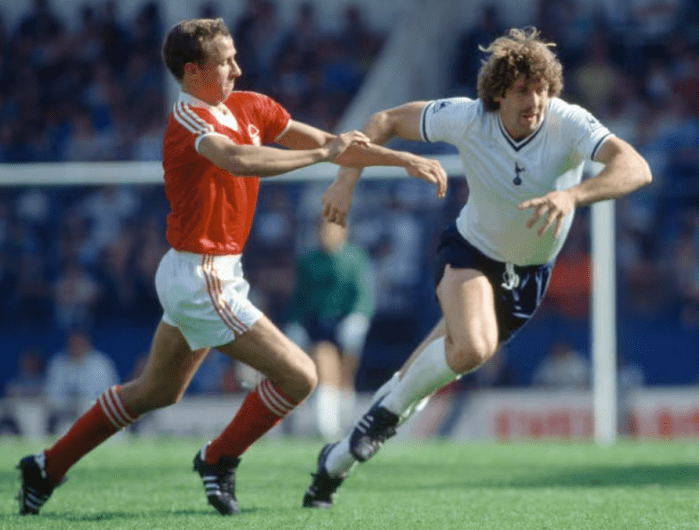
He made his debut on the opening day of the 1976-77 season, in a 3-1 defeat at Ipswich and lost his place after only three matches. He was restored to the first team in February for the final 18 games but Spurs slid all the way to relegation.
Armstrong reckoned with hindsight that it was a five-week pre-season tour that took its toll on the squad. They travelled to Canada, USA, Hawaii, Fiji, New Zealand, Australia and India and, he said: “When I got back, I was absolutely knackered. But we only had 10-12 days to recuperate before pre-season began.”
After Neill left for Arsenal, his replacement, Keith Burkinshaw, often played Armstrong as a central defender having liked what he saw in a pre-season game.
Armstrong told Birnie: “He wanted me to play there because I was quick, strong, good in the air. It was nice in one sense but I didn’t want to play at centre half, I wanted to be up front where the action is.” Even so, he also played at right-back, in midfield and wide on the right.
Brighton fans of a certain vintage remember all too painfully how Spurs managed to gain promotion on the last day of the season.
Armstrong recalled: “We nearly lost it three games from the end when we lost 3-2 at home to Sunderland after I made a mistake playing at centre-half. But then we beat Hull and went to Southampton needing a point.
“It was tense, obviously, but they needed a point as well and it was one of those games where nobody really tried to push on because of the fear factor. We got our point and went off to Cornwall for four days to celebrate!”
For a while, Armstrong and Chris Jones were a forward pairing for Spurs but he admitted that neither of them scored enough goals and the beginning of the end for both of them came when Tottenham bought Steve Archibald for a million and Garth Crooks for £650,000.
Armstrong dropped down a division to join Watford in November 1980 for a £250,000 fee – at the time, a record sale for Spurs, and a record buy for the Hornets. He signed in the same week that Graham Taylor also signed Armstrong’s fellow countryman Pat Rice from Arsenal.
He was part of their promotion-winning squad of 1981-82 and said: “Graham Taylor taught me so much about movement and he took my level of fitness up another notch.
“I was fit and strong but I hadn’t tapped into all my resources. The two years at Watford prior are one of the reasons I had such a good World Cup [in 1982].”
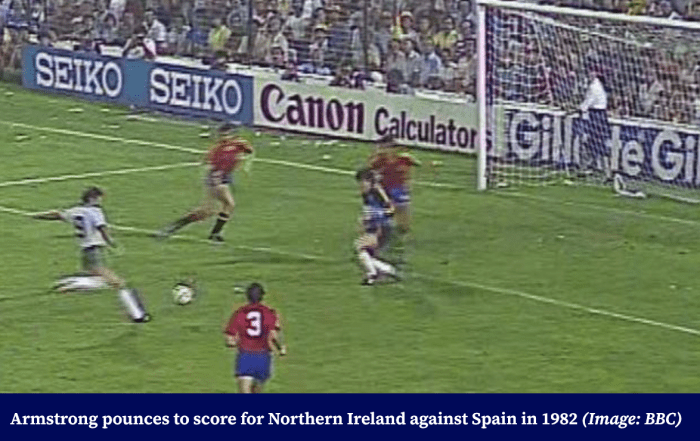
Indeed, it was his winning goal for Northern Ireland against Spain at the 1982 World Cup that he is most remembered for and Armstrong later told The Argus: “If I had to pick one moment in football to relive again it would be that. It would be the highpoint of any player’s career to perform in the World Cup finals. But to score the winning goal against the home nation would be a dream. It was for me.”
In an interview with Andrew French of the Watford Observer, he recalled: “The goal came early in the second half. I was playing as a right-sided midfield player, and I won the ball off the Spanish left-back Gordillo.
“I went on a run for about 60 yards, went past a couple of players – I remember Xavi Alonso’s father, Joaquin, tried to clip my heels – but I then played the ball out wide to Billy Hamilton and kept my run going.
“Billy put in a great cross which the keeper, Luis Arconada, came for and palmed straight out to me. I was about 12 yards out and I just got my head and my knee over the ball and hammered it as hard as I could, and it hit the back of the net.
“It was actually a funny one as the ground went silent because the Spaniards weren’t going to celebrate, and the South American referee had been so poor and given us nothing. I was worried and I remember thinking ‘why isn’t anybody cheering?’
“But then I saw Norman Whiteside and Sammy McIlroy throwing their hands in the air, and then I looked at the ref and he was pointing to the centre. Once I knew he’d given the goal, that’s when the celebrations started.”
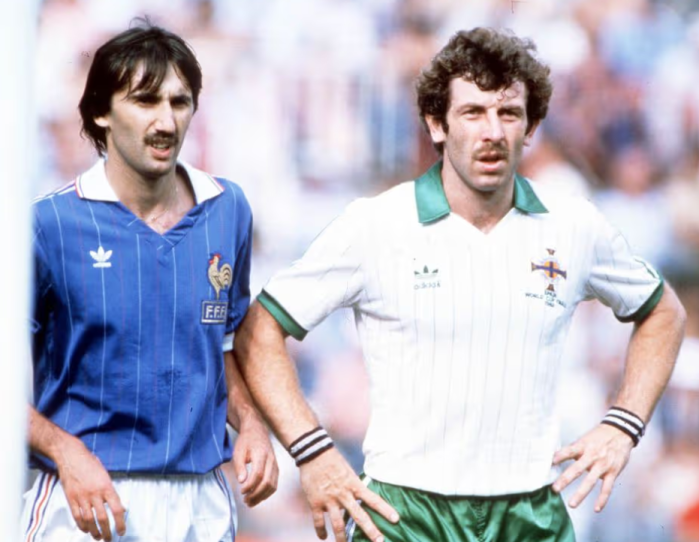
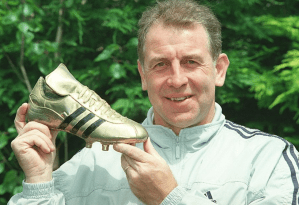
Armstrong had already netted in a 1-1 draw with Honduras and in the next round he scored in Ireland’s 4-1 defeat against France (pictured above); those goals were enough to earn him a golden boot (right) for best British Player of the Tournament.
On his return to the UK, he was back in the top flight but was sidelined for several weeks with a broken ankle sustained when he fell awkwardly in a reserves match. Towards the end of the season, Real Mallorca bid £200,000 for him and he spent two seasons playing in the Spanish league.
Armstrong told Birnie: “I didn’t want to leave. It was a case of Mallorca coming in. It was 200 grand so the club would get almost all their money back on me after three years, which was not a bad deal at all.
“When you go to talk to them and see the money they are going to offer and you realise the tax situation is very different there suddenly it is very attractive. You realise you can make in two years at Mallorca what you could make in six or seven years at Watford or any other English club.
“There was a challenge in Spain, playing in a different country, learning a different language and it did appeal to me in ways other than the money. I was 30, 31, so I thought I’d give it a go because I knew the opportunity would probably not come up again.”
The experience served him well because after his playing days were over he was a TV co-commentator on Spanish football.
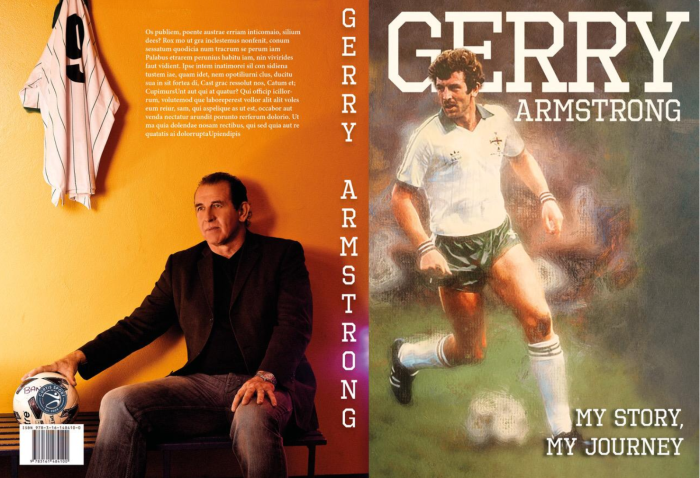
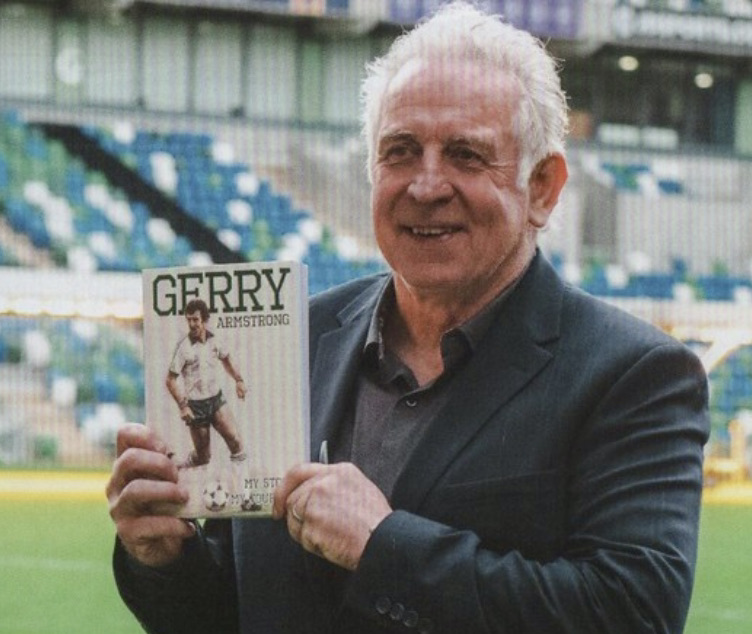
In that respect, Armstrong’s typically Irish gift of the gab long made him an ideal pundit for broadcasters and a journalist’s dream interviewee: tales from his playing days have filled plenty of columns and air time over a good many years, and in 2021 Curtis Sport published his autobiography, Gerry Armstrong: My Story, My Journey.
Born in the County Tyrone village of Fintona on 23 May 1954, Armstrong was a teenager in Belfast at the height of Northern Ireland’s sectarian and political conflict. “There were bombs going off, paramilitaries burning buses and it was a horrific time,” he said.
“At times it felt as if you were living in a movie set, but it was real life. The book isn’t just about the highs, it also paints a picture of what it was like growing up back then.”
Armstrong won 63 caps for Northern Ireland and scored 12 goals, making his debut in 1977 at the age of 22 alongside George Best and Pat Jennings in a 5-0 friendly defeat to West Germany in Cologne.
His first two international goals were scored in a 3-0 World Cup qualifying win over Belgium at Windsor Park seven months later.
Without a doubt, though, 1982 was when he was at the pinnacle of his career. While he’ll forever be remembered for the winner against Spain, he also fondly remembered scoring against Portugal and Israel in qualifying.
“We had to beat Portugal at Windsor Park and we only got one chance that night. Terry Cochrane crossed and I managed to head it into the roof of the night,” he said.
“That win set us up and it then came down to the last game at home to Israel which we had to win to reach Spain. I managed to score the winner and the noise was unbelievable.
“There were 43,500 people inside Windsor. It was only supposed to hold 40,000, so I don’t know how everyone got in. But that’s one of a lot of very special memories.”
By the time of the 1986 World Cup, Armstrong had been in a bit of limbo. He’d returned to the UK the previous August and signed for West Brom on a free transfer but he struggled with travelling to and from London to train and play, didn’t see eye to eye with manager Ron Saunders, and picked up some injuries.
It was former Spurs teammate John Duncan who rode to his rescue. Duncan was in charge of Division Three Chesterfield and he took Armstrong on loan and then signed him permanently, giving him a dozen games, which were enough to put him in contention to be selected by Northern Ireland for the upcoming World Cup in Mexico.
Billy Bingham’s side didn’t make it past the group stage (drawing 1-1 with Algeria; losing 2-1 to Spain and 3-0 to Brazil) and Armstrong only saw action as a 71st minute sub in the Brazil game. Albion winger Steve Penney started the first two matches and was subbed off in each.
It was while Armstrong was away with the Irish squad that Mullery made contact with an offer for the following season.
Although Brighton was the last professional English club Armstrong played for, he lived in the area for several years afterwards. His second wife, Caron, came from Brighton and although his final games as a player were at Glenavon, back in Ireland, he spent some time as a player-coach at Crawley Town, who were in the Beazer Homes League at the time.
In November 1991, he became manager of Worthing and led them to a promotion before being appointed assistant manager of Northern Ireland by his former teammate Bryan Hamilton. He reprised that role for two years under Lawrie Sanchez between 2004 and 2006.






 In parallel lines