
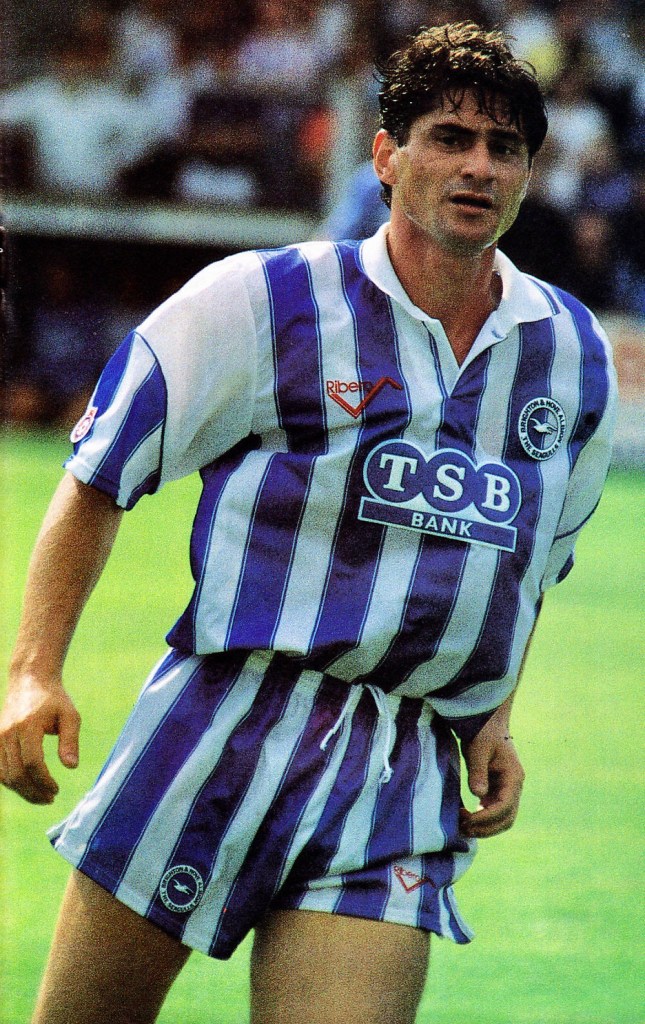
HAVING one former European Cup winning captain turning out for the Seagulls seemed remarkable enough, but then along came another.
Dennis Mortimer lifted that trophy as captain of Aston Villa three years before his former Coventry City teammate Chris Cattlin persuaded him to join the Albion in 1985.
Wind the clock forward to 1991 and Stefan Iovan, who lifted the same trophy in 1986 as captain of Steaua Bucharest, ended a protracted will he/won’t he saga when he joined Barry Lloyd’s promotion-seeking tier two side for a £60,000 fee.
I’d probably go so far as to say, if you ask any Brighton fans who were around when the Seagulls flew to Wembley for the Division Two (Championship equivalent) play-off final in May 1991, Iovan is probably the least remembered member of the side who lost 3-1 to Neil Warnock’s Notts County.
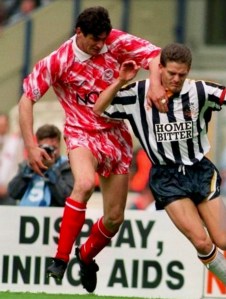
And former Albion favourite Gary Chivers has been pretty damning in retrospective interviews of what he felt went wrong that day.
“It just didn’t happen for us on the day,” he told Luke Nicoli in an April 2021 interview. “They say the buck stops with the manager and I thought we chose a funny line-up and a system that didn’t suit the personnel.
“We brought the Romanian Stefan Iovan in as a sweeper which was a big ask given he’d only just come into the team and the country. He may have been a European Cup winner, but I’d been used to playing alongside Colin Pates at the back – we knew each other’s game inside out.”
In a matchday programme article, Chivers went further and said Lloyd made a “monumental mistake” in playing Iovan as a sweeper when “it was clear he had no pace”.
Chivers reckoned: “Notts County could sense that was our weakness and they were playing balls over the heads of our wing-backs, namely Steve Gatting and myself, and exposing our centre-backs. In all honesty, they were having a field day and young Tommy Johnson – who, of course, would later go on to become a top player with Aston Villa and Celtic – was running rings around poor Stefan.”
After going behind to Johnson’s 29th-minute opener, Albion came close when a Clive Walker header hit the post just before half-time, and Dean Wilkins hit the crossbar with a curling free kick only three minutes into the restart.
But Johnson scored a second on 59 minutes and Dave Regis netted a third 12 minutes later.
Iovan made way for substitute John Byrne, who would certainly have played if he had been fully fit, and Byrne set up Wilkins to make it 3-1 in the last minute.
Born in Moțăței, in the south west corner of Romania, on 23 August 1960, Iovan first played professional football in Resita (150 miles from home) aged 17 and then spent 10 years at Steaua Bucharest, winning 34 caps for his country between 1983 and 1990. He played in a World Cup qualifier against England at Wembley on 11 September 1985, which finished 1-1. Glenn Hoddle opened the scoring for England in the 25th minute and Rodion Cămătaru equalised on the hour mark.
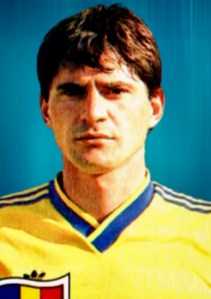
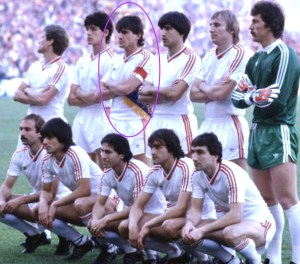
That European Cup win in 1986 was on penalties against favourites Barcelona and was the first ever European Cup final to end 0-0 after 120 minutes. Steaua were also the first ever Eastern European winners.
Although goalkeeper Helmuth Duckadam was lauded as the hero for saving four Barca penalties, journalist Runar Nordvik wrote: “Stefan Iovan was the right back, the captain and the natural authority in the team.”
The following season, he lifted another prestigious trophy aloft when Steaua beat Dynamo Kiev 1-0 in the European Super Cup.
Long-time Albion-supporting freelance journalist Spencer Vignes described Iovan as “the unlikeliest lad ever to pull on an Albion shirt” and “an absolute colossus” in terms of his CV.
Lloyd had been alerted to Iovan’s possible availability during an Albion pre-season trip to Bucharest, as guests of city rivals Dinamo Bucharest. A fee of £60,000 was agreed in November 1990 but there was a long hold-up in him obtaining a work permit and it wasn’t until February1991 he was able to complete the move. Then it was a couple of months before he was deemed ready to play.
Albion had an outside chance of promotion and Iovan was an unused sub for the home game against Notts County on 13 April before making his debut as a sub in a 1-0 defeat at Portsmouth three days later. I remember standing on the terrace at Fratton Park witnessing his first touch: the ball skewed off his boot straight into touch. An inauspicious start.
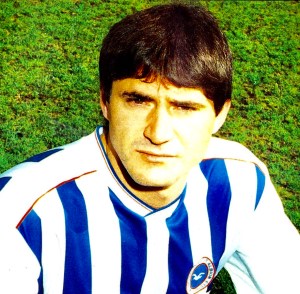
He also went on as a sub the following home game, when the Albion crashed 3-0 to Oxford United. But Lloyd was convinced he’d pulled off a coup, writing in his programme notes for the penultimate home league game against Bristol City: “He arrives at the Goldstone with a record of achievement which arguably puts him on a level higher than any player previously signed by this club.”
Lloyd admitted though: “Compared to other positions, it can take longer for a defender to adjust to the demands of the English game.”
The manager pointed out: “He has been used to playing in a set-up in which defenders mark space – a method which is different from the man-for-man marking system more generally operated in this country.
“Of course, Stefan still has to prove that he can succeed in English football. But we are confident that he has the skill and experience which will enable him to adapt.”
After Albion just edged into the play-offs, a glimpse of what the experienced defender might bring to the party shone out in the two-legged play-off semi-final games against fancied Millwall, when Albion won 4-1 at home and 2-1 at The Den. “Stefan was a giant in both matches, bringing an air of composure and discipline to a back line prone to the jitters,” according to Vignes.
Sidestepping the sort of observations Chivers made of the Romanian’s contribution in the final, the writer maintained: “Notts County proved too strong for us in the final at Wembley, winning 3-1, but with Stefan in our midst the future seemed especially bright.”
And, sounding as though he was trying to convince any doubters, in his programme notes for a pre-season game against Iovan’s former club (Steaua), Lloyd reckoned: “Stefan has become a popular member of the dressing room although he is a very quiet and reserved character. However, now that his English is slowly improving, and he is becoming part of the dressing room banter, he has settled down and obviously is enjoying life in this country.”
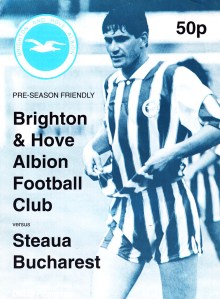
Highlighting the “vital” role Iovan had played as a sweeper in those wins over Millwall, Lloyd pointed out that Albion had continued to play the same system on a three-game pre-season tour in Holland, winning each match.
In broken English, Iovan was quoted in the programme saying: “Pre-season training harder this time but I feel good. I like Brighton. The players, everybody, here very nice.”
Lloyd had said previously he was looking forward to Iovan playing an important role the following season but he was subbed off having started the first two games of the new season (a 2-0 home defeat to Tranmere and a 2-1 loss at Bristol City) and didn’t feature again until November when the side went down 1-0 at Blackburn.

He was also on the losing side later the same month in a ZDS area quarter final game at West Ham, when Brighton went down 2-0 although 10 days earlier he’d helped the Albion grind out a point at Cambridge United when emergency loanee goalkeeper Jurgen Sommer was between the sticks.
By the end of the season, when the Seagulls were relegated, Iovan had at least picked up a winners’ medal – but that was only for the reserve side’s 1-0 win over Langney Sports in the Sussex Senior Cup!
Vignes said it was a mystery why Iovan didn’t feature more for the first team, suggesting the player either wasn’t fit enough or was unable to adapt to a flat back four, having been more accustomed to a sweeper system.
Whatever the reason, he departed Sussex with a whimper, returning to his homeland with Rapid Bucharest.
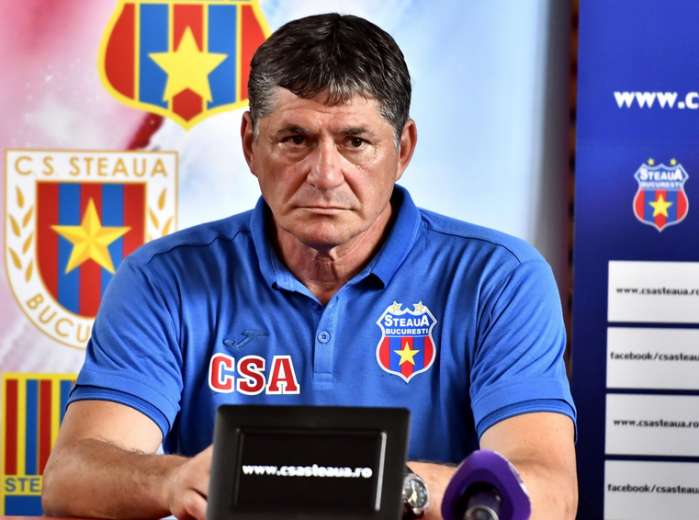
He later coached Steaua, was assistant manager of the Romania national team for a while and remains associated with Steaua as head of youth development.

 Although initially a midfielder, coach Ken Shellito turned him into a defender and Chivers’ versatility in defence meant he could play centrally or in either full-back berth. Among his early contemporaries were John Bumstead,


 In parallel lines