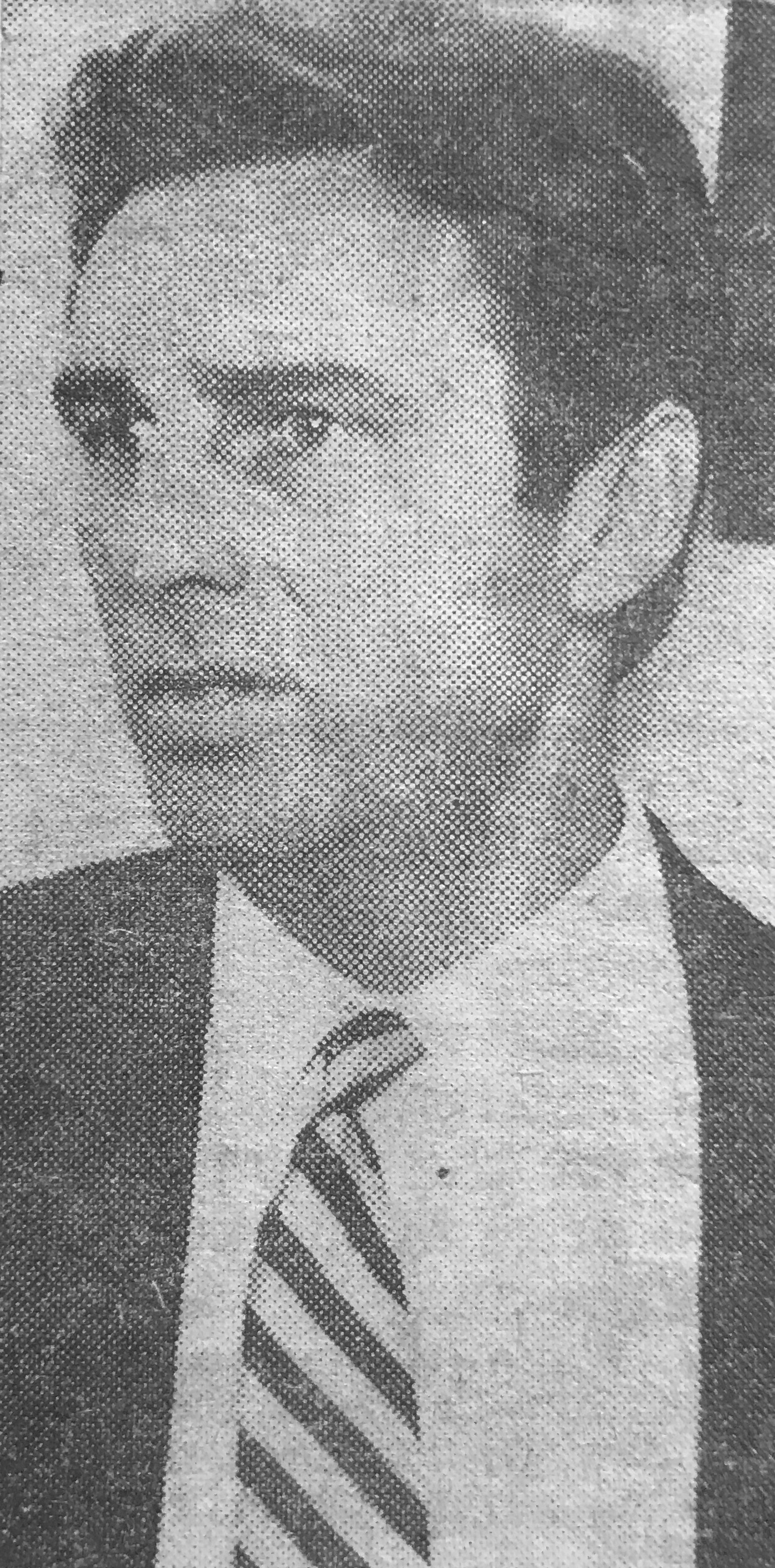
Villa cup winner and captain Pat Saward led Albion to promotion

A FORMER Aston Villa captain and 1957 FA Cup winner steered Brighton to the first promotion I witnessed on my Albion journey.

Genial Irishman Pat Saward, who lived in my hometown of Shoreham during his time as Albion boss, galvanised a squad not expected to be promoted from the third tier and took them up as runners up behind his former club in 1972.

As the champagne flowed in the Goldstone Ground home dressing room, Saward took centre stage surrounded by his blue and white stripe-shirted heroes.
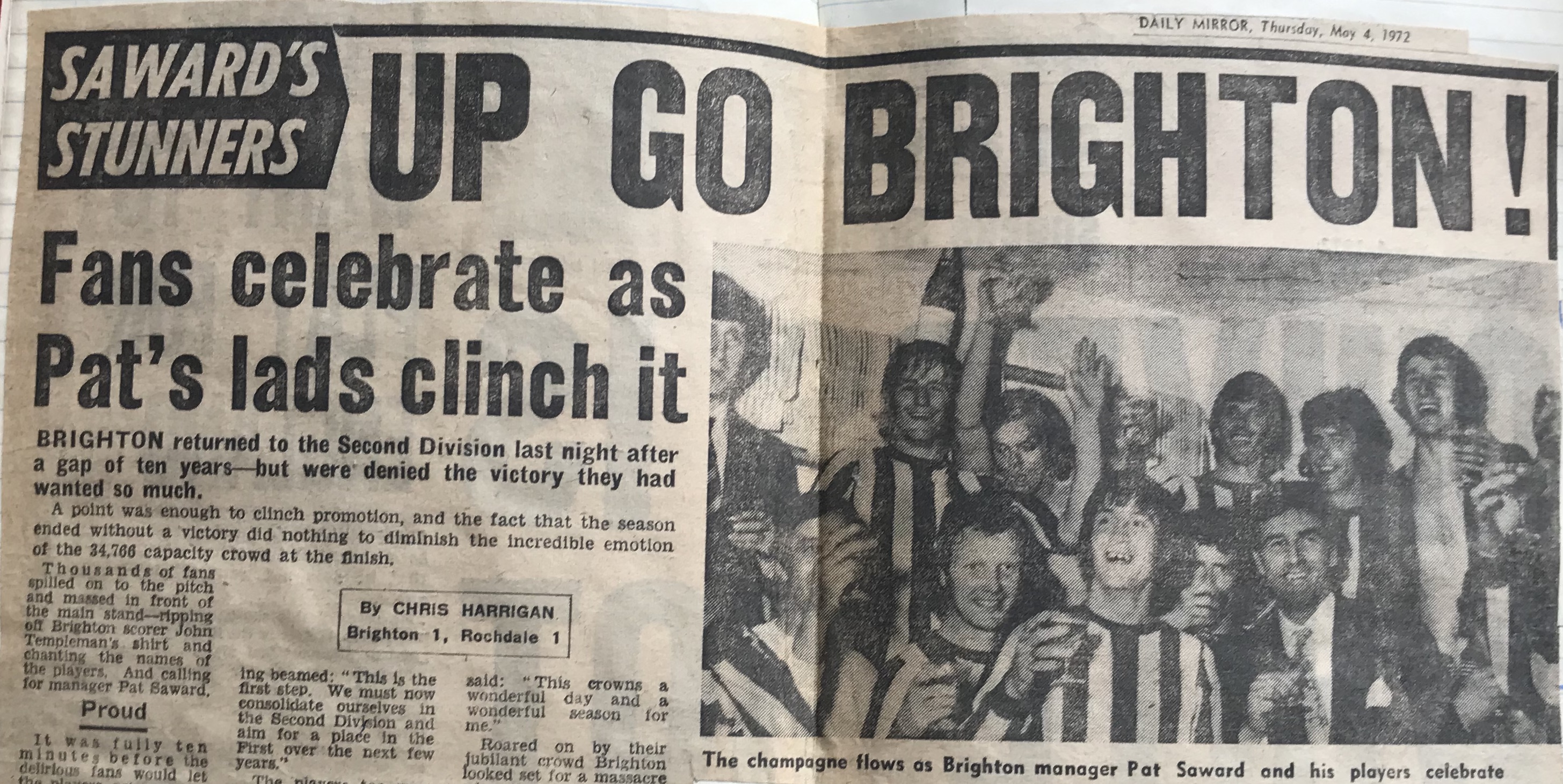
When the promotion tilt had looked like faltering, he’d been bold enough to make drastic changes to the side before a top of the table clash with Villa in front of the Match of the Day cameras. After a memorable 2-1 win in which Willie Irvine scored a goal later judged as the third best in the programme’s Goal of the Season competition, Saward added to his squad on transfer deadline day, bringing in Northern Ireland international Bertie Lutton from Wolves and Ken Beamish from Tranmere Rovers, described in the Official Football League Book as “stocky and packed full of explosive sprinting power, a terrific shot and great appetite for the game”.

Saward told the publication: “They were both last ditch signings and Ken made an astonishing difference. I spent only £41,000 in getting my promotion side together so we were very much Villa’s poor relations in that sense.”

The manager put the success down to: “Dogged determination to succeed from all the players. We stamped out inconsistency. I got rid of ten of the players I inherited and got together a team built on character. That’s the key quality, apart from skill of course.”

However, hindsight reveals the club wasn’t really ready for the higher division and some have suggested Saward broke up the promotion-winning squad rather too hastily. Players he brought in who were used to the level now known as the Championship struggled to gel, and the manager turned to rather too many loan signings.

A mid-season run of 13 consecutive defeats was Albion’s undoing and a glamour FA Cup tie at home to First Division Chelsea in early January 1973 gave a welcome respite from the gloom.

Ahead of the match, Saward opened his heart to Daily Mirror reporter Nigel Clarke, revealing that he couldn’t understand why the side had struggled so much.

“I wish I knew. But I’ve learned more about football these last few weeks than at any other time in my career.

“We are five points behind the next club but I must be the luckiest man in the league. There are no pressures on me,” he said, explaining that supporters were still writing to him, backing him and the team.

“When we came up from the Third Division, I was so big-headed, so confident. I thought with the right results we could go straight through to the First Division. I really did.

“There was spirit and ambition here – and there still is….that’s how this club gets you. My heart is in the place.”

Saward revealed that he had turned down two better paid jobs in the First Division to stay at Brighton after the promotion win, telling Clarke: “What I want is importance, appreciation, understanding and love…not being kicked up the backside and put under the lash.

“Adulation is false. I’ve found my oasis at Brighton and I’m wealthy the way I want to be – in feeling.”

Although the Chelsea game ended in another defeat, fortunes eventually changed the following month – but the damage had been done and Brighton went straight back down.

A defiant Saward promised to blood more youngsters like Steve Piper and Tony Towner, who’d done well when drafted in and Piper, in a matchday programme article, said of him: “Saward was more of a coach than a man-manager, very suave and sophisticated. He knew his football from his days at Coventry.”

However, when results didn’t improve on the return to third tier level, and with a new, ambitious chairman – Mike Bamber – at the helm, Saward was sacked and replaced with the legendary Brian Clough.

Albion’s hierarchy had turned to the untried Saward in the World Cup summer of 1970 after Birmingham City poached Freddie Goodwin from Brighton to replace Stan Cullis as their manager. It was second time lucky for Saward, who’d applied to succeed Archie Macaulay two years previously when Goodwin pipped him to the post.

“Give me ten years and I’ll have Brighton in the First Division,” Saward declared when appointed. Prescient words considering they made it within nine – although it came six years after he’d parted ways with the club.

There’s little doubt Saward was an innovative football man and a popular figure during the first two years of his reign.
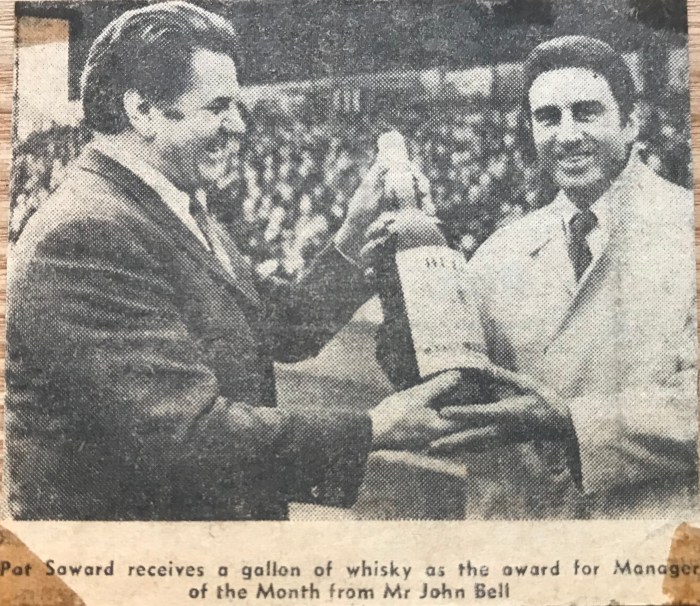
Apart from success on the pitch in the 1971-72 season, the way he involved fans in helping him to improve the side also proved a winner.

His buy-a-player appeal was a direct attempt to involve the supporters in the affairs of their club and Saward led a sponsored walk on Brighton seafront as one of the initial events geared towards generating funds to help him compete in the transfer market.

“Too many people spend too much time shouting about how hard up their club is, and too little time fighting to improve the situation,” Saward said in an article for the April 1971 edition of Football League Review. “You never get success if you sit around. You must have courage, even audacity, and work hard for survival.”

The first funds generated provided Saward with the money to bring in experienced Bert Murray from Birmingham City, initially on loan, and then permanently. Murray would go on to be voted Player of the Year in 1971-72.

Another player who signed on loan at the same time as Murray was Preston’s Irvine, who recalled in his autobiography, Together Again, how Saward wooed him.

“Pat sold me the place with his charm and persuasive ways,” he said, describing the former male model as “extrovert, infectious and bubbly”.

He added: “Pat Saward was a gem of a manager and a pleasure to play for. He said what he thought, but never offensively; in a matter-of-fact, plain-speaking kind of way, rather than aggressively.”

Irvine continued: “Saward had the knack of making people feel important. He instilled pride and a sense of identity…..Pat loved attacking, entertaining football and worked tirelessly for the club. I would have run through that proverbial brick wall for him.”

As Brighton neared promotion, Irvine said: “Saward, with a joke or a smile, an arm around the shoulder or a bit of geeing up, knew just how to keep a dressing room happy or dispel any tension or nerves.”

Sadly, Irvine’s opinion of Saward shifted dramatically when, during the summer, the manager told him he intended to bring in a replacement – although it was three months before he eventually signed Barry Bridges from Millwall.

Saward and new signings Barry Bridges (left) and Graham Howell

Irvine was in the starting line-up at the beginning of the season and scored six times in 13 league and cup games, but, once Bridges arrived in October, his days were numbered, and, before the year was out, he was sold to Halifax Town in part exchange for Lammie Robertson.

Saward had already dispensed with the services of Albion’s other main promotion season scorer, Kit Napier, along with his former captain, John Napier.

Irvine said that once Albion were promoted, Saward changed. “He seemed to become unapproachable, or at least he did to me, and where once I could see him whenever I wanted, now I seemed to have to book an appointment two or three days in advance. We all had to.”

Teammate Peter O’Sullivan, who had repaired his relationship with Saward after some difficult early exchanges which saw the Welshman transfer-listed, also witnessed a change in the manager.

“We had one or two players who were over the hill and Pat just lost the plot. It was grim,” he told Spencer Vignes in A Few Good Men.

Albion’s tier two fortunes were picked over in some detail in a feature reporter Nick Harling compiled for Goal magazine.

“I didn’t foresee the snags and the type of league the Second Division was,” Saward told him. “It’s the hardest division of the four. Everyone is fighting either to stay in or get out.

“It’s a hell of a hard division. It’s a mixture of the First and Third. It’s good and very hard football. They don’t give you an awful lot of time to play.

“It’s a division governed by fear because to drop out of it is not good, while to get out at the top is fantastic. I didn’t believe the gap would be so different.

“Teams are so well organised and supplement their lack of ability with tremendous defensive play. It’s very hard to get results.”

While open and honest, they didn’t sound like the words of a manager very confident of finding a solution, and Saward sought to explain part of the problem when he said: “To me the most important thing is the attitude of mind. Players should have an arrogant attitude, an attitude that they’re going to do well even when the chips are down. But some types are destroyed. These are the ones who succumb and want to rely on other people.

“Here we’ve got some great boys, but I wish to God some of them had more determination.”

Bamber was resigned to relegation but nonetheless confident of where the club was heading. “There’s no doubting it – First Division here we come,” he told the magazine.

Saward added: “I haven’t lost any enthusiasm. I’ve had my hopes dampened slightly, but one overcomes that.

“This club has got to be built for the future. I want to put Brighton on the map.”

Sadly, when Albion’s poor form at the start of the 1973-74 season continued, Saward publicly admitted: “I haven’t any more answers. I am in a fog.”

Unsurprisingly, the Albion’s directors interpreted it as a loss of confidence and sacked him.

It’s front page news on the Evening Argus as Saward is sacked

Saward never managed in the English game again, although he coached in Saudi Arabia for a while.

Born in Cobh, County Cork, on 17 August 1928, Saward lived in Singapore and Malta during his childhood, before the family moved to south London.

His first club was Beckenham FC before he turned professional with Millwall in 1951. He made 118 appearances for the Lions in the next four years.

Saward was 26 when Eric Houghton signed him for Villa for £7,000 in August 1955. The legendary Joe Mercer took over as Villa manager in 1958.

Pat enjoyed a goalscoring debut with his new club, hitting the final equalising goal in a 4-4 draw with Manchester United at Villa Park on 15 October 1955. But he struggled to oust left half Vic Crowe and made only six appearances that season.

In Crowe’s absence through injury the following season, Saward became a regular, making 50 appearances.
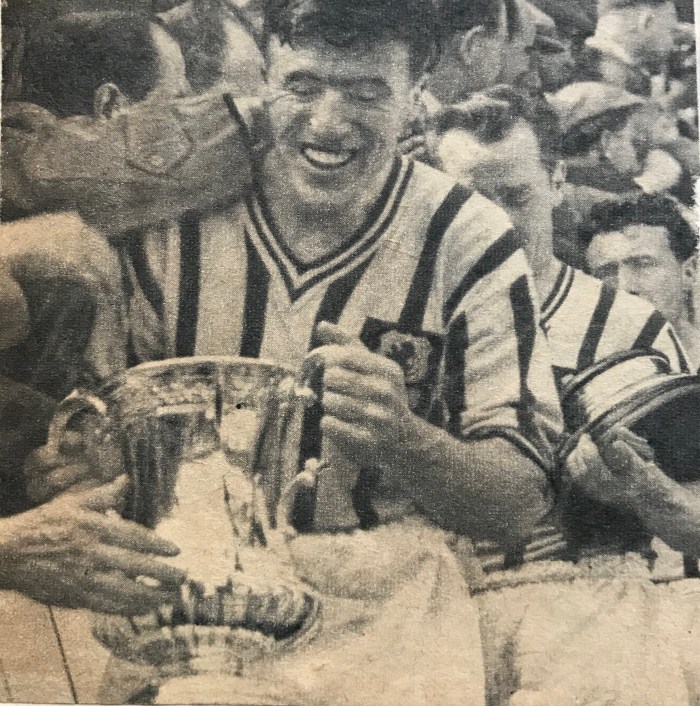
Saward (right) descends the steps at Wembley as a FA Cup winner with Aston Villa

In total, Saward played 170 games for Villa between 1955 and 1960, most notably featuring in their FA Cup winning team in 1957. Villa beat Manchester United 2-1 in the final at Wembley Stadium in front of a crowd of 99,225, Peter McParland scoring twice to win Villa the Cup for a seventh time.

Saward made only 14 appearances as Villa were relegated from the top-flight in 1959 but he was back in harness as captain when they made a swift return as Second Division champions in the 1959-60 season.

In his final season, he made just 12 appearances, his last coming on 22 October 1960 in a second city derby, Villa beating Birmingham 6-2. The following March, he was given a free transfer and moved on to Huddersfield Town.

Saward in the stripes of Huddersfield Town

He had first been selected for the Republic of Ireland on 7 March 1954 in a World Cup qualifier in which Luxembourg were beaten 1-0, and he went on to make 18 appearances for his country, the last, on 2 September 1962, coming when he was 34: a 1-1 draw away to Iceland in Reykjavík.

He played twice against England in World Cup qualifiers in 1957, a 1-1 draw and a 5-1 defeat, when he was up against the likes of Duncan Edwards, Johnny Haynes and Stanley Matthews, and in the same competition against Scotland, in 1961, when the Irish lost 4-1, and his teammates included Johnny Giles.

After 59 appearances for the Terriers, he dropped out of the league but acquainted himself with Sussex when moving to Crawley Town.

Jimmy Hill signed him for Coventry as a player-coach in October 1963 and although he made numerous reserve team appearances, he really made his mark as a coach and was responsible for the rapid development of City’s youth team in the 1960s.
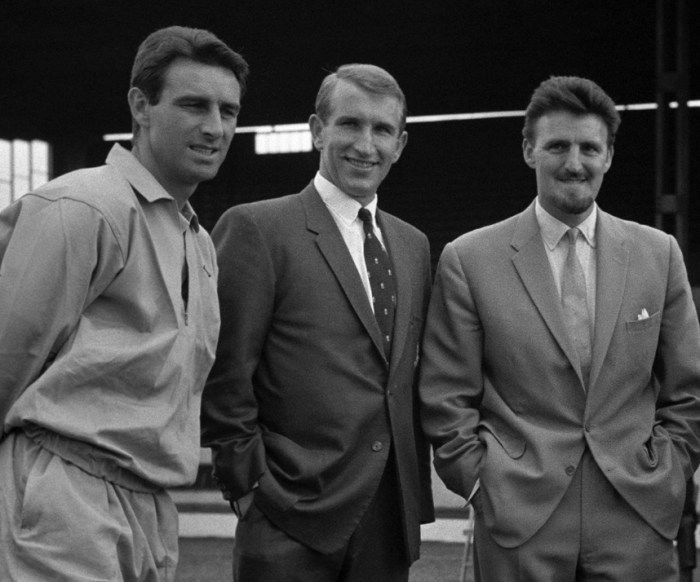
Saward (left) with assistant manager Alan Dicks and Jimmy Hill at Coventry City

Willie Carr and Dennis Mortimer were just two of several first teamers who made it under his guidance. He stepped up to first team assistant manager when his former Eire teammate, Noel Cantwell, was appointed boss in 1967.

Not long after his switch to the Goldstone, Saward picked up one of his former Sky Blues proteges, Ian Goodwin, initially on loan, and then permanently, and eventually made him Albion captain. The rugged defender’s arrival was remembered in an Argus article.

When Saward died on 20 September 2002 following a period when he’d suffered with Alzheimer’s, an excellent Villa website pieced together a detailed obituary. His career is also recorded on the avfchistory.co.uk site.

Saward was laid to rest in the same Cambridge cemetery as his brother Len, a forward who played a total of 170 games for Cambridge United between 1952 and 1958, scoring 43 times. He went on to serve the club behind the scenes in their commercial department.
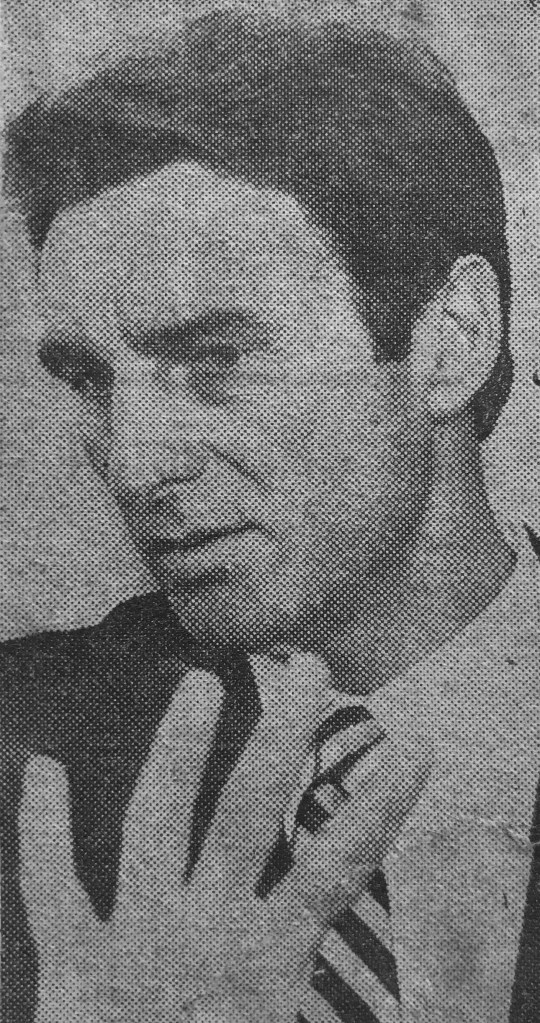
Pictures from my schoolboy Albion scrapbook and various online sources.

Two goals that etched Sammy Morgan’s place in Albion history

HAVING A cheekbone broken in four places during a pre-season friendly summed up the bad luck of never-say-die Northern Irish international striker Sammy Morgan.

His cause wasn’t helped when the manager who signed him six months earlier quit. And, to top it off, while he was recovering from that horrific injury, an Albion footballing legend in the shape of Peter Ward burst onto the scene.

When a £30,000 fee brought him to Brighton from Aston Villa just before Christmas 1975, it looked like the side had found the perfect strike partner for Fred Binney as they pushed for promotion from the third tier.

Unfortunately, the man with the swashbuckling, fearless approach went eight games without registering a goal. However, in his ninth game he made amends in memorable fashion.

Morgan scored both goals in a 2-0 win over Crystal Palace in front of an all-ticket Goldstone Ground crowd of 33,300 – with another 4,000 locked out.

It was 24 February 1976 and the Daily Mail’s Brian Scovell reported the goals thus: “In the 12th minute, Ernie Machin struck an early ball into the middle from the right and Ian Mellor headed on intelligently behind the defence for Morgan to steer the ball into the corner of the net.

“The second goal, in the 55th minute, came when Tony Towner took the ball off Jeffries and set off on a 40-yard run which ended with his shot rebounding off goalkeeper Paul Hammond. Morgan tapped in the rebound.”

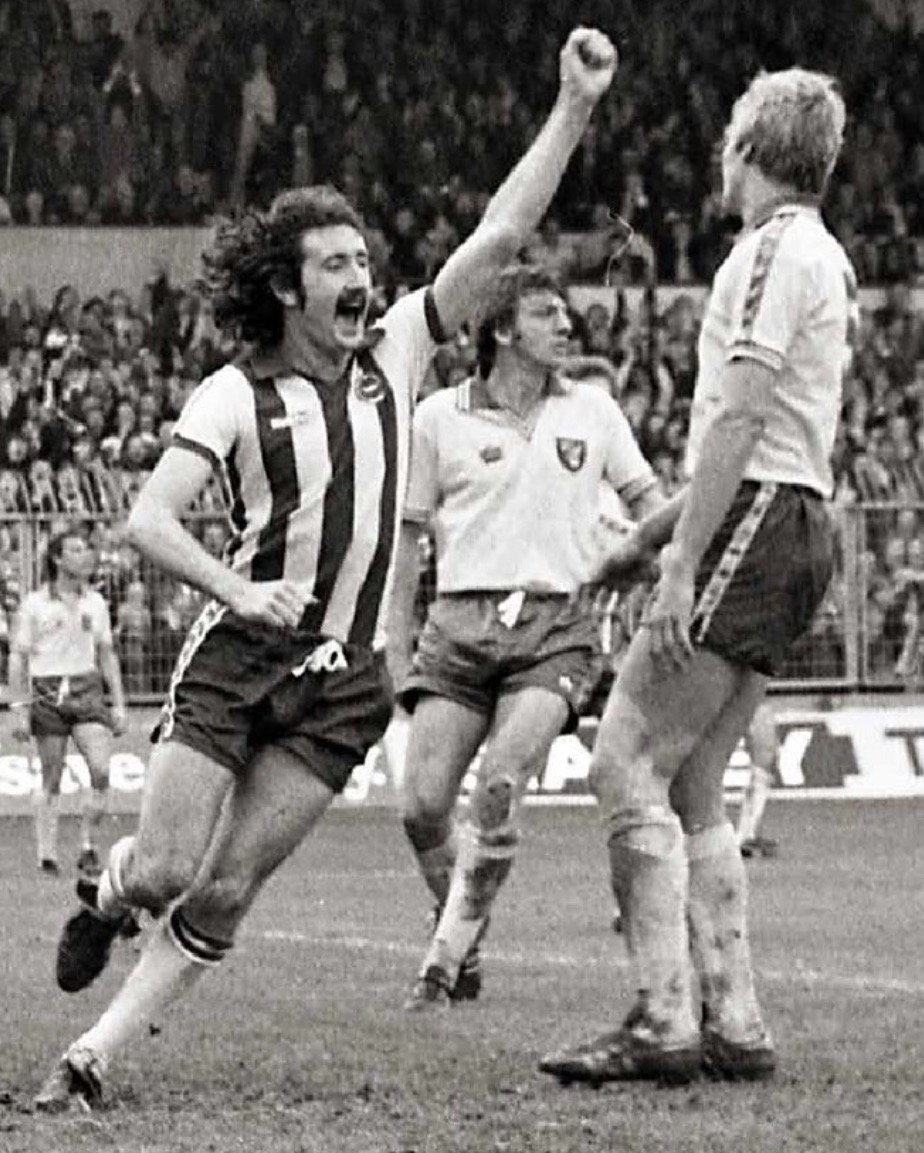
Gritty, angular and awkward, Morgan scored five more before the end of the season, including another brace at home to Swindon.

However, Albion narrowly missed out on promotion and Peter Taylor, the manager who bought Morgan, quit the club in the close season. The new season under Alan Mullery hadn’t even begun when, in a pre-season friendly against Luton Town, Morgan fractured his cheekbone in four places.

“I know I’m probably more prone to injuries than other players because of my style of play, but there’s no way I can change it, even if I wanted to,” Morgan told Shoot! magazine. “I made up my mind as soon as I got back in the team that I’d have a real go and that’s what I’ve done. People say I’m a brave player but I don’t really know if that’s true. I just like to give 100 per cent and that way no-one can ever come back at you.”

In the season before he joined Brighton, a groin injury had restricted him to just three top-flight appearances for Villa and, when he was fit to return, Villa had signed Andy Gray, whose form kept him out of the side.

Initially reluctant to move on, he admitted in that Shoot! interview: “I was sad at the time because I had a lot of happy times at Villa but now I think they may have done me a favour. Brighton are a very good ambitious club and I’ve just bought a house in Peacehaven. Really, I couldn’t be happier.”

Born in Belfast on 3 December 1946, Morgan’s family moved to England to settle in Great Yarmouth and, with an eye to a teaching career, he combined studies with playing part-time football for non-league Gorleston Town.

“Deep down I knew I could make the grade, but the opportunity just wasn’t there,” he told Goal magazine in a 1974 interview. “The local league club was Norwich City and in those days they didn’t seem that keen on local talent.”

Morgan enrolled at teacher training college in Nottingham and just when he thought a professional football career might elude him, Port Vale made an approach.

“I jumped at the chance,” he said. “They let me stay at Nottingham to complete my studies and I would travel up to train and play with them. Deep down I thought that the Third Division was as high as I could get, unless, of course, Vale were promoted.”

In his three years with Vale, where his teammates included Albion legend Brian Horton, he scored 24 goals in 113 appearances, and he caught the eye of the Northern Ireland international selectors. He scored on his debut in a European Championship qualifier with Spain on 16 February 1972 when he took over at centre-forward from the legendary Derek Dougan.

Amongst his illustrious teammates that day were Pat Jennings in goal and the mercurial George Best. Future Brighton left-back, Sammy Nelson (then with Arsenal) was also in the side. The game was played at Boothferry Park, Hull, because of the ‘troubles’ in Northern Ireland at that time and it finished 1-1.

Morgan won 18 caps in total over the next six years, scoring twice more, in 3-0 home wins over Cyprus on 8 May 1973 and Norway on 29 October 1975.

The Goal article noted Morgan “earned a reputation of being a hard, no-nonsense striker who could unsettle defences and goalkeepers with his aggression”.

Aston Villa boss Vic Crowe liked what he saw and reckoned he’d be an ideal replacement for that tough Scottish centre-forward Andy Lochhead, who was coming to the end of his career.

Morgan was by now 27 but, in the summer of 1973, Villa paid a £20,000 fee for his services.

“The offer came right out of the blue and I had no second thoughts about the move at all,” he said. “Being part of such a famous club naturally brings pressures, but I wouldn’t have it any other way.

There was a famous incident in a televised game between Arsenal and Aston Villa when the normally calm, cool and collected Arsenal goalkeeper Bob Wilson went ballistic because of the way Morgan tried to stop him clearing his lines.

Swindon goal celeb“The bigger the atmosphere, the more I like it. For instance, my best two games this season were against Arsenal, and in the replay there was a crowd of 47,000.”

At Brighton, new manager Mullery quickly decided he preferred Ward to Binney and, with Morgan sidelined by that pre-season injury, opted to put former midfielder Ian Mellor up front to partner him.

Wardy MorgBetween them, they literally couldn’t stop scoring goals, and the success of their striking partnership restricted Morgan to only two starts in 1976-77. He was on the sub’s bench throughout that first promotion season under Alan Mullery, and he scored just once in 16 appearances as the no.12.

He subsequently moved on to Cambridge United before a spell in Holland, where he played for Sparta Rotterdam and FC Groningen.

When his playing days were over, he became a teacher back in Gorleston. He also became involved in the Norwich youth team in 1990, signing full time as the youth development officer in 1998 and becoming the club’s first football academy director (he holds a UEFA Class A coaching licence). He resigned in 2004 and moved to Ipswich as education officer.

In 2014, Morgan was diagnosed with stomach cancer and underwent chemo to tackle it. Through that association, in September 2017 he gave his backing to Norfolk and Suffolk Youth Football League’s choice of the oesophago-gastric cancer department at the Norfolk and Norwich University Hospital (NNUH) as its charity of the year.

Even when he could have had his feet up, he was helping to coach youngsters at independent Langley School in Norwich.

  • Pictures from various sources: Goal, Shoot! and the Evening Argus.

Gerry Ryan – ‘a special player and one of football’s nice people’

THERE WAS no shortage of tributes paid to Gerry Ryan when the former Albion winger died at the age of 68 on 15 October 2023.

Fellow Irish international Liam Brady, who appointed Ryan as his assistant when he took charge of the Seagulls in 1996, said: “Gerry was a wonderful team-mate. He was a very quick winger, very brave, and he took people on.

“We had some great games together and then we ended up on opposite sides, for Brighton and Arsenal, in the old First Division.”

Although Ryan and Brady’s time in charge happened during a turbulent time off the pitch, Brady pointed out: “We did a pretty good job in what were, of course, difficult circumstances, and I could see then just what Brighton meant to him – he was in love with the club so much.

“Off the pitch, Gerry was just a really nice guy. He was affable, unassuming and got on with everyone he came in contact with.”

That sentiment was echoed by teammate Gordon Smith who told the Albion website: “Gerry was always fired up to play.

“He was not always first choice, but he was still a very good player. He had this ability to be able to turn games around because he was quick and he could score goals.

“He was so reliable – he could fit into any position with his levels of fitness, ability and positional play.

“We were a very close group; we socialised a lot, we played golf, went to the races and Gerry was a key part of that – he was a really good laugh.”

Turlough O’Connor, another former team-mate, from his early days playing for Bohemians in Dublin, told the Irish Independent: “He was the most easygoing guy you’d ever meet, very laidback and always in a happy mood, and a very good footballer as well.

“He was comfortable both left and right, very good on the ball, and very quick, which helped. A very good crosser, he went by people, and was always a threat. He helped so many times laying on goals for me.”

Ryan was one of the most likeable Albion players for a huge number of fans, and I was one of them.

A versatile trier who was good enough to represent the Republic of Ireland on 18 occasions, the wholehearted Ryan might not make it into the all-time best Brighton XI but, if it was judged on affability, his name would be first on the team sheet.

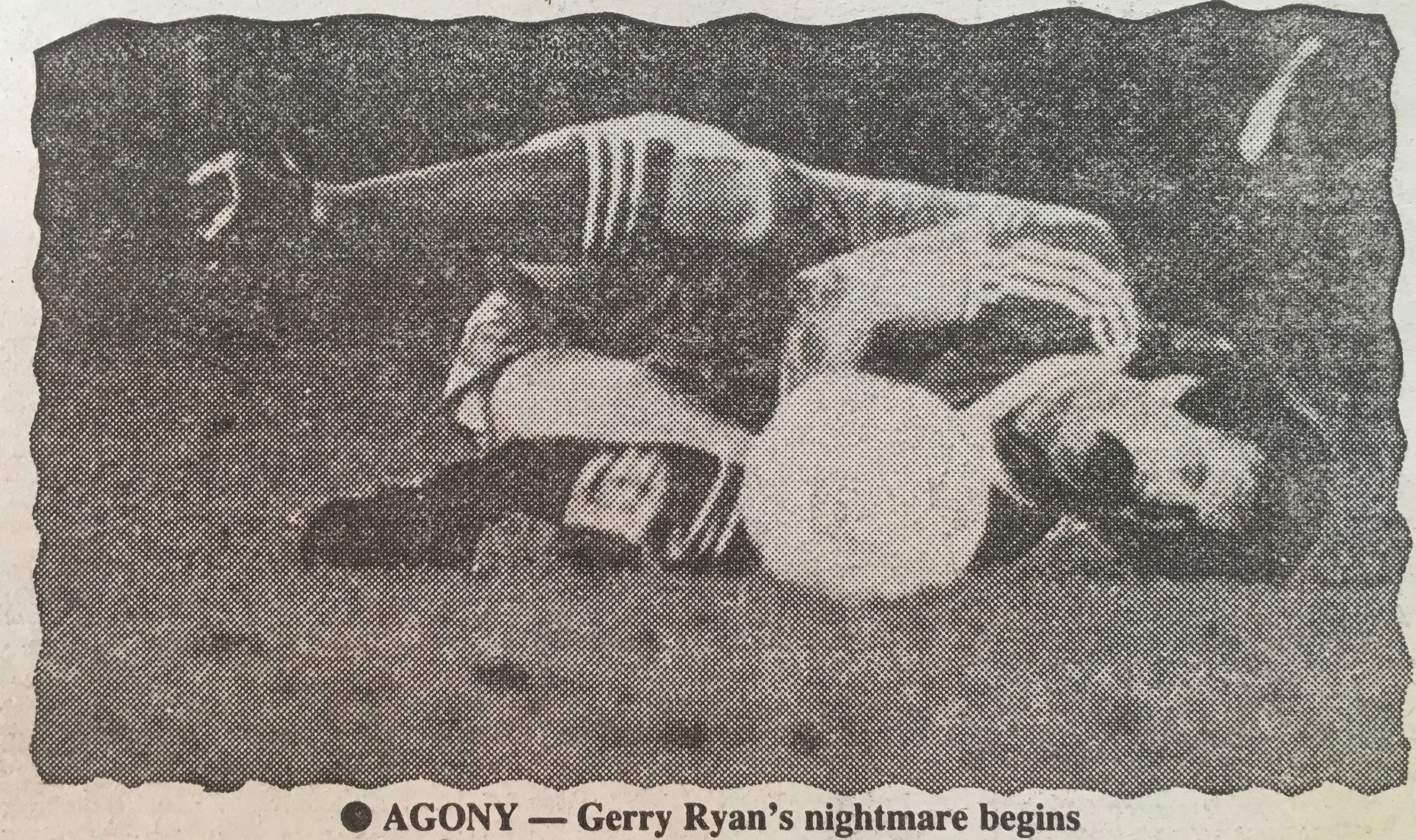
A cruel twist of fate saw his career ended in a tackle made by his Irish teammate (and former Albion boss) Chris Hughton’s brother, Henry. Typically, Ryan bore no grudges, as stressed by former Argus Albion reporter John Vinicombe in an article published in May 1986 when the genial Irishman finally accepted that his career was over.

Describing “the immense dignity and true manliness that Ryan displayed in refusing to condemn or indeed utter any harsh word against the player responsible,” he added: “Where others have sued and raged, slandered, cursed and threatened, Ryan said nothing.”

GR leg break

It was 2 April 1985 when his career was ended by that Hughton tackle in a 1-1 draw with Crystal Palace at Selhurst Park.

“Never in his life has he shirked a tackle and the one that ended his career so unfortunately at Crystal Palace was typical of many he faced in his career,” said Alan Mullery, the manager who signed him for the Seagulls.

“As a person, he is a lovely and typical Irish personality,” Mullery said in the programme for the player’s testimonial game against Spurs at the Goldstone on 8 August 1986. “I can honestly say that I have never met a player who dislikes him or has a bad word to say about him. I will remember Gerry Ryan as being a special player and one of football’s nice people.”

Mullery also referred to a Sunday lunch he and his family had with Ryan and his wife at the time he signed. “When Gerry ordered roast beef and chips I must have known then that I had a very special sort of player. At the time, I was a little dubious but afterwards I had no regrets.”

Mullery had been over in Dublin watching Albion’s Mark Lawrenson playing for the Republic of Ireland and Derby’s Ryan was playing in the same side. He had been having talks about moving to Stoke City but Mullers persuaded him to join Brighton instead, and, in a strange quirk of fate, he made his debut in a 2-2 draw away to Stoke.

After they’d become teammates, Lawrenson was among those players appreciative of Ryan’s “mercurial” qualities. He said in a matchday programme: “He wasn’t the most confident of players but he had loads of ability. For a wide player, he would come in and get goals for you.”

GR capsA week after joining the Seagulls, Ryan became an instant hit with Albion fans when he scored on his home debut in a 5-1 win over Preston. He notched a total of nine goals in 34 appearances in that first season and went on to score 39 in a total of 199 games.

Born in Dublin on 4 October 1955, Ryan was one of eight children. His early education was at the local convent in Walkinstown, a suburb to the south of Dublin where the family lived. At the age of eight he moved on to Drimnagh Castle School (it covered primary and secondary age groups).

At that stage, he was playing Gaelic football and hurling, at which he was capped at under-15 level by Dublin Schools. He didn’t play competitive football until he was 16 when he was introduced to a Dublin football club called Rangers AFC. He played alongside Kevin Moran, who later played for Manchester United, and Pat Byrne, who later played for Leicester City. Byrne and Ryan also played together for Bohemians, the oldest football club in Dublin.

Ryan joined the Dublin Corporation as a clerical officer on leaving school and played for Bohs as an amateur initially before becoming a part-timer on professional terms. By 18, Ryan was a first-team regular and, after collecting a League of Ireland Championship medal, was watched by Manchester United boss Tommy Docherty.

Docherty didn’t pounce then but, after Ryan had stayed four years with Bohemians, the ebullient Scot eventually returned to take him to England as his first signing for Derby County for a fee of £55,000.

The newly-appointed Docherty was determined to shake-up the club and while long-serving goalkeeper Colin Boulton was discarded along with striker Kevin Hector, Ryan, Scottish internationals Bruce Rioch and Don Masson, and Terry Curran and Steve Buckley were all introduced.

Ram Ryan

Ryan spoke about the way Docherty’s attitude towards him changed in an interview with Brian Owen of The Argus in 2016.

“One minute you were the blue-eyed boy, the next he wouldn’t even talk to you,” he said. Ryan made a hamstring injury worse by playing when Docherty insisted he was fit enough, and ended up sidelined for three months. “He didn’t like me then! That’s the way he was, he would turn on you, and he turned on me.”

Within a year, Docherty accepted Brighton’s £80,000 offer for Ryan and, as he was weighing up whether to choose the Seagulls or Stoke City, Ryan consulted the legendary Republic of Ireland and ex-Leeds midfielder Johnny Giles to ask his opinion.

“Gilesy said ‘Stoke have been in and out of the First Division forever but there is something going on down at Brighton. They get great crowds and it’s a beautiful place.’ I went to Brighton that weekend and absolutely loved it,” Ryan told Owen.

It was on 25 September 1978 winger Ryan arrived, prompting the departure of popular local lad Tony Towner after eight years at the Albion.

Five months before Ryan arrived at the Goldstone, he made his international debut, featuring for the first time in April 1978 in a 4-2 win over Turkey at Lansdowne Road. He only scored once for the Republic, but it was a cracking overhead kick in a 3-1 defeat against West Germany.

Ryan Eire

He was one of four regular Eire internationals playing for Albion at the time: Lawrenson, Tony Grealish and Michael Robinson the others.

His final appearance for his country came in a 0-0 draw against Mexico at Dalymount Park in 1984.

Ryan was part of some all-time history-making moments during his time with the Albion – scoring at St James’s Park in the 3-1 win over Newcastle on 5 May 1979 to clinch promotion to the top division for the first time, and burying the only goal of the game as unfancied Albion beat Brian Clough’s European champions Nottingham Forest, who’d previously not lost at home for two and a half years.

Ryan scoresMy personal favourite came on 29 December 1979 at the Goldstone when he ran virtually the entire length of a boggy, bobbly pitch to score past Joe Corrigan in the goal at the South Stand end to top off a 4-1 win over Manchester City. Ryan himself reckoned it was “the best goal I ever scored” as he recounted in a May 2020 BBC Sussex Sport interview with Johnny Cantor.

It was one of the most superb individual goals I saw scored and, when he was trying to recuperate from the horrific leg break which ultimately ended his career, I wrote to him in hospital to say what a special memory it held for me.

I was delighted to receive a grateful reply from him, and he has held a special place in my Albion memory bank ever since.

There were other stand-out occasions, two of which came against Liverpool:

in February 1983 at Anfield when he opened the scoring in Albion’s memorable 2-1 FA Cup triumph en route to the final, and, in the following season, at the Goldstone when he and Terry Connor were on target in Second Division Albion’s 2-0 win over the Reds in the same competition, the first-ever live FA Cup match (other than finals) to be shown (previously any television coverage of FA Cup ties was only ever recorded highlights).

If the modern-day reader can’t quite put the feat in perspective, it is worth pointing out that Liverpool, managed by Joe Fagan, went on to win the League Cup, the League title and the European Cup that season.

Danny Wilson hadn’t long since joined the Albion and, in an interview with the Seagull matchday programme in 2003, he recalled: “That has to be my favourite memory from all my time at the Goldstone. Back then, Liverpool were just awesome, and to beat them like we did was virtually unheard of.”

Ryan’s involvement in the 1983 Cup run was hampered by a hamstring injury which meant he missed out on the semi-final. But, in the days of only one substitute, he was on the bench for the final and, when the injured Chris Ramsey couldn’t continue, Ryan went on at Wembley and did a typically thorough job at right-back.

GR prog snow

Following Albion’s relegation, as the big-name players departed the Goldstone, Ryan’s versatility and play-anywhere attitude came to the fore and, in his last two seasons with the club he was often selected as a centre-forward, although he was not a prolific goalscorer from that position.

After he was forced to quit playing, Ryan took what was then quite a familiar route for ex-players and became a pub licensee, running the Witch Inn at Lindfield, near Haywards Heath. Ryan and goalkeeper Graham Moseley, who he’d known from his days at Derby, were neighbours in Haywards Heath.

GR pots

However, when another of his former Republic of Ireland teammates, Liam Brady, was appointed Albion manager in 1994, it was an inspired choice for him to appoint Ryan as his assistant.

When that all-too-brief managerial spell came to a messy close, Ryan returned to his pub, and then moved back to the family home in Walkinstown. Ryan’s son Darragh played 11 games for the Albion in the late 1990s.

Sadly, in August 2007, Ryan suffered a stroke, and three years later he was diagnosed with kidney cancer. On his death, his family paid tribute to the care he was given by the staff of Our Lady’s Hospice, Harold’s Cross and to the staff of Lisheen Nursing Home, Dr Brenda Griffin, the Beacon Renal Unit, Tallaght, and Tallaght Hospital Renal Unit “for the excellent care given to Gerry over the past number of years”.

Pictures from a variety of sources but mainly from my scrapbook, the matchday programme and The Argus.

Elite career eluded Darren Hughes after cup-winning start

HughesDARREN Hughes won the FA Youth Cup with Everton but it was lower down the league where he built a long career which included a season with second tier Brighton & Hove Albion.
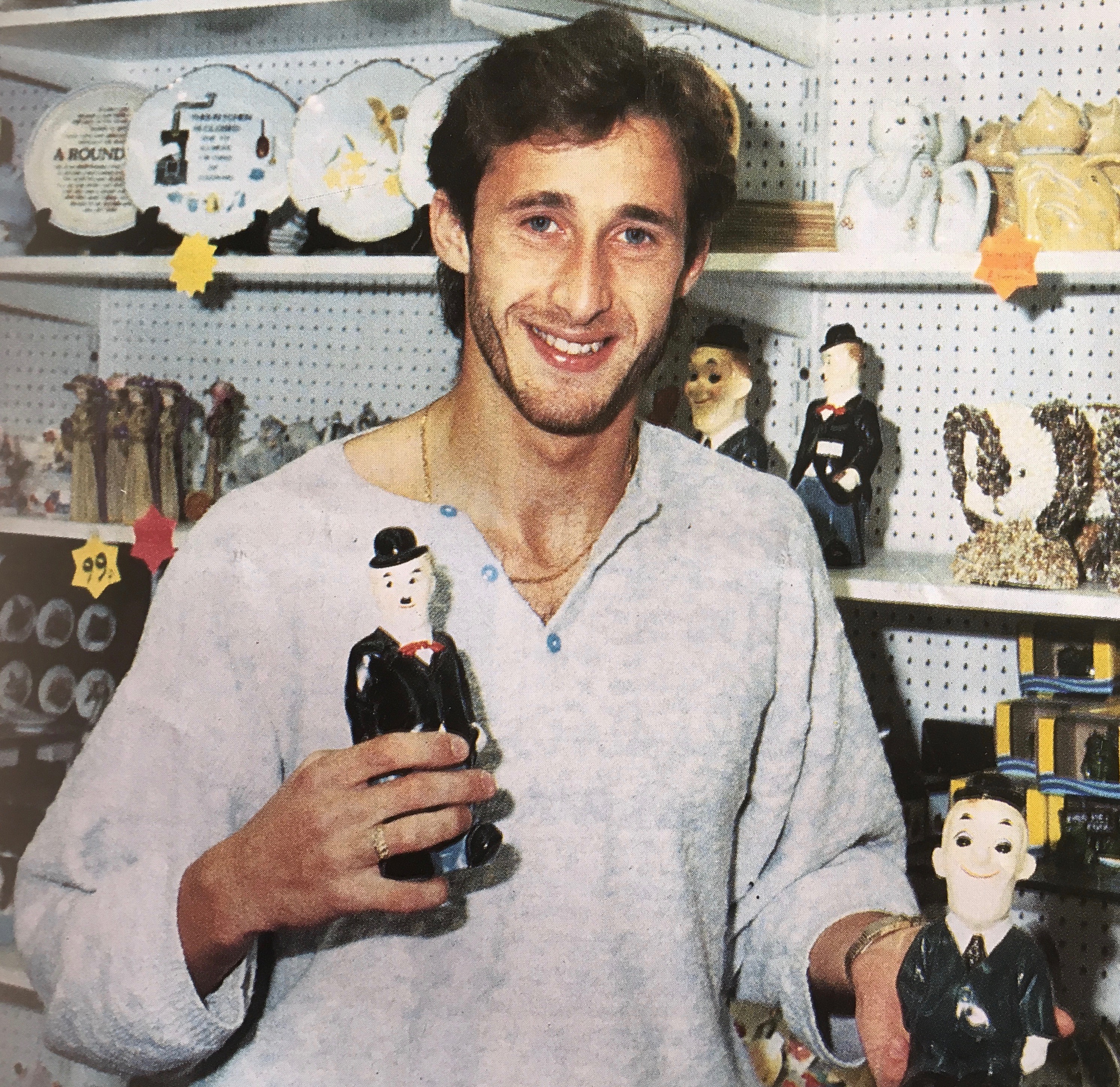
Born in Prescot on Merseyside on 6 October 1965, left-back Hughes played for Everton in two successive FA Youth Cup finals.

He was on the losing side against Norwich City in 1983 (when among his Everton teammates was centre forward Mark Farrington, who later proved to be a disastrous signing for Barry Lloyd’s Brighton).

The tie went to a third game after it was 5-5 on aggregate over the first two legs. The Canaries won the decider 1-0 at Goodison Park. The following year, Hughes was a scorer, and collected a winners’ medal, as Everton beat Stoke City 4-2 on aggregate.

Meanwhile, the young Hughes had broken into Everton’s first team as an understudy to stalwart John Bailey, making his Everton debut two days after Christmas in 1983.

Unfortunately, the game ended in a 3-0 defeat away to Wolverhampton Wanderers, for whom former Albion winger Tony Towner was playing.

It wasn’t until May 1985 that Hughes next got a first team opportunity, featuring in a 4-1 defeat to Coventry City at Highfield Road and a 2-0 defeat to Luton Town – manager Howard Kendall resting some of the first-choice players after the League title had already been won and ahead of the European Cup Winners’ Cup Final against Rapid Vienna.

With the experienced Bailey and Pat Van Den Hauwe in front of Hughes in the pecking order, Kendall gave the youngster a free transfer at the end of the season, and he joined Second Division Shrewsbury Town, where he made 46 appearances.

Hughes played against Albion for Shrewsbury at Gay Meadow on 16 September 1986, and, two weeks’ later, Alan Mullery, back in charge of the Seagulls for a second spell, signed the 21-year-old for a £30,000 fee.

D Hughes blue

Not for the first time, hard-up Albion had devised a scheme to raise transfer funds from supporters, and the money for the purchase of Hughes came from the Lifeline fund which also helped Mullery to buy goalkeeper John Keeley for £1,500 from non-league Chelmsford and striker Gary Rowell, from Middlesbrough.

Hughes made his Albion debut in a 3-0 defeat at home to Birmingham in the Full Members Cup on 1 October 1986 and his first league match came in a 1—0 home win over Stoke City three days later.

“I was quite happy at Shrewsbury,” Hughes told matchday programme interviewer, Tony Norman. “But when the manager told me Brighton were interested in signing me I thought it would be another step up the ladder. It’s a bigger club with better prospects and it’s a nice town as well.”

The single lad, whose parents were living in Widnes, moved into digs in Hove run by Val and Dave Tillson. He was later joined there by Kevan Brown, another new signing, from Southampton.

Hughes said away from football he enjoyed golf and had played rounds with Steve Penney, Dean Saunders and Steve Gatting.

Brown, in a similar programme feature, said Hughes had been a big help in him settling into his new surroundings. “He has been showing me around the area and we’ve become good friends,” he said. “I’m glad I wasn’t put in a hotel on my own.”

Unfortunately for Hughes, life on the pitch didn’t go quite according to plan.

Mullery was somewhat controversially sacked on 5 January 1987 and, although Hughes played 16 games under successor Lloyd, those games yielded only two wins and the Albion finished the season rock bottom of the division.

The only consolation for Hughes was scoring in a 2-0 home win over Crystal Palace on 20 April. His final appearance in a Seagulls shirt came in a 1-0 home defeat to Leeds when he was subbed off in favour of youngster David Gipp.

Having played only 29 games, mostly in midfield, for Brighton, Hughes joined Third Division Port Vale in September 1987, initially on loan, before a £5,000 fee made the deal permanent.

It must have given him some satisfaction to score for his new employer in a 2-0 win against Brighton that very same month.

Hughes spent seven years with the Valiants, helping them to win promotion from the Third Division in 1989, making a total of 222 appearances, mainly as a left back.

His time with Vale was punctuated by two bad injuries – a hernia and a ruptured thigh muscle – and they released him in February 1994.

However, he gradually managed to restore his fitness and in 1995, between January and November, he played 22 games for Third Division Northampton Town.

He then moved to Exeter City, at the time managed by former goalkeeper Peter Fox, where he made a total of 67 appearances before leaving the West Country club at the end of the 1996-97 season.

He ended his career in non-league football with Morecambe and Newcastle Town but could look back on a total of 388 league and cup appearances for six clubs over a 14-year career.

After his playing days were over, according to Where Are They Now? he set up a construction business.

D hughes by tony gordon

Pictures: matchday programme.